INTRODUCTION
Opisthoteuthis is a widely distributed deep-sea cirrate octopod genus closely associated with the bathyal bottom and that generally occurs at depths between 300–2200 m, which makes it the shallowest group of the cirrate families (Collins & Villanueva, Reference Collins and Villanueva2006). The general biology, ecology and distribution of the genus are poorly known and, until recently, the systematics remained somewhat confused (see Collins & Villanueva, Reference Collins and Villanueva2006). In the last taxonomic revision of the genus, Villanueva et al. (Reference Villanueva, Collins, Sánchez and Voss2002) were able to identify several different species present in the north-eastern Atlantic, and the descriptions suggested that the specimens found in Portuguese waters belong to the species Opisthoteuthis calypso (previously misidentified as O. agassizii). The reproductive biology of the genus has been studied by Villanueva (Reference Villanueva1992), Daly et al. (Reference Daly, Boyle and Collins1998), Laptikhovsky (Reference Laptikhovsky1999) and Boyle & Daly (Reference Boyle and Daly2000), and it appears that Opisthoteuthis has a low reproductive investment (and no relationship between total body weight and number of gametes found in reproductive organs) that reflects an extended non-seasonal reproductive strategy, with just few eggs maturing and being released at once. Cirrates are thought to not brood their eggs and, therefore, release them on the bathyal bottom where they take a long period of time to develop (more than one year and half at 4°C; Laptikhovsky, Reference Laptikhovsky1999). In biogeographical terms, the knowledge on these species is still sparse but continues to grow due to the recent efforts of researchers worldwide (e.g. Villanueva et al., Reference Villanueva, Collins, Sánchez and Voss2002; Collins & Villanueva, Reference Collins and Villanueva2006; Rosa et al., in press).
The main objective of this study was to improve the state of knowledge of the biogeography and biology of Opisthoteuthis calypso in the north-eastern Atlantic, namely in the Portuguese continental slope.
MATERIALS AND METHODS
The specimens were collected off the west and south coasts of Portugal on scientific surveys aboard the RV ‘Noruega’ (5 surveys) and RV ‘Mestre Costeiro’ (1 survey) of the ‘Instituto de Investigação das Pescas e do Mar’ (IPIMAR). Catches by the two vessels were made by bottom trawling for 60 minutes, sweeping an average area between doors of 75,634 m2 (measured with Scanmar distance sensors) with nets equipped with 20 mm mesh codends. Sampling stations were selected according to pre-established plans that were set up in a stratified random design. The sampling effort of the research cruises analysed was concentrated at locations south of 39°N and above 800 m, but positions north and below those were equally sampled. Biomasses were determined by the swept area method, considering all sampling stations of each of the research cruises analysed, that fell within the depth interval limited by the verified occurrence of the shallowest and deepest catch of an O. calypso specimen.
From the specimens collected, a sub-set of 31 were measured, weighed, sexed and had their maturity condition assessed and classified on a 1–5 (females) and 1–4 (males) point scale by analogy to other octopods, following Gonçalves (Reference Gonçalves1993). For some of the analyses, this was condensed into a 3 point scale based on Villanueva (Reference Villanueva1992) with an added ‘maturing’ (stage 2) which includes specimens where maturation is well underway but no eggs/spermatophores are visible in the proximal oviduct/seminal vesicle. From a further sub-set of 10 specimens, the beaks (upper and lower mandibles) were measured to add to a database of possible diagnostic features (Clarke, Reference Clarke1986).
RESULTS AND DISCUSSION
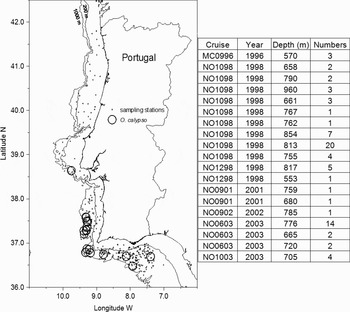
Opisthoteuthis are at the limit of reach of the regular scientific research cruise campaign programme of IPIMAR because of their depth of occurrence. Opisthoteuthis calypso is one of the regular but scarce species encountered, on which data have nonetheless accumulated over the years (Figure 1). In the past 8 years it has been collected almost exclusively onboard vessels engaged in cruises devoted to deep-sea species, notwithstanding the fact that other cruises also operate at the same depths. The important difference between the two series is the fact that the sampling effort at depths greater than 400 m is considerably lower in non-directed cruises.
Sampling effort (dots) and catch locations (open circles) of Opistoteuthis calypso in 7 cruises conducted over 6 years between 1996 and 2003. Depths of occurrence, number of specimens collected and research cruise identification of stations where catches were recorded are provided. The coast of Alentejo is located west facing, south of ~38°N and that of Algarve west facing, south of ~37.3°N and the whole of the south facing coastline.

In bathymetric terms, Opisthoteuthis calypso is clearly a continental slope upper-bound genus in Portuguese waters (Figure 1). In the last 8 years it has been recorded exclusively over muddy bottoms, south of 39°N and below 550 m, the greatest numbers having been found between 775 and 815 m depth. The greatest number of specimens found in any trawl was 14, corresponding to 0.24 km−2. In terms of catch rates, specimens have been caught in numbers of up 0.35 km−2, corresponding to an average of up to 0.03 km−2 per 50 m or 100 m depth interval within the area of occurrence, with depth intervals set up from 0. Biomasses of up to 0.06 kg · km−2 over adequate trawling grounds were recorded. In any one trawl, specimens of varying individual weights were found, there being no apparent size segregation. The probability of encounters with individuals of the species tended to grow with depth as indicated by the accumulated catch curve: within the verified occurrence depth-range, catches in numbers · km−2 increase following a polinomial model of the form Nkm−2 = 4 × 10⁻⁷ · (depth[m])2− 0.0004 · depth[m] +0.0925 (N = 9, r = 0.97, P < 0.01).
With the exclusion of the north-west coast (north of 39°N), where data are insufficient to establish any pattern, the distribution of Opisthoteuthis calypso appears to be concentrated on the western rather than the southern Portuguese coast (assuming unequal variances, t0.05(2),41 = 2.64, P = 0.01) even when depth is used as a covariate (F0.05(1),1 = 19.68, P≪0.01). When a continuum of latitudinal (N = 6, r = 0.01, P > 0.05) or longitudinal (N = 4, r = 0.61, P > 0.05) 0.5° bands is regressed against catches per km2, no significant patterns emerge. Average numbers along the west coast were found to be 0.029 km−2 (SD = 0.067), while along the south coast an average of only 0.0018 km−2 (SD = 0.0093) was recorded. The greatest number of individuals (0.066 km−2, SD = 0.105) was found at the 37°N band on the west coast. In the Algarve, the greatest number of individuals (0.009 km−2, SD = 0.022) was found at the 9°W band. In general the greatest concentrations were found within a restricted area of continental slope, along the south-western coast.
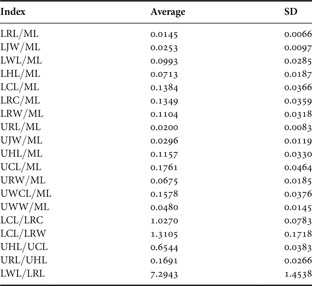
Measurements taken from the beaks and indices calculated are displayed in Table 1. An analysis of the proportion of individuals belonging to each sex reveals that males and females were present in roughly equal number (16:15). Similarly, the distribution of length (t0.05(2)29 = 2.05, P = 0.27) and weight (t0.05(2)29 = 2.05, P = 0.93) of the specimens of each sex in the sample revealed no significant differences between the two. However, weight at length was found to be more variable in males (y = 0.0034x2.6512, r2 = 0.6827, P < 0.01) than in females (y = 0.0034x2.7409, r2 = 0.6851, P < 0.01). Females attain a greater length (80:75 mm mantle length (ML)) and weight (622:346 g total body weight (TBW)) than do males.
Morphometric description of the beak (upper and lower mandibles) of Opisthoteuthis calypso reflected in indices that relate measurements to mantle length and measurements to each other to describe beak shape.

SD, standard deviation; ML, mantle length; LRL, lower rostral length; LJW, lower jaw angle width; LWL, lower wing length; LHL, lower hood length; LCL, lower crest length; LRC, lower rostral tip to corner of lateral wall; LRW, lower rostral tip to inner margin of wing; URL, upper rostral length; UJW, upper jaw angle width; UHL, upper hood length; UCL, upper crest length; URW, upper rostral tip to inner margin of wing; UWLC, upper wing to crest length; UWW, upper wing width.
Males and females in all stages of maturity except senescent were present in the sample (Table 2). One single female was found mature at 80 mm ML and 622 g TBW while males were found mature from 55 mm ML and 257 g TBW. To compare maturity stages and because the numerical intervals of the scale in which they were recorded are not the same for both sexes (Gonçalves, Reference Gonçalves1993), females of maturity stages 2 and 3 (maturing) were combined into a score 2 and stage 4 (mature) converted to a score 3, resulting in a scale comparable to that of Villanueva (Reference Villanueva1992). The maturity scale modified in this way is comparable to that of the males. The statistical analysis of each of the two sex sub-samples thus modified indicates no significant differences in the maturity condition of the 25 specimens grouped by sex (assuming equal variances, t0.05(2),29 = 2.05, P = 0.10). No relationship was found between depth and size or weight.
Average length (ML) and weight (W) and number of Opistoteuthis calypso specimens per sex and maturity stage.

SD, standard deviation.
The bathymetric distribution of this species in Portuguese waters is typical of other species in the genus (Boyle & Daly, Reference Boyle and Daly2000; Collins et al., Reference Collins, Yau, Allcock and Thurston2001; Collins & Villanueva, Reference Collins and Villanueva2006) in other areas of the world. Although some variation occurs (Villaneuva et al., Reference Villanueva, Collins, Sánchez and Voss2002), by and large the genus comprises solely deep-sea species (ICES, 1994) with distributions preferentially below 300 m depth. Because of their deep-sea distribution, lack of commercial interest and lack of dedicated research, few specimens have been reported with additional information on biology and geography (Collins & Villanueva, Reference Collins and Villanueva2006). Villanueva et al. (Reference Villanueva, Collins, Sánchez and Voss2002) base their biological description on 39 specimens collected throughout the eastern Atlantic Ocean and Mediterranean Sea, adding additional data from previously misidentified specimens already described in the literature (Villanueva & Guerra, Reference Villanueva and Guerra1991; Villanueva, Reference Villanueva1992).
The specimens collected all occur within the depth interval previously determined for the species. In Portugal, they have, however, never been found shallower than 570 m in spite of the much greater research effort at shallower depths. Records between 365 and 570 m have been the major part of the occurrences in the eastern Atlantic (Villanueva et al., Reference Villanueva, Collins, Sánchez and Voss2002), while in Galicia 5 specimens were recorded between 336 and 505 m by Alcazar & Ortea (1981, cited by Guerra, Reference Guerra, Ramos, Esteban and Lobo1992) and others are commonly found by trawlers operating between 300 and 800 m (Guerra, unpublished data). The densities encountered off the Portuguese coast are lower than the maximum reported but they suggest an increase with depth that could lead to similar numbers as those previously reported at the depths sampled within the Mediterranean Sea.
In terms of their biology, all the specimens examined in Portugal and those recorded by Alcazar & Ortea (1981, in Guerra, Reference Guerra, Ramos, Esteban and Lobo1992) were smaller than the largest reported by Villanueva et al. (Reference Villanueva, Collins, Sánchez and Voss2002). The weight-range of mature males was within that reported by the same authors, but while those authors did not find immature specimens above 95 g, several specimens between 95 and 245 g collected off the Portuguese coast were found not to be completely mature. Females were also found maturing at up to 231 g contrary to the previous maximum of less than 190 g found by the same authors. Contrary to what has been found in the same and related species (e.g. Boyle & Daly, Reference Boyle and Daly2000), females collected off the Portuguese continental slope attain greater lengths and weights than do males.
Due to the relatively few specimens measured and sexed, it was not possible to establish any assumptions regarding reproductive seasonality. Nevertheless, there is generally no indication of variations in maturation condition of cirrate octopod populations in different seasons of the year (Daly et al., Reference Daly, Boyle and Collins1998; Villanueva et al., Reference Villanueva, Collins, Sánchez and Voss2002) and these are unexpected due to the invariability of environmental conditions in the deep-sea.
It should be noted that the biogeographical and biological data presented here are of importance when added to records obtained by other researchers. The specimens reported herein constitute a numerically significant new addition to the knowledge of the biology and biogeography of this species, adding a further location and nearly doubling the number of specimens already described.