Implications
Piglets’ colostrum intake is crucial regarding short- and long-term survival and performance. However, sows’ colostrum production is limited and piglets’ colostrum intake is highly variable between and within litters. Therefore, knowledge about factors determining colostrum intake variation within and between litters will enable pig producers to optimize colostrum management and ultimately maximize piglets’ lifetime production potential.
Introduction
The crucial role of colostrum on piglet pre-weaning mortality and performance has been reported by several studies (e.g. Devillers et al., Reference Devillers, Farmer, Le Dividich and Prunier2007; Decaluwé et al., Reference Decaluwé, Maes, Wuyts, Cools, Piepers and Janssens2014b). A longer-term impact on mortality and performance was suggested (Devillers et al., Reference Devillers, Le Dividich and Prunier2011; Quesnel et al., Reference Quesnel, Farmer and Devillers2012) and has been recently demonstrated (Declerck et al., Reference Declerck, Dewulf, Sarrazin and Maes2016b). Hence, colostrum management is a promising tool to limit economic losses, health and welfare concerns in commercial pig herds. The supply of energy (Herpin et al., 2005; Le Dividich et al., Reference Le Dividich, Rooke and Herpin2005), immunity (Rooke and Bland, Reference Rooke and Bland2002) and bio-active compounds (Xu et al., Reference Xu, Wang and Zhang2000) by colostrum may explain its positive short- and long-term effects. Total colostrum yield is reported to be independent from litter size (e.g. Devillers et al., Reference Devillers, Farmer, Le Dividich and Prunier2007; Foisnet et al., Reference Foisnet, Farmer, David and Quesnel2010), compromising the individual piglet intake of sufficient colostrum in large litters of high-prolific sows. Moreover, piglets’ colostrum intake is not only limited and highly variable across piglets between litters (Farmer and Quesnel, Reference Farmer and Quesnel2009), but also within litters (Le Dividich et al., Reference Le Dividich, Rooke and Herpin2005; Devillers et al., Reference Devillers, Le Dividich and Prunier2011). By understanding this variation, farrowing management can be adjusted to optimize the use of available colostrum between and within litters. Studies regarding colostrum intake in high-prolific commercial swine herds are needed to unravel the factors explaining the variation in piglets’ colostrum intake. As colostrum intake depends on both the sow’s ability to produce colostrum and the piglets’ ability to extract, suckle and ingest the colostrum (Devillers et al., Reference Devillers, Le Dividich and Prunier2011), the present study aimed to unravel which sow and piglet factors determine the variation of colostrum intake between and within litters at commercial pig herds.
Material and methods
Study population and animal handling
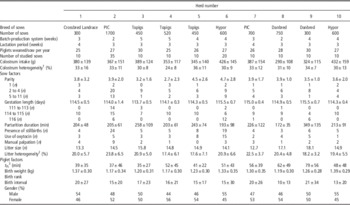
In total, 135 litters comprising 1937 live-born piglets from 10 different commercial pig herds in Belgium were enrolled in the study. A detailed description of the study population can be found in Declerck et al. (Reference Declerck, Dewulf, Decaluwé and Maes2016a and Reference Declerck, Dewulf, Sarrazin and Maes2016b). Studies were approved by the Ethical Committee of the Faculty of Veterinary Medicine, Ghent University, Belgium (no. 2013/98 and no. 2011/85). The herds were selected on the basis of willingness of the farmer to cooperate. In total, five different sow breeding lines were included: one of own crossbred Landrace and four commercial crossbred sows (PIC, Topigs, Hypor and Danbred). In each farm, only one sow breeding line was present. All sows were inseminated with semen from Piétrain boars. Table 1 represents the main herd characteristics, the number of studied sows per herd and the outcome and predictor variables per herd. Farrowing induction was not applied during the study period. Continuous farrowing supervision 24 h a day was performed and sows starting parturition during supervision were enrolled in the study. No restriction on parity or on gestation length was imposed. However, it was taken into account that parity and gestation length were randomly distributed across the different herds and breeds. The periparturient management routines of the herds were maintained as much as possible. The administration of oxytocin or manual birth assistance performed by the farrowing staff was registered. Immediately after birth, piglets were dried with a paper towel and weighed. The birth order was marked on their back and piglets were individually ear tagged and placed back on the place from where they were taken. Furthermore, time of birth and time of first suckling (teat in mouth) were registered. Piglets were weighed individually 24 h after birth of the first littermate. Cross-fostering was not allowed before the 2nd day of life.
Herd characteristics, the number of studied sows per herd and the herd averages±SD with regard to the outcome and predictor variables from 1582 piglets originating from 135 litters on 10 commercial pig herds

1 Colostrum heterogeneity=the CV for colostrum intake of all piglets within a litter (%).
2 Litter heterogeneity=the CV for birth weight of all piglets within a litter (%).
3 t FS=the interval between birth and first suckling (min).
Colostrum intake
Colostrum intake was estimated using the model described by Theil et al. (Reference Theil, Flummer, Hurley, Kristensen, Labouriau and Sorensen2014). This mechanistic model quantifies colostrum intake by sow-reared piglets with normal suckling pattern and normal physical activity compared with bottle-fed piglets. The model is based on 24-h weight gain (WG; g), birth weight (BWb; kg) and duration of colostrum intake (D; min). Colostrum intake was only calculated from 1582 piglets as colostrum intake from piglets that died during the first 24 h was not calculated. Duration of colostrum intake was defined as the time between the first and the second weighing and is shown in the following equation: −106+2.26 WG+200 BWb+0.111 D–1414 WG/D+0.0182 WG/BWb. To evaluate the variation of colostrum intake within a litter, the CV (%) for colostrum intake of all piglets within the litter was calculated by dividing the standard deviation of colostrum intake between littermates by the mean colostrum intake of a litter. This CV will further be referred to as colostrum heterogeneity.
Definitions and data handling
The outcome variables (piglets’ colostrum intake and colostrum heterogeneity) were analyzed as continuous variables. The predictor variables at sow level were breed, parity, gestation length, duration of farrowing, use of oxytocin during parturition, manual birth assistance, stillbirth, litter size and litter BWb heterogeneity. Sows belonged to five different breeding lines: crossbred Landrace, PIC, Topigs, Hypor or Danbred. In the present study, parity ranged from 1 to 11 and was categorized in three groups, namely: parity 1 (young sows), parity 2 to 4 (intermediate sows), parity 5 or higher parity (old sows). Gestation was assumed to start at the day of first insemination (day 0) and day of parturition was assumed to be the last day of gestation. Gestation length varied from 111 to 116 days and was categorized in three groups, namely 111 to 113 days (early parturition), 114 to 115 days (normal parturition) and 116 days (late parturition). The duration of farrowing was calculated as the time interval between the birth of the first and last live-born piglet. A stillborn piglet was defined as a piglet without signs of decay and found dead behind the sow. The use of oxytocin, manual birth assistance and the occurrence of stillbirth were considered as binary variables. Litter size was defined as the number of live-born piglets. To evaluate the birth weight variation within a litter, the CV for birth weight of all piglets within the litter was calculated and will be further referred to as litter BWb heterogeneity. Litter size and litter BWb heterogeneity were considered as continuous variables. The predictor variables at piglet level were the interval between birth and first suckling (t FS), birth weight, birth rank, birth interval and gender. The interval between birth and first suckling was calculated on the basis of time of birth and the time of first suckling. All piglet factors were considered as continuous on behalf of the binary variable gender.
Statistical analysis
Basic descriptive statistics were used to explore the outcome variables (piglets’ colostrum intake and colostrum heterogeneity) and predictor variables at sow level (breed, parity, gestation length, duration of farrowing, use of oxytocin during parturition, manual birth assistance, stillbirth, litter size and litter BWb heterogeneity) and predictor variables at piglet level (t FS, birth weight, birth rank, birth interval and gender). Colostrum intake, colostrum heterogeneity, farrowing duration, litter size, litter heterogeneity and birth weight were normally distributed, whereas parity, gestation length, t FS and birth interval were not normally distributed. Results are reported as mean±SD or median (IQR) when variables are normally or not normally distributed, respectively.
To model possible associations between the outcome and predictor variables, two linear mixed models were fitted. A random herd effect was included to correct for clustering of sows in a herd and to correct for confounding factors at herd level. Similarly, a nested random sow effect was included to correct for clustering of piglets within litters and to correct for confounding factors at the sow level. Initially, univariable linear mixed regression models between the outcome variables and each predictor variable were examined. Statistical significance in this step was assessed at P<0.20. Furthermore, for continuous predictor variables, the assumption of linearity was examined by the Loess curves between each individual predictor variable and the outcome variables and by the scaled residuals of the univariable models. If necessary, transformation of the predictor variables or inclusion of higher order effects was considered. Regarding t FS and birth interval, a log transformation was performed to obtain a linear association with the outcome variables. Second, Pearson’s or Spearman’s rank correlation coefficients, for either normally or not normally distributed independent variables, respectively, were calculated among the significant independent variables to avoid multicollinearity in the next steps. None correlation between two selected independent variables was higher than 0.60 and therefore, multicollinearity could be never assumed. Then, the independent variables were used to build a multivariable linear regression model by a manual stepwise backward model building procedure. Statistical significance in this step was assessed at P<0.05. The estimates of the significant predictor variables are presented with their corresponding 95% confidence interval. Finally, all two-way interactions were tested and removed when non-significant (P>0.05). To check whether the assumptions of normality and homogeneity of variance had been fulfilled normal probability plots of residuals and plots of residuals v. predicted values were generated. Influence of outliers was tested through Cook’s distance, DFFITS (the change in the predicted value for a point, obtained when that point is left out of the regression), and DFBETAS (the standardized difference in the parameter estimate due to deleting the observation). No influential cases were found. Statistical analysis was performed in SAS 9.4 (SAS Institute Inc., Cary, NC, USA).
Results
Descriptive results
Factors at sow and piglet level determining the variation of colostrum intake of 1582 piglets were recorded. Colostrum intake per piglet averaged 371±144 g. Colostrum heterogeneity averaged 31±11%. Sows had a median parity of 3 [2; 5] and a median gestation length of 115 [114; 116] days. Farrowing lasted on average 221±99 min. Oxytocin was administered to 49 (36%) sows and manual birth assistance was offered to 27 (20%) sows. Stillbirth occurred in 74 (55%) litters. Litter size averaged 14±3 live-born piglets. Litter heterogeneity was 20±6%. The median interval between birth and first suckling lasted 37 [20; 67] min. Piglets’ birth weight averaged 1.28±0.32 kg. The median birth interval was 9 [3; 18] min. The number of male live-born piglets was 952 (49%). At the herd level, descriptive data of the outcome and predictor variables are summarized in Table 1.
Colostrum intake
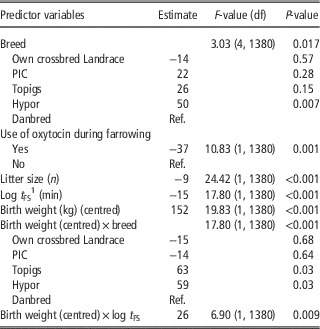
Parity, gestation length, manual birth assistance, stillbirth and birth rank did not affect piglets’ colostrum intake regarding univariable analysis (P>0.20). Breed, the use of oxytocin during farrowing, litter size, birth weight and t FS were retained in the final multivariable model. No multicollinearity was assumed between the remaining variables. In the final multivariable mixed model (Table 2), two significant interaction terms (birth weight×breed and birth weight×t FS) were included. In order to interpret the interacted parameters (birth weight, breed and t FS) in a more comprehensive way, the variable birth weight was centred by subtracting the mean birth weight (1.28 kg). Hence, interaction terms become 0 when the model considered piglets with the mean birth weight. The intercept represents a Danbred piglet with a mean birth weight which dam was not injected with oxytocin during farrowing. The intercept is associated with a mean colostrum intake of 570 g (95% CI 472 to 667).
Parameter estimates of the multivariable linear mixed model with colostrum intake (g) as the outcome variable

1 t FS=the interval between birth and first suckling (min).
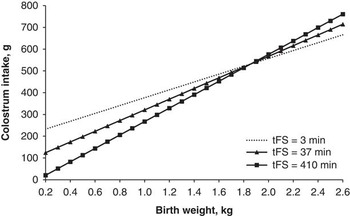
Colostrum intake per piglet varied significantly with breed (P=0.02). Considering piglets with an average birth weight (1.28 kg), Hypor piglets consumed 50 g (95% CI 14 to 87) more colostrum compared with Danbred piglets (P=0.007). Colostrum intake per piglet decreased on average 37 g (95% CI 15 to 59) when oxytocin was applied to the dam (P=0.001). Colostrum intake was negatively associated with litter size as piglets’ colostrum intake decreased on average 9 g (95% CI 6 to 13) for each additional live-born piglet (P<0.001). A positive association between colostrum intake and birth weight was observed (P<0.001), for example, colostrum intake by Danbred piglets with a t FS of 1 min increased on average 152 g (95% CI 62 to 242) with each increase of 1 kg in birth weight. Furthermore, the strength of this positive association between colostrum intake and birth weight varied across breeds (Figure 1). Regarding piglets with a t FS of 1 min, a higher birth weight of an additional kilogram resulted in a significantly steeper increase of colostrum intake in Topigs (215 g, 95% CI 134 to 297) compared with Danbred piglets (152 g, 95% 62 to 242) (P=0.03), and in Hypor (211 g, 95% CI 132 to 290) compared with Danbred piglets (152 g, 95% 62 to 242) (P=0.03). A positive association between colostrum intake and t FS was observed. Considering piglets weighing the mean birth weight (1.28 kg), piglets’ colostrum intake decreased on average 15 g (95% CI 8 to 22) with each unit increase of log t FS. The strength of this positive association between colostrum intake and birth weight was more pronounced for longer t FS (Figure 2). Regarding Danbred piglets, a higher birth weight of an additional kilogram resulted in a significantly steeper increase of colostrum intake if t FS lasted longer (P=0.009).
To illustrate the interaction between birth weight and breed on colostrum intake, hypothetical groups of piglets of different breeds with birth weights varying between the minimum (0.2 kg) and maximum (2.6 kg) observed birth weight, with an interval between birth and first suckling of 1 min and originating from litters with 14 live-born piglets which dam was not injected with oxytocin were generated. For all breeds, a positive association between colostrum intake and birth weight was observed. However, this association was more pronounced (steeper slope) for Topigs and Hypor piglets (symbol ‘*’) compared with the other breeds (symbol ‘$’).

To illustrate the interaction between birth weight and the interval between birth and first suckling (t FS) on colostrum intake, hypothetical groups of Danbred piglets with birth weights varying between the minimum (0.2 kg) and maximum (2.6 kg) observed birth weight, with t FS lasting 3 min (minimum), 37 min (median) and 410 min (maximum), and originating from litters with 14 live-born piglets which dam was not injected with oxytocin were generated. For all t FS, a positive association between colostrum intake and birth weight was observed. However, this association was more pronounced (steeper slope) for longer t FS.

Colostrum heterogeneity
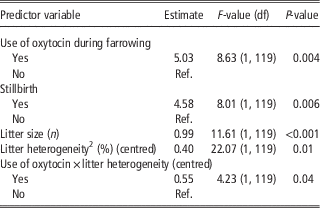
Breed and gestation length were excluded by univariable analysis (P>0.20). Stillbirth, the use of oxytocin during farrowing, litter size, litter BWb heterogeneity were retained in the final multivariable model. No multicollinearity was assumed between the remaining variables. In the final multivariable mixed model (Table 3), a significant interaction term (the use of oxytocin×litter BWb heterogeneity) was included. In order to interpret the interacted parameters (the use of oxytocin during parturition and litter heterogeneity) in a more comprehensive way, the variable litter BWb heterogeneity was centred by subtracting the mean litter BWb heterogeneity (20%). Hence, the interaction term became 0 when the model considered litters with the mean litter BWb heterogeneity (20%).
Parameter estimates of the multivariable linear mixed model with colostrum heterogeneityFootnote 1 (%) as the outcome variable

1 Colostrum heterogeneity=the CV for colostrum intake of all piglets within a litter (%).
2 Litter heterogeneity=the CV for birth weight of all piglets within a litter (%).
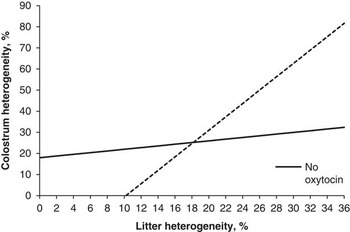
In litters with the mean litter BWb heterogeneity (20%), the colostrum heterogeneity increased on average 5.03% (95% CI 1.64 to 8.42) when oxytocin was administered to the dam (P=0.004; Figure 3). In litters with stillbirth, colostrum heterogeneity was 4.58% (95% CI 1.38 to 7.78) higher compared with litters without stillbirth (P=0.006). For every extra live-born piglet, colostrum heterogeneity increased 0.99% (95% CI 0.42 to 1.57) (P<0.001). A positive association between colostrum heterogeneity and litter BWb heterogeneity was observed. Furthermore, the strength of this positive association between colostrum heterogeneity and litter BWb heterogeneity was more pronounced when oxytocin was applied during farrowing (Figure 3). When oxytocin was not applied during farrowing, colostrum heterogeneity increased 0.40% (95% CI 0.09 to 0.72) with each 1% increase in the litter BWb heterogeneity (P=0.01). When oxytocin was applied, colostrum heterogeneity increased 0.95% (95% CI 0.50 to 1.42) with each 1% increase in the litter BWb heterogeneity (P=0.04).
To illustrate the interaction between the use of oxytocin and litter heterogeneity on colostrum heterogeneity, hypothetical litters with 14 live-born and no stillborn piglets and with a litter heterogeneity varying between the minimum (0%) and maximum (36%) observed litter heterogeneity were generated. Regardless whether oxytocin was used during farrowing or not, a positive association between colostrum heterogeneity and litter heterogeneity was observed. However, this association was more pronounced (steeper slope) when oxytocin was used.

Discussion
Most previous studies estimated colostrum intake by the regression equation of Devillers et al. (Devillers et al., Reference Devillers, van Milgen, Prunier and Le Dividich2004 and Reference Devillers, Farmer, Le Dividich and Prunier2007; Quesnel, Reference Quesnel2011; Decaluwé et al., Reference Decaluwé, Maes, Wuyts, Cools, Piepers and Janssens2014b), whereas colostrum intake in this study was estimated by the mechanistic model of Theil et al. (Reference Theil, Flummer, Hurley, Kristensen, Labouriau and Sorensen2014). As Devillers’ equation was obtained from bottle-fed piglets, colostrum intake of sow-reared piglets is underestimated (mainly) because of the lower amount of energy needed to obtain colostrum in bottle-fed v. sow-reared piglets. The equation by Theil et al. (Reference Theil, Flummer, Hurley, Kristensen, Labouriau and Sorensen2014) is believed to quantify the colostrum intake of sow-reared piglets more accurately and therefore better suited for this study with sow-reared piglets. As the study was conducted across different commercial herds, the present results have a high external validity and practical relevance.
Breed
In the present study, piglets’ colostrum intake was affected by breed. To our knowledge, previous studies did not observe any relationship between colostrum intake and breed, as most of them included only one breed (e.g. Devillers et al., Reference Devillers, Farmer, Le Dividich and Prunier2007; Decaluwé et al., Reference Decaluwé, Janssens, Englebienne and Maes2014a and Reference Decaluwé, Maes, Wuyts, Cools, Piepers and Janssens2014b). Several hypotheses could explain this association. First, colostrum production and hence, colostrum intake might be different among breeds. However, in previous work, we showed that colostrum yield did not differ significantly between breeds (Declerck et al., Reference Declerck, Dewulf, Piepers, Decaluwé and Maes2015). Therefore, the explanation of the association between breed and colostrum intake is more likely related to the significant differences between breeds regarding litter size, birth weight and t FS (data not shown). Also other breed factors, such as udder morphology or teat access (Vasdal and Larsen, Reference Vasdal, Østensen, Melišová and Bozděchová2012; Ocepek et al., Reference Ocepek, Andersen-Ranberg, Edwards and Andersen2016) might influence the different colostrum intake between breeds.
Oxytocin
When oxytocin was administered during farrowing to the sow, colostrum intake decreased, colostrum heterogeneity increased and the strength of the positive association between colostrum and litter BWb heterogeneity was more pronounced. These observations seem to be contradictory regarding the role of oxytocin in milk ejection, postpartum mammary growth and mobilization of body reserves (Kent et al., Reference Kent, Kennaugh and Hartmann2003; Valros et al., Reference Valros, Rundgren, Spinka, Saloniemi, Hulten, Uvnäs-Moberg, Tomanek, Krejci and Algers2004). However, some hypotheses can explain the observed negative impact of oxytocin administration on colostrum intake and colostrum heterogeneity. First, the lower colostrum intake could be due to the underlying indication of oxytocin administration. Oxytocin might be indicated to shorten farrowing duration or speeding up placenta expulsion (Alonso-Spilsbury et al., Reference Alonso-Spilsbury, Mota-Rojas, Martinez-Burnes, Arch, Lopez, Ramirez-Necoechea, Olmos and Trujillo2004; Peltoniemi et al., Reference Peltoniemi, Björkman, Oliviero and Soede2016). The hormones involved in the parturition process are also involved in milk production and milk ejection. Hence, hormonal imbalances resulting in prolonged farrowing and leading to the use of oxytocin may be the underlying mechanism of a lower colostrum production resulting in a lower piglets’ colostrum intake. Second, the lower colostrum intake and the higher colostrum heterogeneity could be related with the consequences of oxytocin (mis)use such as a higher risk of dystocia and intrapartum asphyxia (Alonso-Spilsbury et al., Reference Alonso-Spilsbury, Mota-Rojas, Martinez-Burnes, Arch, Lopez, Ramirez-Necoechea, Olmos and Trujillo2004; Mota-Rojas et al., Reference Mota-Rojas, Martinez-Burnes, Trujillo, Lopez, Rosales, Ramirez, Orozco, Merino and Alonso-Spilsbury2005). Intrapartum asphyxia impairs the vitality in piglets and hence, compromises their colostrum intake (Mota-Rojas et al., Reference Mota-Rojas, Martinez-Burnes, Trujillo, Lopez, Rosales, Ramirez, Orozco, Merino and Alonso-Spilsbury2005). The use of oxytocin increased the influence of litter BWb heterogeneity on colostrum heterogeneity as the risk of asphyxia and impaired vitality by oxytocin (misuse) (Mota-Rojas et al., Reference Mota-Rojas, Martinez-Burnes, Trujillo, Lopez, Rosales, Ramirez, Orozco, Merino and Alonso-Spilsbury2005) might be higher in heterogeneous litters with more low birth weight piglets (Milligan et al., Reference Milligan, Fraser and Kramer2001) as low birth weights are more susceptible to intrapartum asphyxia compared with normal birth weight littermates (Herpin et al., Reference Herpin, Le Dividich, Hulin, Fillaut, De Marco and Bertin1996; Pedersen et al., Reference Pedersen, Berg, Jørgensen and Andersen2011). Finally, the injection itself and the myometrial contractions induced by oxytocin might also be stressful and harmful to sows and hence, compromise suckling behaviour and milk letdown by the sows. Further research is needed to elucidate how oxytocin should be used with regard to colostrum management.
Stillbirth
Colostrum heterogeneity was higher in litters with stillbirth. Quesnel et al. (Reference Quesnel, Farmer and Devillers2012) reported that colostrum yield was negatively associated with the number of stillborn piglets and hence, the lower amount of colostrum in litters with stillbirth could result in more competition among littermates leading to higher colostrum heterogeneity. However, stillbirth was not related with colostrum yield in a previous study (Declerck et al., Reference Declerck, Dewulf, Piepers, Decaluwé and Maes2015). The current observation of higher colostrum heterogeneity in litters with stillbirth might be associated with the fact that in litters with stillbirth, the live-born littermates might also be weakened by temporary hypoxia (Herpin et al., Reference Herpin, Le Dividich, Hulin, Fillaut, De Marco and Bertin1996).
Litter size
When litter size increased, colostrum intake decreased and colostrum heterogeneity increased. As colostrum production is independent from litter size (e.g. Le Dividich et al., Reference Le Dividich, Rooke and Herpin2005; Foisnet et al., Reference Foisnet, Farmer, David and Quesnel2010; Quesnel et al., Reference Quesnel, Farmer and Devillers2012; Declerck et al., Reference Declerck, Dewulf, Piepers, Decaluwé and Maes2015), colostrum intake is especially limited in large litters. Large litters are associated with more competition and teat fights (Milligan et al., Reference Milligan, Fraser and Kramer2001) and hence, colostrum ejection might be disturbed (Andersen et al., Reference Andersen, Naevdal and Bøe2011). Moreover, in large litters, litter heterogeneity is increased by the higher proportion of low birth weight piglets (Milligan et al., Reference Milligan, Fraser and Kramer2001; Quiniou et al., Reference Quiniou, Dagorn and Gaudré2002), implying a higher colostrum heterogeneity with increased litter size. In large litters, it is of utmost importance to use the available amount of colostrum optimally among littermates by proper management practices (Vasdal et al., Reference Vasdal and Larsen2011; Muns et al., Reference Muns, Manteca and Gasa2015 and Reference Muns, Nuntapaitoon and Tummaruk2016).
Litter birth weight heterogeneity
In the present study, colostrum intake by small piglets was negatively correlated with litter heterogeneity (data not shown). Therefore, the observed positive relationship between colostrum and litter BWb heterogeneity can be linked to the fact that low birth weight piglets are disadvantaged in heterogeneous litters.
Birth weight
On the basis of equation to estimate colostrum intake, birth weight largely determines colostrum intake. However, the multivariable model revealed a higher impact of birth weight on colostrum intake than calculated from the equation itself, which is in agreement with the findings of Devillers et al. (Reference Devillers, Farmer, Le Dividich and Prunier2007). The observed positive association between birth weight and colostrum intake is in accordance with previous studies (Tuscherer et al., 2000; Le Dividich et al., Reference Le Dividich, Rooke and Herpin2005; Devillers et al., Reference Devillers, Farmer, Le Dividich and Prunier2007). It might be linked to a higher vitality, competitive advantage at the udder and a higher ability to suckle colostrum from teats (Le Dividich et al., Reference Le Dividich, Rooke and Herpin2005; Devillers et al., Reference Devillers, Farmer, Le Dividich and Prunier2007) in heavier v. lighter piglets. Colostrum management should focus on low birth weight piglets, especially in Topigs and Hypor sows because of the interaction between birth weight and breed on colostrum intake.
The interval between birth and first suckling
The present study observed a higher colostrum intake in piglets with short latency to first suckling, which agrees with the role of t FS as a vitality parameter in newborn piglets (Tuchscherer et al., Reference Tuchscherer, Puppe, Tuchscherer and Tiemann2000; Baxter et al., Reference Baxter, Jarvis, D’Eath, Ross, Robson, Farish, Nevvison, Lawrence and Edwards2008). Vitality immediately after delivery is the first factor influencing the acquisition of colostrum by piglets (Devillers et al., Reference Devillers, Farmer, Le Dividich and Prunier2007; Quesnel et al., Reference Quesnel, Farmer and Devillers2012). Piglets suckling colostrum fast v. slow after delivery were reported to have higher weaning weights and pre-weaning survival rates (Quesnel et al., Reference Quesnel, Farmer and Devillers2012; Decaluwé et al., Reference Decaluwé, Maes, Wuyts, Cools, Piepers and Janssens2014b; Declerck et al., Reference Declerck, Dewulf, Sarrazin and Maes2016b). The observed negative association between colostrum intake and t FS agrees with the observation that measures helping piglets get to the udder are beneficial for survival (Vasdal et al., Reference Vasdal and Larsen2011). The interaction between t FS and birth weight on colostrum intake confirms that both are important vitality parameters (Devillers et al., Reference Devillers, Farmer, Le Dividich and Prunier2007; Baxter et al., Reference Baxter, Jarvis, D’Eath, Ross, Robson, Farish, Nevvison, Lawrence and Edwards2008; Foisnet et al., Reference Foisnet, Farmer, David and Quesnel2010) and may compensate each other. Hence, facilitating the smallest piglets to access the udder might be promising to optimize colostrum intake in low birth weight piglets.
Conclusion
Colostrum intake and heterogeneity are affected by different factors at sow and piglet level. Oxytocin during delivery should be used cautiously as it was negatively related with colostrum intake and increased the heterogeneity in colostrum intake. Furthermore, management measures are needed to prevent or counteract the adverse influences of stillbirth (e.g. parturition supervision), large and heterogeneous litters (e.g. supplementation with colostrum) on colostrum intake and heterogeneity. Colostrum management should focus on low birth weight piglets. The positive association between birth weight and colostrum intake was different among breeds and hence, especially in Topigs and Hypor breeds, efforts should be made to increase birth weight and to favour colostrum intake of low birth weight piglets. Farmers can anticipate the adverse influence of low birth weight on colostrum intake by shortening t FS (e.g. drying and placing the piglets at the udder). Colostrum management should be tailored to specific farm observations in order to optimize colostrum intake across piglets between and within litters and ultimately to maximize piglets’ lifetime production.
Acknowledgement
The authors gratefully acknowledge all helping colleagues and all pig producers that voluntarily agreed to participate in this field study.