INTRODUCTION
Little is known about the past environments of the northern part of Korean Peninsula. In this article, we summarize the results of the preliminary analysis of fossil mammal bones discovered from a recently excavated limestone solution cave of Chongphadae (CPD) village in Hwangju County, Democratic People's Republic of Korea (DPRK).
The archeological excavation and investigation of the Quaternary sites plays an important role in studies of human occupation, subsistence, culture, and paleoenvironment. The Pleistocene sites and remains are often discovered in limestone caves (Wu et al., Reference Wu, Wu and Zhang1989; Castro and Langer, Reference Castro and Langer2011; Comeyne, Reference Comeyne2013).
Many limestone caves are distributed along the Taedong River basin in the DPRK. These limestones formed during the Paleozoic and Cenozoic and comprise most of the rock in the river basin as well as the largest proportion of the basement in the Pyongyang semi-plain, giving rise to a large number of natural caves, providing favorable conditions for Paleolithic people to find shelter.
Even though much archeological and paleontological research has been done on the remains discovered from the Pleistocene sites on the Taedong River basin in the DPRK, the results of those studies have not been published.
In this paper we conduct a preliminary analysis of the collected fossils and, based on that analysis, interpret the paleoenvironment of the Late Pleistocene of the CPD region.
STUDY AREA
During the investigation of deposits in limestone caves along the traces of the ancient Taedong River in Hwangju region, we discovered a cave that contained various and abundant mammal fossils, which are useful for reconstructing the Late Pleistocene environment of the region.
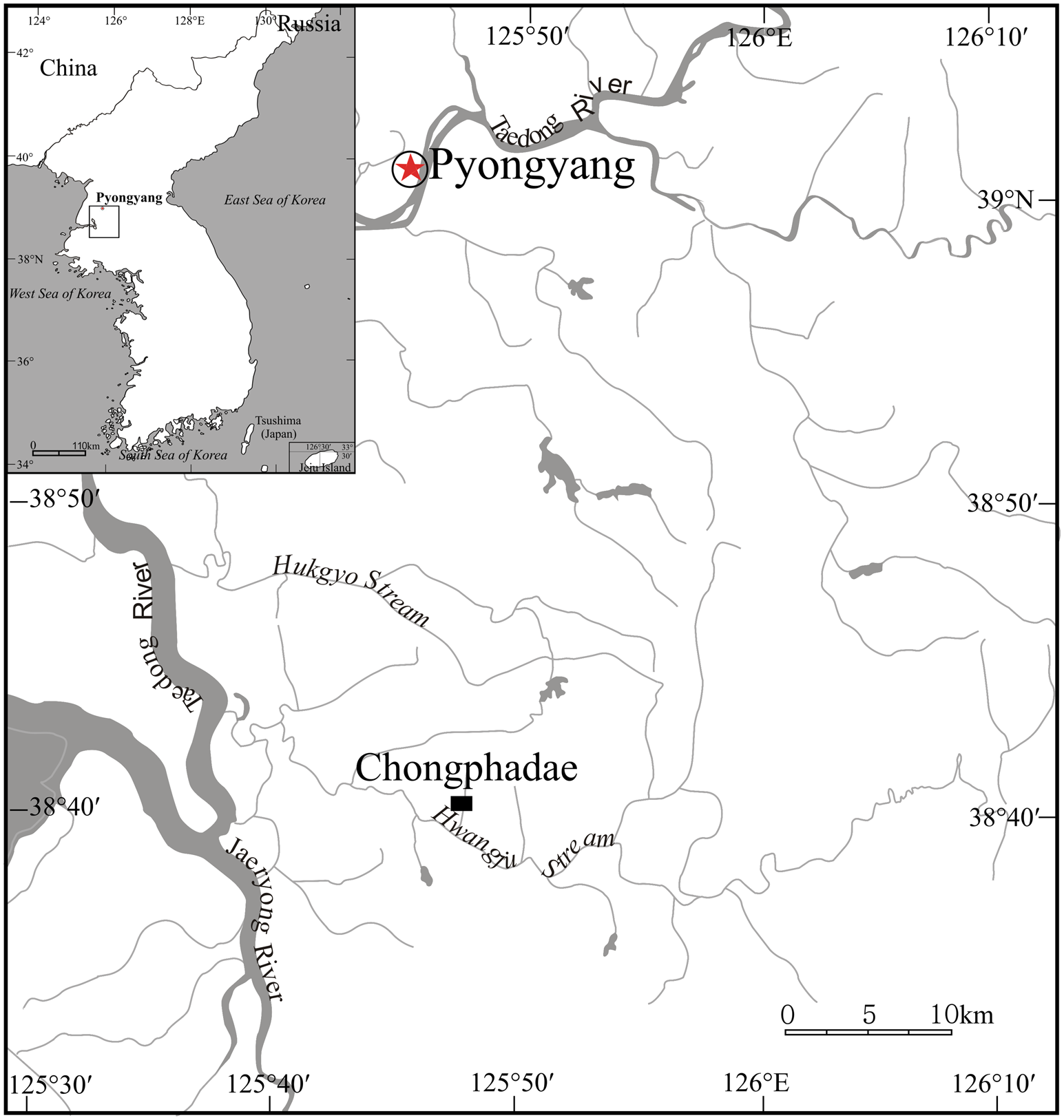
CPD Cave Site (38°40′54″ N, 125°47′30″ E) is a limestone cave located halfway up the hill behind the Chongphadae village of the township area, Hwangju County, North Hwanghae Province, about 40 km south of Pyongyang City and approximately 2 km away from Hwangju Stream, a tributary to the Taedong River (Fig. 1).
Location map of the Chongphadae Cave Site in the Taedong River Basin in the DPRK.

CPD Cave Site is located in the southern margin of Pyongyang semi-plain, which is a mixture of hilly plains, mountains, and rivers. The cave is surrounded by Mt. Jongbang (481 m above sea level), Mt. Chonju (385 m above sea level), Mt. Sambong (346 m above sea level), Mt. Tuam (232 m above sea level), and other hills. Slates, silts, and limestones of the lower Cambrian Junghwa Formation, Hwangju Group, are distributed throughout the CPD Cave Site, and the cave is a karst cavity formed in this limestone. CPD Cave Site is 6 m wide and 32 m long, and the entrance of the cave is 13.7 m high.
Today the region experiences a temperate climate typical of the region. Mean annual precipitation is 906 mm, mean annual temperature is 9.8°C, and rainfall per year is about 800 mm. Temperatures in summer are very different from those in winter; the lowest temperatures occur in January and the highest ones in August, temperatures have a range of more than 30°C, which is a typical continental climate.
Vegetation around the site consists of forests, grasslands, and rivers dominated by trees such as Pinus, Quercus, Castanea, Juglans and Corylus, and herbs such as Atractylodes, Artemisia, Miscanthus, Carex lanceolata, Pteridium aquilinum, Aster scaber, Typha orientalis, and Alisma canaliculatum.
After a preliminary survey in May 1997, a team of researchers at Kim Il Sung University conducted the field work during 1998–2005 and excavated the cave deposits. The collected fossils are stored at the Institute of Human Evolution and Development History, Faculty of History, Kim Il Sung University.
METHODS
We collected and processed approximately 8,675 kg of fossil-bearing sediments from CPD Cave deposits. In order to collect the fossil remains, sediments were reduced using sieves and treated with acetic acid at 10% concentration. As a result 10,844 mammalian fossils were collected.
The specimens of extinct species were identified using published references (Pei, Reference Pei1934; Young, Reference Young1934; Pei, Reference Pei1936; Teilhard de Chardin, Reference Teilhard de Chardin1941; Pei et al., Reference Pei, Woo, Chia, Chow, Liu and Wang1958; Zhong, Reference Zhong1981; Jin et al., Reference Jin, Xu and Li1984; Xu, Reference Xu1986; Dong and Li, Reference Dong and Li2008). Extant species were identified by references (|Young, Reference Young1932, Reference Young1934; Pei, Reference Pei1934, Reference Pei1936, Reference Pei1940; Teilhard de Chardin, Reference Teilhard de Chardin and Young1936, Reference Teilhard de Chardin1941; Pei et al., Reference Pei, Woo, Chia, Chow, Liu and Wang1958; Qi, Reference Qi1975; Zhong, Reference Zhong1981; Stuart, Reference Stuart1982; Jin et al., Reference Jin, Xu and Li1984; Zheng, Reference Zheng1984; Xu, Reference Xu1986; Zheng et al., Reference Zheng, Zhang, Dong and Chang1998; Tong et al., Reference Tong, Liu and Zhang2004; Dong and Li, Reference Dong and Li2008; Comeyne, Reference Comeyne2013) and direct comparison to modern skeletal specimens of known species in the Natural History Museum of Kim Il Sung University and the Natural History Museum of the DPRK.
Each specimen was identified to the lowest taxonomic level possible. The specimens were measured as defined by von den Driesch (Reference von den Driesch1976), and measurements were taken with AIRAJ ARZ-150 mm digital calipers.
The chronology of Layers 12 and 13 is based on 14C dates. The only suitable samples for 14C dating of these layers were mammal bones. The bulk mammal bones were collected, and dating was carried out by the Radiocarbon Dating Laboratory in Kim Il Sung University using a scintilization method. 14C measurements were obtained on deer bones (Layer 12) and horse bones (Layer 13). Collagen extraction from samples were performed using Longin's (Reference Longin1971) method. Radiocarbon ages were converted to calibrated ages by using the IntCal09 terrestrial calibration curve (Reimer et al., Reference Reimer, Baillie, Bard, Bayliss, Beck, Blackwell and Ramsey2009).
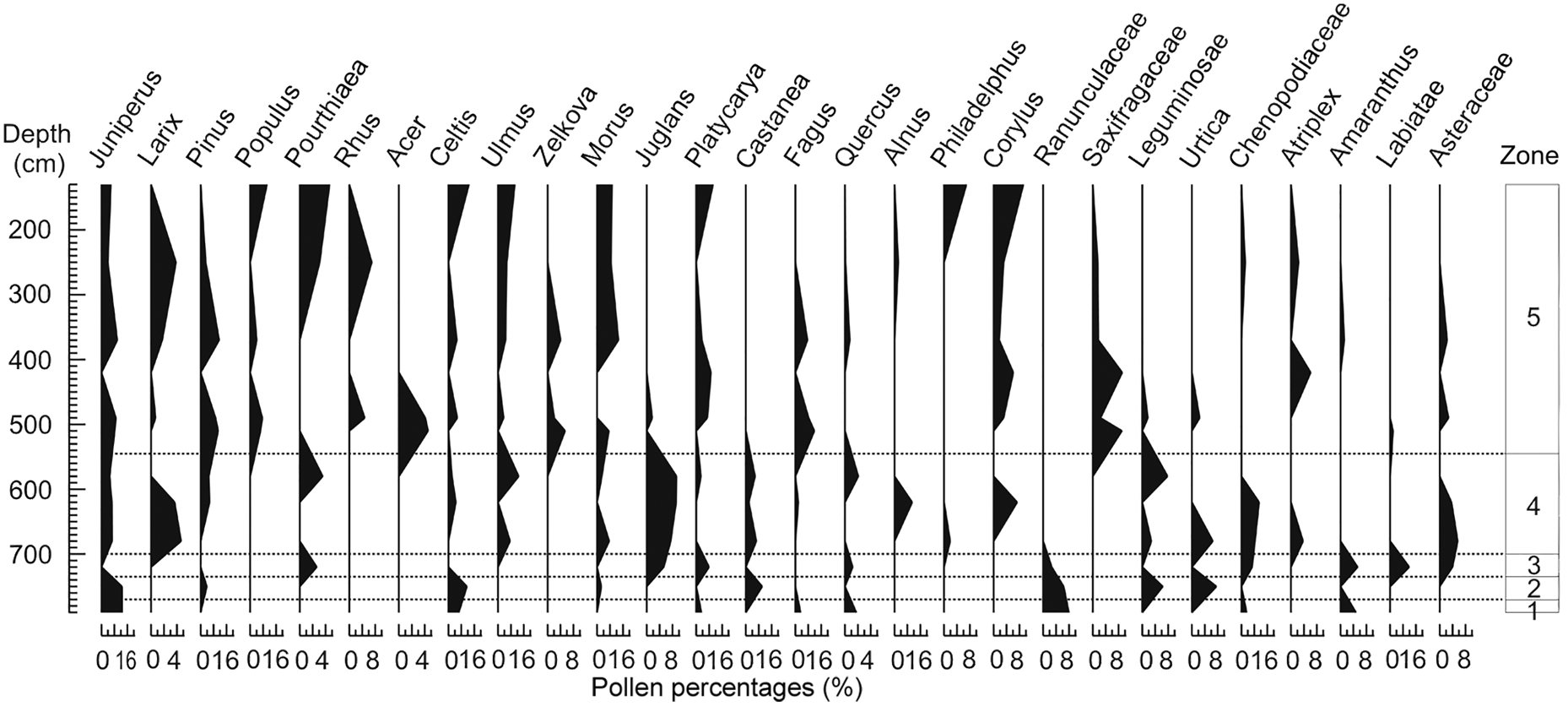
Various palynobotanical remains were also identified. Pollen analysis was conducted on 4–5 samples of ~50 g in each layer. All samples were processed according to the method of Faegri and Iversen (Reference Faegri and Iversen1989). All pollen and spores were counted under a light microscope using 400× magnifications. The pollen percentage diagram (Fig. 2) was constructed using the program PSIMPOLL 4.25 (Bennett, Reference Bennett2005).
Pollen percentage diagram of Chongphadae Cave Site (all taxa which are > 5% of the total counts).

Stratigraphy and Sedimentology
Information on the mammalian diversity of the Pleistocene is usually obtained through the study of cave deposits. Limestone caves often provide ideal conditions for the preservation of animal bones with regard to sediment temperature, humidity, and weathering, etc. (Castro and Langer, Reference Castro and Langer2011).
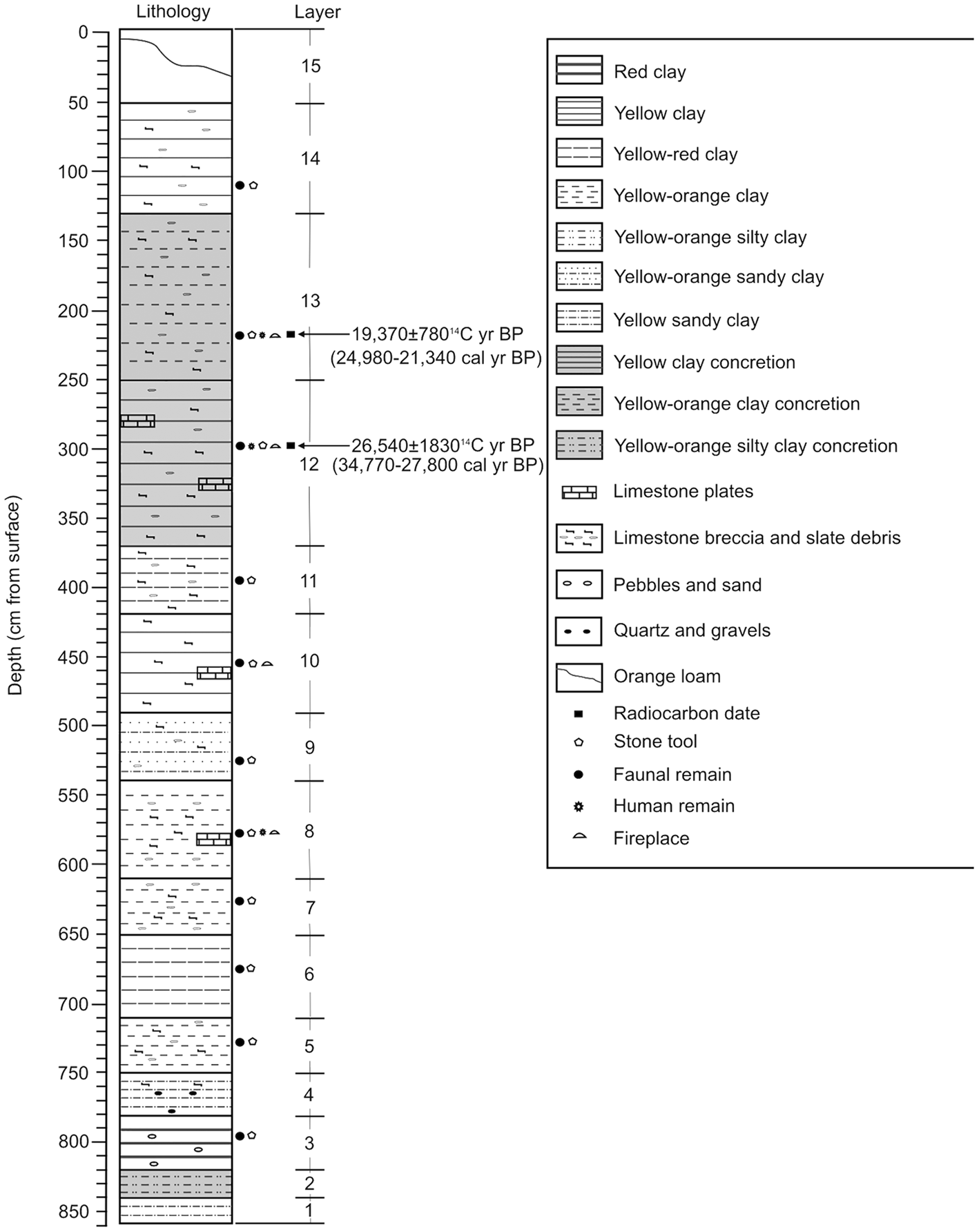
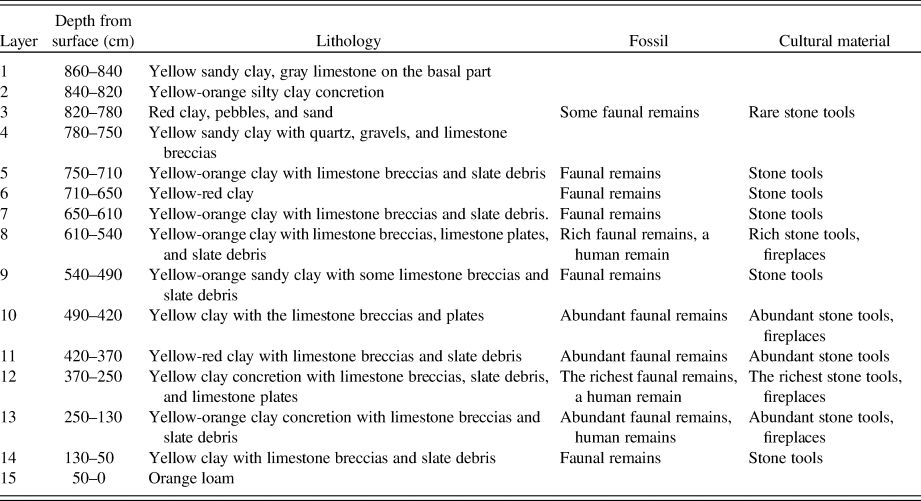
CPD Cave is a karst cavity formed in the grayish limestone of the Lower Cambrian Junghwa Formation, Hwangju Group. The cave sediments include 15 layers and consist of fluvial, cave clay, and calcareous deposits. The Late Pleistocene deposits of CPD Cave comprise an approximately 8.6-m-thick sequence in the section (Fig. 3, which shows the deposit layers from the bottom to the top, Table 1).
Stratigraphic section of the Chongphadae Cave deposits.

Sedimentary layers of Chongphadae Cave.

Layers 1–4 and 9 are composed of fluvial deposits. Layers 6–8 and 10–14 consist of cave clay deposits, which were transported into the cave by physical and chemical weathering and by aeolian processes. The calcareous sediments are represented by Layers 2, 4, 5, and 7–14; they were formed by limestone breccias, limestone plates, stalagmites, and calcareous concretions.
The cave sequence shows an accumulation of yellow-orange or yellow-red clays, with deposition of abundant faunal mammalian remains, stone tools, human remains, and ash accumulations along the entire sequence. Mammalian remains were recovered from Layers 3 and 5–15. No remains were recovered from Layers 1–2 and 4, which are composed of fluvial sand. Human remains were recovered from Layers 7, 12, and 13.
The CPD Cave site includes two layers dating to the Late Pleistocene, based on the presence of deer and horse bone specimens found in Layers 12 and 13, which are the richest in faunal remains, stone tools, and human remains. A deer bone sample from Layer 12 has yielded a date of 34,770–27,800 cal yr BP, and a horse bone sample from Layer 13 has provided a date of 24,980–21,340 cal yr BP (Table 2).
Radiocarbon dating results and corresponding calibrated ages.

RESULTS
CPD cave sediments typically include both large and small mammals, and these fossil remains are well-preserved. The diverse mammalian fauna excavated from CPD Cave includes rodents, lagomorphs, insectivores, carnivores, perissodactyls, artiodactyls, and primates.
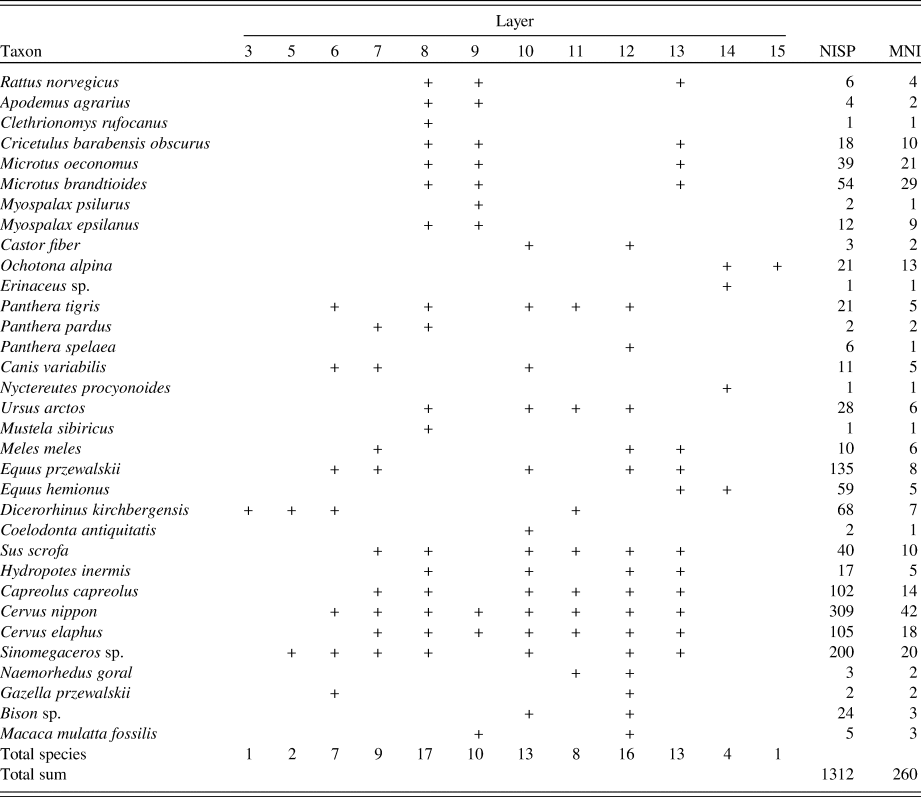
In all, 27 genera and 33 species representing 15 families and 7 orders of mammals were identified. The Late Pleistocene mammalian fauna identified includes 1,312 specimens (number of identified specimens [NISP] = 1,312, minimum number of individuals [MNI] = 260) (Table 3).
Faunal species, number of identified specimens (NISP) and minimum number of individuals (MNI) from Chongphadae Cave.

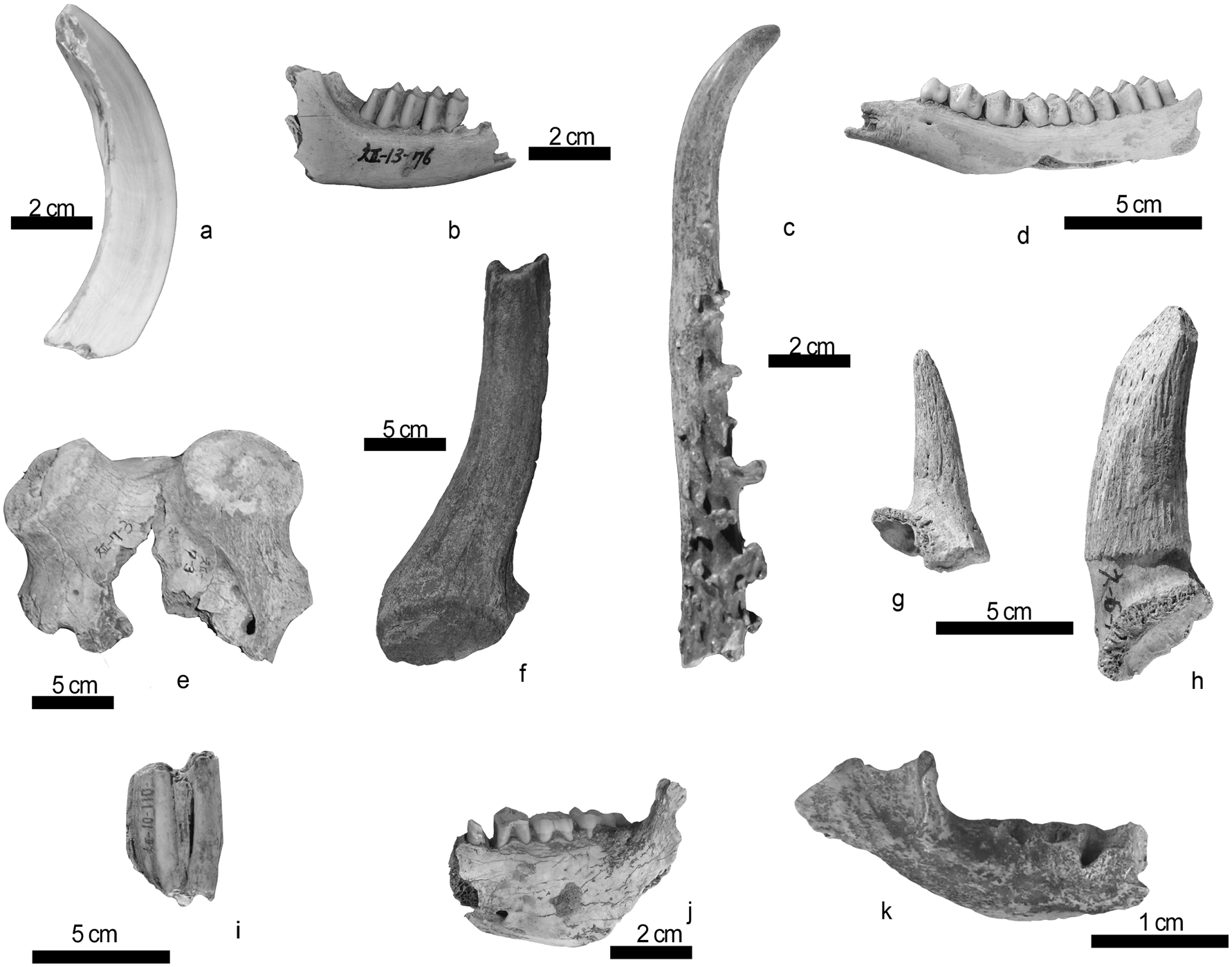
The preliminary analysis of the fossil remains is presented in Table 3; layers are organized from oldest to youngest. Artiodactyls (NISP = 802, 64.6%) dominate the CPD fauna, followed by Perissodactyls (NISP = 264, 21.3%). Rodents (NISP = 139, 10.6%) and carnivores (NISP = 90, 6.9%) are next in relative abundance. Macaque, lagomorph, and insectivore respectively represent 0.08%. Photos of some mammalian remains from CPD Cave are presented in Figures 4, 5, and 6. The specimens identified in this analysis are as follows.
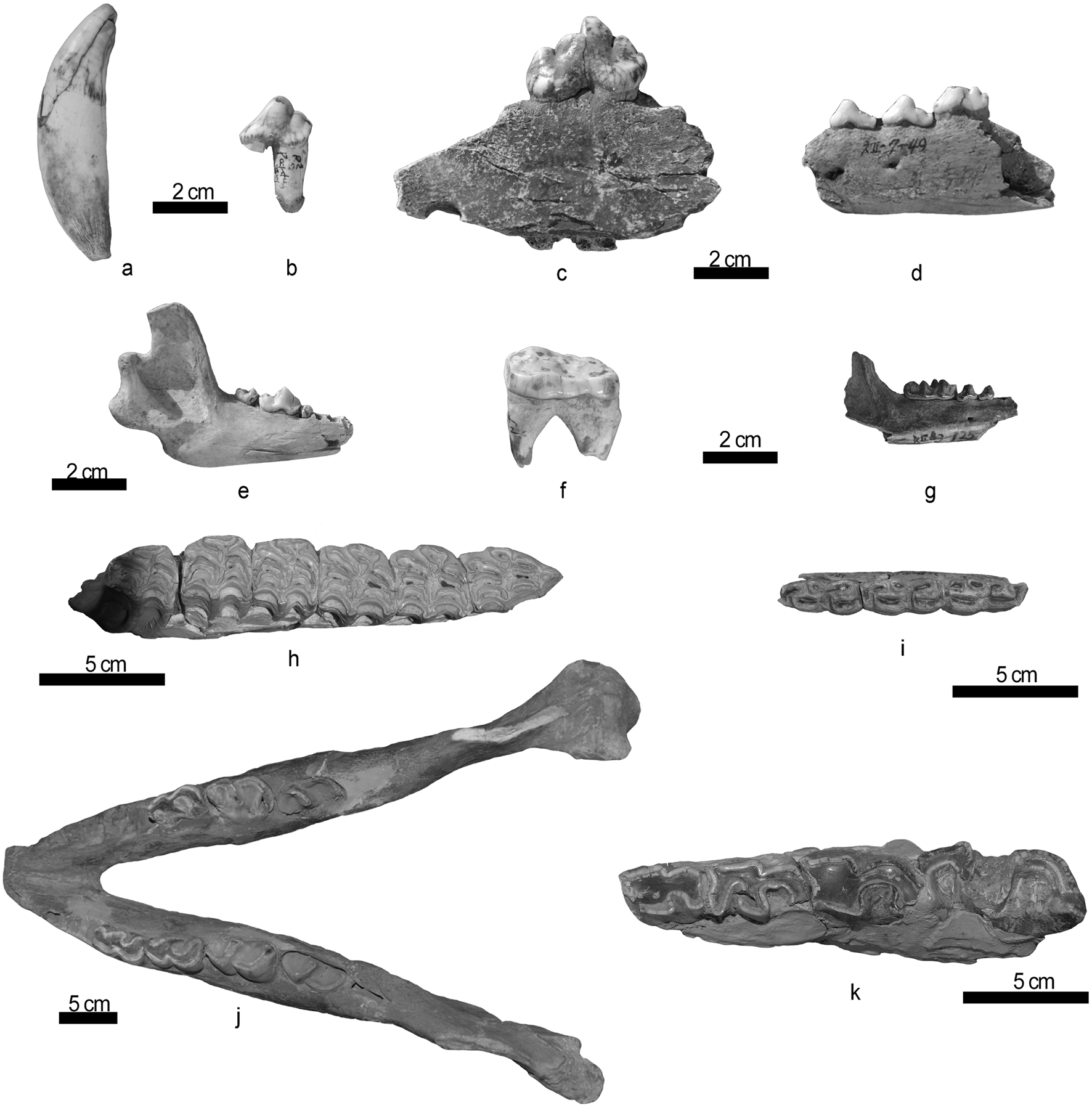
Specimens of Carnivora, Perissodactyla from Chongphadae Cave Site. (a) Incisor of Panthera tigris (Ch-6-2), (b) left P3 of P. pardus (Ch-8-61), (c) right mandible of P. spelaea (Ch-12-52), (d) left mandible of Canis variabilis (Ch-7-49), (e) left mandible of Nyctereutes procyonoides (Ch-14-2), (f) right M2 of Ursus arctos (Ch-10-20), (g) right mandible of Meles meles (Ch-13-125), (h) left maxilla of Equus przewalskii (Ch-13-58), (i) right mandible of E. hemionus (Ch-13-41), (j) mandible of Dicerorhinus kirchbergensis (Ch-13-10), (k) right mandible of Coelodonta antiquitatis (Ch-7-106).

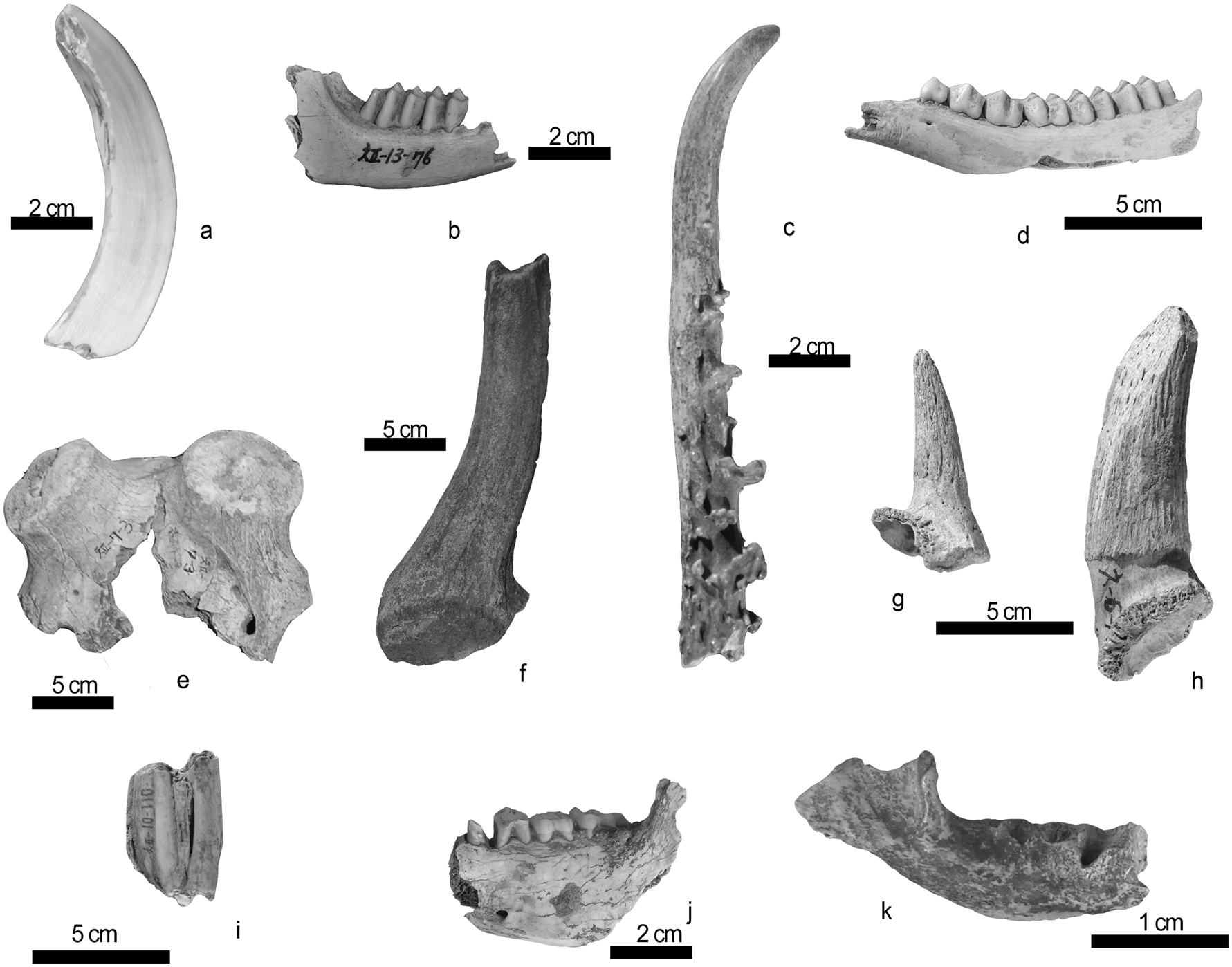
Specimens of Artiodactyla, Primates, and Insectivora from Chongphadae Cave Site. (a) Incisor of Sus scrofa (Ch-10-50), (b) right mandible of Hydropotes inermis (Ch-13-76), (c) antler fragment of Capreolus capreolus (Ch-13-43), (d) left mandible of Cervus nippon (Ch-11-2), (e) cranium of Cervus elaphus (Ch-7-3), (f) antler fragment of Sinomegaceros sp. (Ch-10-108), (g) antler fragment of Naemorhedus goral (Ch-12-119), (h) antler fragment of Gazella przewalskii (Ch-6-1), (i) left M3 of Bison sp. (Ch-10-110), (j) left mandible of Macaca mulatta fossilis (Ch-14-2), (k) right mandible of Erinaceus sp. (Ch-14-3).
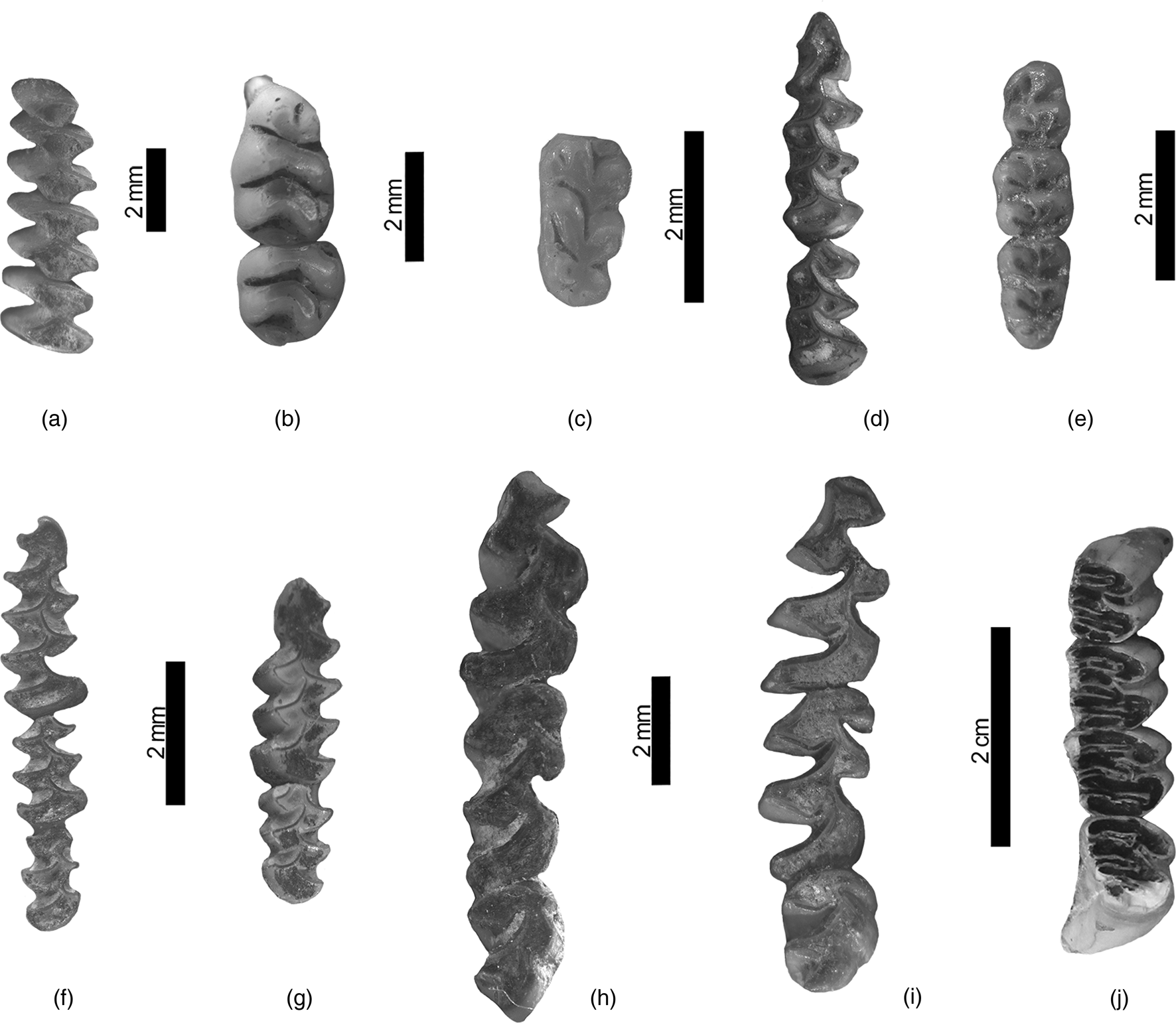
Specimens of Lagomorpha and Rodentia from Chongphadae Cave Site. (a) Right mandible of Ochotona alpina (Ch -14-19), (b) right mandible of Rattus norvegicus (Ch-13-50), (c) right mandible of Apodemus agrarius (Ch -8-57), (d) left mandible of Clethrionomys rufocanus (Ch -8-1), (e) left mandible of Cricetulus barabensis obscurus (Ch -8-64), (f) right mandible of Microtus oeconomus (Ch -13-12), (g) left mandible of M. brandtioides (Ch -8-43), (h) right mandible of Myospalax psilurus (Ch -9-18), (i) right mandible of Myospalax epsilanus (Ch -9-13), (j) left mandible of Castor fiber (Ch -12-1).

Carnivores (Carnivora)
Carnivores constitute roughly 6.4% of CPD fauna
Four families were identified: the Felidae (tigers, leopards, and cave lions), the Canidae (dogs and raccoon dog), the Ursidae (brown bears), and the Mustelidae (weasels and badgers). Carnivores from CPD Cave are represented at a variety of Pleistocene sites of China and Siberia (Pei, Reference Pei1934, Reference Pei1936, Reference Pei1940; Teilhard de Chardin, Reference Teilhard de Chardin1941; Vereshchagin, Reference Vereshchagin1971; Alekseyeva, Reference Alekseyeva1980; Zhong, Reference Zhong1981; Jin et al., Reference Jin, Xu and Li1984; Vereshchagin and Kuz'mina, Reference Vereshchagin, Kuz'mina and Velichko1984; Xu, Reference Xu1986; Zheng et al., Reference Zheng, Zhang, Dong and Chang1998).
Felidae
Remains of Felidae are present in low quantities from CPD Cave
Three species were found. The identifiable remains represent a tiger (Panthera tigris, NISP = 21), a leopard (Panthera pardus, NISP = 2) and a cave lion (Panthera spelaea, NISP = 6).
Tiger (Panthera tigris)
In all, 21 identified specimens are referred to as Panthera tigris: 11 isolated teeth (6 canines [C], 3 incisors [I], 1 first lower molar [M1], and 1 fourth lower premolar [P4]), 1 radius, 3 calcanei, and 6 phalanges (Fig. 4a). The specimens conform to parameters described by Pei (Reference Pei1934) and modern comparative specimens. Tiger remains have been excavated at a variety of Chinese and Siberian Pleistocene sites (Pei, Reference Pei1934, Reference Pei1936, Reference Pei1940; Vereshchagin and Kuz'mina, Reference Vereshchagin, Kuz'mina and Velichko1984).
Leopard (Panthera pardus)
Leopards are represented by the collection of two third upper premolars (P3) (Fig. 4b). These specimens clearly represent leopards based on parameters described by Pei (Reference Pei1934) and modern comparative specimens. Pleistocene leopard specimens are reported from Upper Cave (Pei, Reference Pei1940), Locality 1 of Choukoutien (Pei, Reference Pei1934), Locality 3 at Choukoutien (Pei, Reference Pei1936), and Siberia (Vereshchagin and Kuz'mina, Reference Vereshchagin, Kuz'mina and Velichko1984).
Cave lion (Panthera spelaea)
Cave lions are represented in the CPD Cave collection by 6 specimens: 1 upper jawbone, 1 lower mandible bone, 1 isolated tooth (P3), 2 calcanei, and 1 phalange (Fig. 4c). Cave lions are represented at Siberia's Pleistocene sites (Alekseyeva, Reference Alekseyeva1980) and in the Holarctic region (|Vereshchagin, Reference Vereshchagin1959, Reference Vereshchagin1971). Cave lions inhabited the landscape of cool Pleistocene steppe (Vereshchagin and Kuz'mina, Reference Vereshchagin, Kuz'mina and Velichko1984).
Canidae
Dog (Canis variabilis)
Dogs are represented in the CPD collection by 11 specimens: 1 lower mandible bone and 10 isolated teeth (5 C, 1 P2, 1 P4, 1 M1, and 2 M1) (Fig. 4d). The specimens reported here compare well with parameters described by Pei (Reference Pei1934), Teilhard de Chardin (Reference Teilhard de Chardin1941), and Zhong (Reference Zhong1981). Canis variabilis specimens reported here represent the first fossil record for the species in the DPRK.
Racoon dog (Nyctereutes procyonoides)
Racoon dog is represented in the collection by a lower jawbone that contains the first and second lower molars (Fig. 4e). The specimens are relatively shorter than N. sinensis (Pei, Reference Pei1934) and compared well with parameters described by Jin and colleagues (Reference Jin, Xu and Li1984). Teilhard de Chardin and colleagues (Reference Teilhard de Chardin and Young1936) and modern comparative specimens. Raccoon dogs live in a variety of thickly wooded habitats of the DPRK.
Ursidae
Brown bear (Ursus arctos)
Brown bears are represented in the collection by 28 specimens: 15 isolated teeth (7 C, 2 P4, 1 M1, 3 M2, and 2 M3), 1 humerus, 1 radius, 2 tibiae, 1 femur, 4 calcanei, 1 astragalus, and 3 metacarpi (Fig. 4f). These specimens conform to parameters described by Pei (Reference Pei1934). Brown bears inhabit the heavily wooded forests in the DPRK.
Mustelidae
Weasels (Mustela sibiricus)
A lower jawbone that contains a canine, a fourth premolar, and a first molar was identified as M. sibiricus. The specimen conforms to parameters described by Pei (Reference Pei1934) and to modern comparative specimens for weasels. Weasels inhabit forests, river valleys, and hills of almost all parts of the DPRK.
Badger (Meles meles)
Three lower jawbones were identified as Meles meles (Fig. 4g). These specimens clearly represent badgers based on parameters described by Xu (Reference Xu1986) and Zheng and colleagues (Reference Zheng, Zhang, Dong and Chang1998) and modern comparative specimens. Badgers live in forests and ravines of the DPRK.
Perissodactyls (Perissodactyla)
Perissodactyla remains constitute roughly 21.3% of the total CPD fauna. Some 264 specimens were identified, representing 2 families, 3 genera, and 4 species. The identifiable remains represent the Equidae (horses and Asiatic wild asses) and the Rhinocerotidae (bicorn rhinoceroses and woolly rhinoceroses).
Equidae
Horse (Equus przewalskii)
In all, 135 specimens were identified as E. przewalskii: 3 maxillae, 4 mandibles, 73 isolated teeth (3 P2, 2 P4, 15 M1, 2 M2, 4 M3, 8 P2, 13 P3, 8 P4, 1 M2, 1 M3, and 16 indeterminate teeth), 2 humeri, 1 radius, 2 vertebrae, 3 femora, 2 tibiae, 1 fibula, 2 patellae, 2 calcanei, 5 astragali, 6 carpi, 9 tarsi, 3 metacarpi, 7 metatarsi, 4 first phalanges, 4 second phalanges, and 2 third phalanges (Fig. 4h). These specimens conform to parameters described by Comeyne (Reference Comeyne2013), Jin and colleagues (Reference Jin, Xu and Li1984), and Qi (Reference Qi1975).
Asiatic wild ass (Equus hemionus)
Asses are represented in the collection by 59 specimens: 2 maxillae, 4 mandibles, 39 isolated teeth (1 P2, 5 P3, 3 P4, 3 M1, 1 M2, 4 M3, 4 P2,1 P3, 2 P4, 1 M1, 2 M2, 5 M3, 6 deciduous teeth, and 1 indeterminate tooth), 4 calcanei, 8 astragali, and 2 first phalanges (Fig. 4i). The specimens clearly represent asses based on parameters described by Pei (Reference Pei1940) and Pei and colleagues (Reference Pei, Woo, Chia, Chow, Liu and Wang1958), and modern comparative specimens.
Horses and Asiatic wild asses are typically taxa adapted to the temperate and semiarid grassland.
Rhinocerotidae
Bicorn rhinoceros (Dicerorhinus kirchbergensis)
68 bicorn rhinoceros specimens are identified in the collection: 2 maxillae, 7 mandibles, 58 isolated teeth (1 P1, 1 P3, 1 P4, 2 M3, 1 P1, 1 P2, 3 P3, 2 P4, 2 M1, 5 M2, 2 M3, 3 deciduous teeth, 34 indeterminate teeth), and 1 astragalus (Xu, Reference Xu1986) (Fig. 4j). The remains compare well to bicorn rhinoceroses reported from Pleistocene mammalian fauna of Liaoning Province of China (Xu, Reference Xu1986). In China, bicorn rhinoceroses have been found at sites dating from the Early Pleistocene to the Late Pleistocene (Qiu, Reference Qiu2006).
Woolly rhinoceros (Coelodonta antiquitatis)
Two lower jawbones are referred to as Coelodonta antiquitatis (Fig. 4k). The specimens compare well to woolly rhinoceroses reported from Tingtsun and Qingshantou faunas of China (Pei et al., Reference Pei, Woo, Chia, Chow, Liu and Wang1958; Jin et al., Reference Jin, Xu and Li1984). Woolly rhinoceroses became extinct at the end of the Pleistocene (Van Kolfschoten, Reference van Kolfschoten1995). During the Quaternary rhinoceroses inhabited not only temperate zones, but also the cold climate zone of Eurasia (Boeskorov, Reference Boeskorov2012). The woolly rhinoceroses were adapted to a cold climate and the open steppe (Wu et al., Reference Wu, Wu and Zhang1989; Tang et al., Reference Tang, Liu, Lin and Liu2003; Qiu, Reference Qiu2006).
Artiodactyls (Artiodactyla)
Artiodactyls comprise the most abundant taxa, constituting roughly 64.6% of the CPD fauna. In all, 802 specimens were identified, representing 3 families, 8 genera, and 9 species. Three families are represented: the Suidae (wild boars), the Cervidae (deer), and the Bovidae (bison). Artiodactyls from CPD fauna are represented at a range of Chinese Pleistocene sites (Young, Reference Young1932; Pei, Reference Pei1936; Zhong, Reference Zhong1981; Stuart, Reference Stuart1982; Tong et al., Reference Tong, Liu and Zhang2004; Dong and Li, Reference Dong and Li2008).
Suidae
Wild boars (Sus scrofa)
Wild boars are represented in the CPD collection by 40 specimens: 2 maxillae, 2 mandibles, 33 isolated teeth (5 C, 3 I1, 1 I2, 1 I3, 2 I2, 1 M2, 2 M3, 1 P4, 3 M1, 8 M3, and 6 indeterminate teeth), 1 humerus, and 2 astragali (Fig. 5a). The specimens conform to parameters described by Tong and colleagues (Reference Tong, Liu and Zhang2004) and modern comparative specimens. Wild boars inhabit the deciduous woodland and today are distributed in almost all forests of the DPRK.
Cervidae
Surprisingly, cervids are the most abundant in number of specimens, accounting for roughly 59% of the CPD fauna.
Water deer (Hydropotes inermis)
In all, 17 identified specimens are referred to as Hydropotes inermis: 6 mandibles, 1 humerus, 1 calcaneus, 2 astragali, 2 metatarsi, 4 first phalanges, and 1 third phalanx (Fig. 5b). The specimens conform to parameters described by Pei (Reference Pei1936) and modern comparative specimens. True to its name, the water deer inhabit the well-vegetated riparian zones. Today the water deer inhabit the lowland hills, foothills, and willowy rivulets of the DPRK.
Roe deer (Capreolus capreolus)
In all, 102 specimens were identified as Capreolus capreolus: 35 antler fragments, 3 maxillae, 19 mandibles, 18 isolated teeth (1 P2, 1 P3, 1 P4, 3 M1, 4 M2, 8 M3), 4 humeri, 2 radii, 1 tibia, 1 fibula, 5 calcanei, 6 astragali, 5 first phalanges, 1 third phalanx, 1 metacarpus, and 1 metatarsus (Fig. 5c). These specimens conform to parameters described by Stuart (Reference Stuart1982) and Young (Reference Young1932), and modern comparative specimens. Roe deer are generally associated with areas of suitable woodland cover.
Deer (Cervus nippon)
In all, 309 specimens were identified as Cervus nippon: 25 antler fragments, 6 maxillae, 68 mandibles, 109 isolated teeth(2 I1, 2 P3, 1 P4, 4 M1, 3 M2, 5 M3, 6 P3, 2 P4, 5 M1, 14 M2, 25 M3,and 40 indeterminate teeth), 7 humeri, 4 radii, 5 femora, 5 tibiae, 13 calcanei, 22 astragali, 8 metacarpi, 10 metatarsi, 17 first phalanges, 4 second phalanges, and 6 third phalanges (Fig. 5d). The specimens conform to parameters described by Tong and colleagues (Reference Tong, Liu and Zhang2004) and Young (Reference Young1932), and modern comparative specimens.
Red deer (Cervus elaphus)
Red deer are represented in the CPD collection by 105 specimens: 3 antler fragments, 2 crania, 5 maxillae, 21 mandibles, 46 isolated teeth (1 P2, 6 M1, 2 M2, 3 P3, 15 M1, 8 M2, and 11 M3), 3 humeri, 1 radius, 1 femur, 4 tibia, 2 calcanei, 8 astragali, 2 first phalanges, 3 third phalanges, 3 metacarpi, and 1 metatarsus (Fig. 5e). The specimens in question conform well to parameters described by Tong and colleagues (Reference Tong, Liu and Zhang2004) and modern comparative specimens.
Although C. nippon and C. elaphus are generally abundant in temperate conditions, they were present in both warm and cold periods during the Pleistocene.
Big-horned deer (Sinomegaceros sp.)
Big-horned deer are represented in the collection by 200 identified specimens: 65 antler fragments, 13 maxillae, 32 mandibles, 51 isolated teeth (1 P2, 2 P3, 1 P4, 10 M2, 6 M3, 1 P2, 1 P3, 7 P4, 12 M1, 4 M2, 5 M3, and 1 DP3), 5 scapulae, 1 humerus, 7 calcanei, 4 astragali, 4 first phalanges, 4 second phalanges, 7 third phalanges, 4 metacarpi, and 2 metatarsi (Fig. 5f). These specimens conform well to parameters described by Pei (Reference Pei1936). Sinomegaceros sp. occurred in temperate zones during the Pleistocene and probably inhabited more open areas than dense forests, as indicated by their enormous antlers (Qiu, Reference Qiu2006).
Bovidae
Goral (Nemorhaedus goral)
Gorals are represented in the collection by three antler fragments (Fig. 5g). Gorals now live in deep forests of the DPRK.
Gazelle (Gazella przewalskii)
Gazelles are represented in the CPD fauna by two antler fragments (Fig. 5h). The specimens clearly represent gazelles based on parameters described by Dong and Li (Reference Dong and Li2008). The two gazelle specimens reported here represent the first-reported fossil record for the genus in the DPRK.
Bison (Bison sp.)
In all, 24 specimens were identified as the genus Bison: 18 isolated teeth (2 P2, 1 M2, 1 M3, 3 P2, 2 P3, 1 P4, 1 M1, 2 M2, 2 M3, and 3 indeterminate teeth), 1 humerus, 1 first phalanx, 3 second phalanges, and 1 metacarpus (Fig. 5i). These specimens conform to parameters described by Zhong (Reference Zhong1981).
Primates (Primates)
Macaque remains are present at the lowest rate in the sample of mammal fossils from CPD fauna.
Fossil macaque (Macaca mulatta fossilis)
Macaque remains are represented by five mandibles in the CPD Cave (Fig. 5j). These fossil macaque specimens are the first record from DPRK of this endemic species.
Insectivores (Insectivora)
Erinaceidae
Hedgehog (Erinaceus sp.)
Insectivore remains are represented by a mandible from CPD fauna, and this was identified as the genus Erinaceus (Fig. 5k). This specimen conforms to parameters described by Pei (Reference Pei1936) and modern comparative specimens. Hedgehogs inhabit low grassland with deciduous woodland or scrub (Hutchins et al., Reference Hutchins, Kleiman, Geist and McDade2004).
Lagomorphs (Lagomorpha)
Lagomorphs constitute just 1.6% of total CPD fauna.
Ochotonidae
Alpine pika (Ochotona alpina)
Twenty-one specimens were identified as Ochotona alpine (Fig. 6a). These specimens are mandibles and conform well to modern comparative specimens. Today alpine pikas inhabit the mountainous and rocky areas of the DPRK.
Rodents (Rodentia)
Rodents represent approximately 11. 2% of the identifiable specimens from CPD fauna. In all, 3 families, 7 genera, and 9 species are represented. The identifiable remains represent the Muridae, the Cricetidae, and the Castoridae. The Muridae is represented by two genera: the brown rat (Rattus norvegicus) and the field mouse (Apodemus agrarius). The Cricetidae is represented by four genera: the Eurasian red-backed vole (Clethrionomys rufocanus), the short-tailed hamster (Cricetulus barabensis obscurus), the root vole (Microtus oeconomus), the vole (Microtus brandtioides), the Manchurian zokor (Myospalax psilurus), and the zokor (Myospalax epsilanus). The Castoridae is represented by one genus: beaver (Castor fiber).
Muridae
Brown rat (Rattus norvegicus)
Brown rats are represented in the collection by six mandibles (Fig. 6b). The specimens conform to the modern comparative specimens. Brown rats inhabit every part of the DPRK today.
Field mouse (Apodemus agrarius)
Field mice are represented in the CPD Cave by four mandibles (Fig. 6c). The specimens are relatively larger than wood mice (A. sylvaticus) described by Young (Reference Young1934). Field mice inhabit the edges of lowlands in every part of the DPRK.
Cricetidae
Eurasian red-backed vole (Clethrionomys rufocanus)
A mandible was identified as Clethrionomys rufocanus (Fig. 6d). This specimen conforms to parameters described by Young (Reference Young1934) and modern comparative specimens. Today, Eurasian red-backed voles inhabit the forest regions of the DPRK.
Short-tailed hamster (Cricetulus barabensis obscurus)
Short-tailed hamsters are represented in the CDP fauna by 18 mandibles (Fig. 6e). The specimens conform well to parameters described by Pei (Reference Pei1936) and Zheng (Reference Zheng1984) for hamsters. Today, Cricetulus barabensis obscurus inhabits the edges of hills and forests of the DPRK.
Root vole (Microtus oeconomus)
In all, 39 mandibles were identified as Microtus oeconomus, and these specimens conform to parameters described by Young (Reference Young1934) (Fig. 6f). The geographical distribution of the root vole extends from northwestern Europe to Alaska and northern Canada (Balčiauskas et al., Reference Balčiauskas, Balčiauskienė and Janonytė2012). Root voles inhabit the wet, grassy woodlands of the DPRK.
Vole (Microtus brandtioides)
Fifty-four mandibles are referred to as M. brandtioides. These specimens conform to parameters described by Pei (Reference Pei1936) and Young (Reference Young1934) (Fig. 6g).
Manchurian zokor (Myospalax psilurus)
Manchurian zokors are represented by two mandibles (Fig. 6h).
Zokor (M. epsilanus)
Twelve mandibles were identified as M. epsilanus (Fig. 6i). Zokors are native Asian rodents. The living zokors are distributed in the northeast of Asia and are adapted to cold conditions (Pavlenko et al., Reference Pavlenko, Tsvirka, Korablev and Puzachenko2014). Zokors are absent from the DPRK today.
Castoridae
Beaver (Castor fiber)
Three mandibles are referred to as Castor fiber (Fig. 6j). The specimens conform well to parameters described by Young (Reference Young1934). Beavers were formerly distributed in the habitats of woods around the shores of lakes and rivers but now are not present in the DPRK.
DISCUSSION
The CPD fossil fauna represent a very diverse and abundant Pleistocene assemblage. The presence of Gazella przewalskii, Panthera spelaea, and Macaca mulatta fossilis in the CPD fauna is notable because these specimens represent the first fossil records for each species for the Pleistocene of the DPRK.
Most of the extinct species in the CPD fauna, Dicerorhinus kirchbergensis, Coelodonta antiquitatis, Panthera spelaea, Sinomegaceros sp., Microtus brandtioides, Canis variabilis, and the existing species such as Panthera tigris, Panthera pardus, Nyctereutes procyonoides, Ursus arctos, Meles meles, Equus przewalskii, Equus hemionus, Sus scrofa, Cervus nippon, Cervus elaphus, Gazella przewalskii, Bison sp., etc., were forms characteristic of the Middle and Late Pleistocene in North China and Siberia (Alekseyeva, Reference Alekseyeva1980; Vereshchagin and Kuz'mina, Reference Vereshchagin, Kuz'mina and Velichko1984; Tang et al., Reference Tang, Liu, Lin and Liu2003; Qiu, Reference Qiu2006).
The species identified here offer insights that can be used to reconstruct the Late Pleistocene environment in and around the CPD Cave Site.
Of the 33 taxa identified in CPD fauna, 25 species are strongly associated with the forest area that existed around the CPD Site. Panthera Tigris, Panthera pardus, Ursus arctos, Meles meles, Sus scrofa, Hydropotes inermis, Cervus nippon, Cervus elaphus, Sinomegaceros sp., and others are most commonly found in and around forest areas (Hutchins et al., Reference Hutchins, Kleiman, Geist and McDade2004; Qiu, Reference Qiu2006). Ochotona alpina inhabits the forests and alpine areas, and Erinaceus inhabits the woodlands and lowland grasslands. Rattus norvegicus, Apodemus agrarius, Myospalax psilurus, Clethrionomys rufocanus, and others inhabit the forests and lowland grasslands (Hutchins et al., Reference Hutchins, Kleiman, Geist and McDade2004; Pavlenko et al., Reference Pavlenko, Tsvirka, Korablev and Puzachenko2014).
Dicerorhinus kirchbergensis was strongly associated with hot and humid habitats of forests in the tropical and subtropical regions (Xu, Reference Xu1986; Wu et al., Reference Wu, Wu and Zhang1989; Qiu, Reference Qiu2006).
Equus przewalskii and Equus hemionus are typically taxa adapted to the open habitats of the temperate, semi-arid steppes and grasslands, and bison, Ochotona alpina, and Canis variabilis are also strongly associated with open habitats such as grasslands (Tang et al., Reference Tang, Liu, Lin and Liu2003; Qiu, Reference Qiu2006; Dong et al., Reference Dong, Zhang and Liu2017).
Mustela sibiricus, Microtus oeconomus, and Rattus norvegicus prefer humid habitats in general, and Hydropotes inermis can also easily be encountered in riparian zones. Castor fiber is strongly associated with riparian zones (Hutchins et al., Reference Hutchins, Kleiman, Geist and McDade2004).
In CPD fauna, Cervus nippon, Sus scrofa, Panthera tigris, Ursus arctos, etc., commonly associated with the temperate region, constitute 70.4% of the total fauna, and Coelodonta antiquitatis, Myospalax psilurus, Myospalax epsilanus, etc., associated with cold climates, constitute 25.8% (Wu et al., Reference Wu, Wu and Zhang1989; Van Kolfschoten, Reference van Kolfschoten1995; Qiu, Reference Qiu2006; Boeskorov, Reference Boeskorov2012). This indicates that during the Late Pleistocene, a cool and humid temperate environment existed in the CPD Cave region.
The paleoenvironment correlates of the CPD mammalian fauna are consistent with the available information concerning the palynoflora. Analysis of botanical remains from CPD Cave provides information on the local paleovegetation (see Fig. 2).
The dominant floral elements available are trees (Juniperus, Pinus, Morus, Fagus, Quercus, Platycarya, Ulmus, Celtis, Populus, Juglans, and Corylus), together constituting roughly 60% of the palynoflora. Grasses (Gramineae, Cyperaceae, etc.) and herbs (Chenopodiaceae, Saxifragaceae, Asteraceae, Leguminosae, Liliaceae, and Urtica etc.) dominate identified pollen, together constituting roughly 22% of the palynoflora. Ferns (Polypodiaceae, Botrychium, Osmunda, Pteris, etc.) constitute roughly 16% of the palynoflora. Also represented are riparian species including cottonwoods (Populus), willows (Salix), alders (Alnus), walnuts (Juglans), sedges (Cyperaceae), plantains (Plantago), amaranths (Amaranthus), and polygonums (Polygonaceae).
Together with mammalian fauna at this site, the paleoflora suggests a vegetation association with forests, grasslands, and riparian zones in and around the CPD Cave Site. It appears that trees dominated the local vegetation of CPD Cave Site during the Late Pleistocene. The regional vegetation included pine woodlands and oak woodlands with occasional larches and zelkovas. The remaining elements in the palynoflora appear to represent a grassland and riparian vegetation regime. The dominant floral elements associated with the temperate climate include Juniperus, Ulmus, Acer, Populus, etc., constituting roughly 80% of the palynoflora. Thus, the data indicate that during the Late Pleistocene, a temperate environment existed in this region.
CONCLUSIONS
The mammalian fauna from CPD Cave is diverse and abundant and presents the first reported fossil record of Gazella przewalskii, Panther spelaea, and Macaca mulatta fossilis for the Pleistocene of the DPRK as a whole. Dicerorhinus kirchbergensis, Coelodonta antiquitatis, Panthera spelaea, Macaca mulatta fossilis, Sinomegaceros sp., Microtus brandtioides, etc. are typical Pleistocene species (Qiu, Reference Qiu2006). Equus przewalskii, E. hemionus, Sus scrofa, Bison, and others are the special species of the Late Pleistocene in north China (Qiu, Reference Qiu2006). The currently living species from CPD Cave are mostly found in the forests, grasslands, and riparian zones of the DPRK.
The species composition of the CPD fauna suggests that forests were more widespread in Chongphadae region, Hwangju County, during the Late Pleistocene, but the species are still closely associated with the hills, grasslands, and riparian zones similar to the region today.
The Late Pleistocene environment inferred from the mammalian fauna in and around the CPD Cave Site is consistent with that of the palynoflora and appeared similar to that of Salawusu and Antu (Northern China) by Wu and colleagues (Reference Wu, Wu and Zhang1989). However, it was slightly wetter than these areas.
In summary, the paleoclimate of CPD Cave Site was cooler and wetter than the modern climate of the Hwangju region and was very favorable for the hominids of the time.
ACKNOWLEDGMENTS
We thank the following people for their collection of CPD fauna: Il Nam Kim, Jae Nam Ri, Myong Hyok Ri, Bin Ri, and Won Hyok Ji, Institute of Human Evolution and Development History, Faculty of History, Kim Il Sung University.
We are also grateful to Chol Man Kim, Chol Jun Hwang, the Electronic library, Kim Il Sung University, Chang Jo Chae, Jin Hyok O, and the National Natural Museum for their provision of comparative data of mammal fossils from CPD fauna.