Introduction
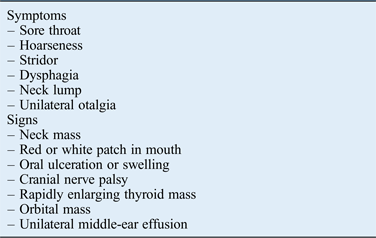
Approximately 16 000 people are diagnosed with head and neck cancer in the UK every year. A general practitioner would expect to see one case of head and neck cancer every six years. There are a number of ‘red flag’ symptoms or signs that alert a clinician to investigate further (Table I).1 These can be quantified and hence contribute to the clinical impression. The presence of specific risk factors, signs or symptoms is well recognised to correlate with a higher likelihood of malignancy; this formed the basis of the development of the two-week referral pathway.1 This facility allows general practitioners to refer patients urgently to secondary care for a specialist opinion so that they are seen within two weeks.1 However, in reality, only a small proportion of these patients will subsequently be diagnosed with a malignancy.
‘Red flag’ signs and symptoms that alert the clinician to a possible cancer diagnosis*

* Any of these lasting more than three weeks
ENT clinicians can also add two further important ingredients into the pot: their experience in examination and their clinical judgement, which is based on years of experience and anecdotal evidence. A lesion which an experienced clinician may consider to be quite clearly benign may be considered as only suspicious by a less experienced colleague. Additionally, although a number of patients do not present with specific signs or symptoms, an instinctive feeling in such cases may lead the clinician to investigate further. Based on quantifiable measures alone, a diagnosis may be missed in such patients.
It is generally accepted that with experience clinicians develop the ability to identify patients with malignancies prior to any diagnostic procedure or investigation. However, this cannot be quantified nor is it a plausible substitute to investigation. The purpose of this observational study was to demonstrate the importance of ‘gut instinct’ and highlight the role it plays in patient assessment and management.
Materials and methods
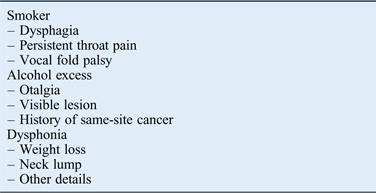
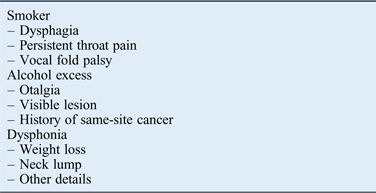
A prospective study of patients presenting to the Otolaryngology Out-patient Department, Sunderland Royal Infirmary, between August and December 2010 was performed. Patients requiring urgent diagnostic endoscopy for suspected cancer were included, and basic demographics (e.g. age, sex), risk factors, symptoms and signs were recorded (Table II). The clinician's gut feeling of the likelihood of malignancy was also documented. It was graded on a linear scale from 1 (very unlikely) to 10 (very likely), and subsequently correlated with histology. All data were recorded in a database and statistical analysis was performed.
Signs and symptoms for each patient type
Approval for this study was obtained from the hospital's Research and Audit Department, which is equivalent to an institutional review board.
Results
Twenty-seven patients underwent diagnostic endoscopy. The mean age was 62.2 years, and 29.6 per cent of patients were referred urgently under the two-week referral pathway. Patients who meet certain criteria in the primary care setting are referred by general practitioners under this pathway.
There was a history of previous head and neck cancer in 18.5 per cent of patients. Thirty per cent of patients presented with one symptom, 33.3 per cent with two, 25.6 per cent with three, 7.4 per cent with four and 3.7 per cent with five (Figure 1). Abnormal results were found in 48 per cent (13) of patients. A histological diagnosis of cancer was made in 37 per cent (10) of patients, while 2 patients had chronic inflammation and 1 patient had dysplasia. The procedure was cancelled for one patient as a result of illness.
Graph demonstrating the relationship between signs and symptoms and histology findings.
Of the patients diagnosed with cancer, only 20 per cent were smokers, and none had a history of excessive alcohol consumption. A diagnosis of squamous cell carcinoma was made in 70 per cent of patients diagnosed with cancer. Of those diagnosed with cancer; 40 per cent presented with one symptom, 30 per cent with two symptoms and 10 per cent each with three, four and five symptoms. No correlation was found between the number of symptoms and the presence of abnormal histology (Kendall's tau-b = −0.333333).
Clinical suspicion of malignancy was graded on a scale of 1–10. The mean clinical suspicion for patients with abnormal histology findings was 7.13, with 2.72 for those with normal histology findings. There was a positive correlation between clinical suspicion and cancer diagnosis (Kendall's tau-b = 0.648749).
Discussion
Clinical decision-making has been widely studied, with various theories describing it as a complex interaction of knowledge, experience and pattern recognition.Reference Rosen, Sands, Morris, Drake and Davis2–Reference Stolper, Van de Wiel, Van Royen, Van Bokhoven, Van der Weijden and Dinant4
The dual process theory encompasses analytical and non-analytical reasoning as two modes of knowing and thinking.Reference Ferreira, Garcia-Marques, Sherman and Sherman5, Reference Evans and Frankish6 The analytical process is controlled, logical and systematic, using algorithms and frameworks based on evidence. At the centre of it, Bayesian logic is used for determining post-test probabilities along with pre-test probabilities and likelihood ratios.Reference Moreira, Bisoffi, Narváez and Van den Ende7 Although most clinicians will be unfamiliar with the statistics underpinning Bayes' theorem, they are inherently Bayesian in their diagnostic reasoning.Reference Gill, Sabin and Schmid8 This has traditionally constituted the standard for best practice, on the assumption that it minimises cognitive bias and has a safer profile, as well as providing a mental ‘safety net’ so that fewer mistakes are made.Reference Shimizu and Tokuda9
In contrast, the intuitive or non-analytical process is much more rapid and less easily quantified. This process is also known as heuristics and is based on subconscious information processing informed by extensive clinical experience and relying on pattern recognition and ‘clinical pearls’.Reference Shimizu and Tokuda9, Reference Klein10 Due to the high accessibility of immediate thoughts, it is considered a more efficient process that enables experienced, skilled clinicians to reach a prompt diagnosis.Reference Stolper, Van de Wiel, Van Royen, Van Bokhoven, Van der Weijden and Dinant4, Reference Shimizu and Tokuda9
The cognitive continuum theory considers these two processes as cognitive modes (analysis and intuition) that exist at either end of a continuum. While analysis is a conscious, slow and controlled process, intuition is described as being unconscious, rapid and of low control.Reference Hamm, Dowie and Elstein11 The intuitive process is almost spontaneous and the knowledge upon which it is based is not directly identifiable; hence, it is considered implicit or tacit knowledge. It was best described by Polanyi as ‘that which we know but cannot tell’.Reference Polanyi12
Cognitive neuroscience research has also demonstrated that emotions make a significant contribution to the decision-making process.Reference Naqvi, Shiv and Bechara13 Referred to as the affect heuristic, this process is informed by the positive or negative feelings evoked by a stimulus or, in this context, a clinical scenario; it is synonymous with the term gut instinct. It is more commonly employed in situations that require a judgement of the risks and benefits, and the strength of positive or negative affect will influence the decision. When considered in the context of clinical decision-making theories, it is clear that gut instinct plays a considerable role as an affect heuristic in intuitive or non-analytical processes.
In this study, the clinicians' gut feelings towards the likelihood of a cancer diagnosis demonstrated a statistically significant positive correlation with cancer diagnosis. Figure 1 shows the number of signs and symptoms present in patients with normal and abnormal histology findings. This indicates that in this study clinicians' gut instincts were predictive of a cancer diagnosis.
Although this is a small study, the findings represent a wider significance. They are supported by the findings of a larger study demonstrating that clinical suspicion was more accurate than positron emission tomography scans in patients presenting with a suspected thoracic malignancy.Reference Baram and Bilfinger14 Another study describing primary care physicians' gut feelings that infections were more serious in children than suggested by clinical assessment also demonstrated that intuition increased the likelihood of a serious illness being discovered.Reference Van den Bruel, Thompson, Buntinx and Mant15
• Clinical decision-making is based on knowledge, experience and pattern recognition
• The presence or absence of clinical signs alone may lead to a missed diagnosis
• Clinical suspicion should be regarded as an integral factor in patient assessment
Alcohol and betel nut consumption and tobacco smoking are major risk factors for head and neck cancer, accounting for 75 per cent of cases.Reference Mehanna, V Paleri, West and Nutting16 Interestingly, in this study only 20 per cent of patients with a positive cancer diagnosis were smokers. Seventy per cent of non-smokers with a positive diagnosis presented with only one or two signs or symptoms. In these cases, it is likely that the clinicians' intuition led to further investigation and eventual diagnosis despite the absence of specific risk factors.
This study demonstrates that clinical intuition is an essential component of patient assessment and management, and is a valuable tool which can guide the diagnostic process. A better understanding of the processes that occur during clinical decision-making may provide clinicians with a deeper insight into their own clinical reasoning. As clinicians increasingly practice in an environment filled with guidelines and protocols, it is important to appreciate the value of clinical intuition.
Conclusion
This study highlights the importance of clinical intuition in cancer diagnosis. Reliance on the presence or absence of clinical signs alone may lead to a diagnosis being missed; although gut instincts cannot be quantified, they should be regarded as an integral part of patient assessment. An increased awareness of the important role that gut feelings play in the clinical setting will help clinicians learn to appreciate their value as an additional resource in the decision-making process.