R1. Introduction
People with particular nonpolitical characteristics, including psychological tendencies, tastes, cognitive patterns, physiological traits, and perhaps even genetics and physical appearance, tend to have corresponding political preferences. The reasons for the correlations of these broader variables and political beliefs are a matter of considerable interest and dispute. In our target article, we asserted that an important organizing feature of the myriad correlations is an individual's degree of negativity bias. More specifically, we summarized extensive empirical evidence that individuals displaying heightened physiological response and concerted attention to negative stimuli also demonstrate a proclivity for political issue stances that can be classified as “conservative” in the sense that they are intended to foster order, stability, security, and tradition.
The 26 commentator teams favor us with unusually thoughtful insights. Perhaps three or four, depending on the reading, believe the negativity bias hypothesis is largely or entirely incorrect but the remaining 22 or 23 accept the general idea and set to work modifying it, expanding on it, specifying where it does and does not work, explaining why it does not work in some areas, trying to make it work where it does not initially seem to work, offering more robust theoretical foundation, suggesting measurement approaches, and generally refining and revising in a helpful and constructive fashion.
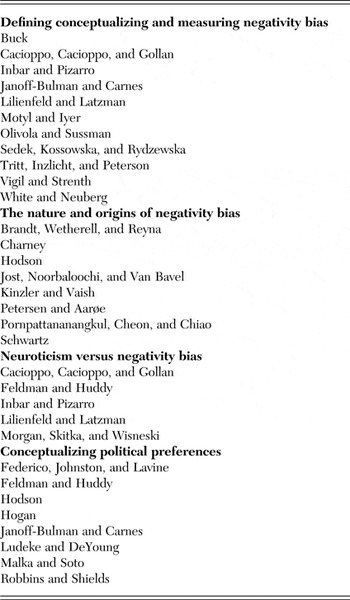
Though it is dangerous to pigeonhole wide-ranging essays, doing so affords organizational structure to the commentaries, as well as to our response. We see them falling into four broad categories as depicted in the accompanying table. Since some commentaries make more than one point, a few are placed in more than one category. Below we briefly address each of these four broad collections of commentaries, apologizing in advance for not having the space to go into the detail each deserves.
Categorizing the commentaries.

R2. Defining, conceptualizing, and measuring negativity bias
At the center of our target article is the claim that political orientations are, at least in part, driven by deeply embedded individual-level variations in orientations to negative stimuli – but what is negativity bias, and what specifically about it explains the link with political orientation? A large number of commentators posed this question in one form or another. The general definition of negativity bias we employ is a tendency to respond more strongly, to be more attentive, and to give more weight to negative elements of the environment. Several commentators accept the claim that individual-level responses – especially implicit responses – to negative stimuli systematically map onto political orientation but argue that we are painting negativity bias with too broad a brush. They suggest it is not generally negative elements of the environment that are relevant but rather more specific types of negative stimuli.
Lilienfeld & Latzman, for example, assert that the connection we seek to explain rests on threat bias rather than the more general concept of negativity bias. Specifically, they distinguish between negative emotionality (“the propensity to experience unpleasant affects of many kinds, including anxiety, irritability, and mistrust”) and constraint (“differential sensitivity to reasonably clear-cut threats”). They also note that “individuals with elevated constraint and its constituent traits, particularly harm-avoidance/fear, exhibit pronounced fear-potentiated startle … and habituate slowly to startle-provoking stimuli.” This notion of constraint is later relabeled “threat bias” and offered as an explicit substitute for our overly broad “negativity bias.” As our own earlier work on startle reflex (Oxley et al. Reference Oxley, Smith, Alford, Hibbing, Miller, Scalora, Hatemi and Hibbing2008) would suggest, we agree that threat sensitivity, and not negative emotionality, is key.
Like Lilienfeld & Latzman, Inbar & Pizarro assert that our approach is overly broad, but their focus is on disgust rather than threat. They support this focus with a cogent and well-defended argument for the role of disgust and the associated behavioral immune system as the central explanation for variations in political orientations. Disgust is, of course, one of the main negatives in our conception of negativity bias, and we have also addressed this topic in previous research (see Smith et al. Reference Smith, Oxley, Hibbing, Alford and Hibbing2011), so once again we find ourselves in agreement with the commentators.
Both sets of scholars are right in calling for a more complete and careful explication of the role of threat and disgust in the broader concept of negativity bias. For example, it would be useful to know the extent to which threat sensitivity and disgust sensitivity are correlated across people. To the extent they both contribute to conservatism, are the effects compensatory, additive, multiplicative, or something else? Also, do threat sensitivity and disgust sensitivity affect different categories of political issues, as some existing empirical work suggests?
Still, Lilienfeld & Latzman's exclusive focus on threat ignores the powerful effects of disgust elucidated by Inbar & Pizarro, just as Inbar & Pizarro's exclusive focus on disgust ignores the powerful effects of threat so accurately described in Lilienfeld & Latzman's commentary. The empirical evidence indicates that both threat and disgust are relevant to political attitudes. Each set of commentators makes a strong case for their preferred subcategory of negativity but does not make a similarly strong case that the other subcategory is irrelevant. This is precisely the case that must be made if the charge that our approach is “overly broad” is to have merit.
Approaching the target essay from the opposite perspective, Tritt, Inzlicht, & Peterson (Tritt et al.) claim that rather than being too broad, we have too narrowly defined the key concept. They suggest that much of the literature we review repeats a flaw in the negativity bias literature by concentrating on valence at the expense of arousal. They point out that responses to positive features of the environment are either entirely ignored by scholars or are measured with low arousal cues that are not comparable with the high arousal cues typically employed to measure negativity bias. As such, they raise the possibility that a key variable in explaining the differences between liberals and conservatives might be degree of arousal regardless of whether the valence of the stimulus is positive or negative. Perhaps once degree of arousal is controlled conservatives are more responsive to all stimuli and not just to negative stimuli. We take their point on the importance of isolating rather than conflating valence and arousal and in some respects it would be even more fascinating if conservatives were, as they suggest, more easily aroused regardless of the stimulus valence. In our own research we have seen occasional hints that conservatives are more responsive than liberals to positive stimuli, but that is not usually the case, and some previous research, contrary to the implications of Tritt et al.'s commentary, does control for degree of stimulus arousal and still finds a greater negativity bias for conservatives. Be that as it may, the arousal hypothesis definitely merits additional empirical scrutiny.
Several other commentaries offer plausible expansions of the negativity bias hypothesis. For Buck, the large research literature on infant attachment provides a broader and more suitable focus than negativity bias. Marshaling arguments that range from Hobbes and Locke to Haidt and Lakoff, Buck offers variation in the degree of secure attachment as an alternative explanation for later adult ideological variation. We certainly are willing to entertain the possibility that levels of infant attachment are associated with levels of negativity bias and join Buck in encouraging efforts to explore this connection.
Other commentators critique our focus on negativity for failing to give equal time to positivity and in the process relegating liberalism to the status of little more than the absence of conservatism. Both Janoff-Bulman & Carnes and White & Neuberg agree that our focus on the negative offers useful insight into avoidance, but both fault us for ignoring the positive. In the more psychological treatment of Janoff-Bulman & Carnes this positive side centers on the approach systems of the brain and the consequent prescriptive moral domain. White & Neuberg take a more evolutionary approach and associate positive motivation with seeking opportunity. There very well may be a parallel positive system but our reading of the literature is that a significant portion of the findings can be accounted for with a focus solely on negativity bias. In our own research, we typically find negativity bias more strongly correlated with conservatism than positivity bias is with liberals but the comments of Janoff-Bulman & Carnes, as well as those of White & Neuberg suggest productive new avenues for investigating the positive side of the ledger. It may be that, given the vulnerable and fragile existence of our ancestors (Pinker Reference Pinker2011), for evolutionarily sensible reasons, sticking with the tried and true (conservatism) is a tighter, more conserved phenotype than liberalism. Though speculative, this point might explain why the focus of research in this area tends to be on explaining conservatism rather than liberalism.
Motyl & Iyer also believe our target article focuses too narrowly on negativity bias and suggest an alternate explanation that includes many of the findings we review but places them within a more general explanation of ideological differences. They accept our central thesis that negativity bias explains many ideological differences but point out (as we do in the target article) that negativity bias does not seem to account for the finding that conservatives tend to have higher levels of life satisfaction. They suggest an important element of conservatives' negativity bias, as well as their greater life satisfaction and generally (compared to liberals) more positive view of life, is a greater desire for cognitive coherence. Motyl & Iyer suggest that conservatives are less willing than liberals to rationalize dissonant states. Faced with the negative or aversive, conservatives recognize and deal with it (as we describe in our previous work – see Dodd et al. Reference Dodd, Balzer, Jacobs, Gruszczynski, Smith and Hibbing2012), a process that leads not just to a more ordered world but also to a hedonic payoff. We find the cognitive coherence hypothesis intriguing and consistent with our speculation that fending off the negative may be more tractable and in some ways more satisfying than constantly seeking unspecified new experiences as many liberals are wont to do.
Motyl & Iyer's commentary also suggests the basis of a response to the criticism of the negativity bias hypothesis raised by Sedek, Kossowska, & Rydzewska (Sedek et al.). The latter point out that conservatism increases with age but that older people also tend to display a more positive outlook, at least in a present-oriented sense. This, they argue, runs counter to the central argument laid out in the target article, yet they also suggest that older adults seem to seek more of a cognitively coherent world view, with a “reliance on highly routinized and schematic cognitive and behavioral patterns.” If Motyl & Iyer's arguments have validity, perhaps Sedek et al.'s arguments are more compatible with our approach than they realize.
More clarity in the central explanatory variable is always desirable. Tritt et al. and Inbar & Pizarro, as well as Lilienfeld & Latzman, are quite right in pointing out that little of the research we reviewed was designed to precisely define negativity bias, let alone translate that definition into an instrument capable of validly measuring that concept. The need for conceptual and measurement clarification is apparent in the commentaries that attempt empirical tests of the negativity bias hypothesis. For example, Vigil & Strenth report the results of a study of theirs in which respondents were asked to mark emotionally ambiguous faces as joyful, angry, fearful, or sad. In a coding scheme that considers fear/anger as negative/aversive and joy/sadness as affiliative, they report no differences between liberals and conservatives (actually, between Democrats and Republicans) and conclude that this result fails to confirm the negativity bias hypothesis. Using an alternative coding scheme where fear/sadness are seen as signals of trustworthiness and anger/joy as capacity, they do find statistical support for a “socio-relational model.” These findings are interesting but may muddy rather than clarify the empirical validity of the hypothesis they seek to test. Their test of the negativity bias hypothesis appears to rest on a continuous variable, with one end of the spectrum anchored by negativity bias and the other by affiliation. We are not convinced affiliation is the opposite of negativity bias and thus are not convinced their study, interesting as it is, constitutes a critical test of the negativity bias hypothesis. Moreover, they employ partisanship as a proxy for ideology and, though these concepts are related, the correlation (in the United States at least) typically is only around 0.5 to 0.6.
We have a somewhat similar reaction to the argument offered by Olivola & Sussman. They report that Republicans as well as Democrats (again, not liberals and conservatives) react positively to facial signals of competence. That is an interesting finding, but it is not clear to us how it is indicative of flaws in the negativity bias hypothesis. Moreover, the differences (or non-differences) between liberals and conservatives in boycotting or “buycotting” strike us as empirically questionable. Some of the survey items measuring these practices (see Newman & Bartels Reference Newman and Bartels2011) refer to “buying American” or supporting local producers as opposed to corporate chains, items loaded with contaminating political content. Finally, it is widely known that people who identify with right-leaning parties tend to be more averse to taxes and less supportive of carbon emission surcharges, and we do not see this fact as contradicting the negativity bias hypothesis.
One of the topics consistently emerging from the commentaries is the need to think clearly about concept definition and operationalization. Fortunately, one set of commentators offers a path for doing exactly that. Cacioppo, Cacioppo, & Gollan (Cacioppo et al.) argue for employing measures and paradigms directly developed in the negativity bias literature as a better and more direct basis for testing the hypothesis that conservatives are higher in negativity bias. Drawing on their earlier work with the Evaluative Space Model (ESM), they describe a set of tightly focused concepts and measures of negativity bias (stronger responses to very negative compared with equally arousing positive stimuli) and positivity offset (stronger responses to mildly positive compared with equally arousing negative stimuli) that have been psychometrically validated. These measures may not be perfect. For example, it is not clear which negative and (especially) positive stimuli are the most appropriate, just as it is not clear whether sympathetic nervous system responses can be employed in addition to self-report response. Still, we view the general approach outlined by Cacioppo et al. as an extremely promising strategy for developing more standardized concepts and measures that will improve testing of the negativity bias hypothesis.
Cacioppo et al.'s ideas address many of the concerns of other commentators. For example, they describe measures of negativity bias that rely on differences between responses to oppositely valenced stimuli of equal arousal. This clearly addresses the potential valence/arousal confound that Tritt et al. raise. By varying the stimuli and producing directly comparable measures of general negativity bias versus more threat specific bias, it should also be possible to get leverage on the issues raised by Inbar & Pizarro and by Lilienfeld & Latzman. Finally, by providing more standardized approaches to concept definition and measurement, a better platform will be available for direct hypothesis tests such as those presented by Vigil & Strenth and clearer guides will exist for drawing inferences from secondary resources, as Olivola & Sussman do.
R3. The nature and origins of negativity bias
As we point out in our target article, one of the clear challenges in examining relationships between elevated negativity bias and political conservatism is the fact that there seem to be many exceptions. A number of commentators address this matter and they tend to fall into two main categories. The first are those commentators who accept the general nature of the negativity bias hypothesis and see these ambiguities as a puzzle that needs to be addressed in order to more fully understand this relationship. The second are those commentators who see the exceptions and incongruities as so numerous and frequent that they contradict and ultimately falsify the entire negativity bias hypothesis.
Schwartz falls into the first category by suggesting that a focus on universal human values is one possible approach to sorting out the instances in which liberals appear to be more responsive than conservatives to negativity. Following Boehnke et al. (Reference Boehnke, Schwartz, Stromberg and Sagiv1998), Schwartz makes the distinction between micro and macro worries. Micro worries are centered on threats to the self or in-group and macro worries are centered on external threats to broader entities such as the whole of society or the world. Schwartz speculates that this distinction between macro and micro worries may correlate systematically with values in a way that distinguishes between liberalism and conservatism (because liberals tend to resonate more with universal or macro values). This line of thought strikes us as utterly sensible and a potentially fruitful line of research.
We would offer the same encouragement to several other lines of research described by the commentators. For example, Brandt, Wetherell, & Reyna (Brandt et al.) suggest that negativity bias underpins the development of a political world view but not necessarily the way an individual reacts to specific events or threats in that world. In other words, negativity bias may shape political traits but is less predictive of the manner in which individuals react to particular environmental states – a possibility we think is worth testing. Kinzler & Vaish suggest a similar notion, arguing that development is crucial to understanding negativity bias. They believe that identifying the precise situations in which individual differences in negativity bias manifest themselves would help greatly in understanding differences across the political spectrum in responses to social versus non-social threats. They assert that variations in development likely shape individual responses to negative stimuli and that the nature of these responses affects political temperament. We have no argument whatsoever with this formulation.
Petersen & Aarøe push the exploration of the causes of negativity bias back in time to their evolutionary origins. Although it is typical to suppose that traits at equilibrium will have little or no meaningful variation, they suggest that at the individual level, variation in other individual traits related to the likelihood or severity of resource loss could lead to compensating variation in the levels of negativity bias. This hypothesis is intriguing, and the variety of studies linking genetic variation to negativity bias cited by Pornpattananangkul, Cheon, & Chiao (Pornpattananangkul et al.) would seem broadly compatible with this line of thinking. In addition to pushing the search for the causes of negativity bias into biology, Pornpattananangkul et al. also suggest considering the impact of culture. In making the argument, they propose a potential source of explanations for the lack of homogeneity in the relationship between negativity bias and political orientation. Though some types of negative stimuli may elicit stronger amygdala activity in conservatives, other types of negative stimuli may activate greater empathic reactions in other parts of the brain in liberals. (As it turns out, our research team has preliminary fMRI evidence that is consistent with this point.) Culture may help to condition these sorts of differential reactions to particular types of stimuli. This seems an admirably comprehensive platform for thinking about political heterogeneity in negativity bias response. Not only is it likely to identify exceptions to the link between negativity bias and conservative political temperament but it may also provide a clear understanding of why these exceptions exist.
One final suggestion regarding the origins of negativity bias is that the information needed was right under our noses – specifically in our dependent variable. The argument here is that political orientation is a cause not a function of negativity bias. The possibility that we might have our “causal arrow” backwards is one we take seriously. Though we believe that variation in negativity bias is a temporally prior cause of variation in ideology, we are also in agreement with Jost, Noorbaloochi, & Van Bavel (Jost et al.) on their two main points: First, that there is a lack of clear empirical research (as opposed to strong theoretical arguments) with the proper dynamic design to definitively answer the causal order question, and second that the actual relationship may be bidirectional, though we would posit a much fatter arrow running from negativity bias to ideology. The important point is that the nature and degree of recursion is an empirical question that modern tools can answer and we agree that teasing out the true causal order should be a research priority.
Charney is one of the few commentators who reject the possibility of a connection between heightened negativity bias and political beliefs. He appears to do so largely because he employs an unusually narrow, U.S.-centric view of the political spectrum and fails to appreciate the depth of political ideology. At one point, however, he does seem to recognize that some people are “stability seekers” whereas others are “innovators” but he is skeptical that those behavioral tendencies are relevant to political orientations. The notion that the “types” Charney acknowledges would be relevant to so much of life but not to politics, flies in the face of common sense, as well as the reflections of Mill and Emerson that we included in the target article (sect. 1, para.1; see also paras. 3 and 4). There is no firewall around the political arena, isolating it from the baseline forces that influence people's orientations and behaviors in all other facets of life. When this basic fact is recognized, the ancient and universal nature of political divisions becomes easy to see. Charney also seems bothered that liberals and conservatives sometimes agree on the elements of the environment that are negative but disagree about how to respond to them, and at other times disagree about whether a given stimulus is in fact negative or positive. To illustrate this point, he claims that “liberals do not perceive a ‘bad man with a gun’ as any less of a threat than conservatives,” and asserts that the only disagreement between liberals and conservatives is over the best way to ameliorate the threat. In truth, empirical research suggests that the level of threat perceived (and the physiological response apparent) in identical situations is quite different for “stability seekers” as opposed to those more comfortable with change. Moreover, the best way to measure these differences is to present stimuli that are as basic and not-overtly-political as possible. If stimuli are politicized, the relationship becomes circular and much less likely to reveal core rather than induced psychological and physiological differences.
R4. Neuroticism versus negativity bias
Several commentators argue that negativity bias is unlikely to be a discriminator of political orientation, because if it were, conservatives would be more fearful and more neurotic, and have a more generally negative outlook on life, an argument similar to that of Sedek et al. described above. These commentators typically go on to point out that, in reality, conservatives are not more neurotic and, indeed, by many measures are happier than liberals and have a more positive outlook.
We take issue with the assumption that being more attentive and aware of negative stimuli automatically translates into neuroticism, fearfulness, depression, or a negative outlook on life. In fact, in our target article, after acknowledging that conservatives score higher than liberals on several measures of subjective well-being, we state that, “being more attuned to the dangers of the world does not make for pessimistic, fearful individuals and being less attuned to dangers does not make for carefree, hedonistic individuals” (sect. 7, para. 1). Several respondents, however, persist in arguing that negativity bias must mean exactly that. For example, Morgan, Skitka, & Wisneski (Morgan et al.) note that an extensive literature finds compared with liberals, conservatives report being happier and better adjusted. They assert our claim that conservatives are more dispositionally sensitive to negative stimuli would be at odds with that literature. They go so far as to state that “a selective review of this body of research might suggest the existence of a conservative positivity bias!” Similar perspectives are expressed in a number of other commentaries, such as Inbar & Pizarro, and we think they all misperceive a central message of the target article.
Responding and attending to negative events is not synonymous with living in fear of them and does not necessarily lead to singular activation of behavioral inhibition as opposed to behavioral approach. The research we reviewed does not demonstrate that conservatives are more fearful, more pessimistic, and more convinced that life is a negative experience. The fact that conservatives display marginally but significantly greater detection, response, and attention to negative events should not lead to the conclusion that conservatives therefore are “fearful and threatened” people. Part of the problem here may be the tendency in previous research to dichotomize behavior into approach or avoid, and, when it is useful to add a third category, attend (see Aron & Aron Reference Aron and Aron1997). As suggested by Dodd et al. (Reference Dodd, Balzer, Jacobs, Gruszczynski, Smith and Hibbing2012), conservatives are more likely than liberals to attend and even to confront the negative, hardly the actions of fearful, withdrawn individuals.
Sedek et al. raise a related issue from the perspective of changes over the life cycle. They begin with the documented fact that political conservatism increases with age. They go on to observe that older people are also more likely to report a reduction in negative emotional experiences and to have some difficulty remembering negative facts. They believe this combination of findings evokes “considerable doubt as to the validity of the target article's central claim.” In truth, it does no such thing. The size of the shift toward political conservatism that comes with age, though statistically significant, is actually quite small. More important, just because age is related positively to conservatism and negatively to some aspects of negativity bias in no way eliminates the possibility that conservatism and negativity bias are positively related (as Sedek et al. note, e.g., preference for closure, which also increases with age, could be an important confound). Several of the studies we cite have included controls for age and they still report a positive correlation between aspects of negativity bias and political conservatism.
We also take issue with the notion that the negativity bias hypothesis is falsified by personality research. Several respondents point out that the two personality traits most consistently associated with political orientation are openness (which correlates with liberal orientations) and conscientiousness (which correlates with conservative orientations). The general argument is (1) any impact of negativity bias must operate through the broader personality traits of the Big Five and (2) negativity bias is subsumed into the larger personality trait of neuroticism. With regard to the latter, Feldman & Huddy argue that “in the personality literature, neuroticism typically captures differences in sensitivity to negative outcomes … yet there is no evidence that neuroticism is associated with conservatism.” We disagree.
First, it is clear that some Big 5 traits – primarily conscientiousness and openness – are indeed consistently correlated with political orientation but it is not evident why it follows that all other aspects of psychology must be rooted in these traits in order to be relevant to politics. Personality is important to politics but the bar for concluding that some particular dimension of psychology or biology is influencing political temperament should not be that it is mediated through one or more or the Big 5 traits. Second, the negativity bias hypothesis does not posit a connection between negativity bias and neuroticism so the absence of a relationship with that personality trait is no problem for the central argument of our target article. Lilienfeld & Latzman realize this and point out that the personality literature suggests two orthogonal dimensions of negative affect. They go on to note that one of these dimensions may correlate with neuroticism but the other definitely does not. The dimension that may correlate with neuroticism is defined by the propensity to experience unpleasant affects of many kinds, including anxiety, irritability, and mistrust and is precisely the sort of psychological dimension that we explicitly argue is not associated with conservatism. The second dimension is constraint and is best accounted for by conscientiousness and openness, not neuroticism. Indeed, one of Lilienfeld & Latzman's criticisms of our target article is that we confound negative emotionality and constraint and they note that a by-product of doing so is often an unnecessary and distracting debate on neuroticism. Several commentators appear to have proved their point.
Tellingly, in earlier work Cacioppo and other colleagues (Norris et al. Reference Norris, Larsen, Crawford and Cacioppo2011) empirically examine the relationships between positivity offset and negativity bias using the ESM framework. They found that individual-level differences in positivity offset and negativity bias were stable across time, that they were consistent across a wide range of stimuli (pictures, sounds, words, games of chance), and, more pertinently, that “positivity offset and negativity bias were generally unrelated to personality measures” (pg. 107). Interestingly, they also found that negativity bias was not related to “satisfaction with life” measures but that positivity offset was. In sum, for our hypothesis to be right, it is not necessary for negativity bias to correlate with neuroticism or for neuroticism to correlate with conservatism. In fact, Motyl & Iyer suggest that successfully monitoring and attending negative features of the environment, as conservatives tend to do, may be just the sort of tractable task – particularly for those who take special pleasure in successfully completed tasks – that is more likely to lead to a fulfilling and happy life than is a constant search for new experience after new experience. Some people who display large negativity biases seem to give evidence of less optimism but this does not tend to be the case for political conservatives. Maybe employing politics in an attempt to minimize the dangers posed by the negative elements of life is mentally healthier than concluding nothing can be done about those dangers. Investigating the reasons people respond so differently to elevated negativity bias and investigating the potential benefits of a viable political outlet for that bias could be valuable lines of research, both with regard to politics and mental health.
R5. Conceptualizing political ideology
A popular view of political ideologies (see especially Jost et al. Reference Jost, Glaser, Kruglanski and Sulloway2003) is that they vary primarily on the basis of two undergirding factors: orientation to change and orientation to inequality. Conservatives, or individuals on the political right, are more likely to oppose social change but to be relatively accepting of inequality. Liberals (as the term is used in the United States), or those on the political left, are more likely to welcome social change but to be deeply bothered by inequality. As several of the commentators are quick to note, the conceptualization of ideology employed in our target article goes rather heavy on orientation to change and lightly on orientation to inequality. They quite appropriately wonder about the relevance of the negativity bias hypothesis to inequality and to the economically-oriented issues that revolve around attitudes toward inequality.
In doing so, the commentators raise questions that go well beyond our target article. How are socio-cultural political preferences (topics such as gun control, school prayer, gay marriage, and capital punishment) related to preferences on political issues related to economic matters? If the relationship is weak or nonexistent, what are the deeper forces that explain each of them and is the negativity bias hypothesis at all relevant to economic issues? If the relationship between economic and sociocultural preferences is solid, what explains the connection? Are those who favor traditional social arrangements naturally or organically inclined to favor free market economic approaches as well and, if so, why? Alternatively, is this connection merely the product of historical quirks and ephemeral, top-down elite framing rather than timeless and universal psychological and physiological tendencies?
Though we plead guilty to emphasizing preferences on sociocultural issues more than economic issues, we disagree with the assertion found in some of the commentaries that our account requires there to be a single ideological dimension. Feldman & Huddy claim that our ideas are “based on the underlying assumption that political ideology can be represented by a single dimension,” and Malka & Soto suggest that individuals who do not consistently organize their political attitudes along a broad conservative–liberal continuum present “a challenge to any claim that a psychological disposition directly or organically leads individuals to adopt broad coherent packages of liberal or conservative attitudes.” Robbins & Shields make a similar point. In truth, we are happy to concede that political issues cover a broad range of topics, that individuals often hold distinct packages of beliefs, and that multiple dimensions therefore are often in evidence. This is why in our target article we acknowledged the diverse dimensions of political issues and speculated that characteristics such as the degree of negativity bias may be “less relevant to economic issues … than … to social issues” (sect 6.2, para. 3) and this is why in our own research we do not use single items that ask respondents to place themselves on an overarching left–right continuum but instead ask them about individual issues so that their positions on those issues can then be flexibly aggregated in a variety of meaningful ways. As such, Feldman & Huddy's point that many self-professed conservatives actually hold liberal issue positions, which although accurate, is quite irrelevant.
If a concept such as negativity bias could account for a significant portion of the variance merely in socio-cultural political preferences, it would be an important accomplishment. If it were able to account for economic or equality issues, as well, we would view this as icing on the cake. The implication that the success of our hypothesis rests on its ability to account for preferences on economic, as well as socio-cultural issues, is inaccurate. Virtually all of the commentators recognize that socio-cultural issues are “core” issues in political life and that economic issues are peripheral (the exception is Feldman & Huddy, who inexplicably assert that economic issues are “historically more powerful and politically consequential”). Sociocultural issues cover a wide range of topics and are the issues that people tend to feel in their gut (see the commentary by Federico, Johnston, & Lavine [Federico et al.]; also see Carmines & Stimson Reference Carmines and Stimson1980). For example, Ludeke & DeYoung (see also Bouchard Reference Bouchard, Voland and Schiefenhövel2009) see sociocultural conservatism as blending with authoritarian attitudes and also religious fundamentalism to form a central “triad,” leaving economic issues on the outside looking in. Economic issues are undeniably important (witness recent riots by the economically downtrodden in Brazil and elsewhere) but sociocultural-religious disputes are continuing flashpoints (witness the recent and massive public demonstrations in supposedly permissive France over gay marriage and the ongoing unrest in the Mideast, Africa, and South Asia over music, schooling for girls, and creeping Western values).
So what is the relationship between people's preferences on sociocultural issues and their preferences on economic issues? The commentators are quite helpful in making progress toward answering this question in spite of mixed signals in the existing literature. Certainly it is the case, as Hogan and other commentators point out, that some individuals adopt free market economic ideas but pro-change sociocultural ideas (permit abortions, legalize drugs, and sanction gay marriage). Such individuals are often called libertarians. The question, however, is whether pro-tradition sociocultural preferences and free-market economic preferences trend together statistically and here answers differ. Feldman & Huddy, citing an unpublished doctoral dissertation, claim that “correlations between economic and social dimensions of ideology are low to non-existent in samples from numerous countries.” Conversely, Robbins & Shields, citing Jost et al. (Reference Jost, Federico and Napier2009) conclude that the correlation between social and economic conservatism “seems clear.”
We believe the explanation for these contradictory messages in extant empirical research has to do with the way political preferences are operationalized. If stances on economic issues are measured in the abstract (e.g., survey items soliciting general attitudes toward taxes, social transfers, and big government), respondents' economic attitudes may appear to be unrelated to their attitudes on socio-cultural issues. However, bloodless survey items of this sort are not particularly meaningful because they do not tap the way people in the real world typically think about economic issues. People tend not to view economic issues as technical matters but rather, if given the opportunity, load them with all kinds of social content; thus, to get valid indicators of people's economic attitudes, the social component must be included.
For example, defense spending is an economic issue involving government spending and the size of the public sector but preferences on it clearly overlap with preferences on gun control, capital punishment, and law and order – “protection” issues, as Janoff-Bulman & Carnes call them. So here we see social issues bleeding over into an economic issue. The same can be seen regarding aspects of social welfare spending. It seems highly unlikely that public attitudes toward welfare spending are a purely economic matter and it is more likely that they are bound up with attitudes toward immigration, in-groups and out-groups, deservedness, and freeriding (a point confirmed by Petersen [Reference Petersen2012]). When economic issues are embedded in real social context, as ordinary people tend to do, the distinction between the two dimensions becomes substantially less clear and this is why research utilizing richer survey items often uncovers a correlation between economic and social issue attitudes.
Even political/economic systems can become socially contextualized. In some parts of Eastern Europe preferences for closure and security sometimes correlate with desires for socialistic rather than free-market policies. This is not particularly surprising given that communist economic policies were an essential part of that region – and a security blanket for many people – for decades. To what extent is the blending of socially conservative and free market political beliefs that is prevalent in many Western political parties, a product of the fact that free market policies are part of the traditional sociocultural fabric of these countries? To what extent did opposition to communism during the Cold War spring from the fact that it was presented to generations of school children not just as a set of economic policies but as a challenge to everything traditional in the West, including Christianity? The social and the economic dimensions of ideology are simply not as clearly separable as some of the commentaries let on which is perhaps why analyses of voting patterns in legislatures, try as they might and regardless of the era, usually produce only one dimension (Poole & Rosenthal Reference Poole and Rosenthal1997).
More generally, the extent, nature, and source of the relationship between economic and social issues is much debated in the commentaries. Some believe both economic and social preferences to be organic, bubbling up from deeper psychological and physiological forces but not necessarily related closely to negativity bias and sometimes arising from entirely separate domains. Several of the commentators wonder whether negativity bias might connect to sociocultural preferences while different psychological and physiological orientations connect to economic preferences. For example, the commentary by Janoff-Bulman & Carnes, as well as recent work by Iyer et al. (Reference Iyer, Koleva, Graham, Ditto and Haidt2012) suggests that orientations toward personal autonomy are central to people's economic attitudes. Although a story could be spun linking negativity bias to personal autonomy, it could also be the case that they are distinct.
Another possibility raised by the commentators is that, because sociocultural issues are core and economic issues are peripheral (see above), then sociocultural issues may very well be organic (connected to deep-seated psychological and physiological tendencies) whereas economic issues are more top-down than bottom-up. Along these lines, the commentators suggest two specific possibilities for the source of economic attitudes.
The first is that economic preferences are elite driven and are by-products of the party/ideological group with which individuals associate. Hogan suggests that identities are formed on the basis of core (usually sociocultural) issues and preferences on peripheral issues are merely the consequence of “socially available political platforms.” Malka & Soto, as well as Federico et al., are clearly thinking along similar lines. In this vision, a social conservative in the U.S. might gravitate to the Republican Party because of its stated positions on core social issues like abortion and school prayer, and then adopt the positions on peripheral (often economic) issues that happen to be championed by that party. Malka & Soto nicely describe how this could work with regard to the core hypothesis of our target article: “Individuals high in negativity bias are organically drawn toward conservative sociocultural attitudes. If such individuals become politically engaged then they will be frequently exposed to political discourse indicating that conservative sociocultural attitudes should be packaged with conservative economic attitudes, which they ultimately come to adopt.” The clear implication is that this transfer will be much less applicable to individuals who tune out political discourse and therefore do not have a well-developed sense of the issue packages involved. This distinction between those who are and those who are not politically well-informed plays an even bigger role in the commentary by Federico et al., who go so far as to assert that among the poorly informed heightened negativity bias will actually be associated with liberal economic stances.
If individuals are merely assimilating positions on peripheral issues that are promoted by those elites who share their sociocultural preferences, this could explain many of the inconsistencies surrounding the negativity bias hypothesis that we note in our target article (e.g., high negativity bias individuals not being particularly bothered by gun accidents, environmental degradation, and the ravages of poverty – sects. 6.1, 6.2, and 6.3). Though we are open to such a possibility, it does not explain what appears to be a modest tendency across time and across countries for elites to combine opposition to social change with a fondness for free market approaches (just as it does not explain why libertarian beliefs, though held by a subset of individuals, are rarely promoted by dominant parties regardless of the political system).
The second possibility is that economic preferences come less from what elites tell individuals to believe than from what the individuals have convinced themselves is in their own self-interest. Some of the commentators imply that conservative sociocultural positions derive from heightened negativity bias but that free market economic beliefs and “positive attitudes toward inequality” tend to derive from “a concern to maximize economic self-interest” (Robbins & Shields). Hogan also asserts that conservatives advocate free-market policies because they are “prudential,” whereas Federico et al. use phrases such as “personal” and “instrumental” to get to much the same place. Such a view is consistent with Hirsh et al.'s finding (Reference Hirsh, DeYoung, Xu and Peterson2010) that although conservatives are more polite than liberals, they also tend to be less empathetic. This situation leads Hogan to speculate that conservatives might have particular trouble with concepts that mix features that resonate with their deep psychological and physiological preferences with features that do not; for example, concepts that are firmly traditional but also deeply empathic or, conversely, positions that are socially novel but prudential. Perhaps this is why, in the view of some, certain empathic features of traditional Christianity have been modified by politically conservative adherents into tenets that are more consistent with cutthroat capitalism.
The larger point of this line of reasoning is that economic preferences are thought to spring not from any organic characteristics (such as negativity bias) but from the specific economic situation in which individuals find themselves, a suggestion Marx would certainly endorse. As Robbins & Shields put it, differences in negativity bias have “a direct effect on security motivation” but not on issues relating to a power motivation such as the desire to improve one's own economic status (see also Feldman & Huddy's connection of economic preferences to Social Dominance Orientation).
Is it really the case, however, that economic more than sociocultural positions are adopted out of prudential concerns? The redistributive policy preferences of multimillionaires such as Warren Buffett and Teddy Kennedy would seem to suggest otherwise and, as Thomas Frank (Reference Frank2004) points out, conservative farmers in Kansas are often strong supporters of economic policies, such as ending farm subsidies, that run directly counter to their personal economic interests. Self-interest does not always explain preferences on economic issues – and it is not necessarily the case that self-interest is irrelevant to stances on sociocultural issues. Some people believe that holding the proper sociocultural beliefs will help them in the afterlife – and what could be more self-interested than that?
The distinction between economic and social issues can even refine the provocative commentary by Hodson, in which he cites empirical research suggesting differences in the cognitive ability of liberals and conservatives. Our reading of the research referenced by Hodson is that it does not suggest that cognitive ability is correlated with overall political ideology, as Hodson implies, but rather that a possible inverse correlation between cognitive ability and conservative positions on sociocultural issues should not be ruled out. The same cannot be said, however, for economic conservatism. In fact, in line with previous research, data to which we have access (from a sample in Australia) seem to suggest that economic conservatives (often libertarians) on average tend to have slightly greater cognitive abilities than liberals, whereas social conservatives tend to have significantly lower cognitive abilities than either liberals or economic conservatives (libertarians). Our belief is that we did not address these matters because they are tangential to negativity bias, though a study of the correlation between negativity bias and cognitive ability would be interesting. Of course, we are studying biases that sometime lurk outside of conscious awareness, so we can hardly authoritatively reject Hodson's suspicions that deep down we wanted to avoid engaging with a potentially inconvenient stream of literature.
In sum, we are quite open to the possibility that negativity bias has a greater influence on social issues than it does on economic issues and in fact suggested that very point in our target article. The commentaries we discuss in this section have helped us greatly in understanding why economic and sociocultural issues might diverge, and they also suggest a potentially profitable set of research agendas, especially pertaining to the causes of economic attitudes.
R6. Conclusion
It is worth noting that the commentaries are devoid of two features that frequently characterize exchanges on the topic of the deeper bases of political orientations. The first is fulminations directed at those with the temerity to suggest that higher-order matters such as morality, religion, and politics are likely grounded in biology and subthreshold forces. The desire to believe that political beliefs spring exclusively from rational, conscious considerations is as strong as it is erroneous, and it is a pleasure to be absolved of the need to fight that fight again here. The second is allegations that any and all research on the deeper bases of political differences is merely a façade for the promotion of a particular political agenda. We are delighted that the commentators joined us in an effort to sort through the nature of these differences without casting aspersions on specific belief sets, and we are especially pleased that a couple of commentators complimented our objectivity despite the emotionally charged nature of political beliefs.
Instead, nearly all of the commentators used their allotted space to offer constructive suggestions for modifying our model by adjusting the way we measure our variables, by including additional variables, or by incorporating the impact of variations in context on the functioning of our model. Several themes recur in multiple commentaries and suggest the need for both careful rethinking and further research. For example, variations in desire for constraint, coherence, or closure was cited by multiple commentators as either an adjunct to negativity bias or as an outright replacement for it. We dealt with parts of this theme in sections 2 and 4 of this response, but clearly this nest of issues needs to be more carefully and explicitly reconciled with our model. Our initial take is that the need for constraint/coherence, or what we refer to in our article as the desire for cognitive closure, may intervene between negativity bias and political orientations. In this view negativity bias is a driver of the need for cognitive closure, thus giving negativity bias both a direct impact on political beliefs and an additional indirect impact through cognitive closure.
An alternative conception more compatible with several of the commentaries would place negativity bias and cognitive closure bias on a more equal footing, with both seen as direct downstream results of the same prior causal mechanism, a view broadly consistent with the commentaries that focus on evolutionary origins (i.e., White & Neuberg and Petersen & Aarøe). Clarifying the details and structural mechanisms that underpin the inter-relation between negativity bias and cognitive closure (or coherence) is a high research priority. Many of the commentaries provide promising pathways to pursue that priority.
Perhaps our favorite criticism of the target article is the admonition from Ludeke & DeYoung that we have cast our net too narrowly by focusing on political orientations. They argue persuasively that the impact is much more inclusive and includes “religiousness, authoritarianism, and traditionalism” in a variety of settings. The suggestion that negativity bias, properly refined and delineated in light of the discussions above, could undergird virtually all of the broad variation in human orientations toward large-scale social organization is heady stuff indeed. Whether or not the contention is pushed that far, the general consensus in the commentaries certainly is consistent with the central argument in our target article that negativity bias may explain a portion of the variation in core political orientations. With appropriate theoretical refinement and more empirical research in the spirit discussed in the commentaries, that portion could turn out to be even more substantial than we have argued.