Indwelling urinary catheters are frequently used in critically ill patients. Approximately 66% of patients in intensive care have urinary catheters in place.Reference Dudeck, Horan and Peterson 1 Almost 50% of all ICU patients have a fever during their ICU stay.Reference Laupland, Shahpori, Kirkpatrick, Ross, Gregson and Stelfox 2 Presence of an indwelling urinary catheter, fever, and bacteriuria together satisfy the National Healthcare Safety Network (NHSN) surveillance definition of catheter-associated urinary tract infection (CAUTI), which is used by participating hospitals nationwide to report CAUTI to the NHSN program. CAUTI rates are available to the public and are considered an indicator of hospital quality. Institutions with high CAUTI rates may incur revenue reductions through pay-for-performance programs such as value-based purchasing and healthcare-associated conditions programs. The 2015 CDC healthcare-associated infection (HAI) progress report based on NHSN data indicates that CAUTI is the only monitored HAI that has increased during the 2010–2013 time period. This finding has led to an increased commitment to reduction initiatives nationwide.
CAUTI reduction, however, is challenging and outcomes have been inconsistent. The lack of specificity of the NHSN definition, particularly in critically ill patients, has been a major limitation. In addition, the surveillance definition does not always reflect the clinical practices of intensivists or infectious disease consultants.Reference Al-Qas Hanna, Sambirska, Iyer, Szpunar and Fakih 3 Here, we sought to delineate the epidemiology of CAUTIs to better understand the value of obtaining urine cultures during fever in the ICU setting.
METHODS
Mayo Clinic is a 1,200-bed hospital with 158 adult intensive care beds. CAUTIs identified using the 2012 and 2013 NHSN surveillance definition form the basis for our cohort. 4 , 5 The most commonly applied NHSN definition required an indwelling urinary catheter in place for >2 calendar days, a positive urine culture with ≤2 species of microorganisms, and at ≥1 of the clinical signs or symptoms (fever >38°C, suprapubic tenderness, or costovertebral angle pain or tenderness). 4 , 5 Our study cohort was comprised of all patients with CAUTI attributed to ICU stay between January 1, 2012, and December 31, 2013. We performed chart reviews to abstract information on urinary catheters, indications for urine culture, symptoms, antimicrobial therapy, and patient outcomes. When fever was the primary indication for urine culture, we performed a chart review to ascertain the cause of fever. Fever evaluation varied according to the complexity of each case. It included history and physical exam, laboratory tests, blood, urine and, lower respiratory tract cultures, and in some patients, lumbar puncture or imaging studies. Patients were followed until death or discharge from the hospital. The primary outcomes were hospital mortality, hospital and ICU length of stay, and bloodstream infection as a result of CAUTI. We used standard descriptive statistical methods and performed analysis with JMP 10 software (SAS Institute, Cary, NC).
RESULTS
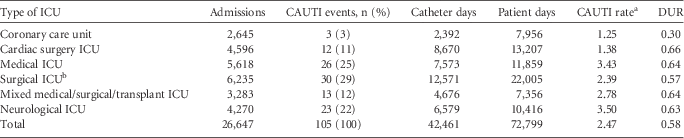
A total of 105 ICU CAUTIs were identified in 6 adult ICUs in 2012 and 2013, for a CAUTI rate of 2.5 per 1,000 catheter days. The observation period included 42,461 catheter days and 72,799 patient days for a device utilization ratio (DUR) of 0.58. A total of 5,243 urine cultures were performed on catheterized urine specimens in this cohort (72 urine cultures per 1,000 patient days, 194 urine cultures per 1,000 ICU admissions).
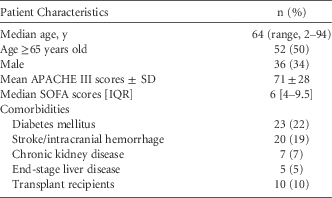
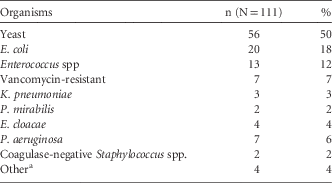
Descriptive characteristics of the cohort can be found in Table 1a. CAUTI rates and DUR by ICU type are reported in Table 1b. The most common organisms identified by urine culture were yeast (50%), E. coli (18%), Enterococcus spp. (12%), and Pseudomonas spp. (6%) (Table 2). The primary indication for urine culture was fever (102 of 105 patients, 97%). In the majority of patients, a possible alternative explanation of fever was identified. Infection other than CAUTI was found in 51 of 102 patients (51%), which included pneumonia (n=28, 55%), followed by bloodstream infection (n=11, 22%). The diagnosis of pneumonia was made on clinical grounds that included a clinical assessment, lower respiratory tract cultures, and radiography. The diagnosis of bloodstream infection was based on positive blood cultures. In 18 of 102 patients (18%), a potential noninfectious cause was identified. Intracranial bleed was the most common potential noninfectious cause (n=6, 33%), followed by postoperative fever (n=4, 22%).
Baseline Demographics for 105 ICU Patients with a CAUTI Event

NOTE. ICU, intensive care unit; CAUTI, catheter-associated urinary tract infection; SD, standard deviation; APACHE Acute Physiology and Chronic Health Evaluation; SOFA, Sequential Organ Failure Assessment.
CAUTI rates and DUR per ICU Type in 105 ICU Patients with a CAUTI Event in 2012 and 2013

NOTE. CAUTI, catheter-associated urinary tract infection; DUR, device utilization ratio; ICU, intensive care unit.
a CAUTI rate is reported per 1,000 patient days.
b Surgical ICU includes general, vascular, thoracic, trauma ICUs.
CAUTI Pathogens

NOTE. CAUTI, catheter-associated urinary tract infection;
a Streptococcus Group B, M. morganii, Acinetobacter spp., Citrobacter spp.
Only 32 of the 102 patients (32%) had no alternative explanation for fever. Of these 32 patients, 21 (66%) initially received empiric antimicrobial therapy at onset of fever, but no targeted antimicrobial therapy changes were made based on the urine culture results. The other 11 patients (34%) did not receive antimicrobial therapy at all. Most of these patients (73%) had candiduria.
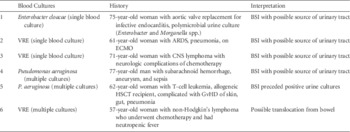
Finally, only 6% of all ICU CAUTIs resulted in blood cultures positive with same organism within 2 days (Table 3). The median ICU length of stay for the patients with CAUTI was 10 days (interquartile range: 6–16 days). In-hospital all-cause mortality was 28%.
ICU Patients with CAUTIs that Resulted in Blood Cultures Positive with the Same Organism Within 2 days

NOTE. ICU, intensive care unit; CAUTI, catheter-associated urinary tract infection; BSI, bloodstream infection; VRE, vancomycin-resistant enterococcus; ARDS, acute respiratory distress syndrome; ECMO, extracorporeal membrane oxygenation; CNS, central nervous system; HSCT, hematopoietic stem cell transplantation; GvHD, graft-versus-host disease.
DISCUSSION
We performed a 2-year retrospective cohort analysis of adult ICU patients who met the NHSN surveillance definition for CAUTI. The majority of patients in our ICUs had urine cultures performed as a part of the clinical evaluation for fever. A minority of patients had urine cultures sent based on other symptoms other than fever.
In most patients with CAUTI, fever could most often be attributed to another source: pneumonia, bloodstream infection, or an intracranial bleed. This finding is consistent with previous studies.Reference Hartley, Valley and Kuhn 6 – Reference Meddings, Reichert and McMahon 8 Fever is extremely common in critically ill patients, and its significance varies depending on clinical context. Fever in the ICU is at times felt to be equivalent with infection, triggering cultures from multiple sites including blood, sputum, and urine cultures.
Any unexplained fever warrants a thorough clinical evaluation that includes a complete history and physical examination. The 2009 IDSA guideline for the diagnosis of CAUTI suggested that catheterized patients be thoroughly evaluated for alternative sources, before attributing symptoms including fever to the urinary tract.Reference Hooton, Bradley and Cardenas 9 Laboratory tests should be ordered only after a clinical evaluation indicates a reasonable pre-test probability that infection might be present.Reference O’Grady, Barie and Bartlett 10 Because of the high frequency of asymptomatic bacteriuria, positive urine cultures often mislead, if not confuse, clinicians in management of the patient. Previous studies have reported that fever in the ICU is represented equally by infectious and noninfectious causes, with the infectious causes usually being infection of the lower respiratory tract, blood, and abdomen.Reference Circiumaru, Baldock and Cohen 11 , Reference Rehman and Deboisblanc 12 Catheter-associated bacteriuria or candiduria usually represents colonization and is rarely symptomatic.Reference Tambyah and Maki 13
The NHSN surveillance definition is promoted as an objective measure of performance and a marker of quality of care. Limitations of the definition are widely recognized. Hanna et alReference Al-Qas Hanna, Sambirska, Iyer, Szpunar and Fakih 3 found that the NHSN definition of CAUTI did not co-relate with clinical practice of either non-infectious disease or infectious disease physicians. In 2009, the NHSN eliminated catheter-associated asymptomatic bacteriuria as part of the definition. As a result, a significant decrease in the incidence of CAUTI was observed, although overall it still did not change the rate of subsequent antibiotic use in patients with positive urine cultures.Reference Press and Metlay 14 In 2013, the NHSN definition was revised again in relation to fever alone as a symptom. 4 Fever is attributed to CAUTI regardless of an alternative explanation. Almost 66% of our cohort had a potential alternative cause of fever. Even in patients with no other identified cause of fever, urine cultures were not acted upon in 34% of cases. Of these patients, 66% had received appropriate empiric antibiotics in their early febrile course, and no targeted change in antimicrobial therapy was made after the results of urine cultures. This finding suggests that urine cultures in ICU patients rarely help clinicians manage overall patient care.
Yeast has been known to frequently colonize urinary catheters. Approximately 50% of isolated organisms in our cohort were yeast. The 2015 NHSN definition has eliminated reporting of candiduria. 15 Although this definition has increased specificity, the window during which the non-specific signs or symptoms including fever count toward the CAUTI definition has increased. With the high frequency of fever in ICU, the definition will cause the overestimation of the incidence of clinically significant CAUTI and is unlikely to be a good measure of hospital quality. Further studies are needed to address the non-specific relationship between fever and bacteriuria to improve the specificity of the NHSN definition in ICU patients.
We identified only 6 patients (6%) in our cohort who had blood cultures positive with the same organism isolated from urine specimen within 2 days (Table 3). It was difficult to differentiate whether the bloodstream infection originated from the urinary tract, was filtered from the bloodstream into the urinary tract, or whether the bladder was an unrelated reservoir. In 2 of the patients, the urinary tract was unlikely to be the source. One patient had vancomycin-resistant Enterococcus (VRE) bacteremia in the setting of neutropenia, and the bloodstream infection was possibly related to the translocation of the enteric pathogen across the compromised colonic mucosa. The other patient had persistently positive blood cultures for P. aeruginosa prior to the positive urine culture, which suggests likely filtration of the pathogen into the genitourinary system. Our findings highlight the low number of complications associated with CAUTI in the ICU patients, which is consistent with previous studies.Reference Kizilbash, Petersen, Chen, Naik and Trautner 16 This finding brings into question the utility of surveillance for this low-frequency, low-morbidity HAI, which does not serve as a valuable patient-centered outcome.
Our study has several limitations. First, it was performed in a single tertiary-care hospital with multiple ICU populations, which may not be representative of other settings. Second, due to the retrospective nature of our study, we relied on the clinical judgment of clinicians caring for the patient in investigating the cause of fever. Third, our cohort was limited to a 2-year study period. Fourth, half of our cohort had yeast as the predominant organism, and with the recent 2015 NHSN definition change that eliminates yeast, our findings are less relevant. However, the frequency of fever in ICU patients will remain high, and as long as clinicians continue culturing urine as part of the clinical evaluation of fever, CAUTI rates will remain high. Further study of the impact of the 2015 NHSN definition changes is needed.
In conclusion, we have demonstrated that most ICU CAUTIs identified by the NHSN surveillance definition are not clinically significant. The practice of obtaining “pan cultures” in response to fever results in CAUTIs. Reducing catheter utilization is a laudable goal because the catheterized bladder serves as a reservoir for bacteria and yeast. However, CAUTIs, as currently defined by NHSN (even with the 2015 definition changes), are not clinically relevant, and efforts to reduce CAUTI may be better directed at other more serious healthcare infections. CAUTI rates are a reflection of institutional culturing practices, and the current emphasis on CAUTI as a measure of a hospitals quality may be misguided.
ACKNOWLEDGMENTS
Financial support. This manuscript was developed and completed in the absence of an outside funding source.
Potential conflicts of interest. At the time of the study, all authors were employed by Mayo Clinic. All authors report no conflicts of interest relevant to this article.