Introduction
A central issue in conservation biology, besides understanding the main threats to biodiversity (Marchese Reference Marchese2015), is to identify biodiversity-rich areas to which conservation resources should be directed. Increased human activity leads to global environmental changes, habitat loss, and species extinctions. Our basic knowledge about diversity and distributional patterns of many biological entities is insufficient. Biogeographic transitional zones represent areas where environmental conditions and ecological factors allow the mixture and co-occurrence of biotic elements from different geographical origins (Ferro and Morrone Reference Ferro and Morrone2014). The increased biodiversity of transitional regions is a result of dispersal processes along gradients (Varga Reference Varga2003), such as elevation and climatic conditions. However, in Europe little attention has been paid to such transitional zones as core areas of soil microarthropod diversity, particularly with respect to local hotspots of diversity and endemism.
Soil organisms probably constitute the most species-rich taxa in terrestrial ecosystems (Wolters Reference Wolters2001; Decaëns et al. Reference Decaëns, Jiménez, Gioia, Measey and Lavelle2006) and the necessity for their conservation has become more urgent (Conti Reference Conti2015). Among soil microarthropods, Protura are distinctive litter and soil-dwelling organisms (length < 2 mm), widely distributed throughout the world with the exception of Arctic and Antarctic regions. This mycophagous class of microarthropods occurs mostly in the rhizospheres of trees. Feeding habits for most species are unknown but some studies observed that they feed on ectotrophic mycorrhizal fungi (see Pass and Szucsich Reference Pass and Szucsich2011). Protura remain a poorly known and neglected taxon in soil ecological and biodiversity studies (Pass and Szucsich Reference Pass and Szucsich2011) as well as in biogeography (Kaneko et al. Reference Kaneko, Minamiya, Nakamura, Saito and Hashimoto2012). Nevertheless, the group is presumed to be a good model for biogeographic analysis due to their low degree of dispersability and limited mobility (Kaneko et al. Reference Kaneko, Minamiya, Nakamura, Saito and Hashimoto2012; Bu et al. Reference Bu, Potapov and Yin2014).
The current distribution of Protura in Europe is a consequence of the overlapping of different climatic fluctuation during Quaternary, allowing species from glacial refugia to move southwards and warm-adapted, thermophilic species to move northwards during warmer interglacial periods (Husemann et al. Reference Husemann, Schmidt, Zachos, Ulrich and Habel2014; Wachter et al. Reference Wachter, Papadopoulou, Muster, Arthofer, Knowles, Steiner and Schlick-Steiner2016). Varga (Reference Varga2013) indicated that the Carpathian Basin and the southern slopes of the Volcanic Carpathians (Transcarpathian region) were important retreat areas for many animal and plant species during glacial and postglacial phases. However, the barrier effect of European mountain ranges varied for different taxa (Husemann et al. Reference Husemann, Schmidt, Zachos, Ulrich and Habel2014).
The Transcarpathian region covers the southwestern slopes and foothills of the Ukrainian Carpathians in the Ukraine. Plains cover the rest of the region. The Transcarpathian region is northeast of the Great Pannonian Plain, partially bounded by the Tysa River and occurring mostly in the southwestern corner of Ukraine with extension into Slovakia, Hungary, and Romania. The Carpathian range forms the northeastern boundary. Neighbouring regions differ in many regional features, including edaphic, climatic, and geomorphological conditions. The sheltered position of the Great Pannonian Plain southwest of the Carpathians gives this plain and for the Transcarpathian region a warmer, drier climate compared to the continental climate of the Carpathians (Hilbers Reference Hilbers2008). Soils differ significantly among regions, with podzols in the mountains, cambisols in the foothills, and chernozems and fluvisols in the lowland. Local climatic conditions that vary from colder and damper in the high mountains to warmer and humid in the foothills and lowland sites enhance their possible importance as a macro-ecotone between the Pannonian and Alpine ecoregions. Pronounced differences in relief have occurred from a complex mix of natural processes, including volcanism, erosion, glaciation, and climate. We hypothesise that the Transcarpathian transitional zone, as a consequence of overlapping of different biogeographic influences, has an increased diversity of Protura through mixing of faunal elements of diverse origins and geographical histories.
Protura have rarely been studied in the Transcarpathian region. Kseneman (Reference Kseneman1938) noted Acerentomon doderoi Silvestri, 1907 (Acerentomata: Acerentomidae) as occurring in the region. Nosek and Vysotskaya (Reference Nosek and Vysotskaya1976) investigated the nests of small mammals and recorded six species of Protura. Protura have been examined in unique and highly vulnerable sites of fluvial forest stands in the Transcarpathian Lowland (Sterzyńska et al. Reference Sterzyńska, Orlov and Shrubovych2012).
The objective of the current study was to determine Protura distribution patterns across three natural landforms within the transitional-ecotone gradients of the Transcarpathian region (lowland, foothill, and mountain), to detect the centres of origin for the proturan fauna, and determine the elements of the fauna that are endemic.
Material and methods
Study area
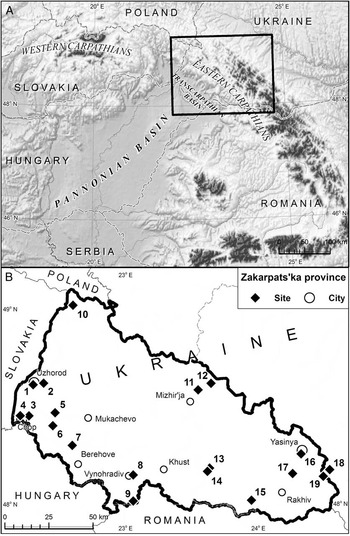
The Transcarpathian region incorporates the inner volcanic band of the Carpathian Mountains (Volcanic Ukrainian Carpathians) and the Transcarpathian Lowland (or Tysa Lowland) (Fig. 1). The northern boundary of the Transcarpathian region is designated by the watershed of the Eastern Carpathians, on the southwest by Neogene volcanic ridges of the Inner Eastern Carpathians and on the southernmost lies the Transcarpathian Lowland, which is a northeastern continuation of the Great Pannonian Plain. The Transcarpathian region has a total area of 12 800 km2; mountains cover more than 80% of the area of the region. The climate of the region is temperate continental but slightly warmer than in other parts of Ukraine at similar latitudes. Annual average precipitation is 780 mm. The average temperature is 21 °С in summer and −4 °С in winter. Soils are mainly brown forest soils on the foothills and meadow gley soils on the lowland part. About 50% of the territory is occupied by forests: oak-hornbeam and oak forests cover the foothills and mountains up to 700 m; beech forests up to 1300 m; spruce forests with admixtures of beech, fir, and cedar pine to 1500–1550 m; and subalpine and alpine meadows above 1550 m. Remaining natural sites are scarce in Central Europe, but are concentrated on the volcanic-tectonic mountain “Chorna Hora” and in the riverine floodplain with flooded forest complexes in the lower reach of the Latoritsa, Tisza, and Borzhava Rivers (Drescher et al. Reference Drescher, Prots and Mountford2003a, Reference Drescher, Prots and Mountford2003b; Drescher and Prots Reference Drescher and Prots2005). “Chorna Hora” is an 823-ha botanical preserve in the Volcanic Carpathians and since 1997 has been included in the Carpathian Biosphere Reserve in Ukraine. Old-growth oak forests cover most of this preserve. The oak forests are primarily durmast oak (Quercus petraea (Mattuschka) Lieblein; Fagaceae), with small components of Quercus polycarpa Schur and Quercus dalachampii Tenore.
Location of the study area (A) and location of the study sites within the Transcarpthian region, Ukraine (B). Lowland sites (1–7, 9); foothill site (8), mountain sites (10–19). See Table 1 for site characteristcs.

Data collection and processing
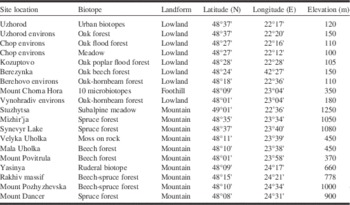
Data on the occurrence of Protura species within Transcarpathian region were obtained from the collections of the State Museum of Natural History (Lviv, Ukraine) and the Institute of Systematics and Evolutions of Animals (Kraków, Poland), gathered from 2006–2010 in 19 sites in the following landforms: lowland (sites 1–7, 9), mountain (sites 10–19) and foothill (site 8 with 10 different biotopes: beech forest (Fagus silvatica Linnaeus; Fagaceae) beech-hornbeam forest (Carpinus betulus Linnaeus; Betulaceae), oak-hornbeam forest, xerothermic oak forest, southern slope scrubs, steppe grassland, open rocky outcrops, moss on rocks, grassy southern slopes, vineyard) (Fig. 1). Protura were extracted from soil samples with a Berlese-Tullgren funnel into 70% ethanol and mounted on microscope slides in Faure’s medium. For this study lowland and mountain “site” was used as a unit of sampling effort, and 10 different biotopes were used for the foothill “site”. The name, geographical coordinates, and elevation of the examined sites are presented in Table 1. A total of 1924 specimens of Protura were examined and identified according to recent taxonomic keys (Nosek Reference Nosek1973; Szeptycki Reference Szeptycki1980, Reference Szeptycki1985, Reference Szeptycki1986, Reference Szeptycki1991; Shrubovych et al. Reference Shrubovych, Schneider and D’Haese2012, Reference Shrubovych, Schneider and D’Haese2014, Reference Shrubovych, Bartel, Szucsich, Resch and Pass2016). All systematics and synonymies are given in Szeptycki (Reference Szeptycki2007). These specimens were categorised biogeographically according to their published Palaearctic geographical distribution (Nosek Reference Nosek1973; Kaprus et al. Reference Kaprus, Shrubovych and Tarashchuk2006; Szeptycki Reference Szeptycki2007; Shrubovych Reference Shrubovych2010; Christian Reference Christian2011; Galli et al. Reference Galli, Capurro and Torti2011; Blesić and Mitrovski-Bogdanović Reference Blesić and Mitrovski-Bogdanović2012). On the basis of range size each Protura species was assigned to a major biogeographic region (Alpine, Continental, Mediterranean, Pannonian) according to European Environment Commission (2017) Natura 2000 terminology of European biogeographic regions or to endemic elements of a defined area (East-Carpathian endemic, Pannonian–Carpathian subendemic, Alpine–Carpathian subendemic).
Geographical coordinates, biotope, and elevation of the studied sites in Transcarpathian region (Ukraine).

Statistical analysis
Individual-based rarefaction and nonparametric asymptotic species richness estimators (Chao 1 and ACE) were used for Protura diversity estimation and to compare measures of species richness across entire Transcarpathian region and examined landforms. Accumulation curves and richness estimators for Protura were generated to evaluate sampling effectiveness by randomising sample 100 times using Estimates 9.1.0 (Colwell Reference Colwell2011). For the purposes of rarefaction analysis the lowland and mountain “sites” was used as units of sampling effort, and for the foothill “site” 10 different biotopes were used as units of sampling effort.
A principal component analysis (PCA) was performed to determine whether the taxonomic composition of Protura (based on presence/absence data) is differentiated in an ordination plot according to the sampled landforms (lowland, mountain, and foothill). To determine the significance of differences among the sites clustered to different landforms, the PCA scores of the first and second axes were used as a synthetic dependent variable in a Kruskal–Wallis one-way analysis of variance (ANOVA). The effect of the three natural landforms on variation in Protura composition was assessed with redundancy analysis (RDA), since the value of gradient length calculated in detrended correspondence analysis (DCA) for the first axis was shorter than 3.0 standard deviation (Lepš and Šmilauer Reference Lepš and Šmilauer2003). To summarise the main patterns of biogeographic variation in the Transcarpathian region and their correlation with natural landforms, we performed two redundancy analyses using a response data matrix obtained by assigning each species to a predefined biogeographic region and to an endemic element at the site. In both analyses natural landforms were recoded as dummy variables. The level of significance in all analyses was α=0.05. Calculations were made with Statistica 7.0 (StatSoft, Kraków, Poland) and Canoco 4.5 (Microcomputer Power, Ithaca, New York, United States of America) software packages, with terminology after Lepš and Šmilauer (Reference Lepš and Šmilauer2003).
Results
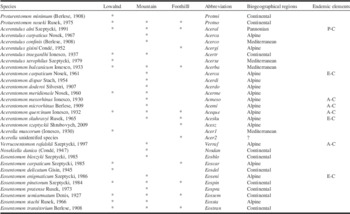
A total of 31 Protura species were recorded in the Ukrainian part of the Transcarpathian region, 15 species from the Transcarpathian Lowland, and 23 species form the Transcarpathian Mountains. Three species (Proturentomon minimum (Berlese) (Acerentomata: Protentomidae), Acerentulus xerophilus Szeptycki (Acerentomata: Acerentomidae), and Acerella muscorum (Ionescu) (Acerentomata: Acerentomidae)) were found only in the Transcarpathian Lowland. On the volcanic-tectonic mountain Chorna Hora 12 species from five genera and three families were found, among which Acerentulus gisini Condé (Acerentomata: Acerentomidae), Acerentomon szeptyckii Shrubovych (Acerentomata: Acerentomidae), and an unidentified species of Acerella Berlese (Acerentomata: Acerentomidae) were found only there (Table 2).
Distributtion pattern and classification of Protura species by biogeographical region and endemic elements in the Carpathian–Pannonian (Transcarpathian) region.

*species occurence in landform.
P-C, Pannonian–Carpathian subendemic; A-C, Alpine–Carpathian subendemic; E-C, Eastern Carpathian endemic.
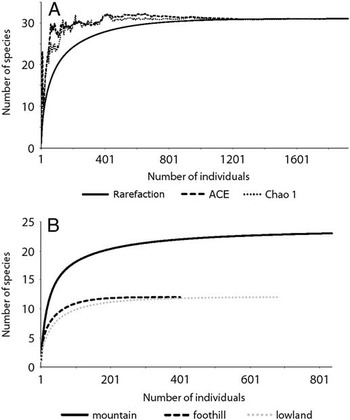
The estimated Protura species richness values for Transcarpathian region were 30.93±0.43 (Chao 1), 30.93±0.25 (ACE); lowland 11.98±0.39 (Chao 1), 11.98±0.19 (ACE); mountain 22.99±0.25 (Chao 1), 22.99±0.09 (ACE); foothill 11.99±0.49 (Chao1), 11.99±0.09 (ACE). The individual-based rarefaction species-accumulation curves for the entire region and estimated a richness value of Chao 1 and ACE approached an asymptote (Fig. 2A) and exhibited little variability between values of species richness for lowland and foothill (Fig. 2B).
Estimators of species richness (Chao 1 and ACE) and the rarefaction species-accumulation curve for Protura within Transcarpathian region (A), and Protura species-accumulation curve obtained for different landforms within the Transcarpathian region (B).

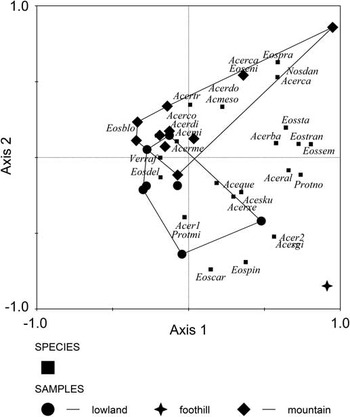
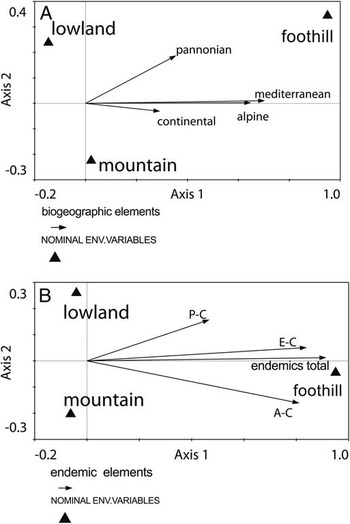
The PCA yielded a distinct separation of the lowland and mountain parts within the Transcarpathian region along PCA axis 1, and of Chorna Hora and the other mountain sites along PCA axis 2 (Fig. 3). Principal component analysis axis 1 accounted for 24.2% of the total variance in the taxonomic composition of Protura, and was positively correlated with the presence of Eosentomon semiarmatum Denis (Eosentomata: Eosentomidae) and negatively correlated with Eosentomon bloszyki Szeptycki. Principal component analysis axis 2 accounted for 14.7% of the total variance in Protura and appeared to be related positively to Eosentomon pratense Rusek and negatively to Eosentomon carpaticum Szeptycki. The lowland, foothill, and mountain sites were significantly separated along the PCA scores of the first and second axis (Kruskal–Wallis one-way ANOVA, H (2, n=38)=28.86, P=0.000). A detrended correspondence analysis revealed that natural landforms within the Transcarpathian region accounted for 26.1% of the variation of the Protura faunal elements composition assigned to biogeographic regions, which was significant according to a Monte Carlo permutation test for all canonical axes (λtrace=0.261, F-ratio=5.582, P=0.042). The foothill Chorna Hora was positively correlated with a high number of proturan species with Pannonian distribution, but also with Mediterranean and Alpine distribution, while mountain sites were mainly correlated with a high number of Protura species with Continental distribution (Fig. 4A). The natural landforms were responsible for the distribution pattern of endemic Protura, explaining 77% of the varation in their composition (Monte Carlo permutation test for total redundancy analysis (λtrace=0.770, F-ratio=26.836, P=0.030). The highest number of proturan endemics was associated with Chorna Hora (Fig. 4B).
Ordination of sites and distributtion of Protura species within the transition zone. Principal component analysis model calculated with non-transformed species data, interspecies correlation scaling, species scores divided by standard deviation and centring by species, non-standardised by sample; sites numbering as in Table 1 and Figure 1, species abbreviations as given in Table 2.

Correlation of Protura species belonging to different biogeographical regions (A) and Protura endemic elements (B) with different landforms (lowland, foothill, and mountain) within the Transcarpathian transition zone, redundancy analysis model calculated with non-transformed data, interspecies correlation scaling, species scores divided by standard deviation and centring by species, not standardised by sample. Abbreviation of endemic elements as given in Table 2.

Discussion
This study revealed a substantially higher species richness (31 species) of Protura in the Transcarpathian region than a previous, more limited study yielding six species from nests of small mammals (Nosek and Vysotskaya Reference Nosek and Vysotskaya1976). This difference certainly is due to a more intensive collecting effort in a wide range of habitats. The known number of Protura species in this small region is rich compared with numbers from other relatively well-studied parts of Europe: Ukraine, 58 species (Shrubovych Reference Shrubovych2010); Poland, 69 species (Szeptycki Reference Szeptycki2007); Romania, 27 species (Shrubovych and Fiera Reference Shrubovych and Fiera2016); Serbia, 38 species (Blesić and Mitrovski-Bogdanović Reference Blesić and Mitrovski-Bogdanović2012); Austria, 58 species (Christian Reference Christian2011); Luxembourg, 30 species (Szeptycki et al. Reference Szeptycki, Stomp and Weiner2003); and Italy 40 species (Galli et al. Reference Galli, Capurro and Torti2011). The high level of species richness recorded in the region corresponds well with the transitional geographical position of Transcarpathia. Since our study area borders both the Alpine region (volcanic part of the Ukrainian Carpathians) and the Pannonian region (Transcarpathian Lowland) we recorded proturan species with Mediterranean, Pannonian, Alpine, and Continental distribution. The relatively high local number of endemics and sub-endemics supports the notion that the Carpathians can be considered a core area of diversity and endemicity for some invertebrate groups with limited mobility (Varga Reference Varga2003). Our results suggest that the Transcarpathian region constitutes a biogeographical transition zone for soil microarthropods, such as Protura.
Interpolation of species richness data with rarefraction and assymptotic richness estimators (Chao 1 and ACE) showed the completeness of proturan species that occur in this region. The extrapolated Protura diversity for Chorna Hora suggests the presence of small variation beetwen lowland and foothill landforms. Further analysis by PCA also showed the main dichotomy of mountain and lowland sites in Protura taxonomic composition, and the unique position of the Chorna Hora reserve. Differences in the faunas can be mainly attributed to elevation gradient, differences in geomorphology (see Pécskay et al. Reference Pécskay, Seghedi, Downes, Prychodko and Mackiv2000; Hetényi et al. Reference Hetényi, Stuart, Houseman, Horváth, Hegedüs and Brückl2009; Ren et al. Reference Ren, Stuart, Houseman, Dando, Ionescu and Hegedus2012; Suda et al. Reference Suda, Yamada, Rhyzov and Stepanchyk2014; Majcin et al. Reference Majcin, Kutas, Bilčik, Bezák and Korchagin2016), and local climate and vegetation cover (Drescher and Prots Reference Drescher and Prots2005). Our results showed that the main distance (across first PCA axis) refers to rather eurytopic species occurring at many sites within the Transcarpathian region, such as E. semiarmatum and E. bloszyki on the mountain sites. Likewise, the second PCA axis indicates a distance between E. carpaticum in the lowland sites and E. pratense on the mountain sites. Eosentomon carpaticum was described from the East Carpathians of Poland (Szeptycki Reference Szeptycki1985) and its occurrence has been subsequently confirmed in the Carpathian Mountains of Romania and Hungary (Shrubovych and Sterzyńska Reference Shrubovych and Sterzyńska2015). Therefore, it has been considered an East-Carpathian endemic. The collection of E. carpaticum in the lowland part of the region is consistent with an earlier report indicating that this species has a wide ecological plasticity and environmental distribution pattern and can predominate in Protura communities outside of mountain habitats in azonal habitats, such as floodplain forests (Sterzyńska et al. Reference Sterzyńska, Orlov and Shrubovych2012). The mountain sites were mainly populated by E. pratense, a species described from Moravia (Rusek Reference Rusek1973), reported from Austria and Germany (Szeptycki Reference Szeptycki2007), and displaying a typical continental distribution. The observed widespread distribution of E. pratense on the southern slopes of the eastern Carpathians supports its status as a thermophilic species.
According to the redundancy analyses, natural landforms within the Transcarpathian region, such as the Transcarpathian Lowland, zone of volcanic deposits, and southern slopes of the Carpathians, determined the distribution pattern of faunal elements shared by Protura species. The significant association of continental Protura species with higher elevation mountain sites and occurrence of species with narrower distribution patterns at mid-altitude sites such as foothill are consistent with Rapoport’s elevation rule, which predicts that species occurring at higher elevations should show larger elevational ranges, on the assumption that species occurring at higher elevations must tolerate a wider range of climatic conditions (Gaston et al. Reference Gaston, Chown and Evans2008). However, Chorna Hora represents an area where Pannonian, Mediterranean, and Alpine biogeographic elements come together with endemic proturan species. The overlap of biogeographic elements of proturan species at Chorna Hora indicate its transitional character, with a high degree of uniqueness of proturans within the region. The lower hilly part as Chorna Hora is an area from which the species A. szeptyckii was described (Shrubovych Reference Shrubovych2009) and a probable new species of Acerella was recorded.
The co-occurrence of Acerella muscorum and a similar unidentified species of Acerella in this small area suggests that active speciation and differentiation of proturan fauna are continuing. The new taxon has been collected only on Chorna Hora, whereas A. muscorum is widely distributed in the Transcarpathian Lowland. The genus Acerella currently contains only three described species (Shrubovych Reference Shrubovych2011), all of which are Mediterranean faunal elements. The explanation for the presence of two Acerella taxa in the same locale requires genetic research that can help to define whether these two species have continental or Mediterranean origins and whether they occur in the volcanic Carpathians. A large genetic variability together with small morphological variability would support the idea that Acerella survived during glacial periods in extra-Mediterranean refugia (Shmitt and Varga Reference Shmitt and Varga2012) on the southern slopes of the Carpathians. However, low genetic variability would more likely indicate that the region was post-glacially recolonised by two different species.
Conclusions
This study improves our knowledge of the diversity and distribution patterns of Protura in the Carpathian region. The Transcarpathian region is characterised by a high species diversity of Protura due to overlap of species distributed across different biogeographic regions (Mediterranean, Pannonian, Alpine, and Continental) and contains a considerable proportion of endemic and subendemic proturan species: four East-Carpathian, five Alpine–Carpathian, and one Pannonian–Carpathian. The Transcarpathian region can be defined as a biogeographical transition zone for soil microarthopods, such as Protura, and the volcanic-tectonic mountain Chorna Hora, on which local hotspots of diversity and endemism occur, represents the most valuable part of Transcarpathia with respect to local hotspots of diversity and endemism.
Acknowledgements
Thanks to all the people from the Carpathian Biospheric Reserve for providing their assistance. The authors especially thank Professor Ernest C. Bernard from Tennessee University for his valuable comments and language improvements. This study was supported by the Museum and Institute of Zoology of the Polish Academy of Sciences, the Institute of Systematic and Evolution of Animals of the Polish Academy of Sciences, and the State Natural History Museum of the National Academy of Sciences of Ukraine.