Sadly, economics today is a relatively monolithic discipline. It is typically defined in terms of one set of assumptions and approaches, rather than in terms of an object of analysis – the economy, which could in principle be analysed from different perspectives. Taking inspiration from some alternative traditions in economics, this essay questions the adequacy of orthodox analyses of health care systems and points to a different approach.
Health care provision and expenditure are attracting increasing attention from economists, but alternative approaches within economics have received relatively little consideration.Footnote 1 Neoclassical theoretical concepts remain at the forefront, despite the claim that they have been transcended elsewhere (Colander, Reference Colander2005). It is argued here that the peculiar features of the health sector and the special requirements of health policy limit the viability of a neoclassical approach even more severely than in other typical areas of its application. As Mark Blaug (Reference Blaug1998: S65) put it: ‘Health economics would seem to be a perfect topic for heterodox dissent … health economics is a field which must make the average neoclassical economist squirm because it challenges his or her standard assumptions at every turn.’
Neoclassical economic theory assumes rational, utility-maximizing behaviour by agents with given preference functions. It focuses on equilibrium states and is marked by an absence of chronic information problems beyond a probability calculus. Instead of focusing on the economy as an object of analysis, neoclassical economics defines itself as the general ‘science of choice’ assuming rational agents. It is sometimes upheld that these neoclassical precepts define economics, and to abandon them is to abandon economics itself. This narrow view of economics is relatively recent. By contrast Alfred Marshall (Reference Marshall1920: 1) defined economics not in terms of specific assumptions but as ‘the study of mankind in the ordinary business of life; it examines that part of individual and social action which is most closely connected with the attainment and with the use of the material requisites of wellbeing’.
The standard normative neoclassical approach to economic welfare assumes that individuals seek to maximize their utility; the individual is the best judge of whether his or her utility is maximized. Changes are acceptable only if they increase the utility of at least one person and decrease the utility of no-one. The latter is of course the Pareto criterion. But these welfare criteria are so unsuited for health policy that many mainstream health economists are inclined to adopt alternative normative criteria, focusing on measures of health rather than utility (Culyer, Reference Culyer1991; Hurley, Reference Hurley, Culyer and Newhouse2000). One is left wondering why neoclassical theoretical propositions are retained, when the standard normative apparatus of neoclassical theory is often abandoned. The adoption of some but not other elements in the standard neoclassical package is a bit odd. This essay questions the relevance of all the defining neoclassical precepts in this context.
Leading mainstream health economists suggest that health care has special features that make it different from other domains of application, posing restrictions on the appropriateness of some neoclassical assumptions. Why is health care different? In response, the literature points to the presence in health care of externalities, information asymmetries, uncertainty, supplier-induced demand, and derived demand (Arrow, Reference Arrow1963; Reinhardt, Reference Reinhardt1985; Labelle et al., Reference Labelle, Stoddart and Ruffles1994; Blaug, Reference Blaug1998; Hurley, Reference Hurley, Culyer and Newhouse2000; Rice, Reference Rice and Davis2001). But while all these features are important, they are neither universal in health care systems nor unique to them (Hodgson, Reference Hodgson2008). Here I try to identify the peculiarities of health care systems by building on the neglected but vital concept of need. By contrast, mainstream economics starts from the subjective satisfaction or utility of the individual. Modern mainstream economics rejects or ignores the concept of need, but many leading economists from Adam Smith to Alfred Marshall have acknowledged objective needs as well as subjective satisfactions.
While shifting the analysis from a utility-based to a needs-based approach, it is not naively assumed that health authorities or professionals always know best. Indeed, the problem is one of institutional design where knowledge is developed and distributed, and where mistakes become useful cues for learning and adaptation. An institutionally sensitive, needs-based analysis is capable of identifying distinctive features of health care. It also proposes a link between the recognition of needs and personal motivation, and argues that the salience and nature of needs in health care is an important motivational factor for health care professionals. This implies a critique of incentive systems that rely principally on pecuniary rewards for health care workers. To simplify the argument I concentrate on essential health care services contracted by specific individuals and provided by trained health care professionals, including primary, hospital, disability, and other forms of care. These aspects of health care provision take up a large and growing part of national income in most developed countries. Less attention is given here to the important issue of public health policy.
Health as a universal need
Health is an objective, universal need, irrespective of whether or not it is also a want. A distinction must be made between wants and needs, where wants are culturally conditioned subjective desires and needs are objective conditions of autonomy, survival, well-being and social interaction (Dewey, Reference Dewey1939; Maslow, Reference Maslow1954; Boulding, Reference Boulding1966; Kapp, Reference Kapp1976; Sen, Reference Sen1985; Lutz and Lux, 1988; Braybrooke, Reference Braybrooke1987; Doyal and Gough, Reference Doyal and Gough1991; Nussbaum and Sen, Reference Nussbaum and Sen1993; Corning, Reference Corning2000). However, for various reasons, several social scientists have become suspicious of a separate concept of need.
Cultural relativists proclaim that apparent needs are simply reflections of a specific culture. Social constructivists decry any objective foundation for the need concept. Nevertheless, as Len Doyal and Ian Gough (Reference Doyal and Gough1991) demonstrate, when confronted with real world circumstances, these perspectives end up relying on universal or objective standards of evaluation, equivalent to needs. Somewhat inconsistently, those that claim that the individual is always the best judge of his or her welfare, rarely go so far as to condone entirely voluntary versions of slavery, pornography, prostitution, incest, drug use, vote-buying, or sex with children. But if satisfaction is everything, why should they be prohibited, especially when the transaction is voluntary on both sides? Furthermore, the establishment of human liberty and the autonomy of choice depend on the ‘need’ for information concerning the choices, some knowledgeable understanding of their consequences, and sufficiently healthy and adequate physical and mental capacities to make an evaluation (Nussbaum and Sen, 1993).
Against cultural relativists and subjectivists, Doyal and Gough (Reference Doyal and Gough1991) and Martha Nussbaum (Reference Nussbaum2000) establish mental and physical health as a basic human need. Its universality is grounded on the common biological and social characteristics shared by all humans. Factors such as clean water, shelter, physical security, and appropriate health care contribute to health needs, and their efficacy can be examined by scientific investigation. Accordingly, most if not all health needs are potentially distinguishable from subjective wants: the latter may vary from individual to individual and culture to culture. Survival, health, and autonomy are the preconditions for individual action in any culture, and thus constitute the most basic human needs.
Definitionally, needs must be satisfied for the individual to avoid serious physical or mental harm. Harm includes impediments to individual aspirations or social involvement. Described in such terms, needs are objective, universal, and trans-cultural. Of course, investigators who attempt to identify and evaluate needs will be encumbered by prejudices that derive in part from their own history and culture. But this does not mean that objective needs do not exist. The problem is to set up scientific procedures and responsive institutions that discern and constantly re-evaluate the nature of needs. We must distinguish between the objective and universal need for health and the individual’s need for health care. Unlike health needs, health care needs vary enormously among people and through time.
By contrast, some health care demands – such as many for cosmetic surgery – have little relation to survival. Some qualify as minor needs at most. On the other hand, severe disfigurement can inhibit social participation and in these cases surgery may become a significant need. As with many classifications, the boundaries are fuzzy. But that does not mean that there is no substance to the distinction. Especially with health care, the majority of needs are obvious in broad terms. Broken bones require surgical treatment, infections require medicines, sicknesses require nursing, and so on.
Some writers acknowledge objective needs in the above manner, but classify them as such only if the means exist to ensure that they are met. Some define health care needs as emerging ‘when an individual has an illness or disability for which there is an effective and acceptable treatment or cure’ (Matthew, Reference Matthew and Gordon1971: 27). This is a capacities-dependent definition of need. By contrast, in line with Doyal and Gough (Reference Doyal and Gough1991), needs are defined here in objective terms that are independent of such the means to meet them. This is a capacities-independent definition of need.
One might expect those influenced by neoclassical economics to focus largely on wants and subjective utility, rather than objective needs. But this is not always the case with health economists. A concept of need relating to the ability to benefit from health care interventions, in contrast to demand (which is a function of preferences and ability to pay) is recognized by several leading mainstream health economists (Culyer, Reference Culyer1995; Hurley, Reference Hurley, Culyer and Newhouse2000). Mainstream health economists often abandon neoclassical welfare analysis, to focus instead on more objective measures such as ‘social indicators’ or the influential ‘Quality Adjusted Life Years’ or ‘QALYs’ (Maynard, Reference Maynard1991). Essentially, these are indicators of need, or of treatment priority based on need (although the methods used to measure QALYs are preference-based).
Compare health care with some other basic needs, such as food. Dietary needs are less complex than health care needs, and include vitamins, energy, fibre, and key chemical elements, while limiting the intake of fats, sugars, salt and so on. By contrast, health care needs often require expert diagnosis. Furthermore, much health care requires the involvement of skilled health care professionals. This is one of the key features that makes health care special.
The recognition that health needs are universal helps to sustain an ethos of professional commitment and obligation by health workers. Health work is much more than a source of remuneration. Typically, health sector workers attempt to meet objective health care needs and deploy deep-seated motivations to care for the welfare of others. While mainstream health economists acknowledge the existence of non-pecuniary motivations in the health sector (Scott et al., Reference Scott, Maynard and Elliott2003), they retain utilitarian theories of motivation that fail to recognize criticisms of this approach in the huge literature on motivation in organizational psychology and elsewhere. Not only is the intrinsic motivation of work itself widely considered in key texts (Vroom, 1964; Deci, 1975; Steers and Porter, Reference Steers and Porter1991; Frey, 1992), but also the more intense motivational spur of health care need is acknowledged in empirical studies of health care professions (Janssen et al., Reference Janssen, Jonge and Bakker1999; Benson and Dundis, Reference Benson and Dundis2003).
In sum, the objective and universal character of health needs conflicts not only with the utilitarian presuppositions at the core of neoclassical economics, but also help to explain the part of the motivations and professional commitments of health care workers. Consequently, a needs-based approach has important implications both for the commissioning and provision of health care services. Theories and policies that underestimate these factors are likely to be at best inadequate, and at worst destructive of commitment and morale among health workers.
Most health care needs are involuntary and unequally distributed
Like health, education is also a universal need, requiring the involvement of skilled professionals. But for reasons given below, there is a divergence in other respects between education and health. The need for health is universal, but the need for health care services is unequally distributed and depends to a significant degree on factors beyond the control of the individual. Generally you don’t choose to be sick – with possible exceptions including illnesses related to drugs, smoking, and alcohol and over-eating. People with inherited illnesses, or inherited dispositions towards illness, do not choose their afflictions either. Furthermore, a large set of needs for health care services result from accidents, for many of which the victim bears little or no responsibility. In short, much of the need for health care results from a lottery of misfortune, as if God was playing dice with human health.
Comparing health care with education or nutrition, some people do have special educational or nutritional needs. But the general need for education or nutrition is much more broadly and more uniformly distributed than the need for health care services. Because many health care patients are innocent of the causes of their plight, only the most hardened and insensitive of observers can avoid reflecting: ‘It could have happened to me.’ This special feature of health care needs has major normative and policy implications. First, the fact that most people do not willingly cause their health problems generates widespread sympathy among others, including health practitioners. This is another source of the motivational ethos of professional obligation in the health sector. It is a further reason why a needs-based approach has implications for the production of health care services, as well as their commissioning.
Second, this special characteristic of health care needs further challenges the typical neoclassical Pareto criterion and gives rise instead to concerns regarding equity or universal access to health care. Mainstream economists are likewise impelled in this direction: so equity or universal access has become a topic of discussion in both orthodox and heterodox texts alike (Culyer and Wagstaff, Reference Culyer and Wagstaff1993; Hurley, Reference Hurley, Culyer and Newhouse2000; Reisman, Reference Reisman1993). It seems obvious that Paretian norms are less appropriate in this context, and it would be better to turn to alternative ethical traditions, including the intellectual lineage from Adam Smith in the Moral Sentiments to John Rawls and beyond, where moral criteria necessarily involve concern for others as well as oneself.
Health care needs are varied and idiosyncratic
The need for health care services is unequal in more senses than one. It is unequal because of the random lottery of misfortune, as discussed above. Furthermore, even when affected by a similar injury or infection, the nature and severity of the outcome can vary from individual to individual. Health care needs are idiosyncratic, reflecting substantial physiological and neurological variations between individuals. Differences in health problems emanate from differences in past environment and genetic endowment. The peculiarities often vary significantly from person to person; each patient requires an individual diagnosis and remedy.
By comparison, the need for educational services is also partly idiosyncratic: a significant proportion of students have special needs. But the degree of heterogeneity and inequality is much less, confirmed by the fact that successful schooling curricula involve a great deal of material and teaching common to all students. Everyone needs to be taught to read. But most will manage to learn together with others in a classroom. By contrast, even among those patients requiring a simple or standard operation, detailed procedures will vary considerably because of differences in age, weight, allergies, and so on. Drugs, physiotherapy, and after-care will differ, because of varied needs.
Some operations – such as for cataracts – are fairly simple and standard. Generally, however, attempts to treat all patients in exactly the same way would be catastrophic. Even when patients with similar afflictions are brought together to benefit from shared specialist skills and equipment (thus realizing possible economies of scale) their detailed health care needs typically remain highly diverse. Highly standardized mass-production of health care services is possible in only a limited number of cases. In contrast to education, there is very little equivalent common provision among patients undergoing health care.
Faced with heterogeneous goods or services, economic analysis faces familiar problems of theoretical tractability. Although there is a significant mainstream literature on heterogeneous goods or services, much standard theory assumes relatively few homogeneous products. However, the problem here is not simply one of building formal models. Under conditions of limited information, the heterogeneity of goods and services creates a set of problems of a contractual and administrative type. Interestingly, these problems appear in both market-based and planned economic systems. They are highly relevant in the health care context. In a market-based system with limited information, the idiosyncrasy and heterogeneity of goods and services is an important source of transaction costs (Williamson, Reference Williamson1975). These are the costs of formulating, monitoring, and enforcing contracts. By contrast, if a set of goods and services were homogeneous, then one standard contract would often do, because their characteristics would in all likelihood be widely known.
Since the pioneering work of Coase (Reference Coase1937), Williamson (Reference Williamson1975) and other ‘new’ institutional economists, the concept of transaction costs has become commonplace in modern economics, although it has proved difficult to incorporate adequately in formal models. By contrast, and with a few exceptions (Hsiao, Reference Hsiao1995; Ashton, Reference Ashton1998; Jan, Reference Jan2000), little attention is paid to the concept and its significance in mainstream health economics. In the purportedly authoritative Handbook of Health Economics (Culyer and Newhouse, Reference Culyer and Newhouse2000), transaction costs are mentioned briefly and without much elaboration. There is no significant discussion of transaction costs in The Elgar Companion to Health Economics (Jones, Reference Jones2006). Yet in health systems that rely more on markets, such as the United States, it is estimated that transaction costs amount to 25% or more of health insurance premiums (Hsiao, Reference Hsiao1995: 138). Transaction costs impinge on both demand and supply in a system. Information and other problems concerning the contracting of insurance affect the demand for health care. Commercialization and competition in the production of health care services enhance possibilities for litigation and contractual dispute. A comparison of different health care systems suggest that high transaction costs is one of the typical downside problems that arise within private and market-based health care provision.
A possible advantage of planned hierarchies is that they may reduce transaction costs, just as they are sometimes reduced by organizing production under the unitary administrative umbrella of the firm (Coase, Reference Coase1937). Nevertheless, while transaction costs may be reduced in a planned system, the planning of heterogeneous goods or services may bring problems of a different kind. Consider the formerly planned economies in the Soviet Union or China. Faced with product heterogeneity and complexity, the central planning authorities were nevertheless obliged to fix relatively simple quantitative targets. However, in focusing on the targets rather than the overall quality or saleability of the output, firms responded by producing unsuitable products. Planning targets in the textile sector in terms of square metres led to the production of thin, fragile cloth. Changing the target to weight led to useless, sackcloth-like material. Plan-fulfilment targets are bound to cause such distortions when significant variations in product characteristics are typical (Nove, Reference Nove1979). Nevertheless, large corporations function as centrally directed organizations, but to some degree they overcome these problems. They cope with dynamic change by decentralizing decision-making, simulating competition between internal divisions and other administrative measures. Furthermore, the Soviet experience suggests that when highly centralized hierarchies settle into established routines, they can manage to function, albeit without much dynamism or growth. Generally, routinized hierarchies can cope better within a steady state rather than with processes of dynamic transformation (Nelson, Reference Nelson1981).
To what extent have plan-fulfilment problems appeared in centrally planned health care systems? Such problems are more likely to emerge if, instead of relying mostly on the judgements and habits of health care professionals and on the routinized practices of local health care organizations, central planners attempt to bring about radical transformations in the system. When changes impact upon the system, routines are disrupted by turbulence and uncertainty. Hence serious problems can arise when central health care authorities, driven by their own strategic agenda, disrupt a system that is moving along largely under the impetus of its local habits and routines. Arguably, such problems have become prominent as a result of a series of radical attempts by British governments since the 1980s to reform the National Health Service in different ways.
In the debate among economists in the 1930s over the efficacy of centrally planned systems, the defenders of central planning used neoclassical theoretical tools. Critics such as Friedrich Hayek (Reference Hayek1945) emphasized that mainstream theory neglected the problems of information, knowledge, heterogeneity, and radical uncertainty that are prevalent in complex economic systems. This goes against the neoclassical theoretical grain, notwithstanding the fact that neoclassical theorists have become more sympathetic to market-based policies. For this reason, this immensely important debate between planning and market-based solutions remains neglected to this day. Although discussion of the respective roles of the market and the public sector is commonplace, it is typically presented in a mainstream framework. Hayek’s epistemic critique of mainstream theory in the planning debate is rarely present in the teaching curricula of university departments of economics. This omission partly accounts for the surprisingly limited discussion within mainstream health economics of the relative virtues of different types of health care system. If mainstream health economists were to pay adequate attention to the problems of knowledge, complexity, heterogeneity, and uncertainty that have to be addressed in such comparative analyses, then they would have to abandon the more optimistic informational assumptions at the core of neoclassical theory.
Note that the argument in this section does not depend on any particular ideological inclination towards either markets or planning. Either way there are problems, due to highly idiosyncratic and heterogeneous needs in the context of uncertainty. Market-based systems increase contracting activity and may exacerbate the problem of transaction costs. Planned systems face the problems of knowledge, complexity, and uncertainty. We are not faced with a simple dichotomy between market-based and planned systems. In fact, most national health care systems involve a complex combination of administration and competition, of public and private provision, and of centralized and decentralized authority.
The evolution of health care needs and systems
Recent decades have seen massive ongoing changes in the nature and distribution of health care needs, and the capacities of health care technologies to meet such needs. These have put new and changing demands on health care systems, although there is some disagreement in the literature regarding the impact of aging on health care costs. It is widely accepted that a number of factors are changing the scale and nature of health care needs. The first is growing longevity and the increasing proportion of elderly in the populations of most developed countries. This is augmenting the need for health care provision for conditions associated with older age. An increase in the proportion of retired people also creates problems for systems of health care funding that rely significantly on taxes or other contributions during periods of employment.
The second major factor is the increasing availability of new technologies for screening, diagnostics, information analysis, and treatment, including expensive new drugs and diagnostic equipment. Because of the costs involved, it is inconceivable that all relevant available technologies will be employed in all cases. The increase in the capacity to meet need comes at a cost, and the more this capacity is enhanced, the greater the potential cost involved. In response there is likely to be an increasing ongoing emphasis on health technology assessment, to determine the benefit of each technique. There is also likely to be the further development of systems of prioritization or rationing. Without such measures, there is the risk of huge cost overruns.
Significantly, new information technologies are giving patients access to new information, leading to a growth in patient awareness and demands for greater empowerment. These additional trends do not themselves increase health care needs (which exist whether or not we are aware of them) but can greatly expand health care demands, and put greater consumer pressure on the health care system. People become more aware of the possibilities and come to expect solutions. Not only are real health care possibilities enlarged, but people come to believe that they need additional health care services. These heightened expectations have major systematic repercussions.
In this dynamic context, it becomes increasingly irrelevant to search for optimal equilibria. Even if an optimum policy solution can be found, it will not remain an optimum for long; relentless technological and demographic changes will shift the optimum solution elsewhere. In any case, problems of uncertainty make the identification of any optimum generally problematic; when it is endlessly shifting then these problems are compounded. This real-world dynamism undermines the relevance of neoclassical assumptions. Instead, there is scope for other approaches to analysis, which abandon the focus on equilibrium and optimum solutions (Veblen, Reference Veblen1919; Schumpeter, Reference Schumpeter1934; Hayek, Reference Hayek1945; Nelson, Reference Nelson1981; Nelson and Winter, Reference Nelson and Winter1982). In their place there is an assessment of the processes of change themselves, with a view to understanding what kind of efficacious interventions are possible in a complex, evolving system, involving unforeseen outcomes.
The dynamic evaluation of health care needs
Economists often assume that they are dealing with consumers who know what they want: consumer demands are sovereign. However, since Arrow’s (Reference Arrow1963) classic paper, even mainstream economists have widely doubted the applicability of standard precepts of consumer demand and sovereignty to health care systems. At least in health care, the consumer is not necessarily the best judge of his or her welfare. Several mainstream economists have instead moved towards a needs-based approach to health care evaluation, although the neoclassical, utility-based theoretical approach remains supreme.
The familiar general objection to a needs-based approach is that it shifts the decision of what is best for the individual to other individuals or institutions, such as experts or the state. It is upheld that such a shift is illiberal and dangerous, because such alternative individuals or institutions have their own vested interests and are insufficiently familiar with individual preferences and circumstances. But in proposing a needs-based approach it is not assumed that needs are readily discernable. Doctors, for example, are often wrong in their diagnoses. The central state is incapable of assessing many detailed needs at the local level. The heterogeneous and idiosyncratic nature of health care needs places further difficulties in the way of centralized assessments. Neither is it proposed here that consumer preferences are irrelevant. Some middle ground must be found between the propositions that the consumer always knows best, and the state or the experts always know best: neither extreme stance is convincing.
Abraham Maslow’s (Reference Maslow1954) famous theory of needs is based essentially on psychological considerations. More recent theories of need – particularly Doyal and Gough (Reference Doyal and Gough1991) – involve societal as well as psychological needs. Societal needs are regarded as the social and institutional preconditions for the meeting of individual needs such as survival and autonomy. Addressing both individual and societal needs, neither individuals nor governments always know best. The problem is to design institutions that set up a creative dialogue between individual preferences and expert advice, embody mechanisms to scrutinize the skills and claims of experts, and facilitate the creation and distribution of relevant knowledge concerning health care.
It is important to emphasize that the incentives involved in the institutional design of health care systems are never entirely pecuniary. Indeed, arguments above concerning the nature of health care needs have proposed that they sustain a professional ethos of care and obligation that is above and beyond any pecuniary motive for health care workers. Health care institutions must nurture and harness this ethos of obligation. While pecuniary incentives are also important, they can be undermined by systems that overshadow override ethical and other commitments by pecuniary incentives. Second, to cope with complexity and change, systems require adequate internal diversity of institutional forms and structural mechanisms. W. Ross Ashby’s (Reference Ross1956) ‘law of requisite variety’ is relevant here. Complexity and variety within the system are necessary so that the system can survive and deal with complexity, variety, and unforeseeable shocks in the real world. A coexisting variety of health care institutions and subsystems provide a nationwide basis for comparative performance evaluation and piecemeal experimentation. A close intellectual mentor for this type of approach is John Dewey (Reference Dewey1939). In the context of uncertainty and complexity, Dewey favoured an experimental, process-oriented and participative democracy. Institutional design had to be cautious and experimental, looking at the whole system as well as particular micro-interactions. He did not privilege expert over other opinion but saw both as necessary parts of the policy process. The primary role of experts is to outline feasible alternatives and their likely consequences (Ryan, Reference Ryan1995; Evans, Reference Evans2000). This aspect of his thinking is highly relevant for health care systems.
Conclusion
The predominant focus in the health economics literature has been on measurement and quantification. Much effort has been put into establishing appropriate measures for use in cost-effectiveness analyses, overlooking the inherent limitations of such approaches. Health care systems are non-linear, complex, and have strong interactive effects. Mainstream health care economists seem to have set themselves the foremost and ultimate goal of providing full information, in a field where problems of complexity and uncertainty are so extreme that such a goal is not remotely achievable. The problems of uncertainty and complexity will not disappear as a result even of titanic efforts of data collection and measurement.
This prognosis is confirmed in practice. Citing studies of the impact of cost-effectiveness research on health systems, Maria Goddard et al. (Reference Goddard, Hauck, Preker and Smith2006: 81) observe that ‘despite the best endeavors of economists over many decades, it is widely acknowledged that economic approaches to priority setting have had only limited impact in practice’. Although there is much discussion of the respective roles of market and state in health care in the mainstream literature, it is often focused on micro instances to the neglect of systemic interactions in a more dynamic and evolutionary context. The theoretical apparatus used to make such evaluations is generally constrained by the protocols of standard neoclassical theory.
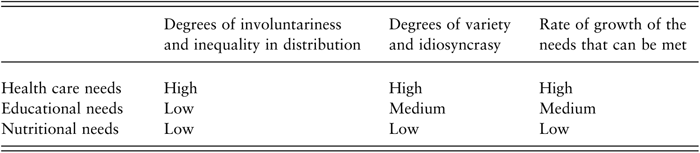
It is been argued here that these protocols are severely challenged by the realities of health care need and provision. While several mainstream health economists have defied neoclassical welfare norms and embraced other indicators, they have been remarkably deficient in utilizing other relevant concepts, including the well-established and highly relevant idea of transaction costs. The focus on the concept of need in the present paper reveals some special qualities of health care, as summarized in Table 1 and compared with other needs.
Comparative dimensions of educational, nutritional and health care needs

Table 1 summarizes some important reasons why health care is special. As argued above, and shown in the first column, with health care needs there is relatively high involuntariness and distributive inequality. Most health care needs emerge beyond individual control and there is a large variation in the degree of health care need between individuals. In practice, this observation enhances the intrinsic motivation and commitment of service providers. By contrast, there is much less inequality in the distribution of educational and nutritional needs.
Turning to the second column, a high degree of variety and idiosyncrasy generates transaction cost problems for a market system and incentive specification problems for a centrally planned system. It may be that planned health systems such as the British NHS have previously been able to mitigate incentive specification problems by maintaining a strong ethic of professional commitment. If true, this has relatively unexplored implications for health policy and the design of health care systems. It would mean that more central planning and less market provision are viable than in other sectors, as long as an ethic of professional dedication and commitment is nurtured.
In the third column, the picture is further complicated by the rate of growth in health care needs due to an ageing population and increasing technological capabilities. Although arguments concerning dynamic systems often point to the virtues of market competition, even here Richard Nelson (1981) argues that theory and evidence both suggest a combination of market and state supply.
Overall, this framework of needs analysis offers a research agenda for the comparison of different systems of provision. It combines with strong arguments in mainstream health economics against a fragmented and competitive system of health insurance, in favour of state or other monopsonistic provision on a universal basis (Arrow, Reference Arrow1963; Rice, Reference Rice and Davis2001). Although there is a relatively superficial empirical literature in this area, in mainstream health economics there is inadequate comparative discussion of health care systems, informed by a theoretical perspective that takes sufficient account of institutional structures.Footnote 2 Issues of structural and overall institutional design are given insufficient attention by health economists. Instead, they emerge in health policy and other areas.
But such comparative system studies seem to provide the most promising route towards an understanding of the merits and demerits of private, public, and mixed provision in this area. We need to explore alternative approaches that have a stronger record in comparative institutional analysis, take into account more than static efficiency comparisons, and deal with other important matters such as learning and technological innovation. The alternative traditions in economics that prioritize these issues are sometimes described as ‘institutional’ or ‘evolutionary’ by their adherents. There are numerous academic articles and book publications in this area. Journals such as the Journal of Economic Behavior and Organization, Journal of Economic Issues, Journal of Evolutionary Economics, and Journal of Institutional Economics all publish material on institutional and evolutionary themes. Dialogue between these alternative currents and those working of health care policies and health care system design, promises to be fruitful and rewarding.