Introduction
Horseweed is one of the most competitive and troublesome weeds in soybean production fields in the United States (Van Wychen Reference Van Wychen2016), including in Nebraska (Sarangi and Jhala Reference Sarangi and Jhala2018). Bruce and Kells (Reference Bruce and Kells1990) reported 71% to 98% soybean yield reduction in nontreated plots with horseweed infestation at a density of 100 to 212 plants m−2. Byker et al. (Reference Byker, Soltani, Robinson, Tardif, Lawton and Sikkema2013a) reported 83% to 93% soybean yield reduction when horseweed was left uncontrolled. Horseweed has evolved resistance to herbicides with several sites of action including glyphosate (Heap Reference Heap2019; Knezevic Reference Knezevic2007). A statewide survey in Nebraska ranked glyphosate-resistant (GR) horseweed as the second most problematic weed in corn (Zea mays L.) and soybean production fields (Sarangi and Jhala Reference Sarangi and Jhala2018). It has been documented that a single horseweed plant can produce up to 200,000 seeds and most of these seeds could germinate immediately after separating from the mother plant (Loux et al. Reference Loux, Stachler, Johnson, Nice, Davis and Nordby2006). Because most horseweed seedlings emerge from the soil surface (Nandula et al. Reference Nandula, Eubank, Poston, Koger and Reddy2006), an increased adoption of reduced or zero-tillage practices over the last several decades has increased horseweed infestation in agronomic crop fields, due to less soil and seed disturbance (Brown and Whitwell Reference Brown and Whitwell1988).
Most horseweed seedlings survive winter conditions as rosettes and bolt in late spring, growing to a height of 0.3 to 1.8 m, depending on the competition (Buhler and Owen Reference Buhler and Owen1997; Regehr and Bazzaz Reference Regehr and Bazzaz1979). Horseweed’s growth stage at the time of herbicide application plays an important role for effective control (Loux et al. Reference Loux, Stachler, Johnson, Nice, Davis and Nordby2006); for instance, studies have reported improved control of horseweed at the seedling to rosette stage with preplant herbicides, such as 2,4-D, dicamba, paraquat, or glyphosate (Bruce and Kells Reference Bruce and Kells1990; Scott et al. Reference Scott, Shaw and Barrentine1998; Thompson et al. Reference Thompson, Steckel, Ellis and Mueller2007; Wilson and Worsham Reference Wilson and Worsham1988). However, reduced control was reported when horseweed was 15 to 35 cm tall at the time of herbicide application (Loux et al. Reference Loux, Stachler, Johnson, Nice, Davis and Nordby2006; Wilson et al. Reference Wilson, Hines, Bellinder and Grande1985). In addition, greater biomass reduction of GR horseweed was reported with glyphosate applied POST at the seedling stage compared with the large rosette or bolting stage (VanGessel et al. Reference VanGessel, Scott, Johnson and White-Hansen2009).
Most horseweed emerges in the fall under Midwestern conditions (Buhler and Owen Reference Buhler and Owen1997); therefore, herbicide application in the fall is a common approach among growers for effective horseweed control. Horseweed can also germinate in the spring and summer (Bhowmik and Bekech Reference Bhowmik and Bekech1993; Buhler Reference Buhler1992; Buhler and Owen Reference Buhler and Owen1997; Davis and Johnson Reference Davis and Johnson2008; Davis et al. Reference Davis, Gibson, Bauman, Weller and Johnson2009), and foliar active herbicides such as 2,4-D applied in fall provide good control of fall-emerged horseweed (Thompson et al. Reference Thompson, Steckel, Ellis and Mueller2007; Wilson and Worsham Reference Wilson and Worsham1988), but cannot control horseweed that emerges in the spring after fall application, because of their limited soil residual activity (Loux et al. Reference Loux, Stachler, Johnson, Nice, Davis and Nordby2006). Unfortunately, because the plants emerging in spring or summer can produce seeds, a management strategy is needed for season-long horseweed control to reduce soil-seedbank replenishment. Management of spring-emerged horseweed is necessary before planting soybean, because very few POST herbicides are available for effective control of emerged glyphosate/acetolactate synthase (ALS) inhibitor-resistant horseweed in soybean (Loux et al. Reference Loux, Stachler, Johnson, Nice, Davis and Nordby2006; Wilson and Worsham Reference Wilson and Worsham1988).
Glyphosate has been an effective herbicide for preplant or POST control of horseweed in GR crops including soybean (Bruce and Kells Reference Bruce and Kells1990; Scott et al. Reference Scott, Shaw and Barrentine1998); however, because of the evolution of GR horseweed in several states in the United States (Heap Reference Heap2019), including Nebraska (Knezevic Reference Knezevic2007), glyphosate is not effective for GR horseweed control. In addition, commonly applied POST herbicides in soybean provide limited horseweed control, specifically when horseweed is taller than 15 cm (Wilson and Worsham Reference Wilson and Worsham1988). A few residual herbicides, such as cloransulam-methyl, metribuzin, or sulfentrazone labeled for horseweed control in soybean, can be tank-mixed with foliar active herbicides before or during soybean planting for season-long control (Loux et al. Reference Loux, Stachler, Johnson, Nice, Davis and Nordby2006). In addition, horseweed has evolved resistance to photosystem II, protoporphyrinogen oxidase, and ALS inhibitors in certain states (Heap Reference Heap2019); therefore, herbicide programs should be carefully selected. With an increasing number of reports of herbicide-resistant weeds, the sole reliance on herbicides for horseweed control is not a desirable approach; therefore, an integrated management program is needed that can provide season-long horseweed control.
Tillage can be an effective tool for the management of horseweed, particularly because of the emergence pattern of this weed in majority of the US states, including Nebraska. Previous studies have reported reduced horseweed emergence with shallow disking or minimum tillage in the fall or spring compared with no tillage (Brown and Whitwell Reference Brown and Whitwell1988; Kapusta Reference Kapusta1979). Although tillage is effective for controlling most weeds, cost of the fuel required for tilling is one of the limiting factors in the cost of crop production (Gianessi Reference Gianessi2005). In addition, tillage has some negative environmental impacts, such as soil compaction, due to the repeated use of heavy machinery, soil erosion, and loss of soil moisture (Gilley and Doran Reference Gilley and Doran1997; Raper et al. Reference Raper, Reeves, Burmester and Schwab2000). Also, growers have reported an increase in cost of management of GR horseweed incurred by using herbicides with alternative sites of action (Scott and VanGessel Reference Scott and VanGessel2007). Tillage is one of the components of integrated weed management; however, to reduce total cost of production and to reduce soil erosion, shallow tillage could be adopted (Fulton et al. Reference Fulton, Wells, Shearer and Barnhisel1996; Raper et al. Reference Raper, Reeves, Burmester and Schwab2000).
Some studies have evaluated the effect of tillage or herbicide programs for horseweed control (Brown and Whitwell Reference Brown and Whitwell1988; Eubank et al. Reference Eubank, Poston, Nandula, Koger, Shaw and Reynolds2008; Kapusta Reference Kapusta1979; Loux et al. Reference Loux, Stachler, Johnson, Nice, Davis and Nordby2006); however, an integrated effect of shallow tillage and herbicide applied at different timings has not been studied, to our knowledge. The objectives of this study were to determine the effect of tillage or herbicide applied in fall or spring followed by a PRE, POST, or PRE and POST herbicide program for GR horseweed control and emergence, as well as soybean injury and yield in Nebraska.
Materials and Methods
Field studies were conducted in 2014–2015 and 2015–2016 at Lincoln Agronomy Farm (40.85°N, 96.62°W) at the University of Nebraska-Lincoln, Lincoln, NE, where the presence of GR horseweed had been confirmed. Horseweed at the research site was 3- to 6-fold resistant to glyphosate compared with a glyphosate-susceptible population (Knezevic Reference Knezevic2007). An adjacent field on the same farm was used for the field experiment to repeat the study in the second year. The experimental site was under rainfed conditions without irrigation and soil at the site was a Crete silt loam (fine, smectitic, mesic Pachic Udertic Argiustolls) with a pH of 7.7 and particle size distribution of 37% sand, 19% clay, 44% silt, and 1.9% organic matter.
The experiments were arranged in a factorial randomized complete block design with two factors: tillage and herbicide (fall tillage, spring tillage, fall herbicide, and spring herbicide) and herbicide timing (no herbicide, PRE, POST, and PRE followed by POST [PRE/POST]). A nontreated control was included in the study for comparison. The experimental plots were 3 × 9 m, replicated four times, and consisted of four soybean rows spaced 76-cm apart. Experiments were initiated with the application of herbicide (2,4-D at 560 g ae ha−1 plus carfentrazone at 13.2 g ai ha−1) or tillage in the fall on November 5, 2014, and November 7, 2015 (Tables 1 and 2). Tillage was accomplished using a 50-cm-wide rototiller (Honda FRC800; American Honda, Alpharetta, GA) operated at a depth of 10 cm. GR horseweed was at the seedling to rosette stage at the time of tillage or herbicide application in the fall. Soybean was the preceding crop in the experimental field during both years. Tillage or herbicide application in the spring (2,4-D at 560 g ae ha−1 + carfentrazone at 13.2 g ai ha−1) was accomplished on April 25 in 2015 and 2016 at 28 to 31 d before planting soybean (Tables 1 and 2). GR soybean variety (‘Fontanelle 64R 20’) was seeded at 350,000 seeds ha−1 in rows spaced 76-cm apart on May 23 in 2015 and May 26 in 2016. A premix of sulfentrazone and metribuzin at 473 g ai ha−1 was applied PRE on the same day after planting soybean (Tables 1 and 2). Cloransulam at 17.7 g ai ha−1 plus fomesafen at 198 g ai ha−1 were applied POST at 25 to 26 d after planting soybean when horseweed was 7- to 14-cm tall on June 18 in 2015 and June 20 in 2016 (Tables 1 and 2). Herbicides were selected for horseweed control using the 2015 Guide for Weed, Disease, and Insect Management in Nebraska (Knezevic et al. Reference Knezevic, Creech, Jhala, Klein, Kruger, Proctor, Shea, Ogg, Thompson, Lawrence and Werle2015). Herbicide rates and application timings, depending on the horseweed growth stage, were based on herbicide label recommendations for soybean in Nebraska (Table 2). Herbicides were applied with a CO2-pressurized backpack sprayer consisting of a four-nozzle boom fitted with AIXR 110015 flat-fan nozzles (TeeJet Spraying Systems Co., Wheaton, IL 60189) calibrated to deliver 140 L ha−1 at 276 kPa.
Date of operation for tillage or herbicide application for glyphosate-resistant horseweed control in soybean in field experiments conducted near Lincoln, NE, in 2014–2015 and 2015–2016.

a A 50-cm-wide rototiller operated at a depth of 10 cm was used for tilling.
b Herbicides were applied in the fall using a backpack sprayer when horseweed was at the seedling to rosette stage and in the spring when horseweed was at the rosette to bolting stage. PRE herbicide was applied on the same day after planting soybean, and POST herbicides were applied when horseweed was 7- to 14-cm tall and soybean plants were at the fourth fifth trifoliate growth stage.
Herbicide products, rates, and application timing for glyphosate-resistant horseweed control in field experiments conducted near Lincoln, NE, in 2014–2015 and 2015–2016.

a 2,4-D and carfentrazone applied during fall or spring were tank mixed with ammonium sulfate (AMS; DSM Chemicals North America Inc., Augusta, GA) at 22 g L−1 and crop oil concentrate (Agridex, Helena Chemical Co., Collierville, TN at 1% v/v). Cloransulam and fomesafen applied during POST application were tank mixed with AMS at 22 g L−1 and nonionic surfactant (Induce, Helena Chemical Co.) at 0.25% (v/v). Herbicides were applied in the fall using a backpack sprayer when horseweed was at the seedling to rosette stage and in the spring when horseweed was at the rosette to bolting stage. PRE herbicide was applied on the same day after planting soybean, and POST herbicides were applied when horseweed was 7- to 14-cm tall and soybean plants were at the fourth to fifth trifoliate growth stage.
Horseweed control was visually estimated at 4 weeks after tillage or herbicide application in fall (WA-Fall); 4 weeks after tillage or herbicide application in spring (WA-Spring); 4 weeks after PRE (WA-PRE) herbicide; 4 weeks after POST (WA-POST) herbicide; and at soybean harvest. The visual estimates were based on a 0% to 100% scale, with 0% corresponding to no control and 100% corresponding to plant death. A similar scale was used to assess soybean injury at 7 and 14 d after fall and spring herbicide application, and PRE or POST herbicide application, with 0% corresponding to no injury and 100% corresponding to soybean plant death. Horseweed density was assessed from two randomly placed 0.5-m2 quadrats from the middle two soybean rows per plot at 4 WA-Fall, 4 WA-Spring, 4 WA-PRE, 4 WA-POST, and at soybean harvest. At maturity, soybean was harvested from the middle two rows of each plot with a small-plot combine, and weight and moisture content were recorded. Soybean yields were adjusted to 13% moisture content (Chahal and Jhala Reference Chahal and Jhala2015; Ganie and Jhala Reference Ganie and Jhala2017).
Statistical Analysis
Horseweed control estimates, density, and soybean injury and yield data were subjected to ANOVA using the PROC GLIMMIX procedure in SAS, version 9.3 (SAS Institute Inc., Cary, NC 27513). Horseweed density and control and soybean yield data were tested for normality and homogeneity of variance assumptions by using Shapiro-Wilks goodness-of-fit test and Levene’s test in SAS. Log-scale transformation was applied to the data when those assumptions were not met. Tillage or herbicide application, PRE/POST herbicide program, and experimental years were considered fixed effects, whereas replications were considered a random effect in the model.
There was no significant interaction between year and tillage or /herbicide application, and PRE/POST herbicide program for horseweed control and soybean yield, but a significant interaction for horseweed density was observed; therefore, density data were analyzed and presented separately for each year and the remainder of the data were combined over 2 years. Data were analyzed separately for each data collection timing. Where the ANOVA indicated tillage or herbicide application or PRE/POST herbicide program effects were significant, means were separated at P ≤ 0.05 using Tukey-Kramer’s pairwise comparison test to reduce type I error for the series of comparisons.
Results and Discussion
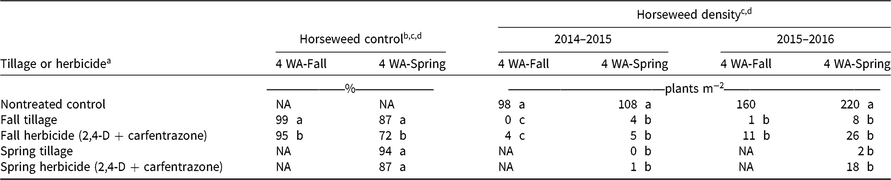
GR horseweed was the dominant weed species at the experimental site and other species, such as common lambsquarters (Chenopodium album L.), giant ragweed (Ambrosia trifida L.), and velvetleaf (Abutilon theophrasti Medik.) were randomly distributed at the research site during both years. Tillage or herbicide (2,4-D at 560 g ae ha−1 plus carfentrazone at 13.2 g ai ha−1) applied in fall provided 95% to 99% control of GR horseweed at 4 WA-Fall (Table 3). Fall tillage was as effective in reducing horseweed density as herbicide applied in fall at 4 WA-Fall during both years. For instance, tillage or herbicide applied in fall reduced GR horseweed density to 0 to 4 plants m−2 and 1 to 11 plants m−2 compared with 98 and 160 plants m−2 in the nontreated control in 2014–2015 and 2015–2016, respectively (Table 3).
Effect of tillage or herbicide on glyphosate-resistant horseweed control and density in field experiments conducted near Lincoln, NE, in 2014–2015 and 2015–2016.

a Tillage or herbicide was applied in the fall when horseweed was at the seedling to rosette stage. Tillage or herbicide was applied in the spring approximately 4 weeks before planting soybean, when horseweed was at the rosette to bolting stage. A 50-cm-wide rototiller operated at a depth of approximately 10 cm was used for tilling.
b Abbreviations: NA, not applicable; WA-Fall, weeks after tillage or herbicide application in fall; WA-Spring, weeks after tillage or herbicide application in spring.
c There was no significant interaction between year and tillage or herbicide for horseweed control, but there was a significant interaction for horseweed density; therefore, density data were analyzed separately for each year, and control data were combined over 2 years.
d Means within columns with no common letter(s) are significantly different according to Tukey-Kramer’s pairwise comparison test (P ≤ 0.05).
Tillage or herbicide (2,4-D 560 g ae ha−1 plus carfentrazone 13.2 g ai ha−1) in spring was applied approximately 4 weeks before planting soybean. Spring tillage provided similar (87% to 94%) GR horseweed control as spring herbicide and fall tillage at 4 WA-Spring; however, herbicide applied in fall restricted horseweed control to 72%, partially because of new horseweed emergence in spring. Kruger et al. (Reference Kruger, Davis, Weller and Johnson2010) reported 90% to 93% control of GR horseweed less than 15 cm tall in Indiana at 4 weeks after application of 2,4-D at 560 g ae ha−1. Fall-applied 2,4-D plus carfentrazone provided 95% GR horseweed control at 4 weeks after application, whereas the same mixture applied in the spring provided 87% control at 4 weeks after application (Table 3).
In contrast to GR horseweed control estimates, statistically similar horseweed densities of 0 to 5 plants m−2 and 2 to 26 plants m−2 were observed with tillage or herbicide applied in the fall or spring in 2014–2015 and 2015–2016, respectively (Table 3). Owen et al. (Reference Owen, Steckel, Koger, Main and Mueller2009) also reported no difference in GR horseweed density at cotton (Gossypium hirsutum L.) planting with herbicide applied in fall or spring. In contrast, Davis et al. (Reference Davis, Gibson, Bauman, Weller and Johnson2009; Reference Davis, Kruger, Young and Johnson2010) reported greater reduction in GR horseweed emergence with spring-applied herbicide compared with fall-applied herbicides. Shallow tillage in fall or spring provided effective control of horseweed in this study. Horseweed seeds do not require dormancy for germination (Nandula et al. Reference Nandula, Eubank, Poston, Koger and Reddy2006) and do not remain viable in the soil for more than 3 years (Comes et al. Reference Comes, Bruns and Kelley1978). Therefore, implementation of tillage could bury horseweed seeds in the soil, reducing emergence and viable horseweed soil seed bank. Similarly, Kapusta (Reference Kapusta1979) reported no horseweed emergence at 7 to 8 weeks after conventional tillage (spring moldboard plough, tandem disc, and spike-tooth harrow) or minimum tillage (tandem disked once or twice) compared with 12,000 to 96,000 horseweed plants ha−1 in no-till soybean. Brown and Whitwell (Reference Brown and Whitwell1988) reported reduced horseweed emergence in cotton with shallow disking reaching 7- to 10-cm deep in fall or before planting in spring, compared with no-tillage.
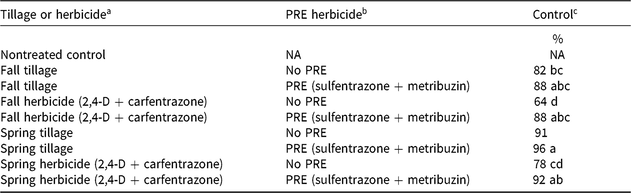
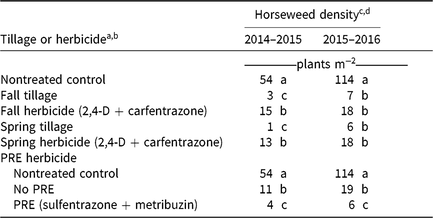
A PRE herbicide, a premix of sulfentrazone and metribuzin at 473 g ai ha−1, was applied on the same day after planting soybean in both years. There was an interaction between tillage or herbicide applied in fall or spring and PRE herbicide (no PRE and PRE) for GR horseweed control at 4 WA-PRE (Table 4). At 4 WA-PRE, tillage in fall or spring without a follow-up PRE herbicide provided similar control (82% to 96%) as tillage followed by a PRE herbicide. In contrast, herbicide applied in fall or spring was not as effective as tillage when no PRE herbicide was applied at 4 WA-PRE and provided only 64% to 78% control. Nandula et al. (Reference Nandula, Eubank, Poston, Koger and Reddy2006) reported that the majority of horseweed seedlings emerge from the soil surface; therefore, the soil disturbance caused by tillage in this study might have incorporated horseweed seeds in the soil, resulting in reduced emergence compared with no-tillage or herbicide treatment. Horseweed was controlled 88% to 92% when fall- or spring-applied herbicide was followed by a PRE herbicide (Table 4). Although horseweed density was affected by tillage or herbicide applied in fall or spring or by PRE herbicide, there was no interaction between these two factors in both years; therefore, we present only the main effects (Table 5). In 2014–2015, tillage in fall or spring had the lowest horseweed density of 1 to 3 plants m−2 compared with 13 to 15 plants m−2 with herbicide applied in fall or spring without tillage and 54 plants m−2 in the nontreated control at 4 WA-PRE. In 2015–2016, tillage in fall or spring resulted in similar horseweed density (6 to 18 plants m−2) as herbicide applied in fall or spring, but less density than the nontreated control (114 plants m−2) (Table 5). Overall, PRE herbicide resulted in the lowest horseweed density (4 and 6 plants m−2 compared with 11 and 19 plants m−2 without a PRE herbicide at 4 WA-PRE in 2014–2015 and 2015–2016, respectively) (Table 5).
Effect of tillage or herbicide on glyphosate-resistant horseweed control at 4 WA-PRE herbicide in field experiments conducted near Lincoln, NE, in 2014–2015 and 2015–2016.

a Tillage or herbicide was applied in the fall when horseweed was at the seedling to rosette stage. Tillage or herbicide was applied in the spring approximately 4 weeks before planting soybean, when horseweed was at the rosette to bolting stage. PRE herbicides were applied on the same day after planting soybean. A 50-cm-wide rototiller operated at a depth of approximately 10 cm was used for tilling.
b Abbreviations: NA, not applicable; WA-PRE, weeks after PRE.
c There was no significant interaction between year and tillage or herbicide application, or PRE herbicide for horseweed control; therefore, data were combined over 2 years. Means within columns with no common letter(s) are significantly different according to Tukey-Kramer’s pairwise comparison test (P ≤ 0.05).
Effect of tillage or herbicide on glyphosate-resistant horseweed density at 4 weeks after PRE in field experiments conducted near Lincoln, NE, in 2014–2015 and 2015–2016.

a Tillage or herbicide was applied in the fall when horseweed was at the seedling to rosette stage. Tillage or herbicide was applied in the spring approximately 4 weeks before planting soybean, when horseweed was at the rosette to bolting stage.
b PRE herbicides were applied on the same day after planting soybean. A 50-cm-wide rototiller operated at a depth of approximately 10 cm was used for tilling.
c There was significant effect of tillage or herbicide applied in fall or spring or PRE herbicide on horseweed density, but no interaction between these two factors during both years; therefore, main effects are presented: Tillage or herbicide programs were averaged over PRE herbicide. PRE herbicide programs were averaged over tillage or herbicide applied in fall or spring.
d Means within columns with no common letter(s) are significantly different according to Tukey-Kramer’s pairwise comparison test (P ≤ 0.05).
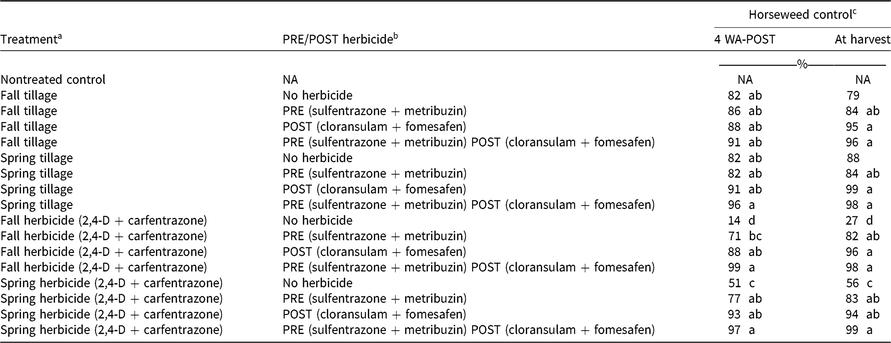
At 4 WA-POST, tillage applied in fall or spring provided 82% control of GR horseweed compared with 14% and 51% control with fall- and spring-applied herbicide, respectively (Table 6). Tillage or herbicide applied in fall or spring followed by a POST herbicide (cloransulam 17.7 g ai ha−1 plus fomesafen 198 g ai ha−1) provided similar (88% to 93%) control as tillage or herbicide followed by a PRE (71% to 86%), or a PRE and POST herbicide (91% to 99%). Horseweed was 7- to 14-cm tall at the time of POST herbicide application, and POST herbicide (cloransulam plus fomesafen) effectively controlled the smaller GR horseweed. Previous studies have reported reduced control when horseweed was more than 15-cm tall at the time of POST herbicide application (Loux et al. Reference Loux, Stachler, Johnson, Nice, Davis and Nordby2006; Wilson et al. Reference Wilson, Hines, Bellinder and Grande1985). In addition, there are very few effective POST herbicide options to control emerged horseweed, especially populations resistant to glyphosate and ALS inhibitors in GR soybean (Loux et al. Reference Loux, Stachler, Johnson, Nice, Davis and Nordby2006; Wilson and Worsham Reference Wilson and Worsham1988). The recent commercialization of dicamba-resistant soybean provided growers an opportunity to apply dicamba for the management of GR horseweed (Byker et al. Reference Byker, Soltani, Robinson, Tardif, Lawton and Sikkema2013a). It is ideal to have horseweed plants shorted than 15 cm at the time of POST herbicide application to achieve effective control in soybean. Horseweed biotypes resistant to cloransulam have been reported in the United States and Canada (Byker et al. Reference Byker, Soltani, Robinson, Tardif, Lawton and Sikkema2013b; Trainer et al. Reference Trainer, Loux, Harrison and Regnier2005), and even though tillage or herbicide applied in fall or spring followed by a PRE or a POST herbicide provided similar control as when followed by a PRE and POST herbicide, a PRE herbicide should be included to reduce later-season horseweed emergence and should include an herbicide with an additional effective site of action in the program for herbicide-resistant weed management (Chahal and Jhala Reference Chahal and Jhala2018; Chahal et al. Reference Chahal, Irmak, Gaines, Amundsen, Jugulam, Jha, Travlos and Jhala2018; Ganie and Jhala Reference Ganie and Jhala2017).
Effect of tillage or herbicide on glyphosate-resistant horseweed control in field experiments conducted near Lincoln, NE, in 2014–2015 and 2015–2016.

a Tillage or herbicide was applied in the fall when horseweed was at the seedling to rosette stage. Tillage or herbicide was applied in the spring approximately 4 weeks before planting soybean, when horseweed was at the rosette to bolting stage. PRE herbicides were applied on the same day after planting soybean, and POST herbicides were applied when horseweed was 7 to 14 cm tall and soybean were at the fourth to fifth trifoliate growth stage. A 50-cm-wide rototiller operated at a depth of approximately10 cm was used for tilling.
b Abbreviations: NA, not applicable; WA-POST, weeks after POST.
c There was no significant interaction between year and tillage or herbicide, or PRE/POST herbicide for horseweed control; therefore, data were combined over 2 years. Means within columns with no common letter(s) are significantly different according to Tukey-Kramer’s pairwise comparison test (P ≤ 0.05).
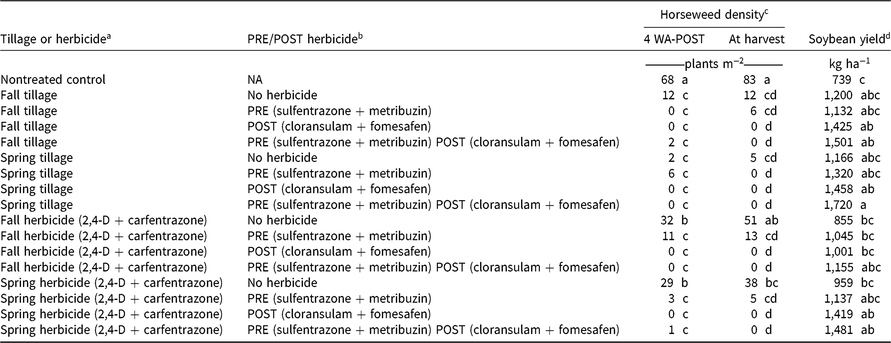
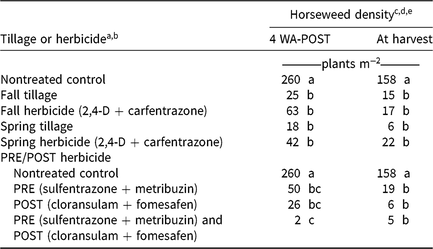
Control estimates corresponded with horseweed density in 2014–2015; for instance, tillage in fall or spring was effective in reducing horseweed density to 2 to 12 plants m−2, similar to 0 to 6 plants m−2 with tillage in fall or spring followed by a PRE, POST, or PRE and POST herbicide at 4 WA-POST in 2014–2015 (Table 7). In contrast, herbicide applied in fall or spring was not as effective in reducing horseweed density (29 to 32 plants m−2) as fall or spring tillage. Horseweed density was reduced to 0 to 11 plants m−2 where herbicide applied in fall or spring was followed by a PRE, POST, or PRE and POST herbicide at 4 WA-POST in 2014–2015. In 2015–2016, there was a significant effect of tillage or herbicide applied in fall or spring, or PRE/POST herbicide program on horseweed density but no interaction between those two factors; therefore, the main effects are presented (Table 8). Tillage or herbicide applied in fall or early spring reduced horseweed density to 18 to 63 plants m−2 compared with 260 plants m−2 with the nontreated control at 4 WA-POST in 2015–2016, indicating the importance of horseweed control in the fall or early spring (Table 8). In a field experiment conducted by Davis et al. (Reference Davis, Gibson, Bauman, Weller and Johnson2009) in Indiana, herbicide application in fall or spring along with crop rotation reduced the ratio of GR to glyphosate-susceptible horseweed plants after 3 to 4 years of the experiment initiation. Therefore, long-term adoption of integrated weed management practices, such as tillage, herbicide, and crop rotation, could affect the population structure of herbicide-resistant and -susceptible horseweed. The PRE, POST, or PRE and POST herbicide program resulted in a horseweed density of 2 to 50 plants m−2 compared with 260 plants m−2 in the nontreated control at 4 WA-POST. At soybean harvest, a similar trend in horseweed control and density was observed with tillage or herbicide and PRE/POST herbicide program as observed at 4 WA-POST. For instance, fall or spring tillage provided 79% to 88% control, which was similar to 82% to 99% control with tillage or herbicide applied in fall or spring followed by a PRE, POST, or PRE and POST herbicide (Table 6). Tillage in fall or spring resulted in a similar horseweed density of 0 to 12 plants m−2 compared with when followed by a PRE, POST, or PRE and POST herbicide in 2014–2015 (Table 7). No soybean injury was observed at 7 or 14 d after PRE or POST herbicides applied in this study (data not shown).
Effect of tillage or herbicide on glyphosate-resistant horseweed density in 2014–2015 and soybean yield in 2014–2015 and 2015–2016 in field experiments conducted near Lincoln, NE.

a Tillage or herbicide was applied in the fall when horseweed was at the seedling to rosette stage. Tillage or herbicide was applied in the spring approximately 4 weeks before planting soybean, when horseweed was at the rosette to bolting stage. PRE herbicide was applied on the same day after planting soybean, and POST herbicide was applied when horseweed was 7 to 14 cm tall and soybean were at the fourth to fifth trifoliate growth stage. A 50-cm-wide rototiller operated at a depth of approximately 10 cm was used for tilling.
b Abbreviations: NA, not applicable; WA-POST, weeks after POST.
c Means within columns with no common letter(s) are significantly different according to Tukey-Kramer’s pairwise comparison test (P ≤ 0.05).
d There was no significant interaction between year and tillage or herbicide, or PRE/POST herbicide for soybean yield; therefore, yield data were combined over 2 years.
Effect of tillage or herbicide on glyphosate-resistant horseweed density in field experiments conducted near Lincoln, NE, in 2015–2016.

a Tillage or herbicide was applied in the fall when horseweed was at the seedling to rosette stage. Tillage or herbicide was applied in the spring approximately 4 weeks before planting soybean when horseweed was at the rosette to bolting stage.
b PRE herbicide was applied on the same day after planting soybean, and POST herbicide was applied when horseweed was 7- to 14-cm tall and soybean plants were at the fourth to fifth trifoliate growth stage. A 50-cm-wide rototiller operated at a depth of around 10 cm was used for tilling.
c Abbreviation: WA-POST, weeks after POST.
d There was a significant effect of tillage or herbicide, or PRE/POST herbicide on horseweed density, but no interaction between these two factors; therefore, main effects are presented.
e Means within columns with no common letter(s) are significantly different according to Tukey-Kramer’s pairwise comparison test (P ≤ 0.05).
Soybean yield in this study did not correspond with the horseweed control estimates, density, and biomass results; most treatments resulted in statistically similar yield (Table 7). For example, tillage or herbicide applied in fall or spring followed by a PRE, POST, or PRE and POST herbicide provided similar soybean yield (855 to 1,501 kg ha−1) as tillage in fall or herbicide in fall or spring (Table 7). Most of the horseweed plants that emerged in fall or spring were controlled with herbicide or tillage applied in fall or spring, and the plants that emerged with or after soybean were not competitive enough to reduce soybean yield; however, those could produce enough seed to germinate in next fall or spring. Therefore, it is ideal to have a follow-up PRE or POST herbicide application for controlling later-emerging horseweed plants. Soybean yield results are consistent with a study conducted by Owen et al. (Reference Owen, Steckel, Koger, Main and Mueller2009) that reported no difference in seed cotton yield despite greater GR horseweed control with dicamba tank mixed with residual herbicide compared with dicamba alone applied in fall or spring.
Practical Implications
Growers in the midwestern United States have adopted no-tillage corn and soybean cropping systems to reduce the cost of production and to reduce soil erosion from crop fields. Therefore, herbicide application in fall, or to some extent in spring, is a common approach among growers for GR horseweed management. In this study, tillage applied 10-cm deep in fall or spring generally yielded fewer GR horseweed plants compared with herbicide applied in fall or spring. Horseweed can also behave as a summer annual, depending on the geographic area, with most germination occurring in late spring (Davis and Johnson Reference Davis and Johnson2008; Davis et al. Reference Davis, Gibson, Bauman, Weller and Johnson2009). Therefore, shallow tillage could potentially be rotated with herbicide in fall or spring to manage GR horseweed. Shallow tillage is cost-effective and can reduce fuel input and soil erosion compared with conventional tillage practices (Fulton et al. Reference Fulton, Wells, Shearer and Barnhisel1996; Raper et al. Reference Raper, Reeves, Burmester and Schwab2000). Besides tillage and herbicide application, corn-soybean rotation has also demonstrated greater reduction in horseweed densities and soil seed bank compared with continuous soybean (Davis et al. Reference Davis, Gibson, Bauman, Weller and Johnson2009). With the increasing number of herbicide-resistant weeds, the adoption of integrated weed management practices, such as crop rotation, tillage, and use of distinct site-of-action herbicides has become crucial. Therefore, in fields with a history of GR horseweed, herbicide applied in fall or spring should be rotated with shallow tillage in fall or spring to achieve effective horseweed control.
Acknowledgments
No conflicts of interest have been declared. This project was based on research partially supported by the Nebraska Agricultural Experiment Station with funding from the Hatch Act through the US Department of Agriculture (USDA) National Institute of Food and Agriculture and USDA National Institute of Food and Agriculture Nebraska Extension Implementation Project. The authors acknowledge the help of Irvin Schleufer.