Children with univentricular pathology represent an important proportion of children undergoing transcatheter interventions in the United States of America, particularly after initial Norwood palliation.Reference Prakash1–Reference Thibault3 In the Norwood population, 36–59% may have aorto-pulmonary collateral flow, which represents a source of additional blood flow to the pulmonary circulation. However, there is paucity of data regarding aorto-pulmonary collaterals; current risk factors are poorly delineated, and haemodynamic and clinical outcomes are unknown.Reference Mcelhinney4,Reference Triedman5
Aorto-pulmonary collaterals are hypothesisd to emerge due to hypoxia-induced vascular endothelial growth factor activity that generates collaterals from the internal mammary arteries, lateral thoracic arteries, thyrocervical trunks, intercostal arteries, and subclavian arteries.Reference Jacobs6–Reference Sandeep8 Risk factors for aorto-pulmonary collateral burden remain elusive, and assessment of their clinical impact is hindered by the inability of diagnostic modalities to assess burden of disease. Cardiac catheterisation, while providing angiographic depiction of disease and aortic and pulmonary arterial oxygen saturations,Reference Grosse-Wortmann, Al-Otay and Yoo9,Reference Whitehead10 does not quantify burden and may underestimate the pulmonary to systemic blood flow (Qp:Qs) ratio; furthermore, these parameters may have greater association with clinical outcomes compared to aorto-pulmonary collateral burden itself, but this has yet to be investigated. MRI quantification becomes difficult with complex pulmonary venous anatomy or not possible, with accuracy, in the presence of metal implants.Reference Powell7,Reference Grosse-Wortmann, Al-Otay and Yoo9
The challenges of establishing risk factors and burden of disease may be the reason that the clinical outcomes attributable to aorto-pulmonary collaterals are poorly understood and characterised. Once diagnosed, current recommendations suggest that aorto-pulmonary collaterals be embolised if they are considered to be moderate or large, to reduce pulmonary over circulation, pulmonary arterial hypertension, and ventricular volume load, with potential for improving long-term outcomes.Reference Mcelhinney4,Reference Geva11 Data from retrospective case series suggest that aorto-pulmonary collateral burden may be correlated with post-Norwood or post-Glenn length of stay, re-intervention, pleural effusions, ventricular dysfunction/failure, mortality, and time to further staging procedures,Reference Mcelhinney4,Reference Triedman5,Reference Sandeep8,Reference Kanter, Vincent and Raviele12,Reference Ichikawa13 but this is yet to be proven in larger studies.
The primary aim of our study was to determine the risk factors for aorto-pulmonary collaterals following the Norwood procedure. Secondarily, we assess whether these risk factors or aorto-pulmonary collateral burden itself have an impact on the outcomes of death, transplantation, pulmonary artery intervention, or aorto-pulmonary collateral intervention at or following the pre-bidirectional Glenn catheterisation.
Methods
Patients
This was a retrospective cohort study of data from consecutive patients undergoing a Norwood procedure for any single-ventricle anatomy at a tertiary centre between January 2011 and March 2016. The study was approved by the institutional review board with waiver of consent.
Primary outcome
The primary outcome of aorto-pulmonary collateral burden at the time of pre-bidirectional Glenn catheterisation was assessed by a single paediatric interventional cardiologist using criteria by Prakash et al.Reference Prakash1 None/mild aorto-pulmonary collateral burden was defined as no or faint opacification of pulmonary arteries and/or veins on angiography and confined to less than one lobe in each lung. Moderate burden was classified as moderate opacification of pulmonary artery and/or veins in both lungs on angiography, involving more than one lobe with vessels opacifying after >2 cardiac cycles or extensive filling of pulmonary arteries/veins in a single lobe or lung with pulmonary vessels opacified within 1–2 cardiac cycles. Severe burden was classified as extensive filling of pulmonary artery and/or veins on angiography in multiple lobes of both lungs, with pulmonary vessels opacified within 1–2 cardiac cycles, usually from multiple systemic arterial sources. The burden was dichotomised into either no/mild disease or moderate/severe disease. Aorto-pulmonary collateral burden was then evaluated as a risk factor for secondary outcomes of death/transplantation, pulmonary artery intervention, or aorto-pulmonary collateral intervention.
Secondary outcomes
The secondary outcomes of death, transplantation, pulmonary artery intervention, and aorto-pulmonary collateral intervention post-bidirectional Glenn catheterisation were collected as time-to-event variables (from the time of pre-bidirectional Glenn catheterisation to event). Data on pulmonary artery and aorto-pulmonary collateral interventions were collected for their cardinal (primary) intervention, and pulmonary artery or aorto-pulmonary collateral re-intervention after the pre-bidirectional Glenn catheterisation was considered as part of the secondary outcome. Covariates included patient characteristics, oxygen saturations, vasoactive inotrope scores during the post-Norwood hospitalisation, interstage interventions, and haemodynamic parameters at the time of pre-bidirectional Glenn catheterisation. Patient characteristics included sex, weight and age at Norwood operation, post-Norwood length of stay, type of shunt, interventions prior to pre-bidirectional Glenn catheterisation, and indications for and time to pre-bidirectional Glenn assessment. Haemodynamic at pre-bidirectional Glenn catheterisation included ascending aortic and pulmonary artery saturations, pulmonary-to-systemic shunt ratioReference Prakash1; arch gradient, atrial septal defect gradient (categorized as restrictive versus non-restrictive); ventricular function and presence and severity of atrioventricular valve regurgitation. Oxygen saturation data were collected at Days 1, 2 and 3 post-Norwood; lowest value prior to discharge; and improvements in oxygen saturations (difference between Day 3 versus Day 1). Patients with operative mortality (defined as death during Norwood hospitalisation or death within 30 days if discharged home before 30 days) or Norwood operation at other institutions with subsequent care at our centre were excluded due to a lack of available follow-up data.
Statistical method
Categorical variables are presented as counts (n) and percentages (%). The distributions of continuous variables are described as means with standard deviation where normally distributed, or medians with interquartile ranges if skewed. All characteristics were summarised stratified by aorto-pulmonary collateral burden.
Risk factors for aorto-pulmonary collateral burden were assessed using multivariable logistic regression. Risk factors for death/transplantation post-Norwood discharge were assessed using multivariable Cox regression. Patients who did not experience the outcome of interest were censored at the time of last follow-up. Risk factors of time to aorto-pulmonary collateral or pulmonary artery interventions were evaluated using the Fine-Gray model, treating death/transplantation as a competing risk. Forward stepwise selection was used for all models, with p < 0.10 required for inclusion in the multivariable model, except for aorto-pulmonary collateral burden, which was included in models for the secondary outcomes regardless of statistical significance. Risk factors were tested for collinearity using variance inflation factors, with tolerance threshold set at 0.10 for exclusion from the multivariable model. Odds ratios and hazard ratios are reported with 95% confidence intervals. All statistical analysis was undertaken on Stata v15.1 (Stata LLC, Texas, United States of America).
Results
Demographic
Among 104 patients undergoing Norwood in the study period, 67 (64.4%) were male, and 81 (77.9%) had hypoplastic left heart syndrome. The median age at Norwood was 4 (interquartile range 3–6) days; Sano shunts were used in 82 (78.8%), and Blalock Taussig Thomas shunts in 22 (21.4%). Patients were in hospital for a median of 32 days (interquartile range 20–43). Other demographic and pre-Norwood factors are listed in Supplement Table 1.
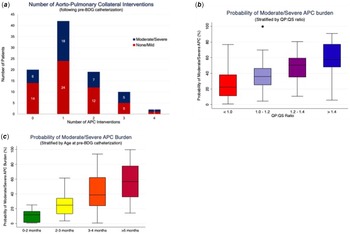
Of the total cohort, 93/104 (89.6%) underwent pre-bidirectional Glenn catheterisation, 90/104 (86.5%) underwent a bidirectional Glenn, and 84/104 (80.8%) received both and constitute the analytic cohort. The group who underwent pre-bidirectional Glenn catheterisation had a higher proportion of males compared to those who did not (68.8% versus 27.3%, p = 0.006); there were no other significant demographic differences in those who were excluded. In the time between Norwood and pre-bidirectional Glenn cardiac catheterisation, 14 (15.1%) and 25 (26.9%) had aortic and shunt interventions, respectively. Aorto-pulmonary collateral intervention at the time of pre-bidirectional Glenn catheterisation was performed in 54.8% (n = 51/93); 86.5% (n = 32/37) of those with moderate/severe and 33.3% (n = 19/56) with mild aorto-pulmonary collateral burden underwent aorto-pulmonary collateral intervention. Other interventions at the time of pre-bidirectional Glenn catheterisation included 19 shunt (20.4%) and 8 pulmonary arterial (8.6%) angioplasties. Moderate or severe dysfunction of the ventricle was identified in 26 (28.0%) and moderate or greater atrioventricular valve regurgitation in 12 (13.0%). Most patients (45.2%) only underwent one aorto-pulmonary collateral intervention (Fig 1a). Further interventions and haemodynamic parameters at pre-bidirectional Glenn catheterisation are listed in Table 1.
( a ) The number of aorto-pulmonary collateral interventions after pre-bidirectional Glenn catheterisation, stratified by aorto-pulmonary collateral disease burden. Predicted probabilities from multivariable regression model, stratified by ( b ) QP:QS ratio and ( c ) age at prebidirectional Glenn catheterisation. APC = aorto-pulmonary collaterals; BDG = bi-directional Glenn; QP:QS = pulmonary to systemic flow ratio.

Baseline demographic, preoperative, post-operative, and non-risk adjusted outcome characteristics of patients following Norwood procedure. Data have been stratified by severity of aorto-pulmonary collaterals (aorto-pulmonary collateral). Normally distributed continuous variables are listed with mean and standard deviation; skewed variables are listed with median and interquartile range.

APC = aorto-pulmonary collaterals; ASD=atrial septum defect; AVVR = atrioventricular valve regurgitation; BT = Blalock-Taussig shunt; HLHS = hypoplastic left heart syndrome; IQR=interquartile range (reported as 25th to 75th percentile); LOS = length of stay; PA = pulmonary artery; QP = pulmonary blood flow; QS = systemic blood flow; SVC = superior vena cava; VISDOS = vasoactive inotrope score on day of surgery.
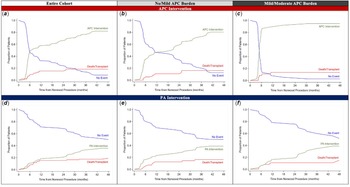
Following bidirectional Glenn, 70/90 (77.8%) of the patients progressed to Fontan. The median follow-up post-Glenn was 1486 days (4.0 years), during which 19 (21.1%) died or were transplanted, 11 (12.2%) underwent their first pulmonary artery angioplasty, and 37 (41.1%) underwent their first aorto-pulmonary collateral intervention. Aorto-pulmonary collateral intervention of any nature (primary and re-intervention) after pre-bidirectional Glenn catheterisation occurred in 74 (82.2%), with 34 (45.9%) at the time of pre-Fontan cardiac catheterisation, 55 (74.3%) received intervention prior to Fontan, and 22 (29.7%) after the Fontan. Other major interventions included tricuspid valve n = 13 (14.0%), atrial septum n = 12 (12.9%), and pulmonary veins n = 7 (7.5%) (Table 1, Fig 2).
Competing risk plots for post-Norwood APC intervention and pulmonary artery intervention. ( a – c ) Cumulative incidence of death/transplantation, APC intervention versus no intervention across ( a ) entire cohort, ( b ) none/mild APC, and ( b ) moderate/severe APC groups. ( d – f ) Cumulative incidence of death/transplantation, pulmonary artery intervention, and no intervention across ( a ) entire cohort, ( b ) no/mild APC, and ( b ) moderate/severe APC groups. APC = aorto-pulmonary collaterals; PA = pulmonary artery.

Aorto-pulmonary collateral burden at pre-bidirectional Glenn cardiac catheterisation
In univariable analyses evaluating the associations between pre-bidirectional Glenn variables and aorto-pulmonary collateral burden (Table 2), male sex; longer Norwood hospital stay; longer time to pre-bidirectional Glenn assessment; higher ascending aortic, pulmonary arterial saturations, Qp:Qs ratio; and severe ventricular or atrioventricular valvular dysfunction were associated with moderate/severe aorto-pulmonary collateral burden (Supplement Table 2). No factors were found to have significant collinearity (Supplement Table 3). In multivariable analysis (Table 2), male sex (odds ratio 3.36, 95% CI 1.17–11.4), age at pre-bidirectional Glenn assessment (odds ratio 2.12, 1.33–3.39 per month increase), and QP:QS ratio (odds ratio 1.23, 1.08–1.41 per 0.1-unit increase) were significantly associated with moderate/severe aorto-pulmonary collateral burden.
Multivariable risk factors of aorto-pulmonary collaterals in patients following their Norwood procedure.

The probability of moderate or severe aorto-pulmonary collateral burden progressively increased with QP:QS ratio and the age at pre-bidirectional Glenn catheterisation. In patients with QP:QS < 1.0, the median probability of having aorto-pulmonary collaterals was 22.5% (interquartile range 11.2–38.1); in patients with QP:QS > 1.4, this increased to 57.6% (interquartile range 47.9–77.1) (Fig 1b). In patients aged less than 2 months at the time of pre-bidirectional Glenn catheterisation, the median probability of aorto-pulmonary collaterals was 10.6% (interquartile range 5.67–19.5); when this age increased to 5 months or greater, the median probability was 56.9% (interquartile range 35.0–76.6) (Fig 1c).
Death/transplantation, pulmonary artery, and aorto-pulmonary collateral intervention following bidirectional Glenn
Multivariable models for the secondary outcomes of (a) death/transplantation, (b) primary pulmonary artery, and (c) aorto-pulmonary collateral intervention at or following pre-bidirectional Glenn catheterisation are listed in Table 3 with corresponding hazard or sub-hazard ratios (univariable analysis in Supplement Table 2). Aorto-pulmonary collateral burden diagnosed at the time of pre-bidirectional Glenn catheterisation was not associated with death/transplantation (hazard ratio 1.19, 95% CI 0.37–3.85), future pulmonary artery intervention (sub-hazard ratio 1.38, 0.32–2.61) or aorto-pulmonary collateral interventions (sub-hazard ratio 1.11, 0.21–5.76). Longer post-Norwood hospital stay was associated with greater risk of death and/or transplantation (hazard ratio 1.22 per week of stay, 95% CI 1.08–1.38), but a lower risk of aorto-pulmonary collateral intervention (sub-hazard ratio 0.86 per week of stay, 95% CI 0.75–0.98). A longer time to pre-bidirectional Glenn catheterisation was associated with higher probability of undergoing aorto-pulmonary collateral intervention (Table 2), but these patients then had a lower risk of subsequent pulmonary artery (sub-hazard ratio 0.80 per month, 95% CI 0.65–0.98) and aorto-pulmonary collateral intervention (sub-hazard ratio 0.79, 0.63–0.99).
Multivariable risk factors death and/or transplantation, pulmonary artery intervention, aorto-pulmonary collateral intervention in following Norwood discharge.

APC = aorto-pulmonary collaterals; BDG = bidirectional Glenn; PA=Pulmonary artery; 95% CI = 95% confidence interval.
To delineate the natural course of post-Norwood interventions of patients with varying aorto-pulmonary collateral burden, we undertook competing risk analysis of event rates following the Norwood procedure. This demonstrated that the cumulative incidence of death and/or transplantation, pulmonary artery intervention, and aorto-pulmonary collateral intervention were similar between the no/mild and moderate/severe aorto-pulmonary collateral burden subgroups over 48 months (Fig 2b and c). The majority of patients with moderate/severe aorto-pulmonary collateral burden underwent aorto-pulmonary collateral intervention within the first 6 months after their Norwood procedure, 87% at the time of their pre-bidirectional Glenn catheterisation (n = 32/37), after which the cumulative incidence of aorto-pulmonary collateral intervention was low (Fig 2c); those with no/mild aorto-pulmonary collateral burden had a steady increase in the cumulative incidence over 48 months (Fig 2b). The incidence of pulmonary artery intervention did not vary significantly based on severity of aorto-pulmonary collateral burden (Fig 2d–f).
Discussion
Key findings
We describe the burden of aorto-pulmonary collaterals, as assessed by cardiac catheterisation, in a series of 93 patients, with four key findings. Firstly, patients who are male, have a higher QP:QS ratio, and older at the time of pre-bidirectional Glenn catheterisation are more likely to have moderate/severe aorto-pulmonary collateral burden at pre-bidirectional Glenn catheterisation. Secondly, at our institution aorto-pulmonary collateral intervention is common among single-ventricle patients who undergo staged palliation: 54.8% of patients had aorto-pulmonary collateral intervention at the time of their pre-bidirectional Glenn catheterisation assessment, and more than 75% of patients had undergone primary or re-do aorto-pulmonary collateral intervention within 48 months of their Norwood procedure, irrespective of disease burden. Thirdly, our cohort had a similar cumulative incidence of aorto-pulmonary collateral intervention irrespective of severity of aorto-pulmonary collateral burden at pre-bidirectional Glenn catheterisation. Fourth, a longer hospital stay post-Norwood is associated with a higher risk of death or transplantation, but a lower risk of aorto-pulmonary collateral intervention at or after the pre-bidirectional Glenn catheterisation among survivors to Norwood hospital discharge.
This report adds to current literature by providing one of the largest cohorts focusing primarily on aorto-pulmonary collateral burden.Reference Mcelhinney4,Reference Triedman5,Reference Powell7–Reference Grosse-Wortmann, Al-Otay and Yoo9,Reference Ichikawa13–Reference Bradley26 Our study is consistent with others in the literature that postulates aorto-pulmonary collateral burden is closely inter-related to pulmonary arterial flow as pre-bidirectional Glenn QP:QS ratio and age at pre-bidirectional Glenn assessment were correlated with aorto-pulmonary collateral burden.Reference Prakash1,Reference Grosse-Wortmann, Al-Otay and Yoo9,Reference Latus22 The impact of aorto-pulmonary collateral burden on long-term outcomes is largely unknown, with current practice advocating early aorto-pulmonary collateral intervention to mitigate chronic volume overload-induced adverse remodelling and its associated morbidity and mortality. In adopting this strategy, we find that most patients at our centre with moderate/severe aorto-pulmonary collateral burden undergo aorto-pulmonary collateral intervention within 6 months of their Norwood procedure, with 86.5% of patients undergoing intervention at the time of pre-bidirectional Glenn catheterisation. Patients with no/mild disease have a much more indolent course, with only 33.9% undergoing aorto-pulmonary collateral intervention at pre-bidirectional Glenn catheterisation, but over 48 months are at no greater risk compared to the moderate/severe group. Both groups have a similar cumulative incidence at the 48 months and over half of patients needed intervention to aorto-pulmonary collateral at the time of pre-bidirectional Glenn catheterisation and three quarters by the time of their Fontan procedure. Of the patients who needed intervention, over half only needed one intervention. Our data therefore support early aorto-pulmonary collateral intervention at pre-bidirectional Glenn catheterisation, as the majority of patients will need aorto-pulmonary collateral intervention prior to Fontan irrespective of disease burden, and in those who receive fenestrated Fontan procedures, some may need intervention until the fenestration is closed. Early intervention may save these patients from re-intervention at a future time point and may help reduce pulmonary arterial pressure and ventricular volume load, and thus potentially improving long-term outcomes.Reference Mcelhinney4,Reference Geva11
We also postulate that patients who had their pre-bidirectional Glenn catheterisation at an older age may represent a more haemodynamically stable group of patients; it is therefore unsurprising that while they are more likely to have a higher burden of aorto-pulmonary collaterals, the need for pulmonary artery or aorto-pulmonary collateral intervention at or after the pre-bidirectional Glenn catheterisation in this group is lower. Surprisingly, the majority of these patients have a Sano shunt (77.4%), where the blood flow usually reduces over time,Reference Latus22 it is likely that patients with early pre-bidirectional Glenn catheterisation have a reduced need for aorto-pulmonary collateral intervention because they maintain a reasonably stable source of pulmonary blood flow in the early post-Norwood period.
The strengths of this report are the following. It is one of the few reports that collectively assesses clinical peri-operative status and catheter-based haemodynamic parameters as risk factors of both disease and long-term outcomes. There is extensive follow-up and resultant longitudinal data. An inherent limitation of studies assessing aorto-pulmonary collateral intervention stems from the current paucity of data, and lack of well-established guidelines or protocols for treatment.Reference Powell7 This confers biases of inter-operator variation for the threshold for intervention. MRI is more sensitive for assessment of aorto-pulmonary collateral burden, but as this was a retrospective study using available imaging data, aorto-pulmonary collateral burden quantification was principally based on cardiac catheterisation.Reference Prakash1 MRI-based flow quantification is the current gold standard, and a prospective study using this modality for quantification of aorto-pulmonary collateral burden will provide a greater guidance on need for aorto-pulmonary collateral intervention, while additionally providing an opportunity to correlate MRI quantification of aorto-pulmonary collateral burden with quantification based on cardiac catheterisation. The current series of only 93 patients, although representing one of the larger studies currently available on aorto-pulmonary collateral burden, is still limited by sample size: several pre- and post-operative variable event rates are not frequent enough for statistical associations. Alternative study designs comparing two cohorts of patients with and without aorto-pulmonary collateral intervention (e.g., propensity-scored matching) may help address these limitations. Furthermore, this is a single centre study, and some children may have undergone post-Norwood interventions at other institutions. These limitations can be addressed by a prospective multicentre study, with complete capture of data on important anatomic findings, haemodynamic parameters, and standardised information on interventions on pulmonary artery, aorto-pulmonary collaterals, ideally collected for a minimum of 5 years to include post-Fontan follow-up.
In conclusion, aorto-pulmonary collateral burden is not uncommon after Norwood procedure and as expected, QP:QS remains a strong marker for aorto-pulmonary collateral burden prior to bidirectional Glenn; presence of major aorto-pulmonary collaterals does not confer a higher long-term risk of death, transplantation, or pulmonary artery intervention.
Acknowledgements
None.
Financial support
This research received no specific grant from any funding agency, commercial, or not-for-profit sectors.
Conflicts of interest
None.
Ethical standards
This was a retrospective cohort study of data from consecutive patients undergoing a Norwood procedure for any single-ventricle anatomy at a tertiary centre between January 2011 and March 2016. The study was approved by the institutional review board with waiver of consent.