





Suicidal ideation and behaviour are major clinical concerns in first-episode psychosis (FEP) and contribute to morbidity and premature mortality. Reference Pompili, Serafini, Innamorati, Lester, Shrivastava and Girardi1 Suicide risk is highest in the early years after onset and may persist despite treatment engagement. Reference Iyer, Mustafa, Moro, Jarvis, Joober and Abadi2,Reference Robinson, Cotton, Conus, Schimmelmann, McGorry and Lambert3 Suicidal ideation has been reported in an estimated 26–46% of individuals with FEP, with suicide attempts reported in nearly 10% before entering treatment and 18% by 4-year follow-up. Reference Iyer, Mustafa, Moro, Jarvis, Joober and Abadi2,Reference Robinson, Cotton, Conus, Schimmelmann, McGorry and Lambert3 Coordinated specialty care (CSC), a team-based, early intervention model that typically includes psychotherapy, medication management, family education and support, case management and supported employment/education, improves clinical and functional outcomes. Reference Correll, Galling, Pawar, Krivko, Bonetto and Ruggeri4 Early intervention programmes have also been associated with reductions in suicidality, although evidence from large, community-based CSC settings remains limited. Reference Tahmazov, Bosse, Glemain, Nabbe, Guillou and Blachier5
Established in 2019, the Early Psychosis Intervention Network (EPINET) is a national learning health system (LHS) of CSC programmes using harmonised assessments. Reference Srihari and Keshavan6 This is the largest real-world, multisite US CSC cohort, and this analysis examines trajectories of suicidal ideation and attempts, suicide deaths and demographic and clinical predictors of risk over the first 2 years of care.
Method
All CSC clinics in EPINET implemented a consensus-derived core assessment battery (CAB) at admission and every 6 months, with data transmitted to the EPINET National Data Coordinating Center (https://nationalepinet.org/core-assessment-battery-cab/). Because most programmes provided 2 years of care and subsequent follow-up was sparse, analyses were limited to a 24-month period. After excluding 2 networks with substantial missing outcome data and patients enrolled before EPINET initiation, the sample included consecutive admissions to community-based CSCs across 6 networks in 15 US states (see Appendix) who had completed at least 1 CAB assessment. CAB was collected as part of routine clinical care and, because the present study involved secondary analysis of deidentified data, informed consent for this analysis was not required. The authors assert that all procedures contributing to this work comply with the ethical standards of the relevant national and institutional committees on human experimentation, and with the Helsinki Declaration of 1975 as revised in 2013.
Suicidal ideation was assessed using a clinician-rated CAB item at admission asking whether, in the past 6 months (i.e. baseline) or since the last assessment at follow-up, the client had suicidal ideation. Responses were coded dichotomously (yes/no). Any suicide attempt was clinician-rated and coded dichotomously for the same assessment windows. The number of suicide attempts was analysed as a count, and suicide deaths were identified from discharge records. Prior hospitalisation was defined as any psychiatric hospitalisation between psychosis onset and CSC entry. Duration of untreated psychosis (DUP) was defined as the time from onset of frank psychotic symptoms to CSC entry, with onset estimated by clinicians based on patient report, family report and record review. Generalised estimating equation models examined repeated binary outcomes over time, including the presence of suicidal ideation and that of any suicide attempt, adjusting for age, sex, race, ethnicity, education, DUP and prior psychiatric hospitalisation. Separately, a zero-inflated Poisson (ZIP) model examined the number of suicide attempts over follow-up as a count outcome. Analyses were conducted in R software (R Foundation for Statistical Computing, Vienna, Austria; https://cran.r-project.org/).
Results
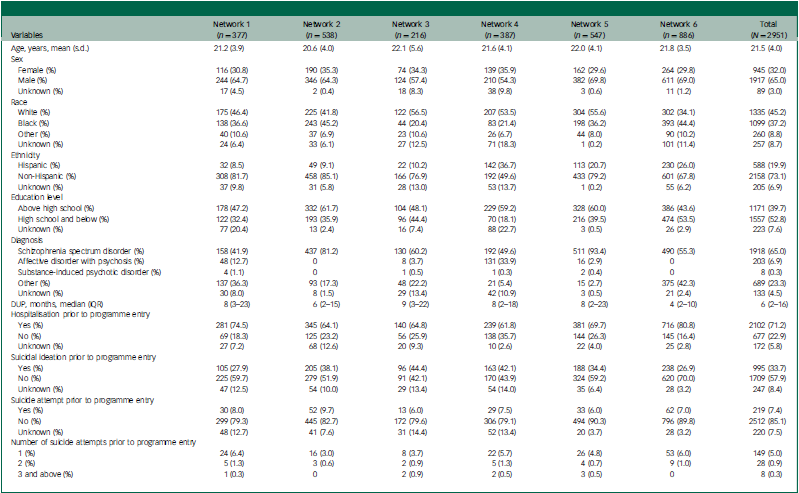
The sample (N = 2951) was young and diverse (Table 1). Mean age at admission was 21.5 years and 65% were male, with 45% identified as White, 37% as Black and 20% as Hispanic. Schizophrenia spectrum disorders were the most common diagnoses (65%). Median DUP was 6 months (interquartile range (IQR) 2–16) and 71% had a previous psychiatric hospitalisation. At admission, 34% reported suicidal ideation and 7% a suicide attempt in the previous 6 months. Among those with available data on number of attempts, most reported a single attempt. Participants lost to follow-up had higher baseline suicidal ideation than completers (38 v. 32%, p < 0.01), but attempt rates did not differ (8 v. 7%, p = 0.55).
Sample characteristics at admission to CSC, by network in EPINET

Table 1 Long description
The table presents sample characteristics at admission to CSC by network in EPINET. It includes data from six networks and a total column. The table has 18 rows and 7 columns. Column headers are Network 1, Network 2, Network 3, Network 4, Network 5, Network 6, and Total. Row labels include Age, Gender, Race, Ethnicity, Education level, Diagnosis, DUP, Hospitalisation prior to programme entry, Suicidal ideation prior to programme entry, Suicide attempt prior to programme entry, and Number of suicide attempts prior to programme entry. Each row provides specific data points for each network and the total. For example, the row for Age shows the mean age and standard deviation for each network and the total. The row for Gender breaks down the number and percentage of females and males in each network and the total. The table also includes data on race, ethnicity, education level, diagnosis, duration of untreated psychosis (DUP), hospitalisation prior to programme entry, suicidal ideation prior to programme entry, suicide attempts prior to programme entry, and the number of suicide attempts prior to programme entry.
CSC, coordinated specialty care; EPINET, Early Psychosis Intervention Network; DUP, duration of untreated psychosis; IQR, interquartile range.
As shown in Fig. 1, odds of suicidal ideation declined significantly over time relative to baseline (all p < 0.001), corresponding to approximately 76% lower odds by 24 months. Younger age (odds ratio per 1-year increase in age, 0.96, 95% CI 0.94–0.98), female sex (odds ratio for male 0.64, 95% CI, 0.55–0.75), White race (odds ratio 1.73, 95% CI 1.46–2.05), non-Hispanic ethnicity (odds ratio 1.50, 95% CI 1.22–1.84) and longer DUP (odds ratio 1.11 per year, 95% CI 1.07–1.15) were associated with higher odds of suicidal ideation.
Adjusted generalised estimating equation model results for suicidal ideation and attempts over 2 years of coordinated specialty care (CSC) (N = 2951). OR, odds ratio; DUP, duration of untreated psychosis.

Odds of any suicide attempt declined significantly over time relative to baseline (all p < 0.001), corresponding to approximately 85% lower odds by 24 months. Younger age (odds ratio per 1-year increase in age 0.92, 95% CI 0.88–0.96), longer DUP (odds ratio 1.08 per year, 95% CI 1.01–1.15) and previous psychiatric hospitalisation (odds ratio 1.72, 95% CI 1.13–2.61) were associated with higher odds of attempt (Fig. 1).
In the ZIP model examining suicide attempt frequency over follow-up, previous psychiatric hospitalisation was associated with a higher rate of suicide attempts over follow-up (incidence rate ratio (IRR) 4.40, 95% CI 1.52–12.80, p = 0.006), whereas being male was associated with a lower rate (IRR 0.33, 95% CI 0.13–0.82, p = 0.018). Baseline suicide attempts were also strongly associated with higher attempt rates over follow-up (IRR 7.30, 95% CI 3.86–13.81, p < 0.001). Other demographic and clinical variables were not significantly associated with attempt counts.
Six participants (0.2%) died by suicide during follow-up, all male, with a mean age of 25.4 years (range 19–30). Three were White, five were non-Hispanic, four had education beyond high school, three had a schizophrenia spectrum diagnosis and five had a previous psychiatric hospitalisation. Mean DUP was 6.2 months (s.d. 4.6; see Appendix).
Discussion
In this large, multisite cohort of individuals with FEP receiving CSC, suicidal ideation and attempts declined substantially over 2 years, with approximately 76% lower odds of ideation and 85% lower odds of attempts by 24 months, confirming previous evidence of reductions in suicidality during early intervention programmes. Reference Tahmazov, Bosse, Glemain, Nabbe, Guillou and Blachier5,Reference Phalen, Jones, Davis, Sarpal, Dickerson and Vatza7 The ethnic diversity of sample is an important strength, and the higher proportion of male participants is consistent with the sex distribution typically observed in FEP cohorts. Reference Phalen, Jones, Davis, Sarpal, Dickerson and Vatza7 At admission, 34% reported suicidal ideation in the preceding 6 months, underscoring high baseline risk because ideation may predict later suicidal behaviour. Reference Bertelsen, Jeppesen, Petersen, Thorup, ⊘hlenschlæger and Quach8 Suicide attempts were reported by 7% of participants, a rate somewhat lower than in previous cohorts, possibly reflecting differences in definitions and assessment windows. Reference Bertelsen, Jeppesen, Petersen, Thorup, ⊘hlenschlæger and Quach8,Reference Addington, Williams, Young and Addington9
Younger age was associated with increased risk, consistent with previous work showing elevated suicide risk early in the course of psychotic illness. Reference Bertelsen, Jeppesen, Petersen, Thorup, ⊘hlenschlæger and Quach8,Reference Nordentoft, Laursen, Agerbo, Qin, Høyer and Mortensen10 Being female was associated with higher odds of suicidal ideation and number of suicide attempts, consistent with previous evidence. Reference Austad, Joa, Johannessen and Larsen11 White and non-Hispanic participants had higher odds of suicidal ideation, although these differences are not well characterised in FEP and may also reflect differences in symptom reporting, cultural expression of distress, pathways to care or unmeasured factors such as patient–provider ethnic concordance. Reference Oluwoye, Davis, Kuhney and Anglin12
Longer DUP was associated with higher odds of ideation and attempts, consistent with previous evidence and a recent systematic review identifying longer DUP and depressive symptoms as key risk factors for suicidal behaviour in early psychosis. Reference Pompili, Serafini, Innamorati, Lester, Shrivastava and Girardi1,Reference Ricci, Sarni, De Berardis, Fraccalini, Martinotti and Maina13 This finding highlights the key role of early detection in supporting people with psychosis and strengthening pathways that reduce delays to CSC entry. Previous psychiatric hospitalisation was also associated with increased risk, probably reflecting greater illness severity, consistent with elevated risk during and following in-patient treatment. Reference Shrivastava, Berlemont, Campbell, Johnston, De Sousa and Shah14
Six participants died by suicide during follow-up (0.2%), a rate lower than in some previous FEP cohorts (e.g. 2.9% over 2 years), Reference Bertelsen, Jeppesen, Petersen, Thorup, ⊘hlenschlæger and Quach8 although lower rates have also been reported (e.g. 0.9% over about 2 years). Reference Robinson, Cotton, Conus, Schimmelmann, McGorry and Lambert3,Reference Addington, Williams, Young and Addington9 Direct comparisons are limited by differences in ascertainment and follow-up, because deaths were identified through discharge records and a substantial proportion of EPINET discharges reflected loss of contact. Reference Phalen, Smith, Jones, Reznik, Marti and Cosgrove15 All deaths occurred among males, consistent with broader evidence that males are more likely to die by suicide even though females more often present with suicidal behaviour. Reference Bertelsen, Jeppesen, Petersen, Thorup, ⊘hlenschlæger and Quach8 These deaths underscore the need for ongoing suicide risk monitoring during early psychosis treatment.
This study has several limitations. As an observational cohort without a comparison group, reductions in suicidality cannot be causally attributed to CSC. Depression was not included in adjusted models because of measurement variability and missingness, despite its relevance to suicidality. Reference Ricci, Sarni, De Berardis, Fraccalini, Martinotti and Maina13 Lifetime history and both method and lethality of suicide attempts were unavailable, limiting interpretation of gender differences. Suicide-related outcomes were assessed using clinician-rated CAB items derived from routine clinical workflows rather than from standardised, suicide-specific instruments, and DUP was based on clinician estimates of psychosis onset using available patient, family and record information. These measures may have introduced variability across sites and over time. Data on CSC team diversity was unavailable, limiting interpretation of ethnic differences in suicidal ideation. Follow-up declined substantially after 2 years, and participants lost to follow-up had higher baseline suicidal ideation than completers, suggesting possible selective attrition. Although missing data remain a challenge in LHS, these real-world settings provide unique opportunities for ongoing quality improvement. Reference Srihari and Keshavan6 More systematic use of evidence-based suicide risk assessment tools in early psychosis programmes may improve both clinical care and data quality in LHS.
In summary, suicide-related outcomes declined substantially during the first 2 years of specialty care in this large, multisite FEP cohort. However, individuals with longer DUP and previous hospitalisation remained at elevated risk. These findings underscore the importance of early detection, sustained suicide risk monitoring and the use of evidence-based approaches to suicide risk assessment and intervention in early psychosis treatment.
Supplementary material
The supplementary material is available online at https://doi.org/10.1192/bjo.2026.12103
Data availability
The data that support the findings of this study are available upon reasonable request from the EPINET National Data Coordinating Center (ENDCC). The data are not publicly available, and access is subject to EPINET approval, applicable institutional requirements and execution of required data-use agreements. The analytic code used in this study is available from the corresponding author upon reasonable request.
Author contributions
All authors listed contributed to the article and are in agreement with the manuscript. S.N.T. contributed to study conceptualisation, methodology, analysis and interpretation and wrote the original draft of the manuscript. Z.S. contributed to study methodology, analysis and interpretation and reviewing and editing the manuscript. F.L. contributed to study methodology, analysis and interpretation and reviewing and editing the manuscript. I.B., M.E.B., M.E.C., J.A.C., L.D., J.H., J.M.K., M.A.L., P.M.-K., T.A.N., D.Ö., D.R., A.S., S.V. and J.L.V. contributed reviewing and editing the manuscript. A.B. and V.H.S. contributed to study supervision and reviewing and editing the manuscript.
Funding
This work was supported by the National Institute of Mental Health under the following award numbers (R01MH120588; Breier, PI), (1R01MH120550-01A1; Bennett, PI) and (1P01MH139228-01; Bennett and Calkins, MPIs), R01MH120597; Dixon and Bello, MPIs, (5R01MH120555; PI: Niendam), (R01MH120599; Lopez, PI), (1R01MH120589; Vinogradov and Meyer-Kalos, MPIs), (R01MH120594; Robinson and Kane, MPIs) and (P50MH115846, Öngür and Hsu, MPIs). The ENDCC was supported by the National Institute of Mental Health under award no. 5U24MH120591. The work of the STEP Program was also supported by the National Institutes of Health (no. R01MH103831) and the Gustavus and Louise Pfeiffer Research Foundation. The funding sources had no role in the design and conduct of the study; collection, management, analysis and interpretation of the data; preparation, review or approval of the manuscript; and decision to submit the manuscript for publication. STEP was also funded by the State of Connecticut, Department of Mental Health and Addiction Services, but this publication does not express the views of the Department of Mental Health and Addiction Services or of the State of Connecticut.
Declaration of interest
None.


 Open access


eLetters
No eLetters have been published for this article.