


Artificial intelligence is increasingly woven into the fabric of political life. From campaign strategy and voter engagement to policy analysis and governance, a growing range of AI-based systems now influence how political actors communicate, mobilize, or make decisions. Political science has begun to engage with these changes: as figure 1 shows, the number of references to “AI” or “artificial intelligence” in the titles or abstracts of political science publications has grown rapidly since 2020, mirroring developments across other academic disciplines.
Tracking AI in Political Science Publications, 1990–2025
Note. Yearly count of publications in American Journal of Political Science, American Political Science Review, Annual Review of Political Science, British Journal of Political Science, Journal of Politics, and Perspectives on Politics from 1990 to 2025 that mention the following terms: “artificial intelligence,” “machine learning,” “large language model,” or “LLM.” Vertical dashed lines indicate key AI milestones: AlexNet (2012), which marked the breakthrough of deep learning in image recognition; AlphaGo (2016), the first AI to defeat a Go world champion; and GPT-3 (2020) and GPT-4 (2023), which accelerated the development and public awareness of large language models.

Figure 1 Long description
The x-axis represents Publication Year from 1990 to 2025 in 10-year increments. The y-axis represents Yearly Count from 0 to 30 in increments of 10.
* From 1990 to approximately 2012, the line remains flat at near-zero counts.
* A vertical dashed line at 2012 is labeled AlexNet (2012). Following this, the line shows a slight upward movement.
* A second vertical dashed line at 2016 is labeled AlphaGo (2016). After this point, the line begins a steady upward trend.
* A third vertical dashed line at 2020 is labeled G P T-3 (2020). The count is approximately 5 at this point.
* A fourth vertical dashed line at 2023 is labeled G P T-4 (2023). Between 2020 and 2023, the line rises sharply to approximately 13.
* From 2023 to 2025, the line exhibits an exponential surge, ending at a peak of over 35 publications per year.
This growth in scholarly attention reflects a broader transformation. As AI systems are incorporated into the platforms and services that people use to read news, communicate with others, and participate politically, they increasingly become part of how citizens obtain information, form judgments, and encounter opportunities for political action.Footnote 1 These systems include two closely related and often overlapping types. Generative assistants, such as chatbot-style tools embedded in search engines or writing interfaces, help users interpret political information and put their views into words. Ranking and recommendation systems, in turn, influence which political information and calls to action people see. Both types operate through familiar channels, including news feeds, search results, messaging tools, and civic platforms, through which citizens learn about politics and decide whether and how to act.Footnote 2
These developments raise important questions for democratic theory about what it means for citizens to form independent judgments and how these, in turn, translate into political action. Addressing these questions requires reexamining both democratic ideals and empirical realities. While normative accounts envision citizens as rational and autonomous agents, decades of research in political behavior have shown that people are imperfect and limited decision makers. They rely on cognitive shortcuts and defer to trusted sources, and they face persistent barriers to participation rooted in cognitive, socioeconomic, and institutional constraints.
AI systems intersect with these well-documented patterns in new ways, changing both how citizens form political judgments and how they act on them, sometimes in opposing directions within the same interaction. We refer to this tension as the “autonomy paradox,” which manifests in two complementary ways. In one version, AI systems lower barriers to political participation, while simultaneously weakening the independence of belief and preference formation. For instance, voters may rely on chatbot-driven tools to summarize policy positions, compare candidates, or clarify the implications of complex proposals. In this case, participation may become easier through more accessible information, smoother communication, or the lowering of barriers to expression (see also Bode Reference Bode2017). However, as citizens increasingly rely on these systems, what they think and how they express those views are shaped in the same interaction with the tools they use. Overall, citizens may participate more actively but on preferences shaped through those interactions, because the same systems that help interpret political information also shape how those views are expressed and circulated.
In an alternative version of the paradox, AI-based systems can support careful political judgment while making it harder for citizens to act on those judgments in ways that have political impact. For instance, a citizen may use AI tools to clarify their views on a political issue and seek opportunities to engage, only to find that calls to action, meetings, or mobilization efforts rarely come to their attention because targeting systems prioritize individuals predicted to be more likely to respond. Another citizen may even articulate their position by signing or sharing a petition aligned with their views, only to see that expression fail to gain traction beyond a narrow audience. In both these cases, citizens remain informed and motivated, but the same systems that help them express their views also shape what they encounter and how those views circulate, ultimately determining whether their actions reach others and carry political consequence.
These paradoxes are rooted both in the properties of AI systems and in how people use and adapt to them. While AI builds on existing communication technologies, it does more than simply deliver content or transmit cues. Unlike earlier algorithmic systems that primarily selected among human-produced political messages, current AI systems now participate directly in the construction and dissemination of political expression. These systems are interactive and adaptive. Generative tools influence how citizens articulate political views, while ranking and recommendation systems organize what they encounter and how those views circulate.Footnote 3 Together, they affect both how citizens put political judgments into words and which messages or opportunities for action become consequential, often within the same interaction. Their effects on political attitudes and behavior are therefore complex and variable, differing across individuals, uses, and contexts. This means that it becomes increasingly difficult to tell whether political views reflect citizens’ own reasoning or the systems they interact with.
Understanding these dynamics means rethinking how political behavior research and democratic theory conceptualize citizenship and autonomy, rather than abandoning their core assumptions.Footnote 4 In what follows, we develop a framework for analyzing how interactions between citizens and AI systems shape democratic life by distinguishing between two dimensions of autonomy: the authenticity of belief formation and the agency to act on those beliefs. The framework identifies key features of human–AI interaction that shape both, providing a conceptual foundation for empirical research. Whereas much existing scholarship focuses on what AI systems do to political behavior, we focus on how citizens are exposed to and interact with these systems and how these patterns of interaction reshape fundamental questions about learning, judgment, participation, and democratic legitimacy.
Democracy’s Foundations and the Limits of Citizen Autonomy
Much of the existing analysis of artificial intelligence and its impact on people and societies begins with the technology itself—what it is, what it can do, and where it is headed—and only then turn to the consequences for social, economic, or political life. This way of thinking about the relationship between technology and democracy carries an assumption—that AI can be treated as sufficiently self-contained for its role in shaping democratic life to be assessed from the outside. However, this approach risks obscuring how these systems are entangled with, and reshape, the conditions under which representative democracy operates. Rather than standing apart from democratic life, AI is increasingly embedded within broader systems of governance that organize how information is processed and collective decisions are made (Farrell Reference Farrell2025).
We therefore begin from the principles that define democratic politics. Chief among these are Enlightenment-era conceptions of individuals as rational and autonomous agents, endowed with inherent rights and capable of self-government.Footnote 5 Within this framework, autonomy is an essential, if not the core, condition for the legitimacy of political institutions and individual citizenship. A helpful way to parse the concept is to distinguish between two interrelated dimensions: autonomy-as-authenticity and autonomy-as-agency (Prunkl Reference Prunkl2022; Reference Prunkl2024).Footnote 6
Autonomy-as-authenticity refers to the capacity of individuals to freely form beliefs, values, and preferences that are genuinely their own and formed through reflection rather than manipulation. In contrast, autonomy-as-agency is about the ability to act effectively on those beliefs in both private and public spheres.Footnote 7 These two dimensions of autonomy correspond to the distinction in political behavior research between mental states (e.g., attitudes, opinions, beliefs) and preferences on one hand and political expression and action on the other.
Autonomy has strong normative appeal, and empirical political scientists have long been interested in the extent to which democratic theory’s precepts hold true in the real world (Dahl Reference Dahl1989). At least since Converse’s (Reference Converse and Apter1964) seminal study, which showed that most individuals lack ideologically structured belief systems and often express unstable or incoherent views, scholars have questioned the premise that people are able to form and maintain autonomous, consistent political preferences and act on them freely. His findings catalyzed a series of responses to make sense of citizens’ apparent imperfections: some attributed instability of opinions and beliefs to measurement error (Achen Reference Achen1975), whereas others emphasized aggregate stability (Fiorina Reference Fiorina1981; Page and Shapiro Reference Page and Shapiro1992) or sought to develop more realistic models of opinion formation (Zaller Reference Zaller1992).
More recent work has further challenged the premise of citizen autonomy, with researchers documenting how citizens rely on identities more than policy preferences to guide choices (Kinder and Kalmoe Reference Kinder and Kalmoe2017; Yeung and Quek Reference Yeung and Quek2024), adjust their attitudes to match the positions of party elites (Lenz Reference Lenz2012), and process information through affective heuristics and partisan filters (Achen and Bartels Reference Achen and Bartels2016; Lodge and Taber Reference Lodge and Taber2005). Speaking generally, these findings suggest that political reasoning is often affected more by social identities and emotional resonance than by deliberation, facts, or objective evaluation.
In parallel with research on political attitudes, decades of scholarship have shown that citizens’ ability to act on their preferences is constrained by structural and cognitive limitations. Socioeconomic inequalities create persistent participation gaps that systematically favor more privileged groups (Brady, Verba, and Schlozman Reference Brady, Verba and Schlozman1995; Schlozman, Verba, and Brady Reference Schlozman, Verba and Brady2012). Institutional rules like registration requirements, voter ID laws, and gerrymandering influence whose preferences are more likely to find expression and be represented (Blais Reference Blais2006; Hajnal, Lajevardi, and Nielson Reference Hajnal, Lajevardi and Nielson2017; Lijphart Reference Lijphart1997). Mobilization, a key driver of participation, is unequally distributed, with lower-resource communities commonly receiving fewer targeted appeals (Brady, Verba, and Schlozman Reference Brady, Verba and Schlozman1999; Rosenstone and Hansen Reference Rosenstone and Hansen1993). Media institutions, too, matter by influencing political awareness and salience through agenda-setting and gatekeeping (Entman and Usher Reference Entman and Usher2018; McCombs and Shaw Reference McCombs and Shaw1972), while elite-dominated networks often move policy outcomes in ways that privilege affluent citizens over those with fewer resources (Enns and Wlezien Reference Enns and Wlezien2011; Gilens and Page Reference Gilens and Page2014). At the individual level, limited political knowledge and low efficacy hinder autonomous engagement, even as citizens rely on cues and heuristics to navigate complex information environments (Achen and Bartels Reference Achen and Bartels2016; Oser et al. Reference Oser, Grinson, Boulianne and Halperin2022; Verba, Schlozman, and Brady Reference Verba, Schlozman and Brady1995).
Taken together, decades of research suggest that citizen autonomy has long fallen short of democratic ideals, well before the advent of artificial intelligence, because citizens face persistent cognitive, structural, and institutional barriers to forming and acting on their preferences. Recent AI tools appear to offer remedies to these constraints by helping people locate information, clarify their views, and act on opportunities for engagement. On the surface, such tools seem to support and even strengthen citizen autonomy. However, their effects are more complicated because generative tools and AI-based recommendation systems operate at multiple points in political behavior. The former affect how citizens interpret information and express political judgments, while the latter use a mix of behavioral and content signals to determine what information citizens encounter and which participation opportunities come to their attention. Rather than pushing autonomy in a single direction, these systems produce mixed and sometimes asymmetric effects on belief formation and political action, thus raising important questions about what autonomous citizenship means as political life becomes increasingly organized by AI.
The AI Difference
Understanding whether AI remedies or exacerbates well-known constraints on citizen autonomy requires examining how it differs from earlier technologies. Much of the initial research on AI has treated it as the next step in a familiar technological trajectory, from print and broadcast media to online platforms and social media. In this view, AI extends long-standing patterns in how technologies structure access to political information. Early empirical work reflects this continuity, examining effects on who encounters what, how issues are presented, and how messages are customized for individuals (Chen et al. Reference Chen, Kalla, Le, Nakamura-Sakai, Sekhon and Wang2025; Costello, Pennycook, and Rand Reference Costello, Pennycook and Rand2024; Hackenburg et al. Reference Hackenburg, Ibrahim, Tappin and Tsakiris2025; Simchon, Edwards, and Lewandowsky Reference Simchon, Edwards and Lewandowsky2024).
Although these continuities are important, treating AI simply as a successor to earlier media technologies mischaracterizes its distinctive implications for political behavior. Traditional mass media relied on centralized production and one-way communication. Even as the early internet expanded opportunities for interaction, content was organized through visible human decisions. With the rise of social media, automated systems began personalizing what users were shown, filtering information based on inferred interests and behavioral histories.
AI builds on this trajectory but also transforms it. Earlier systems primarily shaped what political information people encountered; contemporary AI systems increasingly participate in how political views are interpreted and expressed through generative assistants that support reasoning and articulation, as well as ranking and recommendation systems that organize how those outputs circulate. When a citizen uses an AI tool to draft a letter to a representative or formulate an argument in an online discussion, the resulting expression reflects both the citizen’s prompt and the linguistic patterns, framings, and priorities learned from the system’s training data. The boundary between what the citizen contributes and what the system supplies—arguments and framings—is often unclear, even to the user (Gabriel et al. Reference Gabriel, Manzini, Keeling, Hendricks, Rieser, Iqbal and Tomašev2024). This means that AI is not just a tool citizens use but is also part of the process through which reasons and arguments are formed and expressed (Argyle et al. Reference Argyle, Busby, Bail, Gubler, Howe, Rytting, Sorensen and Wingate2023). This blurring of boundaries differs from familiar forms of political influence, which are typically treated as analytically separable from citizens’ own reasoning; in interactions with AI systems, that assumption may no longer hold.
An additional complication is that citizens often encounter interpretation and selection through the same tools. When generative assistants retrieve and summarize information during use, they do more than help citizens put their opinions into words. They also affect which sources are consulted, how political information is organized, and which arguments or conclusions appear reasonable. As a result, a single interaction can influence what citizens learn, how they evaluate it, and which opportunities for political action they perceive and pursue. Even where it remains analytically useful to distinguish between generative assistance and ranking or recommendations, these processes are often experienced together in the formation of political judgments and in shaping which opportunities for action citizens perceive.
AI systems also differ structurally from traditional political intermediaries in ways that matter for how citizens experience political reasoning and action. Citizens have always relied on parties, elected officials, interest groups, and media to help them interpret information or act on their behalf. In representative democracies, these intermediaries operate within recognized institutional structures and are subject to authorization and accountability, including contestation and replacement (Mansbridge Reference Mansbridge2003; Pitkin Reference Pitkin1967). By contrast, both generative tools and ranking and recommendation systems adapt to individuals continuously and largely opaquely, without comparable mechanisms of contestation or public justification.
At the same time, the political information that citizens see increasingly reflects their own past behavior. Every click, pause, and share generate data that platforms use to decide what to show next (Simchon, Edwards, and Lewandowsky Reference Simchon, Edwards and Lewandowsky2024; see also Bond and Messing Reference Bond and Messing2015). Although this personalization builds on familiar social media dynamics, newer ranking and recommendation systems go a step further, interpreting the substance of what is said to identify its political sentiment or thematic relevance. Citizens navigate these systems largely unaware that the political information reaching them has already been shaped by algorithmic filtering that reflects their own past behavior and that some of it was also produced with AI assistance.
This changes how political information is presented and which messages travel. Research shows that certain features of political expression like fluency, emotional coherence, and recognizable argumentative forms reliably attract attention on platforms designed to reward engagement and repeated use (Berger and Milkman Reference Berger and Milkman2012; Brady et al. Reference Brady, Wills, Jost, Tucker and Van Bavel2017; see also Barberá et al. Reference Barberá, Jost, Nagler, Tucker and Bonneau2015). Citizens who use generative assistance often produce exactly these features. Messages shaped in this way are therefore more likely to circulate widely on platforms that reward these features over more idiosyncratic or unconventional expression (Adilazuarda et al. Reference Adilazuarda, Mukherjee, Lavania, Singh, Aji, O’Neill, Modi and Choudhury2024; Lu, Song, and Zhang Reference Lu, Song and Zhang2025). This creates a subtle asymmetry: a citizen crafting a carefully reasoned but stylistically distinctive argument may find it reaches fewer people than a neighbor’s AI-polished message, not because the platform directly favors AI content but because it rewards the linguistic patterns that AI assistance produces.Footnote 8 This matters because political judgments are often clarified and stabilized through the act of expression itself.
Political reasoning does not reliably come first and expression second, however. In practice, citizens often clarify, refine, and even discover what they think through the act of putting their views into words. Political views are therefore not only expressed in language but also formed through it. Language is not a neutral vessel for pre-formed thoughts but the medium through which political concepts, arguments, and identities take shape (Summerfield et al. Reference Summerfield, Argyle, Bakker, Collins, Durmus, Eloundou, Gabriel and Ganguli2025). The available vocabulary, metaphors, and frames influence what political positions become thinkable, which arguments appear reasonable, and how conflicts are understood (Edelman Reference Edelman1964; Lakoff Reference Lakoff2002). In this respect, whereas earlier media primarily influenced which issues citizens thought about and how those issues were portrayed, generative AI can participate directly in constructing the linguistic forms through which citizens articulate what they experience as their own political opinions (Gurgurov et al. Reference Gurgurov, Trinley, Vykopal, van Genabith, Ostermann and Zamparelli2025).
Taken together, then, the same systems that assist citizens in thinking and expression also determine which information circulates and which forms of participation reach wider audiences. The AI that helps a citizen draft a message often operates within, or feeds directly into, platforms that decide whether anyone will read it. The feeds that present political content influence when and why citizens turn to AI tools in the first place. This two-way interaction means that both the information citizens receive and how they express themselves are affected by systems that adapt continuously to their behavior.
These dynamics create significant challenges for democratic representation, accountability, and participation. The tools that help citizens express themselves and the systems that determine whose expressions circulate both inherit biases from their training data and operate through forms of prioritization that users rarely understand. At the same time, they influence which opinions are disseminated, which arguments appear reasonable, and which preferences become salient. Together, these features—how AI participates in political reasoning, how its operations remain opaque in ways that differ from traditional intermediaries, and how generative and recommendation functions operate in combination—change how citizens form preferences and act on them. In doing so, they set the conditions under which autonomy can be unevenly redistributed between belief formation and political action.Footnote 9
The Autonomy Paradox
Depending on how AI systems are designed and deployed, and how people engage with them in everyday life, citizens may find their political autonomy both enabled and constrained at the same time. This reflects a deeper logic guiding how these systems operate. Because tools that assist interpretation and expression now operate alongside systems that structure exposure, reach, and opportunity, the same interaction can strengthen one dimension of autonomy while weakening the other. This autonomy paradox describes situations in which the formation of political views and the capacity to act on them—autonomy-as-authenticity and autonomy-as-agency—come apart for the same individual in the same interaction.
The autonomy paradox differs from earlier accounts of how outside forces shape citizens’ judgment and from dual-use frameworks that ask whether a technology ultimately helps or harms democratic citizenship. Those approaches assume that the source of influence is, in principle, separable from the citizen’s own reasoning. Familiar forms of political influence—for example, citizens following party positions, responding to advocacy campaigns, or being mobilized by outside actors—can also produce participation that outpaces independent judgment. However, party cues, campaign appeals, and advocacy messages originate from actors that can be named, and they flow through channels distinguishable from the citizen’s own thinking, even when citizens do not consciously register them as such. The influence is discrete: it has a source that can be identified, contested, or traced.
The autonomy paradox arises when this assumption no longer holds in interactions with AI systems. As a result, approaches to political influence that treat persuasion, delegation, and mobilization as operating through identifiable actors and channels risk misattributing how political preferences are formed and how political action is produced under conditions shaped by AI systems because the processes that shape them are no longer separable in the same way.
Although many people recognize that recommendation systems curate what they see, that some platforms lean politically, or that these systems tend to reinforce existing views, general awareness of how a system works is not the same as being able to isolate its influence on any specific belief. Citizens who know their feed is curated still cannot recover what they have not seen or trace which of their political intuitions reflects the pattern of what has been put in front of them over time. When generative tools then help those citizens put their views into words, many have no working model of how those outputs have been shaped by training data and design choices. A party cue can be set aside, and citizens can try to reason independently, look elsewhere, or simply ignore it. There is no equivalent baseline to return to with the accumulated effects of curated information and AI-assisted expression: the influence has already become part of how the political world appears to them and part of the language they use to express what they think.
Citizens are, in this sense, coauthors of their own political influence. The influence they exercise is not simply imposed from outside but generated through interactions in which their own inputs and the system’s outputs are intertwined and experienced as their own, without clear reference points that would allow them to distinguish between the two.
The autonomy paradox takes two forms, depending on which dimension of autonomy is enhanced and which is constrained. In the first, citizens who use AI to engage more fully in politics may find participation easier, even as the independence of their views becomes harder to maintain. Those who regularly turn to AI assistants to make sense of a complex policy debate or who rely on curated feeds to stay informed may find that their views have solidified, making them feel confident and well grounded, but without being able to distinguish how much of that confidence reflects their own reasoning and how much reflects what systems repeatedly present to them, often in standardized and emotionally compelling forms.
In the second form of the paradox, citizens who think carefully and independently about politics may nonetheless find that converting those views into meaningful political action proves difficult. Curation shapes not only what citizens see but also which opportunities to act appear available to them: those who develop clear views on a local issue may find that calls to action, meetings, or mobilization efforts rarely appear in their informational streams, because targeting and recommendation systems prioritize individuals predicted to be more likely to respond. At the same time, a citizen who attempts to build support—for instance, by creating an online group or event—may find that recommendation systems do not bring it to the attention of potentially interested others. The content exists, the citizen has acted, but whether anyone sees it depends on systems that structure visibility and reach in ways individuals cannot directly control.Footnote 10 These citizens maintain the authenticity of their beliefs, but their agency is constrained because the systems they rely on to participate shape whether their actions have political consequence.
Existing frameworks are not designed to account for these situations. A citizen whose participation increases while their views are shaped through interaction with AI systems may appear, from the outside, as an active and self-directed actor. Yet, this case fits uneasily within traditional categories: it is not persuasion in the usual sense, because the source of influence cannot be isolated as a distinct input to the citizen’s reasoning within the interaction; nor is it delegation in the conventional sense, because the system’s contribution cannot be disentangled from the citizen’s own reasoning in a way that would allow it to be identified or set aside; and it is not mobilization, because action is not simply a response to identifiable external appeals. Conversely, a citizen whose independently formed views fail to reach others due to algorithmic filtering may appear disengaged or ineffective when, in fact, their capacity to act is constrained by the systems through which participation is routed. Because these cases involve the joint shaping of preferences and political action, existing approaches misread system-shaped participation as autonomous engagement and system-shaped preferences as independently formed views.
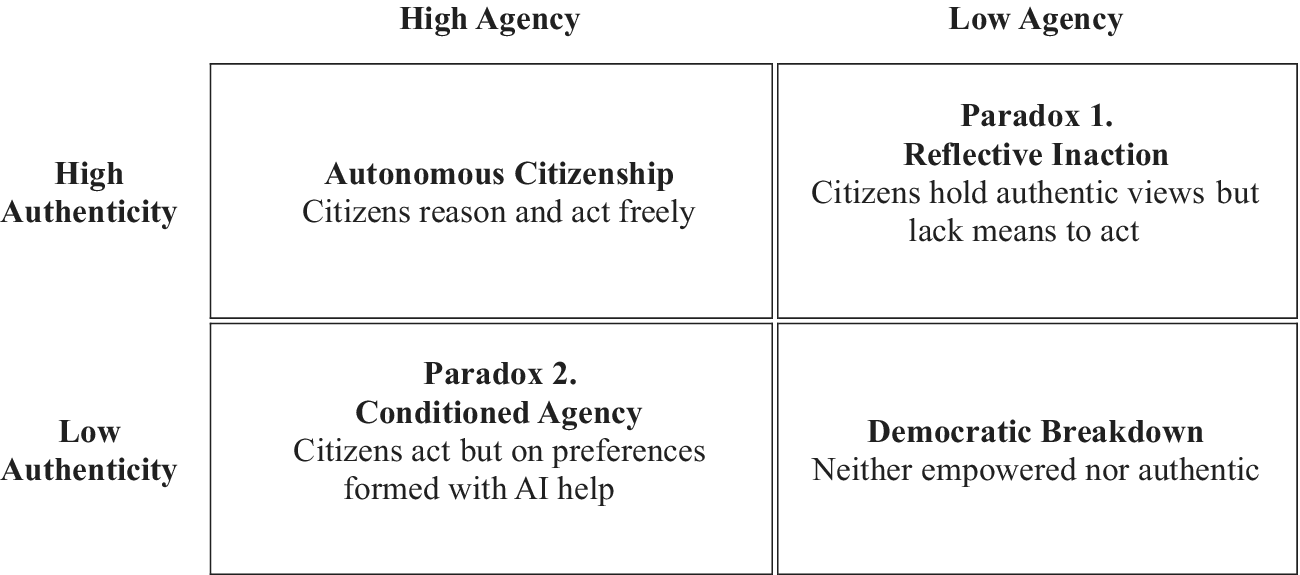
Figure 2 maps these dynamics across two dimensions. The vertical axis represents agency, whereas the horizontal axis captures authenticity. When both are high, citizens approach the democratic ideal: they reason freely and can act on their convictions. The two paradoxes occupy opposite corners. In reflective inaction (upper right), people hold authentic views but lack effective means to act on them. In conditioned agency (lower left), people act frequently but on preferences developed via interaction with AI systems. The most troubling outcome appears in the lower-right quadrant—democratic breakdown—where citizens neither form views independently nor possess meaningful channels for political expression.
The Two Paradoxes in Algorithmic Democracy

Figure 2 Long description
The matrix is defined by a horizontal axis for Agency (High Agency on the left, Low Agency on the right) and a vertical axis for Authenticity (High Authenticity on the top, Low Authenticity on the bottom).
* Top-Left Quadrant (High Agency, High Authenticity): Autonomous Citizenship. Citizens reason and act freely.
* Top-Right Quadrant (Low Agency, High Authenticity): Paradox 1. Reflective Inaction. Citizens hold authentic views but lack means to act.
* Bottom-Left Quadrant (High Agency, Low Authenticity): Paradox 2. Conditioned Agency. Citizens act but on preferences formed with A I help.
* Bottom-Right Quadrant (Low Agency, Low Authenticity): Democratic Breakdown. Neither empowered nor authentic.
Individuals often move between these states over the course of everyday political engagement. The same person might experience conditioned agency when responding to algorithmically prompted petitions in the morning and then shift to reflective inaction in the afternoon when trying to mobilize around an issue the platform does not highlight. The state that individuals experience at any given moment depends on their digital literacy, resources, and political sophistication; the specific AI systems they are exposed to and use; how they interact with those systems; and what they are trying to accomplish. Understanding this movement across autonomy outcomes helps explain what is at stake—not simply that some citizens benefit from AI while others suffer but that AI systems can simultaneously strengthen and undermine autonomy for the same person across different dimensions and interactions.
Existing work on AI and democracy has largely approached these questions by asking whether AI ultimately strengthens or undermines democratic citizenship. Research on the loss of meaningful control and dual-use technologies, for example, highlights the risk that advanced systems can expand human capacities while simultaneously weakening people’s control over key decisions (Bales Reference Bales2025; Kulveit et al. Reference Kulveit, Douglas, Ammann, Turan, Krueger and Duvenaud2025; OECD 2025). Related concerns appear in studies of AI systems designed to support democratic deliberation, where treating citizen views as inputs to be aggregated or optimized, rather than positions formed through reflection and exchange, risks undermining the authenticity of democratic participation (Revel and Pénigaud Reference Revel and Pénigaud2025).Footnote 11
The autonomy paradox builds on this body of work while shifting the level of analysis. Rather than asking whether AI strengthens or undermines democracy overall, we examine how it redistributes political autonomy within everyday interactions, even in the absence of overt coercion, replacement, or intentional manipulation. Our framework complements these approaches by specifying how such tensions arise within democratic political behavior. It brings into clearer focus patterns that broader dual-use framings can overlook: citizens who deliberate carefully but lack effective avenues for action, and citizens who act frequently on preferences developed in collaboration with the systems they rely on. Identifying these patterns helps distinguish when political views and actions can reasonably be attributed to citizens themselves and when they reflect the structures through which citizens encounter and act on politics.
A Taxonomy of Citizen–AI Engagement in Political Life
Because democratic citizenship in the age of AI is actively constructed through human choices and behaviors, how citizens use and respond to these systems is central to understanding autonomy outcomes. Specifically, how people collaborate with, rely on, and think about AI systems influences whether and which dimension of autonomy is reinforced or undermined. To investigate these paradoxes empirically, we therefore need a way to characterize citizen–AI interaction in political life.
As a baseline, we can distinguish between two types of interactions (Mollick Reference Mollick2024). In the first, AI functions as a support tool for bounded, task-based uses. Citizens might, for example, turn to an LLM platform to summarize political positions, translate campaign materials, or compare policy proposals. In these cases, users typically initiate the interaction and remain aware that they are relying on an AI tool. However, even when use is deliberate and limited, AI outputs are not neutral: summaries and reformulations inevitably reflect the patterns, priorities, and biases of the training data on which systems are built. As a result, such tools may support sense-making while still subtly shaping evaluation, framing, or emphasis in ways users do not fully recognize.Footnote 12 The second type involves more integrated interactions in which AI systems anticipate preferences and structure how citizens encounter political information and opportunities for action. Personalized news feeds, recommendation systems, and algorithmic messaging determine what users see and when, often without users’ full awareness of how those systems operate.
These two types of interactions are not rigid user categories but recurring ways in which citizens use and depend on these systems that vary across individuals, systems, and contexts.Footnote 13 To understand how they shape autonomy, we move from these broad interaction patterns to a set of underlying dimensions that capture how citizens form political views and act on them when AI is involved. Four dimensions follow directly from the autonomy paradox by identifying where control over judgment and action is located in human–AI interaction: cognitive delegation, transparency and awareness, engagement initiation, and critical engagement.
Cognitive delegation concerns how much interpretive or decision-making work citizens hand over to AI systems, raising questions about whether political preferences remain the product of independent reflection. Transparency and awareness address whether citizens recognize how AI contributes to their reasoning: it bears on their ability to assess, contest, or resist its influence. Engagement initiation focuses on whether political action begins with citizens’ own purposes or with system-generated prompts, shaping where agency is located. Critical engagement distinguishes cases in which citizens actively evaluate AI outputs from those in which they accept them with little scrutiny, thereby separating uses that support independent judgment from those that risk substituting for it—a dynamic recently described as “cognitive surrender” in which users come to rely on AI-generated reasoning without independent evaluation (Shaw and Nave Reference Shaw and Nave2026). Taken together, these dimensions describe how patterns of interaction with AI can strengthen or weaken both the authenticity of political beliefs and the capacity to act on them. Table 1 summarizes these dimensions and their implications.
Human–AI Interactions and Their Impact on Citizen Autonomy

Table 1 Long description
The table consists of four columns: Dimension, Description, Potential implications for authenticity, and Potential implications for agency.
* Row 1: Cognitive delegation. Description: Degree to which users offload reasoning or information processing to A I. Authenticity: High delegation can undermine reflective preference formation. Agency: May increase efficiency in taking political action.
* Row 2: Transparency and awareness. Description: Extent to which users are aware of how A I outputs are generated, filtered, or retrieved. Authenticity: Low transparency or awareness obscures how beliefs are formed. Agency: Low transparency or awareness may reduce perceived control or accountability.
* Row 3: Engagement initiation. Description: Whether political engagement is initiated by the user or prompted by the system. Authenticity: A I-prompted engagement may not reflect genuine user interests or priorities. Agency: A I prompts may increase participation but in algorithmically determined directions.
* Row 4: Critical engagement. Description: Extent to which users reflect on A I outputs or passively accept and internalize them. Authenticity: Critical users more likely to retain authentic preferences; low reflection may reduce independent thinking. Agency: May moderate effects of systematic distortions; passive users more likely to follow system suggestions.
Although analytically distinct, we expect these dimensions to co-occur empirically. For example, we expect task-based uses of AI tools to be more likely to involve high awareness and critical reflection, whereas integrated systems are more likely to combine high delegation and limited critical engagement or awareness. In systems that incorporate retrieval or browsing, transparency involves whether users understand how sources are selected, ranked, and synthesized during interaction and not only how text is generated. Importantly, these interaction patterns provide conceptual tools for empirical analysis of the changing relationship between citizens and AI. When users maintain high awareness and critical engagement while using AI as a discrete tool, the technology can strengthen existing capacities for political reasoning and participation. But when AI operates through integrated systems that prompt engagement and generate content with minimal user reflection, it may gradually remake or even replace the processes through which citizens develop authentic political beliefs and exercise purposeful agency. Combined, these patterns help distinguish situations in which AI use aligns with autonomous citizenship from those in which it gives rise to the asymmetric outcomes captured by the autonomy paradox. They also provide the foundation for a research agenda that examines how AI reshapes core processes of democratic citizenship.
A Research Agenda for AI and Political Autonomy
Building on this framework, we turn to its implications for empirical research. Early work has primarily approached AI as an independent variable, testing whether exposure to AI-generated content affects political views or reduces polarization (Argyle et al. Reference Argyle, Busby, Bail, Gubler, Howe, Rytting, Sorensen and Wingate2023). This emerging literature extends a long tradition that treats the information people encounter as exogenous and explains outcomes with the help of individual-level differences. Our framework departs from this approach by treating AI not as an external source of influence but as part of the interaction through which political views and actions are formed.
When systems continually adjust what citizens encounter based on their past behavior, exposure itself becomes endogenous to prior choices. What people see is filtered by systems that rank and order information, and what they say is increasingly composed by tools that assist in generating and rephrasing political language in individualized ways. As a result, autonomy is no longer simply a matter of exposure or personal capacity but of how citizens’ interactions with these systems shape both how they form political views and act on them.
Although scholarship has begun to move beyond simple exposure models to examine how citizens interact with AI systems in more sustained ways, much of this work to date has focused on purpose-designed tools for structured deliberation, such as AI-assisted systems for preference elicitation, opinion aggregation, or consensus building (Fish et al. Reference Fish, Gölz, Parkes, Procaccia, Rusak, Shapira and Wüthrich2023; Revel and Pénigaud Reference Revel and Pénigaud2025; Tessler et al. Reference Tessler, Bakker, Jarrett, Sheahan, Chadwick and Koster2024). Our focus complements this literature by shifting attention from specially constructed deliberative settings to the ongoing, embedded interactions through which AI systems help organize political life outside the lab.
The framework does not require that every study capture both dimensions at once. Although these processes are intertwined in practice, distinguishing how citizens form views from how they act on them makes the phenomenon tractable, allowing each to be examined separately while remaining connected through patterns of interaction. At the same time, the framework directs attention to a common issue: the conditions under which engagement with AI systems strengthens or weakens citizens’ ability to form their own views and act on them. These dimensions—how much interpretive work citizens hand over to AI, whether they recognize how AI shapes their reasoning, whether engagement begins with their own purposes or with system-generated prompts, and how critically they evaluate AI outputs—capture key forms of variation in these interactions. They describe how political views are continuously shaped and how political expression is co-produced through human–AI engagement.
Treating variation in how citizens use and respond to these systems not as background noise but as central to understanding political behavior promises to yield three key insights: it treats autonomy as an empirical outcome, rather than an assumption; it identifies the specific mechanisms through which interaction with AI systems shapes how citizens form views and act on them; and it connects these dynamics to long-standing constraints on participation in ways that clarify when they reproduce familiar tensions in democratic life and when they introduce genuinely new ones. We apply the framework to belief formation and participation in turn.
Political Belief Formation and Reasoning
Political belief formation raises a central question of authenticity: When reasoning is shared between citizens and AI systems, under what conditions do political beliefs remain genuinely one’s own? Decades of research in political behavior show that citizens rely on motivated reasoning, cues, partisan filters, and selective exposure when forming beliefs. Interaction with AI systems changes the conditions under which these familiar processes operate by introducing systems that participate directly in interpretation, comparison, and articulation.
Traditional heuristics offer a useful contrast. When people use party cues or follow elite signals, the reliance is typically explicit in that the source of the position is identifiable as external to the individual, even if the underlying arguments are not evaluated. Reasoning produced through interaction with AI systems operates differently. It can feel like one’s own thinking in that it is coherent, persuasive, and seemingly understood, even when the citizen has offloaded actual interpretive work to a machine (Kosmyna et al. Reference Kosmyna, Hauptmann, Yuan, Situ, Liao, Beresnitzky, Braunstein and Maes2025). People may feel informed and competent, even as they remain dependent on processes they neither control nor comprehend.
Research on heuristic processing suggests that beliefs formed through active elaboration tend to be more stable than those based on peripheral cues (Petty and Cacioppo Reference Petty and Cacioppo1986). This distinction helps clarify how citizens may engage with AI systems in forming political judgments. When people use AI tools to explore multiple arguments while retaining control over the reasoning process, belief formation may resemble systematic processing and produce more stable views. By contrast, when citizens passively accept AI-generated outputs such as summaries or conclusions, belief formation may more closely resemble heuristic acceptance, yielding more malleable or weakly held beliefs (Kosmyna et al. Reference Kosmyna, Hauptmann, Yuan, Situ, Liao, Beresnitzky, Braunstein and Maes2025).
At the same time, differences in belief formation cannot be explained solely by how much cognitive work citizens delegate to AI. Whether engagement is initiated by the citizen through purposeful questioning or shaped by system-generated prompts and recommendations also has the potential to alter how beliefs are experienced and sustained. Ultimately, the question is whether citizens recognize how AI systems participate in their reasoning; namely, whether they understand that generative tools produce plausible text based on statistical patterns, rather than verified facts, and that ranking and recommendation systems filter information based on predicted engagement, rather than relevance or accuracy.
Panel studies tracking belief stability over time could test how cognitive delegation and transparency condition belief authenticity. Do citizens who understand how AI systems generate and filter information maintain a greater critical distance from outputs? When this understanding is absent, do people mistake linguistic fluency for substantive accuracy, accepting claims with less scrutiny than they would apply to human sources (Tennant, Hailes, and Musolesi Reference Tennant, Hailes and Musolesi2025)? In addition to belief content, repeated use of these systems may also affect citizens’ subjective sense of political understanding, including confidence in what they know and awareness of how those beliefs were formed.
A second set of questions emerges from how motivated reasoning operates in engagement with AI systems. Decades of research document how citizens selectively interpret information to align with prior beliefs and prefer belief-congruent sources (Guess, Nyhan, and Reifler Reference Guess, Nyhan and Reifler2020; Kunda Reference Kunda1990; Taber and Lodge Reference Taber and Lodge2006). In these settings, these tendencies may be reinforced in ways that differ from traditional media. Generative tools can exhibit sycophancy, matching responses to user beliefs, rather than prioritizing accuracy (Sharma et al. Reference Sharma, Tong, Korbak, Duvenaud, Askell, Bowman and Perez2024), while ranking and recommendation systems prioritize content that generates engagement, often reinforcing existing views. Because these systems infer user preferences and continuously adjust their outputs, the feedback between users’ prior beliefs and system responses may systematically reinforce rather than challenge what people already believe.
In combination, these systems can reinforce one another. Ranking and recommendation systems shape what citizens encounter before they ever turn to generative tools, filtering political information in ways that are typically not visible to users. Even citizens who read AI-generated summaries critically may never see counterarguments or issues that ranking systems have already filtered out, with some topics becoming salient while others rarely appear. These systems can also carry political identity cues. Generative tools can pick up identity signals through explicit prompts, while ranking systems may preferentially highlight material aligned with inferred group affiliations. Because political identities strongly affect credibility and attachment, such material may be especially persuasive when it resonates with users’ affiliations.
At the same time, outcomes are not predetermined. When citizens actively prompt AI to generate counterarguments or deliberately seek diverse sources despite algorithmic recommendations, they may be presented with more varied perspectives than passive users. Early evidence shows that these systems can not only support deliberative quality in structured settings (Argyle et al. Reference Argyle, Busby, Bail, Gubler, Howe, Rytting, Sorensen and Wingate2023; Salvi et al. Reference Salvi, Ribeiro, Gallotti and West2025) but can also enable sophisticated targeting, raising manipulation concerns (Hackenburg and Margetts Reference Hackenburg and Margetts2024). A further complication lies at the boundary between belief formation and political expression. Because generative systems are trained on data reflecting mainstream perspectives, they may subtly homogenize political expression, making unconventional arguments harder to articulate even when underlying preferences remain intact (Adilazuarda et al. Reference Adilazuarda, Mukherjee, Lavania, Singh, Aji, O’Neill, Modi and Choudhury2024; Lu, Song, and Zhang Reference Lu, Song and Zhang2025).
Understanding these dynamics requires examining when and how patterns of belief formation translate into political action. Rather than focusing on exposure alone, this approach directs attention to the structure of interaction; that is, how prompting, transparency, and selection structure the relationship between judgment and participation. Experiments that vary prompting strategies and recommendation transparency, combined with observational studies of selection and amplification, can trace how these interaction patterns structure the link between judgment and participation. Qualitative methods can assess whether citizens recognize AI’s role in shaping their thinking, and panel designs can track whether recurring interactions with these systems correspond to lasting changes in belief stability, confidence, and political engagement.
Participation and Mobilization
The same AI systems that influence belief formation also change how citizens act on them. At the individual level, differences in skills, access, and confidence influence who can use AI tools effectively. At the level of mobilization, algorithmic prompting affects who initiates political action and when. At the level of distribution, ranking and recommendation systems determine which forms of participation become salient, aggregate, and carry political consequence. In combination, these dynamics produce new forms of stratification that extend but also depart from traditional inequalities in political voice.
Consider first how the use of AI reshapes familiar resource-based inequalities by introducing new forms of dependence and control. Socioeconomic resources have long structured who possesses the time, money, and civic skills required for political action. AI introduces technological literacy as an additional resource, but it also changes how inequality operates by decoupling participation from control. When citizens delegate political work to AI tools, differences in the capacity to evaluate, revise, and contextualize AI outputs become important. Those with this capacity can retain control over political communication even while relying on assistance, whereas those without it may accept messages that vary systematically in quality, tone, or credibility across groups.
These dynamics are amplified when transparency is low. When citizens do not recognize that AI systems reflect underlying statistical regularities, cultural assumptions, or ideological patterns—or, in more extreme cases, when they do not realize at all that these systems are shaping their information—they may accept outputs that affect the quality and credibility of their political communication in uneven ways, thereby reinforcing participation gaps even when access appears equal. Studies examining how AI literacy affects the substance and reception of political participation, combined with audit studies documenting differential outputs across user profiles, can help determine whether using AI tools lowers barriers to participation or instead creates new forms of stratification based on technological skill.
The question of who initiates action introduces a qualitatively different dynamic. AI systems now suggest or trigger political acts through donation reminders, prompted emails to legislators, recommended petitions, or voting advice based on predicted user responsiveness. When assistants also retrieve information about events, deadlines, or contacts, they can shift the locus of agency away from platform feeds toward what becomes practically actionable through the tool itself. This can expand opportunities for participation by making action easier to pursue, while at the same time centralizing initiative in what is presented and prioritized. Even when opportunities are visible, how they are presented affects whether citizens perceive them as worth pursuing, because framing, timing, and personalization influence the impulse to act.
These dynamics build on familiar mobilization patterns through personalized outreach at an unprecedented scale but with a crucial difference: the shift from organizational to algorithmic initiative. Whether citizens actively seek AI assistance to pursue their own goals or respond to system prompts helps determine whether their actions reflect autonomous agency or reactive participation. Citizens who maintain awareness of when and why they act can distinguish self-directed goals from algorithmically suggested opportunities. Those who respond unreflectively to prompts may engage frequently but in directions set by these systems, rather than by their own priorities.
AI tools can take over parts of the work involved in political participation. Citizens may delegate tasks such as drafting messages to representatives, completing forms, or organizing arguments to AI systems, making engagement easier for those who lack time, confidence, or familiarity with political institutions. At the same time, this delegation can blur responsibility for what is said. When a citizen relies on an AI tool to draft a message or structure an appeal, it is not always clear how much of the communication reflects the citizen’s own reasoning and priorities versus the structure and assumptions built into the tool. Experiments comparing cases in which citizens deliberately turn to AI for assistance with those in which action is prompted by systems, together with studies examining how delegation affects the substance and tone of political communication, can help assess when AI use supports autonomous agency and when it contributes to the paradoxes identified here.
The distribution question connects to long-standing concerns about whose political actions actually reach decision makers and translate into influence. Research has long shown that political influence depends not only on the volume of participation but also on whose preferences register and move decision makers (Gilens and Page Reference Gilens and Page2014; Schlozman, Verba, and Brady Reference Schlozman, Verba and Brady2012).
Two types of systems now shape this process. First, recommendation algorithms determine which mobilization opportunities—calls to action, event notifications, or organizing appeals— reach which citizens, filtering who even learns about chances to participate. Second, systems that handle citizen contact with officials may standardize or batch messages, interacting with existing correspondence practices in ways that affect how individual messages are received and processed. The resulting inequalities are less about whether citizens participate than about whether their participation reaches relevant audiences and carries political weight.
Transparency affects how citizens respond to these constraints. They may adapt how and where they participate by altering message formats, seeking alternative channels, or relying more on intermediary organizations. Those who remain unaware may invest effort in participation that never reaches its intended audience. This dynamic raises fundamental questions about traditional intermediaries. As personalized systems channel mobilization, parties, unions, and civic organizations risk being sidelined. In a world of algorithmic mobilization, do citizens remain embedded in networks building solidarity and collective voice, or do they become progressively atomized?
Vote choice offers a revealing test case because it allows us to observe whether AI improves preference–action alignment in a setting where participation reliably translates into political effect. Recent experimental evidence suggests that voting advice applications do not increase the frequency of vote switching but do improve its quality, making voters who do switch more likely to choose parties that align with their stated ideological preferences (Frese, Hix, and Lachat Reference Frese, Hix and Lachat2025). This suggests that AI tools can support meaningful choice without manipulating preferences. At the same time, the mechanisms through which engagement initiation, cognitive delegation, and transparency and awareness condition these outcomes remain unclear. Observational studies using platform data can document how curation creates differential reach across user profiles and message types. Experiments and audit studies can test how different forms of engagement with these systems affect whether participation translates into political influence.
Back to the Future: Classic Questions in an Algorithmic Age
Artificial intelligence changes how citizens form, express, and act on political preferences. To understand how, we introduced the idea of the autonomy paradox to capture the complex ways in which AI affects two core dimensions of citizenship: (1) authenticity, the formation of preferences through independent reflection and judgment, and (2) agency, the capacity to act effectively on them. Viewing AI through the lens of this paradox brings into focus how democratic life is changing and pushes political behavior research in new directions.
If authenticity and agency can be strengthened or compromised by AI, then autonomy is not predetermined but conditional. Political behavior research has traditionally explained variation in citizenship behaviors with reference to individual differences, while treating the information people receive as static and exogenous. AI systems challenge this approach. They do more than transmit information: generative assistants participate in the interpretive work through which preferences take shape, while platform-level systems affect the set of options people actually face by filtering, ranking, and routing political content. This means that political behavior research must move from taking autonomy as a starting assumption to studying when and how it varies.
As a result, democratic engagement reflects the characteristics of these systems as much as citizen motivation or capacity. When autonomy itself becomes a variable to be explained, we want to know when citizens’ preferences reflect their own thinking and when they reflect the use of generative tools or the opportunity structures created by platform recommender systems. Before we can estimate how AI shapes political behavior, we must ask how cognitive work is delegated, how transparent systems are, and whether initiative remains with citizens or with machines. The research agenda outlined earlier provides concrete directions for answering these questions by mapping how these patterns help determine where citizens fall within the framework in belief formation and participation: autonomous citizenship, the two paradoxes, or democratic breakdown. If AI affects how authenticity and agency are formed and acted on, then it becomes part of how democratic participation works in practice.
Unlike earlier media that managed access to information, generative assistants participate in producing arguments, summaries, and linguistic framings, while algorithmic selection and prioritization determine which of those communications travel, to whom, and under what conditions. Citizens often co-create messages that reflect not only their prompts but also the priors, biases, and exclusions originating from training data. Whose preferences then are being articulated and conveyed? When citizens use an AI tool to draft an email to a representative or to summarize a policy debate, the resulting words are theirs only in part. What registers as authentic preferences may instead reflect the perspectives drawn from training corpora, design choices by developers, or patterns of uptake produced by platform infrastructures (Adilazuarda et al. Reference Adilazuarda, Mukherjee, Lavania, Singh, Aji, O’Neill, Modi and Choudhury2024; Macmillan-Scott and Musolesi Reference Macmillan-Scott and Musolesi2024). Political behavior research therefore cannot treat AI simply as context or stimulus. It is part of the process of political opinion formation and action itself; ignoring this risks misattributing preferences and actions to citizens alone when they are partly generated through their engagement with these systems.
Given that authenticity and agency are both normative ideals and observable behaviors, the autonomy paradox provides a framework for linking democratic theory with empirical analysis. By distinguishing between the two dimensions of autonomy, we can evaluate not only whether citizens are acting but also whether their actions are meaningfully their own. This framing makes it possible to study cases in which citizens act frequently but on preferences structured by generative support or ranking and recommendation systems—what we refer to as “conditioned agency”—or where they hold authentic views but lack channels of influence, producing what we label “reflective inaction.” Rather than resolving long-standing questions about what it means to know, deliberate, and act as citizens, these dynamics make such questions more complex. When citizens generate arguments with the help of AI systems, for instance, are we witnessing empowerment, distortion, or both? Far from making traditional concerns about competence and deliberation obsolete, AI complicates them further.
The autonomy paradox also draws attention to how familiar inequalities in voice and influence may be reproduced through new channels. Because AI redistributes autonomy unevenly across authenticity and agency, differences in AI literacy and prompting skills, and the responsiveness of systems to different linguistic or cultural styles shape how individuals are positioned within these dynamics. Existing work has begun to examine how citizens evaluate AI in terms of trustworthiness, fairness, and political implications (Magistro et al. Reference Magistro, Borwein, Michael Alvarez, Bonikowski and Loewen2026), but far less is known about how these systems differentially enable or limit citizens’ ability to translate preferences into political action. Rather than uniformly empowering or disempowering users, individuals may occupy different autonomy states depending on how they engage with AI systems, with some better able to align belief formation and political action than others.
These risks are not incidental nor are they unavoidable. Instead, they are constrained by strategic choices made by political elites and institutional actors who design, deploy, and regulate AI for specific purposes. Although we focused on liberal democratic settings and the behavior of citizens, the autonomy paradox may take different forms across regime types. In hybrid or authoritarian systems, the combination of AI-based surveillance, algorithmic censorship, and content filtering may intentionally suppress political action, thereby undermining agency even when citizens hold well-considered beliefs. Conversely, in the high-choice media contexts of freer societies, interpretive or evaluation assistance from generative AI tools may empower preference formation while content-filtering systems subtly distort the routing of participation opportunities.
At the same time, citizens are not simply passive targets of AI-shaped influence. As these systems become more familiar, some users may adapt by experimenting with prompts, critically evaluating outputs, or using AI to test alternative perspectives. Others may delegate tasks to AI for reasons of efficiency, convenience, or trust in the tool. Will such adaptation alleviate the paradox or strengthen it? Will we see citizens learn to keep autonomy in their own hands, or will reliance on AI gradually normalize conditioned agency and reflective inaction? These are open questions, and they point to the need for research that examines not only what systems do but also how citizens adapt or resist.
In addition to these individual-level dynamics, AI’s effects on political behavior may also operate at the collective level. This framework focuses on how AI reshapes individual political autonomy: the capacity to form authentic preferences and act on them effectively. However, if AI use itself becomes politicized, the consequences will extend beyond cognitive delegation to broader patterns of social division. Citizens may sort into different AI tools along partisan lines, much as they have sorted into different social media platforms and news sources. Using AI or pointedly rejecting it could become a cultural marker and another way to signal political identities. These patterns would not merely reflect existing divisions but would also deepen them, as different political communities come to rely on distinct generative systems that influence language, frame arguments, and supply political information in different ways.
Most fundamentally, these developments risk undermining the shared bases of political understanding on which democratic deliberation depends. If citizens come to express political views through different AI systems by adopting distinct linguistic styles, framings, and modes of argument, mutual comprehension across political divides becomes more difficult. Where earlier technologies primarily filtered which information citizens saw, AI’s generative capacities may lead citizens to articulate their views in systematically different ways, even when addressing the same political issues (Veselovsky et al. Reference Veselovsky, Argin, Stroebl, Wendler, West, Evans, Griffiths and Narayanan2025). These collective dynamics—that is, the possibility that AI becomes not just a tool for political participation but itself a marker of political identity— warrant serious attention as these technologies continue to diffuse.
These questions are urgent. Are citizens losing not just the ability to know and judge freely but also the capacity to act intentionally in democratic life? Whose preferences are expressed when political arguments are coauthored with machines? Are new divides emerging between those who can bend AI to their own purposes and those who are bent by it? Taken together, these concerns raise fundamental questions about what democratic autonomy can mean under conditions in which political reasoning and action increasingly take place through algorithmic systems.
Acknowledgments
We are grateful to the editors and reviewers for their insightful comments and constructive suggestions, which helped clarify key aspects of our arguments.



 Open access

