Introduction
Dirofilaria repens is the main filarial species responsible for human subcutaneous/ocular dirofilariasis in the Old World. Mosquito vectors of the genera Culex, Aedes and Anopheles feed indiscriminately on canine reservoirs and in man, so, where canine dirofilariosis exists, human infections also occur (Simón et al., Reference Simón, Siles-Lucas, Morchón, González-Miguel, Mellado, Carretón and Montoya-Alonso2012). Human subcutaneous/ocular dirofilariasis usually presents as a local inflammation at the subcutaneous level, which causes a nodule where the worm is encapsulated and destroyed (Pampiglione et al., Reference Pampiglione, Canestri Trotti and Rivasi1995). In addition, with increasing frequency, non-encapsulated worms are described in ocular locations (Simón et al., Reference Simón, Siles-Lucas, Morchón, González-Miguel, Mellado, Carretón and Montoya-Alonso2012; Kartashev & Simón, Reference Kartashev and Simón2018). Although human infections are usually caused by isolated immature worms (Pampiglione et al., Reference Pampiglione, Canestri Trotti and Rivasi1995), cases have been described in which adult females have embryos in the uterus (Kramer et al., Reference Kramer, Kartashev, Grandi, Morchón, Nagorni, Karanis and Simón2007), which implies the existence of males that fertilized them. However, microfilariae have been detected in the blood of patients in very few cases (Genchi et al., Reference Genchi, Kramer and Rivasi2011). In the last decade, D. repens has experienced a rapid geographical spreading in Europe, from the traditionally southern endemic areas to the central and northern countries, accompanied by an intense increase in human morbidity (Simón et al., Reference Simón, Siles-Lucas, Morchón, González-Miguel, Mellado, Carretón and Montoya-Alonso2012; Kartashev et al., Reference Kartashev, Tverdokhlebova, Korzan, Vedenkov, Simón, González-Miguel, Morchón, Siles-Lucas and Simón2015; Capelli et al., Reference Capelli, Genchi and Baneth2018), so human subcutaneous/ocular dirofilariasis is currently considered an emerging disease in this continent (EASAC, 2010), and becoming a notifiable disease in Ukraine, Russia and Belarus.
Eicosanoids are lipids derived from the metabolism of arachidonic acid that regulate different physiological processes and modulate immune and inflammatory responses in mammals. The overproduction of eicosanoids contributes to the pathogenesis of chronic and acute inflammation, autoimmunity and other pathogenic mechanisms (Brattig, Reference Brattig2004; Yaqoob, Reference Yaqoob2004). Among eicosanoids, thromboxanes (Txs) activate platelet aggregation, stimulate vasoconstriction and mediate the activity induced by leukotriene B4 (LTB4). Additionally, leukotrienes (LTs) trigger chemotaxis of granulocytes, neutrophils and eosinophils, and increase vascular permeability (Rola-Pleszcynski et al., Reference Rola-Pleszcynski, Gagnon and Sirois1983; Bogatcheva et al., Reference Bogatcheva, Sergeeva, Dudek and Verin2005; Cook-Mills & Deem, Reference Cook-Mills and Deem2005). Some studies have demonstrated the increased production of eicosanoids in infections caused by filarial parasites like Onchocerca volvulus and Wuchereria bancrofti (Brattig et al., Reference Brattig, Schwohl, Hoerauf and Büttner2009; Sankari et al., Reference Sankari, Hoti, Das, Govindaraj and Das2013). Furthermore, elevated levels of thromboxane B2 (TxB2) have been observed in the plasma of individuals with pulmonary dirofilariasis (D. immitis), in which it has been suggested that the increase could be related to the release of Wolbachia during the destruction of worms inside the pulmonary nodules (Morchón et al., Reference Morchón, López-Belmonte, Rodríguez-Barbero and Simón2006; Grandi et al., Reference Grandi, Morchón, Kramer, Kartashev and Simón2008). In the present work, the levels of TxB2 and LTB4 were analysed in two groups of individuals diagnosed as having subcutaneous/ocular dirofilariasis caused by D. repens, with and without nodules.
Material and methods
Serum samples
A total of 43 human serum samples were included in this study, divided into three groups. To obtain samples of human serum, blood samples from these individuals were stored in 5 ml tubes, incubated at room temperature for 15 min and centrifuged at 1600 g for 10 min. Finally, they were stored at −80°C. Group 1 (G1) included samples (n = 28) from individuals with subcutaneous dirofilariasis presenting nodules. Group 2 (G2) included samples (n = 5) from individuals with subcutaneous dirofilariasis, presenting non-encapsulated free worms in the ocular periphery. All the individuals of these two groups came from an endemic area of the south-west of Russia. The worms were surgically excised in each of the cases, their DNA extracted and analysed by Polymerase Chain Reaction (PCR) following the methodology described in Gioia et al. (Reference Gioia, Lecová, Genchi, Ferri, Genchi and Mortarino2010). In all cases, specific sequences of D. repens were amplified. Group 3 (G3) included healthy individuals (n = 10) from a non-endemic area of Spain, used as healthy controls.
ELISA assays
The levels of TxB2 and LTB4 in the three groups were analysed by commercial Enzime-Linked immunosorbent assay (ELISAs) (R&D Systems) as described by Morchón et al. (Reference Morchón, López-Belmonte, Rodríguez-Barbero and Simón2006). Serum samples were tested at 1:100 for TxB2 and 1:2 dilution for LTB4. The optical densities were measured at 405 nm in an Easy Reader (Bio-Rad, Madrid, Spain). The conversion of optical densities to pg/ml was carried out following manufacturer's instructions. For TxB2, the intra- and inter-assay precisions (coefficient of variation) ranged from 5.9% to 3.9% and from 8.9% to 5.1%, respectively. For LTB4, the coefficients of variation ranged from 5.9% to 4.0% and from 8.6% to 7.1%, respectively. These values were determined by the manufacture. The Mann–Whitney U-test was used to compare differences in median antibody or eicosanoids levels between the two groups. In all cases, the significance level was established at P < 0.05.
Results and discussion
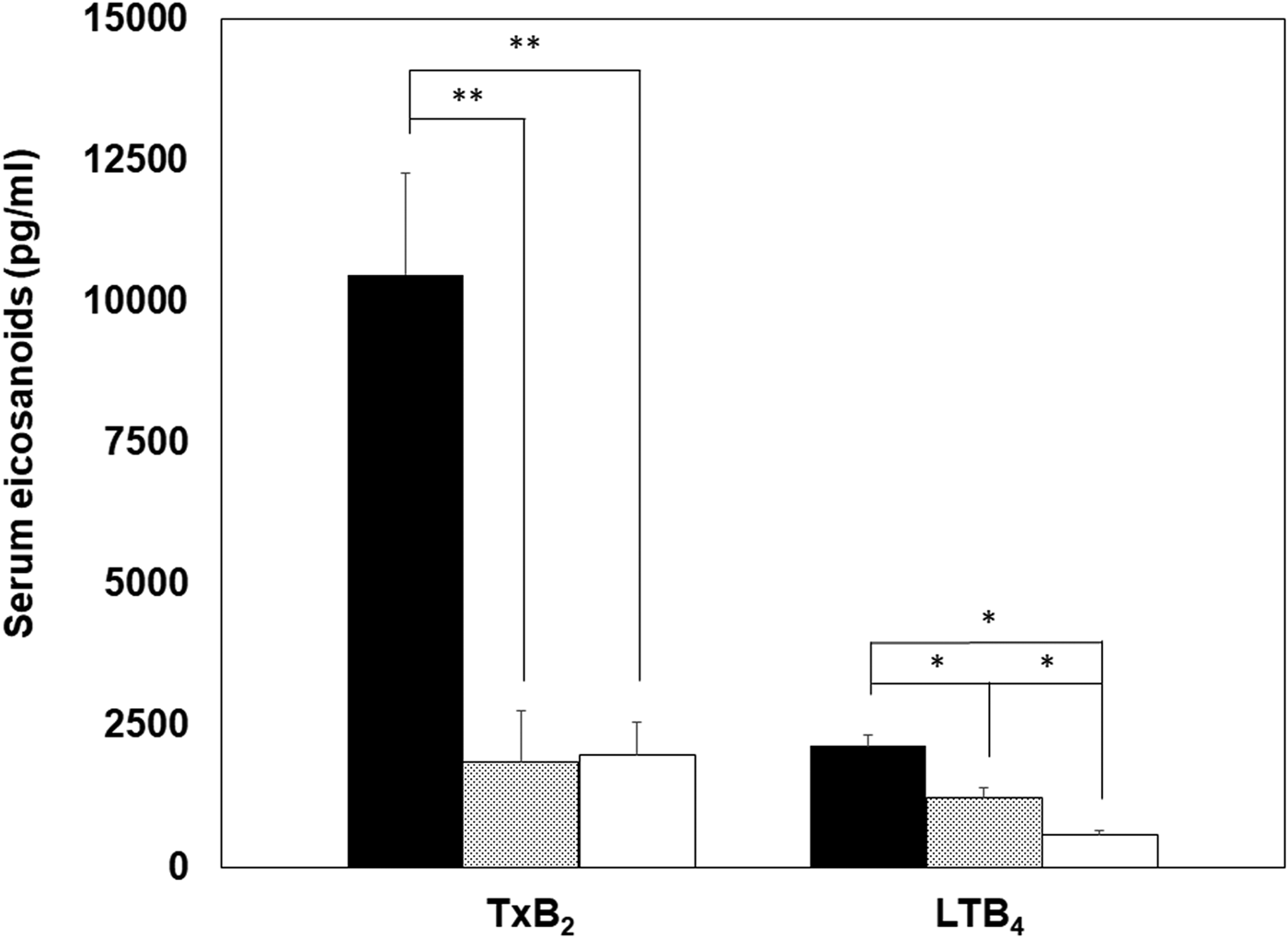
The levels of TxB2 and LTB4 in the different groups appear in fig. 1. Very high levels of TxB2 were detected in the group of individuals with subcutaneous nodules (G1), while the individuals with unencapsulated worms (G2) presented levels of TxB2 similar to the uninfected controls (G3). There are significant differences between the G1 and the other two groups (P < 0.01), but there are no significant differences between G2 and G3. The levels of LTB4 in individuals with nodules (G1) were also significantly higher than those observed in individuals with unencapsulated worms (G2) and in healthy controls (G3) (P < 0.05). In addition, there are significant differences between G2 and G3 (P < 0.05).
Levels of TxB2 and LTB4 detected in individuals diagnosed as having subcutaneous dirofilariasis presenting a subcutaneous nodule (■), individuals with subcutaneous dirofilariasis presenting non-encapsulated worms (░) and healthy controls (□).

Eicosanoids play an important role in the regulation of immune and inflammatory responses in lymphatic filariasis (Liu & Weller, Reference Liu and Weller1992; Liu et al., Reference Liu, Buhlmann and Weller1992), onchocerciasis (Bratting et al., Reference Brattig, Schwohl, Hoerauf and Büttner2009) and human pulmonary dirofilariasis (Morchón et al., Reference Morchón, López-Belmonte, Rodríguez-Barbero and Simón2006, Reference Morchón, Rodríguez-Barbero, Velasco, López-Belmonte and Simón2008), but they have not been studied in subcutaneous/ocular dirofilariasis. Human subcutaneous/ocular dirofilariasis caused by D. repens is not a homogenous disease, neither from the point of view of the biological development of the parasite, nor from its clinical presentation. The most frequent presentation is a nodule of inflammatory origin around a worm located in the subcutaneous tissue or, less frequently, in internal organs (Simón et al., Reference Simón, Siles-Lucas, Morchón, González-Miguel, Mellado, Carretón and Montoya-Alonso2012). However, cases are reported with increasing frequency in the ocular area without encapsulation, showing the worms migratory behaviour in superficial areas, perfectly observable to the naked eye, in many cases (Kartashev & Simón, Reference Kartashev and Simón2018). All this seems to indicate the existence of variants in the relationship between D. repens and the human host, whose biochemical mechanisms have not yet been identified. In the present work, the levels of two pro-inflammatory eicosanoids (TxB2 and LTB4) are determined in individuals diagnosed as having subcutaneous/ocular dirofilariasis. The detection of significantly elevated levels of TxB2 and LTB4 only in individuals with subcutaneous nodules is consistent with the pro-inflammatory activities of both eicosanoids. Similarly, in human pulmonary dirofilariosis caused by D. immitis, very high levels of TxB2 have also been detected in individuals with pulmonary nodules and more moderate levels of LTB4 in seropositive individuals without pulmonary nodules (Morchón et al., Reference Morchón, López-Belmonte, Rodríguez-Barbero and Simón2006). Especially interesting could be the analysis of LTB4 levels, regarding the presence or absence of nodules. The accumulation of eosinophils and the degranulation of mast cells sensitized with IgEs are characteristic of helminth infections. Eosinophils and mast cells are the source of LTs, among which LTB4 recruits and activates, in turn, more granulocytic cells. Several studies suggest that LTB4 may be necessary to control different nematode infections (Rogerio & Aníbal, Reference Rogerio and Anibal2012). On the other hand, the long-term survival of helminths suggests that these develop mechanisms of immune evasion. The nematodes have polyproteins generically called nematode polyprotein allergens that bind fatty acids, among which are LTs. One of these polyproteins, ABA-1, which has been identified in Ascaris lumbricoides and A. suum, interacts with LTs, contributing to their immune evasion by unidentified mechanisms (Moore et al., Reference Moore, McDermott, Price, Kelly and Cooper1999). Another polyprotein of D. immitis, DiAg, stimulates production of non-specific IgEs (Tezuka et al., Reference Tezuka, Imai, Muto, Furuhashi and Fujita2002), which could decrease the efficiency of the action of mast cells and basophils. Through proteomic analysis, several polyproteins have been identified in various antigenic compartments of Dirofilaria (Morchón et al., Reference Morchón, González-Miguel, Carretón, Kramer, Velero, Montoya-Alonso, Simón and Siles-Lucas2014), which are curiously not recognized by sera from humans infected with D. immitis or D. repens, nor by sera from cats with D. immitis (González-Miguel et al., Reference González-Miguel, Rosario, Rota-Nodari, Morchón and Simón2010a, Reference González-Miguel, Morchón, Siles-Lucas, Oleaga and Simónb). This allows us to speculate on the possibility that the lack of inflammatory reaction in some cases of subcutaneous/ocular dirofilariosis associated with the absence of LTB4, could be related to some type of interaction between parasite molecules and this eicosanoid, similar to those described above. Further studies are required to determine if localization at the ocular periphery and/or other factors are responsible for the absence of LTB4 and the encapsulation of worms.
Author ORCIDs
R. Morchón, 0000-0003-2699-1482
Financial support
This work was supported by Agencia de Desarrollo Económico de Castilla y León, Spain (co-financed with FEDER funds).
Conflicts of interest
None.
Ethical standards
The present research was approved by the ethical committee of Veterinary Medicine Service of the University of Las Palmas de Gran Canaria (2017/3) and was carried out in accordance with the current European legislation.