INTRODUCTION
Tropical waters make up nearly one-half the area of the world's oceans (Longhurst & Pauly, Reference Longhurst and Pauly1987), and about one-half of the known cetacean species have tropical or broader distributions. However, relatively little is known about the ecology of pelagic tropical cetacean communities in most areas of the world (Hooker et al., Reference Hooker, Whitehead and Gowans1999). Marine mammal fauna of west African coasts, as well as of the oceanic islands of the Gulf of Guinea, is not well known and, despite historical and oral information of a great diversity, there is very little scientific information about the ecology of species occurring in the region (Hoyt, Reference Hoyt2005).
The tropical archipelago of São Tomé and Príncipe seems to be an important area for cetaceans, probably due to large concentrations of prey as well as the existence of several bays and shallow water that constitute rest areas (Carvalho, Reference Carvalho2004). Besides the presence of coastal species, it must be remembered that the volcanic origin of the islands produces great depths near to the shore, which may favour the approach of pelagic species (Aguilar, Reference Aguilar1985).
In comparison to other areas of the world, little is known about the spatial and temporal patterns of distribution and abundance of cetaceans around this archipelago. Only a few references are available and go back to the 19th and 20th Century whaling periods, when this was an important whaling area. It is known that humpback whales are distributed along the west coast of Africa from South Africa to wintering destinations in the Gulf of Guinea (Budker & Collignon, Reference Budker and Collignon1952; Walsh et al., Reference Walsh, Fay, Gulick and Sounguet2001). Other species, such as sperm, fin and Bryde whales, were also reported (Figueiredo, Reference Figueiredo1958). Occurrence of smaller cetacean species has also been reported in the scientific literature but prior to this study no continuous survey is known. Regarding the lack of evidence the main objective of this study was to conduct a preliminary evaluation on the region upon occurrence of cetaceans. In order to accomplish the objective we intended: (1) to determine the occurrence and distribution of cetaceans in the waters around the São Tomé Island; and (2) to relate the occurrence of the different cetaceans' species with two oceanographic parameters, sea surface temperature (SST) and depth.
MATERIALS AND METHODS
Study area
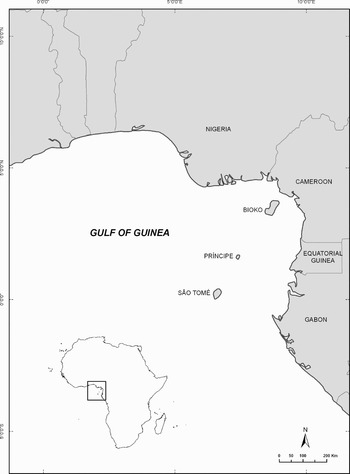
The Democratic Republic of São Tomé and Príncipe is an African equatorial archipelago located in the Gulf of Guinea at the same latitude as the Gabonese coast (see Figure 1). This oceanic and tropical archipelago is the second smallest African country and is composed of two main islands and several small islands and islets.
Geographical location of São Tomé and Príncipe archipelago, in reference to the coast of west Africa.

Numerous rivers, cascades and other water streams flow into the coastline which is outlined by bays and rocky recesses. Its volcanic origin and pronounced relief originate from a reduced continental shelf. According to the topographic maps, in the west side of the island bathymetries of around 200 m can be found almost near the shore.
Survey effort
Biological research was conducted between 2002 and 2005 in São Tomé. A total of 201 boat-based surveys were conducted around São Tomé Island, in order to evaluate cetaceans' presence and their distribution. Surveys were carried out from July to December in 2002, January and August to October in 2003, October and November in 2004 and from August to October in 2005. In 2002 and 2003 the main effort was concentrated in the waters south of São Tomé. In 2004 and 2005, the main effort was on the north and east coast of São Tomé.
The study area extends from the coast to the 2000 m isobaths around the island of São Tomé. A survey route was selected to cover a large part of the island and included areas known to be used by cetaceans and was limited primarily by sea and wind conditions. Dedicated boat surveys were conducted using locally available boats ranging in length from 5 m in years 2004–2005 to 7 m in years 2002–2003 (powered by 25 to 200 HP outboard engines). Surveys were strongly weather-dependent and were conducted whenever the sea conditions were suitable (i.e. wind less than 5 Beaufort). Weather instability within each survey was a constant; surveys were started with wind of 1 or 2 Beaufort and when at sea the survey would be aborted if the wind speed changed to 5 Beaufort.
Survey routes, were not pre-determined with fixed waypoints, but normally ran parallel to the coastline, with some variation, depending on prevailing weather conditions. At least two observers were onboard during each survey. During the surveys, at least one observer was stationed on each side of the boat and scanned an area from directly ahead of the vessel to approximately 135° from the bow of the vessel. When cetaceans were sighted, groups were approached to confirm species identity. Then, a non-intrusive and constant distance of about 50 m was kept from the animals in order to allow the data collection. For each sighting, time, GPS position, species identity, group size, composition and behaviour were noted. Photographs were taken whenever possible. The group was followed until either all information was recorded or the group was lost, in which case the survey would carry on looking for other groups.
Photographs were analysed to confirm species identification, GPS positions were entered into an ArcView 9.1. Depth at each cetacean sighting was derived from bathymetric charts. Four classes of bathymetry were considered ((0–20), (20–100), (100–1000) and (1000–2000) m). Sea surface temperature was obtained from the IRI/LDEO Climate Data Library (http://iridl.ldeo.columbia.edu/index.html) and values used were daily averages which were not measured in real time. The ACTUS program was used to analyse contingency tables assuming rows and columns are independent (Estabrook & Estabrook, Reference Estabrook and Estabrook1989).
RESULTS
Survey effort
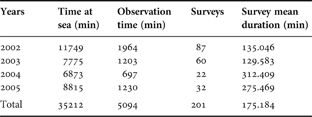
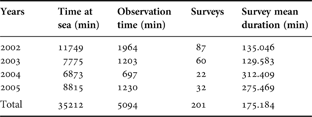
During the four years of study we conducted 201 dedicated boat surveys with a sampling total effort of 35212 minutes, of which 5094 minutes were of direct cetacean observations (Table 1).
Summary of sampling effort (time at sea), cetaceans' direct observation (observation time) and number of surveys conducted in each of the four years of field data collection.
Min, minimum.
Occurrence and distribution of cetaceans
Between 2002 and 2005 we encountered different groups of cetaceans. All cetaceans were identified, corresponding to six different species: sperm whale (Physeter macrocephalus), killer whales (Orcinus orca), humpback whales (Megaptera novaeangliae), pantropical spotted dolphins (Stenella attenuata), bottlenose dolphins (Tursiops truncatus) and long-finned pilot whales (Globicephala melas).
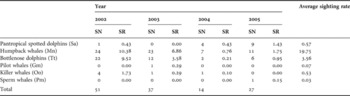
Humpback whales, pantropical spotted dolphins and bottlenose dolphins were the most sighted species, together comprising more than 93% of the sightings. Killer whales, pilot and sperm whales were sighted, respectively, in 4.66%, 0.77% and 0.77% of the encounters. Humpback whales showed the highest average sighting rate (19.75) followed by bottlenose dolphins (3.56); number of sightings and respective sighting rates per year and per species are shown in Table 2.
Number of sightings for each species in the study area between 2002 and 2005 (SN), respective sighting rates considering the number of surveys in each year (SR) and average sighting rate for the four years.

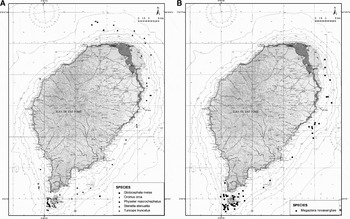
GPS positions of cetaceans' encounters along the coast of São Tomé, N = 129, are mapped in Figure 2.
A total of 129 GPS positions of individual cetacean groups are mapped around the island of São Tomé: (A) delphinids and (B) humpback whales. The start position for each encounter is indicated by a symbol: (★) Globicephala melas, (♦) Orcinus orca, (■) Physeter macrocephalus, (+) Stenella attenuata (▴) Tursiops truncatus and (•) Megaptera novaeangliae.

Relation of cetaceans' occurrence with environmental variables
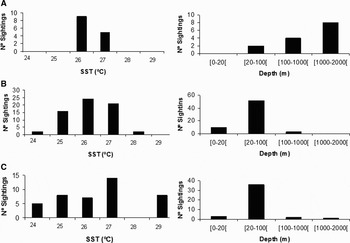
There is a variation in cetacean occurrence in relation to depth and SST. Different species were found throughout a range of temperatures between 24°C and 29°C and a wide range of depths.
We compared relative distributions of three species (humpback whales, pantropical spotted dolphins and bottlenose dolphins) within each habitat category (SST and depth) (see Figure 3). The Chi-square test showed that each species sighting and the depth that they occurred are dependent (χ2 = 120,169; P = 0.000); pantropical spotted dolphins were observed more than expected at depths between 1000 and 2000 m, while the other two species were observed at depths between 20 and 100 m. There is also a dependent relation with the species occurrence and the SST (χ2 = 32,542; P = 0.000).
Comparative distribution of the three most sighted species: (A) pantropical spotted dolphin; (B) humpback whale; and (C) bottlenose dolphin according to SST values (°C) and depth-classes (m).

DISCUSSION
Six different species of cetaceans were seen during the surveys conducted around the São Tomé Island. Humpback whales sighted in the region were the only baleen whales observed and are probably migrating from the Antarctic where they feed to these warm waters to breed (Carvalho, Reference Carvalho2004). Smaller dolphins found in numerous groups are typical on coastal areas of oceanic islands such as São Tomé (e.g. MacLeod & Bennett, Reference MacLeod and Bennett2007). Distribution of the occurring species seems uneven, but weather and sea conditions may have caused a bias in the observation effort and in the detection of cetaceans, especially the small ones. Winds and rough seas often made navigation around São Tomé Island difficult and hazardous which explains, in part, the lack of information about cetaceans occurring in this archipelago as in other parts of the world (Reiner et al., Reference Reiner, Dos Santos and Wenzel1996).
In general, fluctuation of SST may affect cetaceans' distribution primarily by influencing the availability of their preys (e.g. Selzer & Payne, Reference Selzer and Payne1988) also bathymetric features may provide a means of predicting important foraging habitats for cetaceans. We obtained differences in the occurrence of some species, whereas bottlenose dolphins and humpback whales occurred preferentially in coastal and shallow areas, pantropical spotted dolphins were mostly recorded in offshore and deeper waters. Humpback whales occurred significantly more in waters between 20 and 100 m. For humpback whales on their breeding grounds, females with calves usually prefer shallower waters. These areas are also heavily used by humans for coastal trade, commercial and subsistence fishing, whale watching and recreation (Ersts & Rosenbaum, Reference Ersts and Rosenbaum2003), which may cause a conservation issue. Bottlenose dolphins occurred most commonly along the continental shelf (20 to 100 m) which is typical of the species, often living in shallow and relatively confined waters such as mangroves and estuaries. Pantropical spotted dolphins occurred in deep slope waters (>1000 m) such as in other regions of the world (Maze-Foley & Mullin, Reference Maze-Foley and Mullin2006; MacLeod & Bennett, Reference MacLeod and Bennett2007).
Differences in habitat selection among delphinid species may reflect distinct feeding habits and foraging strategies, and also could contribute to reduce ecological competition among species that occur in the same geographical area (Silva et al., Reference Silva, Prieto, Magalhães, Cabecinhas, Cruz, Gonçalves and Santos2003). Hooker et al. (Reference Hooker, Whitehead and Gowans1999), found that both depth and SST had a significant effect on species distributions, but when interactive effects are considered, the effect of depth appears to be more significant than that of SST, which suggests that species distributions are better defined by fixed features of the physical environment than by variable aspects of the environment. This seems to be the case for the most common species occurring off São Tomé.
This study represents a first attempt to document occurrence of cetaceans in São Tomé and Príncipe Archipelago and their distribution according to some environmental variables. However, some reservations shall be taken into consideration due to the fact that this was a preliminary study and results presented here only pertain to some months of the year, not reflecting accurately what happens in the area during the remaining period. Also, for some species, sample size was very small and new data need to be added. Future cetacean surveys are essential to clarify seasonality, distribution, abundance and also to keep records of possible new species sightings in this poorly studied region.
ACKNOWLEDGEMENTS
Thanks to all contributors to this study: President Fradique de Menezes and the Government of São Tomé and Príncipe, Portuguese Embassy in São Tomé and Príncipe, Jan Hartman and Henrique Costa from Eco São Tomé, Tim Collins, Peter Ersts, Francisco Reiner and Maria Pimentel. Rolas Island Resort for logistical and financial support in 2002 and 2003. The 2004 and 2005 field studies were funded by the ECOFAC—Project Espèces Phares, Wildlife Conservation Society and the Portuguese Foundation for Science and Techonology (PhD grant to Inês Carvalho— SFRH/BD/18049/2004).