Introduction
Palliative care goes beyond consideration of physical suffering, to also attend to the psychological, cultural, spiritual, and social needs of persons with a life-limiting illness and their families (WHO, 2020; Lukovsky et al., Reference Lukovsky, McGrath and Sun2021). These holistic needs include end-of-life phenomena considered to have emotional significance for the person who experiences them (Kerr et al., Reference Kerr, Donnelly and Wright2014), and which have variously been described as, “deathbed phenomena” (Corless, Reference Corless2014), “death-related sensory experiences” (Ethier, Reference Ethier2005), “deathbed communications” (Lawrence and Repede, Reference Lawrence and Repede2012), “deathbed visions” (Morita et al., Reference Morita, Naito and Aoyama2016), “deathbed dreams” (Wholihan, Reference Wholihan2016), “near- death awareness” (Pan et al., Reference Pan, Thomson and Costa2021), “deathbed escorts” (Corless, Reference Corless2014), “end-of-life experiences” (Fenwick and Brayne, Reference Fenwick and Brayne2011), or “end-of-life dreams and visions” (Kerr et al., Reference Kerr, Donnelly and Wright2014). This article will use the term “end-of-life dreams and visions (ELDVs)”, which has emerged as the most common in recent literature (Depner et al., Reference Depner, Grant and Byrwa2020; Grant et al., Reference Grant, Depner and Levy2020, Reference Grant, Levy and Lattimer2021).
Devery et al. (Reference Devery, Rawlings and Tieman2015) conducted a systematic review of studies published up to 2012 regarding the nature and content of ELDVs, as well as clinical responses to these phenomena. The authors identified eight studies and concluded that ELDVs are a “common but not well-understood phenomenon” (p. 125) that are “both psychologically and spiritually” important for patients and their families. They also emphasize that ELDVs should be acknowledged as “real” for those who experience them, and suggested strategies to improve clinical practice. These strategies included raising awareness of ELDVs among healthcare professionals, conducting comprehensive assessments to rule out organic or metabolic causes for patients” experiences, and, keeping an open mind as to the reasons why patients or families may be telling them about an ELDV. Most importantly, Devery et al. (Reference Devery, Rawlings and Tieman2015) suggested that healthcare professionals should provide patients and families with reassurance and engage in conversations to explore what meaning or significance the ELDV may have for them. The review by Devery et al. (Reference Devery, Rawlings and Tieman2015) did not include a meta-analysis of the occurrence of ELDVs nor examine the influence that setting, culture, race, or religion might have on ELDVs. Given the 10 years that have elapsed since Devery et al. (Reference Devery, Rawlings and Tieman2015) conducted their searches, it is possible that new evidence has emerged regarding patient, family and health professionals’ understandings of ELDVs, and optimal approaches to related care.
Aim and research questions
The aim of this review was to explore empirical evidence to date on ELDVs as reported by patients, families and health professionals, or volunteers in any setting where end-of-life care has been provided, with a view to answering the following questions:
1. What proportions of patients, bereaved families, healthcare professionals, and palliative care volunteers report ELDVs?
2. What is the content and timing of reported ELDVs?
3. How do patients, bereaved families, health professionals, and volunteers interpret ELDVs?
4. Are patterns in reporting and interpretation influenced by factors such as the group reporting (i.e., patient, family, healthcare professional, volunteers), setting, culture, and religion/spirituality?
5. What care is provided in relation to ELDVs, and what evidence is there for the best approach?
Methods
Eligibility criteria
Articles were eligible for inclusion if they were published in a peer-reviewed English language journal and reported mixed methods, qualitative or quantitative studies exploring reports of ELDVs by patients, families, health professionals, or volunteers in any setting where end-of-life care was provided published up to August 2021.
Articles were excluded if they were examining near-death experiences in a population not approaching end of life. Commentaries, reviews, personal reflections, single case studies, and opinion pieces were also excluded from this review.
Information sources
CINAHL, Medline, Embase, Emcare, and APA PsycInfo electronic literature databases were searched with no date restrictions. Hand searches were conducted on reference lists of any relevant articles found.
Search strategy
Databases were searched with a combination of subject terms (e.g., “terminal care” and “dream”) and keywords relating to ELDVs. Keywords were similar to those used by Devery et al. (Reference Devery, Rawlings and Tieman2015) but were expanded to include any new terms that were found to update the search strategy (Garner et al., Reference Garner, Hopewell and Chandler2016).
Two independent reviewers (AH and TL) reviewed the titles and abstracts of the first 200 records and discussed any discrepancies. This process achieved 99% consensus, after which screening was conducted by one reviewer alone (AH).
Data collection process
Data were extracted and charted into a table detailing: author and year of publication, country and setting, sample characteristics, aims/question, methodology, any intervention, and main study findings.
Study risk of bias assessment
The risk of bias for each study was assessed independently by AH and TL who met to reach consensus. Studies of prevalence were assessed using the Johanna Briggs Institute (JBI) Checklist for Prevalence Studies (Munn et al., Reference Munn, Peters and Stern2018); qualitative studies were assessed using the JBI Checklist for Qualitative Research (Lockwood et al., Reference Lockwood, Munn and Porritt2015); and studies utilizing participant surveys were assessed using the checklist described by Kelley et al. (Reference Kelley, Clark and Brown2003).
Synthesis methods
The proportions of people reporting ELDVs from each participant group (patients, bereaved families, healthcare professionals, and volunteers) were summarized using meta-analyses in accordance with the Cochrane Handbook for Systematic Reviews (Higgins et al., Reference Higgins, Chandler and Cumpston2019). A random effects model was used, and 95% confidence intervals were estimated. Heterogeneity between estimates was measured using I 2 statistics using recommended thresholds.
A narrative approach to synthesis was taken, following guidance by Popay et al. (Reference Popay, Roberts and Snowden2006). In the preliminary synthesis, study findings were grouped according to methodology (qualitative, quantitative, and mixed methods) and tabulated according to key characteristics of setting, population, and findings relating to ELDVs. Study findings were then compared using textual summaries to identify patterns and explore heterogeneity in findings (Kelley et al., Reference Kelley, Clark and Brown2003; Popay et al., Reference Popay, Roberts and Snowden2006; Devery et al., Reference Devery, Rawlings and Tieman2015).
Results
Selection process
Study characteristics
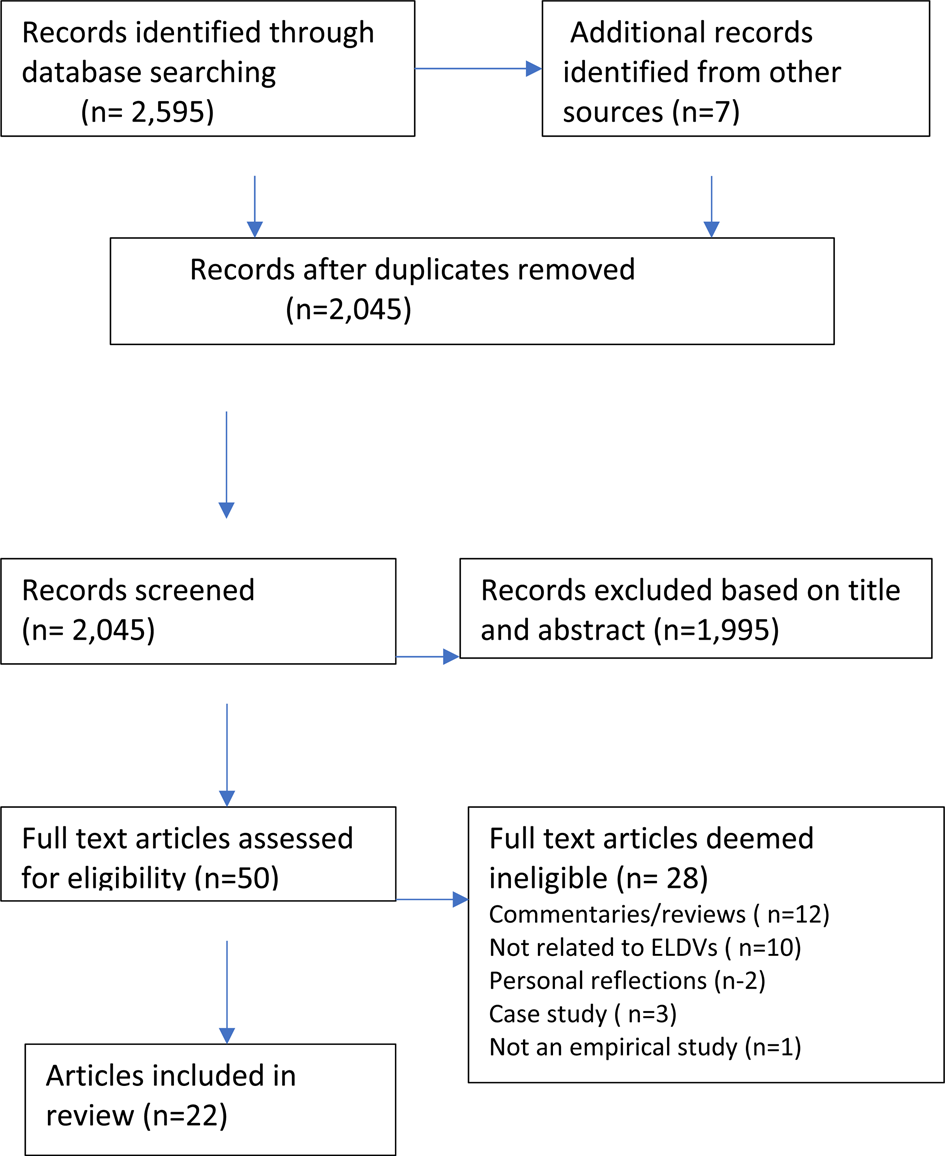
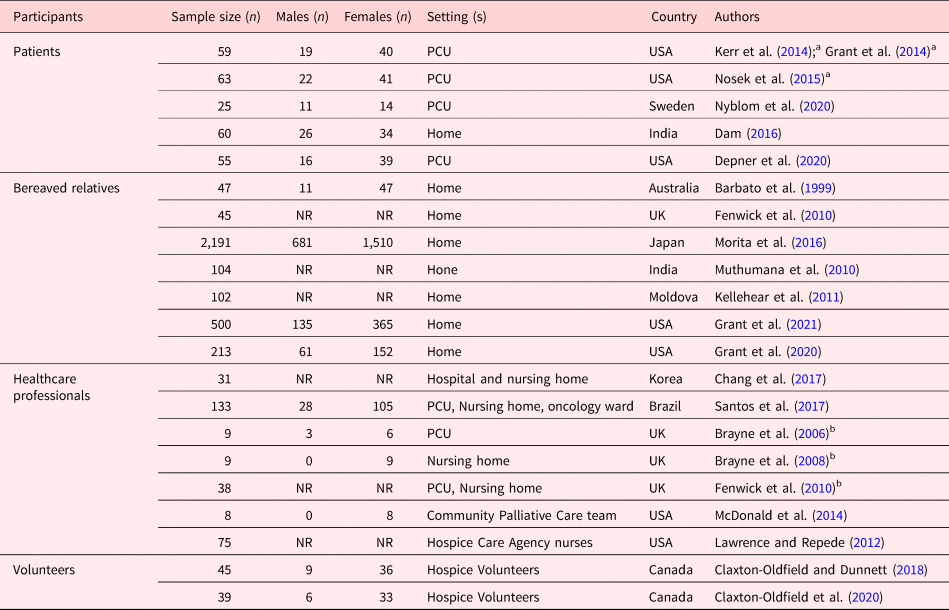
From the database searches 2,045 articles were identified, 22 met inclusion criteria, reporting 18 distinct studies (Figure 1). Of the 18 studies, 8 were quantitative (Barbato et al., Reference Barbato, Blunden and Reid1999; Morita et al., Reference Morita, Miyashita and Shibagaki2006; Lawrence and Repede, Reference Lawrence and Repede2012; Dam, Reference Dam2016; Chang et al., Reference Chang, Ahn and Cho2017; Santos et al., Reference Santos, Paiva and Lucchetti2017; Claxton-Oldfield and Dunnett, Reference Claxton-Oldfield and Dunnett2018; Claxton-Oldfield et al., Reference Claxton-Oldfield, Gallant and Claxton-Oldfield2020), 6 were used mixed methods (Fenwick et al., Reference Fenwick, Lovelace and Brayne2010; Muthumana et al., Reference Muthumana, Kumari and Kellehear2010; Kellehear et al., Reference Kellehear, Pogonet and Mindruta-Stratan2011; Kerr et al., Reference Kerr, Donnelly and Wright2014; Grant et al., Reference Grant, Depner and Levy2020, Reference Grant, Levy and Lattimer2021), and 4 were qualitative (Brayne et al., Reference Brayne, Farnham and Fenwick2006; McDonald et al., Reference McDonald, Murray and Atkin2014; Depner et al., Reference Depner, Grant and Byrwa2020; Nyblom et al., Reference Nyblom, Arnby and Molander2020). The pool of studies included all continents except for Africa and Antarctica (Table 1). Studies were conducted within community palliative care (n = 11), inpatient palliative care units (n = 9), nursing homes (n = 5), and acute hospital care (n = 3). Participants included patients receiving end-of-life care, bereaved families, healthcare professionals, and volunteers. In the overall sample of healthcare professionals, participation by nurses (n = 191) (Brayne et al., Reference Brayne, Farnham and Fenwick2006, Reference Brayne, Lovelace and Fenwick2008; Fenwick et al., Reference Fenwick, Lovelace and Brayne2010; Lawrence and Repede, Reference Lawrence and Repede2012; McDonald et al., Reference McDonald, Murray and Atkin2014; Chang et al., Reference Chang, Ahn and Cho2017; Santos et al., Reference Santos, Paiva and Lucchetti2017) and nursing assistants (n = 58) (Brayne et al., Reference Brayne, Farnham and Fenwick2006; Santos et al., Reference Santos, Paiva and Lucchetti2017) was greater than that of doctors (n = 53) (Brayne et al., Reference Brayne, Farnham and Fenwick2006; Fenwick et al., Reference Fenwick, Lovelace and Brayne2010; Chang et al., Reference Chang, Ahn and Cho2017). Where reported, the number of female participants was greater than that of men (Table 1).
PRISMA flowchart of the article selection process.

Samples and setting for studies of ELDVs included in the systematic review

PCU, Palliative care unit.
NR, not reported.
a Same study group USA.
b Same study group UK.
Risk of bias in studies
More recent studies tended to have a lower risk of bias, regardless of their methodology. For studies of frequency of reporting, sample size and sampling procedures were limited in two of the five studies (Brayne et al., Reference Brayne, Lovelace and Fenwick2008; Fenwick et al., Reference Fenwick, Lovelace and Brayne2010). Across the qualitative studies, there was insufficient reporting regarding the location of the researcher culturally or theoretically (Brayne et al., Reference Brayne, Farnham and Fenwick2006, Reference Brayne, Lovelace and Fenwick2008; Fenwick et al., Reference Fenwick, Lovelace and Brayne2010; Muthumana et al., Reference Muthumana, Kumari and Kellehear2010; Kellehear et al., Reference Kellehear, Pogonet and Mindruta-Stratan2011; McDonald et al., Reference McDonald, Murray and Atkin2014; Nosek et al., Reference Nosek, Kerr and Woodworth2015) and discussion of the influence of the researcher on the research (Brayne et al., Reference Brayne, Farnham and Fenwick2006, Reference Brayne, Lovelace and Fenwick2008; Fenwick et al., Reference Fenwick, Lovelace and Brayne2010; Kellehear et al., Reference Kellehear, Pogonet and Mindruta-Stratan2011; McDonald et al., Reference McDonald, Murray and Atkin2014). Several studies utilizing surveys to collect data were limited by lack of justification of methods being used (Fenwick et al., Reference Fenwick, Lovelace and Brayne2010; Lawrence and Repede, Reference Lawrence and Repede2012; Dam, Reference Dam2016), insufficient description of research tools (Fenwick et al., Reference Fenwick, Lovelace and Brayne2010; Lawrence and Repede, Reference Lawrence and Repede2012; Dam, Reference Dam2016; Claxton-Oldfield and Dunnett, Reference Claxton-Oldfield and Dunnett2018; Claxton-Oldfield et al., Reference Claxton-Oldfield, Gallant and Claxton-Oldfield2020), and lack of detail on methods and tests used for data analysis (Barbato et al., Reference Barbato, Blunden and Reid1999; Fenwick et al., Reference Fenwick, Lovelace and Brayne2010; Lawrence and Repede, Reference Lawrence and Repede2012; Dam, Reference Dam2016; Santos et al., Reference Santos, Paiva and Lucchetti2017; Claxton-Oldfield and Dunnett, Reference Claxton-Oldfield and Dunnett2018). Additionally, there was a lack of reporting on how consent was obtained (Lawrence and Repede, Reference Lawrence and Repede2012; Dam, Reference Dam2016; Claxton-Oldfield and Dunnett, Reference Claxton-Oldfield and Dunnett2018; Claxton-Oldfield et al., Reference Claxton-Oldfield, Gallant and Claxton-Oldfield2020), and discussion on how those who participated may have differed from those who did not (Fenwick et al., Reference Fenwick, Lovelace and Brayne2010; Lawrence and Repede, Reference Lawrence and Repede2012; Dam, Reference Dam2016; Santos et al., Reference Santos, Paiva and Lucchetti2017; Claxton-Oldfield and Dunnett, Reference Claxton-Oldfield and Dunnett2018). Issues of quality will be noted in the discussion where appropriate. The results of individual study quality assessments are available in Supplementary material.
Proportions of participants reporting ELDVs
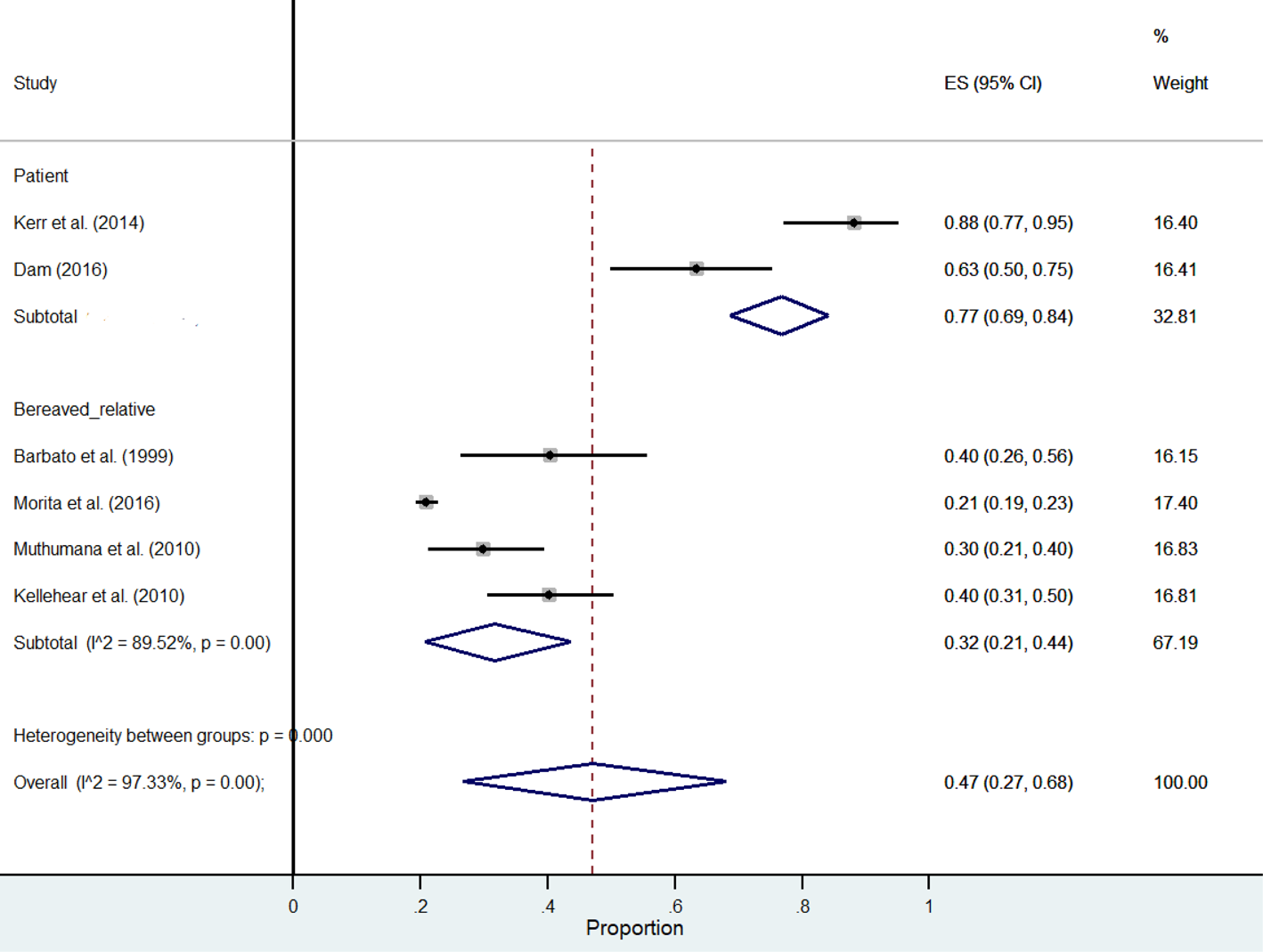
Results from meta-analyses for estimates of the proportion of patients and families reporting ELDVs are provided in Figure 2. Variability in study settings and sample characteristics limited the opportunity for direct comparisons between patients and families with the exception of the community setting in India, where estimates from two separate studies identified a higher rate among patient reports (63.3%; 95% confidence intervals [CIs] 51–75%) compared to bereaved families (30%, 95% CIs 21–39%) (Muthumana et al., Reference Muthumana, Kumari and Kellehear2010; Dam, Reference Dam2016); Muthumana et al. (Reference Muthumana, Kumari and Kellehear2010) suggested that fear of being embarrassed in front of “high status healthcare professionals” might have led to under-reporting by bereaved family members. Morita et al. (Reference Morita, Naito and Aoyama2016) examined ELDVs reported by Japanese carers in the community and suggested that a lack of universal definition for ELDVs might have led to some perceiving the phenomena to be hallucinations or delirium. It is also noteworthy that bereaved family members were asked about their experiences immediately following the death in only one study (Muthumana et al., Reference Muthumana, Kumari and Kellehear2010), with others varying from 1 month to 2 years post-bereavement (Barbato et al., Reference Barbato, Blunden and Reid1999; Kellehear et al., Reference Kellehear, Pogonet and Mindruta-Stratan2011). Authors of these latter studies have suggested that recall might have been a factor influencing estimates.
Forest plot of the proportions of patients and bereaved families reporting ELDVs.

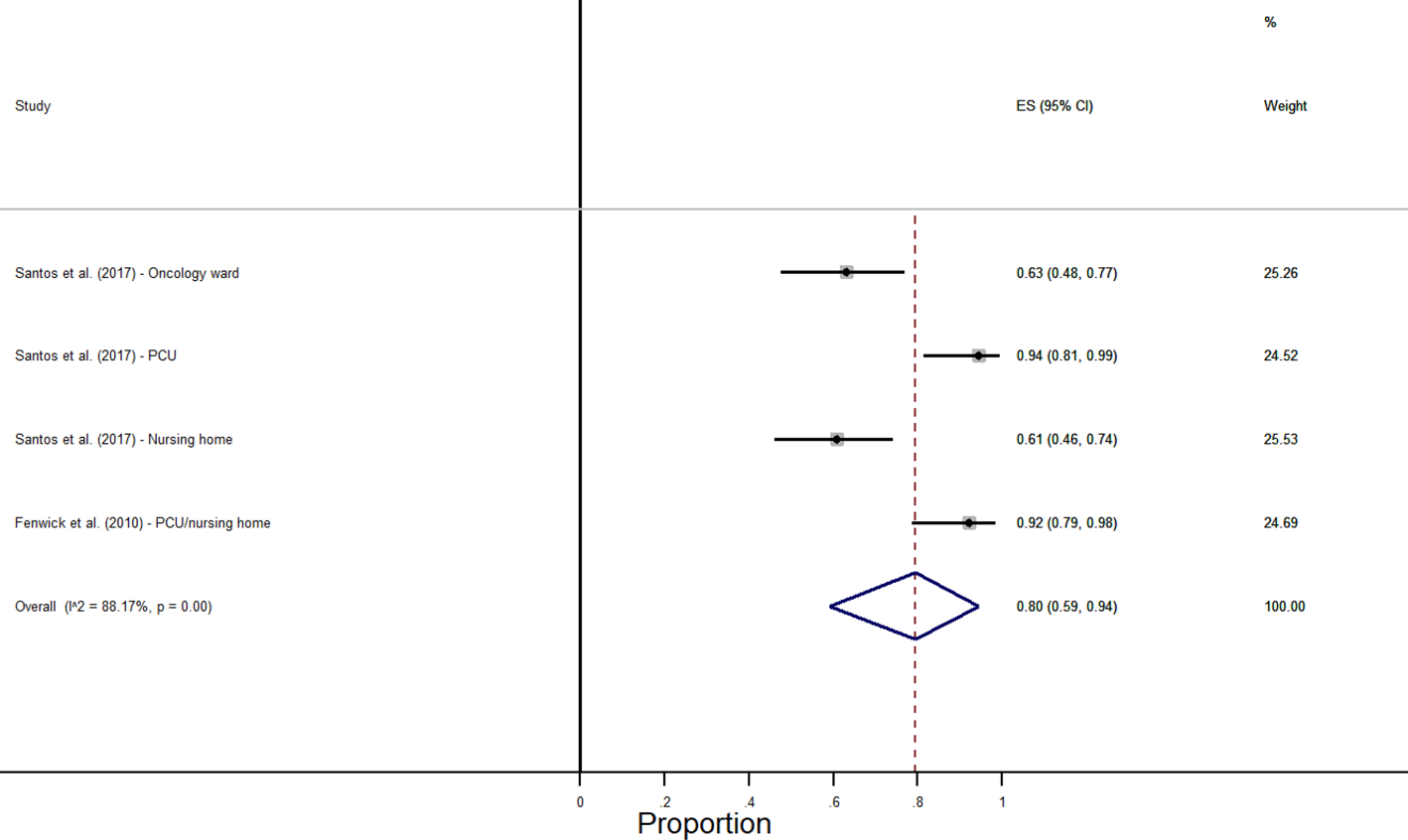
Two studies examined the experience of healthcare professionals, both of which focused on recall over the previous 5 years (Fenwick et al., Reference Fenwick, Lovelace and Brayne2010; Santos et al., Reference Santos, Paiva and Lucchetti2017), with one by Fenwick et al. (Reference Fenwick, Lovelace and Brayne2010) also collecting data prospectively over 1 year. Results from a meta-analysis synthesizing estimates from these studies are presented in Figure 3. Heterogeneity seems to have partly been explained by setting, given that health professionals from palliative care settings tended to have higher reporting rates than those in a nursing home or on an oncology ward, although this was complicated by a comparison that included health professionals from both a PCU and nursing home, albeit a majority from the former. The study by Santos et al. (Reference Santos, Paiva and Lucchetti2017) comparing health professionals within different settings, reporting events from the previous 5 years, found that healthcare professionals in a PCU (94%, 95% CIs 81–99%) were more likely to have witnessed or been told of an ELDV than those in an oncology ward (63%, 95% CIs 48–77%) or nursing home (61%, 95% CIs 47–74%) (Figure 3). The rate reported over 5 years by Fenwick et al. (Reference Fenwick, Lovelace and Brayne2010) (92%, 95%CIs 79–98%) was similar to that of the PCU group of Santos et al. (Reference Santos, Paiva and Lucchetti2017). The healthcare professionals in the Fenwick et al. (Reference Fenwick, Lovelace and Brayne2010) study were predominantly from palliative care units (n = 28) rather than nursing homes (n = 10). Fenwick et al. (Reference Fenwick, Lovelace and Brayne2010) found no significant difference (p < 0.01) between the reporting rates from the retrospective 5-year study and the prospective 1-year study.
Forest plot of proportions of healthcare professionals reporting ELDVs based on care setting.

The groups studied by Santos et al. (Reference Santos, Paiva and Lucchetti2017) had varying rates of exposure to ELDVs, with the estimated median of ELDVs observed or heard described over the 5 years being 15 (Q 25–75%, 4–62.5) for PCU, 3 (Q 25–75%, 0.0–6.5) for oncology, and 1 (Q 25–75%,0.0–0.3) for nursing homes (Santos et al., Reference Santos, Paiva and Lucchetti2017). In comparison, palliative care nurses responding to a survey asking about patients they had cared for, either at home or in a palliative care unit, during the previous 30 days, reported encountering a median of 4.8 patients (CIs not reported) per month experiencing ELDVs (Lawrence and Repede, Reference Lawrence and Repede2012). Fenwick et al. (Reference Fenwick, Lovelace and Brayne2010) report varying exposure rates for healthcare professionals within both their 5-year retrospective (84% reporting 1–50 ELDVs and 8% 50–100 ELDVs) and 1-year prospective studies (62% reporting 1–50 ELDVs and 0% 50–100 ELDVs) and suggest that an inequality of exposure to dying patients may lead to varying reporting rates by healthcare professionals.
Studies focusing on volunteers asked them to report either over the previous 12 months (Claxton-Oldfield and Dunnett, Reference Claxton-Oldfield and Dunnett2018) or the whole of their volunteering experience (Claxton-Oldfield et al., Reference Claxton-Oldfield, Gallant and Claxton-Oldfield2020). Forty-nine percent (95% CIs 33–63%) of volunteers (n = 39) reported either witnessing or being told of an end-of-life dream and vision in the preceding year and 34% (95% CIs 20–48%, n = 45) of volunteers reported events occurring over their entire period of service. Volunteers reporting over the preceding year had an average volunteering experience of 9.6 years (SD = 8.3) (Claxton-Oldfield and Dunnett, Reference Claxton-Oldfield and Dunnett2018) while those reporting from their whole experience had an average of 12.1 years (SD = 9.2) (Claxton-Oldfield et al., Reference Claxton-Oldfield, Gallant and Claxton-Oldfield2020). The authors of the first study themselves highlighted their small sample size and low response rate as factors requiring caution when interpreting their results (Claxton-Oldfield and Dunnett, Reference Claxton-Oldfield and Dunnett2018).
Influence of sample characteristics on ELDV reporting
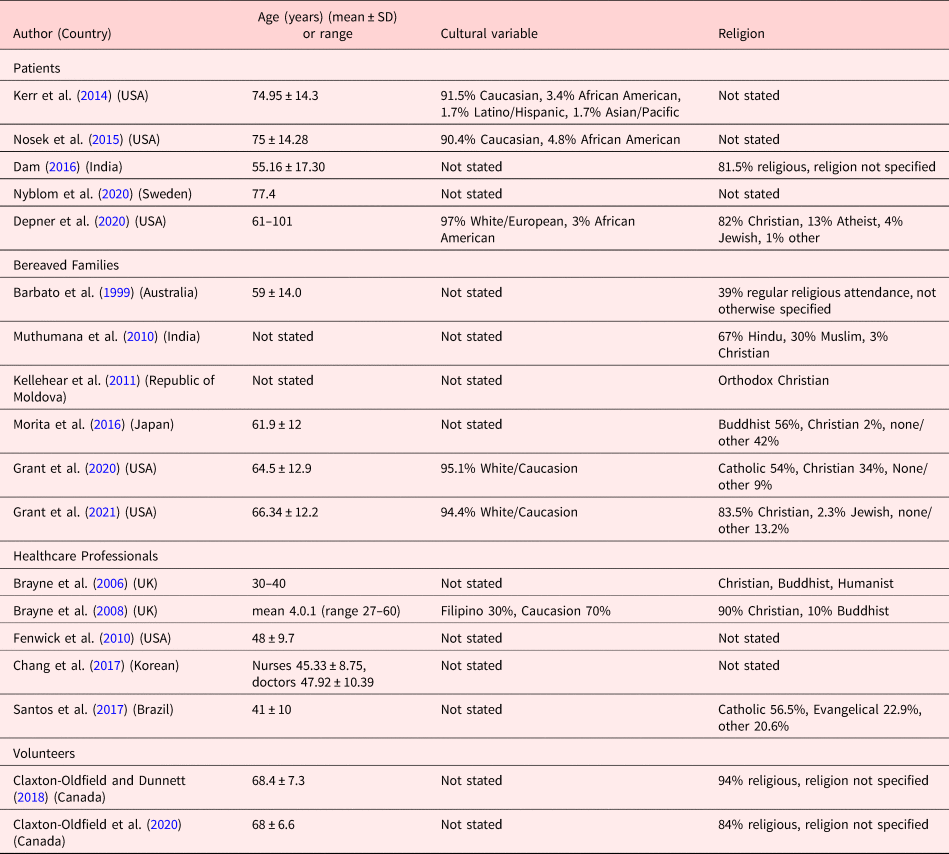
Patients, bereaved families, and healthcare professionals who participated in the studies were from a diverse range of religions and cultures (Table 2). Studies of volunteers were the exception in that both were conducted in Canada, however, few details were provided.
Age, country, cultural variable, and religion of participants

In discussing the effects of religion on patient reports of ELDVs, both Nyblom et al. (Reference Nyblom, Arnby and Molander2020), who studied patients in a “highly secular country” (Sweden), and Dam (Reference Dam2016), who studied patients in a country with a “rich religious heritage” (India), remarked only on the lack of religious content of the ELDVs their patients reported. Muthumana et al. (Reference Muthumana, Kumari and Kellehear2010), in their study of bereaved families in India, reported that 44% of Hindus experienced ELDVs compared to 21.2% of Muslims, and that the reason for this was unclear and required further investigation. In their report of a Japanese study, Morita et al. (Reference Morita, Naito and Aoyama2016) suggested that families with stronger religious beliefs were more likely to report ELDVs but did not investigate this further.
From their study conducted in Brazil, Santos et al. (Reference Santos, Paiva and Lucchetti2017), when comparing their results to studies conducted in the UK (Fenwick et al., Reference Fenwick, Lovelace and Brayne2010) and the US (Lawrence and Repede, Reference Lawrence and Repede2012) suggested that “cultural factors” not otherwise specified were not associated with reporting of ELDVs by healthcare professionals. A study of whether healthcare professionals’ perceptions of ELDVs were influenced by personal spirituality using the Duke Religion Index (DUREL) (Koenig and Büssing, Reference Koenig and Büssing2010), showed that there was no difference in reporting rates between those who had high rates of attendance at organized religious activities (48.4%) compared to those who had low rates of attendance (51.6%, p < 0.267, Chi-squared test) (Santos et al., Reference Santos, Paiva and Lucchetti2017).
Volunteers expressed that their experience of talking to patients about ELDVs had a positive impact on their own spirituality and religious beliefs and lessened their own fears (Claxton-Oldfield and Dunnett, Reference Claxton-Oldfield and Dunnett2018; Claxton-Oldfield et al., Reference Claxton-Oldfield, Gallant and Claxton-Oldfield2020).
Content of experience
In two studies, ELDVs reported directly by dying patients were described as beginning while they were asleep (dreams) but having such intensity that they often continued as a waking reality (visions) (Kerr et al., Reference Kerr, Donnelly and Wright2014; Dam, Reference Dam2016). In all studies, dying patients described in detail their ELDVs as being vivid and real (Kerr et al., Reference Kerr, Donnelly and Wright2014; Dam, Reference Dam2016; Nyblom et al., Reference Nyblom, Arnby and Molander2020).
The majority of ELDVs were of deceased relatives and friends, including — in order of frequency — parents, siblings, and spouses (Muthumana et al., Reference Muthumana, Kumari and Kellehear2010; Fenwick and Brayne, Reference Fenwick and Brayne2011; Kellehear et al., Reference Kellehear, Pogonet and Mindruta-Stratan2011; Depner et al., Reference Depner, Grant and Byrwa2020; Grant et al., Reference Grant, Depner and Levy2020). Other less common phenomena included dreaming of going on a journey (Brayne et al., Reference Brayne, Lovelace and Fenwick2008; Fenwick et al., Reference Fenwick, Lovelace and Brayne2010; Kerr et al., Reference Kerr, Donnelly and Wright2014; Nosek et al., Reference Nosek, Kerr and Woodworth2015; Dam, Reference Dam2016; Claxton-Oldfield and Dunnett, Reference Claxton-Oldfield and Dunnett2018; Nyblom et al., Reference Nyblom, Arnby and Molander2020), seeing animals (Fenwick et al., Reference Fenwick, Lovelace and Brayne2010; Fenwick and Brayne, Reference Fenwick and Brayne2011; Kerr et al., Reference Kerr, Donnelly and Wright2014; Dam, Reference Dam2016), seeing religious figures (Muthumana et al., Reference Muthumana, Kumari and Kellehear2010; Fenwick and Brayne, Reference Fenwick and Brayne2011; Kerr et al., Reference Kerr, Donnelly and Wright2014), increased awareness of impending death (Brayne et al., Reference Brayne, Lovelace and Fenwick2008; Muthumana et al., Reference Muthumana, Kumari and Kellehear2010; Kellehear et al., Reference Kellehear, Pogonet and Mindruta-Stratan2011), seeing beautiful places or colors, and hearing music (Claxton-Oldfield and Dunnett, Reference Claxton-Oldfield and Dunnett2018).
Timing of experience
The time period prior to death over which ELDVs were reported varied from 30 days prior to death up until the person was imminently dying, with the majority occurring in the last 48 h of life (Barbato et al., Reference Barbato, Blunden and Reid1999; Fenwick et al., Reference Fenwick, Lovelace and Brayne2010; Kellehear et al., Reference Kellehear, Pogonet and Mindruta-Stratan2011; Kerr et al., Reference Kerr, Donnelly and Wright2014).
Kerr et al. (Reference Kerr, Donnelly and Wright2014) suggested that the changes in content and frequency of ELDVs in their study may have been prognostically significant, observing that ELDVs involving deceased relatives increased as death neared. Similarly, Brayne et al. (Reference Brayne, Farnham and Fenwick2006) reported healthcare professionals perceiving a change in the language used by patients to describe ELDVs, with those imminently dying talking about deceased relatives who had “visited” and of needing to “leave” suggesting that this may also be a prognostic indicator for nearing death.
Interpretation of ELDVs
The overwhelming interpretation of ELDVs made by most studies was that ELDVs were comforting and provided personal or spiritual meaning, bringing a sense of peace to the patients involved (Morita et al., Reference Morita, Miyashita and Shibagaki2006; Fenwick et al., Reference Fenwick, Lovelace and Brayne2010; Kellehear et al., Reference Kellehear, Pogonet and Mindruta-Stratan2011; Lawrence and Repede, Reference Lawrence and Repede2012; Kerr et al., Reference Kerr, Donnelly and Wright2014; Nosek et al., Reference Nosek, Kerr and Woodworth2015; Chang et al., Reference Chang, Ahn and Cho2017; Santos et al., Reference Santos, Paiva and Lucchetti2017; Claxton-Oldfield and Dunnett, Reference Claxton-Oldfield and Dunnett2018; Claxton-Oldfield et al., Reference Claxton-Oldfield, Gallant and Claxton-Oldfield2020; Depner et al., Reference Depner, Grant and Byrwa2020; Grant et al., Reference Grant, Depner and Levy2020; Nyblom et al., Reference Nyblom, Arnby and Molander2020). However, not all ELDVs were reported as comforting experiences, with a small proportion of patients bereaved families, healthcare professionals and volunteers finding these experiences confusing or distressing, for either the patient or themselves (Barbato et al., Reference Barbato, Blunden and Reid1999; Morita et al., Reference Morita, Miyashita and Shibagaki2006; Fenwick and Brayne, Reference Fenwick and Brayne2011; Kerr et al., Reference Kerr, Donnelly and Wright2014; Dam, Reference Dam2016; Claxton-Oldfield et al., Reference Claxton-Oldfield, Gallant and Claxton-Oldfield2020; Depner et al., Reference Depner, Grant and Byrwa2020).
Patients and bereaved families
The study by Nosek et al. (Reference Nosek, Kerr and Woodworth2015), using the same sample as Kerr et al. (Reference Kerr, Donnelly and Wright2014), analyzed patient responses to ELDVs and identified six categories of ELDVs — “comforting presence,” “preparing to go,” “watching or engaging with the dead,” “loved ones waiting,” “distressing experiences,” and “unfinished business.” “Distressing experiences” were those replaying traumatic life experiences such as previous war experiences, abusive childhoods, or difficult relationships and were described by patients as “reminiscent of negative past experiences” (p. 271). “Unfinished business” referred to experiences of not being able to complete tasks in life that could potentially lead to “increased anxiety about family being left behind, or incomplete tasks” (p. 272).
The study by Kellehear et al. (Reference Kellehear, Pogonet and Mindruta-Stratan2011) identified six similar themes to describe the role ELDVs may have for dying patients, based on proxy reports by families. These included support for the dying person, comfort, companionship, reunion, prognosis, and choice and control. Bereaved families who had witnessed a dying person experiencing an ELDV considered them to be “natural and transpersonal phenomena” within the dying process (Morita et al., Reference Morita, Miyashita and Shibagaki2006). Bereaved families who provided care for the dying also found patients’ ELDVs to be comforting to themselves, and for some, a positive contribution to their grieving process (Barbato et al., Reference Barbato, Blunden and Reid1999; Morita et al., Reference Morita, Miyashita and Shibagaki2006; Fenwick et al., Reference Fenwick, Lovelace and Brayne2010; Fenwick and Brayne, Reference Fenwick and Brayne2011; Lawrence and Repede, Reference Lawrence and Repede2012; Claxton-Oldfield and Dunnett, Reference Claxton-Oldfield and Dunnett2018; Claxton-Oldfield et al., Reference Claxton-Oldfield, Gallant and Claxton-Oldfield2020; Grant et al., Reference Grant, Depner and Levy2020).
Healthcare professionals and volunteers
Healthcare professionals described ELDVs as “transpersonal, spiritual experiences” for patients (Brayne et al., Reference Brayne, Farnham and Fenwick2006, Reference Brayne, Lovelace and Fenwick2008; Fenwick et al., Reference Fenwick, Lovelace and Brayne2010; Chang et al., Reference Chang, Ahn and Cho2017; Santos et al., Reference Santos, Paiva and Lucchetti2017) and spoke of them as “having profound meaning for the patient” (Brayne et al., Reference Brayne, Lovelace and Fenwick2008; Fenwick et al., Reference Fenwick, Lovelace and Brayne2010). In several studies, healthcare professionals reported thinking that ELDVs contributed to a peaceful death and that they were an intrinsic part of the dying process, rather than a result of medications or fever (Lawrence and Repede, Reference Lawrence and Repede2012; Chang et al., Reference Chang, Ahn and Cho2017).
Volunteers who visited dying patients stated a belief that patients who had ELDVs appeared to have a more peaceful death (Brayne et al., Reference Brayne, Farnham and Fenwick2006; Fenwick et al., Reference Fenwick, Lovelace and Brayne2010; Claxton-Oldfield and Dunnett, Reference Claxton-Oldfield and Dunnett2018; Claxton-Oldfield et al., Reference Claxton-Oldfield, Gallant and Claxton-Oldfield2020). Volunteers also expressed that they believed ELDVs to be of a spiritual nature rather than a result of the physical deterioration associated with dying (Claxton-Oldfield and Dunnett, Reference Claxton-Oldfield and Dunnett2018).
In some studies, healthcare professionals expressed the view that ELDVs may be hallucinations caused by delirium (Fenwick et al., Reference Fenwick, Lovelace and Brayne2010; McDonald et al., Reference McDonald, Murray and Atkin2014; Santos et al., Reference Santos, Paiva and Lucchetti2017). However, when asked, 69.3% of Brazilian healthcare professionals (95% CIs 62.3–76.3%) (Santos et al., Reference Santos, Paiva and Lucchetti2017) and 67% of English healthcare professionals (95% CIs 52–87%) (Fenwick et al., Reference Fenwick, Lovelace and Brayne2010) perceived themselves to be able to distinguish between experiences caused by delirium and ELDVs based on the ability of patients to report their experience with clarity and from the demeanor of the patient before, during, and after the event (Brayne et al., Reference Brayne, Farnham and Fenwick2006, Reference Brayne, Lovelace and Fenwick2008; Fenwick et al., Reference Fenwick, Lovelace and Brayne2010; Santos et al., Reference Santos, Paiva and Lucchetti2017). Nurses surveyed by Lawrence and Repede (Reference Lawrence and Repede2012) reported that patients experiencing ELDVs required less medications, and, experienced less terminal agitation than those patients who did not experience ELDVs.
The emotional impact of ELDVs for healthcare professionals was said to be influenced by the emotional response of patients. Healthcare professionals who perceived ELDVs to help patients accept dying said this enabled them to better provide support to patients and families, and to experience a sense of personal and professional satisfaction (McDonald et al., Reference McDonald, Murray and Atkin2014).
Care related to ELDVs
In the study by Santos et al. (Reference Santos, Paiva and Lucchetti2017), examining healthcare professionals in a palliative care unit, nursing homes and an oncology ward, 36.8% of all healthcare professionals stated they were fearful of discussing ELDVs with patients for fear of causing distress, with no significant difference related to setting. This study also revealed a consensus across the settings that professionals felt they lacked training on how to respond to ELDVs. However, those who worked in the palliative care unit exhibited a greater openness and interest in undertaking further training and were more likely to discuss ELDVs with their supervisors and colleagues compared to healthcare professionals from the nursing homes or oncology ward (Santos et al., Reference Santos, Paiva and Lucchetti2017). Respondents who wanted more training identified a specific interest in learning how to interpret and respond to the metaphorical language used by patients approaching death and how to start conversations about this aspect of the dying process. Respondents also expressed the opinion that information on ELDVs should be a part of end-of-life education (Brayne et al., Reference Brayne, Farnham and Fenwick2006; Fenwick et al., Reference Fenwick, Lovelace and Brayne2010; Santos et al., Reference Santos, Paiva and Lucchetti2017).
Two studies conducted with volunteers revealed that, like healthcare professionals, they were open to discussing ELDVs with patients but that they too had not received any formal training in how to approach this. Volunteers specifically requested education on the nature of ELDVs and how best to converse with patients, families, and other members of the healthcare team in a way that did not convey an adverse value judgment on the experience (Claxton-Oldfield and Dunnett, Reference Claxton-Oldfield and Dunnett2018; Claxton-Oldfield et al., Reference Claxton-Oldfield, Gallant and Claxton-Oldfield2020).
Discussion
This systematic review identified a substantial empirical evidence base regarding the rates of reporting, content, timing, and interpretation of ELDVs, synthesizing an additional 16 studies further to those reviewed by Devery et al. (Reference Devery, Rawlings and Tieman2015). Evidence to date suggests that ELDVs are prevalent throughout the dying process. However, while there have been several recommendations for care of patients experiencing ELDVs and their families (Barbato et al., Reference Barbato, Blunden and Reid1999; Brayne et al., Reference Brayne, Farnham and Fenwick2006; Sartori, Reference Sartori2010; McDonald et al., Reference McDonald, Murray and Atkin2014; Devery et al., Reference Devery, Rawlings and Tieman2015; Wholihan, Reference Wholihan2016), there have been no studies evaluating such care. Given the growing number of studies and mainstream journals in which more recent articles have been published, it appears that ELDVs are gaining recognition as a phenomenon of interest and are no longer considered “fringy” (Barbato et al., Reference Barbato, Blunden and Reid1999). However, despite the growing number of studies on this phenomenon, there remains no consensus on the definition of an ELDV and what constitutes an ELDV.
Empirical studies have importantly revealed that rates of reporting for ELDVs appear to be highest for the group of respondents who experience them — patients. While estimates for healthcare professionals in two studies exceeded 90% (Fenwick et al., Reference Fenwick, Lovelace and Brayne2010; Santos et al., Reference Santos, Paiva and Lucchetti2017), participants in this group were reporting on whether they had encountered one or more patient with ELDVs over 5 years. If the majority of patients experience ELDVs as suggested by the patient studies, then all healthcare professionals who routinely care for people who are dying should have encountered at least one patient experiencing an ELDV. This raises the question of why healthcare professionals, as well as bereaved families and volunteers, have lower rates of reporting, for which there is a range of possible answers. First and foremost, rates of reporting by groups other than patients are likely to be affected by whether the patient recounted their experience. Without a universal definition of ELDVs, respondents in other groups may dismiss ELDVs as hallucinations secondary to medications or delirium, or, alternatively they may misconstrue what the patient is saying or doing (Callanan and Kelley, Reference Callanan and Kelley1992; Kellehear, Reference Kellehear2020). A universal definition of ELDVs is urgently needed as misinterpretation of ELDVs by healthcare professionals may lead to inappropriate administration of medical interventions which may inhibit the dying persons’ ability to communicate meaning at the end of life resulting in an increased sense of isolation (Callanan and Kelley, Reference Callanan and Kelley1992; Barbato, Reference Barbato2009; Doka, Reference Doka2020; Kerr and Mardrossian, Reference Kerr and Mardrossian2020). That said, even with an agreed definition to assist clinicians to identify ELDVs, patients may not share their ELDVs due to fear of upsetting loved ones, fear of embarrassment, or simply because they have not been asked (Barbato, Reference Barbato2009).
The studies of healthcare professionals suggest that setting and experience of those caring for the person dying are associated with increased reports of ELDVs, with those who work in palliative care settings being more likely to witness or have an ELDV reported to them compared to oncology and nursing homes (Lawrence and Repede, Reference Lawrence and Repede2012; Santos et al., Reference Santos, Paiva and Lucchetti2017). Unfortunately, there have been no studies examining the experience of healthcare professionals in acute care settings, where over 50% of deaths occur (Broad et al., Reference Broad, Gott and Kim2013; Schwarz and Benson, Reference Schwarz and Benson2018). Future research is needed to determine whether reports of ELDVs provided by acute care health professionals are lower than those from other settings because they are less aware of the phenomena and/or due to infrequent exposure to people who are dying.
Across all studies, nurses and nurses’ aides reported being told of a greater number of ELDVs, when compared to medical staff (Brayne et al., Reference Brayne, Farnham and Fenwick2006, Reference Brayne, Lovelace and Fenwick2008; Lawrence and Repede, Reference Lawrence and Repede2012; McDonald et al., Reference McDonald, Murray and Atkin2014; Chang et al., Reference Chang, Ahn and Cho2017; Santos et al., Reference Santos, Paiva and Lucchetti2017). This has been attributed to the possibility that patients and bereaved family members might be more willing to speak to nurses (Brayne et al., Reference Brayne, Farnham and Fenwick2006), and that medical staff might be more likely to either dismiss a report of an ELDV as not being clinically important or diagnose it as delirium (Fenwick et al., Reference Fenwick, Lovelace and Brayne2007; Janssen, Reference Janssen2015; Chang et al., Reference Chang, Ahn and Cho2017; Kerr and Mardrossian, Reference Kerr and Mardrossian2020; Pan et al., Reference Pan, Thomson and Costa2021). Additionally, nurses provide most of the care to the dying, and therefore have more opportunities to witness or be told of ELDVs (Sartori, Reference Sartori2010; Dong and Fu, Reference Dong and Fu2014; Wholihan, Reference Wholihan2016).
Interestingly, while a meta-analysis was not possible due to methodological differences between studies, the proportion of volunteers reporting ELDVs tended to be lower than that for healthcare professionals. This finding needs to be carefully considered given there were only two studies that examined prevalence in volunteers, each with a small sample size (Claxton-Oldfield and Dunnett, Reference Claxton-Oldfield and Dunnett2018; Claxton-Oldfield et al., Reference Claxton-Oldfield, Gallant and Claxton-Oldfield2020). Also, the likelihood of observing ELDVs will depend on the type of role that volunteers are engaged with, which was not explored in these studies.
The studies reviewed were conducted across much of the world and included people from a variety of cultural, religious, and social backgrounds. We found no evidence to support previous suggestions that informants’ culture, religion, or social background might influence ELDV reporting and content (Alvarardo, Reference Alvarardo2006; Mazzarino-Willett, Reference Mazzarino-Willett2010; Wholihan, Reference Wholihan2016).
The content of ELDVs remains consistent throughout the studies reported and anecdotal reports (Callanan and Kelley, Reference Callanan and Kelley1992; Barbato, Reference Barbato2009; Alvarado, Reference Alvarado2014; Wallace, Reference Wallace2016; Heyen, Reference Heyen2019; Doka, Reference Doka2020) with dreams and visions of deceased relatives, and dreams of travel being most often reported. Studies and anecdotal reports of timing indicate that ELDVs are not “one off” events and not necessarily confined to the “deathbed” but rather can occur over a period of time leading up to one's death with the frequency of ELDVs increasing as death nears (Callanan and Kelley, Reference Callanan and Kelley1992; Barbato, Reference Barbato2009; Kerr et al., Reference Kerr, Donnelly and Wright2014; Doka, Reference Doka2020).
Present throughout all studies was the ongoing debate regarding the nature, cause and significance of ELDVs. Healthcare professionals, experienced in caring for the dying, consistently reported being able to distinguish between “hallucinations caused by fever, medications or delirium” and ELDVs (Brayne et al., Reference Brayne, Farnham and Fenwick2006, Reference Brayne, Lovelace and Fenwick2008; Fenwick et al., Reference Fenwick, Lovelace and Brayne2010; McDonald et al., Reference McDonald, Murray and Atkin2014; Santos et al., Reference Santos, Paiva and Lucchetti2017). However, the veracity of these claims is difficult to assess. Studies with patients have provided support for the idea that ELDVs differ from hallucinations, by the clear vivid accounts given by patients, their demeanor and the nature of the feelings evoked (Fenwick et al., Reference Fenwick, Lovelace and Brayne2010; Kerr et al., Reference Kerr, Donnelly and Wright2014; Nosek et al., Reference Nosek, Kerr and Woodworth2015; Santos et al., Reference Santos, Paiva and Lucchetti2017; Nyblom et al., Reference Nyblom, Arnby and Molander2020). In contrast, studies of patients experiencing delirium report that patients who remember the experience describe it as distressing and being fearful, anxious and threatened during the event (O'Malley et al., Reference O'Malley, Leonard and Meagher2008; Grover et al., Reference Grover, Ghosh and Ghormode2015). Kellehear (Reference Kellehear2020, p. 243) suggests that the use of the term hallucination to describe ELDVs may be “unhelpful” in that it can be “stigmatizing and alarming for patients and families,” and result in a lack of support.
Additionally, Nyblom et al. (Reference Nyblom, Arnby and Molander2020) suggest that it is the patient's ability to recall their dreams and the vivid nature of ELDVs that distinguish them from usual dreams, particularly for elderly patients, as dream recall diminishes with ageing (Zanasi et al., Reference Zanasi, De Peris and Caporali2005; Scarpelli et al., Reference Scarpelli, Bartolacci and D'Atri2019). Analysis of ELDV content would suggest that their role is to provide comfort and closure to the dying (Depner et al., Reference Depner, Grant and Byrwa2020).
It needs to be noted that not all ELDVs are comforting, with a small proportion of patients reporting ELDVs as distressing (Barbato, Reference Barbato2009; Fenwick et al., Reference Fenwick, Lovelace and Brayne2010; Santos et al., Reference Santos, Paiva and Lucchetti2017; Depner et al., Reference Depner, Grant and Byrwa2020). Negative experiences may be reminiscent of past trauma and should not be discounted as having no meaning (Shinar and Marks, Reference Shinar and Marks2015; Depner et al., Reference Depner, Grant and Byrwa2020). At the same time, it is possible that groups other than patients may report ELDVs experienced by loved ones as distressing based on their own response to the event or lack of understanding of what they are witnessing or being told (Morita et al., Reference Morita, Miyashita and Shibagaki2006; Muthumana et al., Reference Muthumana, Kumari and Kellehear2010; Grant et al., Reference Grant, Depner and Levy2020).
Healthcare professionals and volunteers experienced with caring for the dying reported a need to be able to support both patients and families when ELDVs occur (Fenwick et al., Reference Fenwick, Lovelace and Brayne2010; Santos et al., Reference Santos, Paiva and Lucchetti2017) and requested formal education regarding ELDVs and how best to support patients and their families (Brayne et al., Reference Brayne, Farnham and Fenwick2006, Reference Brayne, Lovelace and Fenwick2008; Lawrence and Repede, Reference Lawrence and Repede2012; McDonald et al., Reference McDonald, Murray and Atkin2014; Chang et al., Reference Chang, Ahn and Cho2017). Healthcare professionals who provided support to patients and their families found the experience to be one of comfort to themselves and professionally rewarding (McDonald et al., Reference McDonald, Murray and Atkin2014), and suggest that being able to discuss ELDVs in multidisciplinary meetings would be useful (Brayne et al., Reference Brayne, Lovelace and Fenwick2008; Fenwick et al., Reference Fenwick, Lovelace and Brayne2010; Santos et al., Reference Santos, Paiva and Lucchetti2017). Recent studies of volunteers would also indicate that education concerning ELDVs continues to be lacking and suggests that ongoing training and mentoring for volunteers would be beneficial (Claxton-Oldfield and Dunnett, Reference Claxton-Oldfield and Dunnett2018; Claxton-Oldfield et al., Reference Claxton-Oldfield, Gallant and Claxton-Oldfield2020).
The current lack of formal recognition of ELDVs as part of the dying process has consequences for patients, their families, and healthcare professionals. Despite the absence of evaluative studies, it has been recommended that healthcare professionals should see ELDVs as an opportunity to empower patients and families to find peace and closure, complete any unfinished business, and to attend to any rituals of significance (Fenwick et al., Reference Fenwick, Lovelace and Brayne2007; Barbato, Reference Barbato2009; Mazzarino-Willett, Reference Mazzarino-Willett2010; Broadhurst and Harrington, Reference Broadhurst and Harrington2016; Doka, Reference Doka2020). To this end, it has been suggested that healthcare professionals witnessing an ELDV engage, listen, and validate the patient's experience not only to normalize it but also to ensure that all concerned see it as a transcendent experience rather than a problem requiring medical attention (Callanan and Kelley, Reference Callanan and Kelley1992; Barbato, Reference Barbato2009; Mazzarino-Willett, Reference Mazzarino-Willett2010; Wholihan, Reference Wholihan2016). Future studies are urgently needed to evaluate care related to ELDVs to further inform clinical guidance as misunderstanding an ELDV can have negative consequences for the patient and their family and healthcare professionals (Barbato, Reference Barbato2009; Doka, Reference Doka2020; Kerr and Mardrossian, Reference Kerr and Mardrossian2020).
Limitations
The main limitation of our review is that the lack of a consistent definition for ELDVs means we cannot be sure that estimates of the proportions of participants reporting these phenomena were comparable between studies. There was also heterogeneity among settings and samples that made it difficult to compare directly between groups. Additionally, there is a lack of evidence as to the current state of knowledge of ELDVs within the acute care setting and the ability of healthcare professionals in acute care to respond appropriately to patients experiencing or sharing an ELDV.
Conclusion
ELDVs frequently occur and may be an important accompaniment to the dying process that provide comfort, support, and closure to those who are dying. Across all studies, ELDVs were consistent in their description of being of deceased relatives and of being a personally or spiritually transforming event, indicating that culture and religion appear to not influence the occurrence of ELDVs. Family members and healthcare professionals who witness or are told of ELDVs may also find comfort, but the lack of a universal definition for ELDVs means that these events may be missed.
Healthcare professionals and volunteers who are experienced in caring for the dying acknowledged that ELDVs are comforting to patients and families, while also expressing a need for education to enable them to provide appropriate support. There is increasing acknowledgment of ELDVs within palliative care and nursing home settings, however evidence is lacking for acute care settings.
Supplementary material
The supplementary material for this article can be found at https://doi.org/10.1017/S1478951522000876.
Funding
This research received no specific grant from any funding agency, commercial, or not-for-profit sectors.
Conflict of interest
The authors declare that there is no conflict of interest.