A number of primarily haemodynamic causes are offered for the development of a protein-losing enteropathy after the Fontan procedure for univentricular hearts. On the basis of a literature review, a number of additional non-haemodynamic trigger factors can lead to a protein loss. The observation that a nutritionally treatable intestinal lactase deficiency may significantly worsen protein loss after a Fontan procedure has, in our opinion, not been published to date.
Case report
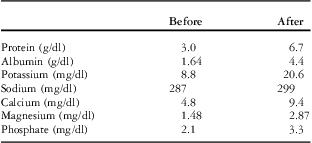
A 12-year-old girl was admitted 10.4 years after Fontan procedure for mitral atresia with a hypoplastic left ventricle, ventricular septal defect, and double-outlet right ventricle. She was in a dystrophic state (body height 111 cm, z – 3.23) 1 and presented with an enlarged abdomen, hepatic margin palpable 6 cm below the right costal margin, moderate ascites, no peripheral oedema noted because of the diuretic treatment, status post tetanic convulsions, and with laboratory values following electrolyte replacement as noted in the Table. Protein-losing enteropathy symptoms developed 4 weeks post-operatively following an infection. Therapeutic trials with cortisone and heparin, as well as pacemaker implantation for sinus node dysfunction, coil occlusion of the aortopulmonary collateral arteries, and conversion of the intra- to extracardiac tunnel were only partially successful or had to be suspended because of complications – osteoporosis with femoral fractures secondary to heparin treatment.
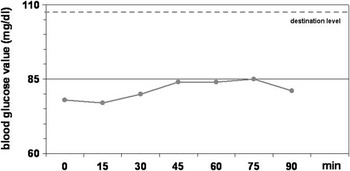
For years, this patient has been noted to experience very loose stools and flatulence. On the basis of the result of the lactose tolerance test (Fig 1), a lactose-free diet and nutritional counselling were instituted. These measures resulted in a short-term reduction in waist circumference, improved stool consistency, and a long-term normalisation of serum electrolytes and protein values (Table 1) along with a 1.3 kg weight gain over a 6-month period. Molecular genetic diagnostics verified a homozygous C/C13910 polymorphism in the LCT gene.
Pathological results of the lactose tolerance test (2 g/kg body weight, 10% solution, fasting). The rise of blood glucose was only 7% (normal value more than 30 mg/dl).

Laboratory serum values before and after lactose-free diet.

Discussion
The prevalence of protein-losing enteropathy after Fontan procedure was reported in a multi-centre study of 3029 patients, 3.7% of whom had a mean age of 11.7 years and an interval of 2.7 years in between surgery and the development of symptoms (0.1 to 16.4 years).Reference Mertens, Hagler, Sauer, Somerville and Gewillig 2 Drug treatment only was successful in 25% of the patients, no improvement was found in 29%, and 46% of the patients died. Surgical treatment – for example, correction of older surgical methods using an attachment to an extracardiac cavopulmonary connection, removal of obstructions within the Fontan circulation, pacemaker therapy to restore a supraventricular rhythm, etc. – was successful in 19% and had no effect in 19% of the patients; 62% of the total 52 patients died. A total of 16 percutaneous interventions were performed in 13 patients. In 12 instances, these procedures resulted in symptomatic improvement and in four had no effect.
In terms of the rare non-cardiac triggers for protein loss, these include a wide range of viral, bacterial, and parasitic infections, systemic lupus, and syndromes.Reference Braamskamp, Dolman and Tabbers 3 The ability to distinguish protein loss due to malnutrition, protein synthesis disorders, or loss via other organs – kidney, liver, skin – is determined by the increased presence of faecal alpha-1-antitrypsin or through the use of radiopharmaceuticals to detect protein leakage.
Lactose intolerance is a common form of the so-called hypolactasia, a known disorder of lactose digestion, which increases from the age of 3 years on. The prevalence of the causative mutation C/C13910 on chromosome 2q21-22 is estimated to be up to 70% of adults in Europe with a northerly–southerly divide.Reference Mottes, Belpinati and Milani 4 , Reference Tobayo-Torres and Nichols 5 Lactase-phlorizin hydrolase activity in the intestinal mucosa is decreased. The diagnosis is based on a positive dietary history confirmed by the lactose tolerance test, the H2-breath test, the detection of gene mutation, and decreased enzyme activity in the intestinal mucosa. Treatment is the reduction or restriction of products containing lactose. Pharmaceutical preparations of lactase, as well as lactose-free milk and dairy products, are also available.Reference Heyman 6
With regard to the above patient, the diagnosis was suspected on the basis of her dietary history combined with the positive findings after lactose tolerance testing. It was confirmed on the basis of the clinical course after introduction of a lactose-free diet coupled with the molecular genetic test results. Additional supportive evidence was provided by the detailed preliminary investigations, including an unremarkable gastroduodeno- and sigmoidoscopy performed by the treating cardiac centre.
The combination of intestinal lactase deficiency with protein-losing enteropathy after Fontan procedure may have significant clinical implications. Dietary treatment of lactose maldigestion can positively impact protein loss and electrolyte imbalance. Further studies should clarify whether, in affected patients, this is a random coincidence or a causal link.
Acknowledgements
The authors gratefully acknowledge Prof. Heinrich Netz, Department of Pediatric Cardiology, University Dr von Haunersches Kinderspital Munich for providing the cardiac results. They wish to thank Dr Ingo Neumann, Labor-MVZ Westmecklenburg Schwerin, for performing genetic analysis.