Introduction
Haemonchus contortus is an important nematode pathogen found in the abomasa of sheep (Ovis aries) and goats (Capra hircus). The blood sucking habit of H. contortus causes anaemia, weight loss and occasional death of the animals if untreated (Urquhart et al., Reference Urquhart, Armour, Duncan, Dunn and Jennings1996). Although the worms from both hosts share similar general morphology, differences in the characteristics of cuticular ridges (synlophe) of worms recovered from sheep and goats has kindled much interest in their detailed morphology, more so in regions where H. contortus is sympatric, especially where sheep and goats share the same pastures (Lichtnefels et al., Reference Lichtenfels, Pilitt and Le Jambre1986, Reference Lichtenfels, Pilitt and Le Jambre1988, Reference Lichtenfels, Pilitt and Hoberg1994).
In a revision of the genus Haemonchus, various characters have been used to differentiate species of this genus, especially male worm characters such as spicules, gubernacula and dorsal rays, which are considered as the main characters by which species can be differentiated (Gibbons, Reference Gibbons1979). Previous taxonomic studies had also used spicule length and distances of right and left barbs from the distal end to the hook of spicules, to differentiate H. contortus from other species of the same genus (Lichtenfels et al., Reference Lichtenfels, Pilitt and Hoberg1994; Jacquiet et al., Reference Jacquiet, Cabaret, Cheikh and Thiam1997). In general, right and left barb lengths of H. contortus are shorter than those of other species (Lichtenfels et al., Reference Lichtenfels, Pilitt and Hoberg1994; Jacquiet et al., Reference Jacquiet, Cabaret, Cheikh and Thiam1997). Species of stomach worms of ruminants have been identified by using synlophe number and pattern on the anterior half of these nematodes (Gibbons, Reference Gibbons1979; Measures & Anderson, Reference Measures and Anderson1983; Lichtenfels & Hoberg, Reference Lichtenfels and Hoberg1993; Lichtenfels et al., Reference Lichtenfels, Pilitt and Hoberg1994). The synlophe pattern of H. contortus was found to be bilaterally and dorsoventrally symmetrical, with 22–30 ridges on the body surface of this worm (Gibbons, Reference Gibbons1979; Lichtenfels et al., Reference Lichtenfels, Pilitt and Hoberg1994).
Previously, the present authors found some morphological variation between H. contortus isolates from sheep and goats in Malaysia (Gharamah et al., Reference Gharamah, Rahman and Siti Azizah2011a) and Yemen (Gharamah et al., Reference Gharamah, Rahman and Siti Azizah2011b). Thus, in is this study, the data from these two countries were analysed using wider statistical analysis to clarify the importance of host or large spatial scale in morphological variation of this worm.
Observations and measurements of synlophe, total body lengths, cervical papillae, spicules, barbs and gubernacula of male worms are reliable tools for species identification of individual worms (Gibbons, Reference Gibbons1979; Lichtenfels et al., Reference Lichtenfels, Pilitt and Hoberg1994), and were thus employed in the present study. This work was conducted to investigate the population and host variations of H. contortus of sheep and goats from Malaysia and Yemen, based on morphological characteristics.
Materials and methods
Collection and examination of Haemonchus contortus
For Malaysia, adult H. contortus worms were collected from Perak and Kelantan states, located in western and eastern parts of the country, respectively. For Yemen, adult worms were collected from Sana'a and Al-Hudaydah governorates, located in northern and western parts of the country, respectively. The geographic distance between Perak and Kelantan is 215 km, while that between Sana'a and Al-Hudaydah is 148 km. These locations were chosen because they are geographically isolated by chains of mountains in the respective countries, and movement of animals between locations is rare. In Malaysia and Yemen, small ruminants are mixtures of domestic and imported animals. Imported animals in Malaysia come from Australia (Chandrawathani, Reference Chandrawathani2004), while those in Yemen come from the Horn of Africa (USAID, 2009).
In Malaysia, it was difficult to obtain adult H. contortus from the abomasa of sheep and goats slaughtered in Perak and Kelantan abattoirs due to the good control regimes practised. Thus adult worms were obtained from the Department of Veterinary Services in each state. In Yemen, adult worms were recovered from the abomasa of sheep and goats obtained from the city abattoirs in Sana'a and Al-Hudaydah.
Worm recovery was carried out according to procedures described by MAFF (1986). After slaughtering, the abomasum was removed from other stomach parts, ligated at both ends and transferred directly to the laboratory in labelled plastic bags. Each abomasum was opened along its greater curvature with a pair of scissors and contents were poured in a glass beaker. Contents were then processed by repeated washings, sedimentation and decantation until the supernatant was clear enough to allow for easy worm collection. The sediment was made up to 1 litre and both the abomasum and its contents were carefully examined. Adult worms were collected using a dissecting microscope and then washed with tap water to remove adherent food residues. Morphological identification of worms was according to taxonomic keys of Soulsby (Reference Soulsby1965) and MAFF (1986). The collected worms were then preserved in 70% ethanol.
Morphometrics of H. contortus from Malaysia and Yemen
Observations and measurements of total body length (BL), length of cervical papillae (CP), length of right and left spicules (RSL and LSL), right and left barbs (tip to hook distance of the spicule, THr and THl) and gubernacula lengths (GL) of male worms were made on worms cleared in lactophenol for study in temporary mounts on a glass microscope slide (Lichtenfels et al., Reference Lichtenfels, Pilitt and Hoberg1994). The length of cervical papillae was measured from the anterior end of the worm to the level of cervical papillae. The spicule with the longer barb was considered to be the right spicule, while the spicule with the shorter barb was considered to be the left spicule (Lichtenfels et al., Reference Lichtenfels, Pilitt and Hoberg1994). Total body length was viewed under a dissecting microscope (Olympus SZ40, Tokyo, Japan with JVC K-F55B colour video camera, Tokyo, Japan) while other characters were viewed under an interference contrast light microscope (Olympus BX50 with JVC K-F55B colour video camera). Measurements were made using Image Analyzer program (version 3.1, Soft imaging system GmbH, Meunster, Germany). Fifty male worms from each host and each study area were used for each observation and measurement (Gharamah et al., Reference Gharamah, Rahman and Siti Azizah2011a, Reference Gharamah, Rahman and Siti Azizahb).
Scanning electron microscopy of synlophe
The pattern of cuticular ridges (synlophe) on the external cuticular surface of adult H. contortus worms was examined using a scanning electron microscope (SEM). Specimens studied included three males and three females of H. contortus from sheep and likewise for goat populations from Malaysia and Yemen. The hexamethyldisilazane (HMDS) technique was used for specimen preparation (Nation, Reference Nation1983).
Data analysis
The program SPSS 13 (SPSS Inc., Chicago, Illinois, USA) was employed for data analysis. The multivariate analysis of principal component analysis (PCA) was used to demonstrate correlations between H. contortus populations of sheep and goats from Malaysia and Yemen, based on simultaneous analyses of all measurable variables. Only data of male worms was analysed because it is more reliable in species identification. Morphometrics of the 400 male worms of sheep and goats from Malaysia and Yemen were used in this analysis. Haemonchus contortus populations were divided as follows: for Malaysia, Perak-Sheep (PS), Perak-Goat (PG), Kelantan-Sheep (KS) and Kelantan-Goat (KG) populations, and for Yemen, Sana'a-Sheep (SS), Sana'a-Goat (SG), Al-Hudaydah-Sheep (HS) and Al-Hudaydah-Goat (HG) populations. Principal component 1 and principal component 2, which had the highest loadings, were used to plot the scatterplot of group separation.
The other widely utilized multivariate analysis, discriminant function analysis (DFA), was also used to discriminate H. contortus populations of sheep and goats from Malaysia and Yemen according to the morphometrics data of male worms. The same populations and morphological characters of PCA were used in DFA. The group separation was displayed in a scatterplot of function 1 versus function 2. Predicted group membership and percentage correct classification to the original population were explained in a table of classification results.
Results
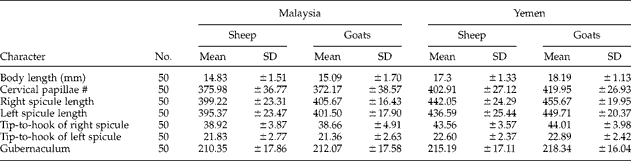
Table 1 shows the morphometrics of H. contortus in sheep and goats from Malaysia and Yemen. Mean values of H. contortus morphological characters in Yemen were higher than those in Malaysia, especially body length, length of cervical papillae and spicule length.
Morphometrics of male H. contortus in sheep and goats from Malaysia and Yemena.
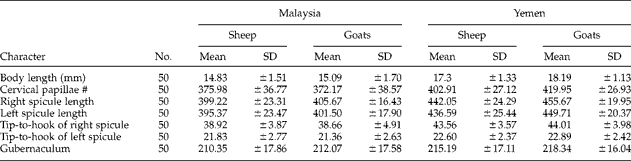
SD, standard deviation; #, measured from anterior extremity.
a Measurements in micrometres unless noted otherwise.
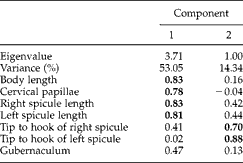
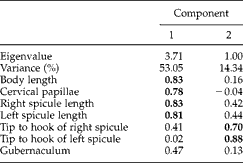
In PCA analysis, two components were generated with significant eigenvalues of more than 1 (table 2). Component 1 with eigenvalue of 3.71 explained 53.05% of the total variance. Component 2 had an eigenvalue of 1.0 which explained 14.34% of the total variance. The first component explained the largest amount of variance and the second component explained the next largest amount of variance. The cumulative percentage of these two components was 67.39%. Rotated matrix was performed to assess the correlation of characters to each component. Component 1 showed high positive weighting for variables BL, CP, RSL and LSL, while component 2 was highly loaded with variables THr and THl. These characters were related to worm size/length.
Eigenvalues, percentage of variance and principal component loadings of H. contortus morphometric charactersa.
a High loadings indicated in bold type.
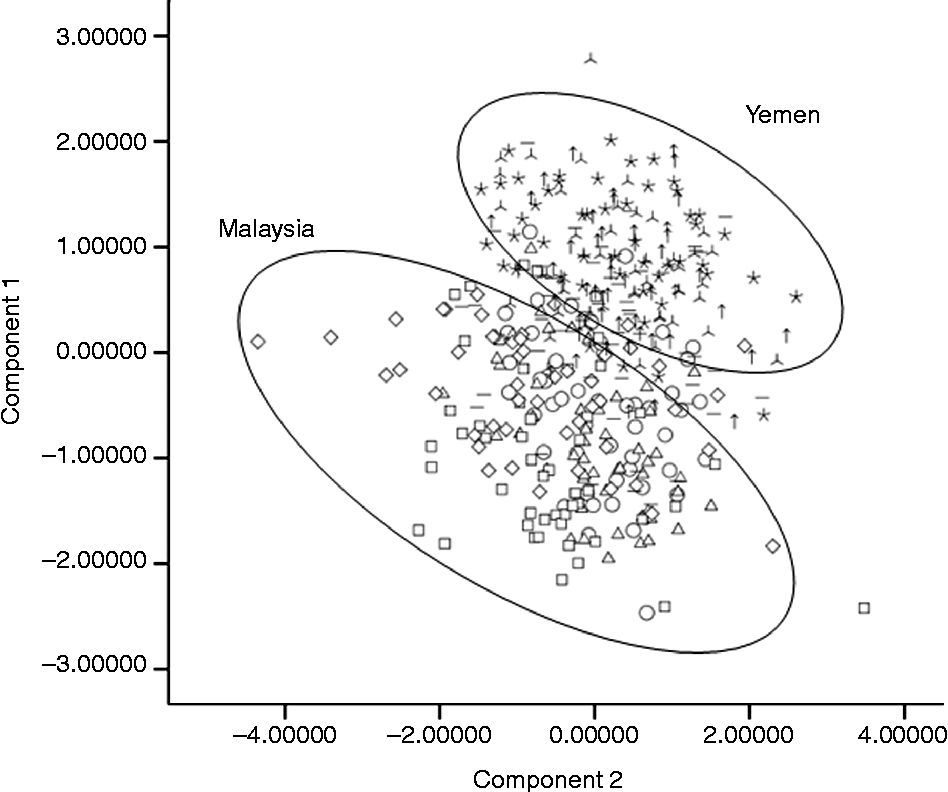
As shown in the ordination plot of PCA (fig. 1), the majority of H. contortus male worms of sheep and goats from Malaysia and Yemen were separated into two distinctive groups based on morphometeric characteristics, with very slight overlapping between the two groups. Thus, the principal component analysis (PCA) revealed the presence of differentiation between H. contortus populations of sheep and goats from Malaysia and Yemen.
Scatterplot of Component 1 against Component 2 of PCA for H. contortus morphometric analysis. PS, Perak-Sheep (open circles); PG, Perak-Goat (open triangles); KS, Kelantan-Sheep (open squares), KG, Kelantan-Goat (open diamonds), SS, Sana'a-Sheep (arrows); SG, Sana'a-Goat (stars); HS, Al-Hudaydah-Sheep (dashes); HG, Al-Hudaydah-Goat (tripods).

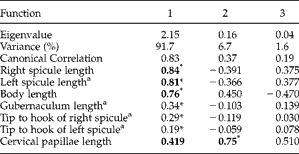
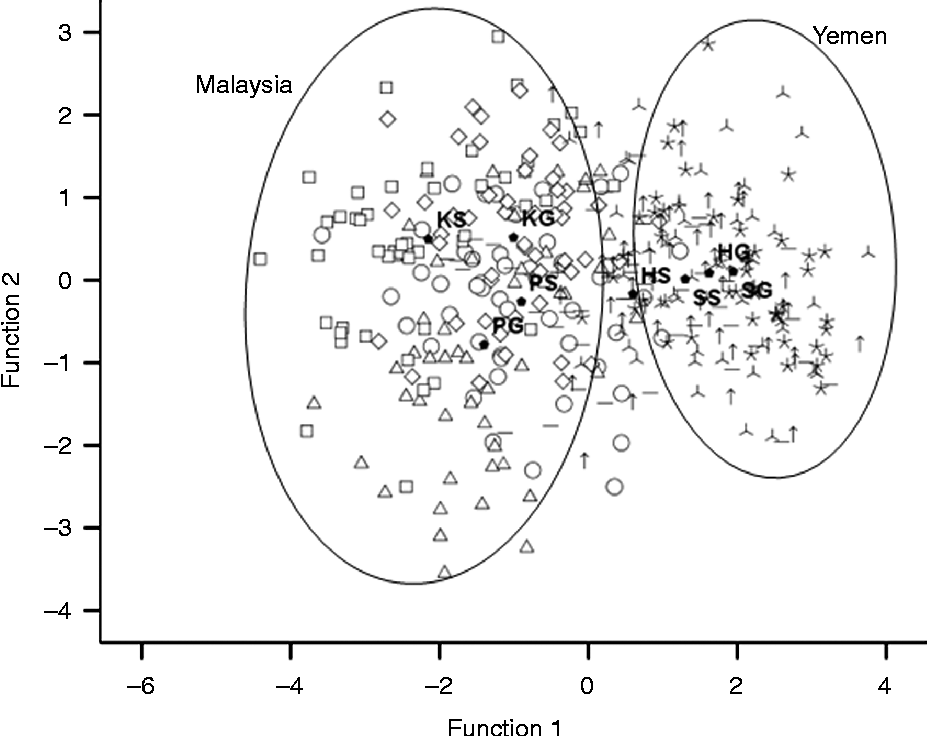
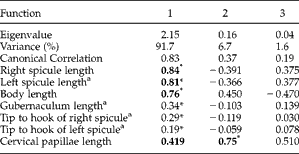
In DFA analysis, three functions were generated but only one had an eigenvalue of more than 1 (table 3). Function 1 with eigenvalue of 2.15 explained 91.7% of the total variance. This function had high loading with four characters, RSL, LSL, BL and CP. Function 2 had an eigenvalue of 0.16 explaining 6.7% of the total variance with high loading for only a single character, CP. The cumulative percentage of these two functions was 98.4%. The scatterplot of DFA (fig. 2) showed that the majority of H. contortus male worms of sheep and goats from Malaysia and Yemen were separated into two distinctive groups based on morphometeric characteristics. Only a slight degree of overlapping between countries, but high overlap within each country, was observed. This confirmed the variation between H. contortus populations of the two countries.
Eigenvalues, percentage of variance, canonical correlation and discriminant function loadings of H. contortus morphometricsa.
a This variable not used in the analysis.
* Largest absolute correlation between each variable and any function. (High loadings indicated in bold type).
Scatterplot of Function 1 against Function 2 of DFA for H. contortus morphometric analysis. PS, Perak-Sheep (open circles); PG, Perak-Goat (open triangles); KS, Kelantan-Sheep (open squares), KG, Kelantan-Goat (open diamonds), SS, Sana'a-Sheep (arrows); SG, Sana'a-Goat (stars); HS, Al-Hudaydah-Sheep (dashes); HG, Al-Hudaydah-Goat (tripods); group centroids (black pentagons).
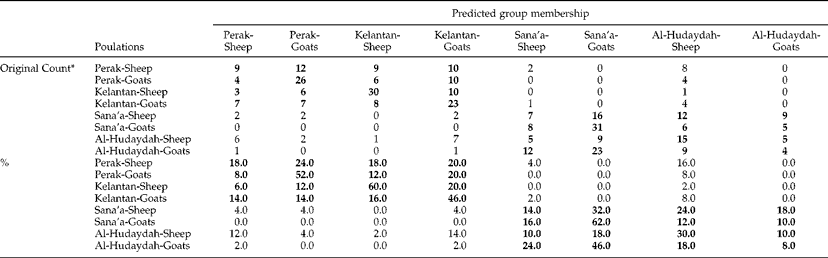
The classification results showed that no population could be entirely assigned to its own group (table 4). Sana'a-Goats showed the highest percentage of correct group classification, with 62.0%, followed by Kelantan-Sheep at 60%. Populations of H. contortus from Malaysia shared a closer within-country identity, i.e. although individuals did not group into their original population, they were more likely to classify in within-country populations. The same trend was observed in populations from Yemen.
Classification results of predicted groups for H. contortus morphometricsa.
a Classification in within-country populations indicated in bold type.
* n= 50 male worms; %, percentage of classification within country populations.
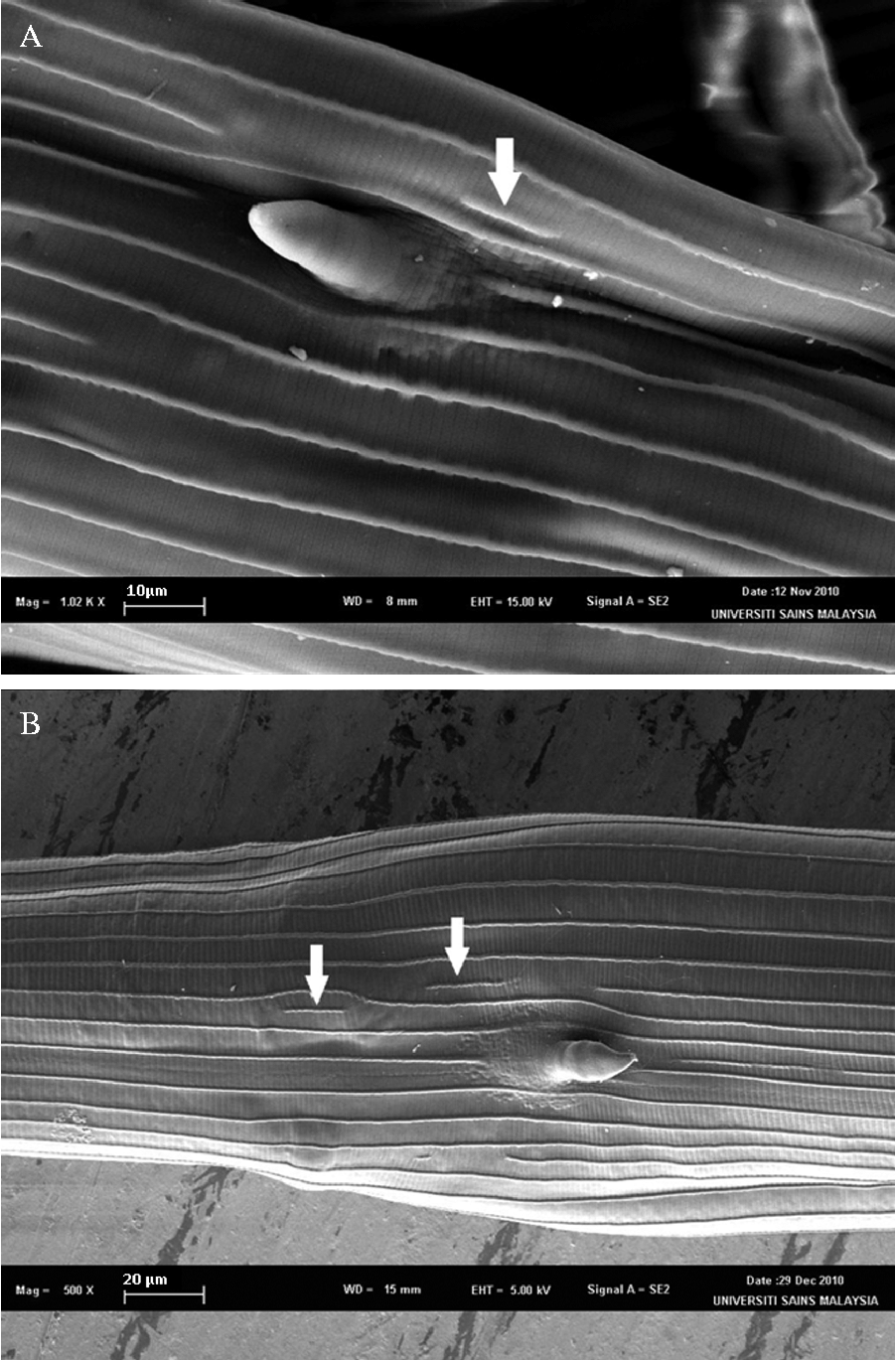
In general, H. contortus adult worms from Malaysia and Yemen showed similar synlophe pattern, but minor variations were observed in worms from Yemen due to the presence of short extra ridges, especially in the region of cervical papillae (fig. 3).
Scanning electron micrographs of the synlophe patterns of male H. contortus from sheep in (A) Kelantan and (B) Al-Hudaydah, at the level of the cephalic papillae, to show the short extra ridges (arrowed). Scale bars: (A) 10 μm; (B) 20 μm.
Discussion
Previously, some morphological differences were observed between H. contortus male worms from sheep and goats in Malaysia (Gharamah et al., Reference Gharamah, Rahman and Siti Azizah2011a) and in Yemen (Gharamah et al., Reference Gharamah, Rahman and Siti Azizah2011b). However, the principal component analysis (PCA) and discriminant function analysis (DFA) showed the presence of differentiation between isolates from the two countries but without host isolation. The body, cervical papillae and spicule lengths were the most important characters that distinguished between populations of the two countries, indicating the importance of size/length variation in the discrimination of these worms. The classification of predicted group also confirmed the distance between populations from the two countries. This differentiation may be due to the absence of host movement between the two countries.
A study of seven isolates of Philasterides dicentrarchi (a parasite of fish) obtained from different parts of Spain and Portugal, showed morphological variations between these isolates based on dicriminant function analysis (Budiño et al., Reference Budiño, Lamas, Pata, Arranz, Sanmartín and Leiro2011). These authors found 8 out of the 16 morphological characters studied to be the most important to discriminate between isolates. These isolates were separated into five clusters in the scatterplot of DFA. The authors demonstrated the presence of a clear intra-specific polymorphism between isolates of this species (Budiño et al., Reference Budiño, Lamas, Pata, Arranz, Sanmartín and Leiro2011). Haemonchus contortus has high phenotypic plasticity and it can evade environmental pressure by exhibiting different epidemiological strategies, depending on the surrounding conditions for the larval stages (Troell et al., Reference Troell, Waller and Hoglund2005).
The pattern of longitudinal ridges on the external cuticular surface of trichostrongylid nematodes was found to be important in distinguishing and determining the relationships among these species (Lichtenfels & Pilitt, Reference Lichtenfels and Pilitt2000). This character had previously been used to distinguish populations of H. contortus from H. placei (Lichtenfels et al., Reference Lichtenfels, Pilitt and Le Jambre1986). In H. contortus, there were only 15 dorsal and 15 ventral ridges, and this number was constant in males and females but with minor variations due to the presence of short extra ridges (Lichtenfels et al., Reference Lichtenfels, Pilitt and Hoberg1994). This is in agreement with the present study. Also, in another study on synlophe pattern, no differences were observed between males and females, with minor variation due to short gaps or breaks in the ridges especially near their anterior or posterior ends (Lichtenfels & Pilitt, Reference Lichtenfels and Pilitt2000).
There are some plausible explanations for the morphological differences observed between H. contortus isolates from sheep and goats in Malaysia and Yemen. First, the genetic plasticity of this worm that has allowed it to succeed in many hosts can result in manifestation of morphological differences between isolates of different hosts, as stated earlier (Whitlock & Le Jambre, 1981). Second, geographical isolation and physical barriers for host movement between the two countries is another possible reason for these observed differences. Third, the presence of different H. contortus isolates in the two countries is possible. Similarly, significant morphological differences were found between four H. contortus isolates from Australia, and, as a possible reason for this variation, the authors suggested that different H. contortus isolates had been introduced through imported animals (Hunt et al., Reference Hunt, Knox, Le Jambre, McNally and Anderson2008).
The development of free-living stages of H. contortus is influenced by climatic and environmental factors, such as temperature, rainfall and humidity (Rossanigo & Gruner, Reference Rossanigo and Gruner1995). Also it has been shown worldwide that the rate of infection is usually influenced by animal management practices (Barger et al., Reference Barger, Siale, Banks and Le Jambre1994; El-Azazy, Reference El-Azazy1995; Sani et al., Reference Sani, Adnan, Cheah and Chandrawathani2004). In Malaysia, there is a continuous organized effort to control worm problems of ruminants (Chandrawathani, Reference Chandrawathani2004; Sani et al., Reference Sani, Adnan, Cheah and Chandrawathani2004), while in Yemen good control regimes against parasitic infections are absent, as reported earlier (Hunter & Heath, Reference Hunter and Heath1984; USAID, 2009). Thus management may be more important in the morphological variation observed in this study, where the absence of good control regimes in Yemen may provide an environment conducive for an increase in numbers and size of worms. This may help to explain why the measurements of worms from Yemen were higher than those from Malaysia.
In conclusion, the results of this study showed the existence of morphological variation between populations of H. contortus from Malaysia and Yemen, but with no host isolation. These results may be evidence of some sub-type differentiation between H. contortus from the two countries. However, further investigations on more populations (where possible), using more advanced and sensitive approaches, should be carried out to clarify this variation.
Acknowledgements
The authors are grateful to R. Nurulaini and S. Khadijah from the Veterinary Research Institute (VRI), Perak and Dr Lee Chai Ha from Kelantan Veterinary Regional Laboratory, Kelantan for providing us with H. contortus samples. The research was funded by Malaysian Research University (RU) grant (No. 1001/PBiologi/811004). The authors have declared no conflict of interests.