Anomie: (noun)
-
1 A lack of moral or social principles in a person or in society.
-
2 Alienation, purposelessness, isolation, confusion or anxiety experienced by an individual, class or society as a result of a lack of standards, values, ideals or direction.
Constitutional anomie is a debilitating condition. Its symptoms include the introduction of reforms in a manner bereft of any underlying logic or explicit principles, combined with the inability to adopt a strategic approach that is sensitive to the interrelated nature of any constitutional configuration. Constitutional anomie is therefore an ailment of both mental and physical health vis-à-vis the body politic. Social and political anxiety, confusion and frustration emerge, with the result that reforms that were designed to enhance levels of public trust and confidence in politics, politicians and political institutions can actually have the opposite effect. The prognosis for constitutional anomie depends on a complex range of factors, but not least is the creation of specific anomalies and inconsistencies that are likely to augment until the pressure for more fundamental measures becomes inevitable. Between 1997 and 2007 the Labour governments of Tony Blair suffered from constitutional anomie. A series of reforms were implemented with little appreciation of:
-
1 What (in the long run) the government was seeking to achieve;
-
2 how reform in one sphere of the constitution would have obvious and far-reaching consequences for other elements of the constitutional equilibrium; or
-
3 any detailed analysis of the nature or model of democracy that existed towards the end of the twentieth century and particularly after 18 years of Conservative government.
If constitutional anomie reflects a sense of alienation or anxiety experienced by an individual or a segment of society as a result of a lack of clarity about the nature of a democracy then one might expect evidence of this affliction's existence to take the form of low levels of electoral turnout and declining amounts of public trust in politicians, political institutions and political processes. As the minister for constitutional affairs, Harriet Harman, emphasized in January 2006 ‘[A] healthy democracy is one that has the active engagement of its citizens. Our democracy lacks legitimacy if, whatever the formal rules about universal suffrage and the right to vote, people don't make it a reality by turning out to vote.’ One might conclude from this quote and the result of the 2005 general election that British democracy is not very healthy and that there are major questions concerning its legitimacy. The minister herself lamented the contemporary existence of ‘democracy deserts’ where high levels of social exclusion are compounded by low levels of democratic engagement.
Indeed, if the central aim of New Labour was to rebuild public trust and confidence in politics then it is difficult to avoid the conclusion that they have been unsuccessful. In coming to this conclusion it is sufficient to highlight the data produced by the Electoral Commission, the British Social Attitudes Survey, the Economic and Social Research Council's (ESRC) Democracy and Participation Programme, and the Hansard Society's Annual Audit of Political Engagement. Taken together, this body of research suggests that: (1) less than one in five adults trust politicians; (2) the public are not uninterested in politics per se but they are utilizing non-traditional forms of political participation and engagement; and, (3) very few members of the public know about or understand recent constitutional reforms, despite the fact that only around 5 per cent believe the ‘British system works well’. In short, the evidence suggests that New Labour's constitutional reforms have failed to reconnect the governed with the governors.Footnote 1 Levels of public distrust and disengagement remain high.
The data and evidence of heightened public distrust of politicians and political institutions alongside a more general sense of public apathy and disengagement – particularly among certain social groups – during 1997–2007 is fundamental in relation to this article's focus on constitutional anomie. Although Britain is by no means unique among advanced liberal democracies in being a ‘disaffected democracy’, the available data does pose distinct questions about the nature and manner in which New Labour approached the issue of constitutional reform and democratic renewal. The absence of any clear underlying logic or principles, combined with evidence that the government was committed to a far-reaching shift in the nature of British democracy in principle but not in practice, arguably alienated large sections of the public and reinforced existing beliefs about the trustworthiness of politicians. Constitutional anomie therefore eviscerated the potential rewards of reform in terms of rebuilding trust because it confused the public about the driving logic or consequences of each specific measure as well as often cultivating an image of a government constantly devolving power with one hand, only to claw it back through patronage or the imposition of exemptions, opt outs or ministerial vetoes at the implementation stage.Footnote 2
As prime minister, Tony Blair made no speeches on the constitution, and a White Paper on the constitution was never forthcoming. Northern Ireland apart, Blair was never a constitutional entrepreneur with a driving passion for change or a clear vision of what a reformed model of British democracy would look like. ‘When it came to having a coherent view about constitutional change, there was no leadership from the top.’Footnote 3 The lord chancellor for much of this period, Lord Irvine, responded to criticisms that the reform programme was disjointed and opaque in terms of underpinning values by stating that the government had no intention of ‘returning to first principles’. ‘Cobbled together on the back of an envelope’ may well have been Hennessy's apt description of constitutional design and reform in Britain during the twentieth century but it arguably reached its zenith during 2004–7 as a lack of consultation, inadequate preparatory work and poor media management led to the government being perceived as floundering, ill prepared, over-hasty and, at times, simply shoddy in relation to constitutional reform.Footnote 4 It is this accusation of constitutional anomie that provides the backdrop to this article.
In this context the publication of ‘The Governance of Britain’ Green Paper in July 2007, just weeks after Tony Blair resigned and was replaced by Gordon Brown, marks a significant point in British constitutional history. As chancellor of the exchequer, Brown had always been more sensitive to the existence and implications of constitutional anomie and during the government's second term (2001–5) he signalled his anxieties in a number of speeches and statements in which he called for a ‘new constitutional settlement’.Footnote 5 ‘The Governance of Britain’ can therefore be located within a broader narrative concerning the evolution and future of British democracy. In terms of style there is a distinct change of emphasis in two clear ways: first, there is an explicit engagement and willingness to promote a discussion about the primary values and principles that should underpin Britain's constitutional arrangements; and, second, an emphasis on broad consultation in relation to both underpinning values and elements of ‘unfinished business’. However, the Green Paper also provides an intriguing glance into the executive mentality, and in particular how members of the government and senior civil servants frame certain issues in terms of key questions.Footnote 6 In this regard it is possible to suggest that the document is misdirected. The foreword by the prime minister states that ‘The Governance of Britain’ is focused on two fundamental questions:
-
1 How should we hold power accountable?
-
2 How should we uphold and enhance the rights and responsibilities of the citizen?
However, it is possible to suggest that these two questions continue to imply a degree of constitutional anomie because they are secondary (or meso-level) questions that can only be answered once broader more macro-political questions regarding what sort of democracy and what specific model or form we are seeking to move towards have been settled. To adopt the metaphor of a journey, the government's questions are akin to discussing what form of transport we might use (train, bus, plane, tram, etc.) before we have decided where we want to go. Following this line of argument it is possible to suggest that if the government is truly committed to forging ‘a new relationship between government and citizen, and begin the journey towards a new constitutional settlement’, then a more constructive approach would take a more expansive and grounded approach by asking two quite different questions:
-
1 What kind of constitution and democracy do we have in Britain at the beginning of the twenty-first century?
-
2 What are we attempting to achieve through the reform process?
These questions are clearly interrelated: answering the second requires at least some attempt at resolving the first. Both questions also involve normative and empirical dimensions that, in turn, force us to consider the tools of political analysis and particularly those that offer the capacity to assess the sum impact of a disjointed series of constitutional reforms. This raises epistemological and methodological questions concerning the concepts, theories and frameworks through which it is possible to deduce subtle, moderate or fundamental changes in a democratic system. However, the significance of these questions of political analysis and the need for explicitly theorized systematic research on the impact and legacy of reforms during 1997–2007 is demonstrated not just by the Labour government's position on constitutional reform but also by the failure of the now burgeoning academic literature on this topic to come to any sort of shared conclusion about the cumulative impact of these measures.
In order to develop and tease apart this accusation of constitutional anomie, the rest of this article is divided into four sections. The first section briefly reviews the broader academic literature on constitutional reform in Britain under New Labour and highlights a stark polarization between those who view the cumulative measures of these reforms as fundamental and those who are more sceptical.Footnote 7 The second section employs Lijphart's methodological frame for assessing patterns of democracy in order not only to explain this academic polarization but also to develop the analytical traction or leverage of the constitutional anomie thesis. The results of Lijphart's methodology allow the third section to argue that the simple majoritarian-consensus polarization that has dominated academic debate and discourse is insufficiently sensitive to the realities of governing Britain in the twenty-first century. The third section therefore presents a secondary theory of bi-constitutionality under New Labour that complements the primary argument regarding constitutional anomie by exposing the existence of increasingly incompatible models of democracy at different levels of governance. The article concludes (in the fourth section) by focusing directly on constitutional anomie and how the government under Gordon Brown is seeking to develop some form of underpinning narrative, a constitutional morality, that can unite the disparate and in many cases anomalous elements of New Labour's constitutional reform programme.
ANALYTICAL POLARIZATION
The main aim of this article is to set out and develop a thesis regarding constitutional anomie, but in a sense one of the clearest signs that this condition exists is reflected in the academic and scholarly literature that has attempted to trace and analyse this process. Therefore, while not attempting to provide a complete and exhaustive review of this growing body of work, it is worth providing a glimpse of the relatively stark divergence of opinion that exists. This is a critical point. It is possible to detect a clear polarization of opinion between a relatively coherent group of scholars who interpret the reforms as representing a radical and fundamental break with Britain's traditional power-hoarding constitution – let us call them the revolutionary theorists – while a second group – the sceptical theorists – emphasize the continuing role and influence of the Westminster model and therefore assess the impact of New Labour's reforms as markedly less significant than the first group do.
The revolutionary theorists are made up of a body of scholars who are broadly of the opinion that during 1997–2007 New Labour implemented fundamental reforms that remodelled Britain's traditional constitution along more pluralist lines. It is in this vein that Peter Mair wrote, ‘New Labour is currently engaged in what amounts to a full-blooded constitutional revolution, dragging the political system away from an extreme version of majoritarian democracy towards a more institutionally consensual model.’Footnote 8 McDonald opens his Reinventing Britain by stating, ‘The proposition behind this book is a simple one. Since the election of the New Labour government in 1997, the British state has undergone radical change.’Footnote 9 The work of Vernon Bogdanor in which he has discussed our ‘new constitution’ and a possible ‘constitutional crisis’ would also sit within this position.Footnote 10 In direct opposition to this view, King's analysis of recent reforms leads him to conclude that Britain ‘remains essentially a power-hoarding or power-concentrating constitution’.Footnote 11 Riddell similarly suggests, ‘At root, Blair has shown himself as much a majoritarian in his instincts as Thatcher.’Footnote 12 This point chimes with the view of Theakston that, ‘Blair's “modernisation” rhetoric cannot disguise a strong personal attachment to the fundamentals of an executive-dominated parliamentary regime.’Footnote 13 Johnson takes on the revolutionary theorists directly by stating that, ‘Despite the best efforts of the protagonists to present the changes as the fulfilment of a radical reform programme there are few grounds for accepting such a view of the matter. The constitution has not been reshaped, or cast in a new form.’Footnote 14
Although seeking to specify two dominant views on the nature and extent of New Labour's constitutional reforms risks exaggerating the degree of coherence that actually exists, it is possible to argue that a constellation of values and assumptions can be identified in each case. Furthermore, what is significant about these analyses is the degree to which a distinct polarization is relatively clear. Even those scholars who adopt a more nuanced and less extreme position can generally be located on the margins of one pole or another. Gamble's analysis, for example, concludes that ‘the UK today is less centralist and less unitary than it was, but it is still a long way from a political system that is truly federal and decentralized, and many doubt it will ever arrive’Footnote 15 would fall, albeit softly, within the sceptical camp. In contrast, the work of Dunleavy on electoral behaviour and reform in which he suggests that Britain is experiencing a transition towards full multiparty politicsFootnote 16 would fit within the revolutionary theorists' camp.
Both camps, however, agree that New Labour's reforms have been far-reaching and have altered the nature of British democracy to some degree. No one is arguing that the reforms are cosmetic: the debate relates to the issue of degree. And yet so far the revolutionary and sceptical camps have largely talked past each other with little attempt to connect, understand or weave together their respective positions as part of a broader, systematic analysis of the constitution as it exists today. This point brings us back to ‘The Governance of Britain’ Green Paper and the argument regarding the need to adopt a more grounded approach that draws upon theoretically informed research in order to obtain a more detailed understanding of British democracy at the beginning of the twenty-first century (Question 1 above). In order to achieve this fine-grained understanding of the cumulative impact of New Labour, the next section updates the seminal work of Arend Lijphart.
PATTERNS OF DEMOCRACY
Lijphart's central thesis is that democratic systems can be placed on an axis, which has majoritarianism at one extreme and consensualism at the other.Footnote 17 Most democratic systems, Lijphart suggests, can be located on a continuum between these poles. The majoritarian–consensus contrast therefore forms the foundation of Lijphart's framework (thereby forming a direct link with the scholarly debate outlined in the previous section). The majoritarian model is a power-hoarding constitution. This condensed power structure is generally nurtured by a winner-takes-all electoral system, an adversarial political culture and a competitive party system based largely around two dominant parties. In the consensus model power is shared and this is commonly achieved through a proportional electoral system, a consensual political culture and a party system involving a number of parties. Lijphart's research suggests that, contrary to popular belief, consensual systems do not commonly suffer from pluralistic stagnation in which the decision-making processes become overly complex, leading to economic inefficiency.
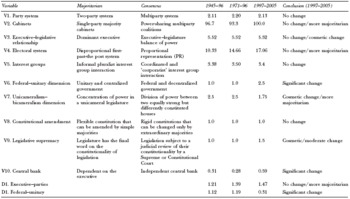
The difference between majoritarian and consensual democracies, according to Lijphart, is that the latter offer greater opportunities for participatory and deliberative democracy, leading to higher levels of public trust and fewer examples of extreme policy shifts. A notable benefit of Lijphart's majoritarian and consensus models is that they facilitate the creation of a ‘conceptual map’ on which specific forms or models of democracy can be located. In order to locate the political system of a country along the majoritarian–consensus axis, two dimensions are established (executive–parties and federal–unitary), each involving five characteristics. These two dimensions and ten characteristics form dichotomous contrasts in terms of majoritarian and consensus models (see the first three columns of Table 1).
Auditing Reform in Britain Under New Labour: Lijphart's Ten Variables and Two Dimensions

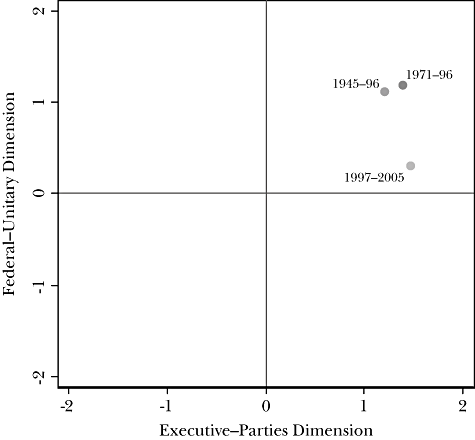
Although Lijphart's last study of Britain covered the period 1971–96 his work has been closely replicated and updated for the years 1997–2005. The results of this analysis have been published at some length elsewhereFootnote 18 and it is neither possible nor necessary to examine each variable in detail in this article (the updated scores and overall conclusion for each variable are set out in the final two columns of Table 1). What is more important in the context of (1) the scholarly polarization noted above; (2) the key question concerning the nature of British democracy at the beginning of the twenty-first century; and (3) the broader argument concerning constitutional anomie put forward in this article is the position of Britain on Lijphart's conceptual map of democracy after two full terms of New Labour government (see Figure 1).
Two-Dimensional Conceptual Map of Democracy in Britain 1945–96, 1971–96, 1997–2005

Lijphart's methodology is not a panacea for the challenges of constitutional political analysis. It has been critiqued, developed and expanded.Footnote 19 And yet it remains ‘the single most influential typology of modern democracies’ and offers the capacity to facilitate both comparative and longitudinal analysis.Footnote 20 Critically, Figure 1 suggests that British democracy has changed under New Labour but that this change has been one sided. There has been a clear shift along the federal–unity dimension, reflecting devolution, the creation of a (albeit ‘second-class’) Supreme Court and an increase in central bank independence. However, there has not been an equivalent shift on the executive–parties dimension. On the contrary, the change on this dimension suggests a slight increase or greater concentration in executive power since 1997; a finding that chimes with the conclusion of the 2006 Power Report that ‘the executive in Britain is now more powerful in relation to Parliament.’Footnote 21 Figure 1 also confirms Norris's 2001 prediction that if Lijphart's analysis was updated it would reveal that, ‘the federal–unitary dimension of British government has been transformed far more than the executive–party dimension…Like Harold Lloyd dangling in midair on a skyscraper ledge, one hand has slipped but the other retains its grip.’Footnote 22
It is clear from the analysis of Lijphart's variables above that New Labour has taken great care to implement its constitutional reforms, however precariously, within the traditional majoritarian structure of British government. These results support Norton's view that, ‘…they [New Labour] have taken the Westminster model, the traditional constitution, and modified it, some would say vandalized, and not actually replaced it with a new form of constitution’.Footnote 23 Crucially, there has been no discernible conception of an alternative constitution. This takes us back once more to the theme of constitutional anomie. Marquand exposed the central core of this criticism when he noted, ‘It is very British, this revolution. It is a revolution without a theory. It is the messy, muddled work of practical men and women, unintellectual when not positively anti-intellectual…A revolution of sleepwalkers who don't quite know where they are going or why.’Footnote 24
Although this comment points towards the existence of constitutional anomie it does little in terms of increasing our detailed understanding of the origins of these dilemmas or the likelihood of constitutional spill-over or spill-back between elements of the reform programme or between different tiers and levels of governance. Moreover, questions exist regarding the degree to which Lijphart's framework increases our understanding in relation to these issues. Indeed, a major ontological and epistemological problem with this debate is that it has become polarized around a binary distinction between consensual or majoritarian forms of democracy when in fact the contemporary reality is far more complex. The ‘Blair paradox’ actually reflects not a simple shift in orientations (from majoritarian power-hoarding to consensual power-sharing) but a multifaceted attempt to overlay a new meta-constitutional orientation – in terms of a set of core values, principles and assumptions about the distribution of power and the relationship between political actors – on top of the existing version. This is the creation of a multilevel polity based upon a more consensual model of democracy within what is, admittedly, an increasingly frail conception of the Westminster model. It is this constitutional engineering, or more precisely the attempt to blend arguably incompatible meta-constitutional orientations, that explains:
-
1 the specific manner in which certain reforms have been implemented;
-
2 why the government has sought to block or marginalize certain issues; and,
-
3 the academic polarization of opinion.
In essence, both the sceptical and revolutionary interpretations have sought to emphasize two sides of the same process. That is a statecraft strategy based upon constitutional co-existence and the parallel operation of markedly different models of democracy within one polity.Footnote 25 Neither academic grouping is therefore ‘wrong’ or ‘right’ because, as previously mentioned, such crude binary distinctions are of little value in this context. This theme of blending or the parallel deployment of different forms (or models) of democracy opens up a discussion regarding bi-constitutionality.
BI-CONSTITUTIONALITY
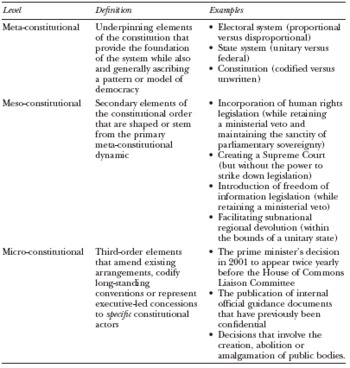
As mentioned above, Lijphart's framework is a valuable heuristic and conceptual tool but it cannot answer all the challenges of political analysis in the sphere of constitutional and democratic reform. Indeed the strict application of Lijphart's framework at the national level risks overlooking the implication of more far-reaching reforms at the periphery (in geographic and administrative terms). The central aim of this section is to develop the argument raised above, that the majoritarian–consensus axis is too simplistic to capture the contemporary complexity of governance in Britain. New Labour has, in effect, been ‘bi-constitutional’– it has sought to apply different meta-constitutional orientations at different political levels.Footnote 26 This has taken the form of a more consensual orientation at the devolved level while retaining a revised version of the Westminster model (i.e. modified majoritarianism) at the national level. This argument can be illustrated through a brief review of electoral reform within the UK since 1997 because electoral systems govern the transfer and allocation of power and therefore form a (if not the) key component of ‘meta-constitutional’ politics (see Table 2). As Dunleavy and Margetts have shown, the choice of electoral system reflects deep-seated beliefs about the distribution of power and the nature of legitimate government.Footnote 27 The politics of electoral reform (i.e. public pressure combined with strategic manoeuvring by political elites to prevent or facilitate change) therefore exposes embedded and profound views about the existing meta-constitutional orientation and alternatives.
Gradations of Constitutional Reform

The need for electoral reform formed the centrepiece of the 1996 Joint-Consultative Committee on Constitutional Reform between the Labour Party and Liberal Democrats, and the Labour Party's 1997 manifesto subsequently pledged the party to ‘hold a referendum on the voting system for the House of Commons’. However, the size of the Labour Party's subsequent victory (winning 418 seats, a majority of 178) meant there was little need for the party to cooperate with the Liberal Democrats, let alone move quickly towards a national referendum on electoral reform. Although an independent commission on electoral reform was established under Lord Jenkins of Hillhead, internal conflict over the issue within the cabinet and the wider party meant that the issue was marginalized and the report's recommendationsFootnote 28 were not taken forward. Ironically, a large element of this intraparty dissent over electoral reform for Westminster had been generated by the failure of the Labour Party to win overall majorities in the first round of elections to the Scottish Parliament and Welsh Assembly and it is at this point that the roots of the Blair paradox and the existence of bi-constitutionalism becomes clear. Devolution to Scotland, Wales and Northern Ireland had always been intended to be a central part of the ‘new politics’ narrative –‘new’ in the sense that it would be based on a more balanced, consensual and less adversarial political culture, increased participation, openness and transparency, explicit constitutional rules, diluted executive power, a more balanced relationship between the executive and legislature, and forms of democracy ‘other than the orthodox voting process’.Footnote 29 This was a central element of the ‘third way’ that insisted that ‘reform of the state and government should be a basic orientating principle of third-way politics – a process of the deepening and widening of democracy’,Footnote 30 or what Lord Giddens would later refer to as ‘a second wave of democratization…the democratization of democracy’.Footnote 31 In practical terms this ‘new politics’ would be engineered through a proportional electoral system, the additional member system in Scotland and Wales and single transferable vote in Northern Ireland, which would reduce the frequency of single-party executives, facilitate the emergence of new smaller parties and establish a more balanced executive–legislative relationship.Footnote 32 However, the day-to-day reality of shared government at the devolved level cemented the traditional and fairly widespread view of many in the Labour Party that electoral reform would undermine the capacity of the party to drive through its policies.Footnote 33
As emphasized above, electoral systems govern the transfer and distribution of power within political systems and as such can be interpreted as aspects of ‘meta-constitutional’ politics because they identify and reflect the fundamental principles of the body politic. The bi-constitutionality of New Labour is demonstrated in the fact that since 1997 New Labour has sought to foster, develop and apply a more pluralist meta-constitutional orientation at the devolved level while seeking to retain a markedly different model of governance at the core, a model founded on a disproportional electoral system. The broader comparative literature on models of democracy and reform demonstrates that constitutions and electoral systems tend to be notoriously resistant to change. Beneficiaries of the existing situation tend to be those whose support is also needed to deliver change. For this reason comparative constitutional history is littered with examples of new governments that renege on pre-election promises to institute reforms that would reduce their capacity to govern.
And yet New Labour's approach is distinct exactly because it has been willing to devolve power, empower other constitutional actors vis-à-vis the executive (e.g. by incorporating the European Convention of Human Rights and introducing a statutory freedomof information regime) and even create new constitutional watchdogs (Electoral Commission, NHS Appointments Commission, Judicial Appointments Commission) – reforms that all indicate a move to a more pluralist and consensual model of democracy. But at the same time New Labour has, as those scholars in the sceptical camp have argued, remained tightly bound to the Westminster model as its default meta-constitutional orientation. This is reflected in the government stance on electoral reform for Westminster, its unwillingness to countenance reforms to the House of Lords that might empower it vis-à-vis the Commons, and its well-documented refusal to shift the balance of power between the executive and legislature.Footnote 34 Labour's hybrid approach, or bi-constitutionalism, dovetails with this article's argument concerning constitutional anomie because the government appears unable or unwilling to explain why it feels a more pluralistic form of governance is appropriate at the devolved level but not at the national level.Footnote 35
This line of argument could be extended in order to pose distinct questions about New Labour's governance reforms at other constitutional levels. Why is a more consensual model of democracy deemed appropriate for devolved democratic arenas at a time when the government is imposing majoritarian-styled reforms on local government?Footnote 36 King develops this theme by stating ‘There can be few countries in the world – perhaps there are none – which have within themselves a variety of governing institutions that are based on such fundamentally divergent constitutional conceptions.’Footnote 37 So far this article has sought to emphasize that British democracy has not shifted from one distinct model to another (majoritarian to consensual), which is the dominant conceptual lens that has shaped debates to date, but that it has sought to develop and institute a new meta-constitutional orientation at the devolved level based upon a more consensual and participatory model of democracy while maintaining (and defending) a quite different meta-constitutional orientation at the national level. This is particularly problematic within a unitary state.
Put differently, federal states, such as Canada, for example, could be interpreted as facilitating bi-constitutionality through their accommodation of ideational shifts that have not become prevalent at the national level. It is in this vein that Lusztig isolates a distinctive ‘Western’ meta-constitutional orientation at the Canadian provincial level that remains, and has been for some time, distinct from the dominant federal orientation.Footnote 38 Australia provides a particularly apt and explicit example of bi-constitutionalism that involves a modified version of the Westminster system alongside constitutional elements (bi-cameralism, written constitution, strong federalism, proportional elections to the second chamber, etc.) commonly associated with consociational polities.Footnote 39 Federalism might therefore be interpreted as allowing the adoption of different models or forms of democracy without creating any formal/constitutional friction or contradictions in a way that is not possible in a formally unitary state such as the UK. Different constitutional configurations will therefore have different effects on ‘locking in’ certain beliefs or assumptions about the nature of democracy, while the existence of chains of democratic arenas within multilevel governance frameworks may extend far beyond bi-constitutionalism and display elements of multi-constitutionalism.
However, the central focus of this article rests on the implementation of a number of disparate reforms during 1997–2007 without any clear attempt to locate them within a broader statement of how they interrelate or of the overall aim of this process. The mixture of radicalism and conservatism and particularly the contradictions of constitutional ‘modernization’ that have characterized New Labour's approach have become known as the ‘Blair paradox’ within the work of leading scholars such as Marquand,Footnote 40 MairFootnote 41 and Norris,Footnote 42 and yet the concept of bi-constitutionalism allows us to understand the existence of inconsistencies and anomalies. Constitutional anomie has resulted from New Labour's failure to locate its reforms within any underpinning principles or an explicit rationale and also from the attempt to run in parallel two models of democracy that are founded upon quite different and at base incompatible (even antagonistic) values.
It is the tensions and anomalies arising from this interaction between attempts to retain traditional aspects of the Westminster model, at least in theory, while at the same time instituting reforms that undermine (or at least set in train dynamics that are likely to destabilize) core tenets of this model that explain and underpin many contemporary tensions in British governance. In a statement that resonates with the themes of constitutional anomie and bi-constitutionality discussed above, Dunleavy notes that ‘in the longer term the coexistence of PR and plurality-rule systems [i.e. power-sharing and power-hoarding]…make a further constitutional restabilisation look likely’.Footnote 43 This notion of restabilization is critical and in many ways underlines the existence and consequences of constitutional anomie. It also flows into a set of questions about how Blair's successor, Gordon Brown, or any future government might seek to counter the existence of constitutional anomie. In this sense the opposite of constitutional anomie is constitutional morality. This refers to morality in the sense of a shared, explicit and broadly accepted statement or set of values, rules, principles – sociopolitical understandings – which act as a form of social glue (or at least provide some sense of the governing logic) through which the public and politicians, the governed and the governors, can frame their relationship(s).
It is in this context that Hazell has called for the government to offer a ‘new narrative’ that can offer a ‘better justification for the first wave of reforms than the bland word of modernisation’, while also working at the level of the citizen in terms of demonstrating the existence and benefits of new rights, forms of accountability and openness.Footnote 44 This demand for a ‘new narrative’ resonates with the notion of constitutional anomie because it explicitly recognizes not only the need to join up the various institutional reforms but also the need to locate that process within a broader public discourse that the public can understand and relate to. The deeper and arguably more insidious paradox of New Labour's reforms is, as we shall see in the next and concluding section, that they have made achieving a revised form of constitutional morality extremely problematic.
CONSTITUTIONAL MORALITY
So far this article has sought to construct and substantiate an argument that the British Labour government continues to suffer from constitutional anomie. This is reflected in its inability to: (1) provide a set of underlying principles or a rationale for the reforms it has implemented since 1997; (2) display any sense of strategic direction; or (3) provide clarity in terms of what the government is trying to achieve. The output of this process has been a set of disjointed reforms that have generally been diluted during the implementation stage.Footnote 45 The outcome of this process has been an increasingly frustrated and suspicious public whose faith in politics, politicians and political institutions has been further weakened by the significant gap between the rhetoric of ministers, which has served to raise public expectations, and reality, in terms of both eviscerated reforms and political behaviour. Consequently the social and political anxiety, confusion and frustration created by constitutional anomie results in reforms that were intended to enhance levels of public trust and confidence in politics actually having the opposite effect. As numerous surveys suggest (see above), if a central ambition of New Labour was to rebuild public trust in politics then it appears to have failed. It was against this background that Gordon Brown made the issue of public trust and democratic renewal the topic of not only his May 2007 leadership campaign but also his first public statement as prime minister and his government's first policy document in the form of ‘The Governance of Britain’ Green Paper.
The aim of this concluding section is to assess whether developments since Gordon Brown became prime minister add weight to or weaken the constitutional anomie thesis. In order to refine the concept of constitutional anomie and develop its analytical leverage it is useful to consider its antithesis – constitutional morality. To adopt this approach is to work within the contours of a distinguished lineage of British constitutional theorists. John Stuart Mill, for example, in Representative Government (1861) referred to constitutional morality as ‘the ethics of representative government’. For Mill, ‘constitutional morality’ forms the basic foundation of any polity through its encapsulation and protection of those basic values, principles and assumptions that are viewed as paramount.
It is possible to continue along a rich seam of writing throughout the nineteenth and twentieth centuries – a path that would pass through Dicey's An Introduction to Study of the Law of the Constitution (1885), which examined how accepted conventions make up the constitutional morality of the day, to Maitland's Constitutional History of England (1965), Dunham's work on the ‘spirit of the constitution’ (1971) and then on to Marshall's (1984) Constitutional Conventions and many other respected texts. Each in their own way discussed constitutional morality as the glue, conscience, or the accepted meta-constitutional orientation of a polity. Put simply, New Labour deconstructed the UK's long-established constitutional morality, its ‘traditional’ constitution, but did not offer an alternative set of governing values or principles. More than this, their approach to reform was confused and inconsistent. The old rules do not appear to suit the new game, and yet the government continues to insist that the old rules still apply.
Some scholars could reject this argument on the basis that the constitution in the UK is (in)famous for being ‘unwritten’ or ‘unprincipled’ but they would be wrong. The British constitution throughout the twentieth century may have been unwritten in the sense of not being set out in one definitive source but it was far from unprincipled. Parties of both the left and the right accepted the logic and principles, and therefore the institutional framework, of the Westminster model. The UK's constitutional morality was therefore relatively clear – Lijphart described it as a ‘blueprint’– and embraced the principles of power-hoarding, unionism, stability, control, distance, and so on.Footnote 46 The Westminster model provided the dominant, almost totemic, meta-constitutional orientation in terms of the core values and assumptions about the distribution of power and the relationship between political actors.
In this context the Green Paper of July 2007 and the White Paper and draft constitutional renewal act of April 2008 can therefore be interpreted as attempts to construct and articulate a form of constitutional morality with the capacity to underpin those reforms that have already been implemented and those which may be delivered in the future, while also delivering a form of social glue in the sense of forging a shared identity and cultivating a sense of shared rights, duties and obligations (i.e. Hazell's ‘New Narrative’).
However, the existence of bi-constitutionalism makes providing a coherent narrative more difficult in a number of ways. Examined in these terms, the great benefit of Britain's traditional Westminster model constitution throughout the nineteenth and twentieth centuries was its internal and external coherence. The rules of the game were simple in a winner-takes-all political system founded on a simple-plurality electoral system. The concept of bi-constitutionalism exposes the fact that the British polity is now neither one nor the other, it is a mixed or hybrid system that lacks any real justification of why different models of democracy or modes of governing have been viewed as appropriate for some levels of government but not others. Nor does it provide any account of the appropriateness of bi-constitutionality or co-existence within a unitary state, especially as the tensions or grating between various models is likely to increase over time as institutional and cultural dynamics flow in divergent directions.Footnote 47 Britain remains, as Bogdanor notes, ‘constitutionally speaking, in a half-way house’,Footnote 48 or as King more starkly concludes ‘a mess’.Footnote 49
Recent attempts by the government to design and deliver a form of constitutional morality have been seen most clearly in relation to the government's willingness to start a ‘national conversation’ about a bill of rights, the notion of ‘Britishness’ and the concept of citizenship.Footnote 50 The relationship between this agenda and the argument regarding constitutional anomie outlined above was set out in Gordon Brown's January 2006 speech on the future of Britishness, in which he emphasized how rediscovering ‘the shared values that bind us together and give us a common purpose’ would allow us to be ‘far more ambitious in forging a new and contemporary settlement of the relationship between state, community and the individual…a common purpose without which no society can flourish’. He went on to highlight the exceptionalism of Britain in having no constitutional statement or declaration enshrining ‘our objectives as a country; no mission statement defining purpose; and no explicitly stated vision of our future’. The government's belief that ‘Britishness’ may offer some form of modernized constitutional morality was explicit when he proceeded to state, ‘I believe that out of a debate [about Britishness], hopefully leading to a broad consensus about what Britishness means, flows a rich agenda for change: a new constitutional settlement…giving more emphasis to the common glue.’Footnote 51 And yet, recent constitutional reforms may eviscerate, or at the very least complicate, the potential benefits of these measures.
A bill of rights and responsibilities may play a role in providing a rhetorical form of constitutional morality but it would be problematic in practice due to specific internal arguments about what precisely the bill of rights should contain, and external questions of compatibility vis-à-vis the European Convention of Human Rights. A less formal and legalistic focus on Britishness, possibly augmented through the introduction of specific mechanisms that were designed to foster a more explicit sense of citizenship – like those suggested in Lord Goldsmith's report of March 2008, Citizenship: Our Common Bond– may provide an alternative strategy for promoting a form of constitutional morality. But again even these measures do not sit comfortably with recent devolutionary reforms that have increased the nationalistic identities of the Scottish, Welsh and Northern Irish and have further weakened (or at the very least relegated) any sense of ‘British’ national identity beyond the English. The capacity of ‘Britishness’ as a binding narrative therefore appears limited at a historical point when the cultural and political strength of the concept is at its weakest. The dilemma of this situation was crudely exposed in March 2008 in the form of the condemnation and contempt with which Lord Goldsmith's review of this issue of citizenship and particularly some of its suggestions were received by nationalist groupings. The leader of the Scottish Nationalist Party, Alex Salmond, immediately announced that his party would use their devolved powers to block any moves to introduce an oath of allegiance to queen and country, while a nationalist politician in Northern Ireland declared the idea ‘divisive and dangerous’.Footnote 52 Although Lord Goldsmith had anticipated in his report that there would undoubtedly be issues raised about ‘how a national day would be received in Scotland, Wales and Northern Ireland’,Footnote 53 few within the government appear to have expected such an extreme response. This, in itself, exposed the difficulty of consolidating a national British identity as a form of social glue or constitutional morality in a time of major constitutional and demographic change. In this regard devolution (alongside other elements of the ‘first wave’ of constitutional reforms) and the concept of Britishness appear to take quite different directions and the government may have to take a quite different strategic direction if it is to counter the challenges of constitutional anomie. As Citrin suggests, ‘Critics might thus assert that devolution gnaws at British national identity from within.’Footnote 54
This suggestion brings us back full-circle to the questions that – as the introduction of this article argued – the government's July 2007 Green Paper on constitutional reform should have focused on: what kind of constitution we have, and what the reform process was attempting to achieve. This article has provided an answer to the first question by offering a systematic analysis of the cumulative impact of New Labour's reforms during 1997–2007 through an analysis that updated Lijphart's methodology for measuring and gauging democratic change. This suggested that Britain has a form of modified majoritarian democracy at the beginning of the twenty-first century. The adjective ‘modified’ in this case relates to the implementation of a form of bi-constitutionalism that has attempted to blend different models of democracy (power-hoarding at the national and local levels, power-sharing at the devolved level) within a unitary state. In essence, New Labour has unleashed an embryonic multilevel polity drawing upon fragments of a more pluralist conception of democracy while at the same time attempting to retain and defend a majoritarian Westminster model.
The inheritance bequeathed to Gordon Brown by Tony Blair is therefore a situation of constitutional confusion and anomie.Rectifying this situation through the design and dissemination of a broadly accepted narrative of change – a constitutional morality – demands skills that King argues the British political elite lack.Footnote 55 These include a mindset of constitutional thinking and design, the capacity to look across departmental boundaries and understand the interrelationships of various elements of the constitutional configuration, and a cultural predisposition that is not disparaging to the role of constitutional theory or jurisprudence as a blueprint or route map for reform. Indeed, ‘The Governance of Britain’ Green Paper underlines the absence of these skills and modes of thinking because although it recognizes a problem with political engagement and begins a debate about the future of constitutional reform it reflects (rather than responds to) the existence of constitutional anomie because many of the reforms it recommends either pull in quite different directions, are largely cosmetic in nature or remain seriously underdeveloped.Footnote 56
Furthermore, the Green Paper's contribution to the development of a sense of constitutional morality is circumscribed by the document's failure to engage with deeper questions about: what the government is seeking to achieve; how future reforms might dovetail with recent measures; or the underpinning principles that will inform future developments. In fact the document is arguably more significant for the issues it either omits completely or seeks to marginalize – electoral reform for Westminster, the future of devolution, the English question, the West Lothian question, the role of the second chamber – rather than the reforms it proposes. The challenge of constitutional anomie is rather greater than ‘The Governance of Britain’ appears to recognize and Hay and Stoker are correct to conclude their response to the document by stating ‘If we are to restore trust to the political process we need a far more wide-ranging debate.’Footnote 57
In this context further weight was given to this article's diagnosis of constitutional anomie by the publication of the constitutional renewal White PaperFootnote 58 in March 2008. The specific proposals, viewed through the framework set out in Table 2, were micro-constitutional (e.g. managing protest around Parliament, flag-flying) or meso-constitutional (e.g. civil service reform, judicial appointments). The most significant proposals in the previous Green Paper had been diluted – there would be no law but merely a convention that MPs ought to vote on sending troops to war, and the attorney general would not lose the power to order the prosecuting authorities to terminate an inquiry. There was no response to Hazell's demand for a ‘new narrative’ or Jeffrey's plea for ‘some kind of renewed statement of purpose of the union post-devolution’.Footnote 59 The macro-constitutional elements of unfinished business from 1997–2007 were once again marginalized, a point that led the Guardian to suggest,
On the constitution he [Brown] has to be much bolder if he is to appear serious. That means more than simply delivering full-blooded versions of the promises floated nine months ago. It means dealing with the meaty problems in the middle of the plate, not just the untidy anomalies around the edge. To his credit, the Prime Minister knows that there is a problem, but his search for solutions has taken on a decidedly retro tone. It as if the National Trust has been brought in to restore a declining constitutional relic.Footnote 60
It could be suggested that the concept of constitutional anomie is just a new term for Britain's well-known constitutional predilection for ‘muddling through’. Moreover, as the Hansard Society's fifth Audit of Political EngagementFootnote 61 clearly suggests, the public are neither knowledgeable about nor clamouring for more constitutional reforms. Why then does this article and its argument matter? They matter empirically because speeches in which politicians raise public expectations regarding constitutional renewal, such as Gordon Brown's ‘New Politics’ speech of September 2007, create an expectations gap between what is promised and what is actually delivered. This contributes and perpetuates a further decline in public trust in politicians that is then augmented by the gap between headline political rhetoric and headline political behaviour. For example, when recommending the constitutional renewal White Paper and draft Bill to the House of Commons, the secretary of state for justice, Jack Straw, did not appear to recognize the contradiction when he stated, ‘Arbitrary action and a lack of transparency…undermine democracy,’ while at that exact moment MPs were taking their attempt to block the publication of household expenses to the High Court.
This article and its argument matter theoretically and conceptually because the application of Lijphart's framework, combined with the concept of bi-constitutionality, complement and enrich alternative explanations. The null hypothesis of a rational choice account, for example, would argue that a political elite that benefit from an extant constitutional configuration will only change things when they are absolutely forced to.Footnote 62 The added value of the argument in this article is that it avoids the overly reductionist basis of such a rational choice theoretic position and instead reveals the statecraft strategy through which a government has sought to channel and shape demands for reform in a way that does not threaten its core position (at least in the short term). Moreover, the multilayered analysis set out above aids our understanding in relation to the manner in which the significance of seemingly meta- and meso-constitutional reforms can be eviscerated through the imposition of apparently micro-constitutional provisions during the implementation stage.
Most broadly this article matters because it suggests that in the current political context stimulating debates about ‘Britishness’, citizenship or a ‘common statement of values’ might, therefore, be regarded as a somewhat weak and oblique response to the challenges of constitutional anomie and democratic renewal set out in this article.