It is well established that there is both theoretical and clinical utility in distinguishing between antisocial adolescents with a childhood history of externalizing problems and those without such a past. Preeminent among theories attempting to demarcate the precise ways in which such groups differ with respect to etiology and course is Moffitt's (Reference Moffitt1993) influential account, which initially focused on two life course patterns of deviant behavior: one that begins in childhood and persists (life-course persistent [LCP]) and one that begins and ends in adolescence (adolescence limited [AL]). Whereas AL antisocial behavior is theorized to reflect a developmentally normative, short-term deviation involving mimicry of antisocial peers, LCP antisocial behavior is thought to have its roots in early intraindividual risks, such as ill health, a difficult temperament, and subtle cognitive deficits, which are in turn amplified by chronic contextual adversity (e.g., poor parenting, poverty, absence of a primary caregiver).
Although Moffitt (Reference Moffitt1993) originally referenced two patterns of antisocial behavior that could be distinguished both with respect to age of onset (preadolescent vs. adolescent) and persistence over time (AL vs. not), empirical tests of the theory (Aguilar, Sroufe, Egeland, & Carlson, Reference Aguilar, Sroufe, Egeland and Carlson2000; Moffitt, Caspi, Dickson, Silva, & Stanton, Reference Moffitt, Caspi, Dickson, Silva and Stanton1996) have mainly compared children persistently antisocial through adolescence (early-onset/persistent [EOP]) and those whose antisocial behavior emerges in adolescence (adolescence onset [AO]) with one another and with youth who show little evidence of externalizing problems through their mid- to late teens (never antisocial [NA]). The logic of this approach is that it allows for tests of Moffitt's (Reference Moffitt1993) theory that examine whether (a) EO antisocial behavior is invariably persistent, (b) AO antisocial behavior is in fact limited to adolescence, (c) individuals who show EOP antisocial behavior are uniquely distinguishable from both nonantisocial youth and AO antisocial individuals in terms of the kinds of intraindividual and contextual adversity they experience in their early lives, and (d) adolescent onset antisocial individuals and nonantisocial youth are similar with respect to these same intraindividual and contextual factors.
Evidence in support of Moffitt's theory is in many respects robust. First, longitudinal studies of antisocial behavior have consistently been able to identify both a small group of persistently deviant youth characterized by chronic antisocial behavior that emerges during childhood and persists into adolescence, as well as individuals who demonstrate no notable history of clinically elevated antisocial behavior in childhood, yet begin to show significant deviant behavior in adolescence (Aguilar et al., Reference Aguilar, Sroufe, Egeland and Carlson2000; Blumstein & Cohen, Reference Blumstein and Cohen1987; Farrington, Reference Farrington, Tonry and Morris1986; Moffitt et al., Reference Moffitt, Caspi, Dickson, Silva and Stanton1996). Second, and perhaps more critically, there is some evidence that persistently troubled youth can be discriminated on measures of intraindividual functioning and contextual adversity in childhood from those who begin to evince antisocial behavior in adolescence (e.g., Moffitt & Caspi, Reference Moffitt and Caspi2001; but see Aguilar et al., Reference Aguilar, Sroufe, Egeland and Carlson2000).
Over time, empirical data have not only confirmed many aspects of Moffitt's (Reference Moffitt1993) account but have also helped to update elements of it. It has become apparent that Moffitt's (Reference Moffitt1993) original theory was not fully inclusive of all antisocial trajectories subsequently identified in longitudinal studies. For example, a small group of individuals who show elevated antisocial behavior in childhood, but not adolescence (“recoveries” or “childhood limiteds” [CLs]), has been routinely identified across studies (Aguilar et al., Reference Aguilar, Sroufe, Egeland and Carlson2000; Moffitt et al., Reference Moffitt, Caspi, Dickson, Silva and Stanton1996). In addition, Moffitt et al. (Reference Moffitt, Caspi, Dickson, Silva and Stanton1996) initially proffered that individuals who showed little or no antisocial behavior in childhood and adolescence (“abstainers”) were likely to be social misfits (attributable to their statistically unusual lack of antisocial tendencies). However, follow-up of these individuals into adulthood has actually yielded evidence for their superior adaptation, even though such individuals describe themselves in adolescence as overcontrolled and socially inhibited (Moffitt, Caspi, Harrington, & Milne, Reference Moffitt, Caspi, Harrington and Milne2002).
In addition and of greatest relevance for the current report, there is some evidence that the AO pathway may not be as benign as originally proposed. For instance, Aguilar et al. (Reference Aguilar, Sroufe, Egeland and Carlson2000) demonstrated that AO antisocial individuals report higher levels of life stress and internalizing problems than their NA peers. Furthermore, follow-up assessments of the Minnesota (Roisman, Aguilar, & Egeland, Reference Roisman, Aguilar and Egeland2004) and Dunedin cohorts (Moffitt et al., Reference Moffitt, Caspi, Harrington and Milne2002; Odgers et al., Reference Odgers, Moffitt, Broadbent, Dickson, Hancox and Harrington2008) have yielded evidence that antisocial behavior that first appears in adolescence is not always limited to adolescence. Although less likely than their EOP counterparts to show persistent antisocial problems into young adulthood, AOs are more likely to have antisocial problems than their NA counterparts as young adults, suggesting that AO antisocial behavior is often more ensnaring than has been assumed.
One explanation for the finding that AO antisocial behavior carries long-term risks is that individuals whose externalizing problems begin early and those whose problem behavior begins in adolescence may carry a common set of antecedent risk factors, albeit to varying degrees. That is, those on the AO pathway may also be troubled, just less so than those whose antisocial behavior begins during childhood. This possibility is consistent with the most recent follow-up of the Dunedin cohort (Odgers et al., Reference Odgers, Moffitt, Broadbent, Dickson, Hancox and Harrington2008), which revealed that both male and female participants on the AO antisocial pathway could be discriminated from individuals who showed low levels of antisocial behavior through adolescence on a number of measures of childhood adversity and intraindividual risk. Specifically, in the Odgers et al. (Reference Odgers, Moffitt, Broadbent, Dickson, Hancox and Harrington2008) study, AO females could be distinguished from consistently low externalizers on 3 of the 12 childhood risk factors assessed (i.e., maltreatment, maternal malaise, and maternal IQ), and AO males carried more risks than consistently low externalizers on half (6 of 12) of the examined indicators (i.e., low socioeconomic status, maltreatment, family conflict, low IQ, undercontrolled behavior, and low reading achievement). (Persistently antisocial participants experienced even more pervasive early adversity than consistently low externalizers, and could be distinguished from low externalizers on 10 of 12 indicators of adversity among females and all 12 indicators among males.)
To examine whether the developmental histories of AO antisocial individuals are more like those who evince EO antisocial behavior or more like those who are NA, in the current study we examined the lives of individuals who were continuously versus discontinuously antisocial in the NICHD Study of Early Child Care and Youth Development (SECCYD). More specifically, the present study examined three indicators of contextual adversity (maternal insensitivity, economic disadvantage, and single parenting) and three intraindividual risks (ill health, difficult temperament, and poor cognitive functioning) reliably associated with higher levels of antisocial behavior and implicated in Moffitt's theory (Dodge & Pettit, Reference Dodge and Pettit2003; Moffitt et al., Reference Moffitt, Caspi, Dickson, Silva and Stanton1996; Nagin & Tremblay, Reference Nagin and Tremblay2001). We reasoned that, if AO antisocial behavior is indeed developmentally normative, there should be few differences in childhood between individuals who evince AO antisocial behavior and those who are NA on measures of early contextual adversity and intraindividual risk. In contrast, if AO antisocial behavior is not part of normative development, we would expect that the early histories of these individuals share certain features with the histories of individuals whose antisocial behavior appears during childhood.
We examined contextual and intraindividual risks during three developmental periods: (a) early childhood (0–3 years), (b) childhood (kindergarten through Grade 6), and (c) adolescence (age 15). Although we were especially interested in examining whether the AO groups differed from low externalizers on measures of contextual adversity and intraindividual risk in infancy (0–3) because these contrasts provide the most focused tests of the normativity of this pattern of AO antisocial behavior, we also drew on data from later assessments of the NICHD SECCYD cohort in grade school and midadolescence to examine whether antisocial groups continued to be discriminated from youth low on externalizing problems in ways already reflected in data acquired during early childhood.
Although not a central focus of this report, we also examined the early histories of individuals whose antisocial behavior begins and ends in childhood (CLs). For example, it is of interest whether EOPs and CLs, both of whom show childhood-onset antisocial problems, have similar or distinct profiles of early contextual adversity and intraindividual risk. It is also significant whether the apparent desistence among CL youth over time is associated with and perhaps promoted by increased contextual and other resources as such individuals transition to adolescence.
Note finally that externalizing groups were defined in two ways in the current report. First, we present analyses using an a priori, theoretically driven method adapted from Moffitt et al. (Reference Moffitt, Caspi, Dickson, Silva and Stanton1996) that relies on demarcating “clinically significant” antisocial behavior in childhood and/or adolescence using T scores to define cut points. The major advantage of this approach is that is it involves the use of a psychologically meaningful threshold for assessing problematic behavior. However, the Moffitt et al. (Reference Moffitt, Caspi, Dickson, Silva and Stanton1996) system is open to the same set of criticisms as other theoretically derived approaches to grouping individuals: specifically, the demarcation of cut points and other decision rules specific to the system can be rightly understood as arbitrary and not necessarily informed by the way externalizing problems are distributed within a given dataset. In addition, such methods (a) often result in the loss of a substantial number of participants who do not meet criteria for any group (i.e., are unclassifiable), and (b) groups based on T scores in particular can suppress sex differences in that such scores are often normed within sex.
In part because of these critiques, tools for deriving empirically based grouping solutions, such as semiparametric group modeling (SPGM; Nagin, Reference Nagin2005; Nagin & Land, Reference Nagin and Land1993), have been increasingly used in research on externalizing trajectories to define groups (for reviews, see Piquero, Reference Piquero and Liberman2007; van Dulmen, Goncy, Vest, & Flannery, Reference van Dulmen, Goncy, Vest, Flannery and Savage2009). One advantage of this approach when applied to raw data is that sex differences in the makeup of groups are not distorted. More generally, such approaches, although not a form of hypothesis testing per se, allow investigators to examine whether theoretical expectations regarding how group trajectories are structured are reflected in the data. Consistent with a general preference that conclusions be robust to method, and with the goal of making findings from the current analyses comparable to those previously reported in this literature, we sorted participants into externalizing groups using both theoretically derived, a priori cutoff scores following Moffitt et al. (Reference Moffitt, Caspi, Dickson, Silva and Stanton1996) and the empirically based SPGM approach, thereby allowing us to ascertain whether substantive conclusions were sensitive to the grouping technique we employed.
Method
Participants
Families were recruited to participate in the NICHD SECCYD during hospital visits to mothers shortly after the birth of a child in 1991 at 10 locations in the United States. During selected 24-hr intervals, all women giving birth were screened for eligibility and willingness to be contacted again. Of the 8,986 mothers who gave birth during the sampling period, 5,416 (60%) agreed to be telephoned in 2 weeks and met the eligibility requirements (mother over 18, spoke English, mother healthy, baby not part of a multiple birth or to be released for adoption, family lives within an hour of research site, neighborhood not deemed too dangerous by police to visit). Of that group, a conditionally random sample of 3,015 was selected (56%) for a 2-week phone call. The conditioning assured adequate representation (at least 10%) of single mothers, mothers without a high school degree, and ethnic minority mothers (not mutually exclusive). At the 2-week call, families were excluded if the baby had been hospitalized for more than 7 days, they expected to move in the next 3 years, or they could not be reached in at least three attempts at telephone contact. A total of 1,525 families were selected for the call as eligible and agreed to an interview. Of these, 1,364 completed a home interview when the infant was 1 month old and became study participants (for additional details see http://secc.rti.org).
The resulting sample was diverse: 24% were minority, 11% of the mothers had not completed high school, and 14% were single at the time of the infant's birth. Mothers had an average of 14.4 years of education. Average family income was 3.6 times the poverty threshold. The participating families were similar to the eligible hospital sample in terms of maternal education, percentage in different ethnic groups, and presence of a husband/partner in the household. Data for the current report are based on 990 children with data on antisocial behavior (as assessed by the Child Behavior Checklist [CBCL] and/or Youth Self-Report [YSR]; Achenbach, Reference Achenbach1991a, Reference Achenbach1991b; Reference Achenbach1997; Achenbach & Edelbrock, Reference Achenbach and Edelbrock1986) at age 15 (see below). We conducted attrition analyses examining the analytic sample and the full sample on child sex, single-parent status in early childhood, income/needs ratio in early childhood, and child ethnicity. Participants in the analytic sample (N = 990) were more likely to be female, χ2 (1) = 5.15, p < .05, more likely to live in a dual-parent household, χ2 (7) = 16.22; p < .01, and had higher income after the birth of the child, t (1269) = −3.26, p = .001. The full sample and analytic sample did not differ by ethnicity.
Procedure
Primary assessments occurred when the participants were 1, 6, 15, 24, 36, and 54 months old; when they were in kindergarten and Grades 1, 2, 3, 4, 5, and 6 and at age 15. As is explained below, antisocial groups were identified based on reported levels of externalizing behavior across seven of these assessment points from kindergarten through age 15. We examined predictors of antisocial groups assessed across three developmental periods: early childhood (0–3), childhood (kindergarten through Grade 6), and adolescence (age 15). Specifically, we took the mean of scores from all assessments pertinent to each construct within each of these three developmental periods. In this report we did not use the age 54 month assessment of the NICHD SECCYD cohort (during which some relevant data were collected) so that we could examine predictors in the first 3 years of life (per Moffitt's theory) and during the developmental periods precisely contemporaneous with the definition of “childhood” used for the assessment of antisocial behavior (i.e., beginning in kindergarten; see below). Missing data on early childhood, childhood, and adolescence risk factors ranged from 0% to 10%.
Identification of antisocial groups
Based on criteria used by Moffitt et al. (Reference Moffitt, Caspi, Dickson, Silva and Stanton1996), antisocial behavior was assessed with the externalizing scale of the CBCL) obtained from the parent, teacher (Teacher Report Form [TRF]), and youth (YSR) versions (Achenbach, Reference Achenbach1991a, Reference Achenbach1991b; Reference Achenbach1997; Achenbach & Edelbrock, Reference Achenbach and Edelbrock1986). Note that the CBCL has been used previously to identify antisocial trajectories in line with Moffitt's theory (Aguilar et al., Reference Aguilar, Sroufe, Egeland and Carlson2000; Roisman et al., Reference Roisman, Aguilar and Egeland2004) and broadly assesses externalizing problems (including the kind of delinquent and aggressive behaviors that are the subject of other studies of Moffitt's group trajectories; e.g., Odgers et al., Reference Odgers, Moffitt, Broadbent, Dickson, Hancox and Harrington2008). We defined antisocial behavior in childhood for the following assessment points where data were concurrently obtained from both mothers and teachers: kindergarten and Grades 1, 3, 4, 5, and 6. Antisocial behavior in adolescence was assessed using the parent and YSR versions of the CBCL collected at age 15. The externalizing scale showed adequate reliability across time, with the coefficient α averaging 0.89 for maternal reports and 0.95 for teacher reports across the childhood assessments. Antisocial behavior in adolescence was also reliably assessed (for mother report, α = 0.91 and for YSR, α = 0.86). The TRF and CBCL externalizing scores were moderately correlated within assessment points during childhood, with correlations ranging from .23 to .41 (all ps < .01; mean r = .34). The age 15 CBCL and YSR were also significantly correlated (r = .32, p < .01).
To investigate how risk factors in early childhood, childhood, and adolescence differentiate among individuals who follow different patterns of externalizing behavior (e.g., AO and EO/persistent), it was necessary to classify individuals into groups. As noted earlier, individuals were grouped in two ways. First, we adapted a strategy previously employed by Moffitt and colleagues (Reference Moffitt, Caspi, Dickson, Silva and Stanton1996) to identify theoretically derived groups of individuals who were (a) consistently low on externalizing, (b) demonstrated elevated levels of externalizing only in childhood, (c) demonstrated elevated levels of externalizing only in adolescence, and (d) demonstrated elevated levels of externalizing throughout childhood and adolescence. Second, we used SPGM (Nagin, Reference Nagin2005; Nagin & Land, Reference Nagin and Land1993) to derive an empirically based grouping solution that best described the data from the NICHD SECCYD.
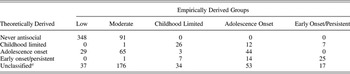
These two distinct strategies produced groups that overlapped considerably (see Table 1). Specifically, most individuals in the NA a priori, theoretically derived group were classified as low or moderate in the SPGM solution. Similarly, there was strong classification overlap between the CL and AO groups in the theoretically derived and SPGM solutions. Finally, individuals in the theoretically derived EOP group were most likely to be classified as EOP in the SPGM solution, although a number of individuals were also classified as CL and AO. Despite the overlap described above, we subsequently used both group solutions in our analyses to examine the robustness of findings based on the two methods used to define groups.
Overlap between theoretically derived and empirically derived (semiparametric group modeling) groups

Note: Groups were cross-classified in two ways. In Model 1, where the unclassified participants from the theoretically derived groupings were dropped, χ2 = 837.95, p < .01. In Model 2, where the classified and nonclassified youth from the theoretically derived group were retained, χ2 = 953.03, p < .01.
aThe total number reflects the 317 youth who were not classifiable in the theoretically derived classification.
Theoretically derived groups
Achenbach (Reference Achenbach1991c) reports that a T score of 60 can be used to define the clinical cut point on the externalizing scales of the CBCL, TRF, and YSR (average T score from highest informant rating: kindergarten: M = 53.96, SD = 8.68; first grade M = 53.57, SD = 8.76; third grade: M = 53.18, SD = 9.30; fourth grade: M = 52.19, SD = 9.10; fifth grade: M = 52.46, SD = 9.33; sixth grade: M = 51.61, SD = 9.45; 15 years: M = 52.14, SD = 9.43). Participants were classified as “antisocial early” if they received an externalizing T score of ≥60 on at least four of the six childhood TRFs or CBCLs with both informants (mother and teacher) providing elevated ratings at least once. We selected this criterion in line with Moffitt et al. (Reference Moffitt, Caspi, Dickson, Silva and Stanton1996), who similarly required that children classified as “antisocial” show clinical elevation on three of four assessments in childhood by either mother or teacher, showing clinical elevation at least once by both informants (although not necessarily concurrently). Participants who did not meet the T ≥ 60 criterion on any of the six childhood TRFs or CBCLs were classified as “not antisocial early.” Similar to Moffitt et al. (Reference Moffitt, Caspi, Dickson, Silva and Stanton1996), participants were classified as “antisocial in adolescence” if they received an externalizing T score ≥60 on at least one of the two adolescent assessments (i.e., YSR or CBCL) at age 15. Participants who did not meet the T ≥ 60 criterion on either of the two age 15 assessments were classified as not antisocial in adolescence.Footnote 1 (Technically, Moffitt et al. [Reference Moffitt, Caspi, Dickson, Silva and Stanton1996] defined clinically elevated as 1 SD above the mean on a nonnormed measure of externalizing problems in the unselected Dunedin cohort; here we use a T score of 60, which is equivalent to +1 SD from the population mean. Moffitt et al. also defined antisocial in adolescence using two self-report measures of delinquency, whereas here we use data from two informants instead.)
Four groups were then identified as followsFootnote 2: NA (44% of the sample; n = 439: 224 males, 215 females)—participants who never showed any clinically elevated externalizing problems; CL (5% of the sample; n = 46: 22 males, 24 females)—participants classified as antisocial early and not antisocial in adolescence; AO (14% of the sample; n = 141: 84 males, 57 females)—participants who did not meet criteria for antisocial early but were antisocial in adolescence; and EOP (5% of the sample; n = 47: 28 males, 19 females)—participants classified as antisocial early and antisocial in adolescence. As is often the case in work in this area using clinical criteria for the creation of groups (e.g., Aguilar et al., Reference Aguilar, Sroufe, Egeland and Carlson2000; Moffitt et al., Reference Moffitt, Caspi, Harrington and Milne2002), a substantial number of participants were excluded (35%; n = 351) because their status was ambiguous (e.g., in childhood they did not meet criteria for either the antisocial or the not antisocial classification). Although this resulted in a reduced sample size, more clearly defined categories were produced. Excluding those whose status was ambiguous, the resulting sample (n = 673) included 358 males and 315 females and was 84% White.
Empirically derived groups
SPGM (Nagin, Reference Nagin2005; Nagin & Land, Reference Nagin and Land1993) is an exploratory, data-driven analytic technique that identifies groups of individuals through a clustering algorithm, rather than by a priori conceptualizations. In the present study, group-based trajectory modeling was used to identify subgroups of individuals who followed similar patterns of externalizing behavior across age. A benefit of this technique over theoretically derived groupings is that group-based modeling ensures that groups are significantly different from one another on the characteristic of interest (here, patterns of antisocial behavior). With group-based modeling, we estimated the probability that each individual belongs to a given group based on the data and simultaneously derived maximum likelihood parameter estimates associated with membership in each of the derived groups (i.e., posterior probabilities of group membership). Based on these probabilities, individuals were assigned to their most likely group.
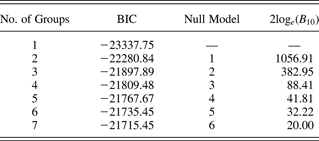
Using raw data (rather than T scores) from the same assessments and informants described above (the highest informant score was used; kindergarten: M = 10.42, SD = 8.12; first grade: M = 9.92, SD = 8.21; third grade: M = 9.63, SD = 8.76; fourth grade: M = 8.89, SD = 8.43; fifth grade: M = 9.03, SD = 8.82; sixth grade: M = 8.39, SD = 8.61; 15 years: M = 11.39, SD = 7.23), we tested for up to seven solutions. Data are assumed to be missing at random; thus, any available data is used to estimate group trajectories and the posterior probability of group membership. Model selection was based on three criteria: (a) the lowest Bayesian information criterion (BIC) relative to other group solutions (Jones, Nagin, & Roeder, Reference Jones, Nagin and Roeder2001), (b) a conceptually clear model, and (c) a model with a sufficient number of individuals in each group so as to be able to examine group differences. The number of classes was decided on, and then the form of the polynomial (e.g., linear, quadratic) used to capture the shape of each trajectory was determined, with the highest significant polynomial trend included in analyses.
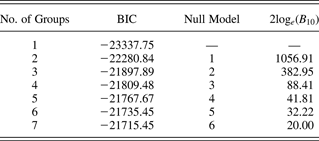
Although the BIC values indicated that a seven-group solution best fit the data (see Table 2), a five-group solution was selected because the six- and seven-group solutions did not add substantially to the understanding of group patterns. Specifically, the additional subgroups in the six- and seven-group solutions were not distinct in shape or level and consisted of groups with less than 3% of the sample, which would not have yielded enough individuals to make group comparisons. Consequently, a five-group solution was selected for its low BIC value, conceptually clear model, and adequate percentage of the sample in each trajectory group.
Bayesian information criterion (BIC) and 2log e(B10) values of the models under consideration
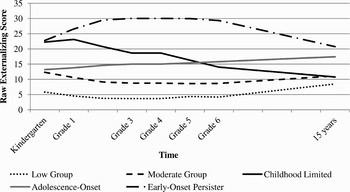
In the five-group solution (see Figure 1), the majority of individuals followed a consistently low pattern of externalizing behavior (low; 41.8% of the sample; n = 414: 173 males, 241 females). Individuals in the next lowest trajectory, a moderately low trajectory, engaged in stable, but relatively low levels of externalizing behavior over time (moderate; 33.7% of the sample; n = 334: 176 males, 158 females). The third trajectory showed high levels of externalizing behavior in childhood, but declined as they transitioned into adolescence. We call this group the CL trajectory group (7.1% of the sample; n = 70: 45 males, 25 females). The fourth trajectory group, the AO group (12.4% of the sample; n = 123: 68 males, 55 females), evinced relatively low levels of externalizing behavior over time, showing elevated levels of externalizing only in adolescence. The final trajectory group, EOP (4.9%; n = 49: 31 males, 18 females), showed high levels of externalizing behavior throughout childhood and adolescence. Examination of the posterior probabilities indicated that individuals were well matched (see Nagin, Reference Nagin2005) to their group (0.90 in the low trajectory, 0.81 in the moderate trajectory, 0.83 in the CL trajectory, 0.79 in the AO trajectory, 0.96 in the EOP trajectory).
Semiparametric group-based models of externalizing.

Predictors of antisocial trajectories
Income/needs ratio
Home visits were conducted when the study children were 1 month old. During this visit, demographic information, including child ethnicity and family income, was collected. Data on family income were updated during phone calls and face-to-face contacts with mothers at regular intervals through 36 months. An income/needs ratio was calculated from US Census Bureau tables as the ratio of family income to the poverty threshold for each household size in early childhood (Month 1 to Month 36), childhood (kindergarten through Grade 6), and adolescence (age 15 follow-up). The ratios were standardized and averaged to create a cumulative income/needs ratio score at each time point. The measure showed good reliability in early childhood (α = 0.94) and childhood (α = 0.97).
Single parenting
During home visits and phone updates, marital status was assessed at 1, 3, 6, 9, 12, 15, 24, and 36 months, as well as at each of the later time points (kindergarten, Grade 1, Grade 3, Grade 4, Grade 5, Grade 6, and age 15). We adopted a conservative definition for single parenting, in that if mothers ever reported being unmarried during a developmental period, they were classified as single parents. Our goal was to identify children who had experienced not living with two married caregivers for any time: (a) in the first 3 years of life, (b) between kindergarten and Grade 6, and (c) in adolescence (i.e., at the age 15 follow-up).
Maternal sensitivity
Maternal sensitivity was assessed in early childhood, childhood, and adolescence. At each age, tapes of mother–child interaction were coded at a nondata collection site by coders who were blind to any information about study families. An early childhood composite was based on mother–child interactions that were videotaped during 15-min semistructured tasks at 6, 15, and 24, and 36 months. A number of scales were used to rate the mothers' behavior from these videotapes. At 6 months, mothers and children were instructed to play together, first with toys available in the home and then with a standard set of toys. At 15, 24, and 36 months, mothers were asked to show their children age-appropriate toys in three containers in a set order. As in prior studies of this sample (e.g., NICHD ECCRN, 2001), observations of maternal sensitivity from the first 3 years of life (6, 15, 24, and 36 months) were standardized and averaged to create a composite of early sensitivity. At 6, 15, and 24 months, the a priori maternal sensitivity composites were constructed by summing ratings for sensitivity to nondistress, positive regard, and intrusiveness (reversed). At 36 months mother's supportive presence, respect for autonomy, and hostility (reversed) scales were composited (composites αs = 0.75, 0.70, 0.79, and 0.78 for the 6-, 15-, 24-, and 36-month composites, respectively, and intercoder reliabilities on scales > .80). Within-age composites showed stability over time (rs = .30–.48; composite measure standardized α = 0.73).
As with the early sensitivity composite, a childhood maternal sensitivity composite was created from videotaped observations of participants and their primary caregivers in Grades 1, 3, and 5. Each of these tasks involved target participants engaged tasks just beyond their capacity to successfully complete while primary caregivers provided aid. For example, the Grade 1 assessment involved the child completing a set of three activities, including reproducing a simple picture. Tasks were updated to be developmentally appropriate: during Grades 3 and 5, for example, primary caregivers and target participants completed both activities and engaged in discussion tasks (e.g., an errand planning task in Grade 3, discussing and attempting to resolve areas of disagreement in Grade 5). Sensitivity was operationalized in Grades 1, 3, and 5 using scales measuring supportive presence, respect for autonomy, and hostility (reversed), which were composited (composites αs = 0.82, 0.80, and 0.85, respectively; interrater reliabilities [intraclass correlations] = .91, .84, and .85, respectively). The three assessments of childhood sensitivity were standardized and composited (α = 0.71).
At age 15, maternal sensitivity was assessed exclusively in the context of an 8-min home discussion of one or two areas of disagreement between the adolescent and mother (e.g., chores, homework, money), selected by the adolescent. Seven-point rating scales of the interaction were used (Owen et al., Reference Owen, Klausli, Aultman, Brown, Little and Milling2006), based on adaptations of the more microanalytic coding systems of Allen and colleagues (Allen et al., Reference Allen, Hall, Insabella, Land, Marsh and Porter2003; Allen, Hauser, Bell, McElhaney, & Tate, Reference Allen, Hauser, Bell, McElhaney and Tate1996) and coding systems used at earlier ages in the NICHD SECCYD (e.g., Owen, Klausli, & Murrey, Reference Owen, Klausli and Murrey2000). The age 15 maternal sensitivity composite comprised the sum of the ratings of mother's validation (enthusiastic, positive reactions to and agreement with the teen's expressed points of view), engagement (expressed interest in the listening to the teen's thoughts and feelings), inhibiting relatedness (cutting off and devaluing the teen's point of view, reverse scored), hostility/devaluing (expressions of anger, discounting or rejection of the teen or the teen's ideas, reverse scored), respect for autonomy (encouragement of and respect for the teen's own ideas and points of view), and valuing/warmth (expressions of positive regard, warmth, and affection). The α of the age 15 measure was moderately high at 0.81 (interrater reliability [intraclass correlation] = .86).
Health status
During home visits and regular telephone calls at 3-month intervals (1, 3, 6, 9, 12, 15, 18, 21, 24, 27, 30, 33, and 36 months), mothers were asked for their judgment of their child's overall health from 1= poor to 4 = excellent. Scores from the 1- through 36-month assessments were standardized and averaged. The reliability of this measure was adequate (α = 0.74). Health status was also assessed in kindergarten, and at Grades 1, 2, 3, 4, 5, and 6. Items were standardized and averaged; the measure showed good reliability (α = 0.83). Finally, in adolescence, the health item was standardized to be consistent with other measures of health.
Early temperament
At the 1- and 6-month visits, mothers completed the Carey and McDevitt (Reference Carey and McDevitt1978) Infant Temperament Questionnaire, which contained 38 items rated on a 6-point scale. The composite total score, where higher scores reflect a more irritable and difficult child, had modest reliability at 1 month (α = 0.67) but showed better reliability at 6 months (α = 0.81). Scores from 1 and 6 months were moderately correlated (r = .32, N = 1,279, p < .0001), and were standardized and averaged. Temperament was assessed only in early childhood using this measure; as such, comparable assessments for childhood and adolescence are not reported.
Cognitive functioning
During laboratory visits at 15, 24, and 36 months, study children were administered measures of cognitive functioning by examiners who had been trained and certified in test administration prior to data collection. At 15 and 24 months, the Bayley Scales of Mental Development (Bayley, Reference Bayley1991) were administered. At 36 months, the Bracken Test of Basic Concepts was administered (Bracken, Reference Bracken1984). Standard scores on these three measures were averaged to form a composite measure of early cognitive functioning. The reliability for this measure was α = 0.70.
In childhood and adolescence, various subscales of the Woodcock–Johnson were administered to assess cognitive ability in a number of developmentally appropriate domains. Within each age period (childhood and adolescence) measures were composited. At Grade 1, subscales of the Woodcock–Johnson consisted of memory for names, memory for sentences, incomplete words, picture vocabulary, letter–word identification, applied problems, and word attack. In the third grade, nine subscales of the Woodcock–Johnson were used: memory for names, memory for sentences, picture vocabulary score, verbal analogies, letter–word identification, passage comprehension, calculation, applied problems, and word attack. In the fifth grade, the picture vocabulary, letter–word identification, passage comprehension, calculation, applied problems, broad reading, and broad math subscales were completed. Finally, at age 15, the picture vocabulary, verbal analogies, passage comprehension, and applied problems scales were administered. Within each time point, the standardized scores from the subscales were averaged. Subsequently, kindergarten through sixth-grade assessments were standardized and combined for an index of childhood cognitive ability (α = 0.95). To be consistent with the other measures of cognitive ability, the age 15 assessment of cognitive ability (α = 0.88) was also standardized.
Results
Analysis plan
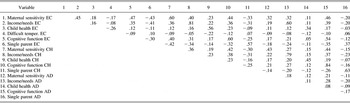
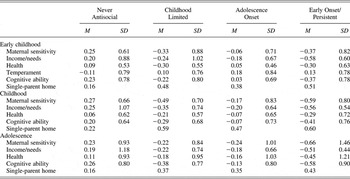
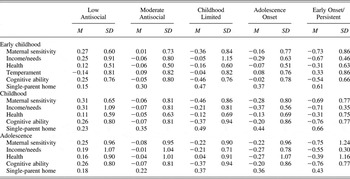
Prior to analyzing group differences, we examined whether the various indicators of contextual adversity and intraindividual risk included in this study represented relatively independent indicators of functioning within early childhood, childhood, and adolescence. As shown in Table 3, although dependent measures were correlated in a theoretically predictable manner (i.e., all correlations were in the expected direction), the dependent measures were not empirically redundant within developmental periods (that said, across-time rank-order stability of constructs was clearly apparent). To examine potential differences among the groups in the theoretically derived and empirically derived (SPGM) solutions, we next used analyses of variance to test if groups were differentiated by levels of maternal sensitivity, income/needs ratio, child health, temperament, cognitive ability, and single-parent home. With the exception of temperament, which was only assessed via maternal report in early childhood, we examined each of these predictors in early childhood (the first 3 years of life), childhood (kindergarten through sixth grade), and adolescence (age 15). Means and standard deviations for each outcome, separately for the theoretically derived and SPGM solutions, are reported in Table 4 and Table 5, respectively. (Throughout the results that follow, contrasts for the theoretically and empirically defined groups are juxtaposed by developmental period.)
Correlations among predictors of antisocial trajectories

Note: Correlations are based on all youth who had valid data at the age 15 follow-up (n = 990). EC, early childhood; CH, childhood; AD, adolescence.
All ps < .05.
Means and standard deviations by theoretically derived group

Note: Values for single-parent homes reflect the percentage of individuals in a single family home over the course of the developmental period.
Means and standard deviations by empirically derived (semiparametric group modeling) group

Note: Values for single-parent home reflect the percentage of individuals in a single family home over the course of the developmental period.
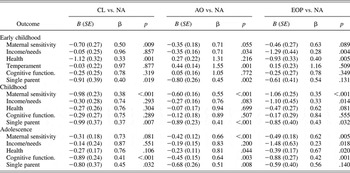
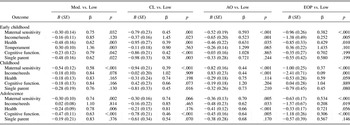
To minimize significant results due merely to chance, for bivariate analyses, in addition to uncorrected p values, we report the Benjamini–Hochberg (BH; Benjamini & Hochberg, Reference Benjamini and Hochberg1995) correction for multiple testing (likewise, below we interpret differences as statistically significant for bivariate analyses if the BH corrected p < .05). As recommended by Williams, Jones, and Tukey (Reference Williams, Jones and Tukey1999), BH was used to adjust p values to preserve a nominal α level of 0.05 only for the comparisons of interest. The comparisons of special interest were between each of the externalizing groups and the NA/low group as well as between the EOP and AO groups. Because these were the only a priori hypothesized differences, they were the only ones tested. (Planned comparisons do not require omnibus tests of group differences; nonetheless, all comparisons produced significant F or χ2 values; see tables for details.) Finally, in addition to providing t statistics and their associated BH-corrected p values in group comparison analyses, we provide estimates of effect size (either ds or η2). Cohen's (Reference Cohen1992) criteria were adopted in interpreting d (small effect = 0.2, medium effect = 0.5, and a large effect = 0.8).
In follow-up analyses we tested if each covariate (maternal sensitivity, income/needs ratio, health, temperament [early childhood only], cognitive ability, and single-parent home) interacted with sex to predict membership in the theoretically derived and SPGM groups. In the first set of models, we entered a covariate, sex, and the interaction between the two variables in a multinomial logistic regression using the lowest externalizing group (NA in the theoretically derived models and the low group in the SPGM groups) as the reference group. In the second set of models, we conducted a binary logistic regression to examine the interaction between the covariate and sex predicting membership in the EOP group compared to the AO trajectory. In these models, the AO group was used as the reference group. Because relatively few such sex interactions emerged, we note in tables when effects were significantly larger for males (M) or females (F) and describe below the overall pattern of results.
Finally, we tested if some of the covariates were better predictors of group membership than others by simultaneously entering all predictors into a multinomial logistic regression predicting group membership, again using the lowest externalizing trajectory as the reference group. Note that these analyses were conducted within each developmental epoch (early childhood, childhood, and adolescence) but not across developmental periods because of the moderate to strong rank-order stability of constructs across time.
Bivariate analyses
Early childhood
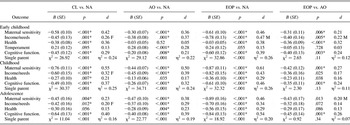
In early childhood, theoretically defined antisocial groups (CL, AO, and EOP) were consistently distinguished from NAs on measures of both contextual adversity and intraindividual risk (see Table 6). Of 18 relevant contrasts, 15 were statistically significant, with these effects ranging from small to medium in magnitude. Similarly, EOPs carried higher levels of contextual and intraindividual risk than AOs on four of the six risk factors examined in the first 3 years of life, with effects again ranging from small to medium. Only 3 of 24 contrasts revealed evidence that sex significantly moderated the overall pattern of results (two effects were larger for males, one was larger for females).
Planned comparisons on early childhood risk factors with theoretically derived groups

Note: CL, childhood limited; NA, never antisocial; AO, adolescence limited; EOP, early onset/persistent; F, effect significantly larger for females; M, effect significantly larger for males. Analysis of variance F statistics were significant for each measure. Early childhood: maternal sensitivity: F (3, 656) = 23.03, p < .001; income/needs: F (3, 657) = 18.89, p < .001; child health: F (3, 658) = 14.06, p < .001; difficult temperament: F (3, 669) = 5.35, p = .001; and cognitive functioning: F (3, 642) = 12.57, p < .001. Childhood: maternal sensitivity: F (3, 644) = 39.28, p < .001; income/needs: F (3, 663) = 19.27, p < .001; child health: F (3, 638) = 6.84, p < .001; and cognitive functioning: F (3, 652) = 19.55, p < .001. Adolescence: maternal sensitivity: F (3, 615) = 16.86, p < .001; income/needs: F (3, 627) = 10.07, p < .001; child health: F (3, 657) = 7.02, p < .001; and cognitive functioning: F (3, 610 = 24.47, p < .001. Chi-square tests were used to examine if being in a single-parent home differed among the groups. No p-value adjustment was conducted on the chi-square tests.
*Significant at the Benjamini–Hochberg adjusted p value.
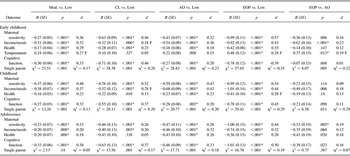
Planned contrasts were also used to examine differences on covariates in early childhood among the SPGM-derived groups (see Table 7) and results largely mirrored those observed in the analyses using the theoretically derived groups. Specifically, the antisocial groups (moderate, CL, AO, EOP) were distinguished from low externalizers on 22 of 24 relevant contrasts, suggesting each of the antisocial groups experienced more contextual adversity and evinced higher levels of intraindividual risk than did low externalizers (significant effects were small to medium in magnitude). Empirically defined EOPs also carried somewhat more risk than AOs in that they could be significantly distinguished (BH corrected) on three of the six indicators examined (EOPs had lower income/needs ratio, more difficult temperaments, and were more likely to experience a single parent in early childhood than AOs). Follow-up multinomial regressions revealed that 4 of 30 effects were larger for females than males.
Planned comparisons on early childhood risk factors with empirically derived (semiparametric group modeling) groups

Note: Mod., moderately low antisocial trajectory; Low, low antisocial trajectory; CL, childhood limited; AO, adolescence limited; EOP, early onset/persistent; F, effect significantly larger for females; M, effect significantly larger for males. Analysis of variance F statistics were significant for each of the measures. Early childhood: maternal sensitivity: F (4, 966) = 31.96, p < .001; income/needs: F (4, 966) = 18.48, p < .001; child health: F (4, 968) = 12.15, p < .001; difficult temperament: F (4, 985) = 8.12, p = .001; and cognitive functioning: F (4, 939) = 30.74, p < .001. Childhood: maternal sensitivity: F (4, 935) = 38.29, p < .001; income/needs: F (4, 973) = 24.02, p < .001; child health: F (4, 925) = 8.05, p < .001; and cognitive functioning: F (4, 955) = 20.06, p < .001. Adolescence: maternal sensitivity: F (4, 892) = 15.47, p < .001; income/needs: F (4, 919) = 11.44, p < .001; child health: F (4, 962) = 7.55, p < .001; and cognitive functioning: F (4, 887) = 23.69, p < .001. Chi-square tests were used to examine if being in a single-parent home differed among the groups. No p-value adjustment was conducted on the chi-square tests.
*Significant at the Benjamini–Hochberg adjusted p value.
Childhood
Next, we examined how covariates in childhood (kindergarten to Grade 6) differed among theoretically derived groups, comparing each group to the NA group and then comparing EOP to AO individuals (see Table 6). Once again, antisocial groups could be distinguished from NAs on measures of risk (14 out of the 15 relevant contrasts were statistically significant and the magnitude of these significant effects was small to medium). In childhood, EOPs had significantly higher levels of risk (BH corrected) on two of the five measures examined (maternal sensitivity and cognitive functioning; small effects). Multinomial regressions revealed that sex moderated only 1 of 15 relevant contrasts.
The pattern of results was similar when we compared the SPGM groups on childhood covariates (see Table 7). Of the 20 relevant contrasts comparing the antisocial groups to low externalizers, 19 of these were statistically significant (small to medium effects). EOPs were only significantly distinguishable from AOs on one of six measures examined (EOPs were more likely than AOs to have experienced a single parent in childhood); however, uncorrected p values suggest that, adopting a more liberal criterion, EOPs did carry more contextual and intradindividual risk in childhood than AOs). Two of 25 effects were larger for females than males in this set of analyses.
Adolescence
We also examined differences among theoretically derived groups on covariates during adolescence (see Table 6). Once again, antisocial groups experienced more risk, in that they had significantly higher levels of contextual adversity and intraindividual disadvantage than did NAs on 14 of 15 relevant contrasts (small to medium effects). EOPs had lower levels of cognitive functioning than did AOs (a small effect), but none of the other 4 relevant contrasts were significant (note that uncorrected p values suggest additional evidence that EOPs were further distinguishable from AOs). For this set of 20 contrasts, multinomial regressions revealed that 2 were moderated by sex (one effect was larger for males, one was larger for females).
We also compared SPGM groups on covariates in adolescence (see Table 7). Antisocial groups experienced and carried consistently higher levels of risk than did low externalizers, with 18 of 20 relevant contrasts revealing significant, albeit small to medium differences. Only one of five relevant contrasts revealed evidence that EOPs had significantly more contextual adversity or intraindividiual risk in adolescence (on maternal sensitivity, a small effect), although uncorrected p values did suggest more contextual adversity and intraindividual disadvantages in the lives of EOPs compared to AOs. None of associations examined in this set of analyses were moderated by sex.
Unique predictive significance of covariates
Early childhood
To examine how covariates might differentially predict membership in the theoretically derived groups, we simultaneously estimated the effects of each covariate in a multinomial logistic regression, using the NA group as the reference group (see Table 8). In early childhood, lower maternal sensitivity, the experience of living in a single parent family, and poor health were uniquely associated with membership in the CL group compared to the NA group. Membership in the AO group was uniquely associated with lower income/needs ratio, living in a single-parent home during early childhood, and a more difficult temperament. Lower income/needs ratio and worse health uniquely predicted greater membership in the EOP group compared to NA youth.
Multinomial logistic regression of theoretically derived externalizing groups with risk factors

Note: CL, childhood limited; NA, never antisocial; AO, adolescence limited; EOP, early onset/persistent. Regressions were conducted separately by developmental period (early childhood, childhood, and adolescence).
Next, we computed the same multinomial logistic regressions, simultaneously estimating the effects of each covariate on SPGM membership, using the low group as the reference group and simultaneously examining all early childhood predictors (see Table 9). Compared to individuals in the low group, membership in the moderate group was uniquely associated with lower maternal sensitivity, living in a single-parent home, worse health, more difficult temperament in early childhood, and lower cognitive functioning. Lower maternal sensitivity, lower income/needs ratio, living in a single-parent home, greater health problems, and lower cognitive functioning were uniquely predictive of membership in the CL compared to the low group. Membership in the AO group was associated with lower maternal sensitivity, greater income/needs ratio, and greater health problems. Lower maternal sensitivity, lower income/needs ratio, and greater health problems in early childhood were uniquely associated with membership in the EOP compared to the low trajectory group.
Multinomial logistic regression of empirically derived externalizing groups with risk factors

Note: Mod., moderately low antisocial trajectory; Low, low antisocial trajectory; CL, childhood limited; AO, adolescence limited; EOP, early onset/persistent. Regressions were conducted separately by developmental period (early childhood, childhood, and adolescence).
Childhood
Multinomial logistic regressions focused on the theoretically derived groups revealed that, compared to the NA group, membership in both the CL and the AO group was associated with lower maternal sensitivity and greater likelihood of living in a single-parent home in childhood (see Table 8). Membership in the EOP group, compared to the NA group, was uniquely predicted by low maternal sensitivity, low income/needs ratio, and experiencing a single-parent home in childhood.
For the SPGM groups (see Table 9), low maternal sensitivity uniquely predicted membership in the moderate trajectory group compared to the low group. Low maternal sensitivity and living in a single-parent home uniquely predicted membership in the CL group, compared to the low group. In childhood, low maternal sensitivity and low income/needs ratio uniquely predicted membership in the AO group. Finally, low maternal sensitivity and low income/needs ratio predicted membership in the EOP group.
Adolescence
In adolescence, multinomial regressions were again used to determine how covariates differentially predicted theoretically derived group membership (see Table 8). Membership in the CL group compared to the NA group was associated with being reared by a single parent and lower cognitive functioning during adolescence. Membership in the AO group (vs. NA) was associated with lower maternal sensitivity, living in a single-parent home, worse health, and lower cognitive functioning in adolescence. Finally, low maternal sensitivity, low income/needs ratio, poor health, and poor cognitive functioning in adolescence were uniquely associated with membership in the EOP group compared to the NA group.
In the last set of models, we tested how age 15 covariates distinguished among SPGM groups in a multinomial logistic regression (see Table 9). During adolescence, low maternal sensitivity, poor health, and low cognitive functioning uniquely predicted membership in the moderate group compared to the low group. Low cognitive functioning uniquely predicted membership in the CL group. AO (compared to low) group membership was associated with low maternal sensitivity, low income/needs ratio, poor health, and low cognitive functioning. Low maternal sensitivity, low income/needs ratio, and poorer cognitive functioning in adolescence were uniquely associated with membership in the EOP group compared to the low group.
Discussion
Consistent with Moffitt's (Reference Moffitt1993) theory, youth who were persistently antisocial through adolescence in the NICHD SECCYD cohort tended to have experienced considerable contextual adversity (e.g., maternal insensitivity, single parenting, low income/needs ratio) and intraindividual risk (e.g., poor general health, difficult temperament, and suboptimal cognitive functioning) from infancy through midadolescence. However, we also found that such contextual and intraindividual adversity was not limited to consistently antisocial youth. All groups of children in the NICHD SECCYD who showed elevated antisocial behavior, regardless of whether it was in childhood, adolescence, or both, evinced both contextual and intraindividual disadvantages in early childhood, childhood, and adolescence relative to youth with consistently low levels of antisocial behavior.
The present findings add to evidence that calls into question the characterization of the AO antisocial trajectory as a developmentally normative phenomenon. As noted earlier, longitudinal studies of both high-risk (Roisman et al., Reference Roisman, Aguilar and Egeland2004) and community (Moffitt et al., Reference Moffitt, Caspi, Harrington and Milne2002) cohorts have revealed that individuals with no notable history of antisocial behavior in childhood who nonetheless begin to show significantly elevated deviant behavior in adolescence (AOs) do not display the marked discontinuity in antisocial behavior between adolescence and adulthood predicted by Moffitt et al.'s (Reference Moffitt, Caspi, Dickson, Silva and Stanton1996) theory.
The present study helps to explain why this may be. In the NICHD SECCYD cohort, AOs defined in a way roughly comparable to AOs by Moffitt et al. (Reference Moffitt, Caspi, Dickson, Silva and Stanton1996) and Odgers et al. (Reference Odgers, Moffitt, Broadbent, Dickson, Hancox and Harrington2008) experienced significantly more adversity from infancy through age 15 compared to NA youth. Although the endogenous and environmental liabilities AOs carry are somewhat less extreme than those that characterize the lives of EOP youth, AOs clearly experience risks during their preadolescent years that have been reliably linked with later antisocial behavior. Of note, participants on the CL pathway also showed evidence of contextual and intraindividual risk from infancy through adolescence. That they were still distinguishable from low externalizers by adolescence perhaps partially explains why such individuals continue to show the evidence of internalizing problems into adulthood that has been documented in other research (Odgers et al., Reference Odgers, Moffitt, Broadbent, Dickson, Hancox and Harrington2008).
Several aspects of this study are noteworthy. First, this investigation is one of only two (see also Aguilar et al., Reference Aguilar, Sroufe, Egeland and Carlson2000) that has been able to provide a prospective and multimethod glimpse at the first 3 years of life of individuals who were persistently versus discontinuously antisocial from infancy to adolescence. As described above, all groups of individuals who showed significant externalizing problems, regardless of whether these problems were of childhood or AO, could be distinguished from low externalizers on measures of both contextual adversity and intraindividual risk. These group differences persisted, in that all antisocial groups continued to be distinguishable from low externalizing youth on markers of contextual adversity and intraindividual risk assessed in childhood and adolescence.
Second, the findings were similar among males and females. Although relevant tests of Moffitt's (Reference Moffitt1993) theory were originally applied to males (Moffitt et al., Reference Moffitt, Caspi, Dickson, Silva and Stanton1996), evidence has accrued in the literature that this conceptualization might be equally applicable to females in terms of understanding the structure and etiology of life course patterns of antisocial behavior (Odgers et al., Reference Odgers, Moffitt, Broadbent, Dickson, Hancox and Harrington2008). This study adds to that growing database, in that we discerned few instances in which sex moderated the associations between predictors and group membership. Nonetheless, we do note that, as expected, males were clearly overrepresented in antisocial groups, whether theoretically or empirically defined.
Third, we find it noteworthy that the results of this study were essentially insensitive to the specific data reduction methods we used to define participants into groups. Specifically, in this study we adapted an a priori scheme involving T scores (normed within sex) to identify “clinically significant” patterns of antisocial behavior in childhood and/or adolescence as well as implemented an empirically based approach (SPGM; Nagin, Reference Nagin2005; Nagin & Land, Reference Nagin and Land1993). As described earlier, both methods have limitations and strengths. Nonetheless, we found empirical convergence in terms of how these methods sorted participants into groups and scant evidence that our substantive conclusions shifted when examining results based on the two distinct grouping methods.
Although we believe that this study provides important replication, extension, and reinterpretation of prior findings in this literature, several limitations of this work should be noted. First and perhaps most critically, although the NICHD SECCYD is a large national study, its sample is not nationally representative. Of the most importance for the present report, although high-risk families were explicitly targeted for recruitment, the study's sampling frame used a set of screening criteria that likely resulted in an underrepresentation of highly antisocial youth. Specifically, children were excluded if their families lived in a neighborhood deemed dangerous by police or if their mother was younger than 18, both established risk factors for the development of antisocial behavior. Second, this study used a psychometrically weaker assessment of early temperament than other measures of contextual and neuropsychological risk, and comparable measures of temperament were not available from childhood or adolescence in the NICHD SECCYD. Third, although Moffitt (Reference Moffitt, Caspi, Dickson, Silva and Stanton1996) has theorized that the underlying intraindividual deficits that launch youth onto the EOP pathway are reflected in poor early health, difficult temperament, and subtle cognitive deficits, it is important to emphasize that such measures are at best indirect indicators of underlying neuropsychological functioning. On this point it is also important to emphasize that Moffitt et al. (Reference Moffitt, Caspi, Dickson, Silva and Stanton1996) clearly used the term “neuropsychological” to refer to a broader set of phenotypes than is reflected in the current parlance of developmental psychology, where the term is now more likely to be used to refer to measures that putatively tap specific aspects of neural functioning such as executive control.
Fourth, the last assessment available for this study was at age 15. Thus, our AO group is composed of relatively earlier onset AO antisocial youth, which might explain their above-average scores on measures of risk. Although Moffitt et al. (Reference Moffitt, Caspi, Dickson, Silva and Stanton1996) did not distinguish between youth whose AO antisocial behavior occurs relatively early versus relatively late in adolescence, our data do not speak to whether it may be developmentally benign to begin antisocial behavior in later adolescence. It is also important to note in this context that, taking our lead from prior work in this area (e.g., Aguilar et al., Reference Aguilar, Sroufe, Egeland and Carlson2000; Moffitt et al., Reference Moffitt, Caspi, Dickson, Silva and Stanton1996), our focus in this study was on a subgroup of individuals whose antisocial behavior emerged during adolescence without reference to whether such behavior is limited to this developmental period; it could well be the case that the subgroup of individuals whose antisocial behavior begins and ends in adolescence do not carry the contextual and intraindividual risks documented here. Although six different assessment points were used to establish levels of antisocial behavior in childhood, note that this study relied on only a single (dual-informant) assessment of antisocial behavior in adolescence. Each of these important issues related to the assessment of antisocial behavior in adolescence will be examined in ongoing assessments of the NICHD SECCYD cohort.
The results of these analyses have important practical implications. They underscore the importance of identifying children at risk to develop antisocial behavior early in development, so that preventive interventions can be implemented. Consistent with an extensive literature in developmental psychopathology, both child and family characteristics, measured across developmental periods, were associated with children's antisocial behavior, regardless of whether the onset was in childhood or adolescence and regardless of whether problems were persistent or more time limited. Thus, low-income, single-parent families, especially those with infants who are seen as fussy and irritable and who experience health problems and cognitive difficulties, are likely candidates for interventions with the ultimate goal of preventing the onset or exacerbation of externalizing behavior early in development. Recent research (Dishion et al., Reference Dishion, Shaw, Connell, Gardner, Weaver and Wilson2008; Gardner et al., Reference Gardner, Connell, Trentacosta, Shaw, Dishion and Wilson2009; Shaw et al., Reference Shaw, Connell, Dishion, Wilson and Gardner2009) is consistent with this view in demonstrating the efficacy of a brief family-centered intervention, the early steps program, which succeeded in decreasing externalizing behavior in young children, identified as low income and then screened for elevated levels of family stress and early emerging behavior problems in toddlerhood. The children in this set of studies are in many ways similar to the children in the NICHD SECCYD who were classified into one of the antisocial groups in terms of both child characteristics (e.g., early difficult behavior) and family adversity (e.g., low income, single parent).
Furthermore, our analyses demonstrated that lower levels of observed maternal sensitivity across early childhood, middle childhood, and adolescence were the most consistent and robust predictors of children's externalizing problems, suggesting the importance of the mother–child relationship for children's optimal adjustment. Thus, these data not only highlight the importance of early preventive interventions beginning in infancy or toddlerhood, but they also suggest that maternal childrearing and the quality of the mother–child relationship is one likely target for early intervention efforts. Increases in positive parenting partially mediated the effects of the early steps intervention on young children's externalizing behavior at ages 3 and 4 (Dishion et al., Reference Dishion, Shaw, Connell, Gardner, Weaver and Wilson2008; Shaw et al., Reference Shaw, Connell, Dishion, Wilson and Gardner2009). Thus, by intervening early in some high-risk families, it may be possible to alter children's developmental pathways, deflecting some children who might otherwise be showing either early onset or even later onset antisocial behavior away from problem behavior.
Our analyses also make it clear that adolescent onset antisocial behavior is not normative and data from Odgers et al. (Reference Odgers, Moffitt, Broadbent, Dickson, Hancox and Harrington2008) suggest that adolescent onset antisocial behavior is, in fact, often a precursor of more severe and long-term adjustment problems. Thus, adolescents whose behavior problems first become apparent later in development might also benefit from interventions that aim to redirect them to more prosocial activities, possibly by working on family communication and support. Taken together, the data make it clear that antisocial behavior, regardless of age of onset, is associated with a set of family and child risk factors that may not bode well for children's development in the absence of intervention.
Over the past decade, Moffitt's (Reference Moffitt, Caspi, Dickson, Silva and Stanton1996) model of the development of antisocial behavior has served the field well. Nonetheless, a revision of this model may be in order. Specifically, although antisocial youth are indeed distinguishable on the basis of when their antisocial behavior emerges (e.g., childhood versus adolescence), it may be that the etiology of these pathways is best characterized as quantitatively, rather than qualitatively, distinct. As shown in the current study, it is possible that all youth who show clinically significant antisocial behavior, irrespective of its age of onset, experience and carry a set of common risk factors, albeit to varying degrees (see also Odgers et al., Reference Odgers, Moffitt, Broadbent, Dickson, Hancox and Harrington2008). Thus, the accumulating evidence suggests that AO antisocial behavior may not be developmentally normative, but instead linked in meaningful ways to early and subsequent contextual and intraindividual disadvantage.