


%20--%3e%3c!DOCTYPE%20svg%20PUBLIC%20'-//W3C//DTD%20SVG%201.0//EN'%20'http://www.w3.org/TR/2001/REC-SVG-20010904/DTD/svg10.dtd'%3e%3csvg%20version='1.0'%20id='Layer_1'%20xmlns='http://www.w3.org/2000/svg'%20xmlns:xlink='http://www.w3.org/1999/xlink'%20x='0px'%20y='0px'%20width='64px'%20height='64px'%20viewBox='5.5%20-3.5%2064%2064'%20enable-background='new%205.5%20-3.5%2064%2064'%20xml:space='preserve'%3e%3cg%3e%3ccircle%20fill='%23FFFFFF'%20fill-opacity='0'%20cx='37.785'%20cy='28.501'%20r='28.836'/%3e%3cpath%20fill='%23595959'%20d='M37.441-3.5c8.951,0,16.572,3.125,22.857,9.372c3.008,3.009,5.295,6.448,6.857,10.314%20c1.561,3.867,2.344,7.971,2.344,12.314c0,4.381-0.773,8.486-2.314,12.313c-1.543,3.828-3.82,7.21-6.828,10.143%20c-3.123,3.085-6.666,5.448-10.629,7.086c-3.961,1.638-8.057,2.457-12.285,2.457s-8.276-0.808-12.143-2.429%20c-3.866-1.618-7.333-3.961-10.4-7.027c-3.067-3.066-5.4-6.524-7-10.372S5.5,32.767,5.5,28.5c0-4.229,0.809-8.295,2.428-12.2%20c1.619-3.905,3.972-7.4,7.057-10.486C21.08-0.394,28.565-3.5,37.441-3.5z%20M37.557,2.272c-7.314,0-13.467,2.553-18.458,7.657%20c-2.515,2.553-4.448,5.419-5.8,8.6c-1.354,3.181-2.029,6.505-2.029,9.972c0,3.429,0.675,6.734,2.029,9.913%20c1.353,3.183,3.285,6.021,5.8,8.516c2.514,2.496,5.351,4.399,8.515,5.715c3.161,1.314,6.476,1.971,9.943,1.971%20c3.428,0,6.75-0.665,9.973-1.999c3.219-1.335,6.121-3.257,8.713-5.771c4.99-4.876,7.484-10.99,7.484-18.344%20c0-3.543-0.648-6.895-1.943-10.057c-1.293-3.162-3.18-5.98-5.654-8.458C50.984,4.844,44.795,2.272,37.557,2.272z%20M37.156,23.187%20l-4.287,2.229c-0.458-0.951-1.019-1.619-1.685-2c-0.667-0.38-1.286-0.571-1.858-0.571c-2.856,0-4.286,1.885-4.286,5.657%20c0,1.714,0.362,3.084,1.085,4.113c0.724,1.029,1.791,1.544,3.201,1.544c1.867,0,3.181-0.915,3.944-2.743l3.942,2%20c-0.838,1.563-2,2.791-3.486,3.686c-1.484,0.896-3.123,1.343-4.914,1.343c-2.857,0-5.163-0.875-6.915-2.629%20c-1.752-1.752-2.628-4.19-2.628-7.313c0-3.048,0.886-5.466,2.657-7.257c1.771-1.79,4.009-2.686,6.715-2.686%20C32.604,18.558,35.441,20.101,37.156,23.187z%20M55.613,23.187l-4.229,2.229c-0.457-0.951-1.02-1.619-1.686-2%20c-0.668-0.38-1.307-0.571-1.914-0.571c-2.857,0-4.287,1.885-4.287,5.657c0,1.714,0.363,3.084,1.086,4.113%20c0.723,1.029,1.789,1.544,3.201,1.544c1.865,0,3.18-0.915,3.941-2.743l4,2c-0.875,1.563-2.057,2.791-3.541,3.686%20c-1.486,0.896-3.105,1.343-4.857,1.343c-2.896,0-5.209-0.875-6.941-2.629c-1.736-1.752-2.602-4.19-2.602-7.313%20c0-3.048,0.885-5.466,2.658-7.257c1.77-1.79,4.008-2.686,6.713-2.686C51.117,18.558,53.938,20.101,55.613,23.187z'/%3e%3c/g%3e%3c/svg%3e)
%20--%3e%3c!DOCTYPE%20svg%20PUBLIC%20'-//W3C//DTD%20SVG%201.0//EN'%20'http://www.w3.org/TR/2001/REC-SVG-20010904/DTD/svg10.dtd'%3e%3csvg%20version='1.0'%20id='Layer_1'%20xmlns='http://www.w3.org/2000/svg'%20xmlns:xlink='http://www.w3.org/1999/xlink'%20x='0px'%20y='0px'%20width='64px'%20height='64px'%20viewBox='5.5%20-3.5%2064%2064'%20enable-background='new%205.5%20-3.5%2064%2064'%20xml:space='preserve'%3e%3cg%3e%3ccircle%20fill='%23FFFFFF'%20fill-opacity='0'%20cx='37.637'%20cy='28.806'%20r='28.276'/%3e%3cg%3e%3cpath%20fill='%23595959'%20d='M37.443-3.5c8.988,0,16.57,3.085,22.742,9.257C66.393,11.967,69.5,19.548,69.5,28.5c0,8.991-3.049,16.476-9.145,22.456%20C53.879,57.319,46.242,60.5,37.443,60.5c-8.649,0-16.153-3.144-22.514-9.43C8.644,44.784,5.5,37.262,5.5,28.5%20c0-8.761,3.144-16.342,9.429-22.742C21.101-0.415,28.604-3.5,37.443-3.5z%20M37.557,2.272c-7.276,0-13.428,2.553-18.457,7.657%20c-5.22,5.334-7.829,11.525-7.829,18.572c0,7.086,2.59,13.22,7.77,18.398c5.181,5.182,11.352,7.771,18.514,7.771%20c7.123,0,13.334-2.607,18.629-7.828c5.029-4.838,7.543-10.952,7.543-18.343c0-7.276-2.553-13.465-7.656-18.571%20C50.967,4.824,44.795,2.272,37.557,2.272z%20M46.129,20.557v13.085h-3.656v15.542h-9.944V33.643h-3.656V20.557%20c0-0.572,0.2-1.057,0.599-1.457c0.401-0.399,0.887-0.6,1.457-0.6h13.144c0.533,0,1.01,0.2,1.428,0.6%20C45.918,19.5,46.129,19.986,46.129,20.557z%20M33.042,12.329c0-3.008,1.485-4.514,4.458-4.514s4.457,1.504,4.457,4.514%20c0,2.971-1.486,4.457-4.457,4.457S33.042,15.3,33.042,12.329z'/%3e%3c/g%3e%3c/g%3e%3c/svg%3e)
%20--%3e%3c!DOCTYPE%20svg%20PUBLIC%20'-//W3C//DTD%20SVG%201.0//EN'%20'http://www.w3.org/TR/2001/REC-SVG-20010904/DTD/svg10.dtd'%3e%3csvg%20version='1.0'%20id='Layer_1'%20xmlns='http://www.w3.org/2000/svg'%20xmlns:xlink='http://www.w3.org/1999/xlink'%20x='0px'%20y='0px'%20width='64px'%20height='64px'%20viewBox='5.5%20-3.5%2064%2064'%20enable-background='new%205.5%20-3.5%2064%2064'%20xml:space='preserve'%3e%3cg%3e%3ccircle%20fill='%23FFFFFF'%20fill-opacity='0'%20cx='36.924'%20cy='28.403'%20r='28.895'/%3e%3cpath%20fill='%23595959'%20d='M37.442-3.5c8.99,0,16.571,3.085,22.743,9.256C66.393,11.928,69.5,19.509,69.5,28.5c0,8.992-3.048,16.476-9.145,22.458%20C53.88,57.32,46.241,60.5,37.442,60.5c-8.686,0-16.19-3.162-22.513-9.485C8.644,44.728,5.5,37.225,5.5,28.5%20c0-8.762,3.144-16.343,9.429-22.743C21.1-0.414,28.604-3.5,37.442-3.5z%20M12.7,19.872c-0.952,2.628-1.429,5.505-1.429,8.629%20c0,7.086,2.59,13.22,7.77,18.4c5.219,5.144,11.391,7.715,18.514,7.715c7.201,0,13.409-2.608,18.63-7.829%20c1.867-1.79,3.332-3.657,4.398-5.602l-12.056-5.371c-0.421,2.02-1.439,3.667-3.057,4.942c-1.622,1.276-3.535,2.011-5.744,2.2%20v4.915h-3.714v-4.915c-3.543-0.036-6.782-1.312-9.714-3.827l4.4-4.457c2.094,1.942,4.476,2.913,7.143,2.913%20c1.104,0,2.048-0.246,2.83-0.743c0.78-0.494,1.172-1.312,1.172-2.457c0-0.801-0.287-1.448-0.858-1.943l-3.085-1.315l-3.771-1.715%20l-5.086-2.229L12.7,19.872z%20M37.557,2.214c-7.276,0-13.428,2.571-18.457,7.714c-1.258,1.258-2.439,2.686-3.543,4.287L27.786,19.7%20c0.533-1.676,1.542-3.019,3.029-4.028c1.484-1.009,3.218-1.571,5.2-1.686V9.071h3.715v4.915c2.934,0.153,5.6,1.143,8,2.971%20l-4.172,4.286c-1.793-1.257-3.619-1.885-5.486-1.885c-0.991,0-1.876,0.191-2.656,0.571c-0.781,0.381-1.172,1.029-1.172,1.943%20c0,0.267,0.095,0.533,0.285,0.8l4.057,1.83l2.8,1.257l5.144,2.285l16.397,7.314c0.535-2.248,0.801-4.533,0.801-6.857%20c0-7.353-2.552-13.543-7.656-18.573C51.005,4.785,44.831,2.214,37.557,2.214z'/%3e%3c/g%3e%3c/svg%3e)
Violence experienced by people with severe mental illness (SMI) is associated with poor symptomatic and functional recovery, high rates of comorbid post-traumatic stress disorder and poor treatment adherence. Reference Goodman, Rosenberg, Mueser and Drake1–Reference Hodgins, Lincoln and Mak4 Violence prevention is a current public health priority 5,Reference Bellis, Hughes, Perkins and Bennet6 but little is known about whether violence against people with SMI differs substantially (in terms of nature, impact and reporting of crime) from violence against the general population. In order to address this gap in knowledge, we conducted a detailed comparative study of the prevalence and impact of violent and non-violent crime among people with SMI. Our primary hypothesis was that, compared with members of the general population, people with SMI would be at increased risk of being victims of personal and household crime, after taking into account sociodemographic confounders. Secondary hypotheses were that (a) the elevated risk of violent victimisation would be accounted for by social deprivation, substance misuse and violence perpetration, (b) victims with SMI would be more likely to experience adverse psychological and social sequelae than victims without SMI, and (c) victims with SMI would be less likely to report victimisation to professionals than victims without SMI.
Method
Design
In this cross-sectional study, we recruited people with SMI under the care of mental health services and interviewed them using a modified version of the Crime Survey for England and Wales (CSEW) questionnaire. We compared findings from our patient sample with findings from participants in the contemporaneous Office for National Statistics (ONS) crime victimisation survey (the CSEW); a nationally representative survey of adults living in private residential household in England and Wales. 7
Setting and participants
Patients with SMI (the patient group) were recruited from two NHS mental health trusts, South London & Maudsley and Camden & Islington, that cover a large diverse catchment area of 1.5 million people living in one of six London boroughs. In this study, SMI is defined in terms of chronicity and need for intensive care from secondary mental healthcare services, and includes people with psychotic disorders (such as schizophrenia or bipolar disorder), as well as those with other diagnoses (for example depression or personality disorder) of a severity requiring intensive service contact. This is in accordance with UK Department of Health definitions. Reference Charlwood, Mason, Goldacre, Cleary and Wilkinson8 Using central information technology registers, we identified all patients in receipt of ongoing care by a named keyworker in 19 community teams in these trusts, and selected a simple random sample for participation. Inclusion criteria for the patient sample were (a) age 18–65, (b) under the care of community mental health teams in one of six London boroughs (Camden, Islington, Southwark, Lambeth, Croydon, Lewisham) for 1 year or more, and (c) living in the community. The exclusion criteria were (a) poor English language proficiency, (b) lacking capacity to consent (and not recovering this capacity over the study course), and (c) unavailable to participate (for example abroad, in prison). As stipulated by the ethics committee, patients were not approached directly but were recruited via their care coordinators. We summarised the study to care coordinators and provided them with patient information sheets. We checked with them the eligibility of patients from our random list who were on their caseload. Care coordinators gave eligible patients a patient information sheet and asked their permission for a researcher to contact them. Patients who granted permission were contacted by a researcher, who answered any queries they had about the study and sought their written consent to participate in the study. Those who provided written consent were interviewed at a time and place that suited them.
The ONS survey recruited a nationally representative random sample of people living in private residential households in England and Wales (the control group). 7 The inclusion criteria for the comparison sample were (a) participants in the 2011/2012 CSEW, (b) resident in any of London’s 32 boroughs, and (c) aged 18–65. We excluded controls with self-reported chronic, disabling mental illness. This study was approved by the Kent Local Research Ethics Committee. Written informed consent was obtained from all patients who participated in the study.
Interview procedures
The ONS national crime survey was conducted by lay interviewers in participants’ homes. 9 It comprised (a) a face-to-face interview, which focused on being a victim of personal or household crime in the past year, and (b) an opt-in self-completion questionnaire for those aged 18–59, which focused on the more sensitive topics of domestic violence, sexual violence, substance misuse and violence perpetration. The self-completion module is typically taken up by 70% of eligible respondents. 9
We modified the ONS survey questionnaire for use with our patient population, mainly by omitting optional modules outside the scope of our research question. The patient survey was conducted by one of six interviewers (three psychologists, one psychiatrist and two research assistants) in either a clinical setting (86%) or in the participant’s home (14%), depending on participant choice. One interviewer from each site attended ONS CSEW interviewer training and instructed the others, in order to keep interview procedures as similar to the ONS survey as possible.
Measures
The primary exposure was SMI (as defined by the patient inclusion criteria above; namely chronic mental disorder requiring ongoing secondary mental healthcare). The primary outcome was being a victim of violent or non-violent crime in the past year among those aged 18–65, as disclosed in the face-to-face interview. Following CSEW definitions, ‘crime’ referred to experiences disclosed by participants, whether or not they were reported to the police. Personal crime was defined as (a) any physical or sexual assault, (b) personal acquisitive crime (robbery, attempted robbery, theft from the person, theft of personal belongings). Household crime was defined as (a) criminal damage, (b) household acquisitive crime (burglary or attempted burglary, theft from household).
The key secondary outcome was being a victim of any physical or sexual violence in the past year among those aged 18–59, as disclosed in either the face-to-face interview or self-completion module. This included domestic violence (perpetrated by partners or family members) and community violence (perpetrated by strangers or acquaintances).
The following additional outcomes of interest were limited to people who reported being victims of violence in the face-to-face interviews: (a) impact of violent crime, measured by asking victims whether they had reported one or more of the following as a result of victimisation: depression, anxiety or panic attacks; loss of confidence; relationship breakdowns; financial loss; time off work; physical illness; injury, (b) reporting of violent crime to the police and satisfaction with police response, (c) among the patient group, reporting to mental health professionals and unmet needs.
Potential confounders, identified a priori from the literature, were: age, gender, ethnicity, marital status, living alone, employment, housing tenure, small area multiple deprivation index (MDI; a composite measure of deprivation in administratively defined areas of around 1500 residents) and output area characteristics (OAC, whereby areas are classified by census-derived socio-demographic characteristics). Potential explanatory factors were substance misuse and violence perpetration. The National Crime Survey has four modules that are each asked of a random quarter of the sample in order to decrease interviewee burden, and the violence perpetration questions were included in one of these modules, so data on this measure were only available for a random quarter of general population participants.
For the patient group, we obtained clinical information from clinical records and/or care coordinators where patients consented to this. Clinical diagnosis was defined as the primary ICD-10 diagnosis 10 given in the clinical records.
Statistical analysis
We used Hsieh’s methods to estimate sample size (a widely used method for estimating sample sizes for logistic regression). Reference Hsieh11 To detect a three-fold excess risk of any victimisation among patients (at the 5% significance level, with a power of 80%), we estimated that we needed 270 patients and 1080 controls.
To address our primary hypothesis, we used multivariate logistic regression to estimate odds ratios for crime victimisation in those with and without SMI, adjusting for the potential confounders listed above (see Table 3 for details of covariates). We tested for a gender interaction in the association between SMI and victimisation. To address our secondary hypothesis on violence victimisation, we estimated the odds for this outcome stratified by gender. We entered covariates in three sequential blocks for demographics, social deprivation and substance misuse/violence perpetration, to explore to what extent these domains accounted for any excess victimisation risk (see Tables 4 and 5 for details on covariates). To address our secondary hypotheses on impact and disclosure, we estimated the relative odds of these outcomes among violence victims with and without SMI, adjusting for victim and crime characteristics (see Table 6 for details).
We conducted a sensitivity analysis estimating the adjusted odds for victimisation among patients and a comparison subgroup matched on borough of residence (restricted to controls who lived in the six London boroughs from which patients were recruited) (online Table DS1). We also conducted a subgroup analysis by diagnosis, comparing patients with schizophrenia and those with other diagnoses v. the control group (online Table DS2). Where there were missing data on more than 5% for a secondary outcome, we described the distribution of missing data across the patient and control groups, and carried out sensitivity analyses to explore potential bias.
Results
Sample flow and characteristics
We recruited patients from 19 community mental health teams. Of 1099 patients randomly selected from the care programme approach (CPA) registers for these teams, 697 (63%) were eligible for this study, of whom 361 (52%) completed the survey from September 2011 to March 2013 (Fig. 1). For the control group we used data from the CSEW conducted from April 2011 to April 2012 (the most recently available CSEW data), with a response rate of 68% for London residents. 7 Of the 3224 CSEW participants aged 18–65 living in London, 3138 met our control inclusion criteria, after excluding 86 participants (2.7%) who reported disabling mental illness. Data on domestic violence from self-completion modules was available for 85% (292/345) of the patient group and 74% (2092/2812) of the control group aged 18–59.
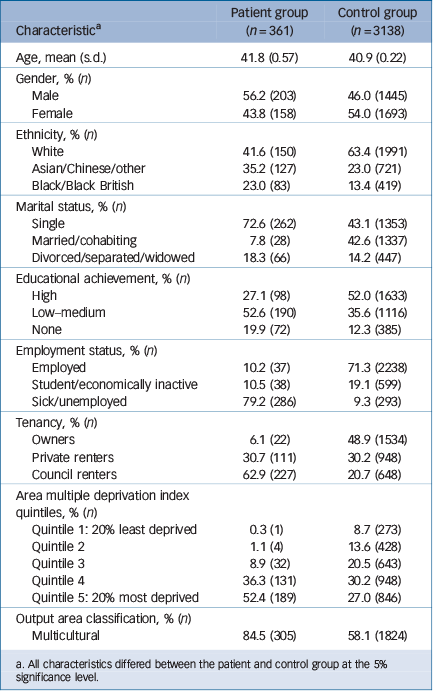
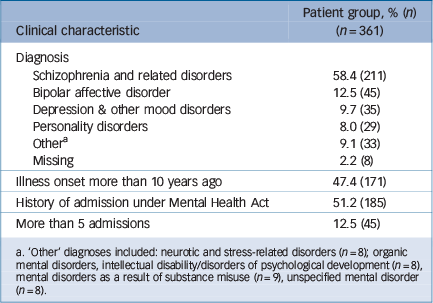
The sample sociodemographics are shown in Table 1. People with SMI had greater levels of social deprivation than the comparison group. The clinical characteristics of the patient group are shown in Table 2. Around 60% had a diagnosis of
Flow of participants in (a) the patient group and (b) the control group.
ONS, Office for National Statistics.

schizophrenia and 51% had a history of admission under the Mental Health Act.
Crime victimisation: face-to-face interview measures
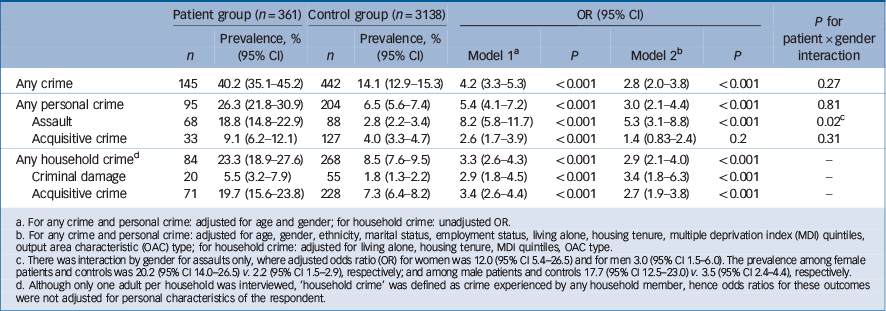
Table 3 shows the prevalence and odds ratios for victimisation experiences reported in the face-to-face interview (adjusted for sociodemographics). The experience of being a victim of any crime was more prevalent among the patient than the control group (40% v. 14%, respectively; adjusted odds ratio (OR) = 2.8, 95% CI 2.0–3.8). In total, 26% of the patient group v. 7% of the control group were victims of any personal crime (adjusted OR = 3.0, 95% CI 2.1–4.4) and 23% v. 9% were victims of any household crime (adjusted OR = 2.9, 95% CI 2.1–4.0). Those in the patient group were at increased adjusted odds of being a victim of assault (adjusted OR = 5.3, 95% CI 3.1–8.8), household acquisitive crime (adjusted OR = 2.7, 95% CI 1.9–3.8) and criminal damage (adjusted OR = 3.4, 95% CI 1.8–6.3); but not of personal acquisitive crime (adjusted OR = 1.4, 95% CI 0.83–2.4). There was an interaction by gender for assault, where adjusted odds ratios for women with SMI compared with control women was 12.0 (95% CI 5.4–26.5), and adjusted odds ratios for men with SMI compared with control men was 3.0 (95% CI 1.5–6.0, P for interaction 0.02).
The results of the sensitivity analysis, which compared the patient and control groups residing in the same boroughs, are reported in online Table DS1 and broadly reflect the findings above. The subgroups analyses, which compared general population controls with (a) people with schizophrenia and (b) those with other diagnoses, show somewhat lower relative odds for those with schizophrenia, but confidence intervals were overlapping for most outcomes (online Table DS2).
Sample socio-demographics for patient and control groups
| CharacteristicFootnote a | Patient
group (n = 361) |
Control
group (n = 3138) |
|---|---|---|
| Age, mean (s.d.) | 41.8 (0.57) | 40.9 (0.22) |
| Gender, % (n) | ||
| Male | 56.2 (203) | 46.0 (1445) |
| Female | 43.8 (158) | 54.0 (1693) |
| Ethnicity, % (n) | ||
| White | 41.6 (150) | 63.4 (1991) |
| Asian/Chinese/other | 35.2 (127) | 23.0 (721) |
| Black/Black British | 23.0 (83) | 13.4 (419) |
| Marital status, % (n) | ||
| Single | 72.6 (262) | 43.1 (1353) |
| Married/cohabiting | 7.8 (28) | 42.6 (1337) |
| Divorced/separated/widowed | 18.3 (66) | 14.2 (447) |
| Educational achievement, % (n) | ||
| High | 27.1 (98) | 52.0 (1633) |
| Low-medium | 52.6 (190) | 35.6 (1116) |
| None | 19.9 (72) | 12.3 (385) |
| Employment status, % (n) | ||
| Employed | 10.2 (37) | 71.3 (2238) |
| Student/economically inactive | 10.5 (38) | 19.1 (599) |
| Sick/unemployed | 79.2 (286) | 9.3 (293) |
| Tenancy, % (n) | ||
| Owners | 6.1 (22) | 48.9 (1534) |
| Private renters | 30.7 (111) | 30.2 (948) |
| Council renters | 62.9 (227) | 20.7 (648) |
| Area multiple deprivation
index quintiles, % (n) |
||
| Quintile 1: 20% least deprived | 0.3 (1) | 8.7 (273) |
| Quintile 2 | 1.1 (4) | 13.6 (428) |
| Quintile 3 | 8.9 (32) | 20.5 (643) |
| Quintile 4 | 36.3 (131) | 30.2 (948) |
| Quintile 5: 20% most deprived | 52.4 (189) | 27.0 (846) |
| Output area classification, % (n) | ||
| Multicultural | 84.5 (305) | 58.1 (1824) |
a. All characteristics differed between the patient and control group at the 5% significance level.
Physical and sexual assaults: face-to-face interview and self-completion measures
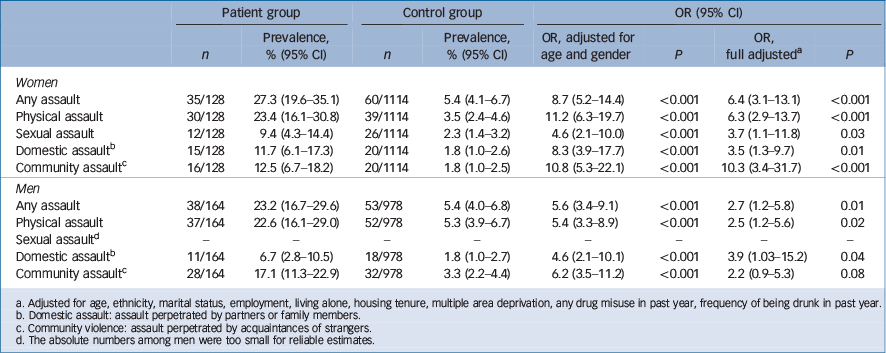
Table 4 shows the prevalence and odds ratios for assaults reported in either the face-to-face interview or self-completion module, by gender. The prevalence of any past-year physical or sexual violence in the patient v. control group was 27% v. 5% for women and 23% v. 5% for men. The odds for any violence victimisation, adjusted
Clinical characteristics of patient group (obtained from clinical records or care coordinator)
| Clinical characteristic | Patient group, %
(n) (n = 361) |
|---|---|
| Diagnosis | |
| Schizophrenia and related disorders | 58.4 (211) |
| Bipolar affective disorder | 12.5 (45) |
| Depression & other mood disorders | 9.7 (35) |
| Personality disorders | 8.0 (29) |
| OtherFootnote a | 9.1 (33) |
| Missing | 2.2 (8) |
| Illness onset more than 10 years ago | 47.4 (171) |
| History of admission under Mental Health Act | 51.2 (185) |
| More than 5 admissions | 12.5 (45) |
a. ‘Other’ diagnoses included: neurotic and stress-related disorders (n = 8); organic mental disorders, intellectual disability/disorders of psychological development (n = 8), mental disorders as a result of substance misuse (n = 9), unspecified mental disorder (n = 8).
for sociodemographics and substance misuse, were 6.4 (95% CI 3.1–13.1) among women and 2.7 (95% CI 1.2–5.8) among men. Women with SMI were at increased adjusted odds of all subtypes of violent victimisation; including domestic physical violence (OR = 3.5, 95% CI 1.3–9.7), community physical violence (OR = 10.3, 95% CI 3.4–31.7) and sexual violence (OR = 3.7, 95% CI 1.1–11.8). Men were at increased risk of being a victim of domestic physical violence (OR = 3.9, 95% CI 1.03–15.2), but their risk of community physical violence was not elevated at the 5% significance level (OR = 2.2, 95% CI 0.9–5.3). The absolute number of men reporting sexual violence was too small to allow for stable estimates.
The effect of adjusting for different risk factors on the association between SMI and violence victimisation is shown in Table 5. Adjustment for social deprivation resulted in little change in the magnitude of this association, whereas additional adjustment for substance misuse and violence perpetration led to a sizeable reduction. After taking into account sociodemographics, substance misuse and violence perpetration, the adjusted odds of violence victimisation was 1.9 (95% CI 0.53–6.8) among men and 7.7 (95% CI 2.5–23.7) among women. Therefore, these factors accounted for the excess risk among men but not among women with SMI.
Impact, reporting and unmet needs among victims of violent crime
A quarter to half of victims in the patient group reported adverse psychosocial effects as a result of victimisation, and 80% reported
Prevalence and odds ratios of past-year personal and household crime victimisation in patients and controls
| Patient group (n = 361) | Control group (n = 3138) | OR (95% CI) |
P for patient × gender interaction |
||||||
|---|---|---|---|---|---|---|---|---|---|
| n | Prevalence,
% (95% CI) |
n | Prevalence,
% (95% CI) |
Model 1Footnote a | P | Model 2Footnote b | P | ||
| Any crime | 145 | 40.2 (35.1–45.2) | 442 | 14.1 (12.9–15.3) | 4.2 (3.3–5.3) | <0.001 | 2.8 (2.0–3.8) | < 0.001 | 0.27 |
| Any personal crime | 95 | 26.3 (21.8–30.9) | 204 | 6.5 (5.6–7.4) | 5.4 (4.1–7.2) | <0.001 | 3.0 (2.1–4.4) | < 0.001 | 0.81 |
| Assault | 68 | 18.8 (14.8–22.9) | 88 | 2.8 (2.2–3.4) | 8.2 (5.8–11.7) | <0.001 | 5.3 (3.1–8.8) | < 0.001 | 0.02Footnote c |
| Acquisitive crime | 33 | 9.1 (6.2–12.1) | 127 | 4.0 (3.3–4.7) | 2.6 (1.7–3.9) | <0.001 | 1.4 (0.83–2.4) | 0.2 | 0.31 |
| Any household crimeFootnote d | 84 | 23.3 (18.9–27.6) | 268 | 8.5 (7.6–9.5) | 3.3 (2.6–4.3) | <0.001 | 2.9 (2.1–4.0) | < 0.001 | – |
| Criminal damage | 20 | 5.5 (3.2–7.9) | 55 | 1.8 (1.3–2.2) | 2.9 (1.8–4.5) | < 0.001 | 3.4 (1.8–6.3) | < 0.001 | – |
| Acquisitive crime | 71 | 19.7 (15.6–23.8) | 228 | 7.3 (6.4–8.2) | 3.4 (2.6–4.4) | < 0.001 | 2.7 (1.9–3.8) | < 0.001 | – |
a. For any crime and personal crime: adjusted for age and gender; for household crime: unadjusted OR.
b. For any crime and personal crime: adjusted for age, gender, ethnicity, marital status, employment status, living alone, housing tenure, multiple deprivation index (MDI) quintiles, output area characteristic (OAC) type; for household crime: adjusted for living alone, housing tenure, MDI quintiles, OAC type.
c. There was interaction by gender for assaults only, where adjusted odds ratio (OR) for women was 12.0 (95% CI 5.4–26.5) and for men 3.0 (95% CI 1.5–6.0). The prevalence among female patients and controls was 20.2 (95% CI 14.0–26.5) v. 2.2 (95% CI 1.5–2.9), respectively; and among male patients and controls 17.7 (95% CI 12.5–23.0) v. 3.5 (95% CI 2.4–4.4), respectively.
d. Although only one adult per household was interviewed, ‘household crime’ was defined as crime experienced by any household member, hence odds ratios for these outcomes were not adjusted for personal characteristics of the respondent.
Prevalence and odds ratios of past-year violence victimisation among the patient and control groups, by gender
| Patient group | Control group | OR (95% CI) | ||||||
|---|---|---|---|---|---|---|---|---|
| n | Prevalence, % (95% CI) |
n | Prevalence, % (95% CI) |
OR, adjusted for age and gender |
P | OR, full adjustedFootnote a |
P | |
| Women | ||||||||
| Any assault | 35/128 | 27.3 (19.6–35.1) | 60/1114 | 5.4 (4.1–6.7) | 8.7 (5.2–14.4) | <0.001 | 6.4 (3.1–13.1) | < 0.001 |
| Physical assault | 30/128 | 23.4 (16.1–30.8) | 39/1114 | 3.5 (2.4–4.6) | 11.2 (6.3–19.7) | 50.001 | 6.3 (2.9–13.7) | < 0.001 |
| Sexual assault | 12/128 | 9.4 (4.3–14.4) | 26/1114 | 2.3 (1.4–3.2) | 4.6 (2.1–10.0) | <0.001 | 3.7 (1.1–11.8) | 0.03 |
| Domestic assaultFootnote b | 15/128 | 11.7 (6.1–17.3) | 20/1114 | 1.8 (1.0–2.6) | 8.3 (3.9–17.7) | <0.001 | 3.5 (1.3–9.7) | 0.01 |
| Community assaultFootnote c | 16/128 | 12.5 (6.7–18.2) | 20/1114 | 1.8 (1.0–2.5) | 10.8 (5.3–22.1) | <0.001 | 10.3 (3.4–31.7) | < 0.001 |
| Men | ||||||||
| Any assault | 38/164 | 23.2 (16.7–29.6) | 53/978 | 5.4 (4.0–6.8) | 5.6 (3.4–9.1) | < 0.001 | 2.7 (1.2–5.8) | 0.01 |
| Physical assault | 37/164 | 22.6 (16.1–29.0) | 52/978 | 5.3 (3.9–6.7) | 5.4 (3.3–8.9) | < 0.001 | 2.5 (1.2–5.6) | 0.02 |
| Sexual assaultFootnote d | – | – | – | – | – | – | – | – |
| Domestic assaultFootnote b | 11/164 | 6.7 (2.8–10.5) | 18/978 | 1.8 (1.0–2.7) | 4.6 (2.1–10.1) | < 0.001 | 3.9 (1.03–15.2) | 0.04 |
| Community assaultFootnote c | 28/164 | 17.1 (11.3–22.9) | 32/978 | 3.3 (2.2–4.4) | 6.2 (3.5–11.2) | < 0.001 | 2.2 (0.9–5.3) | 0.08 |
a. Adjusted for age, ethnicity, marital status, employment, living alone, housing tenure, multiple area deprivation, any drug misuse in past year, frequency of being drunk in past year.
b. Domestic assault: assault perpetrated by partners or family members.
c. Community violence: assault perpetrated by acquaintances of strangers.
d. The absolute numbers among men were too small for reliable estimates.
Exploring risk factors for excess odds of violence victimisation among patients

| Patient group, n/N |
Control group, n/N |
OR (95% CI) of violence victimisation in patient v. control group | ||||||
|---|---|---|---|---|---|---|---|---|
| Model 1Footnote a | P | Model 2Footnote b | P | Model 3Footnote c | P | |||
| Women | 32/110 | 15/277 | 9.1 (4.5–18.4) | <0.001 | 11.7 (4.1–33.3) | <0.001 | 7.7 (2.5–23.7) | <0.001 |
| Men | 32/142 | 14/248 | 5.7 (2.8–11.4) | <0.001 | 4.9 (1.4–15.2) | 0.01 | 1.9 (0.53–6.8) | 0.32 |
a. Adjusted for age and gender.
b. Adjusted for variables in Model 1 and ethnicity, marital status, employment, living alone, housing tenure, multiple area deprivation.
c. Adjusted for variables in Models 1 and 2 and any drug misuse in past year, frequency of drunkenness in past year, any past violence perpetration.
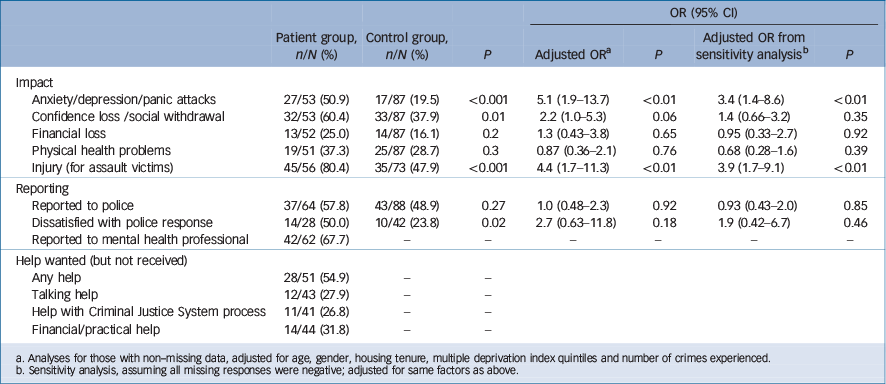
physical injury (Table 6). Victims in the patient group were more likely to report that violence led to social problems, adverse psychological effects (depression, anxiety or panic attacks) and injury than victims in the control group; with four- to five-fold higher odds for the latter two after adjusting for victim and crime characteristics. There was no difference in the proportion reporting financial loss or physical ill health following violence experiences.
Victimisation was reported to the police for 58% of victims in the patient group and 49% of victims in the control group (P = 0.72), with no difference in reporting, even after adjusting for victim and crime characteristics. Patients were more dissatisfied with
Impact, reporting and unmet needs among victims of violent crime
| OR (95% CI) | |||||||
|---|---|---|---|---|---|---|---|
| Patient group, n/N (%) |
Control group, n/N (%) |
P | Adjusted ORFootnote a | P | Adjusted OR from sensitivity analysisFootnote b |
P | |
| Impact | |||||||
| Anxiety/depression/panic attacks | 27/53 (50.9) | 17/87 (19.5) | <0.001 | 5.1 (1.9–13.7) | < 0.01 | 3.4 (1.4–8.6) | < 0.01 |
| Confidence loss /social withdrawal | 32/53 (60.4) | 33/87 (37.9) | 0.01 | 2.2 (1.0–5.3) | 0.06 | 1.4 (0.66–3.2) | 0.35 |
| Financial loss | 13/52 (25.0) | 14/87 (16.1) | 0.2 | 1.3 (0.43–3.8) | 0.65 | 0.95 (0.33–2.7) | 0.92 |
| Physical health problems | 19/51 (37.3) | 25/87 (28.7) | 0.3 | 0.87 (0.36–2.1) | 0.76 | 0.68 (0.28–1.6) | 0.39 |
| Injury (for assault victims) | 45/56 (80.4) | 35/73 (47.9) | < 0.001 | 4.4 (1.7–11.3) | < 0.01 | 3.9 (1.7–9.1) | < 0.01 |
| Reporting | |||||||
| Reported to police | 37/64 (57.8) | 43/88 (48.9) | 0.27 | 1.0 (0.48–2.3) | 0.92 | 0.93 (0.43–2.0) | 0.85 |
| Dissatisfied with police response | 14/28 (50.0) | 10/42 (23.8) | 0.02 | 2.7 (0.63–11.8) | 0.18 | 1.9 (0.42–6.7) | 0.46 |
| Reported to mental health professional | 42/62 (67.7) | – | – | – | – | – | – |
| Help wanted (but not received) | |||||||
| Any help | 28/51 (54.9) | – | – | ||||
| Talking help | 12/43 (27.9) | – | – | ||||
| Help with Criminal Justice System process | 11/41 (26.8) | – | – | ||||
| Financial/practical help | 14/44 (31.8) | – | – | ||||
a. Analyses for those with non-missing data, adjusted for age, gender, housing tenure, multiple deprivation index quintiles and number of crimes experienced.
b. Sensitivity analysis, assuming all missing responses were negative; adjusted for same factors as above.
the police response (50% v. 24%, P= 0.02), but this difference was no longer statistically significant at the 5% level after adjusting for victim/crime characteristics. The same conclusions were reached following a sensitivity analysis; conducted to explore non-response bias, since there was unequal missing data between patients and controls on these outcomes (Table 6). Among the patient group who were victims of violence, 68% reported their experiences to a mental health professional. A total of 55% had unmet support needs; with around a third reporting an unmet need for ‘talking help’, help with the Criminal Justice System process or practical/financial support.
Discussion
Main findings
This study compared the prevalence and correlates of violent and non-violent crime victimisation among people with SMI with a general population control group, and compared impact and disclosure of victimisation. In total, 40% of the patient group compared with 14% of the control group were victims of a crime in the preceding year. Our primary hypothesis that patients would be at increased odds of personal and household crime compared with the general population controls was supported; those in the patient group were five times more likely to be victims of assault, and three times more likely to be victims of household acquisitive crime and criminal damage, after adjusting for sociodemographics and area characteristics. Women with SMI were at particularly high risk of violence, both community and domestic. Our secondary hypothesis that social deprivation, substance misuse and violence perpetration would account for any excess risk of violence victimisation among patients was supported among men with SMI but not among women with SMI (who had eight-fold adjusted odds). Our secondary hypotheses on impact and reporting of crime were partially supported: crime led to greater reported psychological adversity and injury by the victims in the patient group than those in the control group, but surprisingly patients and controls were equally likely to report victimisation to the police.
Findings in the context of past studies
Previously published studies on violence victimisation among people with SMI have had highly heterogeneous settings, populations and measures and have reported prevalence estimates ranging from 4% to 58%. Reference Maniglio12–Reference Hiday, Swanson, Swartz, Borum, Wagner and Hiday16 Few studies have compared victimisation among mental health service users with a control group. Reference Hughes, Bellis, Jones, Wood, Bates and Eckley17–Reference Sturup, Sorman, Lindqvist and Kristiansson21 Silver in the USA compared discharged psychiatric patients with a neighbourhood control sample, and found a two-fold increase in violence victimisation after adjusting for sociodemographics and violence perpetration. Reference Silver19 Teplin et al in the USA and Sturup et al in Sweden compared violent crime against psychiatric patients with data from participants in national crime surveys and after adjusting for a very limited number of confounders found 12-fold and 6-fold higher risk among patients, respectively. Reference Teplin, McClelland, Abram and Weiner18,Reference Sturup, Sorman, Lindqvist and Kristiansson21 Finally, a New Zealand birth cohort found that violent victimisation among a small number of people with schizophreniform disorder (n = 38) was three-fold higher than among those without any psychiatric disorder. Reference Silver, Arseneault, Langley, Caspi and Moffitt20 The studies adjusted for a limited number of confounders and did not assess the impact or reporting of violence. Some past studies measured and reported on victimisation by any perpetrators, including partners and family members, Reference Teplin, McClelland, Abram and Weiner18 but this is one of the few studies to report separately on domestic violence (perpetrated by partners and family members) and community violence (perpetrated by strangers or acquaintances). This is important, since these forms of violence have distinct interventions. Reference Krug22 We found greatly elevated odds of victimisation compared with our general population control group for all violence types (physical and sexual; domestic and community), even after adjusting for a broader range of key individual, household and area characteristics than in studies carried out previously. Reference Teplin, McClelland, Abram and Weiner18–Reference Sturup, Sorman, Lindqvist and Kristiansson21
Our finding that women with SMI were particularly vulnerable to violence is consistent with evidence from Sweden and the USA. Reference Teplin, McClelland, Abram and Weiner18,Reference Sturup, Sorman, Lindqvist and Kristiansson21,Reference Khalifeh and Dean23 In the general population, violence prevention among women is focused on domestic and sexual violence, 24,25 but our finding that women with SMI had increased risks for both domestic and community violence suggests the need for broader interventions in this group.
We found that people with SMI are more likely to report adverse psychological and social effects once victimised. This would compound the personal, public health and economic costs of victimisation in this group, especially given the relatively large contribution of psychosocial impact to the overall economic cost of crime. Reference Dubourg and Hamed26 These findings suggest that people with SMI should be prioritised in public health policies on violence prevention directed at vulnerable groups. Although SMI is uncommon, affecting around 3% of the population, Reference McManus, Meltzer, Brugha, Bebbington and Jenkins27 it is one of the leading causes of global disease burden; and this study and others suggest that experiencing violence is associated with worse function and quality of life among this group. 28
Past studies have shown that substance misuse, social isolation, homelessness and violence perpetration are important risk factors for victimisation among people with SMI; Reference Dean, Moran, Fahy, Tyrer, Leese and Creed13,Reference Hiday, Swartz, Swanson and Borum29,Reference Teasdale30 whereas treatment adherence was protective. Reference Hiday, Swartz, Swanson, Borum, Wagner and Hiday31 In our study, substance misuse and violence perpetration accounted for the excess risk of victimisation among men but not among women; suggesting the need for gender-sensitive interventions given the likely differences in risk pathways.
In routine clinical practice, victimisation is underdetected by mental health professionals, and where it is detected, concerns may not be promptly acted upon. Reference Howard, Trevillion, Khalifeh, Woodall, Agnew-Davies and Feder32 Half of the violence victims in our study had unmet support needs. Mental health professionals need to identify victimisation, mitigate modifiable risk factors and address comorbidity.
Surprisingly, patients were as likely to report victimisation to the police and to progress through the Criminal Justice System as the general population, contradicting previous qualitative evidence that suggested people with mental health problems had limited access to the judicial system. 33 Nonetheless, those in the patient group were less likely to be satisfied with the response of the police, with qualitative research conducted by the UK Charity Victim Support suggesting that they are often not believed and discriminated against within the Criminal Justice System. Reference Pettit, Greenhead, Khalifeh, Drennan, Hart and Hogg34 Clearly criminal justice policies must protect against such discrimination. Half of patients had unmet support needs, including for practical/financial help, psychological support and help with the Criminal Justice System process.
Strengths and limitations
Strengths of this study include a large sample size, with a comparison group drawn from the same geographical area. We derived detailed information on the nature, impact and reporting of crime, and used self-reported measures for domestic and sexual violence (which have higher disclosure rates than interview measures). Reference Walby and Allen35 The response rate was somewhat low at 52%. However, the study researched a sensitive topic, in a population which may have additional barriers to participating in such a study. Although domestic and sexual violence are sensitive topics for any group, they may be even more sensitive and complex for patients with SMI in secondary mental healthcare to discuss, since patients may worry about additional consequences of disclosure such as involuntary hospital admission. Reference Pettit, Greenhead, Khalifeh, Drennan, Hart and Hogg34 We used a rigorous random sampling procedure, using a complete list of all patients on the caseload of included teams, whether or not they were actively engaged in treatment. As stipulated by the ethics committee, we recruited indirectly via care coordinators rather than through direct contact with patients. These factors may explain the lower response rate in this study compared with those using a convenience sample Reference Hughes, Bellis, Jones, Wood, Bates and Eckley17,Reference Oram, Trevillon, Feder and Howard36 or direct recruitment of patients attending out-patient or in-patient services. Reference Teplin, McClelland, Abram and Weiner18 Non-responders had the same demographic profile (in terms of age and gender) as participants. We did not have additional details on the characteristics of non-responders, so it is difficult to comment on the likely magnitude and direction of non-response bias. We speculate that some patients may have failed to respond because they had experienced or were experiencing violence and were worried about the consequences of disclosure (for example increased violence or coercive treatment), which would have led to an underestimate of violence prevalence. Others may have failed to respond because they did not have past experiences of violence and so did not perceive this study as relevant to them, which would have led to an overestimate of violence experiences. The overall effect is difficult to ascertain, but the odds ratios are sizeable and unlikely to be fully explained by non-response bias.
The findings have external validity, mirroring those of related studies in the USA and Sweden. Reference Teplin, McClelland, Abram and Weiner18,Reference Sturup, Sorman, Lindqvist and Kristiansson21 There is potential for observer bias (since interviewers in the patient survey were not masked to the main hypothesis) and reporting bias (the patient and control groups may have different thresholds for disclosing victimisation), but this is mitigated by the highly structured questionnaire, and there is evidence that self-reported victimisation among people with SMI is valid and reliable. Reference Teplin, McClelland, Abram and Weiner18,Reference Fisher, Craig, Fearon, Morgan, Dazzan and Lappin37,Reference Goodman, Thompson, Weinfurt, Corl, Acker and Mueser38 There may be a reporting bias for domestic violence because of the different interview settings – the controls were interviewed at home but most patients were interviewed in clinic, and disclosure may be easier in a clinical setting (although all home-based interviews were conducted in a private setting without others present, and participants themselves filled out a computer-based questionnaire in confidence).
Another limitation is the different sociodemographic profile of the patient and control groups, but we carefully adjusted for a broad range of individual and household measures. Our sensitivity analysis found no evidence for confounding by area of residence. Bias from missing data on impact is possible, but there was no evidence for this from our sensitivity analysis. A small proportion of the control group may have an SMI, since we used a self-reported measure to exclude mental illness in this group. However, the prevalence of SMI in the general population is less than 3%, Reference McManus, Meltzer, Brugha, Bebbington and Jenkins27 and the presence of people with SMI in the control group would have led us to underestimate the relative odds. Findings on prevalence are likely to generalise to other Western urban settings with similar background levels of violence, and those on the relative risk of victimisation are likely to generalise to settings where people with SMI have a similar sociodemographic and clinical profile to the one described here.
In conclusion, victimisation among people with SMI is more prevalent and associated with greater psychosocial morbidity than victimisation among the general population. Our research has shown that women with SMI are at particularly high risk of both domestic and community violence. Violence prevention for people with SMI is likely to require an integrated response by mental health professionals, third-sector organisations and the Criminal Justice System.
Acknowledgements
We acknowledge the support of Camden & Islington South London & Maudsley NHS Foundation Trusts. We acknowledge the CSEW Principal Investigator (Office for National Statistics), sponsors (Home Office, Ministry of Justice, Office for National Statistics), data collectors (TNS BMRB) and the UK Data Archive. We thank Kirsty Collins and Megan Lawrence from the Mental Health Support Network for help with recruitment. We are grateful to all the patients and healthcare professionals who took part in this study. The views expressed in this publication are those of the authors alone.


 Open access


eLetters
No eLetters have been published for this article.