In the middle years of the 1930s, American business seemed beset by mass distrust. In literature and in the visual and performing arts, business elites were charged with conspiracy against human dignity and collective purpose. New laws intruded on commercial privacy and mandated periodic accounting of firms’ operations, finances, and use of investor funds.Footnote 1 Matching the public scrutiny of private enterprise, economists devised new theories of competition and governance premised on the discretion of monopolistic concerns and their executive class.Footnote 2 Despite all of the damning attention, the authority of the professional manager emerged undiminished from the Great Depression. In this article, I examine how the social type of the manager was reimagined during the Depression and poised to become a crucial protagonist in the mid-century mixed economy.Footnote 3 At the heart of this article is a study of how new idioms of business print idealized management. The magazines Business Week and Fortune directed their readers’ attention away from conceptions of the manager as engineer of operational efficiency and toward accounts of management expertly setting policy that integrated firms with industry, markets, and government.
At the turn of the twentieth century, business was guided by an associative ideal that praised executives’ personal values of honesty and fortitude but placed no requirements on their knowledge or expertise. Executive elites coordinated industrial interests through gentlemanly agreements at clubs and at service and trade associations. Their claim of protecting industry from destructive competition seemed to marry private gain to civic virtue. When deliberate concert failed to stave off the stock market downturn of 1929, as it had done in 1907, President Hoover hosted conferences with business leaders to revive their shared purpose. In his “one hundred days,” President Roosevelt subscribed to the same doctrine, and with the National Industrial Recovery Act he sought to fortify voluntary industrial associations with corporatist law. The codes of the National Recovery Administration set standards of production and price floors that relied on the wisdom of industry leaders and the machinery of the Chamber of Commerce and allied trade associations.Footnote 4
By 1935, with the Supreme Court’s repeal of the National Industrial Recovery Act, coordination of business activity through corporate agreement seemed doomed. Business, big and small, had not complied with the codes sabotaging what many saw as an insidious intrusion of the state into private affairs. In the years that followed, emphatically from 1937, the New Deal changed course. The attorney general’s investigations of corporations obstructed the practices of price setting and market segmentation, and legislation prohibited banks from consultative and reorganizational activity that had achieved coordination through financial intermediation.Footnote 5 World War II eased reconciliation between the federal government and the corporate giants, but it did so under terms that did not resurrect corporative or associational arrangements. The legal form for the public–private partnership during the Cold War was contracts for guns and butter, subject to periodical renewal and negotiation.Footnote 6
It was once customary to describe the Great Depression as an interregnum in the history of business, given the period’s apparent dullness in organizational innovation and change.Footnote 7 This article endorses the view that the Great Depression engendered the conditions—technological and administrative—that sustained the extraordinary advance of American corporations during World War II and its aftermath.Footnote 8 Managerial functions, together with the circuits of information and knowledge that supported them, had to be reconfigured in the 1930s to match an age of intense regulatory change, fierce competition for volatile markets, and labor combativeness. Rather than excise the once civic goal of industrial coordination, the unraveling of associativism recast and fortified coordination as an administrative function of professional managers in private and public bureaucracies.Footnote 9 Control of the firm’s external environment was an imperative for survival during the Depression, but it sought more than the defensive containment of threats.Footnote 10 Understanding of political economy, industry, state, and public was also, even primarily, a means to boldly chase opportunity.
The kernel of the cultural authority of management at the turn of the century was operational design. The Efficiency Movement of Henry Taylor had offered the aspiring managerial profession the trappings of a science, but by the 1910s its prestige was exhausted. While the human relations of Elton Mayo and the Hawthorne studies renewed the authority of the manager as designer of a more harmonious workplace,Footnote 11 a companion ideal is discernible that placed managers as interpreters of political economy. In addition to the diagrams of time and motion studies, managers’ tool kit included statistics, economics, and public opinion research.
To examine changes in the representations, and aspirations, of American managers, one may contrast business school curricula, the literature coming out of learned societies, and professional associations or the internal communication of firms. Although I will briefly address that evidential record, I set my focus on tracing the careers of two magazines conceived at the threshold of the Great Depression. Business Week published its first issue on September 7, 1929, seven weeks before Black Tuesday. Fortune started with a trial issue that was circulated to advertisers in the same month and announced to readers of Time on the week of the crash. It began publication in February 1930. The magazines chronicled business practices and, at the same time, reported and advocated for a new orientation of managerial values. While a third of financial and business publications were decimated by the Depression, Business Week and Fortune prospered. Fortune began with 30,000 subscribers and finished the decade with 130,000; Business Week was not far behind with 110,000.Footnote 12 Fortune recovered its startup investment within three years and began making a modest profit. Business Week lost $1.5 million in its first five years, but its prospects improved rapidly after 1934–1935.Footnote 13 They addressed a reader of a new kind: an outward-looking manager. The remarkable commercial success of these publications is of a piece with their intellectual program.
The two magazines intently sought a new kind of business journalism. They abandoned the focus on stock markets and investor sentiment that had been the standard in the genre to devote themselves to executive decision. Both magazines were sold by subscription to corporate supervisory and executive staff. Business Week was marketed by salesmen visits to corporate offices.Footnote 14 While older business titles were recruited to campaigns against the New Deal, Fortune and Business Week remained unaligned.Footnote 15 The two magazines soberly surveyed business in numbers and stories, and photographs and graphs, and took advantage of the disclosures of finances, operations, and strategies of firms. In their reporting both linked profit and growth to the anticipation of change, but understood this calling differently. Business Week promised to weekly scope news and data about industry. It covered mergers and deals, price battles and the summitry of trade associations, and surveyed consumer markets in thick numerical detail. Fortune monthly sought to describe the organizational range of American enterprise and to reveal how profit could be won by ingenuity and a service ethos to customers and associates. It profiled companies and gave each a balance sheet, a compelling mission statement, and a narrative. The imagined reader of these insights was a manager mindful of the diversity and excitement of American capitalism.
I begin by arguing that Business Week and Fortune claimed for themselves a new genre distinct from industrial and financial print that courted a growing readership of professional managers.Footnote 16 I then examine Business Week and Fortune by looking at each magazine’s most emblematic reporting device. The business indicator of Business Week and the corporation story of Fortune represented and tracked American business and anchored the reporting of each issue. I contend that the editorial visions of the magazines assigned managers the coordination of the firm with the state, clients, and competitors, and presented themselves as tools of business decision and planning.
Magazines for Managers
Business print in the 1930s bracketed industrial, professional, science, and technology publications. The first textbook in business journalism, published in 1945, claimed for the genre 1,600 titles with various overlaps in topic and generously estimated a joint readership of 25 million.Footnote 17 At the start of the 1930s, the dominant publications in both readership and prestige were financial papers at the service of capital markets and investors. The earliest publications of this kind date to the early decades of the American republic. The New York Prices Current and the Boston Prices Current and Marine Intelligencer, Commercial and Mercantile were the first in 1795. Some of these titles became working tools for merchants, bankers, and brokers.Footnote 18 The Commercial and Financial Chronicle was the most distinguished and best remembered. At the turn of the twentieth century, it was a trusted companion to Wall Street finance, with quotations of bonds and earning reports occupying the majority of its ninety weekly pages.Footnote 19 The Chronicle was exclusively read by a specialist audience. In the interwar years, a new type of financial paper appeared that captivated the enthusiasm of middle-class investors.Footnote 20 The longest surviving specimens of that press are Forbes and Barron’s. From 1917 Forbes held watch of the stock and bond markets. It claimed a popular following by printing inspirational literature and by offering laconic and boisterous opinions that adapted “yellow press” diction to financial affairs. Barron’s appeared in 1921, and throughout the interwar period was a three-column weekly broadsheet carrying the frontispiece motto: “For those who read for profit.” Its most distinctive features were “Financial Queries and Investment Suggestions,” a one-pager written by the editors, and “What of the Market?,” which appeared on the opening page and was written from the perspective of a Wall Street trader. The financial press that entered the Depression was written for the investor, at times incoherently addressing both amateurs and professionals.
Fortune and Business Week originated with the coincidental ambition of inventing a new kind of magazine directed at executives. The title they sought to better was Nation’s Business, an official publication of the U.S. Chamber of Commerce. The publication began in April 1914 as a dry sixteen-page monthly newsletter to its membership. Within a year, it gained an attractive color cover and type design, reduced its four-column format to spacious two columns, with photographs of places and faces. In 1929 it boasted more than three hundred thousand in circulation and consisted of 240 heavily advertised pages. Inspection of one issue of March 1929 reveals forty-five items of content, including the concluding installment of a long essay by President Hoover on “American Individualism,” along with “an anonymous confession” of “I’m a Failure at Fifty.” Nation’s Business was at the service of boosterism and associativism, ennobling the values and views of the executive elite. Business Week and Fortune agreed that they should be independent. They forbade ghostwriting, which was ubiquitous in periodical business print. All content was to be authored by the magazines’ staff. They opposed relaying the opinions of business leaders, however distinguished they might be, and in a rejection of business hagiography, they demythologized business success.
The two magazines differed in some obvious ways. Business Week asserted technical competence and laborious comprehensiveness. Fortune celebrated luxury and power, taking pride in the verve and depth of its reporting. The publishers’ imprints explain these differences in self-presentation and in the repertoires used to represent business. Fortune’s Time, Inc. was an upstart venture with one fast growing title pitched to an affluent middle-class readership. Meanwhile, Business Week’s McGraw-Hill Publishing Company was the largest publisher of industrial papers in America.
McGraw-Hill’s company history bears a mimetic relationship with the institutional evolution of American capitalism. The company originated with the merger in 1917 of John A. Hill’s magazines in mechanical engineering and mining and James H. McGraw’s electrical engineering and transportation titles. In the company’s jargon, each of these titles was a “vertical” publication. The label comments on how the titles, for instance Coal Age, covered news of vertically integrated industry from supplier to consumer. McGraw-Hill in the 1920s bought competing trade publishers to consolidate the dominance of its catalog within each industry segment. In the course of this wave of mergers and acquisitions, the publishing executives began planning for a title that was not industry specific and could tap economies gained from reusing the operations set up for the various magazines. It was to be a “horizontal” magazine, “serving a function that cuts through all industry.” When McGraw-Hill purchased A. W. Shaw Company in 1928, it also bought a subscription list for its synthetic magazine and created not one but two horizontal titles, Business Week and Factory.
Factory merged with another purchased title, Industrial Management, formerly published by the New York-based Engineering Magazine Co. Like its nearest competitor, a journal called Management and Administration, Factory and Industrial Management shone a light on best practices in production and office design, delivered through diagram-illustrated essays and reports of motion studies.Footnote 21 Business Week was different. It was offered to the subscribers of Shaw’s Magazine of Business as a “liaison agent,” and drew from the knowledge base of twenty-two specialized journals. The new magazine was a departure from the format of the Magazine of Business and its predecessor, System. Footnote 22 It was designed in a portable format with a predictable divisional structure filled by numerous articles, each short in length but written with a care for detail. It followed the design of Time and was the first of its many imitators.Footnote 23
By contrast with the genesis of Business Week, the motivation for Fortune was more idiosyncratic and personal. Most accounts credit the conception of the magazine to Henry Luce’s desire to challenge journalistic conventions. Fortune was the company’s second title, six years after the creation of Time. Luce’s next project was to “accurately, vividly and concretely … describe Modern Business, … the greatest journalistic assignment in history.” The promotional material for Fortune, circulated to advertisers and subscribers, promised “to realize the dignity and the beauty, the smartness and excitement of modern industry.”Footnote 24
The two titles were distinct print objects. Business Week in its first half-year was impressive, with color work on its cover, heavy stock-coated paper, and abundant illustrations in line cuts and halftones. It was an object for the office. Fortune was an object for the executive lounge, with the likeness of a catalogue or a fashion magazine. Fortune was 14 by 11¼, with poster art on its cover, and bulking hand-sewn at 190 pages. In its first two years, it required the combined efforts of two printers, one for the text in letterpress and another for illustrations on thick uncoated paper that took several runs through the presses.Footnote 25 Business Week was portable, to be clipped and pasted and handled. Fortune was too bulky and too expensive for most pockets. Its copies were exhibited and treasured.
While Business Week’s ambitions were set on the comprehensiveness of its journalistic assignment, Fortune was on a mission to document industrial life. Business Week was written by industry journalists and economists trained to address a readership of engineers and managers. In its first decade, Fortune was the collaborative effort of northeastern college graduates and aspiring and accomplished poets and novelists who partnered with industrial photographers and clerical researchers. The differences between publishers, mission, and composition of the newsrooms map onto the two magazines’ distinct vocations in business print. Business Week wanted to be scholarship for business. Fortune sought to offer business its literature.Footnote 26 Business Week captured economic life by indexing. It created a statistical index to record the ebb and flow of economic activity, and it indexed the news of industry, finance, and commerce into ordered sections. Fortune conceived story-types to encapsulate the excitement and beauty of American business.
The imagined reader of financial publications such as the Commercial and Financial Chronicle was the banker or investor alert to the latest equity issuance and the movements of prices and ratings. The targeted reader of Business Week and Fortune was interested in the organization of industry and commerce.Footnote 27 Even though the magazines differed in their approaches to reporting, they agreed that the American manager was watchful and knowledgeable of the scope of American enterprise, and that management consisted of the coordination of firms with competitors, markets, and state.
Indexing
Early advertisements for Business Week promised a magazine for an age of “spread and speed” in American business. The magazine took its slogan from the 1929 report of President Hoover’s Committee on Recent Economic Changes. This reference to government-sanctioned scholarship testifies to the joint commitment of press and state to educate and inform business. When it purchased the A. W. Shaw Company, McGraw-Hill also acquired the publishing rights of Harvard Business Review, the dissertation and casebook series of Harvard Business School. Under the same imprint, McGraw-Hill sold business magazines, academic journals, textbooks, and manuals. The publishers signed up for the educational campaign. Shaw was an early backer of Harvard Business School and promoter of its Bureau of Business Research. He taught at the school from 1911 to 1917, and started a course on Business Policy that was later to develop the famed “case method.”Footnote 28 James H. McGraw lacked the prestige of Harvard employment, but throughout his long career he acted out the demeanor of a “schoolmaster,” which was his occupation prior to publishing.Footnote 29 A core value in industrial publishing, as in business publishing, was to aid the continued education of professionals.
McGraw had retired when Business Week began publication, but his repeated admonition to editors of “know your industry” was often repeated within the company. Business Week, because it covered all industries, required a different motto—to know your economy—and promised its readers the “mountain-top from which you could scan the condition of all business.”Footnote 30 To deliver that promise, the magazine drew on data and research from congressional committees; from trade associations, such as the National Industrial Conference Board; and from statistical institutes, such as the National Bureau of Economic Research (NBER). In addition to relaying the findings of others, the magazine took pride in pursuing its own studies, describing them as a “service” to its subscribers, and kept on its staff an economist (who was a former chief economist and later president of the National Industrial Conference Board) and a statistician.Footnote 31 In spring and summer 1931, for example, the magazine serialized in twenty parts a yearlong research project on “The American Consumer Market.” It was a quantitative description of nearly a thousand items of “just about everything the American people buy” in the period from 1919 to 1930. It was presented to professionals “who need this information to guide their businesses.”Footnote 32 Most of the magazine’s studies scanned the conditions of individual industries. In fall 1930 alone, Business Week surveyed steel, automobile, textiles, railroads, construction, machinery, and banking. It reviewed production statistics for each sector and asked whether rising or decreasing demand was expected and how competition between the major firms would play out. In the words of Business Week’s champion at McGraw-Hill, Malcolm Muir, the magazine helped “an industry … to recognize its interest in other industries, the impact of one on the other.”Footnote 33 Business Week was educating its readers about the channels of commerce and the interdependence of American capitalism.
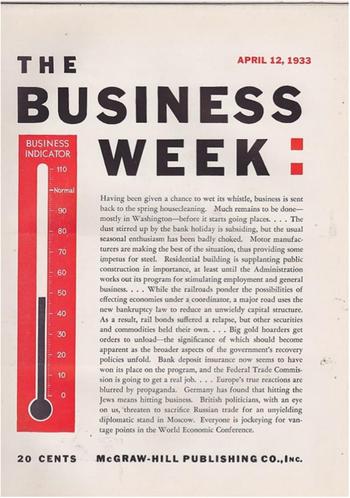
The most iconic feature of Business Week’s reporting was an indicator of business activity. Beginning with the issue for May 7, 1930, Business Week’s cover swapped expensive photographic illustration for a minimalist design. The magazine’s title, followed by a colon, headed the drawing of a thermometer occupying the full height of the page and it was paired with an adjacent text box (Figure 1). The metric reappeared at the end of the book together with an extended review of weekly data on finance, industry, and trade.Footnote 34 In January 1934, the index’s discussion and the accompanying series were moved to the front of the magazine for a “business roundup” and primed the digest of the week’s news. Marked on the thermometer were the scores of the previous week and year, eventually also the scores of the previous month (from 1936) and previous semester (from 1938) for easy visual tally of the progress of business activity.
Business Week, April 12, 1933—typical mid-1930s cover with the “business indicator” priming the week’s news.
Source: Bloomberg L.P. Used with permission.

Business Week’s “business indicator” was a feature of the magazine for more than three decades and the emblem of its commitment to data and social science. Examining the choices involved in the formulation and interpretation of the indicator reveals that Business Week endorsed an ideal of the manager knowledgeable of the conditions of the national economy. Three facets characterized the political economy outlook of the idealized reader. First, objective measurement was preferred over sentiment. Second, national industry was conceived as a delimited and coherent economic entity. Third, the economy was taken to be the subject of private and public administration and not as nature given and regulated by immutable laws.
In its early presentations, the indicator was read as a barometer, and deviations from the norm were interpreted as foretelling good or bad commercial conditions.Footnote 35 For the subscribers of Business Week, the implicit weather metaphor was familiar, as it had been carried over from its preceding title, the Magazine of Business. In its last half decade, the Magazine of Business printed maps of the United States and of the world with colored flags indicating regional expectations of growth. Underlying this weather map was a survey of business sentiment. Every month a ballot was sent to a subset of a mailing list of twenty thousand businesses. A 6-by-5-inch card queried if business activity was above or below average or normal, what was the expected volume increase, and what were the most and least favorable factors for business. The magazine pictured two readers leaning over the map with the posture of generals deciding on troop deployment. The readers were expected to chase the good weather by moving trade to regions with sunny prospects.
The Magazine of Business’ ballot held business leaders as privileged observers of market developments. Business Week continued to collect the sentiment of executives in a similar questionnaire: the Council on the Trend of Business. However, it downgraded the attention given to such findings. Instead, to track business, the magazine favored an index of physical volume of production and trade composed of eight “fundamental indicators.” It introduced the index as “our best judgment, fortified by the application of accepted scientific methods of treatment.”Footnote 36 The remarkable feature of the index was not its statistical sophistication but its intention to place the quantification of economic activity on the table of managerial decision and planning.
The indicator was objective but opaque. The formula of the index was disclosed only in 1938 after it underwent a major reformulation. To accept the plausibility of its component series, it is important to understand them as a sampling of various aspects of business activity. Indeed, no argument was made for the choice of each of the component series or for the insight gained by factoring them together. In its original recipe, the ingredients were “steel ingot production; … building construction … contracts awarded in 37 states; butiminous coal production; electric power production; car loadings of non-bulk freight; checks drawn and cashed in banks in 140 cities outside New York; and outstanding commercial loans of reporting Federal Reserve member banks.”Footnote 37 To readers of the 1930s, the odd mix credibly resembled the formulas of pioneer forecaster Roger Babson and of Carl Snyder’s production index published by the Federal Reserve Bank of New York.Footnote 38
Business Week interpreted the movements of its index with discussions of the interplay between speculation, production, and credit, much like the forecasting routines of the Harvard Economic Service, which began as a research unit within Harvard University’s Department of Economics. It was allied with John Maynard Keynes in the international promotion of barometers. The Economic Service was closed under pressure from Harvard alumni and administration seeking to save face after its failure to predict the Depression. Its former members, notably Warren Persons, carried on offering their services to firms and publications, including begetting one of Business Week’s closest competitors. Barron’s Index of Production and Trade appeared on October 29, 1934, in a regular section near the middle of the magazine, entitled “How’s Business?” and was signed by Persons. Business Week was agnostic about the theory of business cycles. It drew equally from the pseudoscientific methods of Babson and the better credentialed but ill-fated approach of the Harvard Economic Service.Footnote 39
Incoherence in the magazine’s barometric allegiances was unproblematic because the indicator soon began to serve a different purpose that matched its symbolic presentation. Business Week went from calling its index a “barometer” and using it as a forecasting tool to deploying it as a thermometer and an evaluative device. The initial intention in early 1930 was that the index would announce the economic recovery. The magazine’s reading of the barometer throughout 1930 was “cloudy” and “clearing,” but instead of a return to pre-Depression levels, the index continued its descent. In July 1930 the magazine foresaw that the upturn would be evident by August, and business would reach its normal level by October. In the following three weeks, the index fell ten points. By January 1931 the magazine’s belief in the self-correcting powers of business was shattered. After half a year of waiting for the sun to break through, an editorial explained that “recovery will not come by ‘natural’ forces, because there are none in business except the weather; everything that caused and everything that will cure this depression is artificial.”Footnote 40 If the economy was not self-regulating (and thus nothing like the weather) then the movements of the index could not be read as signals of what was to come.
The alternative conception was that the economy was an administered entity, and this insight explains why the magazine came to rely on the indicator to evaluate policy. Business Week’s depressing index was a reminder of the need to engineer recovery, and it provided a measure of the effectiveness of the actions of government, courts, and industrial and trade groups. The indicator also promised to calibrate managerial planning and decision making. As a measurement of the pace of business activity, it could be used to contain excesses in optimism or pessimism and thus coordinate the plans of managers. The magazine’s twelfth “special report to executives” in September 1938 was devoted to asserting the value of the index for managers. Mentioning correspondence from its readers, the magazine explained that the index was used to “compar[e] their sales … with general business activity in order to determine whether salesmen were on their toes,” and that the index was often plotted in annual reports to stockholders to show “how the company was keeping up with the general business parade.” It concluded that “a business index is nothing more or less than a statistical tool, it is to the economist and the business man what a spirit level is to a carpenter.”Footnote 41 The movements of the index promised managers a benchmark to evaluate the performance of their companies and divisions.
As one influential management treatise of the period instructed, the manager must ensure that his firm “adjust itself to the general economic conditions” and “develop its strategy so that this adjustment will result in bettering its own condition.”Footnote 42 Belief in the use of statistics as a means to stabilize business was an idea rooted in the 1920s, thanks in large part to the initiative of Herbert Hoover’s Department of Commerce.Footnote 43 By the 1930s, that conviction was unchallenged and broadcast in the writings of academics and trade associations.Footnote 44 In commercial print, Business Week was not alone. As I previously noted, Barron’s sported its own index of business activity, but trade publications also configured indexes for their specific industries. For instance, Steel, a weekly magazine published by Penton Publishing Company, in Cleveland, held the middle of the book for two pages of indexes and charts on the “business trend,” and it calculated its own index of steel production.
The Business Week indicator was not a precise instrument. The scores were revised each week as a result of corrections to the underlying data series and the moving average smoothing. As years went by, the magazine felt more assured of the accurateness and plausibility of its device and wrote proudly of the careful study that lay behind it. Despite originating from compromise in available data, the magazine believed it was offering its readers the pulse of the American economy. At such confused and uncertain times as the Depression years, Business Week made the economy visible, every week, on its cover. It was in the 1930s that efforts intensified to create some agreed register of national economic activity. That effort was led by the National Bureau of Economic Research, the organization that provided the infrastructure for many of Hoover’s studies of the American economy, and it offered Business Week its early slogan of “spread and speed.”Footnote 45 Postwar, and with the force of international conventions, a system of national income accounts was codified, with the annual gross domestic product as its summary number. Business Week’s indicator, a weekly register, predated these developments. The belief in a unified sphere of economic activity thus preceded the acceptance of modern macroeconomics and of the managed economy.Footnote 46 Familiarity of use with business indicators predisposed businessmen to accept GDP as a measure of national worth and prosperity.Footnote 47
The indicator invited readers of the magazine to be thoughtful and watchful of economic trends, and thus to imagine the manager as literate in political economy. Business schools reengaged with social science during the Depression, notably doubling their teaching in economics and statistics.Footnote 48 The outward-looking manager contrasted with the Efficiency Movement’s engineer who broke down production and distribution into tasks and studied their articulation and timing. From a preoccupation with the pace of production, the managers imagined by Business Week looked to the pace of American business in its totality.
Profiling
Business Week borrowed from social science and private consultancy, while Fortune dismissed both. Time Inc. did not welcome statisticians or economists, and Luce once lamented that “the intellectual is tone deaf to business. What matter? He has read economics” and he “is far better read in economic theory than the businessmen he meets.” Few among the senior staff of Fortune had read economics, and Luce’s quip that “it was easier to turn poets into business journalists than to turn bookkeepers into writers” became a slogan for Fortune’s daring naïveté. At another occasion, Luce restated the case that the writer must be an economist, and that “his approach to economics is through the emotional world of the imagination rather than through the cynical market place.”Footnote 49 Fortune was designed to create literature for business. It addressed political economy through narrative and illustration.
Business Week’s articles were written as news, factual and unadorned. Fortune’s script had structure, with a provocative beginning, a substantive middle, and a clever punch line as a resolution. The lead was crucial not because it contained the gist but because, given that the subjects of the writing were not current and the articles were long, the reader would have to be gripped by story. By default, the hook was size. Photography and strong adjectives invited its readers to marvel at the scale of industry.Footnote 50
It has been insufficiently noted that Fortune’s inaugural subjects, mostly set by Luce, had the magazine responding to the legacy of the early century muckrakers. Fortune’s opening article was about Chicago’s Swift & Company. The meatpacking industry had been the subject of Upton Sinclair’s invective in The Jungle, and of the work of Edward Russell at Everybody’s Magazine.Footnote 51 Fortune visited Swift & Co. to celebrate those features that the critics had described with revulsion, namely its efficiency and size. Parker Lloyd-Smith, the magazine’s founding managing editor, whimsically witnessed how “by countless individual acts of destruction [Swift & Co.] paradoxically increases the value of products which are the countless individual acts of creation.” The article proceeded to sum the bulk of meat markets and the net profits of the grocer trade and all else that could be counted. The article was an example of Fortune’s self-advertised innovation in business journalism: the corporation story.
That Fortune was counter-muckraking explains the focus on the corporation, but it does not account for the finer features of its signature story type. Corporation stories always interrogated the origins of the profiled firm, identified the practices and products that made it distinctive, and treated the corporation as a vital and evolving subject. The personification of corporations, such as “the corporation that makes a flame hotter than hell,” “the corporation that believes in inflation,” or “the corporation that sweetens the world” associated the magazine with the idiom of public relations. Corporate public relations, pioneered in the early 1920s, identified corporations through brands, slogans, and service ethos.Footnote 52 Fortune’s stories established new markers of identity in production methods, marketing, and organizational structures. Fortune and public relations overlapped not only thematically but also in personnel, most conspicuously in the magazine’s art department. Margaret Bourke-White arrived at the magazine after earning some celebrity with Story of Steel, a spectacular portrayal of a foundry. The book owed a debt to John Hill, a pioneer of corporate public relations, who convinced Otis Steel to give Bourke-White access to the mills and to ensure the collaboration of the staff.Footnote 53 Designers of catalogues and of corporate stationery supplied most of the cover art of Fortune (but also communist artist Diego Rivera). Fortune’s stories and illustrations were preoccupied with the public appreciation of corporate capitalism.
Like Business Week, Fortune’s innovations were familiar to the magazine’s target readership, whom the commercial department of Time, Inc. identified to advertisers as “businessmen of “managerial capacity and up”—live-wire executives.”Footnote 54 The editorial department was aware of the promotional value of Fortune’s content and was anxious about its independence. It was usual for companies to order dozens, and occasionally hundreds, of copies of the issue in which they were profiled, and gift these to associates and upper management. It was also usual for companies to advertise in the issue in which they were profiled. In December 1935, Fortune reported on Republic Steel as “the story of the struggle … of a supremely able management against supremely great odds.” It introduced the company’s president, George Girdler, as ruler, risk taker, and ruthless. Four pages after was a full color advert for the firm, which seemed to miss the irony of the feature, penned by Dwight MacDonald. Despite the pull of advertising and sales, there were few controversies over editorial slanting. On one rare occasion, Fortune’s managing editor was welcomed from his vacation by a protest of a writer accusing the editor in charge of hyping the glamour of the subject, the Del Monte Resort in California, by hushing evidence of the weak finances of the firm. After a flurry of memos, the publicity department was cleared of any perverse influence.Footnote 55
None of the celebrated writers of Fortune, such as Archibald MacLeish and James Agee, wrote corporation stories. The magazine’s most acclaimed genre was entrusted to lesser scribes, including Charles Wertenbaker and Frank Jessup, and the journeymen reporters. The compelling character of the corporation story was not found in its lyrical experimentation but in what one staff member called “practical industrial economics.” The purpose was to reveal the secrets of corporations by examination of their “most salient problems,” while ensuring that “the readers sees it in relation to a whole.”Footnote 56 The chosen companies were typically industrial giants, and starting around 1933 each issue included two corporation stories: one a leader of industry and the other a smaller concern in consumer or retail markets. The features invariably described each firm’s share of the market and their model methods of production and distribution before purporting to reveal the secret of their profitability. The depth of reporting was the achievement of an unsung group of women researchers, who began working on stories a month ahead of the writers. Thanks to increased publicity of company finances, they would assemble shareholder reports, financial statements, and speeches by officials, and then construct question sheets querying missing information or conflicting accounts. They would interview accountants and executives, and if a company cooperated they visited its offices to audit its records. When the companies did not collaborate, they guessed or deduced rough figures and shared early drafts to lure disclosure of amending details. Fortune’s second managing editor, Ralph Ingersoll, realizing the roles played by the clerical staff and human calculators, recruited college-trained women knowledgeable with economics and statistics.Footnote 57 The result was a more judicious collection of information and more probing stories, at one point prompting Luce’s grumble, and implicit praise, that the research materials were better than the finished product.Footnote 58
Fortune’s corporation stories read as studies of good decision making in a harsh economic environment. In an unpublished autobiography, Ingersoll described the corporation story as “told in terms of people.” The story would ask: Who had the idea for the business? Also, “What had he done about it? And how had he pulled it off, and with whose help and by what stratagems? It was a way of making money; how—and how much?” Who had the power, and how was it exercised? Finally, “always the whole was to be set in the context of the larger whole that was the industry of which it was a part and the national—even the world—economy.”Footnote 59 For instance, when the magazine visited Pittsburgh Plate Glass, it asked: How had the company remained unharmed by the speculative follies of the late 1920s, expanded its earnings with no debt, and regularly distributed dividends? Its answer: the company found its strength in diversified client and product bases. In November 1932 Fortune countered general pessimism by sketching the profiles of fifteen corporations and how they had won markets and profitability. The attention Fortune gave to markets was attuned to changes in corporate practices. The focus on price competition and integration of production in the 1920s and 1930s shifted to marketing and sales as instruments of corporate control. Fortune held watch of institutional innovation in American capitalism.Footnote 60
Not all of Fortune’s reporting was in praise of the resourcefulness and creativity of American enterprise in the face of adversity. The two most notorious instances of business critique were the March 1934 “Arms and Men” article and the spring 1936 series on U.S. Steel.Footnote 61 The latter appeared in four parts, and it exposed the overreach of U.S. Steel and its assault on competitors and clients. The main focus was set on labor relations, charging the firm with neglect in caring for its employees.Footnote 62 Throughout the decade, labor relations were a constant concern for the magazine. A story about Douglas Aircraft in 1935 was “a great saga of engineering” and “a fine statistical warning to stockholders in aviation manufacturing companies,” but the editor in charge insisted that the writer also describe Douglas’s personnel, types of labor, and how much of it was unionized, because a description of the labor situation is “interesting and important in these times to any company.”Footnote 63 The magazine confidently affirmed the dignity of American labor. In August 1931, Archibald MacLeish wrote that the “American Workingman” was the envy of civilized nations, the most productive, and best paid. The American worker was “a purchaser, a partner, and the key to production,” and unlikely to rebel since he had “ambition for a market and desire for willing cooperation.” In 1935–1936, Fortune printed a series of working-family profiles entitled “Lives and Circumstances,” all with similar conclusions with regard to the motives of workers and their role in maintaining and creating markets.Footnote 64 Fortune did not carry editorials, a rule broken only briefly by an ill-advised series on “Business and Government” in 1938,Footnote 65 but in articles revisiting past economic crises and in invited bylined essays, the magazine came to endorse an underconsumptionist account of the Depression.Footnote 66
Fortune’s unlikely progressivism has seized the attention of its historians, but by contrast its most salient contents have been neglected.Footnote 67 The “corporation story” was Fortune’s indicator, a privileged device to track business that survived past the Depression and World War II. Other story prototypes broke down on their test run. Luce experimented with the “city story,” and in the first year of publication assigned to himself articles on South Bend, Indiana, and Pittsburgh, Pennsylvania.Footnote 68 Luce profiled Pittsburgh as a city of technology and learning. He drew attention to the research facilities of Westinghouse and the philanthropy of Andrew W. Mellon. The personality of Mellon, whose “most apparent characteristic is gentleness,” was for Luce dictating the character of Pittsburgh as a “gentle city.” That a company would take the personality of its president was plausible, and perhaps appropriate, but that a city would fall under a similar spell was disturbing. A story similar in structure about South Bend opened with a counting of how many babies were born a year and closed with two lovers consummating their passion in a Studebaker overlooking peppermint fields. Unlike the corporation profiles, the city stories offered no inspiring insights to the manager and read as banal and sentimental.Footnote 69
Fortune, as a monthly with literary ambitions, was not a publication to report on developing news. Given its concern with public relations, so manifest in its corporate profiles, it is telling that the one component of the magazine that chased current events was the Fortune Survey. The Survey was run by Elmo Roper from 1935 to 1940; it was first quarterly, and then monthly, and it monitored the public mood regarding politics, companies, and products.Footnote 70 The magazine was concerned with business policy in its institutional dimension. Once it profiled a company, it would not return to it for years, and often did not report on more than one firm per industry. Like Business Week, it sought scope and covered the breadth of American business, but its distinctive contribution was the depth with which it probed firm organization. The “corporation stories” studied the architecture of private bureaucracy and seemed to offer blueprints for profitability. This insight was not the accomplishment of the star cast of writers and their prose but an outcome of increased publicity of company operations exploited by the magazine’s diligent researchers.
Fortune was not a tool for day-to-day managerial operation. The magazine imagined a manager seeking control of the external environment by scripting the service ethos and identity of his firm and by stipulating codes of practice with regard to associates and clients. Fortune’s outlook was institutional while Business Week’s was statistical. Nevertheless, Fortune shared with Business Week the ideal of an outward-looking manager who understood the corporation as embedded in an economy and polity.
The Outlook
Business Week and Fortune courted the attention and loyalty of an elite readership. The magazines slighted humor and levity. Business Week’s early issues included full-page cartoons, but these disappeared within a couple of months of publication, never to return. Fortune was regularly drawn to unusual topics, such as an article on the “industry” of Spanish bullfighting, penned by Ernest Hemingway, but even the unusual articles were padded with accounting detail and bore family resemblance with a business school case study. Both magazines were sober, independent, and claimed to be useful, the latter claim often asserted in readers’ correspondence. The press was traditionally sought after for commercial and financial information and as a broker of trust in the markets.Footnote 71 The advisory function played by periodicals was conventionally financial: seeking and speculating on opportunities for investment. Business Week and Fortune wanted to be useful for administration.
To aid their intended reader, the magazines repurposed established idioms and devices. Business Week’s indicator was once the barometer of the forecasters of the 1910s and 1920s. Fortune’s corporation story was indebted to the exposé of the muckrakers of the 1900s and 1910s. These devices yielded insights into the political economy thanks to the interaction among increased availability of business information, new conceptions of the economy, and new visions of managerial control. The component data of the Business Week indicator and the company and industry information that was the foundation for Fortune’s corporate profiles were supplied by the state.Footnote 72 New Deal incorporation and security exchange laws mandated regular disclosure of the finances of publicly traded companies, creating a historical record in the public domain. The magazines mined the value from the expanding economic publicity. The value they sought was to understand general economic conditions, and this preoccupation was an outcome of the traumas of the Great Depression. The belief that the Depression occurred naturally and self-remediably was undermined by the persistence of the downturn and by the plight of mass unemployment and indigence.
The magazines’ devices were the icons of their self-proclaimed innovations in business reporting. The devices anchored the contents of each issue with a promise to reveal essential but elusive features of business: in one case its erratic intensity, in the other its inner structures. From that standpoint, the magazines surveyed the interdependence of American enterprise and the strategies to accommodate the interventionist government, popular distrust of business, and the rise of industrial unionism.
The magazines recorded a new managerial ideal that was in the making since the mid-1920s, when statistical control and public relations were offered as promises to avert the volatility of markets and of public sentiment, but that came into full force only in the middle years of the Great Depression. The magazines imagined the manager as unbound by industry or employer, with the expertise and experience to set a felicitous course in this inhospitable political economy. This conception agreed with changes in business education. Starting in 1933, under the leadership of Joseph Willits, the Wharton School made social science a crucial component of the curriculum, and its manifesto of “The Future of Business Education” urged the “developing [of] an understanding of the economic and social structure of the world.” Wharton also employed Simon Kuznets, who led the construction of the first national income accounts. Similarly, practitioners and gurus, such as James D. Mooney, called on managers to be concerned with the “sphere of policy, with the general problem of fitting the particular industrial effort to its economic, political, and social environment.”Footnote 73 Magazines, together with business theorists and teachers of business, encouraged managers to think of themselves as actors within an administered economy.
While expecting sophistication and literacy from its readers, Business Week and Fortune did not sing the managers’ cognitive powers and ethical integrity or assume them to be all-powerful. Such theses are more likely found in Adolph Berle and Gardiner Means’s The Modern Corporation and Private Property than in Fortune. The magazine decried the belief in the unbound discretion of corporate managers, and even blamed the manager for vanity, “because he has built himself up (or let his publicity department build him up) as a superior being,” in truth, the manager was not a master of circumstances but its victim or beneficiary.Footnote 74 The managerial ideal of the Depression was not triumphant; instead, it dramatized the uncertainty in the economic and political context of firms that were mindful of the dangers of contagion across industries and markets. It ennobled the efforts of the manager by the weight of his responsibility. The manager was the expert who could adapt and perhaps even exploit the harsh environment, knowing how to set the pace of business to the pace of the economy and to trace and exploit the scope of American industry.