Implication
The knowledge of production systems and the opinions of farmers are a prerequisite for a breeding programme. The aim of this study has led to a sustainable genetic improvement programme for the local meat goat breed in Guadeloupe. Other Caribbean islands with similar issues are also interested in such programmes. If successful, this project could be used as an example.
Introduction
There are about 850 million goats in the world (FAOSTAT, 2007). Most of them (75%) are found in the developing countries of Asia, Africa and the Near-East regions (Galal, Reference Galal2005). Their number is increasing since the second part of the 20th century (Morand-Fehr et al., Reference Morand-Fehr, Boutonnet, Devendra, Dubeuf, Haenlein, Holst, Mowlem and Capote2004). They play an important role in the smallholders farming systems (Lebbie, Reference Lebbie2004; Kosgey et al., Reference Kosgey, Baker, Udo and Van Arendonk2006). They participate in the subsistence of a large human population and provide tangible (cash, milk, meat, fibre and manure) and intangible benefits (prestige, saving, insurance, cultural and ceremonial purposes).
Local breeds are usually well adapted to tropical climates. However, their importance has often been underestimated (Baker and Gray, Reference Baker and Gray2004; Dubeuf and Boyazoglu, Reference Dubeuf and Boyazoglu2009). Silanikove (Reference Silanikove2000) and Alexandre and Mandonnet (Reference Alexandre and Mandonnet2005) have shown that local breeds are the most qualified to survive in a harsh environment in low input systems. These hardy multipurpose breeds fulfil intangible benefits that were not often taken into account in crossbreeding or pure breeding selection programmes (Kosgey et al., Reference Kosgey, Baker, Udo and Van Arendonk2006).
Guadeloupe, our case study, is a French island in the Caribbean with a tropical climate. The standard of living and facilities are equivalent to those in European countries. Small animals production exists as a diversification from the main cash crops (sugarcane and banana) inherited from the colonial period. Goats are reared for their meat. Nevertheless, the meat production sector is not fully organised and the informal sector is still predominant (Alexandre et al., Reference Alexandre, Asselin de Beauville, Shitalou and Zebus2006). The official census recorded 31 000 goats in 2006 but field workers have estimated this number to be closer to 60 000 (Agreste Guadeloupe, 2007). Goats are mostly produced in small familial units (six does/farm) for own consumption or for sale. Animals have also a strong cultural importance (Alexandre et al., Reference Alexandre, Asselin de Beauville, Shitalou and Zebus2006).
The local Creole goat comes from the natural mixing of different breeds imported from Africa, Europe and India during colonisation (Naves et al., Reference Naves, Alexandre, Leimbacher, Mandonnet and Menendez-Buxadera2001). This population has been naturally selected for its ability to resist a harsh environment for about three centuries. Inadequate previous development policies had led to mistakes that had slowed down the implementation of breeding programmes for this breed. The value of the Creole goat was then underestimated. Some farmers grouped in a new cooperative structure called Cabricoop are now willing to create a breeding programme. They want to improve the local goat and make this breed more competitive.
In association with extension services and a research institute (INRA), a breeding programme will be implemented to genetically improve the Creole goat. Devendra (Reference Devendra1980) considered that identifying the production systems should be the first step of these programmes. Therefore, a survey was conducted in May 2008 to describe the goat farming systems in Guadeloupe. Special emphasis was given to the practices and opinions of farmers that are relevant for a breeding programme.
Material and methods
Sampling method and data collection
A total of 47 interviews were carried out in the entire island. It corresponded to 1.9% of Guadeloupean goat breeders. The survey aimed to describe the goat-farming system and identify farmers willing to join a Creole goat-breeding scheme. Districts with more than 2% of Guadeloupean goat farms were selected. Thereby, 19 districts out of 32 were visited. The number of interview in each district was proportional to the number of goat farms. Farmers belonging to the Cabricoop were chosen first and then the farmers controlled by extension services in 2008 were randomly picked. With this sampling method, the largest breeders were interviewed. They are also those that are most likely to participate in a breeding programme. Farmers owning only a couple of does were ignored.
An enumerator interviewed every farmer with the help of a questionnaire. It covered seven main subjects: general household characteristics; general farm information (crops, animals and labour); goat farming (breed structure, demography, selection, identification and health); housing and feeding; commercialisation, technical follow-up and advice; past and future of the farm; farmer’s opinion. Information about breed choice and selection goals was specially emphasised. About 150 open and closed questions were answered during a discussion with the farmer.
Data analysis
Data were similarly organised as described by Lassalle and Patry (Reference Lassalle and Patry2007) and followed the order of the questionnaire. In the case of free or multiple-choice answers, each item was weighed according to the total number of answers given. For example, if four answers were given, each one weighed 0.25. A principal component analysis (PCA) was applied using the ADE-4 package of R software (Thioulouse et al., Reference Thioulouse, Chessel, Dolédec and Olivier1997; Chessel et al., Reference Chessel, Dufour and Thioulouse2004) to seven quantitative variables to identify correlations between them.
A multiple correspondence analysis was also conducted on 12 qualitative variables describing the production system. Quantitative variables were first codified to obtain qualitative variables with three modalities. In total, there were 31 modalities. The retained variables were: number of does, farm area, age of farmer, year of installation, off-farm activities, grouping of animals (by sex or age), level of study, grazing management, feeding practice, selection, selling and future herd variation (increase or decrease). Three axes were kept. They explained 36% of the total inertia. Subsequently, a Ward hierarchical classification was performed with SAS software (SAS Institute, 1999 and 2000) on the coordinates of the farms to define five groups.
Results
General characteristics of surveyed farms
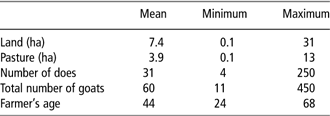
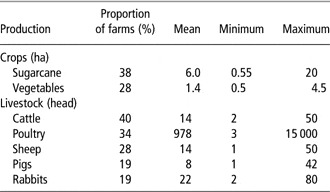
The farms visited showed a great diversity of production systems, from zero grazing to extensive systems (Table 1). The number of goats varied between 11 and 450. On average, 1.4 people worked on the farm. Non-familial labour was hired only on the largest farms. Nine percent of the farmers relied solely on goat farming. Other farmers had either off-farm activities (50%) or other vegetal or animal production (Table 2). They often grew sugarcane or vegetables. Some of them reared cattle, poultry, sheep, pigs or rabbits.
General attributes of farms keeping goats in properties surveyed in Guadeloupe

Crop areas and livestock numbers of farms keeping goats surveyed in Guadeloupe

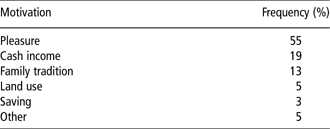
The most important reason given for keeping goats was the pleasure in rearing them (Table 3). This reason was ranked higher (P < 0.01) than the reason related to income. Many farmers (60%) wanted to increase their goat herd. Some others wanted to increase their sheep herd, mostly Martinik sheep, a tropical hair sheep breed imported from Martinique, the neighbouring French island. The PCA showed a negative correlation between the number of sheep and the number of goats reared in the farm.
Main reason given by surveyed goat breeder for keeping goats on farms in Guadeloupe

Breeds and desired traits
The Creole goat has been crossed with the imported meat breed like the Boer or Anglo-Nubian and also the milk breeds like the Saanen and Alpines. Mating being mostly uncontrolled, it was impossible to determine the exact origin of a crossbred animal. That is why in this study these animals will only be referred to as ‘crossbred’. A small number of farmers kept only Creole goats (4%) whereas one-third of them (34%) reared only crossbred goats. The majority had a mixed herd (62%) of Creole and crossbred animals. Among these farmers, 13% joined crossbred bucks to Creole goats.
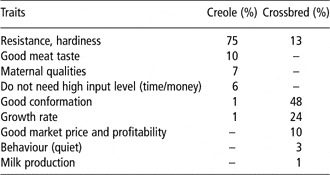
Most of the farmers appreciated the hardiness of the Creole goat (75%) (Table 4). Creole goats were also preferred for the quality of their meat (10%), maternal qualities (7%) and low input level (6%). However, farmers practised crossbreeding for the better conformation (48%), higher growth rate (24%) and market price (10%) reached by crossbreds.
Traits identified by respondent farmers as the individual most desired characteristic in Creole and crossbred goats in a survey carried out in Guadeloupe

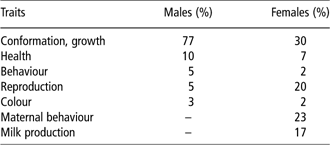
The desired traits for goat selection are given in Table 5. Conformation and growth are largely the most desired traits for males (77% of the answers). They are also important for females (answer frequency 30%). Nevertheless, maternal qualities (maternal behaviour, reproduction and milk production) were frequently cited and represented 60% of the desired traits for females. Health and disease resistance were poorly ranked.
Traits identified as most desired selection characteristic for goats in a survey of farmers in Guadeloupe

Identification and performance recording
Although goat identification was compulsory, it was not always applied. Only 45% of farmers put ear tags on all the animals. Other farmers (38%) identified kids late (few months old) or did not put any ear tag on the bucks because it decreased their value as a ceremonial buck. No identification occurred in 17% of the farms.
An important proportion of farmers (72%) records information on their goats, mainly about reproduction and veterinary treatments. The weight of animals is also measured by 55% of them, mostly on an irregular basis, at birth, weaning, before a sale or a veterinary treatment.
Breeding practices
Two-thirds of the farmers used only one breeding buck. The male was used for 25 months (±11) in the farm for an average of 17 does (±11). Breeding bucks were rented, bought or exchanged with other farmers. Mating practices were different among farmers. Most of the time (73%), farmers brought the buck in the breeding does’ herd and it stayed a limited time, on average 33 days (±27). In some cases (21%), the buck stayed permanently in the herd. Few farmers (6%) practised hand mating, and they were mostly small goat owners. Planned mating at a specific time of the year was done by 21% of the farmers. They tried to avoid kidding during the dry season (December to May) or during the heavy rains of September. First mating of females occurred at 12 months (±5.3), weaning of kids at 109 days (±34) and culling of does after 5 to 6 parities.
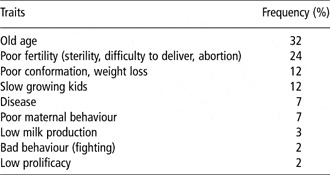
Culling reasons are described in Table 6. After the age (32%), the main culling reasons were poor fertility (24% of the total, 35% when the age criteria are removed), conformation and kid growth (12% of the total each, 18% when the age criteria are removed), and to a lesser extent disease and poor maternal behaviour (7% of the total each, 10% when the age criteria are removed). The answers were consistent with the farmer’s opinion about the desired traits for goat selection for females. They emphasise the importance of maternal qualities, (fertility, kid growth and milk production, maternal behaviour), which represent 45% of the culling reasons (66% of the criteria other than age).
Principle reasons for culling does in goats herds in the farms surveyed in Guadeloupe

Feed management and animal health
All goat herds grazed on natural pastures, except in two farms that practised zero-grazing. One-third of the farmers used the rotational grazing system. Goats stayed for 12 days (±10) on a paddock and then changed to 1 of the 5 (±1.7) others.
Three-quarters of the farmers gave manufactured aliments (pellets) to their goats. However, the quantities and categories of the animal to which they were given changed a lot from one farm to another. Crop residues were also used for feeding goats.
Three-quarters of the farmers drenched the whole herd against gastrointestinal nematodes (GIN) every 2 months (±1.5). Some of them were drenched fortnightly. They found it difficult to space out the treatments.
Selling
Goats were sold alive, mainly to individuals. One-year-old males were sold for consumption or rearing, and adult bucks were sold for ceremonial or reproduction purposes. They could reach very high prices, especially for heavy crossbreds (from 200€ to 2000€ per animal). Meat prices were also very high (20€/kg of meat on average). Culled goats were sold to butchers or slaughterhouses through farmer organisations. Young breeding does were rarely sold even if there was a strong demand for high-quality breeding does.
Farm typology and willingness to join a selection programme
A typology of farmers was created taking 12 variables into account. The main characteristics of each group are described in Table 7. The aim of this typology was to describe the main surveyed goat farming system.
Typology of farms in a survey of goat farmers in Guadeloupe

1. Group 1 is composed of middle-sized farms. Breeders have off-farm activities. Management level is average. These farms do not have any marked characteristics.
2. Group 2 is made of big and traditional farms. Farmers are older, bigger landowners having big herds. They only work on the farm. Their management is traditional with low input. They have mainly Creole goats. They rear all goats together on the same pasture without any separation by sex.
3. Group 3 has extensive and highly diversified farms. Farmers are middle-aged. They want to increase their goat herd. Most of the land owned is devoted to pasture. Their level of diversification is very high. They grow sugarcane or vegetables and rear cattle or sheep.
4. Group 4 includes big and well-organised farms. Farmers are older and bigger landowners. They only work on the farm. They have mostly crossbred animals. Their input level is higher than in the other groups. Their management is optimal: they practise rotational grazing, separate the males and females, deliver proper health care, etc.
5. Group 5 is composed of small surface and highly specialised farms. Farmers are young. They all have off-farm activities. Their land area is very small, even if their herd is of good size. They feed their does with industrial pellets. Some of them practice zero grazing. They are specialised in animal production. Their management is optimal.
Once the typology had been made, the willingness of farmers to join a breeding programme was studied. According to their own opinion, farmers belonging to groups 1, 3 and 5 are the most interested in a selection programme and performance recording for goats, for 75%, 68% and 65%, respectively, of the farmers in each group. They represent 24 farmers in total.
Discussion
Guadeloupean goat farming
Guadeloupean farming systems were mostly based on grazing with a medium level of input. The goat farms surveyed had a small-sized herd compared to temperate countries. Animals were mostly crossbreds.
The present typology was consistent with the one made by Gau et al. (Reference Gau, Naves, Alexandre, Shitalou and Mandonnet2000), except that the smallest farms were excluded from our study. The average number of does per farm visited (31) was higher than the average six does per farm found in official counting. It can be explained by our sampling method. We focused on the largest farms that could potentially participate in a selection programme.
A few issues can limit the development of goat farming. First of all, there is a limited amount of time and money allocated to goat rearing. Goat farming was a complementary activity for most of the farmers and was not the main source of income. Farmers reared goats more for pleasure than for money. These results were quite different from those found in other tropical countries, where insurance and income were highly ranked as reasons for keeping goats (Jaitner et al., Reference Jaitner, Sowe, Secka-Njie and Dempfle2001; Dossa et al., Reference Dossa, Wollny and Gauly2007; Kosgey et al., Reference Kosgey, Rowlands, Van Arendonk and Baker2008). Second, goat stealing and wandering dog attacks discouraged farmers. Goat stealing can be linked to the very high demand for locally produced goat meat. This demand is not satisfied by the Guadeloupean production. Third, goats are in concurrence with sheep (as showed by the PCA). They both occupy the same niche and farmers tend to replace one species with the other.
Possible technical improvements
Some points could be improved to allow for more efficient production: earlier weaning date, shorter kidding interval, better feeding, etc. For example, delivering the recommended quantities of industrial pellets at the key moments (before delivery and during early lactation for does, during mating for bucks and does) and during fattening for the young males will help in more intensive production.
On-farm performance and genealogy recording are essential for the implementation of a selection programme. Some management improvement will be necessary for an easy and efficient recording mechanism. Identification of all animals of the herd will be needed. Grouping of mating and kidding will limit the number of visits of the performance recorders. Some of the farmers seem receptive to such practices, as they already have a record of some data on their flock. These farmers could easily join a selection programme.
Improved reproduction management should be advised in parallel with genetic improvement. First of all, inbreeding should be avoided. Separation of young males from the herd should happen early enough and for reproduction the buck should not be used too long. The choice of bucks and control of mating for selection will also serve this goal. The exchange, rent or purchase of bucks from other farmers or from a future selection nucleus flock should be encouraged and organised. Early first mating (BW below 16 kg) should be discouraged as it limits the growth of does.
Disease resistance does not appear to be an important trait for farmers. Health problems are involved in 7% of the culling (10% of the non-age reasons). It has been observed that GIN decrease herd productivity (Mandonnet et al., Reference Mandonnet, Menendez-Buxadera, Arquet, Mahieu, Bachand and Aumont2006 and Bishop and Morris, Reference Bishop and Morris2007). The prevalence of these nematodes reach 80% to 100% in Guadeloupe and they were responsible for 75% of the pre-weaning mortality (Aumont et al., Reference Aumont, Pouillot, Simon, Hostache, Varo and Barré1997). A good prophylaxis and health-care policy can increase farm productivity. A well-practised rotational grazing system also allows a good compromise between GIN charge and the quality of grass (Mahieu et al., Reference Mahieu, Archimède, Fleury, Mandonnet and Alexandre2008). Mahieu et al. (Reference Mahieu, Arquet, Kandassamy, Mandonnet and Hoste2007) showed that a better drenching policy, for example, using the Famacha© method (Bath et al., Reference Bath, Malan and Van Wyk1996) could be used in addition with selection to increase the genetic resistance of goats to GIN. This method reduces the frequency and number of drenching regimes, thus limiting the anthelmintic resistance in GIN. Training of veterinaries, technicians and farmers is carried out to encourage them to reduce the number of treatments. Farmers are not yet fully aware of the ways to control parasitism without anthelmintic. They underestimate the role played by the genetic resistance of goats to GIN. They believe anthelmintic to be the only solution and lack knowledge about the long-term costs and efficacy of this method.
Position of the Creole goat
Most of the farms used crossbred animals in various proportions. One-third used only crossbred animals. Very few farms (4%) raised only Creole goats. Many farmers preferred to use a heavy crossbred buck than a Creole one. Crossbred males were sold for reproduction at higher prices than Creole males, which were judged as ‘too small’. As in many other places in the tropics (Baker and Gray, Reference Baker and Gray2004), farmers perceived the local breed as ‘unimproved’, whereas larger breeds with a higher growth rate are assumed to be more productive (Alexandre et al., Reference Alexandre, Asselin de Beauville, Shitalou and Zebus2008).
Nevertheless, farmers recognised as valuable the rusticity and maternal qualities of Creole does. They preferred keeping Creole does to keeping Creole bucks. Unfortunately, they did not have any defined crossbreeding strategy, with elected sire and maternal lines. So even if they kept Creole does, they tended to replace them by crossbred young females. In Martinique, the neighbouring island, farmers were looking for good Creole does but had lost most of the maternal lineage by indiscriminate crossbreeding (Alexandre et al., Reference Alexandre, Leimbacher, Maurice, Domarin, Naves and Mandonnet2009). Guadeloupean farmers should become aware of the importance of pure-breeding for female renewal.
Ayalew et al. (Reference Ayalew, Rischkowsky, King and Bruns2003) demonstrated that, in opposition to a common belief, crossbred goats in Ethiopia did not generate more benefits than indigenous ones. The lower input needed by Creole goats, their good adaptability and reproductive traits, linked with an improved management, and maybe a special nice market, could probably generate as much benefit as crossbred goats. Ongoing studies on the meat-productive abilities of the Creole goat indicate that there is a scope for improvement of carcass weight and conformation (Liméa et al., Reference Liméa, Gobardham, Gravillon, Nepos and Alexandre2009). This breed could have a place for meat production, maybe in a niche market based on specific qualities of the product, in production systems that allow the expression of the potential of the breed. A special label for Creole goat meat is envisaged by professional organisations.
Creole goat selection programme
Cooperative and extension services in Guadeloupe are building a selection programme based on the local Creole goat. This survey confirms the feasibility of this development project. A nucleus of Creole goat breeders will conserve and improve the breed, whereas commercial farmers will use these goats as a maternal line for crossbreeding. This will solve problems of uncontrolled mating and loss of Creole maternal lineage.
Kosgey et al. (Reference Kosgey, Baker, Udo and Van Arendonk2006) assessed that failures of breeding programmes came mostly from the lack of involvement of farmers. However, in our case study, farmers were at the origin of the project. Therefore, the basis of the selection programme will be constituted by farmers of Cabricoop. They are the most organised and are already benefiting from a good technical follow-up. About 12 farmers could possibly be retained for breeding and selecting Creole goats. Their 310 does would constitute the nucleus herd. This population size is sufficient; Baker and Gray (Reference Baker and Gray2004) recommended a minimum of 150 females for 5 males. The selected farmers come mainly from groups 1, 3 and 5, and have expressed a strong willingness to join a selection programme. The other farmers of these groups are more interested in buying Creole does for terminal crossbreeding with Boer bucks or other genotypes. Farmers of the groups two and four are not suitable for the selection programme, unless they modify some of their practices. Farmers of group two could have been involved if they had wished to. They have the biggest herd with Creole goats. Thus, they remain very important for breed conservation. However, at present, their structure and management does not allow the implementation of an inventory and performance recording. Farmers of group four refused to use Creole goats, and kept themselves outside the programme.
Possible traits to include in a selection objective
Farmers have defined the traits they consider as important. They focused on the conformation and growth traits for males and females and on maternal qualities for females. Health was not seen as a desired trait. These results are consistent with those of Alexandre et al. (Reference Alexandre, Leimbacher, Maurice, Domarin, Naves and Mandonnet2009) for goats in Martinique, of Jaitner et al. (Reference Jaitner, Sowe, Secka-Njie and Dempfle2001) for West African Dwarf goats in Gambia and with those of Kosgey et al. (Reference Kosgey, Rowlands, Van Arendonk and Baker2008) for small ruminants in Kenya. They differed from the preference of the Djallonké goat breeder in Benin (Dossa et al., Reference Dossa, Wollny and Gauly2007) who considered as equally important reproduction, behaviour, health and meat production.
Creole goats show GIN resistance characteristics (Mandonnet et al., Reference Mandonnet, Aumont, Fleury, Arquet, Varo, Gruner, Bouix and Khang2001) that farmers underestimated. As pure exotic breeds were rare, farmers did not have any comparison, and therefore this trait was probably taken for granted. Wurzinger et al. (Reference Wurzinger, Ndumu, Baumung, Drucker, Okeyo, Semambo, Byamungu and Solkner2006) observed the same situation in Ankole cattle, where farmers considered its disease resistance as given. Lack of objective data and comparison between breeds can also be an explanation. Gicheha et al. (Reference Gicheha, Kosgey, Bebe and Kahi2007) showed that a breeding programme including GIN resistance for Kenyan sheep could give good economic and genetic results. Selection of Creole goats on GIN resistance is possible (Mandonnet et al., Reference Mandonnet, Menendez-Buxadera, Arquet, Mahieu, Bachand and Aumont2006). This trait could therefore be included in the selection objective. Further discussion with professionals will take place about the cost of selection of this trait and its acceptance. Awareness of farmers on health issues should be raised, especially about the costs and unfavourable links with growth and survival.
A good balance should be found between production and fitness traits. The Creole goat should keep its good adaptation and maternal qualities and improve its growth. Further studies will be conducted to determine the selection objective. The biological traits influencing income and expenses will be identified and their economic values will be calculated.
Conclusion
By using a survey, goat farming systems were characterised. Farmers have small-sized herds and use a medium level of inputs. A typology describing the different systems in more detail was created.
The survey was also the first step in the implementation of a selection programme. The most desired characteristic for goats was determined by farmers. A precise inventory of the Creole base population and record of performance are now needed. A breeding objective with economic weighting should also be defined in order to equilibrate the relative importance given to each trait.
The development of a sustainable selection programme requires the integration of its social, economic and environmental components (Brundland, Reference Brundland1987). First, the programme should improve or at least maintain farm profitability . A technical follow-up linked with performance recording and a special label on the meat would be a useful tool. Second, farmers and farmer organisations should be involved from the beginning of the programme to ensure their cooperation. Third, the use and promotion of the local and well-adapted Creole goat will help maintain biodiversity and limit the risks of failure of the programme.
Acknowledgements
The authors thank the farmers, Cabricoop staff and small ruminant section of extension services for their unreserved participation and cooperation. This study was supported by ‘la Région Guadeloupe’ and the European Community (FEOGA).