INTRODUCTION
Driven by the need to diagnose and medicate parasite-induced diseases of humans, crops, farm animals, and wildlife, the phenomenon of parasitism has long been recognized and intensively studied on land. In contrast, parasites in marine ecosystems have received comparatively little attention so far (McCallum et al., Reference McCallum, Kuris, Harvell, Lafferty, Smith and Porter2004), although they are assumed to be of ecological and economic importance also in these environments. Intertidal vertebrates and invertebrates are known to harbour a wide range of macroparasites. Amongst these, digenean trematodes are the prevailing group (Mouritsen & Poulin, Reference Mouritsen and Poulin2002). Digeneans are exclusively endoparasitic and exhibit complex life cycles. The adult stage occurs and reproduces within the final host, which is usually a marine bird, fish or mammal. The parasite is transmitted to the first intermediate host, which is almost always a gastropod or bivalve, by the means of free swimming miracidia. Within the first intermediate host, miracidia develop into sporocysts or rediae, which asexually generate numerous cercariae and emit them into the environment. Cercariae invade the second intermediate host, which may be a marine mollusc, crustacean, fish or polychaete, where they encyst as metacercariae and await ingestion by the final host, which allows the completion of the life cycle. As a consequence of their complex life cycle, digenean trematodes influence a great variety of host organisms. Although they are assumed to play an important role in ecosystems, data on the species composition, spatial distribution and abundance of digenean trematodes originate from a limited number of shore localities. Studies on a broader geographical scale are largely missing. To evaluate the influence of parasitism on individual hosts, populations, communities, and ecosystems, further information is needed, which especially applies to widespread and abundant host species.
The edible cockle Cerastoderma edule (Linnaeus, 1758) is one of the most common soft sediment bivalves in European coastal waters and of commercial importance in some areas of its range. Reviews on the digenean trematodes found in edible cockles are available from the German Wadden Sea (Lauckner, Reference Lauckner1971; Thieltges et al., Reference Thieltges, Krakau, Andresen, Fottner and Reise2006), as well as the French (de Montaudouin et al., Reference de Montaudouin, Kisielewski, Bachelet and Desclaux2000; Lassalle et al., Reference Lassalle, de Montaudouin, Soudant and Paillard2007), Portuguese (Russell-Pinto et al., Reference Russell-Pinto, Gonçalves and Bowers2006) and Moroccan Atlantic coast (Gam et al., Reference Gam, Bazaїri, Jensen and de Montaudouin2008). In contrast, studies from the British Isles focused on individual digenean trematode species exploiting C. edule as first or second intermediate host (Bowers & James, Reference Bowers and James1967; Bowers, Reference Bowers1969; Sannia & James, Reference Sannia and James1978; Goater, Reference Goater1993); a review of the parasite community has not been published to date. The present study aimed to provide an inventory of the macroparasite fauna of C. edule on the south coast of Ireland.
MATERIALS AND METHODS
Study area
The south coast of Ireland mainly consists of rocky shores, interrupted by soft sediment habitats such as estuaries, creeks, coves, and beaches. Seasonal variation of water temperatures is relatively low with approximately 8°C in February and 15°C in August. Tides are diurnal, mean high water at spring tide ranges between 3.2 m (Schull Harbour) and 4.5 m (Waterford Harbour) above chart datum. For further information on coastal habitats in Ireland see Nairn (Reference Nairn2005).
Sampling
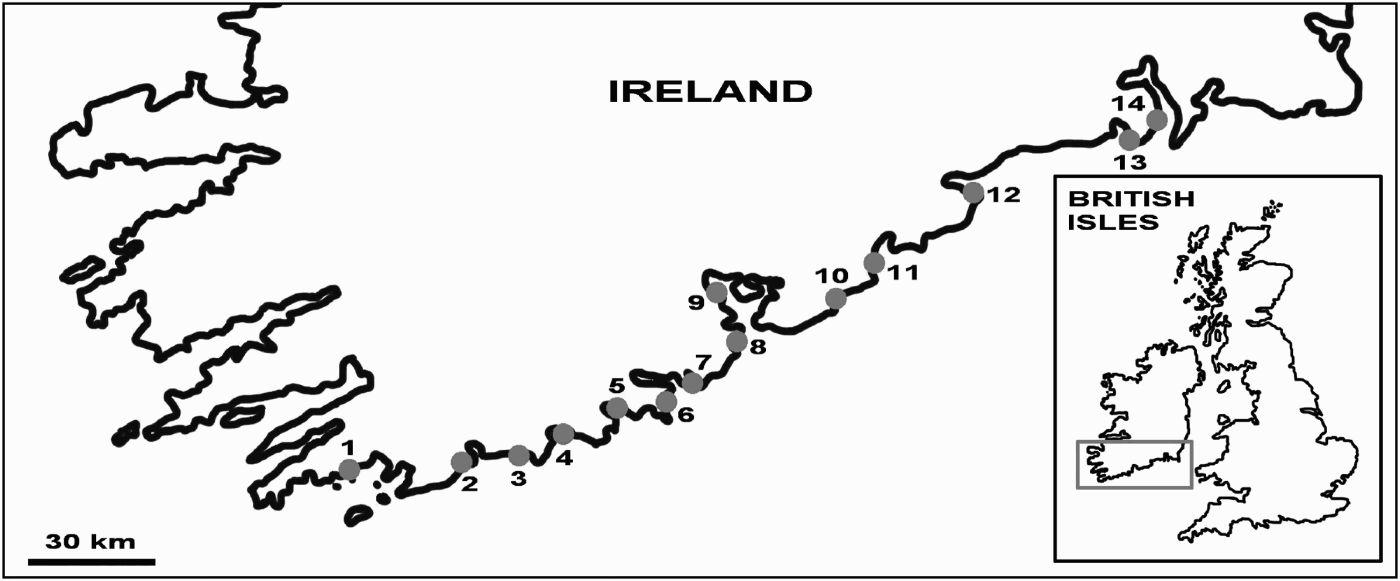
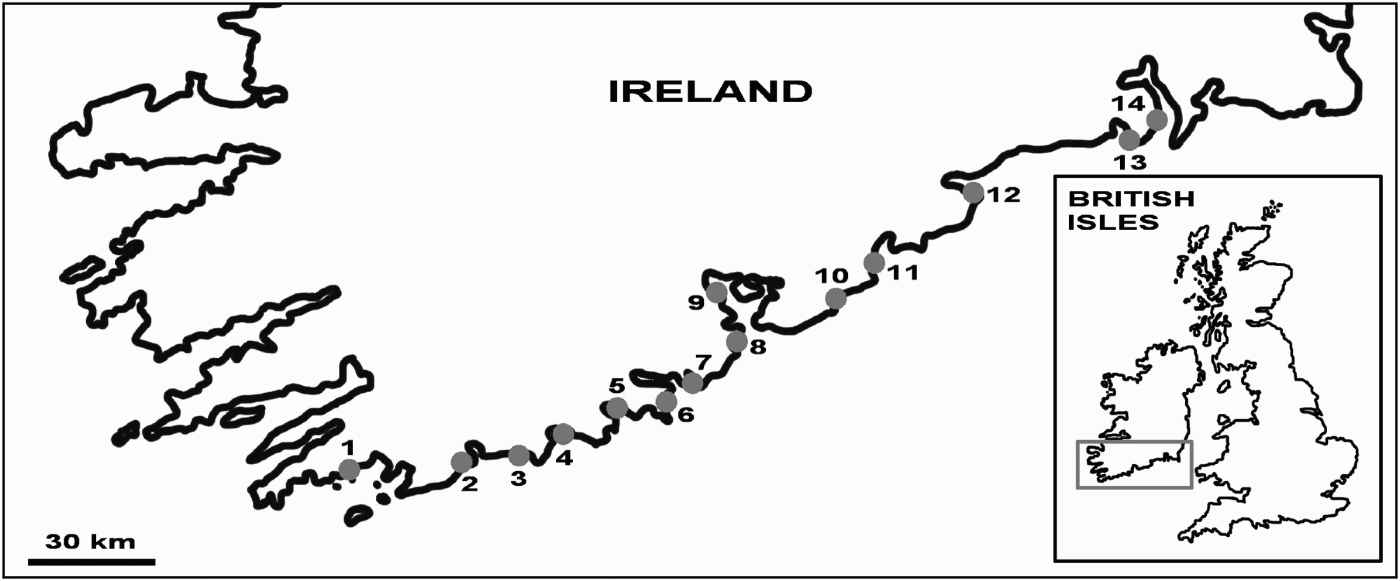
Edible cockles Cerastoderma edule were collected from fourteen locations along the south coast of Ireland in July 2007 (Figure 1; see Table 1 for coordinates). All stations were located in the upper intertidal zone. At each sampling site, the density of C. edule was determined over an area of approximately 100 m2 within ten randomly placed 0.25 m2-quadrats by sieving the upper 10 cm of sediment through a 10-mm mesh. Furthermore, abundances of gastropod and bivalve species known to serve as first intermediate host to digenean trematodes exploiting cockles as second intermediate host were determined. Whilst numbers of common periwinkles Littorina littorea (Linnaeus, 1758), Baltic tellins Macoma balthica (Linnaeus, 1758), and peppery furrow shells Scrobicularia plana (da Costa, 1778) present within each quadrat were counted, density of mudsnails Hydrobia ulvae (Pennant, 1777) was estimated from two sediment subsamples (13.85 cm2 each) randomly taken within each quadrat and sieved through a 1-mm mesh. If available, 50 C. edule individuals were taken haphazardly from the sieve. At sites with low cockle densities, additional specimens were collected using the same procedure as described above in order to obtain sufficient samples. Cockles were transferred to the laboratory and stored deep frozen until parasitological analysis.
Map of the study area including the fourteen sampling sites  on the south coast of Ireland: (1) Schull Harbour; (2) Castle Haven; (3) Rosscarbery Bay; (4) Clonakilty Harbour; (5) Courtmacsherry Bay; (6) Sandy Cove Creek; (7) Oysterhaven; (8) Ringabella Creek; (9) Cork Harbour; (10) Ballycotton Bay; (11) Youghal Bay; (12) Dungarvan Harbour; (13) Tramore Bay; (14) Waterford Bay.
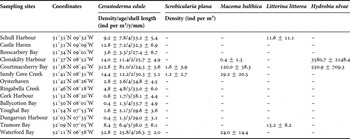
Density (individuals per m2), age (years), and shell length (mm) of Cerastoderma edule sampled from fourteen shore locations on the south coast of Ireland as well as density (individuals per m2) of bivalve and gastropod species serving as first intermediate host to digenean trematodes using C. edule as second intermediate host at the sampling sites. Density and shell length are given as mean ± SD. Age is given as median.

Analysis
In the laboratory, cockle shell length was measured to the nearest 0.1 mm and number of winter rings was counted. To extract metacercariae of the digenean trematode Meiogymnophallus minutus (Cobbold, 1859), which occur unencysted in the wedge-shaped cavity beneath the hinge and surrounding space in C. edule (Bowers et al., Reference Bowers, Bartoli, Russell-Pinto and James1996), ligament and adductor muscles were severed using a scalpel and the left shell valve was detached. Opened cockles were screened for infections using a stereomicroscope with incidental illumination. If present, the frozen mass of metacercarial stages enveloped by host mantle epithelium was transferred to a pressure glass provided with a counting grid and parasites were counted under a transmitted light stereomicroscope. Notes were made on the incidence of hyperparasitism of M. minutus metacercariae by the pathogenic microsporidian Unikaryon legeri (Dollfus, 1912). The dissection technique described above also allowed detection of Labratrema minimus (Stossich, 1887) infections, since daughter sporocysts occurring in the haemolymph of the digestive gland are visible after removal of one shell valve. To survey the remaining macroparasite fauna, the entire soft tissue of 20 cockles per sampling site, randomly selected from the sample, was removed from the shell, squashed using two thick glass slides and screened for infections. Parasites were identified according to Loos-Frank (Reference Loos-Frank1967, Reference Loos-Frank1968), Werding (Reference Werding1969), and Lauckner (Reference Lauckner1971, Reference Lauckner and Kinne1983). The usage of parasitological terms in this paper follows suggestions made by Bush et al. (Reference Bush, Lafferty, Lotz and Shostak1997). Prevalence of infection (number of hosts infected with a particular parasite species divided by the number of hosts examined) as well as intensity of infection (number of individuals of a particular parasite species in a single infected host) was determined. We did not attempt to quantify infection levels of trematodes exploiting C. edule as first intermediate host. Mean prevalence of infection refers to the average prevalence of a particular parasite at all sampling sites. Mean intensity was calculated by dividing the total number of individuals of a particular parasite species by the number of infected individuals at the respective locality. Total mean intensity refers to the average intensity of a particular parasite at all sampling sites where infections occurred.
RESULTS
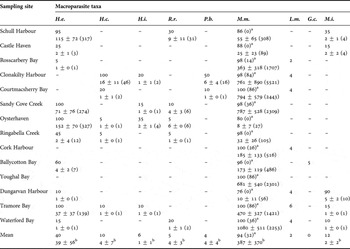
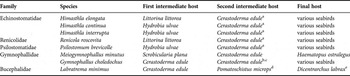
Cockle densities and age structure of the populations differed considerably between sampling sites. Gastropod and bivalve first intermediate hosts of trematode species using Cerastoderma edule as second intermediate host were absent from most of the investigated localities (Table 1). Parasitic infections were present in all cockle populations. Macroparasite species richness ranged between one and six species per site. Overall, ten taxa belonging to three major groups were identified, eight of which were digenean trematodes (Table 2). Amongst the digeneans, species exploiting the edible cockle as second intermediate host were prevailing (Table 3). The gymnophallid Meiogymnophallus minutus was the most widespread parasite by far. Prevalence of this species was high in all samples with almost every screened C. edule showing a metacercarial infection. Intensity of infection was extremely variable within as well as between sampling sites and very high at some stations. The microsporidian hyperparasite Unikaryon legeri occurred in more than half of the locations, but was absent from all cockle populations with relatively low M. minutus infection levels (Table 2).
Prevalence of infection (%; given in first row), mean intensity ± SD (mean number of parasitic stages per host; given in second row), and maximum number of parasitic stages per host (in parentheses; given in second row) of macroparasites found in cockles Cerastoderma edule sampled from the south coast of Ireland. Trematoda: H.e., Himasthla elongata; H.c., H. continua; H.i., H. interrupta; R.r., Renicola roscovita; P.b., Psilostomum brevicolle; M.m., Meiogymnophallus minutus; L.m., Labratrema minimus; G.c., Gymnophallus choledochus. Copepoda: M.i., Mytilicola intestinalis. Intensity of infection was not determined in digenean trematodes using C. edule as first intermediate host, namely L. minimus and G. choledochus.

a, proportion (%; in parentheses) of infected cockles which harboured metacercariae hyperinfected by Unikaryon legeri; b, total mean intensity (see ‘Materials and Methods’ for definition).
Intermediate and final hosts of the digenean trematode species found in Cerastoderma edule on the south coast of Ireland.

a, and other bivalve species, e.g. Mytilus edulis or Macoma balthica; b, ‘winter cycle’; c, alternatively polychaetes, e.g. Nereis spp., Nephtys spp. or Arenicola marina (‘summer cycle’); d, and other fish species, e.g. Pomatoschistus minutus or Atherina boyeri; e, and other fish species, e.g. Conger conger or Lophius piscatorius. Sources: Loos-Frank (1967, 1968); Bowers (Reference Bowers1969); Frank (Reference Frank1969); Werding (Reference Werding1969); Bowers et al. (Reference Bowers, Bartoli and James1990); Faliex & Morand (Reference Faliex and Morand1994); Malek (Reference Malek2001).
The copepod Mytilicola intestinalis Steuer, 1902 was found either as larval or adult stage in five out of 14 shore localities (Table 2). Turbellarians belonging to the genus Paravortex Wahl, 1906 were noticed in some C. edule from Sandy Cove Creek screened alive right after sampling, but not during later parasitological analyses of frozen samples. It appears that distinctive features of this parasite are destroyed by the storage of cockles in the freezer and thus further infections have probably been missed by us. Therefore, this study only refers to the incidence of Paravortex sp. in cockles from the Irish south coast without providing further information on species identity or infection rates and levels.
DISCUSSION
Whilst parasitological surveys are usually restricted to small geographical areas, the present investigation provides information on a comparatively large scale. The fact that most macroparasites were present only at some of the sampling sites stresses the necessity to include a larger number of shore locations in a survey to cover the entire regional parasite fauna. The vast majority of macroparasites found in Cerastoderma edule from the Irish south coast were digenean trematodes, which is in agreement with the assumption that, among the metazoans, trematodes are the most common parasites of intertidal animals (Mouritsen & Poulin, Reference Mouritsen and Poulin2002).
Altogether, 16 digenean trematodes belonging to seven families are known to exploit C. edule (de Montaudouin et al., Reference de Montaudouin, Thieltges, Gam, Krakau, Pina, Bazaїri, Dabouineau, Russell-Pinto and Jensen2009), eight of which were found by the present study. Digeneans using the edible cockle as first intermediate host were less frequent than those using it as second intermediate host, which is concordant with the findings of de Montaudouin et al. (Reference de Montaudouin, Kisielewski, Bachelet and Desclaux2000), Russell-Pinto et al. (Reference Russell-Pinto, Gonçalves and Bowers2006), Thieltges et al. (Reference Thieltges, Krakau, Andresen, Fottner and Reise2006), and Gam et al. (Reference Gam, Bazaїri, Jensen and de Montaudouin2008). It supports the assumption that metacercarial infections are prevailing in marine bivalves compared to infections caused by sporocysts (Sousa, Reference Sousa1991).
We did not detect any parasite species that have not been described previously from C. edule. With the exception of Himasthla continua Loos-Frank, Reference Loos-Frank1967, which has only been found by the present study, the digenean trematode community of cockles on the south coast of Ireland turned out to be identical to the one recently reported from Dublin Bay on the Irish east coast (see de Montaudouin et al., Reference de Montaudouin, Thieltges, Gam, Krakau, Pina, Bazaїri, Dabouineau, Russell-Pinto and Jensen2009). Furthermore, the list of digeneans resulting from our survey is similar to the one available from the German Wadden Sea (Thieltges et al., Reference Thieltges, Krakau, Andresen, Fottner and Reise2006). In addition to the species that we have listed, the review of Thieltges et al. (Reference Thieltges, Krakau, Andresen, Fottner and Reise2006) mentioned Monorchis parvus Looss, 1902 and Gymnophallus gibberosus Loos-Frank, 1971. The former parasite species appears to be a rather rare digenean trematode in central Europe (de Montaudouin et al., Reference de Montaudouin, Thieltges, Gam, Krakau, Pina, Bazaїri, Dabouineau, Russell-Pinto and Jensen2009). Higher infection rates have only been reported from northern Europe, where the parasite has induced mass mortalities within host populations (Jonsson & André, Reference Jonsson and André1992). However, since M. parvus is known from Great Britain (Sannia & James, Reference Sannia and James1978), it probably also appears infrequently in Ireland. In contrast, G. gibberosus, which uses Macoma balthica as first intermediate host, has exclusively been found in the German Wadden Sea and Baltic Sea so far. This is presumably due to the fact that the final host, the eider duck Somateria mollissima (Linnaeus, 1758), breeds in northern Europe (de Montaudouin et al., Reference de Montaudouin, Thieltges, Gam, Krakau, Pina, Bazaїri, Dabouineau, Russell-Pinto and Jensen2009).
Compared to our findings and those of Thieltges et al. (Reference Thieltges, Krakau, Andresen, Fottner and Reise2006), the digenean trematode fauna in C. edule from southern Europe and northern Africa shows some distinct differences with the digeneans Diphtherostomum brusinae (Stossich, 1889), Himasthla quissetensis (Miller & Northup, 1926), Curtuteria arguinae Desclaux, Russell-Pinto, de Montaudouin & Bachelet, 2006, and Meiogymnophallus fossarum (Bartoli, 1965) exclusively reported from these latitudes. While the restricted geographical distribution of D. brusinae and H. quissetensis can be explained by the absence of their first intermediate host Nassarius reticulatus (Linnaeus, 1758) from northern intertidal flats (de Montaudouin et al., Reference de Montaudouin, Thieltges, Gam, Krakau, Pina, Bazaїri, Dabouineau, Russell-Pinto and Jensen2009), the gymnophallid M. fossarum is regarded as a Lusitano–Mediterranean species (Russell-Pinto & Bartoli, Reference Russell-Pinto and Bartoli1992). The first intermediate and final hosts of C. arguinae are still unknown (Desclaux et al., Reference Desclaux, Russell-Pinto, de Montaudouin and Bachelet2006). Therefore, the latitudinal distribution of this species remains unexplained.
Apart from Meiogymnophallus minutus, trematode infection rates and levels were generally low along the entire Irish south coast when compared with the Wadden Sea (Thieltges et al., Reference Thieltges, Krakau, Andresen, Fottner and Reise2006). This is presumably due to the fact that numbers of migratory birds acting as final hosts to many digeneans are much lower here than in the Wadden Sea, where millions of waders congregate in spring and autumn. Both Hechinger & Lafferty (Reference Hechinger and Lafferty2005) and Fredensborg et al. (Reference Fredensborg, Mouritsen and Poulin2006) demonstrated a positive correlation of trematode frequency in the first intermediate host with the abundance of the avian final host. Prevalence of infection in the first intermediate host in turn is known to be a major determinant of infection rates and levels in the second intermediate host. Our study revealed gastropods serving as first intermediate host to digenean trematodes using cockles as second intermediate host such as Littorina littorea and Hydrobia ulvae to be absent from the majority of sampling sites, which also explains low numbers of metacercariae in C. edule from the Irish south coast. The fact that metacercariae of particular parasite species were found at stations where the respective first intermediate hosts were not present (e.g. Himasthla elongata (Mehlis, 1831) infections in cockles from Sandy Cove Creek despite the absence of L. littorea from our quadrats) indicates the ability of cercariae to disperse over considerable distances (de Montaudouin et al., Reference de Montaudouin, Wegeberg, Jensen and Sauriau1998). The absence of certain parasite species from shore locations where the respective upstream host was discovered by us (e.g. absence of Renicola roscovita (Stunkard, 1932) metacercariae from C. edule from Tramore Bay despite the high abundance of L. littorea at this site) demonstrates that presence of the first intermediate host is, although an essential requirement in a parasite's life cycle, not the only factor controlling the incidence of metacercarial infections.
The digenean trematode M. minutus proved to be widely distributed and prevalent in all of the sampled localities along the south coast of Ireland. Almost every cockle examined harboured metacercarial infections of the gymnophallid. However, we found distinct differences in infection levels between sampling sites, with some localities exhibiting rather low and others very high intensities. Such a pattern is commonly observed in digenean trematode parasitism (Mouritsen & Poulin, Reference Mouritsen and Poulin2002). A range of factors has been shown to determine spatial heterogeneity in the occurrence of metacercarial infections, of which the frequency of the first intermediate host is of particular importance (Thieltges & Reise, Reference Thieltges and Reise2007; Thieltges et al., Reference Thieltges, Hussel, Hermann, Jensen, Krakau, Taraschewski and Reise2008). We have found Scrobicularia plana, the first intermediate host of M. minutus, only at two sampling sites and in very low densities, although the high prevalence of metacercarial infections in cockles indicates the presence of peppery furrow shells at all investigated shore locations. This is most likely due to the fact, that S. plana prefers muddy substrates and usually does not occur sympatrically with C. edule. Therefore it is not possible to correlate the current results on intensity of M. minutus metacercariae in cockles with S. plana abundances. In addition to first intermediate host density, host size (de Montaudouin et al., Reference de Montaudouin, Wegeberg, Jensen and Sauriau1998; Jensen et al., Reference Jensen, Castro and Bachelet1999; Fermer et al., Reference Fermer, Culloty, Kelly and O'Riordan2009), age (Thieltges, Reference Thieltges2008; Fermer et al., Reference Fermer, Culloty, Kelly and O'Riordan2009), and condition (Mouritsen et al., Reference Mouritsen, McKechnie, Meenken, Toynbee and Poulin2003) have been demonstrated to influence infection levels in host populations. Mouritsen et al. (Reference Mouritsen, McKechnie, Meenken, Toynbee and Poulin2003) identified abundance of the second intermediate host itself as an additional important factor determining the spatial distribution of metacercarial infections. Compared with figures reported from other European shores (Portugal, Germany and France) by Russell-Pinto (Reference Russell-Pinto1990), Thieltges et al. (Reference Thieltges, Krakau, Andresen, Fottner and Reise2006), and Lassalle et al. (Reference Lassalle, de Montaudouin, Soudant and Paillard2007), M. minutus infection levels were very high on the south coast of Ireland. Hundreds to thousands of metacercariae per host individual were counted regularly. Although such numbers are rather unusual for digenean trematode infections in the second intermediate host in general, they have been reported from M. minutus before (Goater, Reference Goater1993; Gam et al., Reference Gam, Bazaїri, Jensen and de Montaudouin2008; de Montaudouin et al., Reference de Montaudouin, Thieltges, Gam, Krakau, Pina, Bazaїri, Dabouineau, Russell-Pinto and Jensen2009; Fermer et al., Reference Fermer, Culloty, Kelly and O'Riordan2009). It appears that the gymnophallid is able to exhibit very high infection rates and levels where conditions are favourable (e.g. at localities with high abundances of the first intermediate host). This apparently applies to shores of the British Isles (Goater, Reference Goater1993; Fermer et al., Reference Fermer, Culloty, Kelly and O'Riordan2009; this study) as well as the Moroccan Atlantic coast (Gam et al., Reference Gam, Bazaїri, Jensen and de Montaudouin2008; de Montaudouin et al., Reference de Montaudouin, Thieltges, Gam, Krakau, Pina, Bazaїri, Dabouineau, Russell-Pinto and Jensen2009). In Courtmacsherry Bay for example, M. minutus is remarkably abundant with almost 250,000 metacercariae per m2 (mean C. edule density at the site multiplied by the mean intensity of metacercarial infections; this study). Both density of S. plana (~200 individuals per m2; personal observation) and prevalence of M. minutus daughter sporocyst infections in the host population (~20%; personal observation) are very high in some parts of the bay, and presumably account for much of the parasite abundance.
The present study revealed hyperparasitism of M. minutus metacercariae by Unikaryon legeri to be a widespread phenomenon on the Irish south coast. Remarkably, the hyperparasite predominantly appeared in heavily infected cockle population and was missing in those sampling sites where M. minutus infection levels were low. It appears that spores of U. legeri are more likely to establish in Cerastoderma edule harbouring a large population of M. minutus metacercariae.
ACKNOWLEDGEMENTS
The authors are grateful for the comments of two anonymous referees. Jan Fermer received funding from The Embark Initiative, operated by the Irish Research Council for Science, Engineering and Technology (IRCSET).