Peter Sellars’s 1996 staging of Handel’s Theodora at Glyndebourne has become one of the most highly praised opera productions of recent decades – perhaps paradoxically, since Theodora is not an opera, of course, but an oratorio. Very sadly, its renown has become even greater since the death in 2006 of mezzo-soprano Lorraine Hunt Lieberson, who sang the part of Irene: no obituary failed to mention her interpretation of this secondary character, who for many became the emotional axis of the drama precisely thanks to the searing intensity of Hunt Lieberson’s singing and acting. In fact, Glyndebourne’s Irene is probably the portrayal most frequently cited and enthusiastically applauded in discussions of Hunt Lieberson’s art and career. In a widely disseminated tribute, American critic Alex Ross wrote that she ‘rose to fame in Europe in the mid-nineties, mainly on the strength of an instantly legendary performance in Sellars’s production of Handel’s Theodora at the Glyndebourne Festival’.Footnote 1
In all likelihood, though, only a few among those who have contributed in writing to the fame of Sellars’s Theodora and Hunt Lieberson’s Irene actually saw them in the theatre.Footnote 2 Instead, they have seen it on video, as have the many who have expressed their (often exalted) appreciation of the production or Hunt Lieberson’s Irene to me personally, including several dozen students at the institution where I teach. Channel 4 broadcast Theodora live in Britain on 15 June 1996, while a VHS was released by NVC Arts only four months later, with DVD and Blu-ray formats also appearing as they became widespread over the following years. It was only thanks to Channel 4 and NVC Arts’ speedy action, therefore, that Hunt Lieberson’s interpretation of Irene could become legendary ‘instantly’, and that Sellars’s production has been able to rise to such notable fame. Yet most of those who have discussed them in writing never mention this simple fact, which is all the more remarkable since – as is usually the case with Sellars – he is credited with directing the video himself.Footnote 3
In what follows I will discuss a segment of this video, Irene’s Act I aria ‘As with rosy steps the morn’, in order to suggest that the video itself, far from functioning merely as a mirror through which we can have direct access to Sellars’s production and Hunt Lieberson’s interpretation, actively constructs our experience of both. I have chosen this aria not only because it is often mentioned as the apex of Hunt Lieberson’s Irene, but also because here the video seems to highlight and at the same time to conceal its crucial role in particularly intriguing ways.
***
Irene sings ‘As with rosy steps the morn’ as an attempt to instil her fellow Christians with courage in the face of religious persecution in fourth-century Antioch:
As with rosy Steps the Morn
Advancing, drives the Shades of Night;
So from virtuous Toils well-borne,
Raise Thou our Hopes of endless Light.
Triumphant Saviour! Lord of Day!
Thou art the Life, the Light, the Way.
Handel’s setting of Thomas Morell’s text focuses on two main images: the advancing steps of morning, suggested by the steady pulse of quavers, and the rising of ‘our hopes’, evoked by the generally rising profile of the melody. All composerly effort seems to have gone into the A section of the da capo form, however: it is difficult to see any meaningful response to the text of the final couplet, ‘Triumphant Saviour!’, in the music for the corresponding B section, dispatched in just eight bars without a glimmer of triumph or light.Footnote 5 This is not unusual for Handel, who takes a range of approaches to the B section of his da capo arias: one is to use it as an occasion for a modicum of variety (here tonal, modal and partly melodic) before returning to the A section, with little regard for the text to be set. But this feature of ‘As with rosy steps the morn’ makes life even more difficult for a modern director, already challenged by the da capo form.
For the initial section, Sellars has Hunt Lieberson kneel at the front right-hand side of a shadowy stage, on which Theodora and the chorus stand motionless. At ‘Triumphant Saviour!’, however, the lighting grows noticeably brighter and Irene, who has stood up during the preceding ritornello, walks towards stage centre, where Theodora and the chorus also move. Irene’s gestures become more emphatic: arms outstretched and then raised above her head rather than palms covering her face, for example. It seems fair to say that here Sellars is responding to the text rather than the music, except that, at the fermata on the dominant immediately preceding the final note of the section, Hunt Lieberson launches into an elaborate and loud cadenza which goes higher than the written vocal line (up to a high G as opposed to an E), and which sounds exalted, indeed triumphant. Sellars makes this into the psychological turning point of his narrative: during the instrumental bridge back to the initial section Irene assumes the same position she had at the beginning of the aria, but this time she is shadowed by Theodora and the chorus, who then repeat her gestures throughout the da capo. They are very similar to those in the A section – including removing one’s palms from one’s eyes at the first enunciation of the word ‘light’ halfway through – but this time they feel rather different: they are now those of an entire community united in feeling and action, instead of an individual surrounded by motionless onlookers. Irene clearly knows that things have turned around and she has succeeded in imbuing her fellow Christians with her steadfast trust in their triumphant saviour, because her concluding cadenza is soft and low – that is to say, the opposite of her previous one.Footnote 6 Calm conviction has replaced excited fervour. A da capo aria, characterised by the return of the same, has been transformed by its staging into a tale of change. Like many other contemporary directors, then, Sellars has tried to smooth over the dramaturgical alterity of the da capo aria for the modern aesthetic of opera, which still prizes narrative continuity and the highest possible correspondence between represented time and performance time. In other words, he has dramatised ‘As with rosy steps the morn’, narrowing the gap between represented time and performance time, which is famously at its widest in this kind of number.
What does Sellars do when faced with the task of filming his own staging of this aria? The A section includes a couple of total shots of the stage, but most of it is taken up by an extraordinarily extended close-up of Hunt Lieberson’s face, lasting the whole seventy-five seconds of the second statement of the text. The B section is more varied in both types of shots and the rhythm of their succession, but the truly dramatic change comes with the da capo: although close-ups of Hunt Lieberson still dominate, they are constantly interrupted by close-ups or medium shots of chorus members or Dawn Upshaw as Theodora, most lasting only two seconds, and some even shorter – a far cry indeed from those seventy-five seconds during which the camera never leaves Hunt Lieberson’s face in the A section. In the context of the recent history of ‘live’ opera videos, which have tended to adopt a rather standardised approach, in which regularity and predictability dominate, what Sellars does in ‘As with rosy steps the morn’ is remarkable – and it must have been all the more so back in 1996, when Theodora was filmed. But how does the video interact with the staging?
In both cases the motion is from stasis to movement. Whereas the staging of the da capo can be described as a gestural variation on the A section, however, the video presents us with something radically different in the da capo, especially in terms of rhythm, now incommensurably faster and significantly less predictable than in the A section. There is something excited and indeed exciting, and perhaps even a little disorientating, about the video of the da capo, due mostly, I would argue, to its découpage – something which might not have characterised with equal force what happened on stage.Footnote 7 ‘Excitement’ is hardly a word one would associate with the music of ‘As with rosy steps the morn’, however, even if the text of the B section might seem to convey something like excitement, and Hunt Lieberson’s cadenza at its end supports this reading. At the same time, though, her second cadenza exhudes calm conviction instead, as I have suggested above.
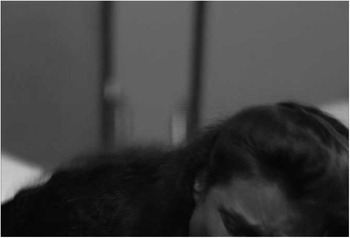
What Sellars does in the video of his own staging of ‘As with rosy steps the morn’, then, is to explore the interplay of different narrative levels which not only operate at different speeds, so to speak, but are also characterised by different emotions. The risk that this interplay might have turned into confusing discord should not be overlooked. That it does not is due in no small part both to Hunt Lieberson’s disarmingly intense dramatic and musical interpretation, and to the way Sellars films her. As she repeatedly bends forward, the camera must follow her movement in order to keep her face within the close-up shot; but several times it fails to move quickly enough, and for a moment Hunt Lieberson’s face slips partially out of the shot (Fig. 1).Footnote 8 Whether Sellars does this on purpose or not, the result is a feeling of improvisation, as if we were seeing the performance truly live, right at the moment when it is taking place, ‘mistakes’ and all. No wonder, then, that – however paradoxical this may seem – we tend to forget that this is a video, and that what happened in the theatre at Glyndebourne in June 1996 might have felt quite different – and also that, alas, Lorraine Hunt Lieberson has long slipped out of this world.
Lorraine Hunt Lieberson singing ‘As with rosy steps the morn’ in the video of Peter Sellars’s Theodora (Glyndebourne, 1996).