INTRODUCTION
The use of parasites as biological markers of fish stocks or populations, a methodology coined and developed in the field of fishery sciences, is ultimately based on the geographical distribution of parasites (Timi and MacKenzie, Reference Timi and MacKenzie2015). Indeed, fish can become infected with a parasite only when they come within the endemic area of that parasite, which is that geographic region where the conditions are suitable for a successful transmission and the completion of its life cycle (MacKenzie and Abaunza, Reference MacKenzie, Abaunza, Cadrin, Kerr and Mariani2013). These suitable conditions include environmental factors, mainly the temperature and salinity profiles, for marine organisms (Esch and Fernández, Reference Esch and Fernández1993), as well as the presence of all hosts involved in the parasite life cycle, which also should be at population densities large enough to sustain parasite populations and ensure transmission. A change in one of these factors, or of any combination of them along a geographic or environmental gradient, will produce a gradual shift of parasite prevalence or abundance and, if several species are considered simultaneously, of parasite assemblage structure and composition. This means that, from an ecological perspective, the reliability of parasites as biological tags is underpinned by the almost universal decay in the similarity of the species composition of assemblages as a function of increasing distance between them (Poulin and Kamiya, Reference Poulin and Kamiya2015).
Although the relationship between population structure studies, in a fishery context, and similarity decay with increasing distance, in a zoogeographical context, have been acknowledged in some papers on parasite tags (Timi et al. Reference Timi, Lanfranchi and Luque2010; Vales et al. Reference Vales, García, Crespo and Timi2011; Braicovich et al. Reference Braicovich, Luque and Timi2012), these two aspects of parasite distribution have usually been addressed independently in the literature. This is probably due to the spatial scales considered by each kind of study. Research on parasite tags tends generally to discriminate between neighbouring fish populations, and very few studies have used parasites as indicators of large scale zoogeographical patterns (Rohde, Reference Rohde2002). On the other hand, research on distance decay of similarity has focused on large spatial scales and in the factors influencing its strength (Soininen et al. Reference Soininen, McDonald and Hillebrand2007), especially when applied to marine fish (Poulin, Reference Poulin2003; Oliva and González, Reference Oliva and González2005; Pérez-del-Olmo et al. Reference Pérez-del-Olmo, Fernández, Raga, Kostadinova and Morand2009; Timi et al. Reference Timi, Lanfranchi and Luque2010).
Recently, based on studies on parasite tags over large spatial scales along south western Atlantic coasts and on their own data, Pereira et al. (Reference Pereira, Pantoja, Luque and Timi2014) proposed that the scope of parasite tags studies can be expanded from local to regional scales as indicators of ecoregions and of higher levels of biogeographic classifications. Similarly, Cantatore and Timi (Reference Cantatore and Timi2015) proposed that shifting the focus from fish/parasite populations to communities can provide information to delineate ecosystem boundaries for host communities. Here we analyze the usefulness of parasites of the Brazilian flathead Percophis brasiliensis (Quoy and Gaimard, 1824) as indicators of zoogeographical regions. This demersal species inhabits coastal waters in the south-western Atlantic, at depths generally not exceeding the 50 m isobath (Milessi and Marí, Reference Milessi and Marí2012). Its distribution extends from 23°S (Rio de Janeiro, Brazil) to 47°S (north of Santa Cruz Province, Argentina) (Cousseau and Perrotta, Reference Cousseau and Perrotta2004), a range over which the distribution patterns and endemisms of the biota have been utilized to describe a series of biogeographical units (realms, provinces, and ecosystems), although with different degrees of geographic resolution depending on the study (Spalding et al. Reference Spalding, Fox, Allen, Davidson, Ferdaña, Finlayson, Halpern, Jorge, Lombana, Lourie, Martin, McManus, Molnar, Recchia and Robertson2007; Menni et al. Reference Menni, Jaureguizar, Stehmann and Lucifora2010; Miloslavich et al. Reference Miloslavich, Klein, Díaz, Hernandez, Bigatti, Campos, Artigas, Castillo, Penchaszadeh, Neill, Carranza, Retana, Díaz de Astarloa, Lewis, Yorio, Piriz, Rodriguez, Yoneshigue-Valentin, Gamboa and Martín2011; Briggs and Bowen, Reference Briggs and Bowen2012).
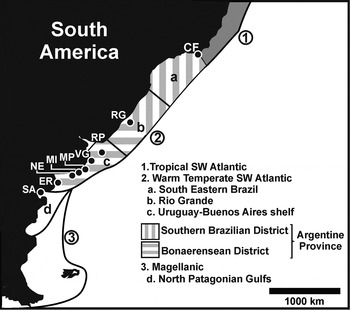
The study area of the present work covers near 3300 km of the coastal region of South America, between Rio de Janeiro and the northern Argentine Sea, which shows a continuous distribution of warm temperate fauna and has historically been characterized as the Argentine Biogeographical Province. It was recently renamed as the Temperate Western South Atlantic Province (Menni et al. Reference Menni, Jaureguizar, Stehmann and Lucifora2010) or Warm Temperate Southwestern Atlantic (Spalding et al. Reference Spalding, Fox, Allen, Davidson, Ferdaña, Finlayson, Halpern, Jorge, Lombana, Lourie, Martin, McManus, Molnar, Recchia and Robertson2007) (Fig. 1).
Map showing the sampling localities in the Southwestern Atlantic coast and their zoogeographical schemes. Numbers (1–3) and letters (a, b, c) show the biogeographic provinces and ecoregions, respectively, according to Spalding et al. (Reference Spalding, Fox, Allen, Davidson, Ferdaña, Finlayson, Halpern, Jorge, Lombana, Lourie, Martin, McManus, Molnar, Recchia and Robertson2007). Striped area shows the districts of the Argentine province according to Menni et al. (Reference Menni, Jaureguizar, Stehmann and Lucifora2010). CF, Cabo Frio; ER, El Rincón; MP, Mar del Plata; MI, Miramar; NE, Necochea; RG, Rio Grande; RP, Río de la Plata; SA, San Antonio Oeste; VG, Villa Gessel.

Percophis brasiliensis in the northern Argentine Sea shows a clear latitudinal population structure as indicated by its parasites (Braicovich and Timi, Reference Braicovich and Timi2008, Reference Braicovich and Timi2010), as well as for other methodologies (Avigliano et al. Reference Avigliano, Saez, Rico and Volpedo2015). In the present work, the distribution of parasites of P. brasiliensis is analysed in this region, where oceanographic conditions, dominated by strong gradients of temperature and salinity that determine fish parasite distributions (Cantatore and Timi, Reference Cantatore and Timi2015), provide a suitable scenario for studies on similarity decay over distance, a pattern already observed for a sympatric fish species in the region (Timi et al. Reference Timi, Lanfranchi and Luque2010). Similarity decay of parasite assemblages over distance is here analysed in relation to existing zoogeographical classifications derived from biological systems other than parasites.
The aim of this study is, therefore, to evaluate the utility of marine long-lived larval parasites as indicators of zoogeographical regions in the South West Atlantic, following the more recent zoogeographical classifications. We predict a similarity decay of parasite assemblages over distance, with departures from predicted values of similarity represented by more pronounced dissimilarities between samples coming from different zoogeographical regions than those caught within the same region, independently of the distance separating them; therefore zoogeographical regions may be identifiable in a distance-decay context.
MATERIALS AND METHODS
Fish and parasites sampling
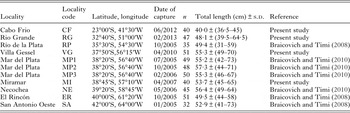
The dataset comprises the parasite communities of 11 samples of P. brasiliensis from nine localities in the south-western Atlantic, covering the entire distribution of the species in the Argentinean Zoogeographical Province (Menni et al. Reference Menni, Jaureguizar, Stehmann and Lucifora2010) (Fig. 1) and including a total of 488 fish. Data from southern zones, in Argentine and Uruguayan waters, were obtained from previous studies, which aimed to use parasites as indicators for discriminating among fish populations (Braicovich and Timi, Reference Braicovich and Timi2008, Reference Braicovich and Timi2010); therefore, there are significant differences among some of them, whereas samples caught seasonally in the same locality were homogeneous in terms of parasite loads. Four new samples were included in the analyses, two from Brazilian waters and two from Argentine waters. The datasets are summarized in Table 1.
Composition of samples of Percophis brasiliensis in nine localities, ordered by latitude, of the South Western Atlantic

Fish were either kept fresh or deep frozen in plastic bags at −18 °C until examination. After thawing, the total length was measured (TL, cm). Parasites sampling procedures were as indicated in Braicovich and Timi (Reference Braicovich and Timi2008, Reference Braicovich and Timi2010).
According to their geographic location, samples were assigned to different biogeographic districts of the Argentine Province: those from Cabo Frio (CF) belong to the Southern Brazilian district, although located in the northern boundary with the Brazilian Province. All samples from the Argentine Sea belong to the Bonaerensean district, with the southern one coming from an ecotonal zone in the limit with the Magellanic Province. The sample from Rio Grande do Sul corresponds to the boundary between the Bonaerensean and Southern Brazilian districts (Menni et al. Reference Menni, Jaureguizar, Stehmann and Lucifora2010) or to the ecoregion named Rio Grande (RG) by Spalding et al. (Reference Spalding, Fox, Allen, Davidson, Ferdaña, Finlayson, Halpern, Jorge, Lombana, Lourie, Martin, McManus, Molnar, Recchia and Robertson2007).
Population and community descriptors
Prevalence and mean abundance for each parasite species in each locality, as well as species richness at infracommunity level were calculated following Bush et al. (Reference Bush, Lafferty, Lotz and Shostak1997). Species richness also was calculated after excluding short-lived parasites (i.e. larval stages living in the gut, adult endoparasites and ectoparasites), with long-lived species being represented by larval species found in tissues or body cavity. Long-lived parasites were selected for all subsequent analyses because samples were caught at different seasons and years and these parasite species, that persist for long periods or even for the entire life of hosts, are more reliable for proper comparisons, diminishing possible effects of seasons or other short-term temporal variations on parasite loads and allowing the locality effects to be more evident.
Similarity analysis
Similarity in parasite species composition was computed at component community and infracommunity levels. Both the Jaccard and Bray-Curtis similarity indices (qualitative and quantitative, respectively) (Magurran, Reference Magurran1988) were calculated between all possible pairs of hosts (infracommunities) from different zones, and those between each pair of localities were averaged. At the level of component communities, Bray-Curtis similarity indices were calculated on values of both prevalence and mean abundance between all possible pairs of samples.
Distance between pairs of host populations was calculated as the shortest linear distance between sampling localities obtained from a map, following the coast line below the 50 m isobath. For samples caught during research cruises and comprising several trawls, a central position was selected as locality; in the case of commercial catches, with no precise information on the capture sites, localities were selected as the point on the 50 m isobath closer to the landing port. Each parasite assemblage was used in more than one pairwise comparison, and consequently was not truly independent from distance in a statistical sense; furthermore, the most recent sample (Cabo Frio) was also the most distant from southern ones and it was composed of the smallest fishes. Therefore a possible relationship between distance and both date of capture and host size could result in an artefact due to these factors. For these reasons, the associations between similarity and geographic distance were tested using Partial Mantel tests implemented in the R package Ecodist package (Goslee and Urban, Reference Goslee and Urban2007). Separate models, including temporal and fish size differences as covariates, were constructed, each using 10 000 permutations of the dataset, this was because preliminary Mantel tests showed no relationship between temporal differences in captures and differences in fish size (r = 0·13, P > 0·05), however both variables were significantly related to geographic distance, with a higher correlation coefficient for size differences (r = 0·77, P < 0·01) than for temporal ones (r = 0·51, P = 0·03). For temporal variability, the number of months from the first sampling date was counted, whereas for differences in fish size between samples, Euclidean distances were calculated between sizes of all possible pairs of hosts from different samples and then data were averaged.
The decay in similarity of parasite communities as a function of geographic distances was assessed in all cases by plotting log-transformed similarity values against untransformed distances (Poulin, Reference Poulin2003) between all possible pairs of localities. Since the values of Jaccard and Bray-Curtis are different, similarity was converted to relative similarity, by expressing each value as a percentage of the maximum of all values obtained in each analysis. This way, the y-axis on all plots had the same scale, which allowed comparisons of decay relationships among dissimilarity indices as well as between infracommunities and component communities.
Departures from predicted regressions on distance decay of similarity are expected between parasite assemblages for two opposite reasons: (1) samples from different zoogeographical regions, especially those from close ones should be more different than predicted by the distance separating them and (2) samples from the same zoogeographical region, especially distant ones, should be more similar than predicted by the distance separating them. As a measurement of these departures, the residuals of each point (the difference between the observed value of the dependent variable and the predicted value) were calculated. All those observed values with residuals larger than 10 (an arbitrarily defined threshold, representing 10% of possible variation of similarity, which was converted to relative similarity, with a maximum 100%) were identified individually.
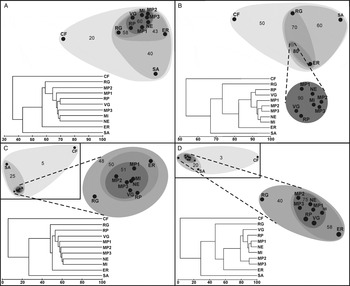
To corroborate the effectiveness of departures from expected values in the regressions as indicators of unexpected high similarity or dissimilarity in relation to the distance separating samples, nonmetric multidimensional scaling analyses (MDS) (Clarke and Gorley, Reference Clarke and Gorley2006) were performed to visualize the geographic patterns in the composition of parasite assemblages for the four datasets. In all cases, the fit of the MDS ordinations was quantified by a value of stress. Hierarchical agglomerative clustering of samples were applied to both averaged infracommunity similarities and component community similarities using group-average linking and the resemblance levels were overlaid on the MDS plots (Clarke and Gorley, Reference Clarke and Gorley2006).
All similarity and distance measures, as well as MDS and clustering analyses were implemented in PRIMER V6 and PERMANOVA+ for PRIMER package (Anderson et al. Reference Anderson, Gorley and Clarke2008).
RESULTS
General results
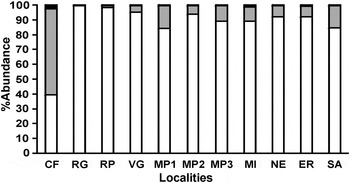
The parasite fauna of the four new samples of P. brasiliensis comprised 30 parasite species (Table 2), whereas a total species richness of 33 was recorded considering all the samples. A total of 471 144 metazoan parasites were counted, with a high proportion of them being represented by long-lived larval stages (439 211 specimens) belonging to 17 species; a smaller proportion, 30 455 individuals, were members of a short lived species complex, namely Scolex polymorphus, living in the gut; finally comparatively minor numbers of adult endoparasites (1344 specimens, 11 species) and ectoparasites (134 specimens, 4 species) were registered. These proportions were quite constant across samples, with the exception of flatheads from CF, where short-lived larval stages predominated numerically (Fig. 2).
Proportional contribution in terms of abundance of different parasite guilds to the assemblages parasitizing Percophis brasiliensis in 11 samples distributed along the south-western Atlantic coasts. Black: short-lived parasites (adult endoparasites + ectoparasites); grey: short-lived larval endoparasites (those living in the gut, such as larval cestodes); white: long-lived larval endoparasites. Locality codes as in Fig. 1.

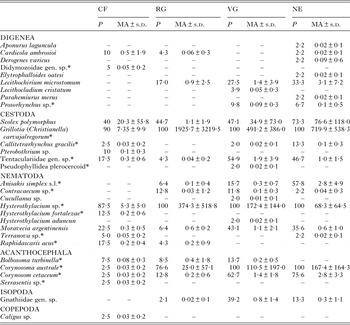
Taxonomic composition, prevalence (P) and mean abundance ± standard deviation (MA ± s.d.) of parasites of Percophis brasiliensis from four newly sampled localities in the South West Atlantic. Long-lived larval species are identified with an asterisk
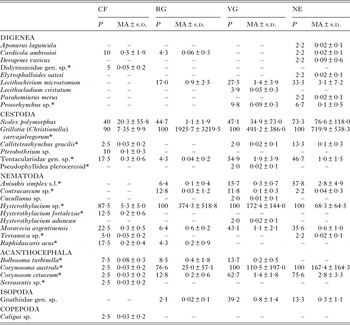
CF, Cabo Frio; RG, Rio Grande; VG, Villa Gessel; NE, Necochea.
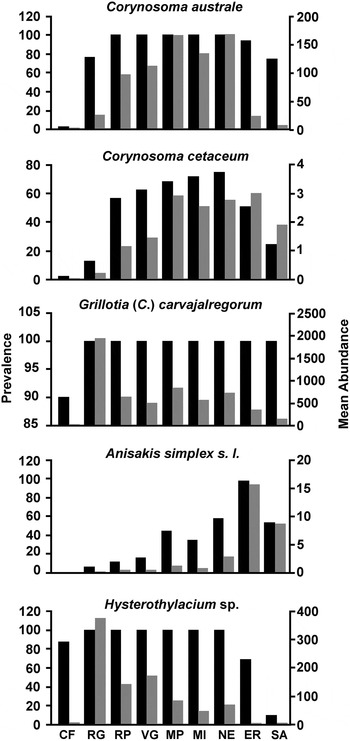
Parasite burdens, in terms of prevalence and mean abundance, varied among the component communities from the considered zones as exemplified by the most prevalent and abundant long-lived species (Table 2), with several species reaching higher loads in the northern Argentine waters, but other increasing either southwards (i.e. A. simplex s.l.) or northwards (i.e. Grillotia (Christianella) carvajalregorum and Hysterothylacium sp.) mainly in terms of abundance; fish from CF showed generally lower values of prevalence and abundance (Fig. 3).
Prevalence (black column) and mean abundance (grey column) of the most prevalent parasites of Percophis brasiliensis in nine samples (three samples from Mar del Plata averaged) distributed along the South Western Atlantic coasts. Locality codes as in Fig. 1.

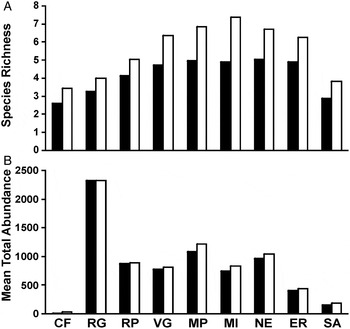
This spatial distribution of parasite species resulted in a bell-shaped distribution of species richness along the latitudinal range (Fig. 4a), a pattern also identifiable for long-lived species, although with more stable values across samples in the northern region of the Argentine Sea. The mean total abundance, irrespective of parasite species, showed a similar pattern with the exception of notably high values in RG (Fig. 4b). In this locality exceptionally high abundances were recorded for G. (C.) carvajalregorum and Hysterothylacium sp., for which maximum values of 16 604 and 3054 larvae were harboured respectively, by a single host.
Averaged descriptors of parasite infracommunities of Percophis brasiliensis in nine samples (three samples from Mar del Plata averaged) distributed along the south-western Atlantic coasts. (a) Species richness; (b) total abundance. White bars: all parasites; black bars: long-lived larval parasites. Locality codes as in Fig. 1.

Similarity analyses
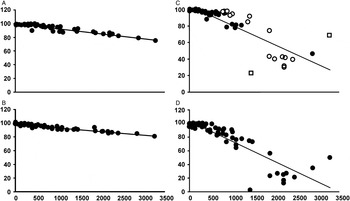
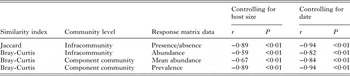
Significant decays in similarity of parasite assemblages over distance were recorded for all communities analysed using both similarity indices and after controlling for temporal and fish size effects (Table 3, Fig. 5). Higher correlation coefficients were observed after controlling for the second variable as a consequence of the stronger correlation between distances separating samples and the differences in host size regarding those of date of capture. Comparing among the four distance-decay regressions, those based on qualitative similarity of infracommunities (Fig. 5a) and on Bray-Curtis similarity of prevalence (Fig. 5b) showed a more gradual slope, representing a lower decay rate, than those based on quantitative similarity of infracommunity abundances (Fig. 5c) and of component community mean abundances (Fig. 5d). Despite their steeper slopes, these regressions showed lower correlation coefficients due to a number of similarities between pairs of samples departing considerably from the expected function. Indeed, residual values >10 were observed only for those regressions concerning infracommunity abundance and mean abundance. Some of these points were considerably more similar than expected given distance separating them, whereas the opposite situation was observed for other pairs of samples. The identification of such values evidenced that, among those points representing pairs of samples more similar than expected (those over the regression line) in the case of infracommunity similarity (Fig. 5c), the most extreme value was the similarity between the northern and southern boundaries of the Argentine province (CF-San Antonio (SA), square over the regression line); the others were those including RG and several localities in the northern Argentine Sea and two including Río de la Plata (RP) and the two southernmost samples El Rincón (ER) and SA (white circles over the regression line). Contrarily, among localities evidencing a higher dissimilarity than expected by the distance between them (those below the regression line), were all represented by pairs of samples including CF (white circles below the regression line), with the most extreme dissimilarity occurring between CF and RG (square below the regression line). A similar picture was observed for analyses based on mean abundances (data not shown).
Relationship between log-transformed similarity and untransformed geographic distance (km) in parasite assemblages of 11 samples of Percophis brasiliensis caught along the south-western Atlantic coasts. Similarities between samples are shown as a percentage of the maximum value of similarity observed. (a) averaged Jaccard similarity of infracommunities, (b) Bray-Curtis similarity of prevalence, (c) averaged Bray-Curtis similarity of infracommunity abundances, (d) Bray-Curtis similarity of component community mean abundance. (c) Different symbols are used to identify pairwise comparisons with residuals >10%; square over the regression line: Cabo Frio-San Antonio; white circles over the regression line: Rio Grande and several localities in the northern Argentine sea and two points including Rio de la Plata and the two southernmost samples (El Rincón and San Antonio); square below the regression line: Cabo Frio-Rio Grande; white circles below the regression line: Cabo Frio and several localities in the northern Argentine sea.

Results of similarity decay analyses over distance of parasite assemblages of Percophis brasiliensis in the South West Atlantic, computed at component community and infracommunity levels, controlling for temporal and fish size effects

MDS and cluster analyses on the four datasets were congruent in their results, revealing apparent patterns of separation between samples following a latitudinal pattern (Fig. 6), which was in all cases substantially different from random as shown by their low stress levels (0·01–0·02). Assemblages in fish from CF were the most different and branched first in the clusters, the second site differing from the rest was SA in all cases. In the case of infracommunity qualitative similarity (Fig. 6a) the third branching region was ER followed by RG, but this order was inverted in the other three analyses (Fig 6b–d); on the other hand, all samples from northern Argentine Sea clustered together at the higher similarity levels in all cases.
Nonmetric two-dimensional ordination plot and cluster analyses of parasite communities in 11 samples of Percophis brasiliensis along the south-western Atlantic coasts. (a) averaged Jaccard similarity of infracommunities, (b) Bray-Curtis Similarity of Prevalence, (c) averaged Bray-Curtis similarity of infracommunity abundances, (d) Bray-Curtis similarity of component community mean abundance. Results of a hierarchical agglomerative clustering are shown as dendrograms and overlaid on the MDS plot with similarity levels represented by a grey scale, with its value given as a number inside each grey area. Locality codes as in Fig. 1.
DISCUSSION
Studies on variability of similarity in parasite assemblages of fish with increasing distance have usually focused on comparisons of distance-decay rates between kinds or species of hosts (Poulin, Reference Poulin2003; Oliva and González, Reference Oliva and González2005), guilds of parasites (Fellis and Esch, Reference Fellis and Esch2005) or hierarchical community levels (Timi et al. Reference Timi, Lanfranchi and Luque2010), as well as being used to compare alternative hypotheses on biogeographical gradients in parasite species diversity (Seifertová, et al. Reference Seifertová, Vyskočilová, Morand and Šimková2008). The present results evidence that, beyond assessing the influence of distance per se on the similarity of parasite communities, distance decay regressions, and the identification of their outliers, can also shed light on the existence of discontinuities or uniformities in the geographic distribution of parasite assemblages and, in turn, in the zoogeography of their fish hosts.
Parasites have been considered as excellent indicators in present day and historical biogeography at different temporal and spatial scales (Brooks and Hoberg, Reference Brooks and Hoberg2000; Waltari et al. Reference Waltari, Hoberg, Lessa and Cook2007). However, few studies have attempted to use parasites as indicators of zoogeographical regions in the marine realm (Rohde, Reference Rohde2002).
Here we tested the potential of parasites as zoogeographical indicators by analysing long-lived parasites of a single species of marine fish, distributed along a unique zoogeographical province to assess their value as markers at lower levels of zoogeographical resolution. This guild was dominant in most parasite assemblages of P. brasiliensis over members of all other guilds, namely ectoparasites, larval gut parasites and adult endoparasites, which is a generalized pattern previously recorded across fish species in the northern Argentine Sea (Cantatore and Timi, Reference Cantatore and Timi2015), and is here mainly due to the high prevalence and abundance of a few dominant species. Samples from CF, on the other hand, were the exception. Lower values of abundance were observed in this locality for those species, which were dominant in southern localities (Corynosoma australe, G. (C.) carvajalregorum and Hysterothylacium sp.), which represent a major difference of this locality regarding southern ones. The lower burdens of these parasites in CF may be due, at least in part, to the smaller size of fish in the sample, since the long temporal persistence of these larval parasites results in cumulative patterns of abundance as fish grow (Timi and Lanfranchi, Reference Timi and Lanfranchi2013). Indeed, Hysterothylacium sp. has often been recorded as more abundant in CF than in southern localities in comparative studies of other fish species (Timi et al. Reference Timi, Luque and Sardella2005, Reference Timi, Lanfranchi and Luque2010; Braicovich et al. Reference Braicovich, Luque and Timi2012; Alarcos et al. Reference Alarcos, Pereira, Taboarda, Luque and Timi2016). However, for the other two parasite species, the abundances were always lower in the region of Rio de Janeiro (RJ) in all these hosts. Furthermore, juvenile P. brasiliensis from waters of the northern Argentine Sea, which were smaller than those from RJ (37·9 ± 4·3, n = 48), harboured notably higher abundances of C. australe (mean abundance = 9·1) and G. (C.) carvajalregorum (mean abundance = 255·6) (unpublished own data), indicating that a locality effect, rather than host size, is determining the abundance of parasite populations. As a result, the sample from the Southern Brazilian district was the most different, probably also influenced by its position in the border with the northern Brazilian zoogeographical province.
In the Bonaerensean district, including fish from RG at the limit with Southern Brazilian district, parasite species showed different patterns of latitudinal variation in their loads. These patterns are attributable to the latitudinal gradient in oceanographic conditions (mostly of temperature and salinity) characteristic of the region (Cantatore and Timi, Reference Cantatore and Timi2015), along which a cline of combinations of biotic and abiotic factors provides sequential sets of optimal conditions where the reproduction and transmission of each parasite species are differentially favoured. These patterns are analogous to those expected according to the ‘favourable centre’ hypothesis, which predicts a unimodal distribution of parasites abundance, peaking at the centre of the geographical range of the host and declining toward the margins (Poulin and Dick, Reference Poulin and Dick2007, Seifertová et al. Reference Seifertová, Vyskočilová, Morand and Šimková2008). This seems to be the pattern for some parasites in P. brasiliensis, and responsible for the higher species richness of its infracommunities in the central zone of the Argentine Province. However, as only larval parasites were included in the analyses, the distribution of definitive, intermediate and other paratenic hosts surely play a major role in their distribution. The apparent ‘favourable centre’ in the central area of the study region is probably determined mainly by environmental conditions rather than by the distribution of P. brasiliensis. As mentioned above, these parasites appear to display similar distributions on other fish species; therefore the confirmation of the existence of repeatable distribution patterns across different host species will provide further evidence of their utility as zoogeographic indicators in the region. Furthermore, as several of the parasites analysed are distributed in other oceans (Sardella et al. Reference Sardella, Mattiucci, Timi, Bastida, Rodríguez and Nascetti2005; Mattiucci and Nascetti, Reference Mattiucci and Nascetti2008; Beveridge and Campbell, Reference Beveridge and Campbell2010) they are potentially applicable as markers of different environmental conditions, and therefore as zoogeographical indicators in other regions.
The gradual variation of parasite species in terms of prevalence and abundance along the latitudinal and environmental gradient resulted in significant decays in similarity of parasite assemblages over distance. Qualitative similarity of infracommunities and quantitative similarity of prevalence decayed at a lower rate than those based on quantitative similarity of abundances (at both infracommunity and component community levels), an expectable result given that compositional variations are thought to be less pronounced within a zoogeographical province. On the other hand, higher variability in the abundance of different parasites among localities is a predictable response to environmental heterogeneity among them; variability probably amplified by the differences of three and four magnitude orders in the abundance of dominant species across sampling sites. These variations in abundance were also responsible for the lower correlation coefficients of abundance-based regressions, especially because similarities between several pairs of samples departed considerably from the expected function, indicating that a border between zoogeographical units could occur when pairs of samples are more different than expected given the short distance separating them. This was the case between the two Brazilian localities, whereas distant localities unexpectedly more similar than predicted reflect their belonging to the same zoogeographical unit, for example RG-SA. The high similarity between both extremes of the study region (CF-SA) is, on the other hand, a consequence of the lower burdens of most parasite species and therefore of the lower infracommunity species richness relative to the central localities. The lower prevalence and abundance recorded for all the species in both extremes of the study area can be attributed to the effect of opposite oceanographic conditions at these extremes, namely tropical waters in the north and subantarctic in the south, therefore similarity in distance-decay should be cautiously interpreted in the light of the knowledge of the environmental conditions characteristic of each region.
These patterns were corroborated by multivariate analyses, which showed recurrent zoogeographical patterns in their results. Indeed, MDS and cluster analyses evidenced a clear first separation between samples from both districts, the Southern Brazilian and the Bonaerensean, with samples from RG clearly belonging to the second one. Among the Bonaerensean samples, SA was clearly different from the rest due to their location in the southern limit of the Argentine province bordering with the Magellanic province, and the ecotonal characteristics of the San Matías Gulf, which is considered as belonging to a different ecoregion (North Patagonian Gulfs) of the Magellanic Province (Spalding et al. Reference Spalding, Fox, Allen, Davidson, Ferdaña, Finlayson, Halpern, Jorge, Lombana, Lourie, Martin, McManus, Molnar, Recchia and Robertson2007). Brazilian flatheads from RG were also different from southern samples, due mostly to their highest abundance of G. carvajalregorum and Hysterothylacium sp., although more similar to them in their compositional structure, indicating their location on or near to the northern boundary of the Bonaerensean district or, following the scheme by Spalding et al. (Reference Spalding, Fox, Allen, Davidson, Ferdaña, Finlayson, Halpern, Jorge, Lombana, Lourie, Martin, McManus, Molnar, Recchia and Robertson2007), their membership to the ecoregion named RG. In synthesis, multivariate analyses revealed the value of larval parasites, recognized previously as suitable markers for flathead stock assessment (Braicovich and Timi, Reference Braicovich and Timi2008, Reference Braicovich and Timi2010), as valuable tools as zoogeographical indicators, corroborating a close fit of similarity between assemblages to existing zoogeographical classifications.
Finally, in light of the observed distributional patterns of parasites of P. brasiliensis, it is concluded that at least two discrete populations of this species inhabits in Brazilian waters, clearly differentiable from those three previously identified in Argentine and Uruguayan seas.
ACKNOWLEDGEMENTS
The authors wish to thank to Instituto Nacional de Investigación y Desarrollo Pesquero, Mar del Plata, and to Instituto de Biología Marina y Pesquera Almirante Storni, San Antonio Oeste, for providing some of the samples from Research Cruises.
FINANCIAL SUPPORT
Financial support to P. E. Braicovich and J. T. Timi provided by grants from CONICET (PIP # 112–201101-00036) and ANPCYT (PICT 2012 # 02094). Financial support to C. Pantoja, A.N. Pereira and J. L. Luque provided by research fellowships from Conselho Nacional de Desenvolvimento Científico e Tecnológico do Brazil (CNPq).