Differing perspectives about the nature of the self stand at the heart of debates about modernity. Philosophers and intellectual historians have chronicled how perceptions of the self have evolved over time to reach a stage often referred to as autonomy. The autonomous self differs from previous varieties of the self because of its relationship to sources of moral authority (Taylor Reference Taylor1989; Reference Taylor2007). In the modern age, persons perceive that their moral frameworks originate from within the self and take priority over the claims made by authorities or institutions external to the self. Rawls (Reference Rawls1971, 3) captures this notion well when he writes that “each person possesses an inviolability founded on justice that even the welfare of society as a whole cannot override.” Moreover, the autonomous self asserts “that it is important to find and live out one’s own [life], as against surrendering to conformity with a model imposed on us from outside, by society, or the previous generation, or religious or political authority” (Taylor Reference Taylor2007, 475). Insisting that individual meaning and identity are primarily constructed outside the confines of social institutions, and often in opposition to those institutions, the autonomous self seeks “a life of self-definition” (Button Reference Button2015, 316). This orientation represents a form of individualism, with consequences for both society and politics.
We agree with political scientists and social psychologists who argue that individualism is a defining element of modern political and social behavior. However, we seek to reexamine the concept because the idea of the autonomous self does not appear in empirical political science. This omission is curious because political theorists have contributed immensely to an understanding of the self and its implications for politics (e.g., Kateb Reference Kateb1992; MacIntyre [1982] Reference MacIntyre2007; Macpherson Reference Macpherson1962; Sandel Reference Sandel1996). Indeed, much of their work explores how modernity has transformed understandings of the self from an entity deeply embedded in social and political institutions to a being who believes oneself to be independent from these sorts of claims. On this line of thinking, individualism manifests itself in the amount of recognition of and deference to external authorities (Taylor Reference Taylor2018). For many political theorists, the relationship between autonomy, the self, and institutions is the key, constitutive feature of individualism, a fact that makes its absence from existing empirical measures all the more surprising. Put differently, the discipline’s contemporary approach to individualism suffers from a problem of content validity—existing indicators do not capture the full content of the concept (Adcock and Collier Reference Adcock and Collier2001).
Because it is currently missing from empirical approaches, we emphasize autonomy by developing a new measure of individualist attitudes and assessing its psychometric properties, including its validity and its reliability over time. We then examine the effect of individualism as autonomy on the conduct of political life in the United States in the context of a pandemic. Pandemics force individuals to sort through a variety of moral dilemmas and choose behaviors that will affect others in the society for good or ill. In making these choices, people can rely on moral frameworks viewed as external to the self or on frameworks originating in the individual, and their choices have profound implications for society’s ability to respond to collective dilemmas. Because it concerns a person’s commitment to autonomy in making moral choices, we label the disposition to rely on the authority of the self as opposed to some external authority “moral individualism.”
Political philosophers have competing expectations about whether the autonomous self contributes to or detracts from the pursuit of collective goods (Kateb Reference Kateb2000; MacIntyre Reference MacIntyre1984), but this question has not been the subject of rigorous empirical investigation. Using multiple surveys fielded in the midst of the COVID-19 pandemic, we uncover strong evidence that moral individualism, as a manifestation of a belief in the autonomous self, affects the attitudes and behaviors of citizens. Even after accounting for economic attitudes, ideology, and partisanship, a commitment to moral individualism can inhibit the ties that bind citizens into well-functioning societies, ultimately making the pursuit of collective goods more difficult. Developing a direct measure of commitment to the autonomous self thus yields new understandings of how individualism affects the conduct of political life.
Economic Individualism
Individualism as an explanatory concept has a vast heritage (Christman Reference Christman2009). It has served simultaneously as the source of a moral framework to validate the organization of society and as a concept to explain why humans behave as they do. The vocabulary for making these moral decisions has an intellectual history that goes well beyond the founding of the United States, though it vividly appears in both early and modern American thought. Indeed, some argue that the emergence of an autonomous self dates back to the challenges posed to the idea of divine creation by Descartes and Bacon (Gillespie Reference Gillespie2008; Taylor Reference Taylor2007). The critical development—and ultimately an inflection point in human history—is the awareness of an inner self that does not depend on a divine source or some other externally appointed law of nature (e.g., Brague Reference Brague and Cochrane2007; Christman Reference Christman2009). From this moment on, humans gain the concepts they need to speak of a world outside the self and to think of freedom as the means to oppose that which is external (Berlin Reference Berlin1969).
Observers have long noted that individualism comprises a core principle in the pantheon of American values (Boorstin Reference Boorstin1965; Hartz Reference Hartz1955; Lipset Reference Lipset1996; McClosky and Zaller Reference McClosky and Zaller1984). In the nineteenth century, Tocqueville worried that individualism, which he described as a tendency that “disposes each citizen to isolate himself from the mass of his fellows” and leave “the greater society to look after itself” (Tocqueville [Reference Tocqueville1835–40] 1969, 506), would inhibit social connections and leave some social needs unaddressed. In their Reference Bellah, Madsen, Sullivan, Swidler and Tipton1985 book Habits of the Heart, Robert Bellah and colleagues describe how Americans had learned to speak a first language that accentuated the individual, stressed a vocabulary of self-fulfillment, and relied on a logic of utility maximization. This language moderated commitments to broader goals and expressed skepticism about authority. When faced with crises and challenges, Bellah worried, individualist societies may lack the moral framework and language to articulate any reasons to forgo physical and psychological satisfaction. Putnam (Reference Putnam and Garrett2020) emphasizes similar themes in his description of the loss of a collective “we” ethos and the rise of the “I” society. Even more evocatively, the sociologist Peter Callero describes American society as “saturated with the holy waters of individualism” in ways that have profound implications for our understanding of social problems and their solutions (Eppard et al. Reference Eppard, Rank, Bullock, Chomsky, Giroux, Brady and Schubert2020, 126).
Despite its frequent invocation, individualism in American political science seems to have become disconnected from its philosophical roots. Empirical researchers have largely ignored theorists’ focus on individualism as autonomy, adopting instead a definition of the concept that recognizes it primarily as an economic construct. Of course, a rich historical record points toward economic activity as a critical feature of what Block (Reference Block2002) calls the “agency” society. This economic focus emerges early on in sociology with the work of Max Weber ([1904] Reference Weber1958), who calls attention to religious ideas in society and the ways in which those ideas make demands on the individual and thus influence and direct everyday economic activity.
Perhaps for these reasons, many political scientists frame individualism as an orientation toward economic activity. For example, Feldman (Reference Feldman1988) employs questions with economic prompts to demonstrate Americans’ support for the individual work ethic, a set of opinions he labels “economic individualism” to emphasize its acquisitive origins. The six-item battery used to create the economic individualism scale is routinely included on the National Election Study (NES) and consistently used in political science:
-
• Any person who is willing to work hard has a good chance of succeeding.
-
• Hard work offers little guarantee of success.
-
• Most people who don’t get ahead should not blame the system; they really have only themselves to blame.
-
• Even if people are ambitious, they often cannot succeed.
-
• If people work hard, they almost always get what they want.
-
• Even if people try hard, they often cannot reach their goals.
While beliefs about economic activity remain vitally important to American political culture, it would be a mistake to make economic preferences the sole dimensions of individualism. For one, these items never directly address key features of capitalism or any other economic system within which individuals act. Instead, they are assertions of causal facts about effort and contemporary success. Rather than capturing a commitment to autonomy, they are primarily beliefs about the relationship between work and achievement. To the extent that such beliefs distinguish the political parties, they are likely to be correlated with ideological or partisan commitments. In that sense, the most widely used contemporary measure of individualism captures perspectives about economic or social mobility, broadly conceived.Footnote 1 But as valuable as this measure is (and we believe it is quite valuable), it is distinct from beliefs about the relationship between the self and institutions of authority. That is, the empirical measures commonly used today do not fully capture the concept of moral autonomy. One could, for example, believe that in the contemporary United States, hard work is often empirically uncorrelated with economic success, while still believing that one’s identity should be self-directed and self-chosen, not imposed by authorities external to the self. Similarly, individuals may firmly insist on the need to respect their autonomy while simultaneously rejecting the empirical conjecture that people who don’t get ahead “really have only themselves to blame.” People could choose their own values as an assertion of autonomy but also reject the values of the contemporary market as presently organized or the structures within which social and economic success is currently achieved. This is, in fact, precisely the position taken by Emerson, Thoreau, and Whitman in an earlier era of American history (Button Reference Button2015).
Individualism as moral autonomy, then, presupposes the justifications the person provides for accepting that “hard work offers little guarantee of success,” and these justifications have rarely been the subject of empirical inquiry. Perhaps the emphasis on market activity in the United States and its connection to ideas of freedom may have forestalled attention to individualism as autonomy. Theorists caution how market frameworks can overshadow other ways of understanding the world (e.g., Brown Reference Brown2019; Polanyi Reference Polanyi1944). While not arguing that social science has capitulated to market understandings of society, we suspect that the singular idea of market individualism is so ingrained in modern American society that individualism, freedom, and markets are often perceived as being synonyms. But this tendency constrains understanding of the full dimensions of individualism. To see the breadth of the concept, we focus on the tension in the liberal tradition between the necessity for institutions to shape and give meaning to individuals and the will that individuals express against the influence of those institutions (Anderson Reference Anderson1992).
Individualism in Social Psychology
Research in social psychology acknowledges the interaction that occurs between the self and society by highlighting the relationship of the individual to their “in-groups” and emphasizing themes of cooperation and competition. Triandis (Reference Triandis2001, 909) states, for example, that “[i]n individualist societies people are autonomous and independent from their in-groups; they give priority to their personal goals over the goals of their in-groups, they behave primarily on the basis of their attitudes rather than the norms of their in-groups, and exchange theory adequately predicts their social behavior.”
Importantly, Triandis and colleagues recognize several orthogonal dimensions of individualism (Singelis et al. Reference Singelis, Triandis, Dharm and Gelfand1995; Triandis Reference Triandis1995). Specifically, they emphasize the distinction between horizontal (emphasizing one’s unique identity and preference for “doing their own thing”) and vertical (emphasizing the need to win competitive struggles, stand apart from others, and be “the best”) individualism.Footnote 2 This line of inquiry proceeds at both the individual and cultural levels of analysis, allowing them to explore the interaction of the two (Triandis Reference Triandis2001; Triandis et al. Reference Triandis, Leung, Villareal and Clack1985).
This particular approach to individualism connects to politics because it acknowledges “[t]he traits that we use in the West cut the pie of experience in ways that implicitly assume that individuals are autonomous entities” (Triandis Reference Triandis2001, 918). A crucial feature of individualism, as elaborated over the last 500 years, is the extent to which individuals take their cues from the “authorities” that surround them.
As with the examples from the measure of economic individualism, however, Triandis’s measures do not completely capture this sort of autonomy, though they come closer. For example, a person could be committed to the idea that “winning is everything” or that workplace achievement is vitally important, but simultaneously believe that the best path to victory is subsuming one’s individual inclinations and following carefully the dictates of relevant authorities. This approach—which would score high on measures of vertical individualism—betrays rather than embodies a commitment to the autonomous “true self” (Newman, Bloom, and Knobe Reference Newman, Bloom and Knobe2014).
Other social psychologists take a different approach to measuring individualism. Shalom Schwartz, for example, identifies multiple core values and emphasizes individuals’ need to define, rank, and prioritize those values when conflicts occur (Schwartz Reference Schwartz1992; Schwartz et al. Reference Schwartz, Cieciuch, Vecchione, Davidov, Fischer, Beierlein and Ramos2012). People will not always have the same ranking of values, but all people adopt a set of values to attain the particular goals they hope to achieve. Political aims such as equality and freedom, too, rest upon this foundation of core values (Schwartz, Caprara, and Vecchione Reference Schwartz, Caprara and Vecchione2010).
Political scientists have adopted Schwartz’s approach by relying on extensive measures of core values and using them to explain their importance relative to political life (Goren and Chapp Reference Goren and Chapp2017; Goren, Smith, and Motta Reference Goren, Smith and Motta2022). However, this approach does not explicitly measure individualism. Instead, individualism emerges at the nexus of other constructs like “self-enhancement,” “conservation,” and “openness to change.”Footnote 3 Without an explicit measure, the literature often uses individualism as a synonym for a cluster of egocentric values. Overall, social psychology’s approach to a discussion of individualism and political life begins with a notion of how the self uses values to make sense of the world. Moral individualism seeks to measure the extent to which people reject or rely upon authoritative institutions to justify the choices they make.
Individualism and the Issue of Multidimensionality
Our approach revisits the concept of individualism by building on previous work by both theorists and social scientists. Our argument is not that any of the previous measures of individualism should be discarded. Rather, individualism as a concept is complex and includes distinct and independent elements, some of which are not adequately captured in existing measures. It can include commitments to certain policy goals (the relationship between hard work and success, for example) and to views about the nature of competition or self-reliance. But if we are to take political philosophers seriously, it must also include beliefs about the autonomy of the self when making moral judgments, beliefs that may be orthogonal to other existing measures. Simply put, the idea of individualism is multidimensional.
As Adcock and Collier (Reference Adcock and Collier2001) note, the process of conceptual development involves reexamining a core concept from several different levels and perspectives. Similarly, Collier and Mahon (Reference Collier and Mahon1993) introduce the idea of “radial categories” as a path forward when a single dimension fails to account for some cluster of attitudes and behaviors. The logic of this approach is that an ideal type exists and that this ideal type would include several distinct features, not all of which may be present simultaneously in any real-world exemplar. In the case of individualism, for example, the central or primary subcategory might include a commitment to the “personal autonomy of the individual,” but the concept will also include variants of this ideal, such as a belief in economic self-sufficiency, an orientation toward members of out-groups, or an understanding of the claims that communities should or should not make on individuals. Like other social science concepts, then, individualism should be thought of as having “properties of non-compensatory multi-dimensional concepts” (Wuttke, Schimpf, and Schoen Reference Wuttke, Schimpf and Schoen2020).
In light of this multidimensionality, we aim to develop a new measure of individualism that focuses on the relationship between the self and external authorities in moral decision making. We begin with three expectations for this new measure. Drawing on the work of Adcock and Collier (Reference Adcock and Collier2001), we first anticipate that the measure will be internally consistent and capture distinct features of the concept that are not currently captured by existing measures (content validation). We expect that our measure will have strong psychometric properties and be relatively stable over time. But we do not expect high levels of correlation between moral individualism and economic, horizontal, or vertical individualism, each of which could be thought of as radial categories or distinct dimensions of the central concept, nor do we expect the various indicators of individualism to load on a single factor.
Second, the fact that the different measures are empirically distinguishable does not mean that they share nothing in common. Specifically, we expect that both our measure of moral individualism and other measures of individualism will predict attitudes about autonomy well (convergent validity). In other words, multiple dimensions of individualism will be implicated in attitudes about individual liberty and the trade-offs between liberty and other values, such as security or public health. A preference for individual freedom may also be seen in attitudes about specific policies that require a trade-off between individualist and collective values. For this reason, we expect our measure of moral individualism, like other measures of individualism, to correlate with attitudes and behaviors that social observers categorize as “individualist” (construct validation). In this sense, our approach should supplement and enrich our theorizing about individualism rather than displace other measures.
Third, we expect our measure will add something new and distinct from other measures to our understanding of how individualism shapes the conduct of public life (discriminant validity). Specifically, because moral individualism concerns a willingness to resist the claims made by institutions or authorities on the individual, we expect that moral individualism will be negatively associated with a tendency to sacrifice on behalf of the larger public good, especially in cases where authorities external to the self appeal for such sacrifice. This unwillingness to heed appeals from external authorities will be unique to moral individualism and will be especially associated with self-reports of volunteering, political participation, or other communal action. In other words, when asked by others to do so, moral individualists will be less likely to engage in collective action on behalf of the public good, a dynamic we do not expect from other measures.
We test these competing possibilities in the context of a unique social challenge in the United States. The outbreak of the novel coronavirus (COVID-19) calls attention to the claims that governments and communities can make on individuals. We find that a more complete understanding of individualism—one that takes moral autonomy seriously—helps to account for the attitudes and behaviors expressed in the public arena. It is not that economic individualism does not matter; rather, other accounts of individualism also matter and, in some respects, matter differently. Even after accounting for other indicators, moral individualism predicts an unwillingness to sacrifice on behalf of others and, more broadly, to participate in public life.
Data and Methods
Data for this study were drawn from five distinct surveys collected between 2018 and 2022 (combined N = 12,169).Footnote 4 Prior to the pandemic, we fielded a survey that included measures of moral individualism to a national sample of 2,000 adults across the United States. YouGov administered the study online, and respondents were matched to a sampling frame constructed from the American Community Survey (ACS) with the aim of generating a sample whose characteristics mirror those of the general population of the United States.
Our primary survey dataset for the analyses we consider here was administered online by YouGov to a national sample of 1,300 adult respondents between May 18–22, 2020—approximately two months after widespread economic and social upheaval related to COVID-19 began. As with the 2018 study, respondents were matched to an ACS sampling frame to reflect the population of the United States. This study includes not only our new measure but also measures of other facets of individualism typically employed by political scientists and social psychologists, including economic individualism, horizontal individualism, and vertical individualism.
To ensure that our results are robust to the pandemic’s enduring challenge, we also fielded surveys with a short version of our key measure of moral individualism at three subsequent points in time. In October and November of 2020, we participated in the Western States Survey (WSS), which included 3,600 respondents from five western states (Arizona, Colorado, Nevada, New Mexico, and Utah), again administered by YouGov. Finally, we also participated in a multiwave panel study sponsored by the University of North Carolina (UNC), with waves fielded via Qualtrics to a nationally diverse sample of 2,852 respondents in August 2021 and to 2,417 respondents in March 2022. A total of 575 respondents were included in both waves, allowing us to assess stability over time.
Summary statistics for all samples can be seen in appendix tables A1–A5. While only the 2018 and 2020 YouGov studies were designed to be fully representative of the US population and the differences across the samples matter, all five samples are quite diverse in terms of gender, race, age, education, family income, and political attitudes.
A New Measure
A key goal of our effort is to develop a new battery of questions designed to explore how individuals view their relationship to external sources of authority. Our approach drew inspiration from the tolerance literature (Marcus Reference Marcus1995), where respondents are first asked to identify their “most disliked” group, then prompted to respond to questions about their willingness to extend civil liberties protections to that group. The notion behind this two-step approach is that tolerance is only meaningful with respect to groups the respondent finds objectionable. Similarly, independence from external authority is meaningful only with respect to the social or cultural authorities that people might respect or value, and different people value different authorities. Some prize religious authority; others, science; others, their family and friends; still others may defer to social norms or the public more broadly.
To that end, we first presented respondents with a curated list of authority figures who might be important sources of guidance “as you decide what is the best way to live your life and what is best for society.”Footnote 5 We constructed this list with the help of pilot surveys in both the United States and the United Kingdom in which we asked open-ended questions so respondents could recount the different influences that seemed important to them in various facets of their lives. From those responses, we culled a list of widely cited influences: religion, family, science, good friends, teachers, and what the public generally thinks is right.Footnote 6 Respondents were asked to rank these influences according to their importance for the respondent, then describe the influence they ranked as most important in an open-ended text box.Footnote 7
As table 1 shows, across all five surveys, a majority of respondents identified a family member as the most important influence in their decision making. The distribution of responses is roughly similar across datasets, with one exception: the percentage of respondents naming science nearly doubled in 2020, with slight decreases in the number of respondents choosing religion, friends, and the “other” category. The category with the largest decline in responses over time is religion. Given the context of the coronavirus pandemic, it is perhaps not surprising that science loomed substantially larger as an important authority for many Americans beginning in 2020.
Authority Referents: Most Important Influence in Helping Make Decisions

Note: Cell entries are the percentage choosing each option as their most important influence (survey weights included). In 2018, the other category included teachers, work colleagues, public opinion generally, and well-known media personalities. In all subsequent years, the other category included teachers and public opinion generally.
Because a subset of respondents answered both waves of the 2021 and 2022 UNC-sponsored surveys, we are also able to assess the temporal stability of choices about authority referents. As table 2 shows, about 62% of respondents chose the same moral authority referent in both years.Footnote 8 As a point of comparison, we look to the 2018 and 2020 panels of the General Social Survey (GSS), a high-quality national sample where respondents answered a set of core political and social questions across multiple waves. It appears that choices of authority referents are somewhat less stable than partisanship (a three-point scale of Democrats, independents, and Republicans, with leaners included with the partisans), but roughly on par with the temporal stability of self-identified ideology (conservative, moderate, or liberal), economic class, and a six-point scale measuring strength of belief in God. By contrast, reported authority referents are considerably more stable than beliefs about papal infallibility, an item from the racial resentment scale, and views about government aid to the poor. We take these results as persuasive evidence that the first step in our approach is about as stable as self-reports of other core features of political, economic, or social identity and much more stable than policy attitudes.
Stability of Views about Authority Referents over Time

Note: Cell entries are the percentage of respondents choosing the same response for each relevant variable at t 1 and t 2.
For the second step in the process, we asked respondents a series of questions about their relationship with the referent they identified as most influential. These questions tapped into the respondent’s sense that only self-authorized choices are legitimate and their willingness to resist valued influences, with the authority they selected as most influential piped into the text.Footnote 9
-
• The values that come from [MOST INFLUENTIAL AUTHORITY] are really no better than my own personal values.
-
• My current way of deciding what is right and wrong is better than the way [MOST INFLUENTIAL AUTHORITY] taught me.
-
• Only I can decide what is right, I cannot even trust [MOST INFLUENTIAL AUTHORITY] to help me decide.*
-
• I am not the only one who can decide what is right and wrong for me. I can also trust [MOST INFLUENTIAL AUTHORITY] to help me decide.
-
• I would have found the same truths about life even if [MOST INFLUENTIAL AUTHORITY] had not been there to help.
-
• My own judgment is more important than [MOST INFLUENTIAL AUTHORITY]’s judgment.*
-
• The world has many truths, and whatever I learned from [MOST INFLUENTIAL AUTHORITY] is just one of them.
-
• Nobody, not even [MOST INFLUENTIAL AUTHORITY], can decide what is right and wrong, except for me.*
-
• When faced with a difficult choice, I think it is more important to follow my heart than to do what [MOST INFLUENTIAL AUTHORITY] thinks is right.*
-
• It is OK to reject the values [MOST INFLUENTIAL AUTHORITY] teaches.
In the YouGov 2018 and 2020 surveys, we also asked study participants to respond to the traditional economic-individualism battery described above, Triandis’s measures of horizontal and vertical individualism, and the child-rearing-values questions that are often used to measure authoritarianism (Feldman and Stenner Reference Feldman and Stenner1997; Hetherington and Weiler Reference Hetherington and Weiler2009; Stenner Reference Stenner2005). As Stenner (Reference Stenner2005, 14) argues, authoritarianism is a predisposition having to do with “the appropriate balance between group authority and uniformity, on the one hand, and individual autonomy and diversity, on the other.” Political science research has shown that authoritarians tend to see the world in black-and-white terms, are highly sensitive to in-group/out-group boundaries, and have a strong need to defend the social order and existing group norms against those who would undermine the group and its values (Hetherington and Weiler Reference Hetherington and Weiler2009; Stenner Reference Stenner2005).
In contrast to authoritarianism, moral individualism is less focused on policing in-group/out-group differences or tolerance toward outsiders and more focused on how people see themselves in relation to the external authorities of greatest importance to them, whether liberal or conservative. That is, we are trying to measure the extent to which the individual prioritizes commitment to self over other potential allegiances, not the extent to which he or she is willing to defend in-group/out-group boundaries, which is at the heart of authoritarianism. We expect that the two indicators will not be highly correlated because they are tapping distinct elements of the relationship between the self and external sources of authority. In sum, we expect that our measure will be distinguishable from both economic approaches to individualism, on the one hand, and authoritarianism, on the other.
Because our two-step method allows study participants to choose the referent most important to them, we account for potential differences across referents in two ways: first, in constructing the measure, we employ an item response theory (IRT) model that allows discrimination parameters to vary by referent. Second, we also assess the robustness of our analyses by supplementing ordinary least squares (OLS) regression with random effects models that include a random effect for the referent. We expect average levels of individualism to vary with the referent, but we see these differences as a strength, not a weakness of the measure. Empirically, the fact that respondents can choose different referents means that the aggregate index of the individualism measure is likely to display helpful variation, with respondents at many points along the distribution. At the same time, our approach is designed to yield a measure that will be substantively and theoretically meaningful. People have different influences and value those influences differently, and their willingness to reject the constraints of external influences also varies. This observation seems critical to understanding how individualism, as we have defined it, manifests itself in modern life.
Figure 1 presents the distribution of moral individualism separately by referent in the YouGov 2020 sample. Dashed lines indicate the mean for each distribution, and the different distributions are colored by referent. High scores mean a much greater willingness to substitute one’s own judgments for the advice or teachings of the referent.Footnote 10 As expected, choice of authority is correlated with mean levels of moral individualism. Average levels of individualism were below the scale midpoint for respondents choosing religion or science but above the midpoint for those who chose family or friends as their key influences. Put differently, respondents who reported that science or religious leaders were key sources of authority were less likely to push back against the judgments of those authorities. By contrast, those who prized family or friends first were somewhat more likely to resist advice and guidance from those influences. As appendix figure A1 shows, these dynamics were similar in every study—respondents who chose science or religion as their most important authority referent tended to score lower on the moral individualism scale than respondents who emphasized other authorities.
Moral Individualism Distribution by Referent, YouGov 2020

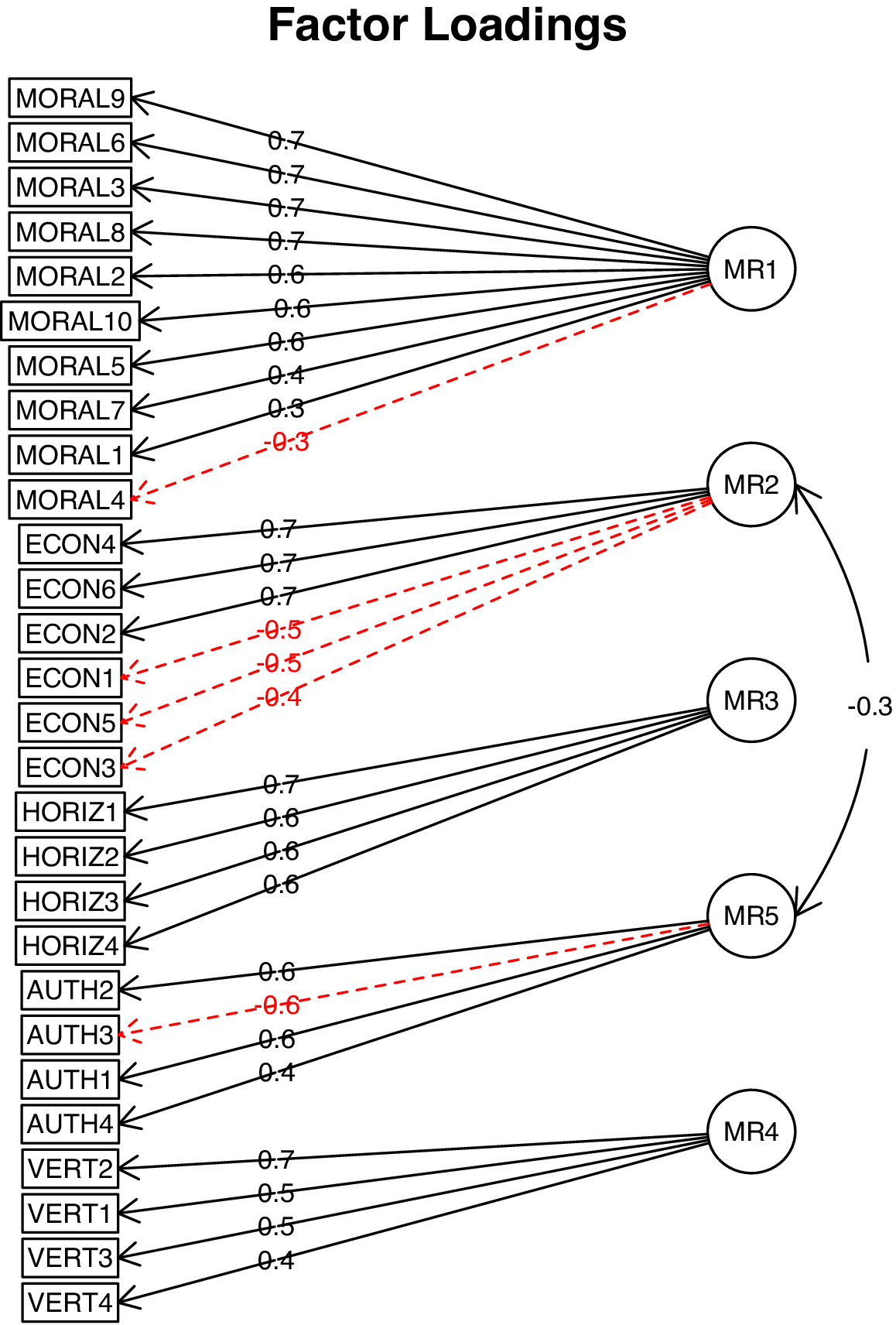
To what extent is moral individualism distinct from other existing measures? To answer this question, we first conducted an exploratory factor analysis with our moral individualism items, the traditional economic individualism questions, the measures of horizontal and vertical individualism, and indicators of authoritarianism. The analysis produced strong evidence of five distinct factors in both 2018 and 2020 (see appendix figure A2 for details). Figure 2 shows how the YouGov 2020 survey items loaded onto each factor after oblique rotation using oblimin, with factor loadings below 0.25 dropped and negative relationships shown in red. Each of the individualism measures appears to be a distinct factor, with little correlation across the factors other than perhaps a weak relationship between economic individualism and authoritarianism. This factor structure was essentially identical in the YouGov 2018 data (see appendix figure A3). If we allow for a larger number of factors, the measures remain distinct from each other, and the primary difference is that economic individualism separates into two factors by the direction of the survey items.
Factor Analysis of Key Measures, YouGov 2020

Figure 3 presents the correlation and distributions of each of the summary measures as well as self-reported ideology, coded with higher scores indicating conservatism.Footnote 11 The main diagonal shows the distribution of each measure, and the figures below those distributions show the relationships between each measure with a LOWESS curve. Above the main diagonal are the pairwise correlations between the measures.
Correlations between Key Measures

As expected, the four indicators of individualism were not highly correlated with each other. Correlations between economic individualism and the other measures proved anemic: it was correlated with moral individualism at r = 0.05 and with horizontal individualism at r = 0.08. Slightly stronger correlations emerged between moral individualism and horizontal (r = 0.13) and vertical (r = 0.19) individualism and between economic and vertical (r = 0.13) individualism. But as the pairwise relationships in the figure make clear, these measures did not move together in lockstep and thus seem to be tapping distinct elements of individualist thought. Notably, economic individualism correlated with authoritarianism (r = 0.30) and with conservatism (r = 0.45) more highly than the other measures, meaning that it is a more politicized indicator. By contrast, moral individualism was distinct from authoritarianism and conservatism (r = 0.05 in both cases).
As can be seen in appendix figure A4, the basic pattern was very similar in 2018—low correlations between moral individualism and economic individualism (r = −0.11), moderate correlations between moral individualism and horizontal (r = 0.21) and vertical (r = 0.18) individualism, and a stronger correlation between economic individualism and ideology (r = 0.46). Again, moral individualism and authoritarianism were distinct (r = −0.10). The 2020 Western States Survey did not include indicators of horizontal or vertical individualism, and in that sample, the correlation between moral and economic individualism was positive and moderate in size (r = 0.23), though the two measures hardly marched in lockstep. And we again find little connection between moral individualism and authoritarianism (r = 0.01), but a strong relationship between economic individualism and ideology (r = 0.49). Across multiple different robustness checks, then, the basic result was consistent: our measure of moral individualism identifies a latent attitude that is separate from economic individualism and from the measures that emerge from social psychology, which in turn are also distinct from each other. These patterns strongly support our insight that existing measures do not cover the full spectrum of understandings of individualism.
In addition, we generally find weak relationships between the different measures of individualism and demographic characteristics (appendix table A7), indicating that individualists can be found among various groups and backgrounds. Older respondents were slightly less likely to be moral or vertical individualists and slightly more likely to be horizontal individualists. Nonwhites scored slightly higher on measures of moral individualism, while college graduates tended to report lower levels of both moral and economic individualism. None of these relationships could be described as large: for example, the effect of racial identity was only about 4 percentage points on the moral individualism scale.Footnote 12 Nonetheless, we control for these demographic characteristics in subsequent analyses to ensure that the relationships we identify are driven by individualism, not by some other respondent attribute or characteristic.
Finally, having already demonstrated the temporal stability of authority referents, we assess the test-retest reliability of the full measure of moral individualism by computing the correlation between the 2021 and 2022 measures for respondents who completed both waves of the UNC surveys. Again, we compare those results to correlations for key measures across waves of the 2018 and 2020 GSS. As table 3 demonstrates, the correlation between t 1 and t 2 measures of moral individualism was 0.45 for all respondents and 0.63 for respondents who chose the same referent in both waves. This level of reliability ranks below that of partisanship and strength of belief in God, but is roughly similar to ideology, economic class, and racial resentment and more reliable than views about papal infallibility and government aid to the poor. The measure’s test-retest reliability was much lower (r = 0.15) among those who chose different authority referents across the two waves. These results are consistent with two conclusions: first, the choice of authority referents matters, and respondents answer the questions at any given point in time with their chosen referent in mind. Second, overall levels of reliability are high—so high among those who chose a consistent authority referent that they are exceeded only by partisanship and belief in the divine.

Dependent Variables
We fielded our core study in the midst of a global pandemic in which Americans were being asked to accept the authority of institutions to protect public health. Our primary aim was to understand the relationship between various indicators of individualism and a willingness to pursue collective purposes like the physical health of the community. We explored this theme in several ways.
We first probed political attitudes by asking respondents to indicate their level of agreement or disagreement with a series of statements about the respondent’s commitment to individual liberty as opposed to other values like security or minimizing death. We followed up these questions by exploring support for pandemic-related government decisions that implicate a trade-off between liberty and other values, such as stay-at-home orders and mandated school and nonessential business closings. We also presented respondents with a series of forced-choice alternatives—reopening the economy versus public health, price gouging versus public access to basic goods, and following what the individual thinks is best versus listening to public health officials.
Next, we asked multiple questions about the respondent’s political behavior and support for collective action related to the pandemic. First, we presented respondents with a series of hypothetical vignettes probing their willingness to take specific actions like donating hand sanitizer to first responders, donating N95 masks to doctors and nurses, or contributing goods for the homeless in the area. Second, we asked respondents to report whether they had actually taken actions like helping neighbors or friends, making masks, donating blood, or wearing a mask in public since the pandemic began. In the Western States and UNC surveys, we also asked respondents to self-report about vaccination. Finally, we explored political activity outside the pandemic and interest in volunteering for various causes.
In all, we employed multiple question formats and approaches to investigate how individualism shapes a willingness to set aside individual interests for the broader good of the community in the midst of a public health crisis. Given the low levels of correlation across the different measures of individualism, we can also explore the unique contributions of each to political attitudes and behavior, controlling for other political variables likely to matter for these outcomes as well, such as partisanship and ideology. Previous work conducted at similar points in time has shown, for example, a strong relationship between partisanship or ideology and health-related pandemic behaviors (Druckman et al. Reference Druckman, Klar, Krupnikov, Levendusky and Ryan2021; Gollwitzer et al. Reference Gollwitzer, Martel, Brady, Pärnamets, Freedman, Knowles and Van Bavel2020; Grossman et al. Reference Grossman, Kim, Rexer and Thirumurthy2020; Kushner Gadarian, Goodman, and Pepinsky Reference Gadarian, Shana and Pepinsky2020; Rothgerber et al. Reference Rothgerber, Wilson, Whaley, Rosenfeld, Humphrey, Moore and Bihl2020; van Holm et al. Reference van Holm, Monaghan, Shahar, Messina and Surprenant2020). Our models also include controls for demographic characteristics, including age, gender, race, education, and income, that have been shown to have important effects on political participation (Burns, Schlozman, and Verba Reference Burns, Schlozman and Verba2001; Verba, Schlozman, and Brady Reference Verba, Schlozman and Brady1995).
Findings
Individualism is often closely tied to views about the meaning of liberty (Christman Reference Christman2009), and we expect that multiple indicators of individualism will be associated with a preference for individual freedom over other values (convergent validity). For this reason, we asked respondents their level of agreement or disagreement with two statements meant to contrast liberty with values like security and public health:
-
• “We should not trade liberty for security even if it means some people will make poor choices.”
-
• “It is more important to respect people’s individual freedom than to keep the overall number of deaths from coronavirus low.”
Table 4 presents evidence that both moral and economic individualism are strongly correlated with responses to these items. Respondents scoring higher on both indicators were substantially more likely to prize liberty over security and even deaths in the community. These effects remain robust in the presence of controls for a variety of other measures and demographic characteristics and regardless of whether we use OLS or random effects models. The magnitude of the relationship between individualism and these dependent variables is extremely large, rivaling or exceeding the effect of moving from the most liberal to the most conservative ideological self-identity. As another point of comparison, the effect of moral individualism is about twice the size of the difference between being a pure independent and a strong Republican. The effects of horizontal and vertical individualism and of authoritarianism were, in turn, much smaller and less consistent. Nearly identical dynamics characterize the relationship between moral or economic individualism and specific pandemic policies like stay-at-home orders, closing schools, or shuttering nonessential businesses (see appendix table A12 for details).
Attitudes about Freedom

Note: Cell entries are OLS regression coefficients (columns 1 and 3) and random effects coefficients (columns 2 and 4), with standard errors in parentheses. The random effect is the referent ranked first by the respondent. Dependent variables are five-point indicators, with higher scores representing greater agreement. Independents are the baseline category for the partisanship variable. Full results with demographic controls can be found in appendix table A10. *** p < 0.01, ** p < 0.05, * p < 0.10.
As an additional test of the relationship between individualism and attitudes toward the pandemic, we presented respondents with a series of forced-choice alternatives dealing with some of the key public policy choices facing the nation at the time of the survey, including the need to reopen the economy as soon as possible, even if more people get sick; the advisability of price gouging in the face of shortages of basic goods and services; and the need to listen to public health officials as opposed to doing what the respondent thinks is best. Specific question wording can be found in table 5.
Forced-Choice Question Alternatives

In each case, moral and economic individualists proved much more likely to resist action to blunt the pandemic and its effects. Figure 4 shows the effect of each measure on the probability of expressing support for public health officials, reopening the economy, and allowing price gouging. Moral and economic individualists favored reopening the economy and allowing price gouging, while they were less likely to say they should listen to the advice of public health officials. The effects of moral individualism were especially impressive—substantially larger than economic individualism, though in the same direction, and as large or larger than the effects of ideology or partisanship.Footnote 13 Notably, the effect of moral individualism exceeded that of economic individualism, despite the fact that several of the forced-choice alternatives included an economic element. And as with the attitudes about freedom, the effects of horizontal individualism, vertical individualism, and authoritarianism tended to be smaller and less consistent.
Effects of Individualism on Forced-Choice Questions
Note : Point estimates reflect the marginal effect of each measure on the predicted probability of taking action. Spikes represent 95% confidence intervals. Partisanship shows the effect of being a strong Republican, as opposed to a pure independent. Average marginal effects predicted from results in appendix table A11.

We have seen that both moral and economic individualists prize individual autonomy above other values, including the aggregate number of deaths in the community, and that they are less supportive of measures taken by elected officials and other public health authorities to curb the pandemic. This pattern strongly supports our expectations and represents meaningful evidence of convergent validity. But beyond these attitudinal measures, we are also interested in the relationship between individualism and behavior. In that domain, we expect that the effects of moral and economic individualism will diverge, especially in response to requests by external authorities to put aside individual preferences for the good of the whole. These types of choices came into sharp relief during the first months of COVID-19. In the midst of a pandemic, the willingness to sacrifice individual preferences for the common good is the key to controlling the spread of the virus.
We measured a willingness to engage in collective action in two ways. First, we presented respondents with a series of hypothetical vignettes, each of which was designed to reveal a willingness to forego personal gain for the common good. In the first, we asked respondents to imagine that the authority they indicated was most important to them had asked them to donate small bottles of hand sanitizer so that first responders and others in need might have access to them. In the second vignette, we asked them to imagine that their state governor had asked everyone to donate N95 masks for doctors and nurses who need them as they care for sick patients. We told respondents to assume they had 10 hand sanitizer bottles and 10 N95 masks that they had purchased prior to the pandemic. In these vignettes, respondents indicated how many bottles or masks, out of 10, they would donate. Finally, we asked the respondent to imagine that the local community had asked for contributions of goods to help the homeless in the area. For this question, respondents indicated how likely on a scale from one to five they would be to “go out of [their] way to purchase what is necessary to contribute.”
In each case, moral individualists proved substantially less likely to sacrifice on behalf of the collective good, as shown in figure 5. Those at the top of the moral individualism scale donated, on average, about 1.5 fewer bottles of hand sanitizer or N95 masks than did those at the bottom of the scale. Similarly, moving from the bottom to the top of the scale was associated with a substantial decrease in the likelihood of contributing goods to the homeless. These effects were unique to moral individualism. Economic individualism had no relationship to a willingness to sacrifice on behalf of the public good, and effects on donating behavior were inconsistent for the other key measures. By contrast, strong partisanship, whether from Republicans or Democrats, tended to be associated with an increased likelihood of donating to the public.Footnote 14 Thus, while both moral and economic individualists tended to share similar attitudes about the importance of individual autonomy in the midst of the pandemic, only moral individualists proved unwilling to sacrifice for the collective good in our hypothetical vignettes.
Effects of Individualism on Responses to Vignettes
Note : Point estimates reflect the regression coefficient for each measure on vignette responses. Spikes represent 95% confidence intervals. Partisanship shows the effect of being a strong Republican, as opposed to a pure independent. Full models can be seen in appendix table A13.

As a second measure of the willingness to engage in pandemic-related collective action, we asked respondents to report whether they had personally engaged in any of ten possible efforts to alleviate the pandemic, including reaching out to help neighbors, friends, or family members; joining online community groups; volunteering for in-person activities related to the pandemic; making or donating masks for those in need; donating money to the COVID-19 response; donating blood; or donating time to help those who are high risk (e.g., shopping for or delivering groceries, helping with home maintenance, etc.). On average, survey respondents reported participating in about 2.6 out of the 10 actions, and the median number was 2. These are self-reports, not observations of actual behavior, and it is possible that individualists will be less prone to social desirability effects than others. However, the mean and median reports are low enough to allay concerns that social desirability concerns inflated self-reports excessively.
As with the vignette results, moral individualists proved especially reluctant to report actions meant to help others or otherwise respond to the pandemic. Figure 6 presents the marginal effect of the various measures of individualism and ideology on a willingness to take four different actions—helping family members, reaching out to neighbors, giving time to help high-risk groups, and wearing a mask. In each case, moral individualism was negatively related to self-reported action. Relationships between these dependent variables and the other measures of individualism were generally statistically indistinguishable from 0, with the exception that horizontal individualists were more likely to say they helped family or wore a mask.
Effects of Individualism on Willingness to Take Collective Action
Note : Point estimates reflect the marginal effect of each measure on the predicted probability of taking action. Spikes represent 95% confidence intervals. Partisanship shows the effect of being a strong Republican, as opposed to a pure independent. Average marginal effects predicted from results in appendix table A14.

The effect of moral individualism was dramatic and large. Moving from the scale minimum to maximum of moral individualism was associated with a more than 30 percentage-point decrease in the predicted probability of reaching out to family, helping neighbors, and wearing a mask, and moral individualism decreased the likelihood of helping high-risk groups by nearly 15 percentage points. In other words, moral individualists were uniquely and substantially less likely to report that they had taken part in efforts to care for others or to take precautions like wearing a mask that would curb the spread of the virus in the community.
Overall, moral individualism was negatively and statistically significantly related to five of the 10 actions on our questionnaire (appendix table A14). For another four items, the coefficient was negative but not statistically significant. The coefficient for moral individualism was positive and statistically significant for only one item in our battery—participating in “in-person volunteer activities related to the COVID-19 response.” This positive relationship was unexpected, though the question wording of this item is somewhat vague and could include efforts to protest mask restrictions or other public health guidelines. At a moment in the pandemic when in-person gatherings were generally discouraged, it is notable that moral individualists were actually more likely to say they participated in face-to-face events.
We also computed a summary measure of the number of COVID-assistance items each respondent reported, and again found that moral individualism was uniquely and powerfully related to lower scores on that measure (table 6). The effect is very large—more than double the effect of ideology and far larger than the effects of all the other measures of individualism, none of which are statistically distinguishable from 0. Controlling for other characteristics, moving from the scale minimum to maximum of moral individualism reduces the number of COVID-related assistance efforts by a little less than one standard deviation. And in a simple comparison of those above the scale midpoint in moral individualism with those at or below the midpoint, Cohen’s d is 0.29, a result typically interpreted as a moderate effect size.
Collective Action (OLS/Random Effects), 2020 YouGov Survey

Note: Cell entries are OLS (columns 1, 3, and 5) and random effects (columns 2, 4, and 6) regression coefficients, with standard errors in parentheses. Dependent variables are summary indicators of self-reported behavior. COVID assistance ranges from 0–10; political activity ranges from 0–5; and volunteering ranges from 0–9. Independents are the baseline category for the partisanship variable. This table reports only the key independent variables of substantive interest. Full results with demographic controls can be found in appendix table A16. *** p < 0.01, ** p < 0.05, * p < 0.1.
These results persist when we add controls for support for Donald Trump, given his prominent role in spurring reactions to the pandemic, and for prosociality, or a general tendency to assist others. Appendix table A17 highlights these robustness checks for the COVID assistance index and for mask wearing, specifically. We measured support for Trump on a four-point scale tapping confidence in his ability to deal with the pandemic, and prosociality is a three-item index drawn from a commonly used battery (Caprara et al. Reference Caprara, Steca, Zelli and Capanna2005).Footnote 15 Both of these measures were significantly related to COVID behaviors, but even after controlling for them, the effect of moral individualism remains large and statistically significant.
We also asked respondents to self-report two non-COVID types of public activities—a standard political participation index and their interest in volunteering for various community events. The participation index included five items: attending local political meetings; displaying political signs; working for a candidate or campaign; donating money to a candidate, campaign, or political organization; and talking to people to try to show them why they should vote for or against any candidates or issues. The volunteering battery included nine options designed to gauge interest in helping children or youth; serving with a religious organization; helping seniors; helping at a hospital or medical facility; working with the homeless or poor; helping to preserve the environment; working for a political campaign or cause; promoting an arts organization; and being part of a neighborhood watch. For each battery, we computed a summary measure of the total number of activities respondents said they had done in the past year (in the case of the political items) or would find appealing (from the list of the volunteering items).
As table 6 shows, moral individualists’ reticence to engage in collective action was not confined to the pandemic. It also extended to political activities generally and to interest in volunteering. Again, the effect was substantial. For the political activity battery, moving from the bottom to the top of the moral individualism scale was associated with a decrease of just over half an item. This is roughly similar in magnitude to the positive effect on participation of partisanship.Footnote 16 The relationship between moral individualism and interest in volunteering was even larger, reducing the number of volunteering activities by a little less than two items. Overall, the COVID, political, and volunteering batteries tell a similar story: moral individualists were uniquely less willing to invest in helping their neighbors or participating in the collective life of the community. None of the other measures of individualism yielded similar results.
As a robustness check, we examined the relationship between moral individualism and collective action both before COVID and later in the pandemic’s progress. In 2018, results nearly perfectly replicated the 2020 patterns: moral individualism exerted a negative effect on both political activity and interest in volunteering, and this relationship was substantially larger than for any other measure of individualism (see appendix table A18 for details). The 2020 Western States Survey included the economic individualism measure and a reduced version of the moral individualism index, along with a four-item index of pandemic-related behaviors, the same political activity measures found on the 2018 and 2020 YouGov surveys, and questions about an additional set of political activities.Footnote 17 By October 2020, residents had considerable experience with the challenges accompanying COVID, and cases were beginning to increase significantly from summer lows. Again, however, we find considerable evidence of moral individualists’ retreat from collective endeavors. Moral individualists participated in fewer political activities, and they were again less likely to report wearing masks or social distancing (appendix table A19). Economic individualists were also less politically engaged, but moral individualists proved uniquely less enthusiastic about mask wearing and other forms of pandemic-related collective action.
Finally, as a follow-up to the COVID items we fielded in early 2020, we also included questions about vaccination in the 2020 Western States Survey and in both waves of the UNC surveys. Again, we find strong evidence that moral individualism shaped responses to the pandemic. In the 2020 Western States Survey, fielded prior to widespread access to vaccination, we asked respondents to indicate how likely they were to get the vaccine when it became available. OLS results reveal moral individualists to be about 30 percentage points less likely to report a desire to receive the vaccine when shots became available, though the effect was larger for economic individualists.Footnote 18
In the 2021 and 2022 UNC surveys, we asked respondents to report their current vaccination status. As figure 7 highlights, moral individualism was again negatively correlated with vaccination. The effect was substantial—moving from the bottom to the top of the moral individualism scale was associated with a nearly 40 percentage-point decrease in self-reported vaccination, and in 2022, the effect was about 20 percentage points. Though these surveys did not include other measures of individualism, the results include controls for ideology and partisanship, and the effects of individualism dwarfed the effects of those political identities. While we cannot conclude from the vaccination analysis that the effects of moral individualism differed from other measures of individualism, we interpret these patterns as strong confirmation that moral individualism played a meaningful role not just in behavior in the initial months of the pandemic, but in the nation’s vaccination effort as well.
Effects of Individualism on Self-Reported Vaccination Status
Note: Point estimates reflect the marginal effect of each measure on the predicted probability of self-reported vaccination. Spikes represent 95% confidence intervals. Partisanship shows the effect of being a strong Republican, as opposed to a pure independent. Average marginal effects predicted from results in appendix table A21.

Overall, this pattern represents strong evidence that moral individualism contributes something distinct to our understanding of the relationship between individualism and collective endeavors. For pandemic-related behaviors, political participation, and interest in community volunteering more generally, no other measure exhibits a negative relationship that is so consistently large and statistically robust. The relationship between the self and external authorities shapes not only attitudes about the meaning of liberty, but also engagement in the life of the community more generally.
Discussion
While political theorists have spent considerable time developing the idea of the autonomous self, they have also developed conflicting expectations about how autonomy might affect collective action and political participation. On the one hand, observers like Tocqueville worried that a tendency to individualism would cause Americans to withdraw from collective endeavors, leaving critical social needs unaddressed. Similarly, MacIntyre (Reference MacIntyre1984) argues that only by accepting that we are embedded within specific institutions and communities and that those communities make binding claims upon us are we called to live up to our moral responsibilities to each other, including via many forms of participation in democratic life (see also Sandel Reference Sandel1996; Taylor Reference Taylor1989). Otherwise, individuals are “continually liable to be blinded by immediate desire” and “to be distracted from [their] responsibilities” (MacIntyre Reference MacIntyre1984, 10). This rejection of common, collective purpose is also the heart of Putnam’s (Reference Putnam and Garrett2020) argument about the differences between an “I” and “we” society. In a similar vein, at the beginning of the pandemic, Linker (Reference Linker2020) called the “don’t tread on me” spirit of American individualism a “suicide pact that threatens individuals as well as the political community as a whole” because it undermined a sense of common goodwill and collective responsibility.
On the other hand, a parallel tradition in political philosophy sees autonomy as supportive of action on behalf of others and regards such action as especially valuable because it is authentic—that is, freely chosen by the individual, not imposed by others external to the self. On this account, individualism is not the same as selfishness, and in fact, prioritizing rights-based defenses of individualism protects the nation from damaging forms of collectivism. For example, Kateb (Reference Kateb2000) objects to the idea of patriotism in part because group-based claims increase the possibility of violence against out-groups. Rights-based individualism counters this tendency and thus strengthens, not weakens, democratic society (Kateb Reference Kateb1992).
These potential virtues of individualism are supported by considerable social science evidence. For example, when individual identity is subsumed in group identity, the likelihood of empathy toward out-groups declines and individual moral standards can be abandoned, enabling out-group harm (Cikara et al. Reference Cikara, Bruneau, Van Bavel and Saxe2014). Self-determination theory holds that when behaviors are autonomous—freely chosen by the individual, not imposed by other entities—prosocial outcomes that benefit both the helpers and the helped are more, not less, likely (Weinstein and Ryan Reference Weinstein and Ryan2010). Others show that more individualist cultures are positively correlated with altruism—nonreciprocal acts that improve the well-being of others (Rhoads et al. Reference Rhoads, Gunter, Ryan and Marsh2021). In this sense, an individualism that values autonomy may make Americans more generous, support authentic action, and reduce intergroup tensions. As Marsh (Reference Marsh2021) puts it, when it comes to care for the well-being of the community, “Far from being our worst trait, individualism may be among our best.”
Because scholars have not previously created a satisfactory measure of beliefs about the autonomous self, however, ours is the first attempt of which we are aware to adjudicate empirically between these two theoretical perspectives about the implications of autonomy. Our two-step approach yields a scale with strong psychometric properties that is distinct from other common measures of individualism. We find strong evidence that our measure of moral individualism is negatively correlated with a willingness to engage in the collective life of the community, especially within the context of a global pandemic. Like economic individualists, moral individualists prize individual liberty and autonomy over security and even public health. During the early days of the pandemic, they were more eager to reopen the economy, including at the cost of American lives, and they were less supportive of public officials’ efforts to contain the virus.Footnote 19 But moral individualists were uniquely less willing to contribute goods for public purposes, even in hypothetical vignettes, and far less likely to report efforts to assist neighbors, family, or high-risk individuals. They were also much less likely to take simple steps to help curb the spread of the virus like wearing a mask. This reticence to sacrifice for the public good extended beyond the pandemic to civic engagement and volunteering for community-related causes more generally. These relationships were robust to the inclusion of controls for other factors that have been shown to affect public responses to the pandemic, including ideology and partisanship.
On balance, these findings bolster the concerns of political theorists who worry about the social implications of individualism as autonomy (MacIntyre Reference MacIntyre1984; Sandel Reference Sandel1996; Taylor Reference Taylor1989; Tocqueville [1835–40] 1969). To be sure, an ability to determine the course of one’s own life, even if those choices are in tension with institutional preferences, is an important social and political value, and our argument is not that the consequences of such autonomy are always negative or that institutional authority should always predominate. A commitment to liberty remains an important element of liberal democracy. Still, our findings serve to highlight the tension between an increase in individualism as autonomy and a decrease in the attachments of citizenship. As Taylor (Reference Taylor2018, 112) writes, when attachments to citizenship wane, society consists more and more of “a people increasingly less capable of forming a common purpose and carrying it out.” Our aim has been to better understand how beliefs about the self might affect the pursuit of such common purpose.
But these results also raise additional questions about citizens’ relationships to institutions and about the robustness of the results across different contexts—such as outside the United States. To highlight just one example, in our results, science and religion both receive more respect as authorities than the other options, such as family (the modal category) and friends. What accounts for these differences, and what are the implications? Do these differences hold in different cultures and settings? Religion and science seem to share an epistemic element that reduces the likelihood that individuals will dismiss their judgments too casually. While political debates often pit religion and science against each other, they both seem to act as curbs on the self, a finding that should prompt further theoretical and empirical exploration.
Conclusion
The background theory and initial empirical results presented here represent an attempt to expand the discussion about individualism as a political value by relying on theoretical traditions about the relationship between the self and external sources of authority. Our data indicate that existing measures do not fully capture the ways in which individuals understand themselves and their relationship to the world around them. And while a concern with collective action has long been at the heart of political science’s understanding of democratic life, previous approaches to collective dilemmas have primarily emphasized the roles of rationality and interests. Our evidence is consistent with the idea that the content of citizen beliefs—and specifically, their beliefs about the need to assert personal autonomy from institutions they care about—matters for the ability to solve collective action problems, above and beyond their political identities and economic interests. The unique and clarifying context of the pandemic brings these beliefs and their implications into especially sharp relief and also suggests the need for additional testing in other contexts. Because the United States has been engaged in the project of creating a notion of the “individual” for over two centuries now, the contours and dimensions that have emerged call for a reevaluation of the way in which that concept is understood. Such an effort promises a more complete assessment of what is at stake in the modern project.
Supplementary Material
To view supplementary material for this article, please visit http://doi.org/10.1017/S1537592723001019.
Acknowledgments
This research received funding from Brigham Young University’s College of Family, Home, and Social Sciences, Department of Political Science, and the Center for the Study of Elections and Democracy. Thanks to Ethan Meldrum for outstanding research assistance. We are grateful for constructive comments and feedback from faculty and students at the CSED Research Lab at Brigham Young University. Earlier iterations of the measure of moral individualism were presented at the 2019 annual meetings of the Southern Political Science Association and the Midwest Political Science Association, and the 2018 and 2019 annual meetings of the American Political Science Association. We especially acknowledge the considerable support and many helpful suggestions from Lisa Argyle, Ethan Busby, David Ciuk, Ryan Davis, Shana Gadarian, Marc Hetherington, Yanna Krupnikov, and Quin Monson.