Introduction
Placing frail older parents in institutions has become increasingly prevalent in Chinese societies like Hong Kong, as evidenced by the steady expansion of the nursing home industry (Cheng Reference Cheng1993; Cheng and Chan, Reference Cheng and Chan2003). As many as 7% of persons aged 60 years and over now live in residential care homes in Hong Kong (see Cheng and Chan, Reference Cheng and Chan2003; Census and Statistics Department, 2007). Institutions are primarily seen as settings for providing personal and nursing care (Challis and Bartlett, Reference Challis and Bartlett1988). As a consequence, the psychosocial needs of the residents are rarely a subject of interest in the literature.
Although Western studies found continuing contact with network members among nursing home residents, and the formation of relationships within the home (Port et al., Reference Port2001; Gaugler et al., Reference Gaugler, Zarit and Pearlin2003) especially for women and those without mobility and audiovisual impairments (Bitzan and Kruzich, Reference Bitzan and Kruzich1990; Sherer, Reference Sherer2001), recent studies suggest that these are not the case for the Chinese. Traditionally, older persons are cared for by their children, especially the eldest son and his wife (Cheng and Chan, Reference Cheng and Chan2006). Because being institutionalized implies personal disgrace and the failure of children to honor duties, relationships with children can become quite tense and difficult during the transition to a nursing home. For instance, a recent study has shown that 70% of nursing home residents in Hong Kong severed links with their children, especially sons, and no longer considered them as part of their social network (Cheng, Reference Cheng2009). Feeling abandoned by children, the residents may not welcome support exchanges with others in the home as doing so may require one to disclose relationships with children, and visits from family and friends may be discouraged for similar reasons (Lee et al., 2001). Moreover, the prevailing norm of harmony and institutional hierarchy both encourage compliance to routines and discourage expression of personal needs, so that only a small minority found meaningful relationships within the institution, mostly with staff. As a result, nursing home residents in Chinese societies are mostly isolated, avoid disclosing personal and family issues, and refrain from seeking support (Lee et al., 2001; Cheng, Reference Cheng2009). What remains unclear is whether the limited interactions that remain between residents and their families, friends, fellow residents, and staff are still beneficial to the psychological well-being of the large number of older persons now living in nursing homes in Hong Kong and other Chinese societies.
This study examined the associations between social support and psychological well-being in the nursing home sample reported by Cheng (Reference Cheng2009). It focuses on the effects of both structural (network size and contact frequency) and functional support on well-being. Whereas structural support refers to the more quantifiable aspects of social support such as network size and contact frequency, functional support captures the qualitative characteristics such as emotional and instrumental support (Cohen and Wills, Reference Cohen and Wills1985), and both types of support have been well demonstrated to impact on health and psychological well-being (Cohen et al., Reference Cohen, Gottlieb, Underwood, Cohen, Underwood and Gottlieb2000). Moreover, because being able to reciprocate and to provide support is important for older persons, including those with chronic disability (Boerner and Reinhardt, Reference Boerner and Reinhardt2003), and predicts well-being and mortality beyond the effects of received support (Liang et al., Reference Liang, Krause and Bennett2001; Brown et al., Reference Brown, Nesse, Vinokur and Smith2003), we will also look at the effects of provided support. We hypothesized that network size, contact frequency, received support, and provided support would be positively related to life satisfaction and positive affect, and negatively related to depression and loneliness. When examining the associations between contact and received support on the one hand, and psychological well-being on the other, measures corresponding to specific sources of contact and support, namely immediate family members (mostly children), other relatives, friends, and staff and residents in the same home, were used so that the relative importance of these persons could be discerned.
Methods
Managers of seven nursing homes in Hong Kong were asked to identify residents who were dependent in basic self-care but were reasonably cognitively intact to respond to interview questions properly. Inclusion criteria were: (i) having any impairment in activities of daily living (ADL) as measured by the Barthel Index (Mahoney and Barthel, Reference Mahoney and Barthel1965), and (ii) having a Mini-mental State Examination (MMSE) score ≥ 18 (Folstein et al., Reference Folstein, Anthony, Parhad, Duffy and Gruenberg1985). A total of 126 residents were referred by the managers and were screened using the Barthel measure and the MMSE. Seventy-two residents who met the criteria were included in the study (success rate = 57.1%). However, one participant had missing data on psychological well-being variables, leaving 71 individuals (80.3% women; mean age = 80.9 years, SD = 6.14, range = 65–95) for analysis. The participants provided informed consent to participate, and were interviewed individually face-to-face in a private area for about half an hour. The study was approved by the Ethics Subcommittee of the Research Committee of the City University of Hong Kong. More details about the sample can be found in Cheng (Reference Cheng2009).
Using the network mapping procedure (Kahn and Antonucci, Reference Kahn, Antonucci, Baltes and Brim1980), participants placed network members in one of three concentric circles representing different degrees of closeness with self. Persons so important that it is difficult to imagine life without them were placed in the inner circle. Those less close but still important in one's life were placed in the middle circle. Finally, any additional persons considered as part of the social network would be placed in the outer circle. All persons nominated became the participant's social network. We divided each resident's network according to relationship types: family members (including spouse, children, and grandchildren), other relatives (mostly siblings), friends, and fellow residents and staff in the institution.
For each network member, a number of questions were asked. Contact frequency was measured on a six-point scale of 1 (occasional), 2 (once a month), 3 (several times a month), 4 (once a week), 5 (several times a week), and 6 (daily). We recoded these options to represent approximately the number of visits per month, so that occasional = 0.4, once a month = 1, several times a month = 2.5, once a week = 4, several times a week = 15, and daily = 30. (We tried other values for “occasional” and the results turned out essentially the same.) In addition, functional support received (both emotional and instrumental) was measured by eight items (confiding, showing affection, companionship, paying respect, sickness care, daily assistance, advice and guidance, and financial aid) rated on a scale of 1 (rarely) to 5 (always; α = 0.75). Because of the nature of this sample (e.g. being frail and institutionalized), functional support provided by the participant was measured with three items (confiding, showing affection, and advice and guidance) rated on the same five-point scale (α = 0.71). For measures of contact frequency and functional support, those without network members were assigned a score of 0. Because number of contacts and support exchanges are directly proportional to network size, average scores were taken for these measures by dividing the total score by the number of network members in that category.
Psychological well-being was assessed by four variables. First, the four-item Geriatric Depression Scale was used (α = 0.71; Cheng and Chan, Reference Cheng and Chan2004; Cheng et al., Reference Cheng2010). Second, loneliness was measured with a three-item scale (Hughes et al., Reference Hughes, Waite, Hawkley and Cacioppo2004) that correlated at r = 0.82 with the Revised UCLA Loneliness Scale (Russell et al., Reference Russell, Peplau and Cutrona1980). Items were rated on a scale of 1 “hardly ever,” 2 “some of the time” and 3 “often” (α = 0.80). Third, the Positive Affect subscale of the Chinese Affect Scale (Cheng, Reference Cheng and Chan2004) was used, in which six positive emotions were rated on a scale of 1 “rarely” to 5 “very often” against the past week (α = 0.89). The measure showed convergent validity with self-esteem, optimism, and extraversion, and discriminant validity with negative trait ratings, and it fluctuated correspondingly with daily life events over time (Hamid and Cheng, Reference Hamid and Cheng1996). Fourth, the five-item Satisfaction with Life Scale, rated from 1 “strongly disagree” to 7 “strongly agree” (α = 0.89) was used (Diener et al., Reference Diener, Emmons, Larsen and Griffin1985). This measure was found to have high two-month test-retest reliability (r = 0.82) and to correlate positively with measures of happiness and negatively with negative affect (Diener et al., Reference Diener, Emmons, Larsen and Griffin1985). Furthermore, confirmatory factor analysis showed that the Chinese Affect Scale and the Satisfaction with Life Scale could be distinguished from each other (Cheng, Reference Cheng2004).
Statistical analysis
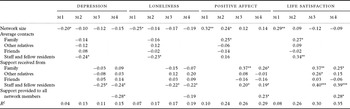
Despite a small sample size, it was sufficient to detect a medium effect size with up to six predictors, power ~ 0.80, and α = 0.05, 1-tailed, in multiple regression (Cohen, Reference Cohen1988). Nevertheless, because of the need to apply statistical controls, we first regressed the four well-being variables on a number of control variables, namely age, sex, marital status (0 = not married, 1 = married), education (0 = no education, 1 = some education), length of stay, ADL impairment, and self-rated health (1 = very poor, 5 = excellent). The unstandardized residuals (variance not accounted for by the control variables) of the well-being variables were then saved for subsequent analyses. These residualized scores were each regressed on (i) network size (M1), (ii) M1 plus contact frequency, broken down by relationship categories (M2), (iii) M1 plus functional support received, broken down by relationship categories (M3), and (iv) M3 plus average support provided to all network members (see Table 1). These four regression models allowed an examination of the incremental variance contributed by contact and support exchanges beyond that by network size, as well as the relative contribution of the different sources of support. The relationship-specific variables and length of stay were log-transformed to correct for skewness due to the extent of zero scores.
Hierarchical regression of psychological well-being variables on social support variables, controlling for age, sex, marital status, education, length of stay, ADL, and self-rated health

Note. Figures shown are standardized regression coefficients. M1, M2, M3 and M4 are different regression models. The total variance explained by each model equaled residual variance × R 2. The residual variances were 0.76 for depression, 0.65 for loneliness, 0.70 for positive affect, and 0.73 for life satisfaction.
*p < 0.05, **p < 0.01, ***p < 0.001.
Results
On average, the participants had a Barthel score of 16.74 (SD = 3.14; range = 2–19) and MMSE score of 23.93 (SD = 3.54; range = 18–30). They had been resident in the home for between 2 months and 17 years (mean = 4.83 years, SD = 3.93). Using a threshold of 2 on the GDS (Cheng and Chan, Reference Cheng and Chan2004; Cheng et al., in press), 58% of the participants were likely to be clinically depressed. Excluding those without specific types of network members (35% without family members, 56% without other relatives, 25% without friends, 81% without institution mates), the residents received a total of 3.6 visits per month (SD = 5.6, range = 0.4–30.8) from all family members combined, 2.8 visits (SD = 5.8, range = 0.0–30.4) from other relatives, and 0.8 visits (SD = 1.0, range = 0.4–4.4) from friends. Contacts with staff and fellow residents were more or less daily by nature.
These control variables explained 24% of the variance in depression, 35% in loneliness, 30% in positive affect, and 27% in life satisfaction. Across all analyses, only ADL, subjective health, and length of stay were the significant predictors. More functional impairments and poorer subjective health were associated with poorer psychological well-being, whereas a longer length of stay was associated with better well-being.
Results of the main analyses are displayed in Table 1. Network size explained 4–10% of the residual variances in the well-being measures, and contact frequency another 9–18%. In comparison, support received explained 7–22% and support provided accounted for another 2–5%, of the residual variances, beyond those contributed by network size. Network size became mostly nonsignificant after entering the contact or functional support measures, suggesting that the protective effects of social network were largely due to the interactions and support exchanges with network members. Contacts and support exchanges with family members were associated with positive well-being only, whereas those with staff and fellow residents were associated with both positive and negative well-being. However, other relatives and friends were generally irrelevant to the residents’ well-being. Importantly, being able to reciprocate support was also significantly related to well-being, except for positive affect.
Discussion
The current study examined the influence of structural and functional social support on the psychological well-being of nursing home residents in Hong Kong, while comparing the relative contributions of different types of relationship (i.e. family, other relatives, friends, and persons within the institution). Although network size was related to well-being, its effect was nonsignificant after controlling for average contact and functional support, suggesting that it is the actual interaction, and its quality, that determine whether a relationship enhances well-being, even for those who have been institutionalized. Results showed that only contacts with and support from the family and staff and fellow residents were associated with well-being, after controlling for sociodemographic variables, physical health, length of stay, and network size. Relatives and friends had no independent effects on the residents’ psychological well-being. Finally, providing support was significantly related to well-being, and this perception, which makes one feel useful, might be of greater importance to nursing home residents than community-dwelling older adults. Furthermore, it may be especially relevant in the Chinese context because of the strong norm of reciprocity in collectivist cultures (Nemoto, Reference Nemoto1998).
The contacts and support exchanges with staff and residents in the home appeared to be more important for the residents’ well-being than those with the family, which were associated with positive well-being (life satisfaction and positive affect) only; the former were related to negative (depression and loneliness) as well as positive well-being. Although family is usually the preferred provider of social support (Cantor, Reference Cantor1979; Litwak, Reference Litwak1985), its role is generally limited to providing support that is unrelated to constant functional assistance. Because residents in Hong Kong's nursing homes typically have no access to a telephone, visits become the only means to maintain support exchanges that would be largely emotional in nature. However, as shown in this study, visits from family members (mostly children still remaining in the network) were disappointingly few. Perhaps the mere mental representation of significant others as supportive persons, and children as filial, is already sufficient to make a lasting influence on one's satisfaction with life. Moreover, the nature of the exchanges during visits by family members may determine their psychological impacts. Lee et al. (Reference Lee, Woo and Mackenzie2002) found that nursing home residents, in order to normalize or re-establish their lives inside the home, detached themselves emotionally from family members, and avoided talking with them about their personal problems (including adjustment issues in the home). Typically, during such visits, both sides (residents and their family members) hide their problems and any negative feelings they might have, so as not to make the other party worry when they leave. Rather, both parties focus on the positive, even to the extent of glorification, and this might partly explain why family visits were especially associated with positive emotions among the residents, but did not alleviate depression and loneliness.
By contrast, persons in the institution provide daily contacts and socializing. Staffs also provide daily assistances in various matters, including personal and nursing care. Although Western studies suggest that residents make friendships in institutions, Lee et al. (Reference Lee, Woo and Mackenzie2002) suggest that residents are most concerned with respecting each other's territories, conforming to the rules and observing staff authority, not making trouble, and maintaining superficial harmony. They observed few interactions among the residents. Echoing their findings, 90% of the nominated network members in the institutions in our sample were staff (Cheng, Reference Cheng2009). In fact, despite the Chinese emphasis on the family, being able to establish connections inside the nursing home might be the hallmark of successful adaptation, or what Lee et al. (Reference Lee, Woo and Mackenzie2002) called “regaining normality”. This might be the reason why support from staff and fellow residents was even more strongly associated with well-being than support from family members.
Three limitations of this study need to be acknowledged. First, the difficulty of recruitment suggests that those who volunteered would tend to be healthier and more socially active than the general population of residents. Second, the small sample size precluded simultaneous examination of the independent effects of all the social support variables. Finally, the cross-sectional design does not allow inferences about causation. Despite these limitations, this study has contributed to the literature by showing the relative importance of the different relationships in the residents’ lives.
Conflict of interest
None
Description of authors' roles
S.-T. Cheng initiated the study, designed the research, collected the data, performed data analysis, and wrote up part of the paper. C. K. L. Lee and P. K. Chow both contributed to writing parts of the paper.
Acknowledgments
The preparation of this manuscript was supported in part by Competitive Earmarked Research Grant No. CityU1495/05H of the Research Grants Council of Hong Kong.