Environmental surfaces and equipment in hospitals may serve as reservoirs for pathogens.Reference Weber, Rutala, Miller, Huslage and Sickbert-Bennett 1 Objective assessment of the cleanliness of the patient care environment may identify deficits in cleaning and opportunities to reduce the risk of healthcare-associated infections (HAIs).Reference Eckstein, Adams and Eckstein 2 The Centers for Disease Control and Prevention (CDC) encourages hospitals to assess environmental cleanliness. 3 All methods of assessing cleanliness have advantages and disadvantages, and the lack of a standardized cleanliness benchmark makes direct comparison of methods challenging. 3
Adenosine triphosphate (ATP) luminescence technology is more effective than visual inspection,Reference Huang, Chen and Chen 4 is faster than microbiologic cultures, and allows immediate and objective feedback. This technology measures the amount of organic matter on a surface as a proxy for cleanliness. Manufacturer-recommended cutoff values are used to determine whether a surface “passes” or “fails”; however, microbiological data to support these cutoff values are limited. We examined the relationship between ATP concentration and bacterial burden on hospital environmental surfaces.
METHODS
From November 2015 to March 2016, surfaces in occupied patient rooms and other patient care areas in an 862-bed tertiary-care hospital were sampled using 2 environmental cleaning assessment methods: ATP burden in relative light units (RLU) using the CleanTrace Hygiene Management System (3M, Maplewood, MN) and bacterial burden in colony-forming units (CFU) per square centimeter using BBL Rodac contact plates (Becton Dickinson, Franklin Lakes, NJ). For the ATP assay, the manufacturer-recommended sampling area of 16 in2 (103.2 cm2) and a cutoff value for a “clean” surface of <250 RLU were used. Following study planning, the manufacturer-recommended cutoff value for a “clean” surface was changed to <200 RLU. Data were analyzed using both cutoff values. On contact plates, <1 CFU per cm2 was used as the cutoff for a “clean” surface.Reference Dancer 5 Surfaces sampled included adjacent sections of overbed tables, mobile workstations, visitor chairs, toilet seats, nursing station countertops, and glucometers. The ATP assay was completed first to ensure that this convenience sample included an even distribution of ATP burden levels (0–125, 126–250, 251–500, 501–1,000, and >1,000 RLU). The Institutional Review Board at Weill Cornell Medicine approved the study.
To assess the relationship between RLU and CFU, Spearman and Pearson correlations were calculated with log-transformed RLU values, and a negative binomial model was selected. To determine an optimal RLU cutoff value, logistic regression and a receiver operating characteristic (ROC) curve were used. Rodac plates with >200 CFU were considered too numerous to count and were recorded as 200 CFU.
RESULTS
In total, 98 surfaces in 4 inpatient units were assessed without regard to the time elapsed since last cleaned. Surfaces included nursing-station countertops (n=28) and glucometers (n=19), as well as overbed tables (n=19), mobile workstations (n=8), visitor chairs (n=9), and toilet seats (n=9) in occupied patient rooms. The median RLU value was 372 (range, 13–139,021), and the median CFU count was 0.7 per cm2 (range, 0–7.8). Cleanliness pass rates varied by assessment method: 40 surfaces (40.8%) passed by ATP assay (using the <250 RLU cutoff value) and 65 surfaces (66.3%) passed by CFU count (Table 1).
Comparison of Environmental Cleanliness Results by Assessment MethodFootnote a

NOTE. ATP, adenosine triphosphate; CFU, colony-forming units.
a ATP assay cleanliness assessment used a manufacturer-recommended benchmark of <250 relative light units (RLU) and bacterial burden assessment used a benchmark of <1 CFU/cm2.
Of 98 surfaces sampled, 53 surfaces (54.1%) had concordant results by ATP assay (using the <250 RLU cutoff) and CFU count. Among concordant samples, 30 surfaces (30.6%) passed both tests and 23 surfaces (23.5%) failed both tests. Of 45 discordant samples, 35 surfaces (35.7%) passed by CFU count but failed by ATP assay, and 10 surfaces (10.2%) passed by ATP assay but failed by CFU count.
Using Pearson and Spearman correlation coefficients, there was a modest but significant association between log-transformed ATP values and CFU counts (Pearson correlation coefficient 0.23, p<0.0001; Spearman correlation coefficient 0.30, p<0.001). Under the negative binomial model, ATP value predicted CFU count (P=.008). In this model, if the RLU value increased 100%, the mean CFU count increased 15.7%.
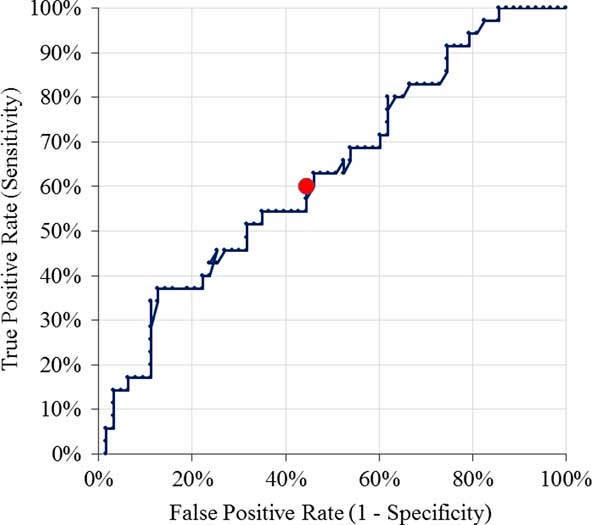
The area under the ROC curve of ATP values was 0.63 (Figure 1). A cutoff value of 384 RLU maximized both sensitivity (54.3%) and specificity (55.6%) (Figure 1). The sensitivity indicated that 54.3% of samples with a positive culture (≥1 CFU/cm2) yielded an RLU value ≥384. Similarly, the specificity indicated that 55.6% of samples with a negative culture (<1 CFU/cm2) yielded an RLU value <384.
Receiver operating characteristic (ROC) curve of cleanliness benchmarks based on ATP assay calibrated against bacterial burden. Bacterial burden assessment used a benchmark of <1 CFU/cm2. Maximum sensitivity and specificity were reached at 384 RLU (sensitivity 54.3%; specificity, 55.6%), indicated by the red bullet. The manufacturer-recommended cutoff for cleanliness of <250 RLU had a sensitivity of 68.6% and specificity of 44.4%. The updated manufacturer-recommended cutoff for cleanliness of <200 RLU had a sensitivity of 71.4% and specificity of 38.1%.

The sensitivity and specificity of manufacturer-recommended ATP cutoff values at the time of the study and at time of publication were assessed. A 250 RLU cutoff yielded 68.6% sensitivity and 44.4% specificity. A 200 RLU cutoff yielded 71.4% sensitivity and 38.1% specificity.
DISCUSSION
While ATP luminescence technology monitoring is not equivalent to microbiologic testing of environmental surfaces, these findings suggest that a correlation exists between RLU and CFU. Furthermore, these findings generally support the manufacturer-recommended cutoff values, demonstrating relatively high sensitivity but rather low specificity for the presence of viable bacteria on surfaces. Surfaces for which sampling resulted in a positive culture (≥1 CFU/cm2) were more likely to have an RLU value ≥384; however, with a false-negative rate of 45.7%, such a cutoff would likely be unacceptable for the assessment of hospital cleanliness.
The sensitivity of ATP assays for the presence of viable bacteria increased as the ATP value cutoff decreased. In this study, the updated cutoff value of <200 RLU demonstrated greater sensitivity, which would be prioritized over specificity in the case of discharge cleaning. The ramifications of lower specificity (eg, recleaning a surface that was already clean) are not resource heavy, while the potential ramifications of lower sensitivity include a suboptimally cleaned environment and an increased risk of HAI in subsequent room occupants.
Cleanliness assessment by ATP assay was generally more stringent than by CFU count. This finding may be attributable to the ability of the ATP assay to detect nonbacterial organic material. In this study, high ATP values did not always indicate the presence of viable bacteria. The difference in fail rates between these 2 methods was also observed in the study by Ho et al,Reference Ho, Wang and Jiang 6 who found that cleanliness fail rates were ~9% higher when assessed by ATP assay than when assessed by CFU count.
Other studies have determined ATP cutoff values through ROC curve analysis for the same ATP assay used in this study. Following area adjustment to the sampling area of this study, the ATP cutoff values that optimized sensitivity and specificity for presence of viable bacteria were found to be 756 RLU (7.34 RLU/cm2) by Ho et al,Reference Ho, Wang and Jiang 6 574 RLU (5.5 RLU/cm2) by Huang et al,Reference Huang, Chen and Chen 4 and 824 RLU (8 RLU/cm2) by Smith et al.Reference Smith, Beam and Sayles 7 All of these studies found higher ATP cutoff values than the current study (384 RLU); however, we employed a more conservative definition for cleanliness based on proposed microbiological standards for hospital surfaces (ie, <1 in this study vs <2.5 CFU/cm2 in other studies).Reference Dancer 5
Our study has several limitations. This was a single-center study with a small sample size. Sampling bias could be a factor; however, sampling sites were adjacent and grossly appeared to be of equal cleanliness. Rodac plates were incubated in aerobic conditions, preventing recovery of anaerobic organisms. Additionally, Rodac plates do not discriminate between pathogenic and nonpathogenic bacteria. Finally, cleaning chemicals, such as the bleach-based product used at our institution, may interfere with ATP assay results.Reference Brown, Eder and Thompson 8
Given its ease and ability to provide real-time data, ATP luminescence technology may serve as a useful proxy for microbial contamination in the hospital environment. However, better discriminative methods for assessment of environmental cleanliness are needed. In addition, further study of the association between the level of hospital cleanliness and risk of HAIs is needed.
ACKNOWLEDGMENTS
The New York State Department of Health (NYSDOH) provided research support but was not involved in study design, conduct, analysis, nor reporting. The data and conclusions reported here do not necessarily represent the opinions, interpretations, or policy of the State of New York.
Financial support: This study was funded by the NYSDOH (grant no. C028680) as a part of the Healthcare-Associated Infection Prevention Project.
Potential conflicts of interest: All authors report no conflicts of interest relevant to this article.