FOCUS POINTS
• MAO inhibitors still play a role in modern psychopharmacology.
• Distinct and understandable pharmacological mechanisms account for MAOIs and their therapeutic actions, serotonin syndrome/toxicity, sympathomimetic drug interactions, and dietary tyramine interactions.
• Dispelling the myths about these older agents and learning the truth—as well as the pharmacology behind it—can allow clinicians to confidently integrate these agents into clinical practice for patients who do not respond to first-line treatment.
Introduction
The first clinically effective antidepressants discovered were inhibitors of the enzyme monoamine oxidase (MAO). Today, there are several agents with variations of this mechanism of action. Despite the fact that MAO inhibitors (MAOIs) can be highly effective therapeutic agents for depression and some anxiety disorders, they tend to be underutilized in clinical practice.Reference Zisook1–Reference Cole and Bodkin4 There are many reasons for this, including the fact that there are many other treatment options, which prevent clinicians from becoming familiar with MAO inhibitors. Because these drugs are no longer emphasized in medical education, there is a great deal of misinformation and mythology about their dietary and drug interactions. This article is intended to serve as a guide for clinicians who are not particularly familiar with MAO inhibitors; its aim is to help clinicians integrate these agents into clinical practice when appropriate.
The Tyramine Interaction
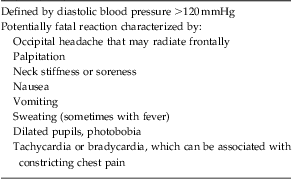
One of the biggest barriers to using MAO inhibitors has traditionally been the concern that a patient taking one of these drugs may develop a hypertensive reaction after ingesting tyramine in the diet.Reference Magyar, Szatmary, Szebeni and Lengyel5 Tyramine works to elevate blood pressure because it is a potent releaser of norepinephrine.Reference Stahl6–Reference Wimbiscus, Kostenko and Malone8 Normally, MAO-A acts to destroy norepinephrine to keep it in balance. Since accumulated norepinephrine can cause vasoconstriction and elevated blood pressure via increased binding at alpha 1 and other adrenergic receptors, its normal destruction by MAO-A helps to prevent these negative effects, even if foods high in tyramine are ingested.Reference Stahl6, Reference McCabe and Tsuang7, Reference Gardner, Shulman, Walker and Tailor9 In fact, the body has a huge capacity for processing tyramine, and the average person is able to handle approximately 400 mg of ingested tyramine before blood pressure is elevated.Reference Stahl6 A so-called “high-tyramine diet,” by contrast, represents only around 40 mg of tyramine.Reference McCabe and Tsuang7 When MAO-A inhibition takes place in the presence of tyramine, the increase in norepinephrine induced by tyramine is not countered by its destruction via MAO-A, and consequently the combination can lead to a very large accumulation of norepinephrine. Such a great norepinephrine accumulation can lead to excessive stimulation of postsynaptic adrenergic receptors, and therefore dangerous vasoconstriction and elevation of blood pressure. It may take as little as 10 mg of dietary tyramine to increase blood pressure when MAO-A is essentially knocked out by high doses of an MAO inhibitor,Reference Da Prada, Zurcher, Wuthrich and Haefely10 and that is why 40 mg is considered a high-tyramine diet. Some blood pressure elevations can be very large, sudden, and dramatic, causing a condition known as a hypertensive crisis, which can rarely cause intracerebral hemorrhage or even death (Table 1).Reference Stahl6
Hypertensive crisis
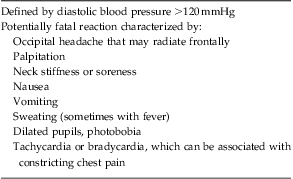
From Stahl SM. Stahl's Essential Psychopharmacology, 3rd ed. New York, NY: Cambridge University Press; 2008, p. 586.
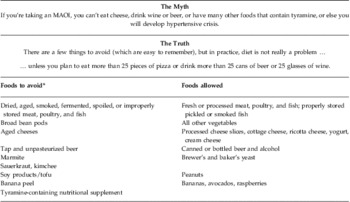
Because of the potential danger of a hypertensive crisis from a tyramine reaction in patients taking irreversible MAO inhibitors, a certain mythology has grown up around how much tyramine is in various foods and therefore what dietary restrictions are necessary (Table 2). Since the tyramine reaction is sometimes called a “cheese reaction,” there is a myth that all cheese must be restricted. However, while that is the case for aged cheeses, it is not necessary for most processed cheese or for most cheese utilized in most commercial chain pizzas.Reference Shulman, Walker, MacKenzie and Knowles11–Reference Shulman and Walker13 Thus, it is not true that a patient on a MAO inhibitor must avoid ingestion of any cheese. Also, it is not true that such patients must avoid all wine and beer. Canned and bottled beer are low in tyramine; generally only tap and nonpasteurized beers must be avoided, and many wines are actually quite low in tyramine.Reference Shulman, Walker, MacKenzie and Knowles11–Reference Shulman and Walker13 Of course, every prescriber should counsel patients taking the classic MAO inhibitors about diet and keep up to date with the tyramine content of foods their patients wish to eat.
Dietary guidelines for patients taking MAOIs

*Not necessary for 6 mg transdermal or low-dose oral selegiline.
From Stahl SM. Stahl's Essential Psychopharmacology, 3rd ed. New York, NY: Cambridge University Press; 2008, p. 584.
There are some types of antidepressant MAOIs that do not require any dietary restrictions due to tyramine. Selegiline is a selective MAO-B inhibitor at low doses, but must be administered in high oral doses in order to inhibit MAO-A as well.Reference Angst, Amrein and Stabl14–Reference Zsilla, Foldi, Held, Szekely and Knoll17 Antidepressant effects require inhibition of MAO-A;Reference Stahl6, Reference Chen, Holschneider, Wu, Rebrin and Shih18–Reference Mann, Frances, Kaplan, Kocsis, Peselow and Gershon20 thus, with antidepressant oral doses of selegiline, one also has risk of tyramine reactions. However, delivering selegiline through a transdermal patch allows inhibition of both enzymes in the brain while bypassing inhibition of MAO-A in the gut.Reference Stahl6, Reference Rapaport21 That is, transdermal delivery is like an intravenous infusion without the needle—delivering the drug directly into the systemic circulation, hitting the brain in high doses, and avoiding a first pass through the liver.Reference Stahl6, Reference Wecker, Copeland and Pacheco22–Reference Feiger, Rickels, Rynn, Zimbroff and Robinson24 By the time the drug recirculates to the intestine and liver, it has much decreased levels and significantly inhibits only MAO-B in these tissues. This action is sufficiently robust and selective, so that for low doses of transdermal selegiline, no dietary tyramine restrictions are necessary. At high doses of transdermal selegiline, there is likely some MAO-A inhibition in the gut, and thus some dietary tyramine restrictions may be prudent.Reference Cole and Bodkin4
Another method to theoretically reduce risk of tyramine reactions is to use reversible MAO-A inhibitors. Irreversible inhibition of MAO-A, as with the older MAO inhibitors, prevents the enzyme from ever functioning again; enzyme activity returns only after new enzyme is synthesized.Reference Krishnan25, Reference Schatzberg26 Reversible inhibitors of MAO-A (RIMAs), on the other hand, can be removed from the enzyme by competitors.Reference Stahl6, Reference Da Prada, Kettler, Keller, Burkard, Muggli-Maniglio and Haefely27, Reference Lotufo-Neto, Trivedi and Thase28 Thus, when tyramine increases norepinephrine release, it increases the competition for MAO-A. The RIMA can then be displaced, allowing for normal destruction of the extra norepinephrine and reducing the risk of a tyramine reaction.Reference Stahl6 However, RIMAs still carry the dietary restriction warnings of irreversible MAOIs.
Drug–Drug Interactions
While MAOIs are famous for their tyramine reactions, drug–drug interactions are potentially more important clinically. Drug–drug interactions may not only be more common, but also some interactions can be incredibly dangerous and potentially lethal.Reference Sternbach29, Reference Gillman30 Also, drug interactions with MAOIs are poorly understood by many practitioners. Most candidates for MAOI treatment will require treatment with many concomitant drugs over time, including treatment for coughs and colds and for pain, so not knowing which drugs are safe to give and which ones to avoid can unnecessarily prevent a practitioner from using an MAOI at all for someone who requires any concomitant medications.
There are 2 general types of potentially dangerous drug interactions with MAOIs for a practitioner to understand: those that can raise blood pressure by sympathomimetic actions and those that can cause a potentially fatal serotonin syndrome by serotonin reuptake inhibition.
MAOIs and noradrenergic agents
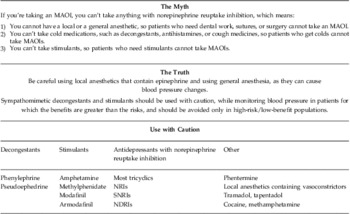
When drugs that boost adrenergic stimulation by a mechanism other than MAO inhibition are added to an MAOI, potentially dangerous hypertensive reactions can occur. For example, decongestants stimulate postsynaptic alpha-1 receptors; this constricts nasal blood vessels, but does not typically elevate blood pressure at therapeutic doses.Reference Stahl6 However, the direct alpha-1 stimulation of a decongestant combined with the noradrenergic action of an MAO inhibitor may be sufficient to cause hypertension or even hypertensive crisis.Reference Stahl6, Reference Lawrence, Adra and Gillman31 This is less likely with topical/intranasal administration and less likely in those not vulnerable to hypertension, but must be monitored in all patients taking a decongestant with an MAOI. Other agents that can increase noradrenergic activity include stimulants and some antidepressants, as well as other drugs (Table 3).Reference Stahl6 Practical guidance on specific interactions is provided in the following section.
Drugs that boost norepinephrine and thus should be used with caution with MAOIs

NRI: norepinephrine reuptake inhibitor; SNRI: serotonin norepinephrine reuptake inhibitor; NDRI: norepinephrine and dopamine reuptake inhibitor.
MAOIs and serotonergic agents
A potentially much more dangerous combination than that of adrenergic stimulants and MAOIs is the combination of agents that inhibit serotonin reuptake with those that inhibit MAO. Inhibition of the serotonin transporter (SERT) leads to increased synaptic availability of serotonin.Reference Dvir and Smallwood32 Similarly, inhibition of MAO leads to increased serotonin levels. In combination, these 2 mechanisms can cause excessive stimulation of postsynaptic serotonin receptors, which has the potential to cause a fatal “serotonin syndrome” or “serotonin toxicity.”Reference Gillman33
The general clinical features of serotonin toxicity can range from migraines, myoclonus, agitation, and confusion on the mild end of the spectrum, to hyperthermia, seizures, coma, cardiovascular collapse, permanent hyperthermic brain damage, and even death at the severe end of the spectrum.Reference Sun-Edelstein, Tepper and Shapiro34 Early diagnostic criteria for serotonin toxicity (syndrome) were developed by Sternbach based on examination of published case reports.Reference Sternbach35 However, these criteria may lack both sensitivity and specificity.Reference Dunkley, Isbister, Sibbritt, Dawson and Whyte36
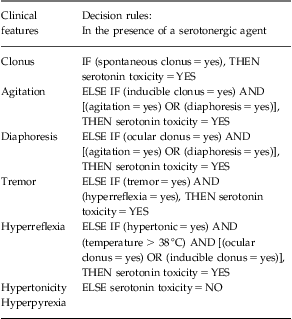
The apparent limitations of the Sternbach criteria for serotonin toxicity prompted another group to develop a set of diagnostic criteria. These criteria—called the Hunter serotonin toxicity criteria—are based on retrospective analysis of more than 2200 patients who experienced overdose from a serotonergic drug.Reference Dunkley, Isbister, Sibbritt, Dawson and Whyte36 It was determined that only 5 of the clinical features associated with serotonin toxicity were needed to make an accurate diagnosis: clonus, agitation, diaphoresis, tremor, and hyperreflexia. In addition, hypertonicity and hyperpyrexia were present in all life-threatening cases of serotonin toxicity. They also developed decision rules for diagnosis, based on the presence or absence of the seven clinical features (Table 4).Reference Dunkley, Isbister, Sibbritt, Dawson and Whyte36 Practical guidance on specific interactions is provided in the following section.
Hunter criteria for serotonin toxicity

What Patients on MAOIs Can and Cannot Take: Myth vs. Truth
The cold medication interaction
For patients with colds/upper respiratory infections who are on MAO inhibitors, it is probably best to use antihistamines, which are safe with the exception of those that are also serotonin reuptake inhibitors (e.g., brompheniramine and chlorpheniramine) (Table 3). Cough medicines with expectorants or codeine are safe, but avoid dextromethorphan, a weak serotonin reuptake inhibitor.Reference Sun-Edelstein, Tepper and Shapiro34
Small, open-label studies have been conducted to investigate potential drug–drug interactions between transdermal selegiline and sympathomimetics.Reference Azzaro, VanDenBerg, Ziemniak, Kemper, Blob and Campbell37 Change in heart rate and blood pressure was evaluated in a sample of 25 healthy controls during administration of pseudoephedrine (or phenylpropanolamine) alone, transdermal selegiline alone, or the combination. No significant differences were found. Nonetheless, the combination of transdermal selegline with sympathomimetics is still formally contraindicated.
The stimulant interaction
Combining an MAOI with a stimulant can increase the risk of a hypertensive reaction.Reference Stahl6, Reference Stahl38–Reference Fawcett, Kravitz, Zajecka and Schaff41 However, although formally contraindicated, stimulants can be given by experts with caution and appropriate monitoring, either as bridging medications when starting or stopping MAOIs or as augmenting medications to boost partial response to MAOIs (Table 3).Reference Stahl6, Reference Stahl38–Reference Feighner, Herbstein and Damlouji40, Reference Berlanga and Ortega-Soto42 They should not be used in patients who are known cocaine/methamphetamine/stimulant abusers.
The anesthetic interaction
Both general anesthesia and local anesthetics that contain epinephrine can cause changes in blood pressure (Table 3). Thus, for a patient taking an MAO inhibitor who needs to have a local anesthetic, one should choose an agent that does not contain vasoconstrictors.Reference Huyse, Touw, van Schijndel, de Lange and Slaets43 For elective surgery, one should wash out the MAO inhibitor 10 days prior to the surgery.Reference Huyse, Touw, van Schijndel, de Lange and Slaets43 For urgent surgery or elective surgery when the patient is still taking an MAO inhibitor, one can cautiously use benzodiazepine, mivacurium, rapacuronium, morphine, or codeine.
The tricyclic interaction
MAOIs are formally contraindicated in the prescribing information for patients taking antidepressants that are norepinephrine reuptake inhibitors, such as most tricyclic antidepressants. This is because the sudden addition of noradrenergic reuptake blockade in someone on an MAOI may result in a hypertensive reaction. However, with the exception of clomipramine, a potent serotonin reuptake inhibitor, other tricyclic antidepressants can be combined with MAOIs with caution for severely treatment-resistant patients (Table 3).Reference Stahl6, Reference Stahl38, Reference Feighner, Herbstein and Damlouji40, Reference Berlanga and Ortega-Soto42 If this option is selected, one should start the MAO inhibitor at the same time as the tricyclic antidepressant (both at low doses) after an appropriate drug washout; then, one should alternately increase the doses of these agents every few days to a week as tolerated.Reference Stahl6 The MAOI should not be started first.
Cyclobenzaprine, carbamazepine, and oxcarbazepine are structurally related to tricyclic antidepressants, and thus some practitioners believe they cannot be used with MAOIs; however, these agents do not block serotonin or norepinephrine reuptake and thus can be used with caution.Reference Stahl6
The painkiller interaction
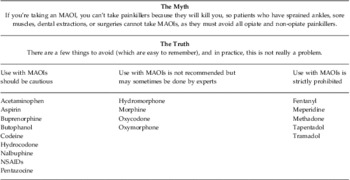
There is no interaction between MAOIs and opioid mechanisms; instead, the reason why some opioids must be avoided is that certain agents (meperidine, methadone, and tramadol) have serotonin reuptake inhibition,Reference Fuller and Snoddy44 while another (tapentadol) has norepinephrine reuptake inhibition (Table 5).Reference Hartrick and Rozek45 Analgesics, including opioids, that are safe to administer with an MAOI are those lacking serotonin reuptake inhibiting properties, such as aspirin, acetaminophen, nonsteroidal anti-inflammatory drugs, codeine, hydrocodone, and some others (Table 5).
Combining MAOIs and pain medications

The psychotropic drug interaction
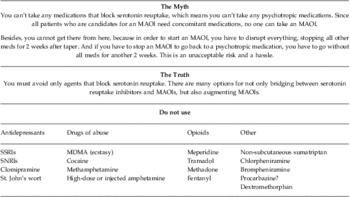
One can essentially never combine agents that have potent serotonin reuptake inhibition with agents given in doses that cause substantial MAO inhibition (Table 6).Reference Gillman46 This includes any selective serotonin reuptake inhibitor (SSRI); any serotonin norepinephrine reuptake inhibitor (SNRI), including the appetite suppressant sibutramine (now removed from most world markets); and the tricyclic antidepressant clomipramine. Opioids that block serotonin reuptake, especially meperidine but also tramadol, methadone, and dextromethorphan, must also be avoided when an MAO inhibitor is given. Several drugs of abuse also block serotonin reuptake; thus, diligent questioning about drug use is necessary when considering prescribing an MAO inhibitor.
Drugs to avoid due to risk of serotonin syndrome/toxicity

SSRIs: selective serotonin reuptake inhibitors; SNRIs: serotonin norepinephrine reuptake inhibitors; MDMA: 3,4-Methylenedioxymethamphetamine.
Although it is commonly believed that serotonin 1A partial agonism could contribute to serotonin syndrome, this mechanism is not actually a contraindication but can be administered with caution by experts in combination with MAO inhibition.
Switching and bridging
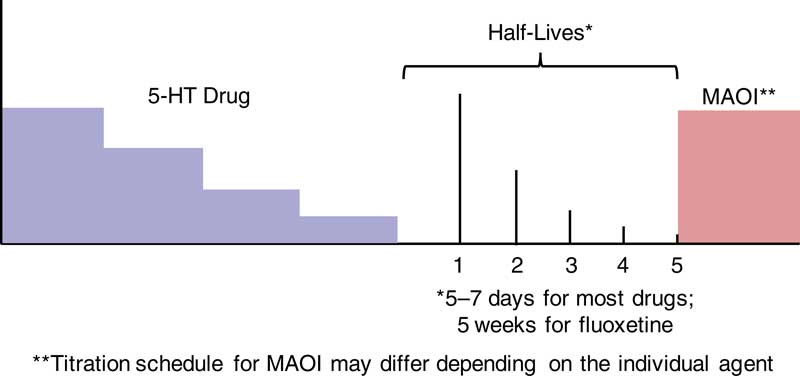
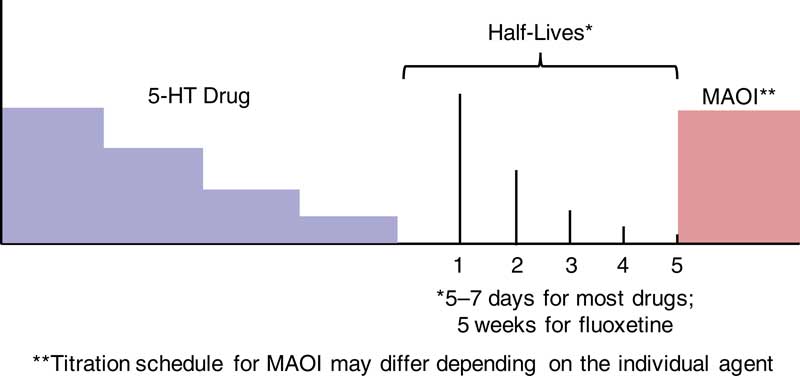
Because of the risk of serotonin toxicity, complete washout of a serotonergic drug is necessary before starting an MAO inhibitor (Figure 1). One must wait at least 5 half-lives after discontinuing the serotonergic drug before starting the MAO inhibitor.Reference Stahl38 For most drugs, this means waiting 5–7 days; a notable exception is fluoxetine, for which one must wait 5 weeks due to its long half-life.Reference Stahl38
Switching from a serotonergic drug to an MAOI.
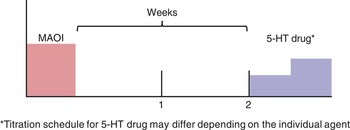
If one is switching from an MAO inhibitor to a serotonin reuptake inhibitor, one must wait at least 14 days following the discontinuation of the MAO inhibitor before starting the serotonergic drug (Figure 2).Reference Stahl38
Switching from an MAOI to a serotonergic drug.

Because there is a required gap in antidepressant treatment when switching to or from an MAO inhibitor, clinicians may be concerned about managing symptoms during that time period. There are many medication options, depending on the individual patient's situation. These include benzodiazepines, Z drug sedative hypnotics, trazodone, lamotrigine, valproate, and several other anticonvulsants, stimulants, and atypical antipsychotics. Specifically, although trazodone does have serotonin reuptake inhibition at antidepressant doses (i.e., 150 mg or higher), this property is not clinically relevant at the low doses used for insomnia while bridging an MAO inhibitor.Reference Stahl6 The atypical antipsychotic ziprasidone also has serotonin reuptake inhibition, but this is not likely to be potent enough at therapeutic doses to be a problem.Reference Stahl6
The Bottom Line
MAOIs should not be discounted as valuable treatment options for treatment-resistant depression and some treatment-resistant anxiety disorders. Although use of an MAOI does require a watchful eye over dietary intake, the restrictions are not as widespread as many believe. Likewise, although drug interactions can be serious, and concomitant medication use must be stringently overseen, there are some mistaken beliefs regarding the extent of the medication mechanisms that must be avoided. In short, one should be cautious when combining an MAOI with anything that boosts norepinephrine, because this can raise blood pressure, and one should completely avoid combining an MAOI with anything that blocks serotonin reuptake, because this can cause a dangerous or fatal serotonin syndrome/toxicity. Once armed with knowledge of MAOI therapeutic, dietary, and drug interaction mechanisms, clinicians may be able to revive these agents as therapeutic tools in the fight against treatment-resistant depression and anxiety.
Disclosures
Meghan Grady does not have anything to disclose. Stephen M. Stahl, MD, PhD is an adjunct professor of psychiatry at the University of California, San Diego School of Medicine, and an honorary visiting senior fellow at the University of Cambridge, UK. Over the past 12 months (December 2010–December 2011), Dr. Stahl has served as a consultant for Acadia, AstraZeneca, Avanir, Biomarin, BristolMyers Squibb, Cenerex, Dey, Eli Lilly, Forest, GenoMind, GlaxoSmith Kline, J & J, Jazz, Lundbeck, Merck, Neuronetics, Novartis, Noven, ONO, Orxigen, Otsuka, PamLabs, Pfizer, PgXHealth, RCT Logic, Rexahn, Roche, Servier, Shire, Solvay, Sunovion, Trius, and Valeant. He has served on speakers bureaus for Arbor Scientia, AstraZeneca, Eli Lilly, Forest, J & J, Merck, Neuroscience Education Institute, Pfizer, Servier, and Sunovion, and he has received research and/or grant support from AstraZeneca, Cenerex, Eli Lilly, Forest, GenOmind, Merck, Neuronetics, PamLabs, Pfizer, Roche, Schering Plough, Sepracor, Servier, Shire, Sunovion, Torrent, and Trovis.
Acknowledgment
Financial Support. The activity is supported by an educational grant from Dey Pharma, L.P.