INTRODUCTION
Patients with head and neck cancer are often nutritionally supported during therapy by percutaneous endoscopic gastrostomy (PEG) tube, as eating by mouth becomes difficult for the patient due to both the primary tumour and the side effects of radiation therapy. This procedure is considered safe, efficacious and some centres institute placement of a PEG tube before the point in time where a patient has difficulty with oral intake. Metastasis of a primary head and neck cancer to the PEG tube site is a rare occurrence and estimates of the overall incidence of this phenomenon range from 0.5 to 2% (refs. 1–4) at a median interval of 6 months. We report two cases (1.3%) of metastasis to the PEG stoma among the 153 head and neck cancer patients treated at Fox Chase Cancer Center.Reference Turaka5
CASE PRESENTATIONS
Case 1
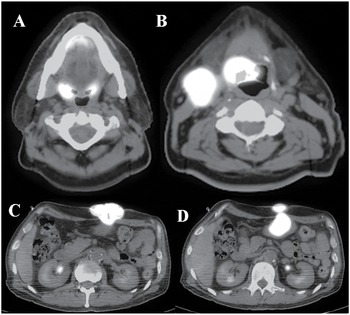
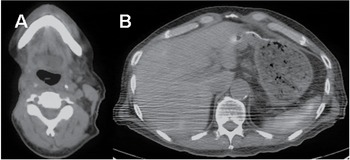
A 59-year-old man with 15-pack-year smoking history presented with a mass in the right upper neck and was found to have a 4-cm mass in the right tongue base on clinical examination. Biopsy was positive for squamous cell carcinoma (SCC). He also had 5-cm ipsilateral lymph nodes at level II/III and was staged clinical stage IV (T2 N2b M0). FDG positron emission tomography (PET) scan showed soft tissue density in the right BOT and level II lymph nodes (Figure 1a,b). PEG tube was placed before treatment. He was treated with concurrent chemoradiation therapy, 70 Gy in 35 fractions, 2 Gy per fraction, 5 fractions a week over 46 days by intensity-modulated radiation therapy technique, along with concurrent cisplatin+cetuximab chemotherapy and had a complete response at 3 months. At 7 months, PET scan showed soft tissue mass around the PEG tube and abdominal wall (Figure 1c,d). Biopsy was positive for SCC and treated with resection followed by post-operative radiation therapy 50.40 Gy in 28 fractions, 1.8 Gy per fraction over 38 days, 5 fractions per week by three-dimensional conformal radiotherapy technique using 6/10 MV photons. Clinical, radiological (Figure 2a,b) evaluation at subsequent follow ups revealed no evidence of recurrent disease and patient was doing well at last visit (2 years of follow up) and was on feeding jejunostomy tube.
FDG PET pre-treatment images showing (a) soft tissue lesion in the right base of tongue and (b) enlarged right level II lymph node and (c, d) recurrence at the percutaneous endoscopic gastrostomy tube site on skin surface with extension into the abdomen and stomach wall.

FDG PET scan images showing no evidence of disease locally at (a) BOT at last follow up visit and (b) at the PEG tube site on the abdominal wall.

Case 2
The second case is a 62-year-old Caucasian woman with 20 pack-year smoking history and heavy alcohol use in the past was found to have non-healing ulcer over few months on tongue causing difficulty swallowing and speech. Clinical examination showed a large lesion over the oral tongue extending to the base of tongue and vallecula with enlarged right level IB, IIA lymph nodes, and largest measuring 2 cm in size. Biopsy was positive for invasive SCC and was staged clinical stage IV (T4 N2B M0). She underwent placement of a PEG tube and tracheostomy before treatment due to respiratory compromise and treated with definitive radiation treatment to a total dose of 70 Gy in 35 fractions, 2 Gy per fraction over 46 days, 5 fractions per week by parallel opposed lateral portals, 6 MV photons, along with concurrent weekly cisplatin chemotherapy. Subsequently she underwent a right neck dissection at 3 months and one of six lymph nodes was positive for residual tumour but was disease free locally. At 11 months of follow up, she noted an enlarging mass at the PEG tube site. Biopsy of the mass demonstrated invasive SCC, extending into the stomach and underwent wide excision of the skin, subcutaneous tissue, rectus fascia and muscle, and partial gastrectomy with placement of a jejunostomy tube for feeding. Subsequently she was treated with postoperative radiation to a dose of 50.40 Gy in 28 fractions, 1.8 Gy per fraction over 38 days, 5 fractions per week by two oblique parallel opposed fields using 10 MV photons.
She had extensive progression of disease at the tongue base, with extension into the parapharyngeal region and left carotid space at 1 year of follow up, refused further treatment, and has unfortunately subsequently succumbed to disease.
Discussion
Although rare, the occurrence of PEG tube site metastasis has been reported increasingly in the literature in recent years. Based on our experience and the published data, PET-computed tomography can be a useful tool in evaluating the presence of PEG site metastases.Reference Purandare6
Several risk factorsReference Cappell1 for metastasis at the PEG stoma have been identified in a recent review by Cappell et al. which were tumour characteristics, including pharyngoesophageal location, squamous cell histology, advanced stage, poorly differentiated histology, and large mass size. Other risk factors were technique-related, including endoscopic method (surgical gastrostomy), pull-string technique, direct introducer technique, and insertion of PEG before initiation of chemo or radiotherapy.
There has been much debate on the mechanism of spread in this phenomenon. One hypothesis was direct seeding of the PEG stoma by passing instruments through the oropharynx and past the tumour, with direct transfer of viable tumour cells to the surgical site.Reference Pickhardt, Rohrmann and Cossentino7 The alternative hypothesis was that the tumour spreads through haematogenous or lymphatic spread.Reference Strodel and Kenady8 It has been suggested that the healing surgical stoma was well-vascularised, and that the healing wound may provide a mechanism for isolating the tumour cells in an immunoprotected environment. Additional arguments for this mode of spread included the frequent simultaneous occurrence of metastases in other parts of the body, which suggest that systemic dissemination has occurred.Reference Hosseini and Lee9 The most accepted theory currently is direct tumour seeding by passing the gastrostomy tube through the tumour site, with transmigration of viable tumour cells to the gastrostomy site.Reference Maccabee and Sheppard2 Attempts to minimise incidence of metastatic disease to the PEG stomata have therefore focused primarily on decreasing transfer of viable tumour cells to the surgical site, and several have been proposed:
Reducing tumour burden by means of chemotherapy or radiation therapy before insertion of PEG tube.Reference Cruz3
Use of a disposable sheath or introducer in the region of the tumour to minimise contact with the tumour to decrease cellular transfer.Reference Ananth and Amin10
CONCLUSION
Metastasis to PEG tube stoma in patients with head and neck cancer occurs in around 1% of patients. The exact mechanism by which this phenomenon occurs remains uncertain. We encourage all individuals involved in the care of patients with head and neck cancer to be aware of the possibility of metastasis to the PEG tube site, and hope to persuade them to take this occurrence into consideration when assessing the necessity of enteral support, the technique by which the PEG tube is inserted, and in the long-term follow-up of these patients in order to provide early diagnosis of metastasis to the PEG tube site.