Introduction
Quality of life (QoL) is often used as a clinical efficacy measure for psychosocial intervention trials in Alzheimer's disease (AD) (Katona et al., Reference Katona, Livingston, Cooper, Ames, Brodaty and Chiu2007; Andrieu et al., Reference Andrieu2009). However, there is still a lack of knowledge about the concept QoL, especially how QoL evolves over time in this patient group. Only a small number of studies have explored how the disease process in AD affects the patient's QoL in a longitudinal perspective. The first of such studies was conducted by (Lyketsos et al., Reference Lyketsos, Gonzales-Salvador, Chin, Baker, Black and Rabins2003) on patients who were living in long-term care facilities. Proxy-rated QoL of the patients was assessed over a two-year period. The results showed a significant decline of QoL in the patient group as a whole. However, nearly 49% of the patients showed either an improvement or no change even at two years follow-up. During one-year follow-up an overall decline in QoL was observed in a large Scandinavian study including AD patients with mild to severe dementia (both patient and proxy rating), and changes in proxy-rated QoL were significantly correlated to Mini-Mental State Examination (MMSE) scores and inversely related to the degree of neuropsychiatric symptoms (Jonsson et al., Reference Jonsson2006). Another longitudinal study (one-year follow-up) of AD patients living at home or in institutions did not demonstrate a clear picture of decline in QoL, and there were vast individual differences in patient-rated QoL (Selwood et al., Reference Selwood, Thorgrimsen and Orrell2005; Missotten et al., Reference Missotten2008). A similar pattern of findings was reported in a recent study with a six-month follow-up of 238 AD patients living in care homes in the UK (patient- and staff-rated QoL) (Hoe et al., Reference Hoe, Hancock, Livingston, Woods, Challis and Orrell2009). No overall change of QoL in AD patients was evident but individual differences in QoL were prominent. A significant association of change in QoL was also noted with symptoms of depression and cognitive performance. Cross-sectional studies across different dementia levels have found no consistent association between QoL and cognitive decline (Missotten et al., Reference Missotten2008).
Although the results from these previous studies differ as to the exact nature of change of QoL, they highlight the subjective nature of the concept in this population. Moreover, it is difficult to draw a conclusive picture from the results due to prominent methodological differences, mainly in terms of the care setting from which the sample was selected and whether the caregiver or patient rated the QoL scales. Most of the studies have examined either institutionalized patients or a combination of institutionalized and community-dwelling patients thereby making it difficult to generalize the results, especially for home-living patients with mild AD. Similarly, the different studies had used different QoL rating systems, with some using both proxy and patient-rated QoL versions for analysis. The small sample size in most of these studies, as well as the use of different QoL instruments, further questions the generalizability.
An important aspect of QoL research in AD has been the study of the clinical factors associated with QoL. The association between QoL and other variables such as depression, activities of daily living (ADL), cognitive performance and behavioral symptoms may vary across the disease spectrum although there is indication that depression has an impact on QoL regardless of cognitive status (Logsdon et al., Reference Logsdon, Gibbons, McCurry and Teri2002; Ettema et al., Reference Ettema, Droes, de, Ooms, Mellenbergh and Ribbe2005). However, research into the longitudinal aspect of QoL and its association with these clinical characteristics has been sparse. Previous studies have found an association between QoL and mood (Selwood et al., Reference Selwood, Thorgrimsen and Orrell2005) and cognition (Hoe et al., Reference Hoe, Hancock, Livingston, Woods, Challis and Orrell2009). This indicates to some extent that QoL may be related to clinical changes caused by the disease state. However, more information is needed in this area, mainly with patients having different disease severity and from various care settings in order to generate a conclusive picture.
The aim of the present study was to investigate how proxy-rated QoL changes over a three-year period in a large cohort of home-living patients with mild AD. The study also aimed to explore how the changes in QoL were associated with changes in clinical parameters.
Methods
The study was based on data from a subgroup of patients in the Danish Alzheimer's Intervention Study (DAISY) (Waldemar et al., Reference Waldemar2011). The study was conducted across five different regions of Denmark. It was designed as a one-year- multicentre, randomized controlled, rater-blinded trial with 1:1 randomization to follow-up group or to follow-up with the addition of a multifaceted, semi-tailored intervention program group. The evaluations were performed at baseline prior to randomization, and then at 6, 12 and 36 months respectively. QoL data from the baseline evaluation has been published previously (Bhattacharya et al., Reference Bhattacharya, Vogel, Hansen, Waldorff and Waldemar2010).
Study design
For the purpose of the present study 102 participants were included. To rule out any potential effect of the semi tailored intervention on the change of patient's QoL only patients who participated in the DAISY follow up group were included. Only the survivor cohort who completed assessment in all the time points was included (only AD patients). The evaluations at baseline, 12 and 36 months were considered for analysis.
The DAISY study included 330 home-dwelling patients and their primary caregivers. The subjects were diagnosed within less than 12 months of inclusion with probable AD (McKhann et al., Reference McKhann, Drachman, Folstein, Katzman, Price and Stadlan1984), mixed AD (World Health Organization, 1993), or dementia with Lewy bodies (DLB) (McKeith et al., Reference McKeith1996). Further inclusion criteria were age over 50 years, MMSE score 20 or above, and at least weekly contact with a primary caregiver who was willing to participate in the study and the intervention program. Exclusion criteria were severe somatic or psychiatric complaints (including impaired hearing or vision), patients participating in other intervention studies and those living in nursing homes.
The assessments at baseline were conducted by local project coordinators in the local memory clinics in the five centers. The follow-up visits at 12 and 36 months were home visits performed by independent raters who were not part of the project or employees of the memory clinics. None of the raters visited the same patient-caregiver couple more than once.
Ethics
The DAISY project was approved by the Danish Data Protection Agency (j.nr.2003-41-3178). The local Scientific Ethical Committee has evaluated the project protocol (j.nr., (KF) 02-005/04) and the project was registered in the Clinical Trial Database, ISRCTN74848736. All participants gave informed consent to participate in the study.
Assessment of quality of life
EuroQol 5D Visual Analogue Scale (EQ-5DVAS)
The EuroQol-5D (EQ-5D) is a commonly used generic instrument in which the respondents are asked to rate their current health state on five dimensions, with three possible levels for each dimension (EuroQol, 1990). The EQ-5D also includes a Visual Analogue Scale (VAS), with values from 0 (worst health state) to 100 (best possible health state). The present study included only the VAS, rated by the caregivers based on their impression of the patient's current health state. In the final analysis, the changed scores for VAS were calculated by subtracting the 12-month VAS from baseline (VAS 12) and the 36 months VAS from baseline (VAS 36).
Quality of Life in Alzheimer disease scale (QOL-AD)
The QOL-AD was specifically developed for use in patients with AD and their caregivers (Logsdon et al., Reference Logsdon, Gibbons, McCurry and Teri1999). Thirteen domains (physical health, energy, mood, living situation, memory, family, marriage, friends, self, ability to do chores, ability to do things for fun, money, and life as a whole) are rated on a four-point scale, 1 being poor and 4 being excellent. The maximum score is 52 and the minimum is 13. In the present study, the caregivers independently rated the scale on the basis of their current impression of the patient's QoL. For the changed scores of QOL-AD scale, the QOL-AD at 12 months was taken out from the baseline QOL-AD (QOL-AD 12) and similarly the changed scores at 36 months were calculated by subtracting the 36 months QOL-AD from the baseline (QOL-AD 36).
Clinical Outcome Variables
Mini-Mental State Examination (MMSE)
MMSE is used to detect cognitive impairment, to assess the severity of cognitive problems and to monitor cognitive changes over time. The scores range from 0 to 30, with higher scores indicating better cognitive function (Folstein et al., Reference Folstein, Folstein and McHugh1975).
Cornell Scale for Depression in Dementia (CSDD)
This is a 19-item depression scale that has been designed to measure depression in dementia (Alexopoulos et al., Reference Alexopoulos, Abrams, Young and Shamoian1988). The interviewer administers the scale in two steps. First, the caregiver is asked about the patient's depressive symptoms based on their observations of the patient during the past week before the interview. Following this, the rater interviews the patient and based on his judgment from the two interviews, marks each of the items. The total score ranges from 0 to 38, with a higher score indicating more pronounced depressive symptoms. A score below 6 is generally associated with the absence of significant depressive symptoms; scores above 10 indicate probable major depression.
Neuropsychiatric Inventory (NPI-Q)
NPI-Q is a clinical instrument that has been designed to evaluate neuropsychiatric symptoms in dementia. It measures 12 categories of symptoms and is administered to the informant/caregivers in an interview format. The caregivers provide a retrospective account (previous month) of the presence of neuropsychiatric symptoms in the patients. For each of the symptoms present, the caregivers were then asked to rate the severity of the symptom on a scale from 1 to 3 with 3 being the most severe. The NPI-Q yields a total severity score (0–36), with higher scores indicating more pronounced symptom severity (Kaufer et al., Reference Kaufer2000).
Alzheimer's Disease Cooperative Study, Activities of Daily living Inventory (ADCS-ADL)
This is an informant/caregiver administered 23-item scale to measure performance of activities of daily living (Galasko et al., Reference Galasko1997). The caregivers are asked in an interview format to rate the patient's level of performance for each activity in the past four weeks. The caregivers are carefully instructed not to base their responses on their own perceptions about the patient's abilities but on the patient's actual performance in daily life. The score ranges from 0 to 78 with higher scores indicating better functioning.
Statistical analysis
Repeated measure ANOVA was conducted to examine the level of significance for the overall change in QoL across the three time points (baseline, 12 and 36 months) as well as the change in the clinical variables of depression, ADL, cognitive performance (MMSE) and neuropsychiatric problems. To show the change of QoL from baseline, changed scores were calculated by subtracting baseline QoL scores (QOL-AD total score and VAS score) from the 12-month and 36-month QoL scores. Furthermore, the same procedure was used to obtain the changed scores for the clinical variables of CSDD, MMSE, ADCS-ADL and NPI-Q severity subscale. To investigate the impact of baseline QoL ratings on QoL ratings at 12 and 36 months respectively, stepwise linear regression analysis with plots of residuals as model control were applied with baseline QoL ratings, CSDD, MMSE, ADCS-ADL and NPI-Q severity (change from baseline scores) as independent variables. A p-value of 0.05 was considered statistically significant. The level of significance was adjusted using Bonferroni correction when multiple comparisons were performed.
Results
Clinical characteristics
At baseline the mean patient age was 76 years (± 7.1), and for the caregivers it was 66 years (± 12.7). The majority of the patients were married (70.1%) and 71.3% of them lived together with at least one other person. Among the caregivers the majority were female (66.5%) who were spouses of the AD patients (64.6%) and the majority had daily contact with the patients (76.6%). The percentage of patients living at home at baseline was 97.6% and in the follow-up it was 91% at 12 months and 86.3% at 36 months respectively. Therefore, the patient population throughout the analysis were predominantly home living.
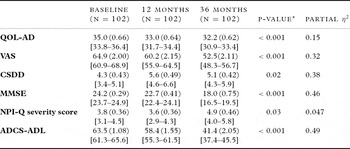
The MMSE, CSDD and ADCS-ADL scores for the three time points are shown in Table 1. The mean scores for depressive symptoms and neuropsychiatric symptoms were low throughout the whole study period. As expected, both MMSE and ADCS-ADL scores showed significant mean decline (p < 0.001), as well as when the different time points were compared to each other. For CSDD an overall effect of time was found (p = 0.02). The difference from baseline to 12 months was found to be significant, but the score at 36 months did not differ significantly from the baseline score or the score at 12 months (after adjusting for multiple comparisons). For the NPI-Q an overall significant effect of time was found (p = 0.03). When the different time points were compared on an individual basis the score at 36 months was significantly higher than at 12 months, but the rest of the comparisons for NPI-Q score were not significant.
QoL scores and clinical parameters (shown as mean (SE) [95% confidence interval])

* Repeated measures ANOVA.
QOL-AD = Quality of Life in Alzheimer Disease scale; CSDD = Cornell Scale for Depression in Dementia; MMSE = Mini-Mental State Examination; VAS = Visual Analogue Scale; NPI-Q = Neuropsychiatric Inventory; ADCS-ADL = Alzheimer's Disease Cooperative Study, Activities of Daily living Inventory.
Change in QoL from baseline
QoL scores from all three time points are shown in Table 1. Repeated measures ANOVA showed significant effect of time (p < 0.001) for both the QOL-AD and the VAS scale. When pair wise comparison was performed, the QOL-AD had significant average decline from baseline both at 12 and 36 months follow-up. However, change from 12 to 36 months did not show a significant change. The eta value (partial η2), on the other hand, showed that the overall decline in QOL-AD was modest but somewhat higher for VAS. The VAS scale showed significant decline across all time points.
The change from baseline for the QOL-AD scores showed a mean decline of 1.9 (QOL-AD12) and 2.8 (QOL-AD36). The mean change from baseline in EQ-VAS score was 4.7 for VAS 12 and 12.4 for VAS36. The change from baseline in both QOL-AD and VAS had a wide variation as shown in Figure 1. At the 12-month follow-up 48.3% of the sample had an improvement in their QoL (QOL-AD12), with 10.6% showing an improvement of 3 points or more (regarded as significant according to Hoe et al., Reference Hoe, Hancock, Livingston, Woods, Challis and Orrell2009). The VAS12 showed an improvement in QoL for 28.1% of the sample with another 22.1% showing no change in QoL. The VAS36 showed improvement in 30.6%of cases.
Change from baseline scores on QOL-AD and EQ-VAS (12 and 36 months).

Change in QoL and association with clinical symptoms and baseline ratings
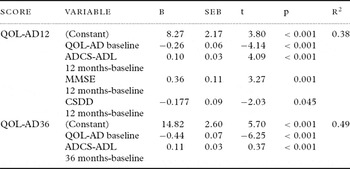
When baseline QOL-AD ratings, CSDD, MMSE, ADCS-ADL and NPI-Q were entered into a stepwise linear regression model of QOL-AD12, baseline QOL-AD ratings, CSDD, MMSE and ADCS-ADL were included (for results see Table 2). For QOL-AD36 only baseline QOL-AD ratings and ADCS-ADL score were included (for results see Table 2).
Linear regression analyses: contributions of QOL-AD baseline ratings, Cornell depression scale, MMSE, NPI-Q and ADCS-ADL score on QOL-AD12 and QOL-AD 36.

QOL-AD = Quality of Life in Alzheimer Disease scale; CSDD = Cornell Scale for Depression in Dementia; MMSE = Mini-Mental State Examination; ADCS-ADL = Alzheimer's Disease Cooperative Study, Activities of Daily living Inventory.
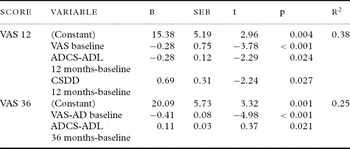
When baseline VAS ratings, CSDD, MMSE, ADCS-ADL and NPI-Q were entered into a stepwise linear regression model of VAS12, baseline VAS ratings, CSDD and ADCS-ADL were included (for results, see Table 3). For VAS36, only baseline VAS ratings and ADCS-ADL score were included (for results see Table 3).
Linear regression analyses: contributions of VAS baseline ratings, Cornell depression scale, MMSE, NPI-Q and ADCS-ADL score on VAS12 and VAS36

VAS = Visual Analogue Scale; CSDD = Cornell Scale for Depression in Dementia; ADCS-ADL = Alzheimer's Disease Cooperative Study, Activities of Daily living Inventory.
Discussion
To our knowledge this is the first report of the longitudinal changes in proxy-rated QoL in a large sample of home-living patients with AD over a three-year period. On a group level there was a global decline in QoL over the 36-month follow-up period, but the effect size of the change was rather small and there were vast individual differences. Measures of functional decline (MMSE and ADL) also showed decline during the three-year period indicating that dementia progressed in a typical manner in this patient group. Previous studies on changes in QoL in AD have been done mainly on samples from nursing/care homes (Missotten et al., Reference Missotten2008), or by including combination of nursing home and home-living patients (Hoe et al., Reference Hoe, Hancock, Livingston, Woods, Challis and Orrell2009), and the findings from these studies may not be generalized to AD patients living in the community. One previous study found an overall decline in QoL (Lyketsos et al., Reference Lyketsos, Gonzales-Salvador, Chin, Baker, Black and Rabins2003) but the majority of the previous studies showed no change in QoL even after one or two years (Selwood et al., Reference Selwood, Thorgrimsen and Orrell2005; Missotten et al., Reference Missotten2008; Hoe et al., Reference Hoe, Hancock, Livingston, Woods, Challis and Orrell2009). QoL can be rated in different ways. Our study only included proxy-rated QoL, as opposed to some of the previous studies that only included patient-rated QoL (Selwood et al., Reference Selwood, Thorgrimsen and Orrell2005; Hoe et al., Reference Hoe, Hancock, Livingston, Woods, Challis and Orrell2009). Thus, methodological differences primarily concerning rater perspective and dementia severity of included patients make comparison of the few published studies on longitudinal change in QoL difficult. The present study indicates that (proxy-rated) QoL on a group level does decline over time in the first years after dementia is diagnosed (if diagnosed in an early phase).
However, although there was a significant mean decline in QoL, the individual score distributions showed vast variations in both the QOL-AD as well as the VAS scale. Previous studies have also found similar results (Missotten et al., Reference Missotten2008; Hoe et al., Reference Hoe, Hancock, Livingston, Woods, Challis and Orrell2009). A considerable proportion of the patients improved in QoL both at the 12-month and the 36-month follow-up and many others showed no change. The improvement in patients’ QoL could be explained to some extent by the fact that the depressive symptoms and neuropsychiatric problem severity did not deteriorate significantly at all the time points. A lower rate of depression and neuropsychiatric problems may result in better QoL, and there may have been a bias in this patient group since the amount of depressive and other neuropsychiatric symptoms generally remained low through the three years.
The wide distribution of individual scores brings into question the interpretation of global scores. An overall change on a group basis (decline as well as improvement) should be interpreted with caution, as it may not take into account the vast individual variations. This also highlights the subjective and dynamic nature of the concept of QoL. Previous authors have pointed to the fact that some people adapt to their situation with time and therefore their interpretation of subjective well-being and health also modifies accordingly, and may not reflect their actual disease state (Evans and Huxley, Reference Evans and Huxley2005). In this study, where only proxy-rated QoL was investigated, caregivers’ adaptation to the patients’ state of health may to some degree explain the wide variation in QoL score, even after considerable disease progression. This indicates that QoL may be affected more by inherent personality traits of the individual rating QoL. The results have important implications for researchers planning intervention studies in AD. QoL has been used popularly as an efficacy parameter in intervention studies (Spector et al., Reference Spector, Woods and Orrell2008), and the results from our study also clearly demonstrate that QoL measures tap different functions than typical clinical variables (e.g. cognitive dysfunction and psychiatric symptoms) that may be relevant to monitor when an intervention is made in relation to demented persons. However, the wide variations in change from baseline scores may affect the validity of QoL measures as efficacy parameters because improvements in QoL cannot with certainty be appraised as an effect of an intervention. This area needs intensive investigation, especially on generating factors for individual variations in QoL in dementia.
The present study found significant association between change of QoL from baseline to 12 months measured by the QOL-AD and changes in clinical characteristics such as mood (CSDD), cognitive performance (MMSE) and functional limitation (ADCS-ADL). The level of association could, however, only be regarded as modest. At 36 months changes in QOL-AD from baseline were significantly associated only with change in functional performance (ADL). Some previous studies have found significant association between QoL and clinical factors such as depression, neuropsychiatric disturbance and functional limitations, in cross-sectional evaluations, but others have not (Logsdon et al., Reference Logsdon, Gibbons, McCurry and Teri1999; Hoe et al., Reference Hoe, Hancock, Livingston, Woods, Challis and Orrell2009). Thus, from the present study it seems that change of QoL is relatively independent of the effect of change in other clinical parameters. Only the QOL-AD scores had significant correlations with change in some of the important clinical characteristics at the early stages (12-month follow-up) but this did not continue in the 36-month evaluations. This again highlights the fact that QoL changes are dependent on individual factors. Importantly, the results showed that a change in QoL (both on QOL-AD and VAS) to some degree depends on the baseline QoL rating because people with high scores are more likely to obtain lower scores at follow-up and vice versa. This tendency has also been found in previous studies (Selwood et al., Reference Selwood, Thorgrimsen and Orrell2005; Hoe et al., Reference Hoe, Hancock, Livingston, Woods, Challis and Orrell2009).
QoL is essentially a subjective phenomenon, but the scales used to measure QoL in dementia (and many other diseases) have an objective character. Capturing all aspects of QoL by using short questionnaires is off course not possible but some disease specific scales (e.g. QOL-AD) have high face validity for investigating QoL in dementia since they include many aspects of QoL that may be important for elderly people with cognitive impairment (Logsdon et al., Reference Logsdon, Gibbons, McCurry and Teri2002). In the present study the EQ VAS was also included as a measure of QoL. This scale has been used in previous studies on QoL in dementia (Coucill et al., Reference Coucill, Bryan, Bentham, Buckley and Laight2001; Ankri et al., Reference Ankri, Beaufils, Novella, Morrone, Guillemin, Jolly, Ploton and Blanchard2003) but the validity of such a generic scale in dementia may be questioned. EQ-VAS was designed to assess QoL across disease groups (EuroQol, 1990) and has been used for different purposes (e.g. to examine socioeconomic effects). Thus, QOL-AD may have higher validity as a QoL instrument in AD than EQ-VAS but we have chosen to analyze the VAS data in this study also because very few reports on longitudinal changes in QoL have been published and because we wished to examine longitudinal changes in both generic and disease specific scales.
An important feature of the present study is the homogeneity of the study sample and the inclusion of a large cohort of home-living AD patients. However, the study design may have given some bias towards better functioning patients than the AD population as a whole (as shown by the generally low scores on CSDD and NPI-Q). Further, all patients completed a three-year follow-up period in a study and in the first months they may have received more attention and information than is typically provided for patients with dementia in Denmark. Thus, more studies on the longitudinal changes of QoL in AD (including the pattern of individual differences) would be interesting. Another interesting aspect of future studies would be to compare changes in patient- and proxy-rated QoL over time.
To summarize, there was an overall decline in QoL of AD patients over three years; however, vast individual variations were noted. A “global” pattern of change of a dynamic and subjective concept such as QoL is found to be questionable based on these results. On the whole, change in QoL could not be strongly accounted for by change in the most important clinical variables (cognition and neuropsychiatric symptoms), and may depend more on individual inherent traits of the individual.
Conflict of interest
None.
Description of authors’ roles
A. Vogel and S. Bhattacharya were responsible for conceptualization, design, data analysis, and writing of the paper. G. Waldemar was responsible for the DAISY program and participated in the study design and supervised the whole process of writing the paper. F. Waldorff gave valuable suggestions and comments that helped in conceptualizing the paper and took part in the design of the DAISY study.
Acknowledgments
The study was supported by the Agency for Social Service, the Ministry of Social Affairs, with contributions from the Ministry of Health and the Danish Health Foundation. We thank the project coordinators in the five regions – Anna Marie Hansen, Marianne Refslund, Dorte Dyre, Mette Lassen and Ane Eckermann – who collected the baseline data, as well as all the raters who made the home visits to collect the data.