1. Introduction
Discussions of determinism and indeterminism play an important role in many areas of philosophy. In philosophy of science, they have acted as probes into the basic structure of many physical theories; in philosophical logic, such discussions have triggered the development of a number of different logical systems, some of which have found application in computer science.
When it comes to defining indeterminism, one can discern two related but technically different approaches. The basic idea behind indeterminism is that given the way things are at one moment in time, more than one future course of events is possible. One way to spell this out is to start with a class of separate possible courses of events and the notion of a state at a moment. If the same state occurs in at least two different courses of events that disagree about the future development after the respective occurrences, the class is indeterministic. If that class is given via a scientific theory, that theory is accordingly diagnosed to be indeterministic. As a way of classifying scientific theories, this approach was pioneered by Montague (Reference Montague and Willner1962). After several refinements (see, e.g., Earman Reference Earman, Butterfield and Earman2006), many of which were triggered by specific issues of space-time theories, this approach grounds the generally accepted definition of indeterminism for scientific theories: “a theory is deterministic if, and only if: for any two of its models, if they have instantaneous slices that are isomorphic, then the corresponding final segments are also isomorphic” (Butterfield Reference Butterfield2005). A different way to model indeterminism is to start not with separate courses of events (called “models” in the above quote, but see sec. 2) to be matched via their states at moments but with a unified structure of moments within which one can identify the possible courses of events—histories—as substructures. This approach is more in line with an indexical understanding of branching future possibilities, according to which different possible courses of events can literally share a past segment. Such branching history structures were developed in Prior’s tense logic (Prior Reference Prior1967); an important early paper is Thomason (Reference Thomason1970). In so-called branching time (BT; a somewhat misleading label, as time does not branch, only temporal histories do), a single history is pictured as a linearly ordered set of moments carved from a global partial ordering of moments. BT is used as a background for the “seeing to it that” logic of agency (Belnap, Perloff, and Xu Reference Belnap, Perloff and Xu2001) and arguably corresponds well to the phenomenology of an open future. However, the framework is nonrelativistic: a moment (an element of the ordering) has to represent all of space simultaneously.
Theories of branching space-times (BST) extend the branching histories idea by taking histories to be space-times rather than linearly ordered chains of moments. Belnap’s version of BST (BST92; Belnap Reference Belnap1992) provides a mathematically rigorous theory of objective indeterminism in a relativistic setting. BST92 retains BT’s underlying algebraic approach of starting with a partially ordered set that can be called Our World as it represents all events that are, were, or will be possible. The notion of modal consistency, that is, possible co-occurrence within a single consistent course of events, which in the case of BT comes down to order relatedness (linearity), has to be extended: in the case of BST92, consistency is taken to mean the existence of a common upper bound (two events are compatible if there is, so to speak, a perspective from which both events have occurred). Building on that definition, the histories in Our World are defined as maximally modally consistent subsets. These histories represent the possible courses of events in our world—complete space-times—that branch off from one another at choice points whose future light cones differentiate the histories.
Despite its relativistic soundness and some applications to physical theories (e.g., Placek Reference Placek, Czarnecki, Kijania-Placek, Poller and Woleński2010), BST has not been much referenced in discussions of space-time theories, even when such discussions are concerned with questions of determinism and indeterminism. In fact, BST92 and some related BST theories have received a fair share of critique on the basis of technical considerations of the space-time models of general relativity (Earman Reference Earman and Dieks2008). Some of that criticism does not apply to BST92 since it only points out conceptual unclarities in relatives of that framework and not in BST92 itself, but there remains an important point of criticism in that BST92 corresponds poorly to general relativity’s background in differential geometry. While some recent publications (e.g., Placek and Belnap Reference Placek and Belnap2012) have begun to address this worry, we agree that so far, no extant formal specification of BST fully meets the critique.
This article spells out an overarching framework that is meant to do justice both to the logical aspects of BST and to the physical considerations supporting general relativistic space-time theories. It will be proved that our framework, which deviates from the mentioned theory of BST92 in some technical details, is truly a theory of branching (in the sense of logic) space-times (in the sense of general relativity).
2. Terminology
When discussing formal models that incorporate modality, such as theories of branching histories, it is important to use terminology that allows some necessary distinctions. Modal consistency (“modal flatness”) is usually a property of substructures and not of a full structure, which incorporates different alternatives and is therefore meant to be modally inconsistent. We suggest distinguishing
• a logical theory, specified via a set of axioms in some formal language,
• models of a logical theory, that is, structures fulfilling the axioms,
• a physical theory, which normally should not be identified with some axiomatic framework,
• a solution to the equations of the theory, which is a mathematical structure and can often be identified with a history (a complete possible course of events), and
• the metaphysical notion of a world as something that is unified by “suitable external relations” (Lewis Reference Lewis1986, 208).
It is common to identify the notions of model, solution to the equations, history, and (possible) world. This identification is not mandatory, however, and in fact positively harmful when it comes to BST. A history (possible course of events) indeed has to be “modally flat,” containing no modally incompatible events. In the case of BST, models contain more than one history, and each model (in the logical sense) specifies a world (in the given metaphysical sense). Following Belnap, we propose to call such a world (a model of BST) “Our World” rather than a “possible world,” since the notion of a possible world tends to trigger the image of modal consistency (while, to repeat, this is not part of the definition of what a world is).
3. An Overview of BST92
Here we give the axiomatic basis of BST92, due to Belnap (Reference Belnap1992, Reference Belnap2003). Later on we will deviate from this framework in a small but substantial matter of topological detail, in order to move it closer to general relativity.
A model of BST92 is a nonempty partial order  (a nonempty set
 together with a transitive, antisymmetric relation
 ) subject to the set of constraints given below.Footnote 1 Elements of
 are called possible point events, or, briefly, events. Let
 be the set of maximal upward-directed subsets of
 . (In a partial order, a set is upward directed iff for any two of its elements
 and
 , there is an element
 such that
 and
 . We often shorten this to “directed.”) Elements of
 , that is, maximal directed subsets
 , are called histories. A chain in
 is a linear subset, that is, a subset
 such that for any
 we have either
 or
 .
The axioms of BST92 are as follows:
•
 is a nonempty, dense partial order without maxima.
• Each lower-bounded chain
has an infimum in , written .• Each upper-bounded chain
has a supremum in () for each history for which .• (Prior choice principle) If
is a lower-bounded chain in none of whose elements is an element of , then there is a choice point such that is maximal in , and (i.e., for all , we have ).
 is a nonempty, dense partial order without maxima.
 has an infimum in
 , written
 .
 has a supremum in
 (
 ) for each history
 for which
 .
 is a lower-bounded chain in
 none of whose elements is an element of
 , then there is a choice point
 such that
 is maximal in
 , and
 (i.e., for all
 , we have
 ).
Note that by the given definition, histories are downward closed: if  and
 such that
 , then also
 . Accordingly, if
 is a lower-bounded chain in history
 , then
 as well.
As a first link with space-time theories, we can give a generic definition of the causal and the chronological past and future of events in a BST92 model, as follows:
Definition 1. Given a BST92 model  , an event
 lightlike precedes
 (in symbols:
 ) iff
 and there is only a single maximal chain that has
 as its first and
 as its last point. Event
 chronologically precedes
 (in symbols:
 ) iff
 and it is not the case that
 .
On the basis of these notions, we can define the notions of the causal and the chronological future (and analogously, past) of an event  , as usual:
Definition 2. Given a BST92 model  and some
 , the causal future of
 ,
 , and the chronological future,
 , are defined as follows:

The corresponding past notions are

4. The Hausdorff Property in Space-Time Theories
A topological space  , where
 is a nonempty set and the topology
 is the collection of open sets, is Hausdorff if any two elements of
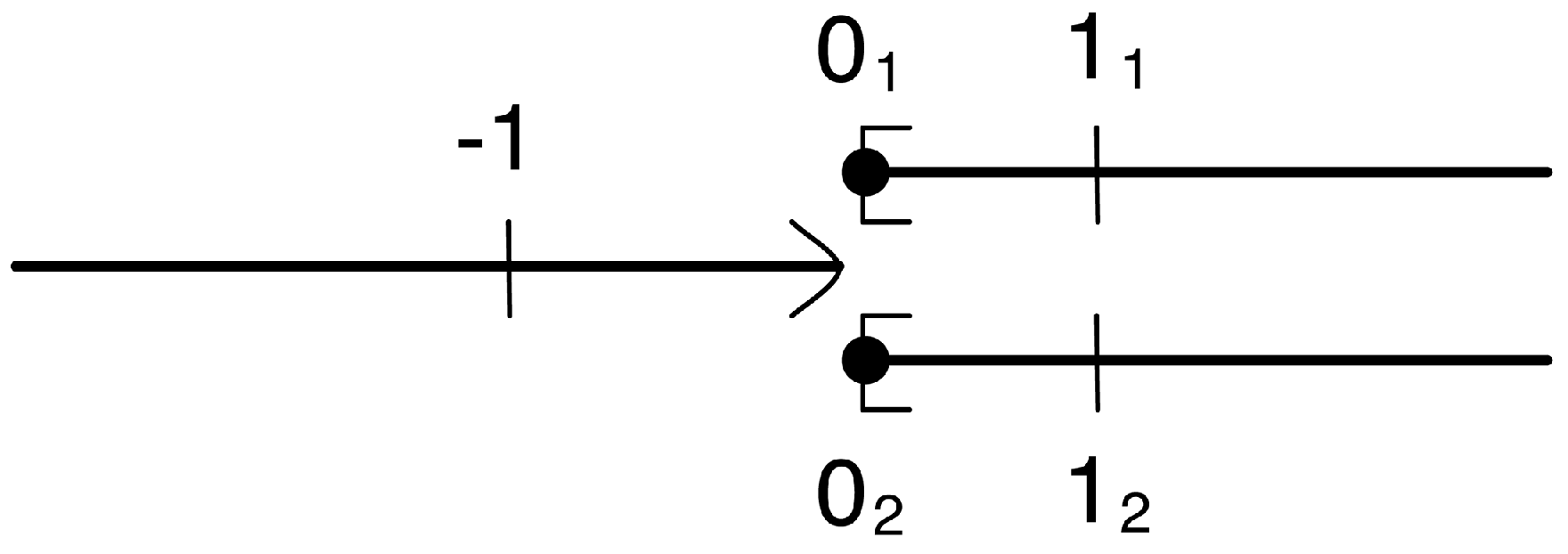
 can be separated by disjoint open sets.Footnote 2 Hausdorffness forbids, intuitively speaking, the existence of “unseparably close points” or perhaps “doubled points” or “points that occupy the same position.” The branching real line pictured in figure 1 is a simple example of a non-Hausdorff space. Following Hajicek (Reference Hajicek1971), who credits Geroch for the notation, we will write
 to indicate that the points
 and
 violate the Hausdorff condition, that is, that
 and
 cannot be separated by disjoint open sets. In figure 1 we have
 . The notation usefully suggests graphically that in such a case,
 and
 “branch off” from some common trunk, like the left part of the branching lines of figure 1. In fact, in our examples below such
 and
 will always be different limits of a single converging sequence.
Branching real line as a simple non-Hausdorff space. A basis for the topology is given by the open intervals in both tracks, reaching into the common part on the left.

As defined, BST92 does not come with a topology. One natural topology has recently been discussed extensively by Placek and Belnap (Reference Placek and Belnap2012). With respect to this topology, the Hausdorff property generically fails in models of BST92. Models of BST92 are not locally Euclidean, however, and thus do not form (generalized) manifolds.Footnote 3
Is non-Hausdorffness a good idea for grounding BST? The discussion of this issue is somewhat tangled. Earman (Reference Earman and Dieks2008) in his overview of “individual branching” for single space-times concludes that the only viable path to individually branching space-times comes from non-Hausdorff models because other approaches (e.g., so-called trousers worlds) appear unfeasible. While we follow Earman in this assessment, we want to stress that BST—at least in the form of BST92 and in the form that we are trying to develop further here—is not meant to give a picture of a single space-time that somehow branches (perhaps like an amoeba undergoing fission) but to integrate several histories within one logical model. The branching (overlapping) histories are individually nonbranching and, in fact, Hausdorff space-times. Still, it is useful to look at the physicists’ discussion of non-Hausdorffness that Earman references.
In mathematical physics, Hajicek (Reference Hajicek1971) proves an important result about solutions to the Einstein field equations whose maximal analytic extensions are non-Hausdorff: roughly, a non-Hausdorff space-time either fails to be strongly causal or admits bifurcating geodesics. Hajicek interprets this result as showing that “all such [i.e., non-Hausdorff] space-times must be weakly acausal” (75), which would indeed be reason enough for a physicist to shun non-Hausdorff space-times. It is interesting to see how Hajicek supports his interpretation of his theorem. Commenting on bifurcating curves, he writes: “It is easily seen that such curves can only exist in a non-Hausdorff space. Then, if we have some system of ordinary differential equations which has locally a unique solution … it is immediate that this system cannot have two different solutions … unless these solutions form a bifurcate curve. Therefore, in view of the classical causality conception coinciding with determinism it is sensible to rule out the bifurcate curves” (79). The dialectics is thus as follows: a result from mathematical physics (Hajicek’s theorem 4) establishes (roughly) that in non-Hausdorff space-time models either there is a violation of strong causality or there are bifurcating curves. An appeal to determinism rules out the latter; considerations of physicality rule out the former. This amounts to rejecting non-Hausdorff models.
We agree with this argument completely. If BST were to give models of a single space-time, these models should not contain bifurcating curves, and most probably they should not be weakly acausal either, so that non-Hausdorffness would be ruled out. However, if one takes up the issue of non-Hausdorff models in order to build formal models for indeterminism, which is what drives the development of BST, then the above argument obviously pulls no weight. The main challenge for bringing together BST and general relativity, in our view, lies not in non-Hausdorffness but in the failure of BST92 to provide generalized manifolds.Footnote 4
5. Simple Branching: Generalized Minkowskian Manifolds
We move on to the construction of simple branching models that provide a bridge between the logical, order-theoretic point of view of BST (histories, i.e., single space-times, as directed sets) and the topological point of view of general relativity (a single space-time as a differential manifold).Footnote 5 The main technical challenge is to define structures in which two or more space-times are pasted together in such a way that the resulting object is locally Euclidean and makes sense as a model of objective indeterminism. In this article, we discuss the simplest case of such pasting, which is to paste together  Minkowski space-times (of dimension
 ) at the origin, to arrive at a structure
 . There are various choices for this pasting, depending on whether the
 origins are represented by one or by
 different points in the resulting structure and on how the rim of the future light cone at the origin is handled. BST92’s prior choice principle demands identifying the
 origins as one point but keeping separate the rim of the future light cones above the origin. This is what breaks local Euclidicity: on such a structure, one cannot define a locally Euclidean topology (unless one gives up connectedness, which is not an interesting option). Since we want to define generalized manifolds, we have to ascertain local Euclidicity. This means that we need to differ from BST92 in the pasting construction.
Our choice is to define structures of  -fold branching,
 -dimensional Minkowski space-time
 as follows:Footnote 6
Definition 3 ( ). The
 -fold branching,
 -dimensional Minkowski space-time
 is defined from the
 -dimensional Minkowski space-time
 (for simplicity, we use
 with the Minkowskian ordering
 ) by setting a to-be-multiplied region
 to be the future light cone of the origin, including the rim of the light cone and the origin itself:

defining  layers, for
 , to be

and pasting them via

The ordering  on
 is the union of the usual Minkowskian orderings in the layers, and the locally Euclidean topology
 is given via the countable basis of open balls with rational center coordinates
 and rational radius
 in the finitely many layers
 ,

Note that the layers themselves, each of which is homeomorphic to  , are open sets in this topology and that for
 ,
 . Note also that
 .
6. Capturing Modal Consistency
Our structures  are still partial orders, as in BST92, but we want to move from the order-theoretic to a generalizable, topological characterization of modal consistency. Intuitively and by the pasting construction, the maximal modally consistent subsets of
 should be exactly the layers
 ,
 . These cover the whole of
 without any gaps or holes, and they are also individually such that in each layer, each space-time point of Minkowski space-time
 occurs exactly once. These layers are also the histories in the sense of the usual order-theoretic definition of BST92: each layer is a maximal directed set in
 .Footnote 7 The question before us is how to capture this intuitive notion of modal consistency in purely topological terms.
Hajicek (Reference Hajicek1971) defines the useful notion of an H-submanifold of a  -manifold (where the H stands for “Hausdorff,”
 graphically represents non-Hausdorffness as branching, and a
 -manifold is a generalized manifold):
Definition 4 (H-manifold). Given a  -manifold
 , a subset
 is an H-submanifold iff
 is open, connected, Hausdorff, and maximal with respect to these properties (i.e., every proper superset of
 is not open, not connected, or not Hausdorff).
Hajicek (Reference Hajicek1971) also suggests to write  for the set of points in
 that are non-Hausdorff related to some point in
 ,

On our way toward a useful generalized notion of modal consistency, we note some facts about the points in  that are non-Hausdorff related to some other point (obviously there are no such points in case
 ):
Lemma 1. Let  for some
 and some
 . Then for
 we have

Accordingly,

and for  a layer (
 ), we have

Using a further lemma, we can then prove that the layers of  are in fact H-submanifolds:Footnote 8
Lemma 2. Let  for some
 ,
 , and let
 be a layer (
 ). Then
 is an H-submanifold of
 .
However, the notion of an H-submanifold is not sufficient as an analysis of modal consistency, given that we also want the other direction of lemma 2:
Fact 1.  has an H-submanifold that is not equal to one of the layers
 ,
 .
Proof by example. We divide the rim of the forward light cone of the origin into a left and a right part, which are allowed to overlap at the origin:

We have  and
 . Now consider the set

that is,  is the whole of the pasted space
 without half of the rim of the forward light cone in each layer. Note that the origin in both layers is removed in constructing
 , which makes it intuitively weird. But as a fact,
 is an H-submanifold of
 . This follows directly from Hajicek (Reference Hajicek1971, theorem 2). So, we know that not every H-submanifold can be taken to be a history.
By a more detailed consideration of this and other examples, we are finally led to our official topological definition of a maximal consistent set, or a history:Footnote 9
Definition 5. Given  for some
 and
 , a history in
 is a subset
 that is maximal with respect to the properties of being (i) open, (ii) connected, (iii) Hausdorff, and (iv) for each subset
 , if
 , then
 as well.
As a test for the usefulness of this definition, we can now indeed prove both directions of the analogue of lemma 2:
Lemma 3. Given  for some
 and
 , a subset
 is a history according to definition 5 iff
 for some
 .
Definition 5 can be applied to any H-manifold; it is not limited to the structures  with respect to which it was motivated. So we have arrived at a general definition of modal consistency in BST.
7. Conclusion
In this article, we have given an overview of the main challenges facing the construction of explicit formal models for indeterminism in a general relativistic setting. The best extant candidate framework for such models is Belnap’s BST92. Some criticisms leveled against the project of constructing BST seem misplaced, as they rely on the idea that in BST, a single space-time should somehow branch or bifurcate. We agree that this should be avoided. The branching in BST is of a modal nature, and as single space-times are modally consistent, they themselves do not branch. The BST approach, once it is followed with mathematical rigor and once a topology is defined, does lead to non-Hausdorff models, however. Again, a fair share of the criticism of non-Hausdorff models only applies to single space-times and not to BST structures. There is one specific challenge that has not been met so far, however: BST92 does not define generalized manifolds, and therefore the link with general relativity is not satisfactory. We believe that we have met this challenge, at least for simple structures.
In this article, we have defined a method for pasting Minkowski space-times in a locally Euclidean way, such that the resulting structures are generalized manifolds. We have also given a novel definition of modal consistency, which is purely topological and which generalizes the order-theoretic definition in terms of directedness on which BST92 is built.
A lot remains to be done. So far we have only investigated the simplest structures: pasted Minkowski space-times. We propose that locally, any useful BST should look like one of the  we have defined here. The study of global features of our BST models, however, has to be left for future work.
 ,” which is defined in the usual way:
 if and only if (iff)
 and
 .
 -like construction is given in Visser (
 structures or their generalizations mentioned below. McCabe (
 , which is directed. For maximality, observe that any “new” element to be added to
 has to come from
 with
 ; by the definition of the ordering, the resulting superset of
 is not directed.