Background/significance
CHD is the most common birth defect, affecting ~32,000 infants each year in the United States of America alone.Reference Hoffman and Kaplan 1 Nearly 2.3 of every 1000 infants undergo life-saving surgical or transcatheter intervention in the first year of life.Reference Gillum 2 Learning that one’s infant has a life-threatening congenital anomaly and witnessing one’s infant undergoing frequent invasive procedures can be extremely traumatic for parents.Reference Melnyk, Alpert-Gillis and Feinstein 3 , Reference Manne, Du Hamel, Gallelli, Sorgen and Redd 4 Anxiety and stress often peak in the days and weeks after hospital discharge, when parents no longer have immediate access to the nursing and medical staff support to which they had become accustomed during the hospitalisation.Reference Morgan, Craig, Grant, Sands, Doherty and Casey 5 This finding is especially true for families who live long distances from the treating cardiac centre, those with limited financial or social support, and single parents.Reference Vilhjalmsson and Kristjansdottir 6 , Reference Visconti, Saudino, Rappaport, Newberger and Bellinger 7
We designed the REACH intervention for families with infants recovering from complex congenital heart surgery with the intent to decrease parental stress and improve their quality of life and ensure infant stability. The purpose of this paper is to describe the methods of a randomised controlled trial that was designed to determine whether REACH would favourably affect parental and infant outcomes. The results of the trial are beyond the scope of this manuscript and will be reported in a future publication.
Parental stress
It is known that stress levels are higher in parents of children with chronic illness and/or disabilities compared with the general population.Reference Breslau, Staruch and Mortimer 8 , Reference Hintermair 9 The stress of caring for infants with complex CHD is unrelenting and may last weeks, months, and often years, placing parents at risk for developing post-traumatic stress disorder, as well as significantly decreased quality of life.Reference Melnyk, Alpert-Gillis and Feinstein 3 Results from a focus group study that we conducted of mothers of infants with complex CHD between 4 and 8 months of age, the constant need for vigilance around infant healthcare needs, mandatory around-the-clock feeding, and a constant fear of the next complication emerged as themes. This constant vigilance and night-time waking contributed to daytime fatigue, anxiety, and distress.Reference Hartman and Medoff-Cooper 10
CHD
Critical CHD warranting surgery during the first weeks of life may be classified as either having univentricular physiology such as in hypoplastic left heart syndrome or biventricular physiology as in transposition of the great arteries. The abnormal cardiac anatomy and physiology are addressed using fairly well-established perioperative management strategies and surgical interventions. Although much attention has been given to the outpatient follow-up care for shunt-dependent infants with univentricular physiology,Reference Ghanayem, Cava, Jaquiss and Tweddell 11 few data exist for the follow-up care of infants with biventricular physiology. Recent studies have demonstrated that infants undergoing biventricular repair have feeding and growth issues and parents experience stress when taking these infants home as well.Reference Hartman and Medoff-Cooper 10 , Reference Tregay, Brown and Crowe 12 , Reference Anderson, Marino and Irving 13
Home monitoring programmes
Initial reports of favourable outcomes in the interstage period associated with home monitoring programmes for infants recovering from the Norwood operation first appeared in 2003.Reference Ghanayem, Hoffman and Mussatto 14 Such programmes are now used in most centres in North America.Reference Carlo, Cnota, Dabal and Anderson 15 Before discharge, parents receive standardised education on “red flags”, which are indications to immediately contact healthcare providers between clinic visits.Reference Ugonabo, Hirsch-Romano and Uzark 16 , Reference Nieves, Uzark, Rudd, Starwn, Schmelzer and Dobrolet 17 Patients are discharged with infant weighing scales and pulse oximeters to monitor daily weight, enteral intake, and systemic oxygen saturation. In most programmes, parents review these data weekly with a nurse practitioner and discuss feeding strategies using standardised nutritional guidelines to optimise weight gain during the interstage period.Reference Weston, Adil Husain and Curzon 18 In conventional home monitoring programmes, parents report varying abilities to communicate with providers about these protocol violations such as changes in infant behaviour or appearance or a parental feeling that “something is not right”.Reference Tregay, Brown and Crowe 12
The implementation of conventional home monitoring programmes has generally been associated with decreased mortality but inconsistent effects on infant weight gain and parental anxiety.Reference Rudd, Fommelt, Hehir, Slicker, Mussatto and Ghanayem 19 – Reference Petit, Fraser, Mattamal, Slesnick, Cephus and Ocampo 21 Conventional home monitoring programmes typically exclude infants with complex biventricular physiology, despite the fact that such patients are at risk for both morbidity and mortality, and have no proven interventions to decrease parent stress and improve parental quality of life. Moreover, increased parental anxiety associated with the implementation of a home monitoring programme has been reported by one group of investigators.Reference Stoffel, Spirig, Stiasny, Bernet, Dave and Knirsch 22 It is important to explore these issues further in infants with univentricular physiology and to describe the needs of parents of infants with biventricular CHD having undergone corrective surgery.
Telehealth
Telehealth (or telemedicine) has long been used in adults with chronic illnesses and in a variety of locations, including rural areas. Conditions that have been the focus of telehealth initiatives include chronic heart failure, chronic obstructive pulmonary disease, depression, dementia, diabetes, and weight loss. Further, telehealth has been shown to decrease hospitalisations of nursing home residentsReference Grabowski and O’Malley 23 and is reported to be cost-effective in supporting long-term conditions such as depression and cardiovascular disease.Reference Thomas, Man and O’Cathain 24 In a recent review, Tappenden et alReference Tappenden, Campbell, Rawdin, Wong and Kalita 25 describe the cost-effectiveness and the clinical benefits of nurse-led interventions for home-bound adult patients with a wide variety of long-term care issues. In addition, telemedicine and phone messaging has been linked to an increase in the timeliness of attending the cardiology clinic in adults, increased satisfaction in making clinical decisions with the use of video conferencing, and facilitation of self-management of long-term illnesses.Reference McCrossan, Morgan, Grant, Sands, Craig and Casey 26 – Reference de Jongh, Gurol-Urganci, Vodopivec-Jamsek, Car and Atun 30
Compared with adults, the use of telehealth in infants and children is less well established. In the paediatric cardiac population, telehealth was first introduced as a diagnostic tool for physicians.Reference Grant, Morgan and McCrossan 31 More recently, McCrossan et alReference McCrossan, Morgan, Grant, Sands, Craig and Casey 26 reported that video conferencing is feasible and a preferred method of communication with parents in the care of infants with CHD. Parents reported significantly decreased anxiety levels after the implementation of combined visual and audio contact with providers.Reference Dehghani, Atallah and Rebeyka 28 However, the users found the video conferencing system to be cumbersome, as it was dependent on a broad-band system that was unreliable and had suboptimal video quality. Some experience exists with automatic wireless transmission of daily weight in infants with functional single-ventricle heart defects, but this modality has been associated with multiple challenges including inconsistent wireless connection and data transmission and no difference in weight gain compared with usual care at time of stage 2 palliation.Reference Black, Sadanala, Mascio, Hornung and Keller 32 , Reference Cross, Steury, Randall, Fuska and Sable 33 Finally, most telemedicine programmes for home monitoring in cardiac infants have used phone calls for communication between parents and providers rather than visual technology.Reference Black, Sadanala, Mascio, Hornung and Keller 32 , Reference Cross, Steury, Randall, Fuska and Sable 33
Design transitional telehealth home care: REACH trial
Study setting
To address some of the limitations of conventional home monitoring programmes, we developed the REACH intervention. The REACH protocol combined an evidence-based advance practice nurse transitional care model with an innovative use of technology to support infant cardiac patients and their parents after hospital discharge.
Trial design
To assess the effectiveness of REACH, we conducted the Transitional Telehealth Home Care: REACH Trial (NCT01941667). In this multicentre randomised, controlled trial, we hypothesised that parents and infants assigned to REACH would have improved outcomes compared with families assigned to a conventional home monitoring programme. Specifically, we aimed to reduce parental stress, measured using the Parental Stress IndexReference Abiden 34 and Post Traumatic Distress SurveyReference Manne, Du Hamel, Gallelli, Sorgen and Redd 4 ; improve quality of life, assessed using the Ulm Quality of Life IndexReference Goldbeck and Melches 35 ; and social support, measured using the Enriched Social Support Index.Reference Vaglio, Conard and Poston 36 Infant outcomes included temperament, measured using the Early Infancy Temperament QuestionnaireReference Medoff-Cooper, Carey and McDevitt 37 ; feeding behaviours,Reference Wright, Parkinson and Drewett 38 measured using the Millennium Infant Study Questionnaire and parent description; and weight gain. All measures were taken within the first few weeks at home and at the end of their participation in the study. We also anticipated the impact of REACH to decrease healthcare resource utilisation, with fewer re-admissions, emergency department use, and unplanned acute care physician and cardiology clinic visits.
Sample and setting
Infants and their parents were enrolled from three large academic medical centres in the Midwestern and North East regions of the United States of America. Infants with CHD were eligible for the trial if they had a birth weight ⩾2500 g and were at least 37 weeks of gestation at birth, had no chromosomal abnormalities (except 22q11), underwent cardiac surgery before 3 weeks of life, and were discharged from the hospital by 2.5 months of age. Infants were excluded if they had sustained significant neurologic injury or were listed for heart transplant, or if their parents did not speak or read English.
An a priori power analysis determined that a sample size of 164 infants was needed to detect a difference in parental stress using 80% power and for two type I error rates – 0.05 and 0.017. Accounting for attrition, we aimed to enroll 250 patients for randomisation. Families were enrolled after infant extubation and before discharge from the hospital. Participants were randomised using a randomly permuted blocks algorithmReference Beller, Gebski and Keech 39 to ensure equal distribution between groups of infants with univentricular and biventricular physiology. Each family was followed up until 4 months after hospital discharge – for infants with biventricular physiology – or admission for second-stage surgery – for infants with univentricular physiology.
Human rights, safety, and treatment fidelity
Approval was obtained from the Institutional Review Board (IRB) at each participating centre. Before data collection, all participants provided written informed consent.
A Data and Safety Monitoring Board was established for the oversight of the study. Members were four independent clinician scientists who all had expertise in CHD and psychological interventions.
Each study site had a minimum of two advance practice nurses – or one advanced practice nurse and research coordinator – and two cardiologists on the REACH team. To maintain fidelity between study sites, all advance practice nurses were trained on the protocol by the project manager. Further, weekly meetings were held with all advance practice nurses to discuss 10% of all virtual home visits completed that week. In addition, any re-admissions owing to poor weight gain or vomiting and visits to an emergency department were reviewed.
Conventional home monitoring programmes (control group)
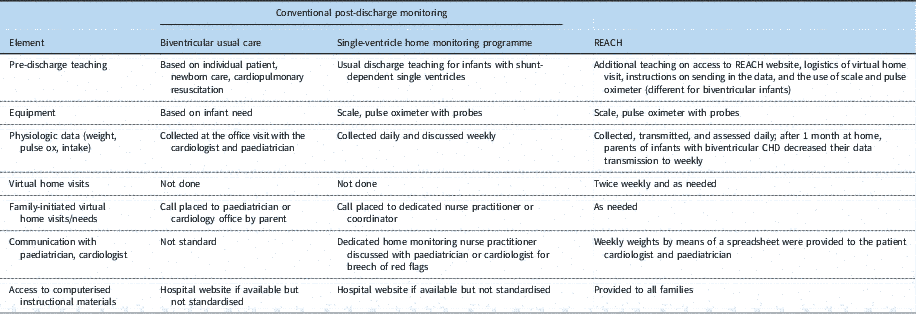
Before the onset of the REACH trial, infants with shunt-dependent univentricular physiology were monitored closely after discharge at study centres using established, conventional home monitoring programmes (Table 1). Follow-up care for infants with biventricular physiology was less intense and not standardised. Infants with biventricular physiology were not discharged with scales or pulse oximeters on a routine basis. Telehealth or text messaging was not formalised in the care of infants with CHD at any of the three sites.
Elements of REACH protocol versus usual care.

The intervention: REACH
Infants assigned to the intervention group received all elements of conventional home monitoring programmes that were already established in study centres (Table 1). In addition, patients assigned to REACH received daily transmission and evaluation of infant data; virtual home visits, twice weekly and as needed; and access to online educational protocols that addressed topics such as feeding, fortification, and the care and placement of nasogastric tubes. Table 1 outlines the differences between usual care and REACH.
Individualised parameters for alarm triggers were set for poor weight gain (or weight loss), change in oxygen saturation, change in heart rate, and inadequate caloric intake. On the basis of these triggers, the computer software sent additional alerts to the nurse practitioners, research coordinators, and families advising them that parameters were out of range. Before discharge home, the inpatient team determined adequate daily caloric intake.
Before discharge from the hospital
While in the hospital, the advance practice nurse established a relationship with the infant and parents to facilitate the assessment of the infant at home. A schedule was established for the daily automated, computer-generated messages (sent from MyBuddyCheck, described below) and twice-weekly virtual home visits (described below). Adjustments to the schedule were made in the event of parental need or healthcare provider – for example, paediatrician or cardiology – visits. As described previously, questionnaires regarding parental stress,Reference Cross, Steury, Randall, Fuska and Sable 33 post-traumatic stress,Reference Manne, Du Hamel, Gallelli, Sorgen and Redd 4 quality of life,Reference Abiden 34 feeding behaviours,Reference Medoff-Cooper, Carey and McDevitt 37 social upport,Reference Goldbeck and Melches 35 and infant temperamentReference Vaglio, Conard and Poston 36 were provided for a parent to complete at home.
In addition to the usual discharge teaching, REACH participants received pre-discharge educational training by an advance practice nurse. This training included a review of “red flags” (e.g., when to contact a clinician), written material on how to access the online study materials, and education items. Instruction in the use of Skype® or Facetime® was provided given varied levels of parental experience with video-chatting. In the event that parents had no access to internet or video conferencing, the needed equipment was provided using study funds.
At home
Daily monitoring and computer-generated messaging
At the same time each day, an automated text message or phone call was sent to parents requesting clinical information such as oxygen saturation, heart rate, weight, enteral intake, and new concerns via MyBuddyCheck, a telehealth platform. MyBuddyCheck uses automatic speech recognition, e-mail, and text message technologies to provide secure interactive personal self-monitoring solutions. The majority of parents chose to receive text messages and not phone calls. These messages asked questions such as “do you need to speak to an advance practice nurse” and “do you have any concerns about your infant”. Other questions inquired about the presence of vomiting, meal refusals, diaphoresis, skin colour changes, or irritability. Parents were encouraged to reach out to the advance practice nurse if the infant developed concerning signs and symptoms such as vomiting, irritability, or changes in colour. The MyBuddyCheck system tracked parental responses, automatically identified inadequate weight gain, enteral intake, oxygen saturation outside a pre-specified range, or increased heart rate. When pre-specified thresholds were breached, the MyBuddyCheck system sent automated messages to all REACH team advance practice nurses, research coordinators, and parents. In addition, the advance practice nurses were able to view weights, enteral intake, heart rate, and oxygen saturation in graph format before phone calls or virtual home visits. Advance practice nurses and research coordinators reached out to the family if no daily data were received.
Advance practice nurse review of the data
A designated advance practice nurse at each centre was responsible for evaluating the data for each patient on a daily basis. During the assessment of the data, one of three decisions was made:
∙ No action was needed. All physiologic data for the infant were stable
∙ Measurements were inadequate and phone call was placed to the parents for further evaluation. For instance, parents may have made a math error, entered the data incorrectly, or requested a phone call with the REACH advance practice nurse.
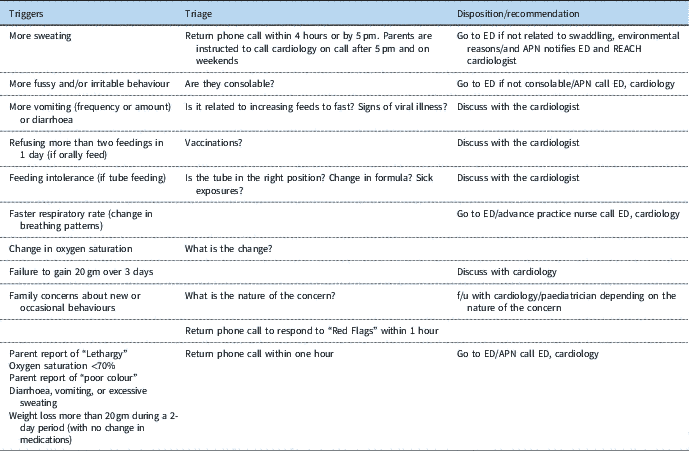
∙ Phone call within 1 hour to assess the infant status for concerning data (red flag breach): Parental report of “lethargy”, oxygen saturation <70%, “poor colour”, diarrhoea, vomiting, excessive sweating, or weight loss more than 20 g over a 2-day period.
During phone calls with parents, the REACH advance practice nurse assessed the parent and infant to determine the severity of the issue. For example, advance practice nurses would triage parent reports of infant irritability, which can occur for a variety of reasons such as constipation, gas, colic, or physiologic instability. Occasionally, parents indicated that they were scared or simply wanted reassurance especially within the first few weeks at home. If the advance practice nurse made a recommendation to contact the paediatrician or cardiologist, or go to the emergency department, the advance practice nurse would notify the infant’s primary cardiologist, the REACH cardiologist, the paediatrician, and the emergency department (as appropriate). No longer than 24 hours after such a recommendation, the REACH advance practice nurse made a return call to follow-up with the parents to ensure that all concerns had been addressed, except on weekends. Follow-up calls to parents were also conducted if the parent reached out to the on-call cardiology service off hours as there was no overnight REACH team coverage.
Twice weekly scheduled virtual home visits
Twice-weekly virtual home visits were conducted with the infant and parent at a pre-arranged time. Calls or texts were placed to the parent to confirm availability for the scheduled visit. Before each virtual home visit, the advance practice nurse assessed the recently submitted data. During these virtual visits, a scripted interview was conducted with the parent to review infant progress specifically related to infant behaviour, colour, and caloric intake, weight, breathing, and oxygen saturation. A visual inspection of the infant, parent, and environment was made and the parent’s comfort and stress levels related to the baby’s care were assessed. Strategies for stress reduction were discussed. Feeding regimen and patterns were discussed during each virtual home visit. Recommendations for increasing caloric intake were provided using established protocols.Reference Weston, Adil Husain and Curzon 18 In the event of clinical concerns during the virtual home visits, recommendations were made as previously discussed. Finally, medication changes, and any visits to the paediatrician, cardiologist, or emergency department visits were reviewed. The calls were always started with “Is there anything you are concerned about or want to cover today?” and concluded with the phrase “Is there anything else I can do to help you?” The frequency of messaging and twice-weekly virtual home visits were reassessed on a weekly basis. Case review and weekly team meetings determined a change in frequency. In the event of wireless malfunction, a phone interview was conducted and a video of the infant was sent via text messaging for visual inspection of the infant.
Unplanned family-initiated home care visits
Families were encouraged to reach out with any concerns between the scheduled virtual home visits. Parents typically preferred communicating through text message, but if many text messages were required to relay a point, phone calls were made. Concerns raised by parent could be simple – for example, “I am out of phone minutes”; concerning and quantifiable – for example, decreased enteral intake or oxygen saturations; subjectively complex – for example, fussiness; or statements such as the infant “just looks different”. Some parent-initiated communications could be owing to “red flags”, such as increased irritability, feeding refusals, change in behaviour, vomiting, or changes in breathing or oxygen saturation. These comments warranted rapid contact with the family and possible virtual home visits or visits to the cardiologist, paediatrician, or emergency department (Table 2).
Triage for triggers and disposition.

ED=emergency department; APN=advance practice nurse; f/u=follow-up.
Communication with paediatrician, cardiologist, emergency department
Once patients were enrolled in the REACH trial, all primary healthcare providers – for example, paediatrician, cardiologist, and study cardiologist – were notified and informed to expect communication from the study team regarding clinical issues. REACH team members informed the paediatrician of any changes in infant status such as cough, nasal congestion, diaper rash, or changes in feeding regimen. Further, the REACH team informed the cardiologist of any “red flags” and if a parent was directed to take the infant to the emergency department or the cardiology clinic. Finally, the majority of the cardiologists – both primary and REACH cardiologists – had access to the computerised infant clinical data but were also sent the average weight gain at least biweekly.
Planned statistical analysis
We plan to assess the effects of the REACH intervention versus usual care on parent outcomes of stress, quality of life, social isolation, and symptoms of post-traumatic stress disorder at 4 months using general linear modelling. Continuous variables will initially be compared between groups using two-sample t-tests or non-parametric Wilcoxon statistics depending on the normality of the data. Levene’s tests will be used to assess homogeneity of variance. Binary and categorical variables will initially be compared between groups using Fisher’s exact tests. Significant differences between groups on these variables will result in their use as covariates in the general linear modelling of outcome at 4 months. Separate general linear models will be generated for each of the outcome measures. Each outcome measure will be regressed on intervention group assignment, and any other covariates deemed prognostic in the initial analysis described. Independence of observations will be ensured by the study design; residual plots will be used to visually assess the assumption of linearity among outcome and individual continuous variables. To protect against violations in the homoscedasticity assumption, the robust variance estimator (Huber Sandwich Estimator) will be used to estimate the variance of the maximum likelihood estimates. Least square means will be used to estimate effect sizes for the intervention on the various outcome measures.
Infant stability will be assessed by measures of weight gain, feeding behaviours, and frequency of unscheduled cardiology and emergency room visits. Weight gain will be measured in terms of WHO-standardised velocity growth score from discharge to 4 months. Weight velocity z score will be regressed on intervention group assignment using general linear modelling as described above, with adjustment for initial weight z score and any other covariates deemed prognostic by the initial univariate analyses. Again, model assumptions will be evaluated.
Healthcare outcomes such as number of re-admissions, total re-admission days, emergency department visits, and unscheduled acute care physician office visits will be measured as counts and analysed using longitudinal log-linear regression models in generalised estimating equations with the Poisson distribution as the working model for the outcomes. For each of these end points, the difference in mean predicted counts is the outcome of interest – for example, difference between groups in total re-hospitalisation days. Predicted counts will be calculated for the follow-up intervals of 0–120, 0–30, 30–60, 60–90, and 90–120 days. The individual number of re-hospitalisations will be modelled using Poisson/negative binomial/zero-inflated negative binomial regression, depending on the goodness-of-fit statistics.Reference Selvin 40 , Reference Greene 41
Conclusion
REACH is the first randomised control trial evaluating an intervention to improve both parent and infant outcomes after cardiac surgery. Key outcomes include parental stress, quality of life, post-traumatic stress, and infant weight gain. REACH uses a unique combination of technology and intensive advance practice nurse monitoring strategy that adds to existing home monitoring programmes developed for infants with univentricular hearts. The protocol encompasses a telehealth platform for communication between parents and healthcare providers and virtual home visits for visual assessment of patients, parents, and the home environment. Unlike conventional home monitoring programmes, infants with biventricular physiology were also included for intensive monitoring after discharge. To date, there are limited data on parental needs in infants with biventricular physiology, and the findings of the REACH trial will help to fill this gap in knowledge.
Acknowledgements
The authors acknowledge Drs Martha Curley, Alex Hanlon, David Goldberg, Shobha Natarajan, and Alyson Stagg for their participation in this endeavour. Dr Curley provided clinical trial support. Dr Hanlon provided statistical support. Drs Goldberg and Natarajan were cardiologists on the REACH team at The Children’s Hospital of Philadelphia. Stagg provided much support to the REACH protocol and for the manuscript. Finally, the authors would also like to acknowledge the staff nurses in both institutions, and last but not least the families for participating in this protocol.
Financial Support
This study was supported by The National Institute of Nursing Research (grant number RO1NR002093).
Conflicts of Interest
None.