INTRODUCTION
The usefulness of assessing the viability of a new technology during the research and development (R&D) phase is generally acknowledged. Such ex ante analysis is even more imperative in view of increasingly limited agricultural R&D resources. However, it is still not standard practice to include profitability assessments in agronomic trial results in developing countries (e.g. Diatta et al., Reference Diatta, Kotchi and Sahrawat2002). In part, this reflects a disciplinary focus and a relative unease in applying multi- or trans-disciplinary approaches. Profitability also adds to the perceived site- and time-specificity of research findings as prices vary over space (e.g. depending on market access), can be distorted by policies (e.g. fertilizer subsidies) and are subject to market fluctuations (e.g. 2008 food crisis). However, there is an increasing tendency to include profitability indicators in agronomic trial results (e.g. Bationo et al., Reference Bationo, Ayuk, Ballo and Kone1997). Often such economic analysis encompasses partial budgeting, is not based upon robust formulae and is largely dependent upon the quality of the experimental data used (Riley and Alexander, Reference Riley and Alexander1997).
Relatively standard assessment approaches for the analysis of agronomic data have been variously developed and applied in developing country settings (Ashby, Reference Ashby1990; Baum et al., Reference Baum, Gyiele, Drechsel and Nurah1999; Boughton et al., Reference Boughton, Crawford, Krause and de Frahan1990; CIMMYT, 1988; Mutsaers et al., Reference Mutsaers, Weber, Walker and Fischer1997; Upton, Reference Upton1996). However, many of these publications are not easily available (Riley and Alexander, Reference Riley and Alexander1997), although some can now be found on the internet (e.g. Boughton et al., Reference Boughton, Crawford, Krause and de Frahan1990; CIMMYT, 1988). The standard assessment approaches work relatively well when input and output markets are reasonably well developed and market prices thereby provide representative values for farmers' decision making. Non-tradable inputs and outputs can often also be reasonably estimated through their opportunity costs. Particularly problematic though is the assessment of trial results for innovations that still lack a developed supply market. This typically implies that initial access to the new technology is problematic and transaction costs high. This makes the access cost potentially prohibitive for most resource poor farmers. It also makes it problematic to estimate realistically the future profitability and technology prospects and derive the corresponding implications for R&D.
Phosphorus (P) can be a significant soil fertility constraint for agricultural productivity (Bationo et al., Reference Bationo, Ayuk, Ballo and Kone1997; Kpomblekou and Tabatabai, Reference Kpomblekou and Tabatabai2003; Shapiro and Sanders, Reference Shapiro and Sanders1998). Chemical fertilizer sources are not necessarily an accessible or adequate solution for resource poor farmers in sub-Saharan Africa, particularly as such fertilizer often has to be imported and its subsequent distribution is difficult and costly (Breman et al., Reference Breman, Groot and van Keulen2001). There are a number of natural rock phosphate deposits on the continent, e.g. Togo and Mali (Bationo et al., Reference Bationo, Ayuk, Ballo and Kone1997; Diatta et al., Reference Diatta, Kotchi and Sahrawat2002) in West Africa, and Egypt, Ethiopia (Haque and Lupwayi, Reference Haque and Lupwayi1998), Kenya (Waigwa et al., Reference Waigwa, Othieno and Okalebo2003) and Tanzania (Van Vuuren and Hamilton, Reference Van Vuuren and Hamilton1992). This has generated an interest in developing these sources as alternative supply of P for crop production. Natural supplies also imply that rock phosphate is a generally acceptable source for organic and low external input agriculture (e.g. Edwards-Jones and Howells, Reference Edwards-Jones and Howells2001).
There are two key assumptions behind the interest in rock phosphate. First, that rock phosphate is an adequate substitute for chemical P sources. Second, that rock phosphate, being locally available, is implicitly a low cost source of P (e.g. Kpomblekou and Tabatabai, Reference Kpomblekou and Tabatabai2003; Manley et al., Reference Manley, Chotte, Masse, Laurent and Feller2002: 267). However, these assumptions are not necessarily correct.
Rock phosphate is not a perfect substitute for chemical fertilizer as its accessibility to plants is gradual and initially low, primarily due to its relatively low solubility. The short-term effectiveness of rock phosphate is therefore generally low compared to sources such as triple super phosphate (Waigwa et al., Reference Waigwa, Othieno and Okalebo2003). This has led to research into amendments to enhance its effectiveness, including the use of i) organic matter (Breman et al., Reference Breman, Groot and van Keulen2001; Sahrawat et al., Reference Sahrawat, Abekoe, Diatta, Tian, Ishida and Keatinge2001; Waigwa et al., Reference Waigwa, Othieno and Okalebo2003); ii) acidulation (Haque et al., Reference Haque, Lupwayi and Ssali1999; Kpomblekou and Tabatabai, Reference Kpomblekou and Tabatabai2003); and iii) leguminous green manure/cover crops (Sahrawat et al., Reference Sahrawat, Abekoe, Diatta, Tian, Ishida and Keatinge2001; Somado et al., Reference Somado, Becker, Kuehne, Sahrawat and Vlek2003; Vanlauwe et al., Reference Vanlauwe, Diels, Sanginga, Carsky, Deckers and Merckx2000). Such complementary technology generally makes the technology more complex and costly to apply. There can also be significant quality differences between rock phosphate sources (Haque and Lupwayi, Reference Haque and Lupwayi1998; Kpomblekou and Tabatabai, Reference Kpomblekou and Tabatabai2003). At the same time there is genetic variation in P efficiency between and within crops, as in the case of rice (Oryza spp.) germplasm (Kirk et al., Reference Kirk, George, Courtois and Senadhira1998). It has therefore been suggested to use P-efficient genotypes and P management in an integrated approach (Sahrawat et al., Reference Sahrawat, Abekoe, Diatta, Tian, Ishida and Keatinge2001).
Rock phosphate is also not necessarily a low cost source of P. Rock phosphate is a bulky product and therefore implies significant transport costs (Edwards-Jones and Howells, Reference Edwards-Jones and Howells2001), an issue compounded by the limited infrastructure in sub-Saharan Africa and the significant distance between the sources and potential users (Kuyvenhoven et al., Reference Kuyvenhoven, Becht and Ruben1996). These costs are likely to be significantly higher for early adopters, as the limited market implies accessibility problems and high transaction costs per kg. The slow release implies rock phosphate is an investment in soil fertility with up-front costs.
Previous studies have indeed generated varying conclusions on the economic potential of rock phosphate. A first group of studies concluded that rock phosphate was not economically feasible at their respective study sites (Ahmed et al., Reference Ahmed, Sanders and Nell2000; Nagy et al., Reference Nagy, Sanders and Ohm1988; Shapiro and Sanders, Reference Shapiro and Sanders1998), being a complement and not a substitute for inorganic fertilizers. A second group provided mixed results (Hien et al., Reference Hien, Kabore, Youl and Lowenberg-DeBoer1997; Waigwa et al., Reference Waigwa, Othieno and Okalebo2003), whereas a third set was primarily positive (Bationo et al., Reference Bationo, Ayuk, Ballo and Kone1997; Kuyvenhoven et al., Reference Kuyvenhoven, Becht and Ruben1996; Van Vuuren and Hamilton, Reference Van Vuuren and Hamilton1992). Differences in terms of location, prevailing prices and methodology likely contributed to the variation in outcomes between these studies. In part these can be attributed to the limited development of the rock phosphate market in sub-Saharan Africa, particularly in areas not in direct proximity to the source.
The present paper develops a methodology that allows assessment of the viability of a new technology such as rock phosphate when its market is undeveloped and its on-site price unknown or not necessarily representative for future adopters.
MATERIAL AND METHODS
The methodology is based on the concepts of break-even and expected marginal rate of return. Break-even analysis is a business concept whereby production costs equate to income. This implies there is no profit or loss, but production costs are fully recovered. It can be used to derive the minimum price at which a product could be sold and/or the maximum production cost that can be incurred without making a loss. Marginal rate of return (MRR) is a technology assessment concept that estimates the relative return to a change in technology after having recovered the additional costs of the technology (CIMMYT, 1988). Experience and empirical evidence have shown that for resource-poor farmers the minimum MRR is typically 50–100%. A technology change with a MRR of less than 50% will not have many takers whereas a technology change with a MRR of more than 100% is likely to generate widespread interest (the 100% is equivalent to the ‘2 to 1’ return of which farmers often speak). Surveys can help elicit the MRR acceptable to farmers in the respective recommendation domain. A rough estimate of the MRR is to double the prevailing cost of capital in the informal market (CIMMYT, 1988).
The methodology applied combines the two concepts to estimate the technology prices that would generate a MRR of 50% and 100%. These ex ante estimates are target threshold prices: an indicative range of maximum prices that farmers are likely to be willing to pay for the new technology. Only if the future market is able to supply the new technology within or below the threshold price range is significant demand and adoption likely.
We can estimate the target threshold price of the input as:

where:
TTP = target threshold price of input (Euro/kg)
IB = incremental benefits generated (discounted value, Euro/ha)
IC = incremental costs incurred for application (Euro/ha)
IQ = incremental quantity of input applied (kg/ha)
MRR = marginal rate of return (fraction).
We apply the methodology to the results reported by Diatta et al. (Reference Diatta, Kotchi and Sahrawat2002) for a long-term on-station experiment of rock phosphate application to upland rice on an Ultisol of the humid forest zone in western Côte d'Ivoire. The experiment was established in the rainy season of 1998 and continued for a total of four years to capture carry-over effects. The rock phosphate treatments included a one-time application in 1998 of four levels of P (0, 150, 300 and 450 kg P per ha) from fresh rock phosphate from Mali (13.4% P). The trial included five upland rice (Oryza spp.) genotypes: four upland NERICAs (New Rices for Africa, cross of glaberrima × sativa) and one sativa cultivar (WAB56–104). Seasonal rainfall (June–October) ranged from 1690 to 2260 mm (Diatta et al., Reference Diatta, Kotchi and Sahrawat2002).
We apply the methodology from the perspective of the end-user and thereby use on-farm prices and context. Diatta et al. (Reference Diatta, Kotchi and Sahrawat2002) provide the yield response obtained under experimental on-station conditions. On-station experimental yields are typically higher than those a farmer could expect from the same treatment for several reasons, including smaller plots and more precise and timely crop management and harvesting on station (CIMMYT, 1988). The extent of yield bias can be estimated by comparing yields obtained in the experimental treatment which represents farmers' practice with yields in farmers' fields in the same season and agro-ecology or recommendation domain (CIMMYT, 1988). Yield data to allow such comparison are, however, not available for upland rice in the target region (e.g. Orr et al., Reference Orr, Sumberg, Erenstein and Oswald2008). As a general rule, total yield adjustments between 5 and 30% are appropriate (CIMMYT, 1988). Here we assume that farmers will obtain 80% of the reported yield increase (adjusted yield). The additional yield is valued at €0.15 per kg to reflect the prevailing farm gate paddy price at the time and adjusting for the additional harvest labour. The application of rock phosphate is a one-time investment. To adequately assess the value of the future benefit stream we discount future values at 25% per annum, a discount rate representative of resource poor farmers' time preferences. Labour is the sole incremental cost incurred for application at an estimated distribution rate of 75 kg of substrate per day and a prevailing on-farm wage rate of €1.14 per day at the time. The on-farm context implies that the estimated target threshold prices are farm gate prices, inclusive of transport and transaction costs.
RESULTS
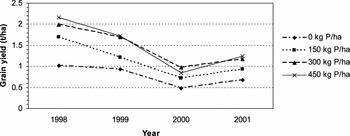
Figure 1 summarizes the average yield responses reported by Diatta et al. (Reference Diatta, Kotchi and Sahrawat2002). There is a positive yield response both in the year of application (‘direct effect’) and subsequent years (‘residual effect’). The first dose of 150 kg P shows the largest yield response, and the response levels off for the subsequent incremental doses. Yields in the third year (2000) were relatively low due to insect and disease attack. The magnitude of the response and its statistical significance varies per genotype, year and dose (Diatta et al., Reference Diatta, Kotchi and Sahrawat2002).
Average response of 5 upland rice genotypes to a single application of rock phosphate in 1998 at 4 rates and its residual effect in 1999, 2000, and 2001 in a long-term experiment on an Ultisol of the humid forest zone in Côte d'Ivoire. (Source: data from Diatta et al., Reference Diatta, Kotchi and Sahrawat2002.)

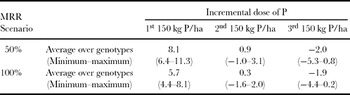
Table 1 estimates the corresponding target threshold prices for rock phosphate using a MRR of 50% and 100%. The target price is inversely related to the MRR, so target prices are higher for 50% than for 100% MRR. For the first incremental dose of 150 kg P ha−1 and a MRR of 50%, the target threshold price averages Euro cents 8.1 per kg rock phosphate over the genotypes. For the same first dose but a MRR of 100%, the price averages Euro cents 5.7 per kg. The corresponding price ranges for the second incremental dose are substantially lower, with average prices (Euro cents per kg rock phosphate) of 0.9 (MRR 50%) and 0.3 (MRR 100%). For the third incremental dose the averages are negative – implying that the incremental costs of application alone are already higher then the incremental benefits.
Target threshold prices for rock phosphate (Euro cents / kg rock phosphate, farm gate) for upland rice on an Ultisol of the humid forest zone in Côte d'Ivoire.

DISCUSSION
The ex ante model helps delineate a range of maximum prices farmers are likely to be willing to pay for a new technology. Our results suggest that for rock phosphate to be viable for upland rice farmers in the humid forest zone of West Africa its on-farm price should generally not surpass Euro cents 5.7–8.1 per kg of rock phosphate. The model complements agronomic trials and thereby provides a useful tool to help define the technology potential – particularly for situations when the technology supply market is undeveloped and its on-site price unknown or not necessarily representative for future adopters.
Reliable agronomic trial data are a key model input to derive the yield response to the new technology. The present application relied on reported reliable long-term trial data for one crop, one site and one soil type with five genotypes and three incremental technology doses (Diatta et al., Reference Diatta, Kotchi and Sahrawat2002). The model results clearly also depend on the complementary data used and the assumptions made. For instance, not using adjusted yields or using lower discount rates will increase the target threshold prices somewhat. As an illustration, a discount rate of only 10% would augment the threshold range to Euro cents 7.8–11.0 per kg of rock phosphate. Care should also be taken in generalizing the model results beyond the experimental treatments included and the corresponding target environment of this study.
The original trial shows significant variation in yield response over dosage and genotype (Diatta et al., Reference Diatta, Kotchi and Sahrawat2002). The limited response to the second and third incremental doses of P may imply that smaller incremental steps and a lower maximum dose are needed in future trials and these could possibly identify higher response rates and correspondingly higher target prices. The variation over genotypes is illustrated in Table 1 by the inclusion of minimum and maximum values. A genotype may show a high yield response and a consequent high target price. However, this needs to be interpreted with caution if the genotypes' overall performance is wanting. Such variations emphasize the dependence of the model on the underlying trial. Refinements in the trial design and its wider replication would enhance the robustness of the results. This also emphasizes that the present model results only provide an indicative price range that rice farmers in the environment studied are likely to be willing to pay for rock phosphate.
For comparison purposes, the market rate for rock phosphate in Sikasso (southern Mali, close to the source but some 500 km northeast of the experimental site) was Euro cent 5 per kg at the time. This price falls just below the estimated average target price range for the first 150 kg, but still does not include transport and transaction costs. Furthermore, although slightly lower than the average target price for the first dose, it still surpasses the target price for three of the five genotypes at MRR 100%. Therefore, despite the significant yield response to the first 150 kg of P, the economic attractiveness of the dose is less compelling. The lower to no yield response to the second and third incremental doses of P are not economically attractive – an issue underlined by the comparison with the Sikasso market price.
The ex ante model complements agronomic trials and helps put yield responses into perspective. It thereby provides valuable feedback and feed forward mechanisms for agricultural R&D. It can help reorient technology development towards less costly and more viable technology options. It can help delimit tentative recommendation domains for the new technology. Significant adoption is only likely where the new technology can be supplied within or below the target threshold price range. In the case of a point-source technology such as rock phosphate, the price of a technology is spatially determined and augments as one moves away from the source. The tentative feasible area for the technology is thereby spatially delimited by where the two prices equate. This further helps explain the varying economic potential of rock phosphate reported in the literature. The feasible area could conceivably be extended by cost reductions through development of rock phosphate mining technology and economies of scale.
The ex ante model thus complements the toolbox of standard assessment approaches for the analysis of agronomic data. Its contribution is by combining two basic economic concepts (break-even and marginal rate of return) and then working backwards, i.e. translating the physical observed performance of a new technology into target threshold prices that users are likely to be willing to pay. This derived proxy thus provides a threshold price for a new technology that lacks a developed market. It thereby circumvents the lack of a representative market price to feed into standard assessment procedures. This can also be contrasted with the contingent valuation method, which provides a formal approach to elicit a market valuation through stated preferences. Willingness to pay, whether derived or elicited, thereby provides feedback to adapt and develop R&D strategies. Finally, the paper illustrates the potential for trans-disciplinary approaches, whereby ‘standard’ approaches for one discipline can be integrated and applied with other approaches and disciplines, to address agricultural R&D challenges more effectively and efficiently.
Acknowledgements
The paper builds on earlier work when the author was associated with the Africa Rice Center (WARDA) and the trial results as reported by Diatta et al., Reference Diatta, Kotchi and Sahrawat2002. The views expressed in this paper are the author's and do not necessarily reflect the views of the author's current or previous institution.