1. Introduction
Continuous-state branching (CB) processes are stochastic processes that can be obtained as the scaling limits of sequences of Galton–Watson processes when the initial number of individuals tends to infinity. They can thus be seen as a model for a large branching population. The genealogical structure of a CB process can be described by a continuum random tree (CRT), introduced first by Aldous [Reference Aldous5] for the quadratic critical case; see also Le Gall and Le Jan [Reference Le Gall and Le Jan24] and Duquesne and Le Gall [Reference Duquesne and Le Gall18] for the general critical and sub-critical cases. We shall only consider the quadratic case; it is characterized by a branching mechanism  $\psi_\theta$:
 \begin{equation}\psi_\theta(\lambda)=\beta \lambda^ 2+ 2\beta\theta \lambda, \quad \lambda\in [0, +\infty ),\end{equation}
where  $\beta>0$ and
 $\theta\in {\mathbb R}$. The sub-critical (resp. critical) case corresponds to
 $\theta>0$ (resp.
 $\theta=0$). The parameter
 $\beta$ can be seen as a time-scaling parameter, and
 $\theta$ as a population size parameter.
In this model the population dies out almost surely (a.s.) in the critical and sub-critical cases. In order to model a branching population with stationary size distribution, which corresponds to what is observed at an ecological equilibrium, one can simply condition a sub-critical or a critical CB to not die out. This gives a Q-process (see Roelly-Coppoleta and Rouault [Reference Roelly-Coppoletta and Rouault27], Lambert [Reference Lambert23] and Abraham and Delmas [Reference Abraham and Delmas1]), which can also be viewed as a CB with a specific immigration. The genealogical structure of the Q-process in the stationary regime is a tree with an infinite spine. This infinite spine has to be removed if one adopts the immigration point of view; in this case the genealogical structure can be seen as a forest of trees. For  $\theta>0$, let
 $Z=(Z_t, t\in {\mathbb R})$ be this Q-process in the stationary regime, so that
 $Z_t$ is the size of the population at time
 $t\in {\mathbb R}$. The process Z is a Feller diffusion (see for example Section 7 in [Reference Chen and Delmas14]), solution of the stochastic differential equation
 \begin{equation}dZ_t=\sqrt{2\beta Z_t}\, dB_t+2\beta(1-\theta Z_t)dt,\end{equation}
where  $(B_t, t\geq 0)$ is a standard Brownian motion. See Chen and Delmas [Reference Chen and Delmas14] for studies on this model in a more general framework. See Section 3.2.4 for other contour processes associated with the process Z. Let
 $A_t$ be the time to the most recent common ancestor of the population living at time t; see (5.3) for a precise definition. According to [Reference Chen and Delmas14], we have
 ${\mathbb E}[Z_t]=1/\theta$ and
 ${\mathbb E}[A_t]=3/4\beta\theta$, so that
 $\theta$ is indeed a population size parameter and
 $\beta$ is a time parameter.
Aldous and Popovic [Reference Aldous and Popovic6] (see also Popovic [Reference Popovic26]) give a description of the genealogical tree of the extant population at a fixed time using the so-called ancestral process, which is a point process representation of the height of the branching points of a planar tree in a setting very close to  $\theta=0$ in the present model. We extend the presentation of [Reference Aldous and Popovic6] to the case
 $\theta\geq 0$, which can be summarized as follows. Set
 ${\mathbb R}^*={\mathbb R}\setminus\{0\}$. The ancestral process (see Definition 3.1) is a point measure
 \begin{equation*}{\mathcal A}(du, d\zeta)=\sum_{i\in {\mathcal I}} \delta_{u_i, \zeta_i}(du,d\zeta)\end{equation*}
on  ${\mathbb R}^*\times (0,+\infty)$ with countable many atoms, where
 $u_i$ represents the (position of the) individual i in the extant population and
 $\zeta_i$ its ‘age’. (The position 0 will correspond to the position of the immortal individual. The order on
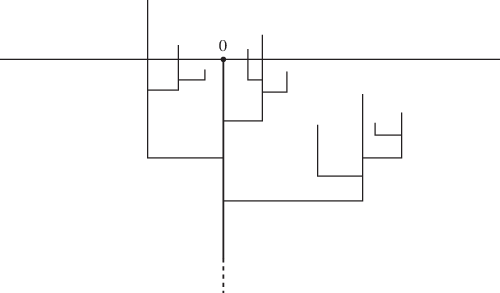
 ${\mathbb R}$ provides a natural order on the individuals through their positions, which means that we are dealing with an ordered or planar genealogical tree.) From this ancestral process, we informally construct a genealogical tree
 ${\mathfrak{T}}({\mathcal A})$ as follows. We view this process as a sequence of vertical segments in
 ${\mathbb R}^2$, the tops of the segments being the
 $u_i$ and their lengths being the
 $\zeta_i$. We add the half-line
 $\{0\}\times ({-}\infty,0]$ to this collection of segments. We then attach the bottom of each segment such that
 $u_i>0$ (resp.
 $u_i<0$) to the first longer segment to the left (resp. right) of it. See Figure 1 for an example. This provides the planar tree
 $\mathfrak{T}({\mathcal A})$ associated with the ancestral process
 ${\mathcal A}$ (see Proposition 3.1 for the definition and properties of this locally compact real tree with a unique semi-infinite branch). To state our result, we decompose the extant population at time t into two sub-populations so that its size
 $Z_t$ is distributed as
 $E_{\textrm{g}}+E_{\textrm{d}}$, where
 $E_{\textrm{g}}$ (resp.
 $E_{\textrm{d}}$) is the size of the population grafted on the left (resp. on the right) of the infinite spine. Below we state the main result of Section 3; see Propositions 3.2. and 3.3.
An example of an ancestral process and the corresponding genealogical tree.

Theorem 1.1. Let  $\theta\geq 0$. Let
 $E_{\textrm{g}},E_{\textrm{d}}$ be independent exponential random variables with mean
 $1/2\theta$, and with the convention that
 $E_{\textrm{d}}=E_{\textrm{g}}=+\infty $ if
 $\theta=0$. Conditionally given
 $(E_{\textrm{g}},E_{\textrm{d}})$, the ancestral process
 ${\mathcal A}(du, d\zeta)$ is a Poisson point measure with intensity
 \begin{equation*}{\textbf 1}_{({-}E_{\textrm{g}},E_{\textrm{d}})}(u)\, du\, |c^{\prime}_\theta(\zeta)|d\zeta,\end{equation*}
where  $c_\theta(h)$ is the probability (under the excursion measure) that the CB process with branching mechanism (1.1) will survive up to time h, and is given by
 \begin{equation}\forall h>0,\quad c_\theta(h)=\begin{cases}\frac{2\theta}{{\mathop {\textrm{e}^{2\beta\theta h}}}-1} & \mbox{if }\theta>0\ {(sub\hbox{-}critical\ case)},\\[4pt]
(\beta h)^{-1} & \mbox{if }\theta=0\ {(critical\ case)}.\end{cases}\end{equation}
Furthermore, the tree  ${\mathfrak{T}}({\mathcal A})$ is distributed as the genealogical tree of the extant population at a fixed time
 $t\in {\mathbb R}$.
The ancestral process description allows us to give elementary exact simulations of the genealogical tree of n individuals randomly chosen in the extant population at time 0 (or at some time  $t\in {\mathbb R}$, as the population has a stationary distribution). We present here the static simulation for fixed
 $n\geq 2$ given in Subsection 4.1; see also Lemma 4.1. See Figure 7 for an illustration for
 $n=5$.
Theorem 1.2. Let  $\theta>0$. Let
 $n\in {\mathbb N}^*$.
-
(i) Size of the extant population.
Let
 $E_{\textrm{g}}, E_{\textrm{d}}$ be independent exponential random variables with mean $1/2\theta$. ($E_{\textrm{g}}+ E_{\textrm{d}}$ corresponds to the size of the extant population.)
-
(ii) Picking n individuals in the extant population.
Let
$(X_k, k\in \{1, \ldots, n\})$ be, conditionally on $(E_{\textrm{g}}, E_{\textrm{d}})$, independent uniform random variables on $[-E_{\textrm{g}}, E_{\textrm{d}}]$, and set $X_0=0$. (The individual 0 corresponds to the infinite spine.) -
(iii) The ‘age’ of the individuals.
For
$k\in \{1, \ldots, n\}$, set $\Delta_k$ as the length of the intermediate interval to the next $X_j$ on the right if $X_k<0$ or on the left if $X_k>0$:
Conditionally on
\begin{equation*}\Delta_k=\begin{cases} X_k -\max\{X_j,\, X_j<X_k\text{ and } 0\leq j\leq n\} & \text{if $X_k>0$},\\[4pt]
- X_k +\min\{X_j,\, X_j>X_k\text{ and } 0\leq j\leq n\} & \text{if $X_k>0$}.\end{cases}\end{equation*}
$(E_{\textrm{g}}, E_{\textrm{d}}, X_1, \ldots, X_n)$, let $(\zeta_{k}^{ \text{S}}, 1\leq k\leq n)$ be independent random variables such that $\zeta_{k}^{ \text{S}}$ is distributed as follows, where U is uniform on [0, 1]:
\begin{equation*}{\mathop{\frac{1}{2\theta \beta}}\nolimits} \log\left(1- \frac{2\theta \Delta_k}{\log(U)}\right).\end{equation*}
-
(iv) The tree.
Let
$\mathfrak{T}_n^{ \text{S}}$ be the tree associated with the ancestral process
\begin{equation*}\sum_{k=1}^n \delta_{\big(X_k, \zeta_{k}^{ \text{S}}\big)}.\end{equation*}


Then the tree  $\mathfrak{T}_n^{ \text{S}}$ is distributed as the genealogical tree of n individuals picked uniformly at random among the extant population.
The notion of genealogical tree is appropriate for certain abstractions of genetic relations (e.g. mitochondrial DNA that is maternally inherited when ignoring paternal leakage or hetero-mitochondrial inheritance) in diploid organisms. It is however unclear how to extend our exact simulation algorithm to pedigree-conditioned genealogies as formalized in Sainudiin, Thatte, and Véber [Reference Sainudiin, Thatte and Véber29].
In the spirit of Theorem 1.2, we also provide two dynamic simulations in Subsections 4.2 and 4.3, where the individuals are taken one by one and the genealogical tree is then updated. Our framework allows us also to simulate the genealogical tree of n extant individuals conditionally given the time  $A_0$ to the most recent common ancestor of the extant population; see Subsection 4.4. Let us stress that the existence of an elementary simulation method is new in the setting of branching processes (in particular because this method avoids the size-biased effect on the population which usually comes from picking individuals at random), and the question goes back to Lambert [Reference Lambert22] and to [Reference Chen and Delmas14, Theorem 4.7].
The ancestral process description also allows us to compute the limit distribution of the total length of the genealogical tree of the extant population at time  $t\in{\mathbb R}$. More precisely, let
 $\Lambda_{t,n}$ be the total length of the tree of n individuals randomly chosen in the extant population at time t; see (5.5) for a precise definition. Below we state the main result of Section 5; see Theorem 5.1.
Theorem 1.3. Let  $\theta>0$. The sequence
 $\left(\Lambda_{t,n} - {\mathbb E}[\Lambda_{t,n}|Z_t], n\in {\mathbb N} ^*\right)$ converges a.s. and in
 $L^2$ towards a limit, say
 ${\mathcal L}_t$, as n tends to
 $+\infty$. And we have
 \begin{equation*}{\mathbb E}[\Lambda_{t,n}|Z_t]=\frac{Z_t}{\beta} \log\left(\frac{n}{2\theta Z_t }\right) + O(n^{-1}\log(n)).\end{equation*}
In the Kingman coalescent model, which corresponds to a model where the population has constant size, the first coalescent time of n individuals randomly chosen in the extant population is distributed according to an exponential random variable with mean  $2/n(n-1)$. We deduce that the total length of the genealogical tree of n individuals randomly chosen in the extant population at time t, say
 $L_{t,n}^K$, is distributed as
 \begin{equation*}\sum_{k=2}^{n} k \times 2 k^{-1} (k-1)^{-1} E_{k-1}=2\sum_{k=1}^{n-1} k^{-1} E_k,\end{equation*}
where  $(E_k, k\in {\mathbb N}^*)$ are independent exponential random variables with mean 1. Elementary computation on independent exponential random variables gives that
 $L_{t,n}^K$ is also distributed as
 $2\max_{1\leq k\leq n-1} E_k$. This implies that
 $L_{t,n}^K - 2 \log\!(n)$ converges in distribution towards a Gumbel distribution as n goes to infinity. (See Pfaffelhuber, Wakolbinger and Weisshaupt [Reference Pfaffelhuber, Wakolbinger and Weisshaupt25] for more results on this model.) The fact that the same shift in
 $\log(n)$ appears in the Kingman coalescent model and in Theorem 1.3 comes from the fact that the speed of coming down from infinity (or the birth rate of new branches near the top of the tree in forward time) is of the same order for the Kingman coalescent (see [Reference Berestycki, Berestycki and Limic8]) and for this model (see Corollary 6.5 and Remark 6.6 in [Reference Chen and Delmas14]).
As part of Theorem 5.1, we also get that  ${\mathcal L}_{t}$ coincides with the limit of the shifted total length
 $L_\varepsilon$ of the genealogical tree up to
 $t-\varepsilon$ of the individuals alive at time t obtained in [Reference Bi and Delmas11]: the sequence
 $(L_\varepsilon - {\mathbb E}[L_\varepsilon|Z_t], \varepsilon>0)$ converges a.s. towards
 ${\mathcal L}_{t}$ as
 $\varepsilon$ goes down to zero. Intuitively, taking
 $\varepsilon_n$ (random) such
 $t-\varepsilon_n$ is the first time backward where the number of ancestors of the extant population at time t is n, we get that
 $L_{\varepsilon_n}$ is distributed as
 $\Lambda_{t-\varepsilon_n, n}$. However, one expects that at the coalescent time
 $t-\varepsilon_n$ the size of the population
 $Z_{t-\varepsilon_n}$ is stochastically smaller than
 $Z_t$; see [Reference Chen and Delmas14, Proposition 4.5]. Thus,
 $\Lambda_{t-\varepsilon_n, n}$ does not have the same distribution. But, as
 $\lim_{n\rightarrow \infty } \varepsilon_n=0$, and thus
 $\lim_{n\rightarrow \infty } Z_{t-\varepsilon_n}=Z_t$, one expects that this difference might disappear in the limit. The proof of Theorem 1.3 is in fact based on technical
 $L^2$ computations.
We refer to [Reference Bi and Delmas11] for properties of the stationary process  $({\mathcal L}_{t}, t\in {\mathbb R})$. We only recall that the Laplace transform of
 ${\mathcal L}_{t}$ is given, for
 $\lambda>0$, by
 \begin{equation}{\mathbb E}\left[{\mathop {\textrm{e}^{-\lambda {\mathcal L}_{t}}}}|Z_t\right]={\mathop {\textrm{e}^{-2\theta Z_t \, \varphi(\lambda/(2\beta\theta))}}}\quad \text{with}\quad \varphi(\lambda )=-\lambda \int_0^1 \frac{1- v^\lambda}{1-v} \, dv,\end{equation}
and that  $\varphi$ is the Laplace exponent of a Lévy process as
 \begin{equation*}\varphi(\lambda)=\int_0^\infty (1-{\mathop {\textrm{e}^{-\lambda t}}}-\lambda t)\, \frac{{\mathop {\textrm{e}^{t}}}}{({\mathop {\textrm{e}^{t}}}-1)^2}\, dt.\end{equation*}
The paper is organized as follows. We first introduce in Section 2 the framework of real trees and we define the Brownian CRT that describes the genealogy of the CB in the quadratic case. Section 3 is devoted to the description via a Poisson point measure of the ancestral process of the extant population at time 0 and Section 4 gives the different simulations of the genealogical tree of n individuals randomly chosen in this population. Then, Section 5 concerns the asymptotic length of the genealogical tree for those n sampled individuals.
2. Notation
We set  ${\mathbb R}^*={\mathbb R}\setminus\{0\}$,
 ${\mathbb N}^*=\{1, 2,\ldots, \}$, and
 ${\mathbb N}={\mathbb N}^* \cup \{0\}$. Usually I will denote a generic index set, which might be finite, countable or uncountable.
2.1. Excursion measure for Brownian motion with drift
In this section we state some well-known results on excursion measures of the Brownian motion with drift. Let  $B=(B_t, t\geq0)$ be a standard Brownian motion and let
 $\beta>0$ be fixed. Let
 $\theta\in {\mathbb R}$. We consider
 $B^{(\theta)}=(B^{(\theta)}_t, t\geq 0)$ a Brownian motion with drift
 $-2\theta$ and scale
 $\sqrt{2/\beta}$:
 \begin{equation}B^{(\theta)}_t =\sqrt{\frac{2}{\beta}}\, B_t-2\theta t, \quad t\geq 0.\end{equation}
Consider the minimum process  $I^{(\theta)}=(I_t^{(\theta)}, t\geq 0)$ of
 $B^{(\theta)}$, defined by
 \begin{equation*}I^{(\theta)}_t=\min_{u\in [0, t]} B^{(\theta)}_u.\end{equation*}
Let  $n^{(\theta)}(de)$ be the excursion measure of the process
 $B^{(\theta)} - I^{(\theta)}$ above 0 associated with its local time at 0 given by
 $ -\beta I^{(\theta)}$. This normalization agrees with the one in [Reference Duquesne and Le Gall18] given for
 $\theta\geq 0$; see the remark below. Let
 $\sigma=\sigma(e)=\text{inf}\{s>0, \, e(s)=0\}$ and
 $\zeta=\zeta(e)=\max_{s\in [0, \sigma]}(e_s)$ be the length and the maximum of the excursion e.
Remark 2.1. In this remark, we assume that  $\theta>0$ (i.e. the Brownian motion has a negative drift). In the framework of [Reference Duquesne and Le Gall18] (see Section 1.2 therein),
 $B^{(\theta)}$ is the height process which codes the Brownian continuum random tree (CRT) with branching mechanism
 $\psi_\theta$ defined by (1.1). It is obtained from the underlying Lévy process
 $X=(X_t, t\geq 0)$, which in the case of quadratic branching mechanism is the Brownian motion with drift:
 $X_t=\beta B^{(\theta)}_t=\sqrt{2\beta}\, B_t-2\beta\theta t$ (see the formula (1.7) in [Reference Duquesne and Le Gall18]). According to [Reference Duquesne and Le Gall18, Section 1.1.2], considering the minimum process
 $I=(I_t, t\geq 0)$, with
 $I_t=\min_{u\in [0, t]} X_u$, the authors choose the normalization in such a way that
 $-I$ is the local time at 0 of
 $X-I$. The choice of the normalization of the local time at 0 of
 $B^{(\theta)} - I^{(\theta)}$ is justified by the fact that
 $I=\beta I^{(\theta)}$. Recall the definition of
 $c_\theta$ in (1.3). Then from Section 3.2.2 and Corollary 1.4.2 in [Reference Duquesne and Le Gall18], we have that for
 $\theta\geq 0$,
 \begin{equation}n^{(\theta)}\left[1- {\mathop {\textrm{e}^{-\lambda \sigma}}}\right]=\psi_\theta^{-1}(\lambda), \quad \lambda>0,\end{equation}
and
 \begin{equation}n^{(\theta)} (\zeta\geq h)=n^{(\theta)} (\zeta> h)=c_\theta(h), \quad h>0.\end{equation}
For  $\theta\in {\mathbb R}$, let
 ${\mathbb P}_\theta^\uparrow(de)$ be the law of
 $B^{(\theta)} - 2 I^{(\theta)}$. According to Proposition 14 and Theorem 20 in Section VII of [Reference Bertoin10],
 ${\mathbb P}_\theta^\uparrow(de)$ is the law of
 $B^{(\theta)}$ conditionally on being positive. For
 $\theta\in {\mathbb R}$, let
 $n_{\theta}$ be the excursion measure of
 $B^{(\theta)}$ outside 0 associated with the local time
 $L^0=L^0(B^{(\theta)})$. For completeness, we give at the end of this section a proof of the following known result. Let
 ${\mathcal C}([0, +\infty ))$ be the set of real-valued continuous functions defined on
 $[0, +\infty )$. Recall that, according to Definition (2.1) of
 $B^{(\theta)}$, the case
 $\theta<0$ corresponds to a positive drift for the Brownian motion.
Lemma 2.1. We have for  $\theta\in {\mathbb R}$ and
 $A\in {\mathcal C}([0,+\infty ))$ a measurable subset
 \begin{equation}n_{\theta}(e\in A)=\frac{\beta}{2} \left[n^{(|\theta|)} (e\in A) + n^{(|\theta|)} ({-}e\in A)+ 2|\theta|{\mathbb P}_\theta^\uparrow ({-}{\textrm{sgn}}(\theta) e \in A)\right].\end{equation}
We also have that
 \begin{equation}{\mathbb P}_\theta^\uparrow(de)={\mathbb P}_{-\theta}^\uparrow(de)\quad \text{and}\quad n^{(\theta)}(de ) {\textbf 1}_{\{\sigma<+\infty \}}= n^{(|\theta|)}(de),\end{equation}
and for  $\theta<0$
 \begin{equation}n^{(\theta)}(\sigma=+\infty )=2|\theta|\quad \text{and}\quad n^{(\theta)}(de){\textbf 1}_{\{\sigma=+\infty\}} =2|\theta|{\mathbb P}_\theta^\uparrow(de).\end{equation}
Furthermore, if  $\theta<0$, then
 $-\beta I^{(\theta)}_\infty $ is exponentially distributed with parameter
 $2|\theta|$.
Remark 2.2. The excursion measure  $n^{(\theta)}$ corresponds also to the excursion measure
 $\bar n^{(\theta)}$ introduced in [Reference Abraham and Delmas2] of the height process in the super-critical case, i.e. for
 $\theta<0$. Indeed Corollary 4.4 in [Reference Abraham and Delmas2] gives that
 $\bar n^{(\theta)}(de ) {\textbf 1}_{\{\sigma<+\infty \}}= n^{(|\theta|)}(de)$, and Lemma 4.6 in [Reference Abraham and Delmas2] gives that
 $\bar n^{(\theta)}(\sigma=+\infty )= 2|\theta|$.
Let  $\theta\geq 0$ and let
 ${\mathcal N}(dh, d \varepsilon, de)=\sum_{i\in {\mathcal I}} \delta(h_i, e_i) (dh,de)$ be a Poisson point measure on
 ${\mathbb R}_+ \times {\mathcal C}([0, +\infty ))$ with intensity
 $\beta{\textbf 1}_{\{h\geq 0\}}\, dh \, n^{(\theta)}(de)$. For every
 $i\in {\mathcal I}$, we set
 \begin{equation*}a_i=\sum_{j\in {\mathcal I}}{\textbf 1}_{\{h_j<h_i\}}\sigma(e_j)\quad \mbox{and}\quad b_i=a_i+\sigma (e_i),\end{equation*}
where  $\sigma(e_i)$ is the length of excursion
 $e_i$. For every
 $t\geq 0$, we set
 $i_t$ to be the only index
 $i\in{\mathcal I}$ such that
 $a_i\leq t<b_i$. Notice that
 $i_t$ is a.s. well-defined except on a Lebesgue-null set of values of t. We define the process
 $(Y,J)=((Y_t, J_t), {t\geq 0})$ by
 \begin{equation*}Y_t=e_{i_t}(t-a_{i_t})\quad \mbox{and}\quad J_t=h_{i_t}\quad \text{for } t\geq 0,\end{equation*}
with the convention  $Y_t=0$ and
 $J_t=\text{sup}\{J_s, s<t\}$ for t such that
 $i_t$ is not well-defined. Since
 $n^{(\theta)}$ is the excursion measure of
 $B^{(\theta)}- I^{(\theta)}$ above 0 associated to its local time at 0 given by
 $-\beta I^{(\theta)}$, we deduce the following corollary from excursion theory.
Corollary 2.1. Let  $\theta\geq 0$. We have that (Y, J) is distributed as
 $(B^{(\theta)}- I^{(\theta)}, - I^{(\theta)})$, and thus
 $Y-J$ and
 $Y+J$ are respectively distributed as
 $B^{(\theta)}$ and
 $B^{(\theta)} - 2 I^{(\theta)}$.
According to [Reference Rogers and Pitman28, Theorem 1], and taking into account the scale  $\sqrt{2/\beta}$, the process
 $B^{(\theta)} - 2 I^{(\theta)}$ is a diffusion on
 $[0, +\infty )$ with infinitesimal generator
 \begin{equation}\beta^{-1} \, \partial^2_x + 2|\theta| \coth\!(\beta |\theta|x)\, \partial_x, \quad x\in [0, +\infty ).\end{equation}
Proof of Lemma 2.1. Since  $B^{(\theta)} - 2I^{(\theta)}$ and
 $B^{({-}\theta)} - 2 I^{({-}\theta)}$ have the same distribution (see [Reference Rogers and Pitman28, Theorem 1]), we deduce that
 ${\mathbb P}_\theta^\uparrow(de)={\mathbb P}_{-\theta}^\uparrow(de)$, which gives the first part of (2.5).
For  $\theta, \lambda\in {\mathbb R} $, we set
 $\varphi_\theta(\lambda)=\psi_\theta(\lambda/\beta)=\beta ^{-1} \lambda^2- 2\theta \lambda$ so that
 ${\mathbb E}[\!\exp( \lambda B^{(\theta)}_t)]=\exp\!(t \varphi_\theta(\lambda))$. Elementary computations give
 \begin{equation*}\int_0^\infty {\mathop {\textrm{e}^{-\lambda x}}} c_\theta(x)^{-1} \,dx={\mathop{\frac{1}{\varphi_\theta(\lambda)}}\nolimits}\quad \text{for all $\lambda>2\beta \max\!(\theta, 0)$}.\end{equation*}
This implies that  $1/c_\theta$ is the scale function of
 $ B^{(\theta)}$; see Theorem 8 in Section VII of [Reference Bertoin10]. Thanks to Theorem 8 and Proposition 15 in Section VII of [Reference Bertoin10], there exists a positive constant
 $k_\theta$ such that for all
 $t>0$ and A in the
 $\sigma$-field
 ${\mathcal E}_t$ generated by
 $(e(s), s\leq t)$,
 \begin{equation}n^{(\theta)} (A, \sigma>t) = k_\theta {\mathbb E}_\theta^\uparrow \left[ c_\theta( e(t)) {\textbf 1}_A \right],\end{equation}
and  $ n^{(\theta)} (\zeta>h) = k_\theta c_\theta(h)$ for all
 $h>0$. We deduce from (2.3) and the latter equality that
 $k_\theta=1$ for
 $\theta\geq 0$.
We now prove that  $k_\theta=1$ for
 $\theta<0$ as well. Assume that
 $\theta<0$. Letting t go to infinity in (2.8) (with A fixed) and using that
 ${\mathbb P}_\theta^\uparrow(de)$-a.s.,
 $\lim_{t\rightarrow +\infty } e(t)=+\infty$, we deduce that
 \begin{equation}n^{(\theta)}( A, \sigma=+\infty )=2|\theta| \, k_\theta{\mathbb P}_\theta^\uparrow(A) \quad \text{for all $A\in {\mathcal E}_t$ and all $t\geq 0$,}\end{equation}
and taking for A the whole state space, we get that
 \begin{equation}n^{(\theta)}(\sigma=+\infty)=2|\theta| k_\theta. \end{equation}
By excursion theory and the chosen normalization, we get that  $ - \beta I^{(\theta)}_\infty $ is exponential with parameter
 $n^{(\theta)}(\sigma=+\infty)$. Since by scaling
 $ -I^{(\theta)}_\infty$ is also distributed as
 $\text{inf}\{ B_t - \beta \theta t, \, t\geq 0\}$, we deduce from [Reference Borodin and Salminen12, IV-5-32, p. 70] that
 $ -I^{(\theta)}_\infty$ is exponential with parameter
 $2\beta |\theta|$ and thus that
 $ -\beta I^{(\theta)}_\infty$ is exponential with parameter
 $2 |\theta|$. This implies that
 $n^{(\theta)}(\sigma=+\infty)=2|\theta|$, which gives the first part of (2.6); thus, thanks to (2.10), we get
 $k_\theta=1$. We then use (2.9) with
 $k_\theta=1$ to get the second part of (2.6).
Let  $\theta<0$. Let
 $t>0$ and
 $A\in {\mathcal E}_t$. We have
 \begin{align*}n^{(\theta)} (A, \sigma>t)&= {\mathbb E}_\theta^\uparrow \left[ c_\theta( e(t)) {\textbf 1}_A \right]\\&= 2|\theta| {\mathbb P}_\theta^\uparrow(A) + {\mathbb E}_{|\theta|}^\uparrow \left[c_{|\theta|}(h)( e(t)) {\textbf 1}_A\right]\\& = n^{(\theta)} (A, \sigma=+\infty ) + n^{(|\theta|)} (A, \sigma>t),\end{align*}
where, for the first equality, we used (2.8) and  $k_\theta=1$; for the second, we used the fact that
 $c_{\theta}(h)=2|\theta| + c_{|\theta|}(h)$ for all
 $h>0$, by (1.3), and that
 ${\mathbb P}_\theta^\uparrow(de)={\mathbb P}_{-\theta}^\uparrow(de)$; and for the last, we used (2.8) with
 $|\theta|$ instead of
 $\theta$ and
 $k_{|\theta|}=1$, as well as (2.9). This implies the last part of (2.5) for
 $\theta<0$. We also deduce from (2.2) that
 $n^{(\theta)} (\sigma=+\infty )=0$ for
 $\theta\geq 0$. Thus the second part of (2.5) holds also for
 $\theta\geq 0$ and thus for
 $\theta\in {\mathbb R}$.
We shall now prove (2.4). Recall that  $n_\theta$ is the excursion measure of
 $B^{(\theta)}$ outside 0 associated with the local time
 $L^0=L^0(B^{(\theta)})$,
 $n^{(\theta)}(de)$ is the excursion measure of
 $B^{(\theta)}- I^{(\theta)}$ above 0, and
 $n^{({-}\theta)}(de)$ is the excursion measure of
 $B ^{({-}\theta)}- I^{({-}\theta)}$ above 0. Notice that
 $B ^{({-}\theta)}- I^{({-}\theta)}$ is distributed as
 $-( B^{(\theta)}- M^{(\theta)})$, where
 $M^{(\theta)} =(M_t^{(\theta)}, t\geq 0)$, defined by
 $M^{(\theta)}_t=\text{sup}_{u\in [0, t]} B^{(\theta)}_u$, is the maximum process, and thus
 $n^{({-}\theta)}(d({-}e))$ is the excursion measure of
 $B ^{(\theta)}- M^{(\theta)}$ below 0. According to [Reference Bertoin9, p. 334] (where the statement is for
 $\beta=2$, but can clearly be adapted to
 $\beta>0$ using a scaling in time), we get that
-
(i)
$n^{(\theta)}(de)$, the excursion measure of $B^{(\theta)}- I^{(\theta)}$ above 0, is equal, up to a multiplicative constant due to the choice of the normalization of the local times, to ${\textbf 1}_{\{e>0\}} n_\theta(de)$; -
(ii)
$n^{({-}\theta)}(d({-}e))$, the excursion measure of $B ^{(\theta)}- M^{(\theta)}$ below 0, is equal, up to a multiplicative constant due to the choice of the normalization of the local times, to ${\textbf 1}_{\{e>0\}} n_\theta(de)$.


Thus, we have, for some positive constants  $a_\theta$ and
 $b_\theta$, that
 \begin{equation*}n_\theta(de)=a_\theta n^{(\theta)}(de) + b_\theta n^{({-}\theta)}(d({-}e)).\end{equation*}
Thanks to (2.5) and (2.6), we find that (2.4) will be proved once we prove that  $a_\theta=b_\theta=\beta/2$.
Let us assume for simplicity that  $\theta\geq 0$ (the argument is similar for
 $\theta\leq 0$). By excursion theory,
 $L^0_\infty $ is exponential with parameter
 $n_\theta(\sigma=+\infty )= b_\theta n^{({-}\theta)}(\sigma=+\infty )=2\theta b_\theta$. According to [Reference Borodin and Salminen12, V-3-11, p. 90],
 $L^0_\infty $ is exponential with parameter
 $\beta \theta$ (use the fact that
 $(L^0_t, t\geq 0)$ is distributed as
 $(L^0_{2t/\beta} (W), t\geq 0)$, the local time at 0 of the Brownian motion
 $W=(W_t=B_t - \beta\theta t, t\geq 0)$). This gives
 $b_\theta=\beta/2$.
We now prove that  $a_\theta=\beta/2$. Let
 $T= \text{sup}\{B^{(\theta)}_t, t\geq 0\}$. We have
 \begin{align*}{\mathbb P}(T<a) & ={\mathbb E}\left[{\mathop {\textrm{e}^{- n_{\theta}(\zeta\geq a, e>0)\, L^0_\infty }}}\right]={\mathbb E}\left[{\mathop {\textrm{e}^{- a_\theta\, n^{(\theta)} (\zeta\geq a)\,L^0_\infty }}}\right]\\[4pt]
& = {\mathbb E}\left[{\mathop {\textrm{e}^{- a_\theta c_\theta(a) \, L^0_\infty }}}\right]= \frac{\beta\theta }{\beta\theta+ a_\theta c_\theta(a)},\end{align*}
where we used that  $L^0_\infty $ is exponential with parameter
 $\beta \theta$ for the last equality. Since by scaling T is also distributed as
 $\text{sup}\{ B_t - \beta \theta t, \, t\geq 0\}$, we deduce from [Reference Borodin and Salminen12, IV-5-32, p. 70] that T is exponential with parameter
 $2\beta \theta$. This gives
 ${\mathbb P}(T<a)=1 - {\mathop {\textrm{e}^{- 2\beta\theta a}}}$. Using (1.3), we deduce that
 $a_\theta=\frac{\beta}{2}$. This ends the proof of the lemma.
2.2. Real trees
The study of real trees was originally motivated by algebraic and geometric problems; see in particular the survey [Reference Dress, Moulton and Terhalle15]. Real trees were first used to study CRTs in [Reference Evans, Pitman and Winter21]; see also [Reference Evans20].
Definition 2.1. (Real tree.) A real tree is a metric space  $({\textbf t},d_{\textbf t})$ with the following properties:
-
(i) For every
$x,y\in{\textbf t}$, there is a unique isometric map $f_{x,y}$ from $[0,d_{\textbf t}(x,y)]$ to ${\textbf t}$ such that $f_{x,y}(0)=x$ and $f_{x,y}(d_{\textbf t}(x,y))=y$. -
(ii) For every
$x,y\in{\textbf t}$, if $\phi$ is a continuous injective map from [0, 1] to ${\textbf t}$ such that $\phi(0) = x$ and $\phi(1) = y$, then $\phi([0, 1]) = f_{x,y}([0, d_{\textbf t}(x,y)])$.


Notice that a real tree is a length space as defined in [Reference Burago, Burago and Ivanov13]. A rooted real tree is given by  $({\textbf t}, d_{\textbf t}, \partial_{\textbf t})$, where
 $\partial=\partial_{\textbf t}$ is a distinguished vertex of
 ${\textbf t}$, which will be called the root. We remark that the set
 $\{\partial\}$ is a rooted tree that contains only the root.
Let  ${\textbf t}$ be a compact rooted real tree and let
 $x,y\in{\textbf t}$. We denote by
 $[\![ x,y]\!]$ the range of the map
 $f_{x,y}$ described in Definition 2.1. We also set
 $[\![ x,y[\ $k_{\textbf t}(x)$, as the number of connected components of
 ${\textbf t}\setminus\{x\}$ that do not contain the root. If
 $k_{\textbf t}(x)=0$ (resp.
 $k_{\textbf t}(x)>1$), then x is called a leaf (resp. a branching point). A tree is said to be binary if the out-degree of its vertices belongs to
 $\{0,1,2\}$. The skeleton of the tree
 ${\textbf t}$ is the set
 $\textrm{sk}({\textbf t})$ of points of
 ${\textbf t}$ that are not leaves. Notice that
 ${\textrm{cl}}\; ( \textrm{sk}({\textbf t}))={\textbf t}$, where
 ${\textrm{cl}}\;(A)$ denote the closure of A.
We denote by  ${\textbf t}_x$ the sub-tree of
 ${\textbf t}$ above x, i.e.,
 \begin{equation*}{\textbf t}_x=\{y\in{\textbf t},\ x\in [\![\partial,y]\!]\},\end{equation*}
rooted at x. We say that x is an ancestor of y, and write  $x\preccurlyeq y$, if
 $y\in {\textbf t}_x$. We write
 $x\prec y$ if furthermore
 $x\neq y$. Notice that
 $\preccurlyeq$ is a partial order on
 ${\textbf t}$. We denote by
 $x\wedge y$ the most recent common ancestor (MRCA) of x and y in
 ${\textbf t}$, i.e. the unique vertex of
 ${\textbf t}$ such that
 $[\![\partial,x]\!]\cap[\![\partial,y]\!]=[\![\partial, x\wedge y]\!]$.
We denote by  $h_{\textbf t}(x)=d_{\textbf t}(\partial,x)$ the height of the vertex x in the tree
 ${\textbf t}$ and by
 $H({\textbf t})$ the height of the tree
 ${\textbf t}$:
 \begin{equation*}H({\textbf t})=\max\{h_{\textbf t}(x),\ x\in{\textbf t}\}.\end{equation*}
Recall that  ${\textbf t}$ is a compact rooted real tree; let
 $({\textbf t}_i, {i\in I})$ be a family of rooted trees, and
 $(x_i, {i\in I})$ a family of vertices of
 ${\textbf t}$. Let
 ${\textbf t}_i^\circ={\textbf t}_i\setminus\{\partial_{{\textbf t}_i}\}$. We define the tree
 ${\textbf t}\circledast_{i\in I} ({\textbf t}_i,x_i)$ obtained by grafting the trees
 ${\textbf t}_i$ onto the tree
 ${\textbf t}$ at points
 $x_i$ by
 \begin{align*} {\textbf t}\circledast_{i\in I}({\textbf t}_i,x_i) & ={\textbf t}\sqcup\left(\bigsqcup_{i\in I} {\textbf t}_i^\circ\right),\\[4pt]
d_{{\textbf t}\circledast_{i\in I} ({\textbf t}_i,x_i)}(y,y^{\prime}) & =\begin{cases}d_{\textbf t}(y,y^{\prime}) & \mbox{if }y,y^{\prime}\in {\textbf t},\\[3pt]
d_{{\textbf t}_i}(y,y^{\prime}) & \mbox{if }y,y^{\prime}\in {\textbf t}_i^\circ,\\[3pt]
d_{\textbf t}(y,x_i)+d_{{\textbf t}_i}(\partial_{{\textbf t}_i},y^{\prime}) & \mbox{if } y\in{\textbf t}\mbox{ and }y^{\prime}\in{\textbf t}_i^\circ,\\[3pt]
d_{{\textbf t}_i}(y,\partial_{{\textbf t}_i})+d_{\textbf t}(x_i,x_j)& \\[3pt]
\qquad+d_{{\textbf t}_j}(\partial_{{\textbf t}_j},y^{\prime})& \mbox{if } y\in{\textbf t}_i^\circ\mbox{ and }y^{\prime}\in{\textbf t}_j^\circ\mbox{ with }i\ne j,\end{cases}\\[3pt]
\partial_{{\textbf t}\circledast_{i\in I}({\textbf t}_i,x_i)}& =\partial_{\textbf t},\end{align*}
where  $A\sqcup B$ denotes the disjoint union of the sets A and B. Notice that
 ${\textbf t}\circledast_{i\in I}({\textbf t}_i,x_i)$ might not be compact.
We say that two rooted real trees  ${\textbf t}$ and
 ${\textbf t}^{\prime}$ are equivalent (and we write
 ${\textbf t}\sim{\textbf t}'$) if there exists a root-preserving isometry that maps
 ${\textbf t}$ onto
 ${\textbf t}'$. We denote by
 ${\mathbb T}$ the set of equivalence classes of compact rooted real trees. The metric space
 $({\mathbb T},d_{GH})$, with the so-called Gromov–Hausdorff distance
 $d_{GH}$, is Polish; see [Reference Evans, Pitman and Winter21]. This allows us to define random real trees.
2.3. Coding a compact real tree by a function and the Brownian CRT
Let  ${\mathcal E}$ be the set of continuous functions
 $g:[0,+\infty)\longrightarrow [0,+\infty)$ with compact support and such that
 $g(0) = 0$. For
 $g\in {\mathcal E}$, we set
 $\sigma(g)=\text{sup} \{x, \, g(x)>0\}$. Let
 $g\in {\mathcal E}$, and assume that
 $\sigma(g)>0$, i.e. g is not identically zero. For every
 $s, t \geq 0$, we set
 \begin{equation*}m_g(s, t) = \text{inf} _{r\in [s\wedge t,s\vee t ]}g(r)\end{equation*}
and
 \begin{equation}d_g(s, t) = g(s) + g(t) - 2m_g(s, t ).\end{equation}
It is easy to check that  $d_g$ is a pseudo-metric on
 $[0,+\infty)$. We then say that s and t are equivalent if and only if
 $d_g(s, t) = 0$, and we denote by
 $T_g$ the associated quotient space. We keep the notation
 $d_g$ for the induced distance on
 $T_g$. Then the metric space
 $(T_g, d_g)$ is a compact real tree; see [Reference Duquesne and Le Gall19]. We denote by
 $p_g$ the canonical projection from
 $[0, +\infty )$ to
 $T_g$. We will view
 $(T_g, d_g)$ as a rooted real tree with root
 $\partial = p_g(0)$. We will call
 $(T_g,d_g)$ the real tree coded by g, and conversely we will say that g is a contour function of the tree
 $T_g$. We denote by F the application that associates with a function
 $g\in{\mathcal E}$ the equivalence class of the tree
 $T_g$.
Conversely, every rooted compact real tree (T, d) can be coded by a continuous function g (up to a root-preserving isometry); see [Reference Duquesne16].
We define the Brownian CRT,  $\tau=F (e)$, as the (equivalence class of the) tree coded by the positive excursion e under
 $n^{(\theta)}$; see Section 2.1. And we define the measure
 ${\mathbb N}^{(\theta)}$ on
 ${\mathbb T}$ as the ‘distribution’ of
 $\tau$, i.e. the pushforward of the measure
 $n^{(\theta)}$ by the application F. Notice that
 $H(\tau)=\zeta(e)$.
Let e have ‘distribution’  $n^{(\theta)}(de)$, and let
 $(\Lambda_s^a, s\geq 0, a\geq 0)$ be the local time of e at time s and level a. Then we define the local time measure of
 $\tau$ at level
 $a\geq 0$, denoted by
 $\ell_a(dx)$, as the pushforward of the measure
 $d\Lambda_s^a$ by the map F; see [Reference Duquesne and Le Gall19, Theorem 4.2]. We shall define
 $\ell_a$ for
 $a\in {\mathbb R}$ by setting
 $\ell_a=0$ for
 $a\in {\mathbb R}\setminus [0, H(\tau)]$.
2.4. Trees with one semi-infinite branch
The goal of this section is to describe the genealogical tree of a stationary CB with immigration (restricted to the population that appeared before time 0). For this purpose, we add an immortal individual living from  $-\infty$ to 0, which will be the spine of the genealogical tree (i.e. the semi-infinite branch) and will be represented by the half straight line
 $({-}\infty,0]$; see Figure 2. Since we are interested in the genealogical tree, we do not record the population generated by the immortal individual after time 0. The distinguished vertex in the tree will be the point 0; in the terminology of Section 2.2, this would be the root of the tree. In what follows, however, in accordance with the natural intuition, we will speak of it as the distinguished leaf. In the same spirit, we will give another definition for the height of a vertex in such a tree in order to allow negative heights.
An example of a tree with a semi-infinite branch.

2.4.1. Forests
A forest  ${\textbf f}$ is a family
 $((h_i,{\textbf t}_i), \, i\in I)$ of points of
 ${\mathbb R}\times {\mathbb T}$. Using an immediate extension of the grafting procedure, for an interval
 $\mathfrak{I}\subset {\mathbb R}$ we define the real tree
 \begin{equation}{\textbf f}_\mathfrak{I}=\mathfrak{I}\circledast_{i\in I, h_i\in \mathfrak{I}}({\textbf t}_i, h_i).\end{equation}
For  $i\in I$, let us denote by
 $d_i$ the distance on the tree
 ${\textbf t}_i$ and by
 ${\textbf t}_i^\circ={\textbf t}_i\setminus\{\partial_{{\textbf t}_i}\}$ the tree
 ${\textbf t}_i$ without its root. The distance on
 ${\textbf f}_\mathfrak{I}$ is then defined, for
 $x,y\in{\textbf f}_\mathfrak{I}$, by
 \begin{equation*}d_{\textbf f}(x,y)=
\left\{\begin{array}{l@{\quad}l}d_i(x,y) & \text{ if }x,y\in{\textbf t}_i^\circ,\\[4pt]
h_{{\textbf t}_i}(x)+|h_i-h_j|+h_{{\textbf t}_j}(y) & \text{ if } x\in{\textbf t}_i^\circ,\ y\in{\textbf t}_j^\circ\mbox{ with }i\ne j,\\[4pt]
|x-h_j|+h_{{\textbf t}_j}(y) & \text{ if } x\in\sqcup_{i\in I}{\textbf t}_i^\circ,\ y\in{\textbf t}_j^\circ,\\[4pt]
|x-y| & \text{ if } x,y \in\sqcup_{i\in I}{\textbf t}_i^\circ.\end{array}\right.\end{equation*}
Let us recall the following lemma (see [Reference Abraham and Delmas3]).
Lemma 2.2. Let  $\mathfrak{I}\subset {\mathbb R}$ be a closed interval. If, for every
 $a,b\in\mathfrak{I}$ such that
 $a<b$, and every
 $\varepsilon>0$, the set
 $\{i\in I,\ h_i\in[a,b],\ H({\textbf t}_i)>\varepsilon\}$ is finite, then the tree
 ${\textbf f}_\mathfrak{I}$ is a complete locally compact length space.
2.4.2. Trees with one semi-infinite branch
Definition 2.2. We define  ${\mathbb T}_1$ as the set of forests
 ${\textbf f}=((h_i,{\textbf t}_i), \, i\in I)$ such that
-
• for every
$i\in I$, $h_i\leq 0$; -
• for every
$a<b$ and every $\varepsilon>0$, the set $\{i\in I,\ h_i\in[a,b],\ H({\textbf t}_i)>\varepsilon\}$ is finite.


The following corollary, which is an elementary consequence of Lemma 2.2, associates with a forest  ${\textbf f}\in{\mathbb T}_1$ a complete and locally compact real tree.
Corollary 2.2. Let  ${\textbf f}=((h_i,{\textbf t}_i), \, i\in I)\in {\mathbb T}_1$. Then the tree
 ${\textbf f}_{({-}\infty,0]}$ defined by (2.12) is a complete and locally compact real tree.
Conversely, let  $({\textbf t},d_{\textbf t}, \rho_0)$ be a complete and locally compact rooted real tree. We denote by
 ${\mathcal S}({\textbf t})$ the set of vertices
 $x\in{\textbf t}$ such that at least one of the connected components of
 ${\textbf t}\setminus\{x\}$ that do not contain
 $\rho_0$ is unbounded. If
 ${\mathcal S}({\textbf t})$ is not empty, then it is a tree which contains
 $\rho_0$. We say that
 ${\textbf t}$ has a unique semi-infinite branch if
 ${\mathcal S}({\textbf t})$ is non-empty and has no branching point. We let
 $({\textbf t}_i^\circ,i\in I)$ denote the connected components of
 ${\textbf t}\setminus{\mathcal S}({\textbf t})$. For every
 $i\in I$, we let
 $x_i$ denote the unique point of
 ${\mathcal S}({\textbf t})$ such that
 $\text{inf}\{d_{\textbf t}(x_i,y),\ y\in{\textbf t}_i^\circ\}=0$, and
 \begin{equation*}{\textbf t}_i={\textbf t}_i^\circ\cup\{x_i\},\qquad h_i=-d(\rho_0,x_i).\end{equation*}
We shall say that  $x_i$ is the root of
 ${\textbf t}_i$. Notice first that
 $({\textbf t}_i, d_{\textbf t}, x_i)$ is a bounded rooted tree. It is also compact, since, according to the Hopf–Rinow theorem (see [Reference Burago, Burago and Ivanov13, Theorem 2.5.26]), it is a bounded closed subset of a complete locally compact length space. Thus it belongs to
 ${\mathbb T}$.
The family  ${\textbf f}=((h_i,{\textbf t}_i), \, i\in I)$ is therefore a forest with
 $h_i<0$. To check that it belongs to
 ${\mathbb T}_1$, we need to prove that the second condition in Definition 2.2 is satisfied, which is a direct consequence of the fact that the tree
 ${\textbf f}_{[a,b]}$ is locally compact.
We can therefore identify the set  ${\mathbb T}_1$ with the set of (equivalence classes of) complete locally compact rooted real trees with a unique semi-infinite branch. We can follow [Reference Abraham, Delmas and Hoscheit4] to endow
 ${\mathbb T}_1$ with a Gromov–Hausdorff-type distance for which
 ${\mathbb T}_1$ is a Polish space.
We extend the partial order defined for trees in  ${\mathbb T}$ to forests in
 ${\mathbb T}_1$, with the idea that the distinguished leaf
 $\rho_0=0$ is at the tip of the semi-infinite branch. Let
 ${\textbf f}=(h_i,{\textbf t}_i)_{i\in I}\in{\mathbb T}_1$ and write
 ${\textbf t}={\textbf f}_{({-}\infty,0]}$, viewed as a real tree rooted at
 $\rho_0=0$ (with a unique semi-infinite branch
 ${\mathcal S}({\textbf t})=({-}\infty,0]$). For
 $x,y\in {\textbf t}$, we set
 $x\preccurlyeq y$ if either
 $x,y\in S({\textbf t})$ and
 $d_{\textbf f}(x,\rho_0) \geq d_{\textbf f}(y, \rho_0)$, or
 $x,y\in {\textbf t}_i$ for some
 $i\in I$ and
 $x\preccurlyeq y$ (with the partial order for the rooted compact real tree
 ${\textbf t}_i$), or
 $x\in {\mathcal S}({\textbf t})$ and
 $y\in {\textbf t}_i$ for some
 $i\in I$ and
 $d_{\textbf f}(x,\rho_0)\geq |h_i|$. We write
 $x\prec y$ if furthermore
 $x\neq y$. We define
 $x\wedge y$, the MRCA of
 $x,y\in {\textbf t}$, as x if
 $x\preccurlyeq y$, as
 $x \wedge y$ if
 $x,y\in {\textbf t}_i$ for some
 $i\in I$ (with the MRCA for the rooted compact real tree
 ${\textbf t}_i$), and as
 $h_i\wedge h_j$ if
 $x\in {\textbf t}_i$ and
 $y\in {\textbf t} _j$ for some
 $i\neq j$. We define the height of a vertex
 $x\in {\textbf t}$ as
 \begin{equation*}h_{\textbf f}(x)= d_{\textbf f}(x, \rho_0 \wedge x)- d_{\textbf f}(\rho_0, \rho_0 \wedge x).\end{equation*}
Notice that the definition of the height function  $h_{\textbf f}$ for a forest
 ${\textbf f}=(h_i,{\textbf t}_i)_{i\in I}\in {\mathbb T}_1$ is different from the height function of the tree
 ${\textbf t}={\textbf f}_{({-}\infty,0]}$ viewed as a tree in
 ${\mathbb T}$, as in the former case the root
 $\rho_0$ is viewed as a distinguished vertex above the semi-infinite branch (all elements of this semi-infinite branch have negative heights for
 $h_{\textbf f}$, whereas all the heights are nonnegative for
 $h_{\textbf t}$).
2.4.3. Coding a forest by a contour function
The construction of a tree of the type  ${\textbf f}_{[0, +\infty)}$ via a contour function as in Section 2.3 is already present in [Reference Duquesne17] and in [Reference Athreya, Löhr and Winter7, Section 7.4]. This construction is recalled in Subsection 3.2.4 below. We now present a construction of a tree of the type
 ${\textbf f}_{({-}\infty,0]}$ via a contour function as in Section 2.3. Let
 ${\mathcal E}_1$ be the set of continuous functions g defined on
 ${\mathbb R}$ such that
 $g(0)=0$ and
 $\liminf_{x\rightarrow -\infty } g(x)= \liminf_{x\rightarrow +\infty }g(x)=-\infty$. For such a function, we still consider the pseudo-metric
 $d_g$ defined by (2.11) (but for
 $s,t\in{\mathbb R}$) and define the tree
 $T^-_g$ as the quotient space on
 ${\mathbb R}$ induced by this pseudo-metric. We set
 $p_g$ as the canonical projection from
 ${\mathbb R}$ onto
 $T^-_g$.
Lemma 2.3. Let  $g\in {\mathcal E}_1$. The triplet
 $(T^-_g,d_g,p_g(0))$ is a complete locally compact rooted real tree with a unique semi-infinite branch.
When there is no possibility of confusion, we write  $T_g$ for
 $T^-_g$.
Proof. We define the infimum function  $\underline g(x)$ on
 ${\mathbb R}$ as the infimum of g between 0 and x:
 $\underline g(x)= \text{inf}_{[x \wedge 0, x \vee 0]} g$. The function
 $g-\underline g$ is nonnegative and continuous. Let
 $((a_i, b_i), i\in I)$ be the excursion intervals of
 $g-\underline g$ above 0. Because of the hypothesis on g, the intervals
 $(a_i, b_i)$ are bounded. For
 $i\in I$, set
 $h_i=g(a_i)$ and
 $g_i(x)=g((a_i+x)\wedge b_i) - h_i$, so that
 $g_i\in {\mathcal E}$. Consider the forest
 ${\textbf f}=((h_i,T_{g_i}), \, i\in I) $.
It is elementary to check that  $({\textbf f}_{({-}\infty , g(0)]}, d_{\textbf f}, g(0))$ and
 $(T_g,d_g,p_g(0))$ are root-preserving and isometric. To conclude, it is enough to check that
 ${\textbf f}\in{\mathbb T}_1$. First observe that, by definition,
 $h_i\leq 0$ for every
 $i\in I$. Let
 $r \gt 0$, and set
 $r_{\text{g}}=\text{inf}\{x, \, \underline g (x)\geq g(0)-r\}$ and
 $r_{\text{d}} = \text{sup}\{x, \, \underline g (x)\geq g(0)-r\}$. Because of the hypothesis on g, we have that
 $r_{\text{g}}$ and
 $r_{\text{d}}$ are finite. By continuity of
 $g- \underline g$ on
 $[r_{\text{g}}, r_{\text{d}}]$, we deduce that for any
 $\varepsilon>0$, the set
 $\{i\in I; \, (a_i, b_i)\subset [r_{\text{g}}, r_{\text{d}}] \text{ and } \text{sup}_{(a_i, b_i)} (g-\underline g) \gt \varepsilon \}$ is finite. Since this holds for any
 $r>0$ and since
 $H(T_{g_i})=\text{sup}_{(a_i, b_i)} (g-\underline g) $ for all
 $i\in I$, we deduce that
 ${\textbf f}\in{\mathbb T}_1$. This concludes the proof.
2.4.4. Genealogical tree of an extant population
For a tree  ${\textbf t}\in {\mathbb T}$ or
 ${\textbf t}\in {\mathbb T}_1$ (recall that we identify a forest
 ${\textbf f}\in{\mathbb T}_1$ with the tree
 ${\textbf t}={\textbf f}_{({-}\infty,0]}$, with a different definition for the height function) and
 $h\geq 0$, we define
 ${\mathcal Z}_h({\textbf t})=\{x\in {\textbf t}, \,h_{\textbf t}(x)=h\}$ to be the set of vertices of
 ${\textbf t}$ at level h, also called the extant population at time h, and we define the genealogical tree of the vertices of
 ${\textbf t}$ at level h by
 \begin{equation}{\mathcal G}_h({\textbf t})=\{x\in {\textbf t}; \, \exists y\in {\mathcal Z}_h({\textbf t}) \text{ such that } x\preccurlyeq y\}.\end{equation}
For  ${\textbf f}\in{\mathbb T}_1$, we write
 ${\mathcal G}_h({\textbf f})$ for
 ${\mathcal G}_h({\textbf f}_{({-}\infty,0]})$.
3. Ancestral process
Usually, the ancestral process records the genealogy of n extant individuals at time 0 picked at random from the whole population. Using the ideas of [Reference Aldous and Popovic6], we are able to describe in the case of a Brownian forest the genealogy of all extant individuals at time 0 by a simple Poisson point process on  ${\mathbb R}^2$.
3.1. Construction of a tree from a point measure
Definition 3.1. A point process  ${\mathcal A}(dx,d\zeta)=\sum_{i\in {\mathcal I}}\delta_{(x_i,\zeta_i)}(dx,d\zeta)$ on
 ${\mathbb R}^*\times (0,+\infty)$ is said to be an ancestral process if the following properties hold:
-
(i) For all
$i,j\in {\mathcal I} $, $i\ne j\Longrightarrow x_i\ne x_j$. -
(ii) For all
$a,b\in{\mathbb R}$ and $\varepsilon>0$, ${\mathcal A}([a,b]\times[\varepsilon,+\infty))<+\infty$. -
(iii)
$\text{sup}\{\zeta_i,x_i>0\}=+\infty$ if $\text{sup}_{i\in {\mathcal I}}x_i=+\infty$; and $\text{sup}\{\zeta_i,x_i<0\}=+\infty$ if $\text{inf}_{i\in {\mathcal I}}x_i=-\infty$.


Let  ${\mathcal A}=\sum_{i\in {\mathcal I}}\delta_{(x_i,\zeta_i)}$ be a point process on
 ${\mathbb R}^*\times [0,+\infty)$ satisfying (i) and (ii) from Definition 3.1. We shall associate with this ancestral process a genealogical tree. Informally the genealogical tree is constructed as follows. We view this process as a sequence of vertical segments in
 ${\mathbb R}^2$, the tips of the segments being the
 $x_i$ and their lengths being the
 $\zeta_i$. We then attach the bottom of each segment such that
 $x_i>0$ (resp.
 $x_i<0$) to the first left (resp. first right) longer segment, or to the half-line
 $\{0\}\times ({-}\infty,0]$ if such a segment does not exist. This gives a (non-compact, unrooted) real tree that may not be complete. See Figure 1 for an example.
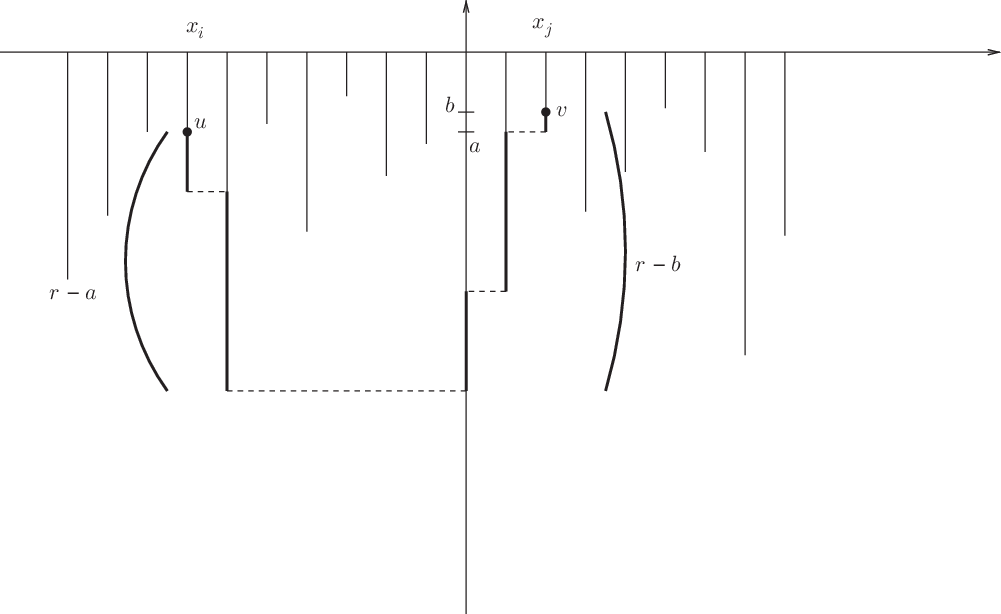
An example of the distance d(u, v) defined in (3.2).

Let us turn to a more formal definition. Let us define  ${\mathcal I}^{\text{d}}=\{i\in{\mathcal I},\ x_i \gt 0\}$ and
 ${\mathcal I} ^{\text{g}}=\{i\in{\mathcal I},\ x_i \lt 0\}= {\mathcal I}\setminus{\mathcal I}^{\text{d}}$. We also set
 ${\mathcal I}_0={\mathcal I}\sqcup \{0\}$,
 $x_0=0$, and
 $\zeta_0=+\infty$. For every
 $i\in{\mathcal I}_0$, we denote by
 $S_i=\{x_i\}\times({-}\zeta_i,0]$ the vertical segment in
 ${\mathbb R}^2$ that links the points
 $(x_i,0)$ and
 $(x_i,-\zeta_i)$. Notice that we omit the lowest point of the vertical segment. Finally we define
 \begin{equation}\mathfrak{T}=\bigsqcup_{i\in{\mathcal I}_0}S_i.\end{equation}
We now define a distance on  $\mathfrak{T}$. We first define the distance between leaves of
 $\mathfrak{T}$, i.e. points
 $(x_i,0)$ with
 $i\in{\mathcal I}_0$, then extend it to every point of
 $\mathfrak{T}$. For
 $i,j\in{\mathcal I}_0$ such that
 $x_i<x_j$, we set
 \begin{equation}d((x_i,0),(x_j,0))=2 \max\{\zeta_k, \,x_k \in J(x_i,x_j)\},\end{equation}
where, for  $x<y$,
 $J(x,y)= (x,y] $ (resp. [x, y), resp.
 $[x,y]\backslash \{0\}$) if
 $x\geq 0$ (resp.
 $y\leq 0$, resp.
 $x<0$ and
 $y> 0$), with the convention
 $\max\emptyset=0$. For
 $u=(x_i,a)\in S_i$ and
 $v=(x_j,b)\in S_j$, we set
 \begin{equation}d(u,v)=|a-b|{\textbf 1}_{\{x_i=x_j\}}+ (|a-r|+|b-r|){\textbf 1}_{\{x_i\neq x_j\}},\end{equation}
with  $r=\frac{1}{2}d((x_i, 0), (x_j, 0))$. See Figure 3 for an example. It is easy to verify that d is a distance on
 $\mathfrak{T}$. Notice that
 $\mathfrak{T}$ is not compact, in particular because of the infinite half-line attached to (0, 0). In order to stick to the framework of Section 2.4, we will consider the origin (0, 0) to be the distinguished point in
 $\mathfrak{T}$, located at height
 $h=0$.
Finally, we define  $\mathfrak{T}({\mathcal A})$, with the metric d, as the completion of the metric space
 $(\mathfrak{T},d)$.
Remark 3.1. For every  $i\in{\mathcal I}^{\text{d}}$, we set
 $i_\ell$ to be the index in
 ${\mathcal I}_0$ such that
 \begin{equation*}x_{i_\ell}=\max\{x_j,\ 0\leq x_j<x_i\mbox{ and }\zeta_j>\zeta_i\}.\end{equation*}
Notice that  $i_\ell$ is well-defined, since there are only a finite number of indices
 $j\in{\mathcal I}_0$ such that
 $x_j \in [0, x_i)$ and
 $\zeta_j>\zeta_i$. Similarly, for
 $i\in{\mathcal I}^{\text{g}}$, we set
 $i_r$ to be the index in
 ${\mathcal I}_0$ such that
 \begin{equation*}x_{i_r}=\min\{x_j,\ x_i<x_j\leq 0\mbox{ and }\zeta_j>\zeta_i\}.\end{equation*}
The distance d identifies the point  $(x_i,-\zeta_i)$ (which does not belong to
 $\mathfrak{T}$ by definition) with the point
 $(x_{i_\ell},-\zeta_i)$ if
 $x_i>0$ and with the point
 $(x_{i_r},-\zeta_i)$ if
 $x_i<0$, as illustrated on the right-hand side of Figure 4.
The Brownian motions with drift, the ancestral process, and the associated genealogical tree.

Proposition 3.1. Let  ${\mathcal A}$ be an ancestral process. The tree
 $({\mathfrak{T}}({\mathcal A}),d,(0, 0))$ is a complete and locally compact rooted real tree with a unique semi-infinite branch, and the associated forest belongs to
 ${\mathbb T}_1$.
We shall call  ${\mathfrak{T}}({\mathcal A})$ the tree associated with the ancestral process
 ${\mathcal A}$.
Proof. By construction of  $(\mathfrak{T},d)$ (see (3.1), (3.2), and (3.3)), it is easy to check that
 $\mathfrak{T}$ is connected and that d satisfies the so-called four-points condition (see Lemma 3.12 in [Reference Evans20]). To conclude, use the fact that those two conditions characterize real trees (see Theorem 3.40 in [Reference Evans20]). This implies that both
 $(\mathfrak{T}, d)$ and its completion are real trees. By construction of
 $\mathfrak{T}$, it is easy to check that
 $\mathfrak{T}({\mathcal A})$ has a unique semi-infinite branch.
Let us now prove that  $\mathfrak{T}({\mathcal A})$ is locally compact. Let
 $(y_n, n\in {\mathbb N})$ be a bounded sequence of
 $\mathfrak{T}$.
On one hand, let us assume that there exists  $i\in {\mathcal I}_0$ and a subsequence
 $(y_{n_k}, k\in {\mathbb N})$ such that
 $y_{n_k}$ belongs to
 $S_i=\{x_i\}\times ({-}\zeta_i, 0]$. Since, for
 $i\in {\mathcal I}$, there exists a unique
 $j\in {\mathcal I}_0$ such that
 $S_i\cup \{(x_j,-\zeta_i)\}$ is compact in
 $(\mathfrak{T},d)$ (see Remark 3.1), and since, for
 $i=0$,
 $S_0=\{0\}\times ({-}\infty,0]$, we deduce that the bounded sequence
 $(y_{n_k}, k\in {\mathbb N})$ has an accumulation point in
 $S_i\cup \{(x_j,-\zeta_i)\}$ if
 $i\in {\mathcal I}$ or in
 $\{0\}\times ({-}\infty , 0]$ if
 $i=0$.
On the other hand, let us assume that for all  $i\in {\mathcal I}_0$ the sets
 $\{n, \, y_n\in S_i\}$ are finite. For
 $n\in {\mathbb N}$, let
 $i_n$ be uniquely defined by
 $y_n\in S_{i_n}$. Since
 $(y_n, n\in {\mathbb N})$ is bounded, we deduce from Conditions (ii)–(iii) in Definition 3.1 that the sequence
 $(x_{i_n}, n\in {\mathbb N})$ is bounded in
 ${\mathbb R}$. In particular, there is a subsequence
 $(x_{i_{n_k}}, k\in {\mathbb N})$ that converges to a limit, say a. Without loss of generality, we can assume that the subsequence is non-decreasing. We deduce from Condition (ii) in Definition 3.1 that
 $\lim_{\varepsilon\downarrow 0} \max\{ \zeta_i, a-\varepsilon<x_i<a\}=0$. This implies, thanks to Definition (3.2), that
 $(\{x_{i_{n_k}}\}\times\{0\}, k\in {\mathbb N})$ is Cauchy in
 $\mathfrak{T}$ and, using (ii) again, that
 $\lim_{k\rightarrow+\infty } \zeta_{i_{n_k}}=0$. Then we use the fact that
 \begin{equation*}d(y_{n_k}, y_{n_{k^{\prime}}})\leq \zeta_{i_{n_k}} + \zeta_{i_{n_{k^{\prime}}}}+ d((x_{n_k}, 0), (x_{n_{k^{\prime}}}, 0))\end{equation*}
to conclude that the sequence  $(y_{n_k}, k\in {\mathbb N})$ is Cauchy in
 $\mathfrak{T}$.
We deduce that every bounded sequence in  $\mathfrak{T}$ has a Cauchy subsequence. This proves that
 $\mathfrak{T}({\mathcal A})$, the completion of
 $\mathfrak{T}$, is locally compact.


3.2. The ancestral process of the Brownian forest
Let  $\theta\geq 0$. Let
 ${\mathcal N}(dh,d\varepsilon,de)=\sum_{i\in I}\delta_{(h_i,\varepsilon_i,e_i)}(dh,d\varepsilon,de)$ be, under
 ${\mathbb P}^ {(\theta)}$, a Poisson point measure on
 ${\mathbb R}\times\{-1,1\}\times{\mathcal E}$ with intensity
 $\beta dh\, (\delta_{-1}(d\varepsilon)+\delta_{1}(d\varepsilon))\,n^{(\theta)}(de)$, and let
 ${\mathcal F}^{(\theta)} =((h_i,\tau_i), \, i\in I)$ be the associated Brownian forest where
 $\tau_i=T_{e_i}$ is the tree associated with the excursion
 $e_i$; see Section 2.3. As explained in Section 3.2.4, this Brownian forest models the evolution of a stationary population directed by the branching mechanism
 $\psi_\theta$ defined in (1.1).
We want to describe the genealogical tree of the extant population at some fixed time, say 0. The genealogical tree under consideration is then  ${\mathcal G}_0({\mathcal F}^{(\theta)})$ as defined by (2.13). To describe the distribution of this tree, we use an ancestral process as described in the previous subsection. We first construct a contour process
 $(B_t,t\in{\mathbb R})$ (obtained by the concatenation of two independent Brownian motions distributed as
 $B^{(\theta)}$) which codes for the tree
 ${\mathcal F}^{(\theta)}_{({-}\infty,0]}$ (see Section 2.4 for the notation). The supplementary variables
 $\varepsilon_i$ are needed at this point to determine whether the tree
 ${\textbf t}_i$ is located on the left or on the right of the infinite spine. The atoms of the ancestral process are then the pairs formed by the points of growth of the local time at 0 of B and the depth of the associated excursion of B below 0.
3.2.1. Construction of the contour process
Let  $\theta\geq 0$. Set
 ${\mathcal I}=\{i\in I; \, h_i<0\}$.
For every  $i\in {\mathcal I}$, we set
 \begin{equation*}a_i=\sum_{j\in {\mathcal I}}{\textbf 1}_{\{\varepsilon _j=\varepsilon_i\}}{\textbf 1}_{\{h_j<h_i\}}\sigma(e_j)\quad \mbox{and}\quad b_i=a_i+\sigma (e_i),\end{equation*}
where we recall that  $\sigma(e_i)$ is the length of the excursion
 $e_i$. For every
 $t\geq 0$, we denote by
 $i_t^{\text{d}}$ (resp.
 $i_{t}^{\text{g}}$) the only index
 $i\in{\mathcal I}$ such that
 $\varepsilon_i=1$ (resp.
 $\varepsilon_i=-1$) and
 $a_i\leq t<b_i$. Notice that
 $i_t^{\text{d}}$ and
 $i_{t}^{\text{g}}$ are a.s. well-defined except on a Lebesgue-null set of values of t. We set
 $B^{\text{d}}=(B^{\text{d}}_t, {t\geq 0})$ and
 $B^{\text{g}}=(B^{\text{g}}_t, {t\geq 0})$, where, for
 $t\geq 0$,
 \begin{equation*}B^{\text{d}}_t=h_{i_t^{\text{d}}}+e_{i_t^{\text{d}}}(t-a_{i_t^{\text{d}}})\quad \mbox{and}\quad B^{\text{g}}_t=h_{i_{t}^{\text{g}} }+e_{i_{t}^{\text{g}}}(\sigma(e_{i_{t}^{\text{g}}})-(t-a_{i_{ t}^{\text{g}}})).\end{equation*}
We deduce from Corollary 2.1 that the processes  $B^\textrm{d}$ and
 $B^\textrm{g}$ are two independent Brownian motions distributed as
 $B^{(\theta)}$. We define the process
 $B=(B_t,t\in{\mathbb R})$ by
 $B_t=B^{\text{d}}_t{\textbf 1}_{\{t>0\}} + B^{\text{g}}_{-t}{\textbf 1}_{\{t<0\}} $. By construction, the process B indeed codes for the tree
 ${\mathcal F}^{(\theta)}_{({-}\infty,0]}$.
3.2.2. The ancestral process
Let  $(L_t^{\ell},t\geq 0)$ be the local time at 0 of the process
 $B^{\ell}$, where
 $\ell\in\{\text{g}, \text{d}\}$. We denote by
 $((\alpha_i,\beta_i), \, i\in {\mathcal I}^{\ell})$ the excursion intervals of
 $B^{\ell}$ below 0, omitting the last infinite excursion if any, and for every
 $i\in {\mathcal I}^{\ell}$ we set
 $\zeta_i=-\min\{B_s^{\ell},\ s\in(\alpha_i,\beta_i)\}$.
We consider the point measure on  ${\mathbb R}\times {\mathbb R}_+$ defined by
 \begin{equation*}{\mathcal A}^{\mathcal N}(du,d\zeta)=\sum_{i\in{\mathcal I}^{\text{d}}}\delta_{(L^{\text{d}}_{\alpha_i}, \zeta_i)}(du,d\zeta)+\sum_{i\in{\mathcal I}^{\text{g}}}\delta_{({-}L^{\text{g}}_{\alpha_i}, \zeta_i)}(du,d\zeta).\end{equation*}
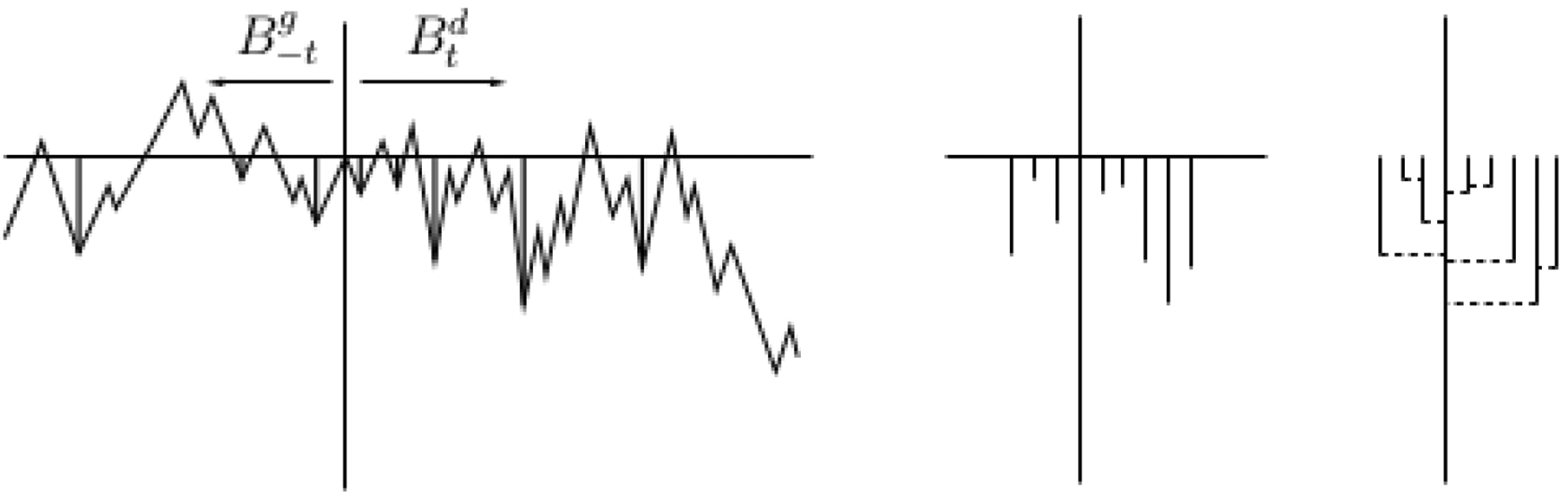
See Figure 4 for a representation of the contour process B, the ancestral process  ${\mathcal A}^{\mathcal N}$, and the genealogical tree
 ${\mathcal G}_0({\mathcal F}^{(\theta)})$. In this figure, the horizontal axis represents the time for Brownian motion on the left-hand figure, whereas it is in the scale of local time for the ancestral process on the two right-hand figures. This will always be the case in the rest of the paper when we are dealing with ancestral processes.
Let  $[-E_{\textrm{g}},E_{\textrm{d}}]$ be the closed support of the measure
 ${\mathcal A}^{\mathcal N}(du,{\mathbb R}_+)$:
 \begin{align*}E_{\textrm{d}} & =\text{inf}\{u\geq 0,\ {\mathcal A}([u,+\infty)\times{\mathbb R}_+)=0\}\\\text{and}\quad E_{\textrm{g}} & =\text{inf}\{u\geq 0,\ {\mathcal A}(({-}\infty,-u]\times{\mathbb R}_+)=0\},\end{align*}
with the convention that  $\text{inf} \emptyset=+\infty $. Notice that, for
 $\ell\in\{\text{g},\text{d}\}$, we also have
 $E_\ell=L_\infty^\ell$. We now give the distribution of the ancestral process
 ${\mathcal A}^{\mathcal N}$. Recall that
 $c_\theta$ was defined in (1.3).
Proposition 3.2. Let  $\theta\geq 0$. Under
 ${\mathbb P}^{(\theta)}$, the random variables
 $E_{\textrm{g}},E_{\textrm{d}}$ are independent and exponentially distributed with parameter
 $2\theta$ (and mean
 $1/2\theta$), with the convention that
 $E_{\textrm{d}}=E_{\textrm{g}}=+\infty $ if
 $\theta=0$. Under
 ${\mathbb P}^{(\theta)}$ and conditionally given
 $(E_{\textrm{g}},E_{\textrm{d}})$, the ancestral process
 ${\mathcal A}^{\mathcal N}(du, d\zeta)$ is a Poisson point measure with intensity
 \begin{equation*}{\textbf 1}_{({-}E_{\textrm{g}},E_{\textrm{d}})}(u)\, du\, |c^{\prime}_\theta(\zeta)|d\zeta.\end{equation*}
Notice that the random measure  ${\mathcal A}^{\mathcal N}$ satisfies Conditions (i)–(iii) from Definition 3.1 and is thus indeed an ancestral process.
This result is very similar to Corollary 2 in [Reference Bi and Delmas11]. The main additional ingredient here is the order (given by the u variable), which will be very useful in the simulation.
Proof. Since  $B^{\text{d}}$ and
 $B^{\text{g}}$ are independent with the same distribution, we deduce that
 $E_{\textrm{g}}$ and
 $E_{\textrm{d}}$ are independent with the same distribution. Let
 $\theta>0$. Since
 $B^{\text{d}}$ is a Brownian motion with drift
 $-2\theta$, we deduce from Lemma 2.1 that
 $E_{\textrm{d}}$ is exponential with mean
 $1/2\theta$. The case
 $\theta=0$ is immediate.
The excursions below zero of  $B^{\text{d}}$ conditionally given
 $E_d$ are excursions of a Brownian motion
 $B^{({-}\theta)}$ with drift
 $2\theta$ (by symmetry with respect to 0) conditioned on being finite, i.e. excursions of a Brownian motion
 $B^{(\theta)}$ with drift
 $-2\theta$; see Lemma 2.1. Moreover, by (1.3),
 $c_\theta$ is exactly the tail distribution of the maximum of an excursion under
 $n^{(\theta)}$. Standard theory of Brownian excursions gives then the result.
3.2.3. Identification of the trees
Let  ${\mathfrak{T}}^{\mathcal N}=\mathfrak{T}({\mathcal A}^{\mathcal N})$ denote the locally compact tree associated with the ancestral process
 ${\mathcal A}^{\mathcal N}$; see Proposition 3.1. Based on the following proposition, we shall say that the ancestral process
 ${\mathcal A}^{\mathcal N}$ codes for the genealogical tree of the extant population at time 0 for the forest
 ${\mathcal F}^{(\theta)}$.
Proposition 3.3. Let  $\theta\geq 0$. The trees
 ${\mathcal G}_0({\mathcal F}^{(\theta)})$ under
 ${\mathbb P}^{(\theta)}$ and
 ${\mathfrak{T}}^{\mathcal N}$ belong to the same equivalence class in
 ${\mathbb T}_1$.
Proof. Let us first remark that the genealogical tree  ${\mathcal G}_0({\mathcal F}^{(\theta)})$ can be directly constructed using the process B as described in Figure 5.
The genealogical tree inside the Brownian motions.

More precisely, recall that B is the contour function of the tree  ${\mathcal F}^{(\theta)}_{({-}\infty,0]}$. Let us denote by
 $p_B$ the canonical projection from
 ${\mathbb R}$ to
 ${\mathcal F}^{(\theta)}_{({-}\infty,0]}$ as defined in Section 2.4. Recall that
 $((\alpha_i,\beta_i), \, i\in {\mathcal I}^{\ell})$, with
 $\ell\in\{\text{g}, \text{d}\}$, are the excursion intervals of
 $B^\ell$ below 0. Then
 ${\mathcal G}_0({\mathcal F}^{(\theta)})$ is the smallest complete sub-tree of
 ${\mathcal F}^{(\theta)}_{({-}\infty,0]}$ that contains the points
 $(p_B(\alpha_i), i\in {\mathcal I}_{\text{g}}\bigcup{\mathcal I}_{\text{d}} )$ and the semi-infinite branch of
 ${\mathcal F}^{(\theta)}_{({-}\infty,0]}$.
Let  $i,j\in{\mathcal I}$ with
 $0<\alpha_i<\alpha_j$, for instance. By definition of the tree coded by a function, the distance between
 $p_B(\alpha_i)$ and
 $p_B(\alpha_j)$ in
 ${\mathcal G}_0({\mathcal F}^{(\theta)})$ is given by
 \begin{equation*}d(p_B(\alpha_i),p_B(\alpha_j))=-2\min_{u\in [\alpha_i,\alpha_j]}B_u.\end{equation*}
But, by definition of  ${\mathcal A}^{\mathcal N}$, we have
 \begin{align*}-\min_{u\in [\alpha_i,\alpha_j]}B_u
& =\max_{k\in{\mathcal I}\, \alpha_i\leq \alpha_k\lt \alpha_j}\bigl({-}\min_{u\in[\alpha_k,\beta_k]}B_u\bigr)\\
&=\max_{k\in{\mathcal I}\, \alpha_i\leq \alpha_k \lt \alpha_j} \zeta_k.\end{align*}
The other cases  $\alpha_j<\alpha_i<0$ and
 $\alpha _i<0<\alpha_j$ can be handled similarly. We deduce that the distances on a dense subset of leaves of
 ${\mathcal G}_0({\mathcal F}^{(\theta)})$ and
 $\mathfrak{T}^{\mathcal N}$ coincide, which implies the result by completeness of the trees.
3.2.4. Local times and other contour processes
Recall  $\theta\geq 0$. The Brownian forest
 ${\mathcal F}^{(\theta)}$ can be viewed as the genealogical tree of a stationary CB process (associated with the branching mechanism
 $\psi_\theta$ defined in (1.1)); see [Reference Chen and Delmas14]. To be more precise, for every
 $i\in I$ let
 $(\ell^{(i)}_a, \, a\geq 0)$ be the local time measures of the tree
 $\tau_i$. For every
 $t\in{\mathbb R}$, we consider the measure
 ${\textbf Z}_t$ on
 ${\mathcal Z}_t({\mathcal F}^{(\theta)})$ defined by
 \begin{equation}{\textbf Z}_t(dx)=\sum _{i\in I} {\textbf 1}_{\tau_i}(x)\, \ell_{t-h_i}^{(i)} (dx),\end{equation}
and we write  $Z_t={\textbf Z}_t(1)$ for its total mass, which also represents the population size at time t. For
 $\theta=0$, we have
 $Z_t=+\infty$ a.s. for every
 $t\in{\mathbb R}$. For
 $\theta>0$, the process
 $(Z_t, {t\geq 0})$ is a stationary Feller diffusion, solution of the stochastic differential equation (1.2); see Corollary 3.3. in [Reference Chen and Delmas14], as well as Theorem 1.2 in [Reference Duquesne17].
In the literature, one also considers the so-called Kesten tree, which is the genealogical tree associated with the Feller diffusion  $Z^+$ solving (1.2) for
 $t\geq 0$ with initial condition
 $ Z_0^+=0$. It corresponds to the genealogy of a sub-critical branching process started from an infinitesimal individual alive at time 0, conditionally on the non-extinction event. In our setting, the genealogical tree corresponds to
 ${\mathcal F}^{(\theta)}_{[0, +\infty )}$, and the process
 $Z^+$ is distributed as
 ${\textbf Z}^+(1)=({\textbf Z}_t^+(1), t\geq 0)$, with the measure
 ${\textbf Z}^+_t$ on
 ${\mathcal Z}_t({\mathcal F}^{(\theta)}_{[0, +\infty )})$ defined by
 \begin{equation*}{\textbf Z}^+_t(dx)=\sum _{i\in I} {\textbf 1}_{\{h_i\geq 0\}}\, {\textbf 1}_{\tau_i}(x)\, \ell_{t-h_i}^{(i)} (dx).\end{equation*}
It can also be described using a contour process obtained by the concatenation at infinity of two independent Brownian motions distributed as  $B^{(\theta)}$ conditioned to be positive. We use the description given in [Reference Duquesne17], which is valid in the general Lévy case; see also [Reference Athreya, Löhr and Winter7, Section 7.4], which corresponds to the case
 $\theta=0$.
Let  ${\mathcal E}_2$ be the set of continuous nonnegative functions g defined on
 ${\mathbb R}$ such that
 $g(0)=0$ and
 $\lim_{x\rightarrow -\infty } g(x)= \lim_{x\rightarrow +\infty }g(x)=+\infty$. For such a function, we again consider the pseudo-metric
 $d_g$ defined by (2.11), but for
 $s,t\in{\mathbb R}$, and with
 $m_g(s,t)$ replaced by
 $m_g(s,t)= \text{inf}_{r\not \in [s\wedge t,s\vee t ]} g(r)$ if
 $st<0$. We define the tree
 $T^+_g$ as the quotient space on
 ${\mathbb R}$ induced by this pseudo-metric. We set
 $p_g$ to be the canonical projection from
 ${\mathbb R}$ onto
 $T_g$. For
 $g\in {\mathcal E}_2$, the triplet
 $(T^+_g,d_g,p_g(0))$ is a complete locally compact rooted real tree with a unique semi-infinite branch. We continue to call g the contour process of
 $T^+_g$.
Let  $B^+=(B^+_t, t\in {\mathbb R})$ be such that
 $(B^+_t, t\geq 0)$ and
 $(B^+_{-t}, t\geq 0)$ are independent and distributed as
 $B^{(\theta)} -2 I^{(\theta)}$, which is a diffusion on
 ${\mathbb R}_+$ with infinitesimal generator given by (2.7). Thanks to Corollary 2.1, we get that the tree
 $T^+_{B^+}$ with contour process
 $B^+$ is distributed as the genealogical tree
 ${\mathcal F}^{(\theta)}_{[0, +\infty )}$ which is associated to the Feller diffusion
 ${\textbf Z}^+(1)$ (solution of (1.2) on
 ${\mathbb R}^+$ with
 $Z_0=0$).
Let  $\theta>0$. It is also immediate to give the contour process of the genealogical tree conditionally on the extinction being at time 0. Recall the tree defined by its contour process with the concatenation at 0 defined in Lemma 2.3. Set
 $B^-=-B^+$. It is left to the reader to check that the tree
 $T^-_{B^-}$ with contour process
 $B^-$ is distributed as the genealogical tree of the Feller diffusion
 ${\textbf Z}^-(1)=({\textbf Z}^-(1)_t, t\leq 0)$ conditioned to die at time 0 and started with the stationary distribution at
 $-\infty $ (solution of (1.2) on
 ${\mathbb R}_-$ with
 $Z_0=0$), where the measure
 ${\textbf Z}^-_t$ on
 ${\mathcal Z}_t({\mathcal F}^{(\theta)}_{({-}\infty , 0]})$ is defined by
 \begin{equation*}{\textbf Z}^-_t(dx)=\sum _{i\in I} {\textbf 1}_{\{\zeta_i+h_i
< 0\}}\, {\textbf 1}_{\tau_i}(x)\, \ell_{t-h_i}^{(i)} (dx),\end{equation*}
where  $\zeta_i$ is the height of the tree
 $\tau_i$. This result can also be deduced from the reversal property of the Brownian tree; see [Reference Abraham and Delmas3].
4. Simulation of the genealogical tree ($\theta>0$)

We use the representation of trees via the ancestral process (see Section 3), which is an atomic measure on  ${\mathbb R}^*\times (0,+\infty )$ satisfying conditions of Definition 3.1.
Under  ${\mathbb P}^ {(\theta)}$, let
 $\sum_{i\in I}\delta_{(h_i,\varepsilon_i,e_i)}$ be a Poisson point measure on
 ${\mathbb R}\times\{-1,1\}\times{\mathcal E}$ with intensity
 $\beta dh\, (\delta_{-1}(d\varepsilon)+\delta_{1}(d\varepsilon))\,n^{(\theta)}(de)$, and let
 ${\mathcal F}^{(\theta)}=((h_i,\tau_i), \, i\in I)$ be the associated Brownian forest. We denote by
 $\ell_a^{(i)}$ the local time measure of the tree
 $\tau_i$ at level a (recall that this local time is zero for
 $a\not\in [0, H(\tau_i)]$), and we denote by
 $\partial _i$ the root of
 $\tau_i$. Recall that the extant population at time
 $h\in {\mathbb R}$ is given by
 ${\mathcal Z}_h({\mathcal F}^{(\theta)})$ defined in Section 2.4.4, and the measure
 ${\textbf Z}_h$ on
 ${\mathcal Z}_h({\mathcal F}^{(\theta)})$ is defined by (3.4).
Let  $(\mathfrak{X}_k, k\in {\mathbb N}^*)$ be, conditionally given
 ${\mathcal F}^{(\theta)}$, independent random variables distributed according to the probability measure
 ${\textbf Z}_0/Z_0$. Notice that normalization by
 $Z_0$, which is motivated by the sampling approach, is not usual in the branching setting; see for instance Theorem 4.7 in [Reference Chen and Delmas14], where the sampling is according to
 ${\textbf Z}_0$ instead, leading to the bias factor
 $Z_0^n$.
For every  $k\in {\mathbb N}^*$, we denote by
 $i_k$ the index in I such that
 $\mathfrak{X}_k\in\tau_{i_k}$. For every
 $n\in{\mathbb N}^*$, we set
 $I_n=\{i_k,\ 1\leq k\leq n\}$, and for every
 $i\in I_n$ we denote by
 $\tau_i^{(n)}$ the sub-tree of
 $\tau_i$ generated by the
 $\mathfrak{X}_k$ such that
 $i_k=i$ and
 $1\leq k\leq n$; i.e.
 \begin{equation*}\tau_i^{(n)}=\bigcup_{1\leq k\leq n,\ i_k=i}[\![ \partial_ i,\mathfrak{X}_k]\!].\end{equation*}
We define the genealogical tree  $T_n$ of n individuals sampled uniformly at random from the population at time 0 by
 \begin{equation*}T_n=({-}\infty , 0] \circledast_{i\in I_n}(\tau_i^{(n)},h_i).\end{equation*}
Notice that  $T_n\subset T_{n+1}$. Since the support of
 ${\textbf Z}_h$ is
 ${\mathcal Z}_h({\mathcal F}^{(\theta)})$ a.s., we get that a.s.
 ${\textrm{cl}}\; \left( \bigcup _{n\in {\mathbb N}^*} T_n \right)= {\mathcal G}_0({\mathcal F}^{(\theta)})$, where
 ${\mathcal G}_0({\mathcal F}^{(\theta)})$ (see Definition (2.13)) is the genealogical tree of the forest
 ${\mathcal F}^{(\theta)}$ at time 0.
Recall  $c_\theta$ as defined in (1.3). For
 $\delta>0$, we will consider in the next sections a positive random variable
 $\zeta_\delta^*$ whose distribution is given by, for
 $h>0$,
 \begin{equation}{\mathbb P}(\zeta^*_\delta<h)={\mathop {\textrm{e}^{-\delta c_\theta(h)}}}.\end{equation}
This random variable is easy to simulate, since if U is uniformly distributed on [0, 1], then  $\zeta^*_\delta$ has the same distribution as
 \begin{equation*}{\mathop{\frac{1}{2\theta \beta}}\nolimits} \log\left(1- \frac{2\theta\delta}{\log(U)}\right).\end{equation*}
This random variable appears naturally in the simulation of the ancestral process of  ${\mathcal F}^{(\theta)}$, because if
 $\sum_{i\in I} \delta_{(z_i, \zeta_i)}$ is a Poisson point measure on
 ${\mathbb R}\times{\mathbb R}_+$ with intensity
 \begin{equation*}{\textbf 1}_{ [0, \delta]}(z)\, dz \, |c^{\prime}_\theta(\zeta)|d\zeta\end{equation*}
(see Proposition 3.2 for the interpretation), then  $\zeta^*_\delta$ is distributed as
 $\max _{i\in I} \zeta_i$.
We now present many ways to simulate  $T_n$. This will be done by simulating ancestral processes (see Section 3), which code for trees distributed as
 $T_n$.
Recall that for an interval I, we write  $|I|$ for its length.
4.1. Static simulation
In what follows, S stands for ‘static’. Assume  $n\in {\mathbb N}^*$ is fixed. We present a way to simulate
 $T_n$ under
 ${\mathbb P}^{(\theta)}$ with
 $\theta>0$. See Figures 6 and 7 for an illustration for
 $n=5$.
-
(i) The size of the population on the left (resp. right) of the origin is
$E_{\textrm{g}}$ (resp. $E_{\textrm{d}}$), where $E_{\textrm{g}}, E_{\textrm{d}}$ are independent exponential random variables with mean $1/2\theta$. Set $Z_0=E_{\textrm{g}}+E_{\textrm{d}}$ for the total size of the population at time 0. Let $(U_k, k\in {\mathbb N}^*)$ be independent random variables uniformly distributed on [0, 1] and independent of $(E_{\textrm{g}}, E_{\textrm{d}})$. Set $X_{0}=0$ and, for $k\in {\mathbb N}^*$, $X_k=Z_0 U_k - E_{\textrm{g}}$ as well as ${\mathcal X}_k=\{-E_{\textrm{g}},E_{\textrm{d}}, X_0, \ldots, X_k\}$. -
(ii) For
$1\leq k\leq n$, set $X_{k,n}^{\text{g}}=\max \{x\in {\mathcal X}_n, \, x<X_k\}$ and $X_{k,n}^{\text{d}}=\min \{x\in {\mathcal X}_n, \, x>X_k\}$. We also set $I^{\text{S}}_{k}=[X_{k,n}^{\text{g}}, X_k]$ if $X_k>0$ and $I^{\text{S}}_{k}=[X_k, X_{k,n}^{\text{d}}]$ if $X_k<0$. -
(iii) Conditionally on
$(E_{\textrm{g}}, E_{\textrm{d}}, X_1, \ldots, X_n)$, let $(\zeta_{k}^{ \text{S}}, 1\leq k\leq n)$ be independent random variables such that for $1\leq k\leq n$, $\zeta_{k}^{ \text{S}}$ is distributed as $\zeta^*_\delta$ (see (4.1)), with $\delta= |I^{\text{S}}_{k}|$. Consider the tree $\mathfrak{T}^{\text{S}}_n$ corresponding to the ancestral process ${\mathcal A}_n^{\text{S}}=\sum_{k=1}^n \delta_{(X_k, \zeta_{k}^{ \text{S}})}$.


One realization of  $E_{\textrm{g}}, E_{\textrm{d}}, X_1, \ldots, X_5$.

One realization of the tree  $\mathfrak{T}_5^{\text{S}}$.

This gives an exact simulation of the tree  $T_n$, according to the following result.
Lemma 4.1. Let  $\theta>0$ and
 $n\in {\mathbb N}^*$. The tree
 $\mathfrak{T}_n^{\text{S}}$ is distributed as
 $T_n$ under
 ${\mathbb P}^{(\theta)}$.
Proof. Let  $B=(B_t, t\in {\mathbb R})$ be the Brownian motion with drift defined in Subsection 3.2.1, and let
 $(L_t,t\in{\mathbb R})$ be its local time at 0, i.e.
 \begin{equation*}L_t=L_t^{\text{d}}{\textbf 1}_{t>0}+L_{-t}^{\text{g}}{\textbf 1}_{t<0}.\end{equation*}
We set  $L_\infty=L_\infty^{\text{d}}+L_{\infty}^{\text{g}}$, and we consider independent and identically distributed variables
 $(S_1,\ldots, S_n)$ distributed according to
 $dL_s/L_\infty$. We denote by
 $(S_{(1)},\ldots,S_{(n)})$ the order statistics of
 $(S_1,\ldots S_n)$, and for every
 $i\leq n$ we set
 \begin{equation*}M_i=\begin{cases}-\min_{u\in [S_{(i)}, S_{(i+1)}\wedge 0]}B_u & \mbox{if }S_{(i)}<0,\\-\min_{u\in [S_{(i-1)}\vee 0, S_{(i)}]}B_u & \mbox{if }S_{(i)}>0.\end{cases}\end{equation*}
We set
 \begin{equation*}\mathcal{A}_n=\sum_{1\leq i\leq n}\delta_{(L_{S_{(i)}},\zeta_i)},\end{equation*}
which is an ancestral process (see Definition 3.1), and let  $\mathfrak{T}(\mathcal{A}_n)$ be the associated tree. As B is the contour process of the tree
 $\mathcal{F}_{({-}\infty,0]}$, we get that
 $T_n$ and
 $\mathfrak{T}(\mathcal{A}_n)$ are equally distributed.
Moreover, by Proposition 3.2, Proposition 3.3, and standard results on Poisson point processes, we get that  $\mathfrak{T}(\mathcal{A}_n)$ and
 $\mathfrak{T}_n^S$ are also equally distributed.
4.2. Dynamic simulation (I)
We can modify the static simulation of the previous section to provide a natural dynamic construction of the genealogical tree. In what follows, D stands for ‘dynamic’. Let  $\theta>0$. We build recursively a family of ancestral processes
 $({\mathcal A}_n, n\in {\mathbb N})$, with
 ${\mathcal A}_0^{\text{D}}=0$ and
 \begin{equation*}{\mathcal A}_n^{\text{D}}=\sum_{k=1}^n \delta_{(V_k, \zeta_k^{\text{D}})}\end{equation*}
for  $n\in {\mathbb N}^*$.
-
(i) Let
$E_{\textrm{g}}$, $E_{\textrm{d}}$, $(X_n, n\in {\mathbb N})$, and $({\mathcal X}_n, n\in {\mathbb N}^*)$ be defined as in (i) of Section 4.1. For $n\in {\mathbb N} ^*$, set $X_n^{\text{g}}=\max \{x\in {\mathcal X}_n, x<X_n\}$ and $X_n^{\text{d}}=\min \{x\in {\mathcal X}_n, x>X_n\}$. For $n\in {\mathbb N} ^*$ and $\ell\in \{\text{g}, \text{d}\}$, define the interval $I_n^{\ell}= [X_n \wedge X_n^\ell, X_n\vee X_n^\ell]$ and its length $|I_n^{\ell}|=|X_n - X_n^\ell|$.We shall consider and check by the induction the following hypothesis: for
$n\geq 2$ the random variables $V_1, \ldots, V_{n-1}$ are such that
(4.2)where
\begin{equation}X_{(0,n-1)}<V_{(1,n-1)}<X_{(1, n-1)}< \cdots < V_{(n-1, n-1)}
< X_{(n-1, n-1)},\end{equation}
$(V_{(1, n-1)}, \ldots, V_{(n,n)})$ and $(X_{(0,n-1)}, \ldots, X_{(n-1,n-1)})$ respectively are the order statistics of $(V_1, \ldots, V_{n-1})$ and of $(X_0, \ldots, X_{n-1})$. Notice that (4.2) holds trivially for $n=1$.
We set
${\mathcal W}_n^{\text{D}}=(E_{\textrm{g}}, E_{\textrm{d}}, X_1, \ldots, X_n, V_1, \ldots, V_{n-1},\zeta^{\text{D}}_{1}, \ldots, \zeta^{\text{D}}_{n-1})$. -
(ii) Assume
$n\geq 1$. We work conditionally on ${\mathcal W}^{\text{D}}_n$. On the event $\{X_n^{\text{d}}=E_{\textrm{d}}\}$ set $I_n=I_n^{\text{g}}$ and on the event $\{X_n^{\text{g}}=-E_{\textrm{g}}\}$ set $I_n=I_n^{\text{d}}$. On the event $\{X_n^{\text{d}}=E_{\textrm{d}}\}\bigcup \{X_n^{\text{g}}=-E_{\textrm{g}}\}$, let $V_n$ be uniform on $I_n$, and let $\zeta_{n}^{\text{D}}$ be distributed as $\zeta^*_\delta$ (see (4.1)) with $\delta= |I_n|$. -
(iii) Assume
$n\geq 2$ and that (4.2) holds. We work conditionally on ${\mathcal W}^{\text{D}}_n$. On the event $\{-E_{\textrm{g}}<X_n^{\text{g}},\,X_n^{\text{d}}<E_{\textrm{d}}\}$, there exists a unique integer $\kappa_n\in \{1, \ldots, n-1\}$ such that $V_{\kappa_n}\in [ X_n^{\text{g}},\,X_n^{\text{d}}]$. If $X_n\in [X_n^{\text{g}}, V_{\kappa_n})$, set $I_n=I_n^{\text{g}}$; if $X_n\in [V_{\kappa_n}, X_n^{\text{d}}]$, set $I_n=I_n^{\text{d}}$. Then let $V_n$ be uniform on $I_n$, and let $\zeta_{n}^{\text{D}}$ be distributed as $\zeta^*_\delta$, with $\delta= |I_n|$, conditionally on being less than $\zeta^{\text{D}}_{\kappa_n}$. -
(iv) Thanks to (ii) and (iii), notice that (4.2) holds with
$n-1$ replaced by n, so that the induction is valid. Set
and consider the tree
\begin{equation*}{\mathcal A}_n^{\text{D}}={\mathcal A}_{n-1}^{\text{D}}+ \delta_{(V_n, \zeta^{\text{D}}_{n})}\end{equation*}
$\mathfrak{T}_n^{\text{D}}$ corresponding to the ancestral process ${\mathcal A}_n^{\text{D}}$.


See Figures 8 and 9 for an example of  $\mathfrak{T}_4^{\text{D}}$ and
 $\mathfrak{T}_5^{\text{D}}$.
An example of the tree  $\mathfrak{T}_4^{\text{D}}$.

An example of the tree  $\mathfrak{T}_5^{\text{D}}$. The length of the new branch attached to
 $V_{5}$ is conditioned to be less than that of the previous branch that was in the considered interval attached to
 $V_{2}$.

Then we have the following result.
Lemma 4.2. Let  $\theta>0$. The sequences of trees
 $(\mathfrak{T}_n^{\text{D}}, n\in {\mathbb N}^*)$ and
 $(T_n, n\in {\mathbb N}^*)$ under
 ${\mathbb P}^{(\theta)}$ have the same distribution.
Proof. We consider  $\sum _{i\in {\mathcal I}}\delta_{(u_i,\zeta_i)}$ the ancestral process associated to the Poisson point measure
 $\sum_{i\in I}\delta_{(h_i,\varepsilon_i,e_i)}$ defined in Subsection 3.2.2. Let
 $(X^{\prime\prime}_k, k\in {\mathbb N} ^*)$ be independent uniform random variables on
 $[-E_{\textrm{g}}, E_{\textrm{d}}]$. Set
 $X^{\prime\prime}_0=0$. For
 $n\geq 1$, let us denote by
 $(X^{\prime\prime}_{(k,n)}, {0\leq k\leq n})$ the order statistic of
 $(X^{\prime\prime}_0,\ldots,X^{\prime\prime}_n)$.
For every  $n\geq 1$ and every
 $1\leq k\leq n$, we set
 $i_{k,n}$ to be the index in
 ${\mathcal I}$ such that
 \begin{equation*}\zeta_{i_{k,n}}=\max _{X^{\prime\prime}_{(k-1,n)}\leq u_i
< X^{\prime\prime}_{(k,n)}}\zeta_i.\end{equation*}
Note that this index exists, since for every  $\varepsilon>0$, the set
 $\{i\in {\mathcal I},\ \zeta _i>\varepsilon\}$ is a.s. finite. We set
 $V^{\prime\prime}_{(k,n)}=u_{i_{k,n}}$ and notice that, by standard Poisson point measure properties,
 $V^{\prime\prime}_{(k,n)}$ is, conditionally given
 $(X^{\prime\prime}_0,\ldots,X^{\prime\prime}_n)$, uniformly distributed on
 $[X^{\prime\prime}_{(k-1,n)},X^{\prime\prime}_{(k,n)}]$. We define
 \begin{equation*}{\mathcal A}^{\prime\prime}_n=\sum_{k=1}^n \delta_{(V^{\prime\prime}_{(k,n)}, \zeta_{i_{k,n}})}.\end{equation*}
By construction, it is easy to check that the order statistics
 \begin{equation*}X^{\prime\prime}_{(0,n)}<V^{\prime\prime}_{(1,n)}<X^{\prime\prime}_{(1, n)}< \cdots < V^{\prime\prime}_{(n, n)}
< X^{\prime\prime}_{(n, n)}\end{equation*}
are distributed as
 \begin{equation*}X_{(0,n)}<V_{(1,n)}<X_{(1, n)}< \cdots < V_{(n, n)}
< X_{(n, n)}.\end{equation*}
For  $1\leq k\leq n$, let
 $j_{k,n}\in \{1, \ldots, n\}$ be the index such that
 $V_{(k,n)}=V_{j_{k,n}}$. By construction, we then deduce that
 $(((V_{(k,n)},\zeta^{\text{D}}_{j_{k,n}}), 1\leq k\leq n), n\in {\mathbb N}^*)$ is distributed as
 $(((V^{\prime\prime}_{(k,n)},\zeta_{i_{k,n}}), 1\leq k\leq n), n\in {\mathbb N}^*)$. This implies that the sequences of ancestral processes
 $({\mathcal A}^{\prime\prime}_n, n\in {\mathbb N}^*)$ and
 $({\mathcal A}_n, n\in{\mathbb N}^*)$ have the same distribution. Then we use Proposition 3.3 to get that the sequence of trees
 $(T^{\prime\prime}_n, n\in {\mathbb N}^*)$, with
 $T^{\prime\prime}_n$ associated to
 ${\mathcal A}^{\prime\prime}_n$, is distributed as
 $(T_n, n\in {\mathbb N}^*)$.
4.3. Dynamic simulation (II)
In a sense, we had to introduce another piece of random information corresponding to the position  $V_{n}$ of the largest spine of the sub-tree containing
 $X_{n}$. The construction in this subsection provides a way to remove this additional information (which is now hidden), but at the expense of possibly exchanging the newly inserted branch with one of its neighbors. In what follows, H stands for ‘hidden’. An example is provided for
 $\mathfrak{T}^{\text{H}}_4$ and
 $\mathfrak{T}^{\text{H}}_5$ in Figures 10, 11, and 12.
An example of the tree  $\mathfrak{T}^{\text{H}}_4$ with the new individual
 $X_5$.

An example of the tree  $\mathfrak{T}^{\text{H}}_5$ with
 $\mathfrak{T}^{\text{H}}_4$ given in Figure 10 and the event associated with
 $p_{\textrm{d}}$ (a new segment is attached to
 $X_{5}$).

An example of the tree  $\mathfrak{T}^{\text{H}}_5$ with
 $\mathfrak{T}^{\text{H}}_4$ given in Figure 10 and the event associated with
 $p_{\textrm{g}}$ (the segment previously attached to
 $X_2$ is now attached to
 $X_5$, and a new segment is attached to
 $X_2$).

Let  $\theta>0$. We build recursively a family of ancestral processes
 $({\mathcal A}_n^{\text{H}}, n\in {\mathbb N})$, with
 ${\mathcal A}_0^{\text{H}}=0$ and
 \begin{equation*}{\mathcal A}_n^{\text{H}}=\sum_{k=1}^n \delta_{(X_k, \zeta_{k,n}^{\text{H}})}\end{equation*}
for  $n\in {\mathbb N}^*$.
-
(i) Let
$E_{\textrm{g}}$, $E_{\textrm{d}}$, $(X_n, n\in {\mathbb N})$, and $({\mathcal X}_n, n\in {\mathbb N}^*)$ be defined as in (i) of Subsection 4.1. For $n\in {\mathbb N} ^*$, set $X_n^{\text{g}}=\max \{x\in {\mathcal X}_n, x<X_n\}$ and $X_n^{\text{d}}=\min \{x\in {\mathcal X}_n, x>X_n\}$. For $n\in {\mathbb N} ^*$ and $\ell\in \{\text{g}, \text{d}\}$, define the interval $I_n^{\ell}= [X_n \wedge X_n^\ell, X_n\vee X_n^\ell]$ and its length $|I_n^{\ell}|=|X_n - X_n^\ell|$.We set
${\mathcal W}_n^{\text{H}}=(E_{\textrm{g}}, E_{\textrm{d}}, X_1, \ldots, X_n,\zeta^{\text{H}}_{1, n-1}, \ldots, \zeta^{\text{H}}_{n-1, n-1})$. -
(ii) Assume
$n\geq 1$. On the event $\{X_n^{\text{d}}=E_{\textrm{d}}\}$ set $I_n=I_n^{\text{g}}$, and on the event $\{X_n^{\text{g}}=-E_{\textrm{g}}\}$ set $I_n=I_n^{\text{d}}$. Conditionally on ${\mathcal W}_n^{\text{H}}$, let $\zeta_{n,n}^{\text{H}}$ be distributed as $\zeta^*_\delta$ (see (4.1)) with $\delta= |I_n|$; and for $1\leq k\leq n-1$, set $\zeta^{\text{H}}_{k,n}=\zeta^{\text{H}}_{k,n-1}$. -
(iii) Assume
$n\geq 2$. We work conditionally on ${\mathcal W}_n^{\text{H}}$. We define
\begin{equation*}p_{\textrm{d}}=\frac{|I_n^{\text{d}}|}{|I_n^{\text{d}}|+|I_n^{\text{g}}|}\quad \text{and}\quad p_{\textrm{g}}=1-p_{\textrm{d}}=\frac{|I_n^{\text{g}}|}{|I_n^{\text{d}}|+|I_n^{\text{g}}|} \cdot\end{equation*}
-
(a) On the event
$\{0\leq X_n^{\text{g}},\,X_n^{\text{d}}<E_{\textrm{d}}\}$, there exists a unique integer $\kappa_n^{\text{d}} \in \{1, \ldots, n-1\}$ such that $X_{\kappa_n^{\text{d}}} = X_n^{\text{d}}$. For $1\leq k\leq n-1$ and $k\neq \kappa_n^{\text{d}}$, set $\zeta^{\text{H}}_{n,k} = \zeta^{\text{H}}_{n-1,k}$. Write
With probability
\begin{equation*}\zeta^{\text{H}}_n=\zeta^{\text{H}}_{n-1, \kappa_n^{\text{d}}}.\end{equation*}
$p_{\textrm{d}}$, set $\zeta_{n,\kappa_n^{\text{d}}}^{\text{H}}= \zeta^{\text{H}}_{n}$ and let $\zeta_{n,n}^{\text{H}}$ be distributed as $\zeta^*_\delta$, with $\delta= |I_n^{\text{g}}|$, conditionally on being less than $\zeta^{\text{H}}_{n}$.
With probability
$p_{\textrm{g}}$, set $\zeta_{n,n}^{\text{H}}= \zeta^{\text{H}}_{n}$ and let $\zeta^{\text{H}}_{n, \kappa_n^{\text{d}}}$ be distributed as $\zeta^*_\delta$, with $\delta= |I_n^{\text{d}}|$, conditionally on being less than $\zeta^{\text{H}}_{n}$. -
(b) On the event
$\{-E_{\textrm{g}}< X_n^{\text{g}},\,X_n^{\text{d}}\leq 0\}$, there exists a unique integer $\kappa_n^{\text{g}} \in \{1, \ldots, n-1\}$ such that $X_{\kappa_n^{\text{g}}} = X_n^{\text{g}}$. For $1\leq k\leq n-1$ and $k\neq \kappa_n^{\text{g}}$, set $\zeta^{\text{H}}_{n,k} = \zeta^{\text{H}}_{n-1,k}$. Write
With probability
\begin{equation*}\zeta^{\text{H}}_n=\zeta^{\text{H}}_{n-1, \kappa_n^{\text{g}}}.\end{equation*}
$p_{\textrm{g}}$, set $\zeta_{n,\kappa_n^{\text{g}}}^{\text{H}}= \zeta^{\text{H}}_{n}$ and let $\zeta_{n,n}^{\text{H}}$ be distributed as $\zeta^*_\delta$, with $\delta= |I_n^{\text{d}}|$, conditionally on being less than $\zeta^{\text{H}}_{n}$.
With probability
$p_{\textrm{d}}$, set $\zeta_{n,n}^{\text{H}}= \zeta^{\text{H}}_{n}$ and let $\zeta^{\text{H}}_{n, \kappa_n^{\text{g}}}$ be distributed as $\zeta^*_\delta$, with $\delta= |I_n^{\text{g}}|$, conditionally on being less than $\zeta^{\text{H}}_{n}$.
-
-
(iv) Let
$\mathfrak{T}^{\text{H}}_n$ be the tree corresponding to the ancestral process
\begin{equation*}{\mathcal A}_n^{\text{H}}=\sum_{k=1}^n \delta_{(X_k, \zeta^{\text{H}}_{k,n})}.\end{equation*}


We now have the next result.
Lemma 4.3. Let  $\theta>0$. The sequences of trees
 $(\mathfrak{T}^{\text{H}}_n, n\in {\mathbb N}^*)$ and
 $(T_n, n\in {\mathbb N}^*)$ under
 ${\mathbb P}^{(\theta)}$ have the same distribution.
Proof. The proof is left to the reader. It is in the same spirit as the proof of Lemma 4.2, but here we consider the random variables  $((V^{\prime\prime}_{(k,n)}, 1\leq k\leq n), n\in {\mathbb N}^*)$ to be unobserved.
4.4. Simulation of genealogical tree conditional on its maximal height
Let  ${\mathcal F}^{(\theta)}=((\tau_i, h_i), \, i\in I)$ be a Brownian forest under
 ${\mathbb P}^{(\theta)}$. Recall the definition of
 $A_0$, the time to the MRCA of the population living at time 0, given in (5.3). The goal of this section is to simulate the genealogical tree
 $T_n$ of n individuals uniformly sampled in the population living at time 0, conditionally given that the time to the MRCA of the whole population is h, i.e. given
 $A_0=h$.
Let
 \begin{equation*}{\mathcal A}(du,d\zeta)=\sum_{j\in {\mathcal I}}\delta_{(u_j,\zeta_j)}(du,d\zeta)\end{equation*}
be the ancestral process of Definition 3.1. Recall the notation  $E_{\textrm{g}},E_{\textrm{d}}$ from Subsection 3.2.2. Let
 $\zeta_{\text{max}} =\text{sup} \{\zeta_j,\ j\in {\mathcal I}\}$ and define the random index
 $J_0\in {\mathcal I}$ so that
 $\zeta_{\text{max}} =\zeta_{J_0}$. Note that
 $J_0$ is well-defined since for every
 $\varepsilon>0$, the set
 $\{j\in {\mathcal I}, \zeta_j>\varepsilon\}$ is finite. We set
 $X=u_{J_0}\in({-}E_{\textrm{g}}, E_{\textrm{d}})$. Note that
 $\zeta_{\text{max}} $ is distributed as
 $A_0$.
For  $r\in {\mathbb R}$, let
 $r_+=\max(0,r)$ and
 $r_-=\max(0, -r)$ be respectively the positive and negative part of r. The proof of the next lemma is postponed to the end of this section.
Lemma 4.4. Let  $\theta>0$. Under
 ${\mathbb P}^{(\theta)}$, conditionally given
 $\zeta_{\text{max}} =h$, the random variables
 $E_g+X_-$,
 $|X|$,
 $E_d-X_+$, and
 ${\textbf 1}_{\{X\geq 0\}}$ are independent;
 $E_g+X_-$,
 $|X|$, and
 $E_d-X_+$ are exponentially distributed with parameter
 $2\theta +c_\theta(h)$, and
 ${\textbf 1}_{\{X\geq 0\}}$ is Bernoulli
 $1/2$.
Let  $h>0$ be fixed. For
 $\delta>0$, let
 $\zeta^{*,h}_\delta$ be a positive random variable distributed as
 $\zeta^*_\delta$ conditionally on
 $\{\zeta^*_\delta\leq h\}$; i.e. for
 $0\leq u\leq h$,
 \begin{equation*}{\mathbb P}(\zeta^{*,h}_{\delta \leq u})={\mathbb P}(\zeta_{\delta}^{*\leq u} m|\zeta_{\delta}^{*\leq h})={ {\textrm{e}^{-\delta(c_\theta(u)-c_\theta(h))}}}.\end{equation*}
Then the static simulation runs as follows.
-
(i) Simulate three independent random variables
$E_1,E_2,E_3$ exponentially distributed with parameter $2\theta+c_\theta(h)$, and another independent Bernoulli variable $\xi$ with parameter $1/2$. If $\xi=0$, set $E_{\textrm{g}}=E_1,\ X=E_2,\ E_{\textrm{d}}=E_2+E_3$, and if $\xi=1$, set $E_{\textrm{g}}=E_1+E_2,\ X=-E_2,\ E_{\textrm{d}}=E_3$. Let $X_k$ and ${\mathcal X}_k$ be defined as in (i) of Subsection 4.1 for $1\leq k\leq n$. -
(ii) Let the intervals
$I_k^{\text{S}}$ be defined as in (ii) of Subsection 4.1 for $1\leq k\leq n$. -
(iii) Conditionally on
$(E_{\textrm{g}}, E_{\textrm{d}}, X, X_1, \ldots, X_n)$, let $(\zeta_{k}^{h}, 1\leq k\leq n)$ be independent random variables such that, for $1\leq k\leq n$, $\zeta_{k}^{h}$ is distributed as $\zeta^{*,h}_\delta$ with $\delta= |I^{\text{S}}_{k}|$ if $X \not \in I_k^{\text{S}}$, and $\zeta_{k}^{h}=h$ if $X \in I_k^{\text{S}}$. Consider the tree $\mathfrak{T}^h_n$ corresponding to the ancestral process
\begin{equation*}{\mathcal A}_n^h=\sum_{k=1} \delta_{(X_k, \zeta_{k}^{h})}.\end{equation*}


The proof of the following result, which relies on Lemma 4.4, is similar to that of Lemma 4.1, and is not reproduced here.
Lemma 4.5. Let  $\theta>0$,
 $h>0$, and
 $n\in {\mathbb N}^*$. The tree
 $\mathfrak{T}_n^h$ is distributed as
 $T_n$ under
 ${\mathbb P}^{(\theta)}$ conditionally given
 $A_0=h$.
Notice that the height of  $\mathfrak{T}_n^h$ is less than or equal to h. When it is strictly less than h, this means that no individual of the oldest family has been sampled.
Proof of Lemma 4.4. By Proposition 3.2, the pair  $E=(E_{\textrm{g}},E_{\textrm{d}})$ under
 ${\mathbb P}^{(\theta)}$ has density
 \begin{equation*}f_E(e_{\textrm{g}}, e_{\textrm{d}})=(2\theta)^2{\mathop {\textrm{e}^{-2\theta(e_{\textrm{g}}+e_{\textrm{d}})}}}{\textbf 1}_{\{e_{\textrm{g}}\geq 0, e_{\textrm{d}}\geq 0\}}.\end{equation*}
Moreover, by standard results on Poisson point measures, the conditional density of the pair  $(X,\zeta_{\text{max}})$ given
 $(E_{\textrm{d}},E_{\textrm{g}})=(e_g,e_d)$ exists and is
 \begin{align*}f_{X,\zeta_{\text{max}}}^{E=(e_{\textrm{g}},e_{\textrm{d}})}(x,h)&=\frac{1}{e_{\textrm{g}}+e_{\textrm{d}}}{\textbf 1}_{[-e_{\textrm{g}},e_{\textrm{d}}]}(x)\, (e_{\textrm{g}}+e_{\textrm{d}})\, |c^{\prime}_\theta(h)|{\mathop {\textrm{e}^{-c_\theta(h)(e_{\textrm{g}}+e_{\textrm{d}})}}}{\textbf 1}_{\{h\geq 0\}}\\& ={\textbf 1}_{[-e_{\textrm{g}},e_{\textrm{d}}]}(x)\, |c^{\prime}_\theta(h)|{\mathop {\textrm{e}^{-c_\theta(h)(e_{\textrm{g}}+e_{\textrm{d}})}}}{\textbf 1}_{\{h\geq 0\}}.\end{align*}
We deduce that the vector  $(E_{\textrm{g}},E_{\textrm{d}},X,\zeta_{\text{max}})$ has density
 \begin{equation*}f(e_{\textrm{g}},e_{\textrm{d}},x,h)=(2\theta)^2|c^{\prime}_\theta(h)|{\mathop {\textrm{e}^{-(2\theta+c_\theta(h))(e_{\textrm{g}}+e_{\textrm{d}})}}}{\textbf 1}_{\{ e_{\textrm{g}}\geq 0, \, e_{\textrm{d}}\geq 0, \, -e_{\textrm{g}}\leq x\leq e_{\textrm{d}}, \, h\geq 0\}}\end{equation*}
and that the random variable  $\zeta_{\text{max}}$ has density
 \begin{align*}f_{\zeta_{\text{max}}}(h)& =\int (2\theta)^2|c^{\prime}_\theta(h)|{\mathop {\textrm{e}^{-(2\theta+c_\theta(h))(e_{\textrm{g}}+e_{\textrm{d}})}}}{\textbf 1}_{\{ e_{\textrm{g}}\geq 0, \, e_{\textrm{d}}\geq 0, \, -e_{\textrm{g}}\leq x\leq e_{\textrm{d}}, \, h\geq 0\}}\,de_{\textrm{g}}\,de_{\textrm{d}}\,dx\\& =(2\theta)^2|c^{\prime}_\theta(h)|\frac{2}{(2\theta+c_\theta(h))^3}\, {\textbf 1}_{\{h\geq 0\}}.\end{align*}
Therefore, the conditional density of the vector  $(E_{\textrm{g}},E_{\textrm{d}},X)$ given
 $\zeta_{\text {max}}=h$ is
 \begin{equation*}f_{E,X}^{\zeta_{\text{max}}=h}(e_{\textrm{g}},e_{\textrm{d}},x)=\frac{1}{2}(2\theta+c_\theta(h))^3{\mathop {\textrm{e}^{-(2\theta+c_\theta(h))(e_{\textrm{g}}+e_{\textrm{d}})}}}{\textbf 1}_{\{e_{\textrm{g}}\geq 0, \, e_{\textrm{d}}\geq 0, \, -e_{\textrm{g}}\leq x\leq e_{\textrm{d}}\}}.\end{equation*}
For any nonnegative measurable function  $\varphi$, we have
 \begin{align*} & {\mathbb E}^{(\theta)}[ \varphi(E_{\textrm{g}}+X_-,|X|,E_{\textrm{d}}-X_+){\textbf 1}_{\{X\geq 0\}} m|\zeta_{\text{max}}=h] \\
& \quad ={\mathbb E}^{(\theta)}[\varphi(E_{\textrm{g}},X,E_{\textrm{d}}-X){\textbf 1}_{\{X\geq 0\}} m|\zeta_{\text{max}}=h]\\
& \quad =\int\varphi(e_{\textrm{g}},x,e_{\textrm{d}}-x)\frac{1}{2}(2\theta+c_\theta(h))^3{\mathop {\textrm{e}^{-(2\theta+c_\theta(h))(e_{\textrm{g}}+e_{\textrm{d}})}}}{\textbf 1}_{\{e_{\textrm{g}}\geq 0, \, e_{\textrm{d}}\geq x\geq 0\}}\,de_{\textrm{g}}\, de_{\textrm{d}}\,dx\\
& \quad =\int\varphi(e_1,e_2,e_3)\frac{1}{2}(2\theta+c_\theta(h))^3{{\textrm{e}^{-(2\theta+c_\theta(h))(e_1+e_2+e_3)}}}{\textbf 1}_{\{e_1\geq 0, \, e_2\geq 0, \, e_3\geq 0\}}\, de_1\,de_2\, de_3,\end{align*}
using an obvious change of variables. Similarly, we get
 \begin{multline*}{\mathbb E}^{(\theta)}[ \varphi(E_{\textrm{g}}+X_-,|X|,E_{\textrm{d}}-X_+){\textbf 1}_{\{X<0\}} m|\zeta_{\text{max}}=h]\\={\mathbb E}^{(\theta)}[ \varphi(E_{\textrm{g}}+X_-,|X|,E_{\textrm{d}}-X_+){\textbf 1}_{\{X\geq 0\}} m|\zeta_{\text{max}}=h].\end{multline*}
This proves the lemma.
5. Renormalized total length of the genealogical tree
Let  ${\mathcal F}^{(\theta)}=((h_i,\tau_i), \, i\in I)$ be a Brownian forest under
 ${\mathbb P}^{(\theta)}$ with
 $\theta>0$. Recall that the tree
 ${\mathcal F}^{(\theta)}_{({-}\infty , 0]}$ belongs to
 ${\mathbb T}_1$. For a forest
 ${\textbf f}\in{\mathbb T}_1$, recall that
 ${\mathcal Z} _h({\textbf f})$ denotes the set of vertices of
 ${\mathcal F}^{(\theta)}_{({-}\infty,0]}$ at level h. We shall also consider
 ${\mathcal Z}_h^*({\textbf f})={\mathcal Z}_h({\textbf f}) \bigcap {\mathcal S}({\textbf f}_{({-}\infty , h]})^c$, the extant population at time h except the point on the semi-infinite branch
 $({-}\infty , h]$. For
 $r\leq h$, we define the set of ancestors at time r in the past of the extant population at time h, forgetting the individual in the infinite spine, as
 \begin{equation}{\mathcal M}_r^h({\textbf f})={\mathcal G}_h({\textbf f})\bigcap {\mathcal Z}_{r}^*({\textbf f}), \end{equation}
and denote its cardinality by
 \begin{equation}M_r^h({\textbf f})={\textrm{Card}}\;({\mathcal M}_r^h({\textbf f})). \end{equation}
We also define the time to the MRCA of  ${\mathcal Z}_t({\mathcal F}^{(\theta)})$ as
 \begin{equation}A_t=t-\text{sup}\left\{r\leq t;\, M_r^t =0\right\}.\end{equation}
We want to define the length of the genealogical tree  ${\mathcal G}_t({\mathcal F}^{(\theta)})$ of all extant individuals at time t (which is a.s. infinite) by approximating this genealogical tree by trees with finite length and taking compensated limits. Without loss of generality we can take
 $t=0$ (since the distribution of the Brownian forest is invariant under time translation).
Two approximations may be considered here. For the first, we consider for  $\varepsilon>0$ the genealogical tree of individuals at time
 $t-\varepsilon$, with descendants at time t, and let
 $\varepsilon$ go down to 0. We define the total length of the genealogical tree of the current population up to
 $\varepsilon>0$ in the past as
 \begin{equation}L_\varepsilon=\int_\varepsilon^{\infty } M_{-s}^0 \, ds.\end{equation}
Set  $L=(L_\varepsilon, \varepsilon>0)$. According to [Reference Bi and Delmas11], we have that
 ${\mathbb E}[L_\varepsilon|Z_0]= -Z_0\log(2\beta \theta \varepsilon)/\beta+O(\varepsilon)$ (see also (5.8), as
 $\tilde L_\varepsilon$ is distributed as
 $L_\varepsilon$), and that the sequence
 $(L_\varepsilon -{\mathbb E}[L_\varepsilon|Z_0], \varepsilon>0)$ converges a.s. as
 $\varepsilon$ goes down to zero towards a limit, say
 ${\mathcal L}$. We recall (1.4):
 \begin{equation*}{\mathbb E}\left[{\mathop {\textrm{e}^{-\lambda {\mathcal L}}}}|Z_0\right]={\mathop {\textrm{e}^{-2\theta Z_0 \, \varphi(\lambda/(2\beta\theta))}}},\quad \text{with}\quad \varphi(\lambda )=-\lambda \int_0^1 \frac{1- v^\lambda}{1-v} \, dv\quad \text{ for all } \lambda>0.\end{equation*}
The second approximation consists in looking at the genealogical tree associated with n individuals picked at random from the population at time 0. Recall Definition (3.4) for  ${\textbf Z}_h$. Let
 $(X_k, k\in {\mathbb N}^*)$ be, conditionally on
 ${\mathcal F}^{(\theta)}$, independent random variables with distribution
 ${\textbf Z}_0(dx)/Z_0$. This models individuals uniformly chosen from the population living at time 0. Define the set of ancestors of
 $X_1, \ldots, X_n$ at time
 $s< 0$ as
 \begin{equation*}{\mathcal M}_s^{(n)}({\mathcal F}^{(\theta)})=\{x\in {\mathcal M}_s^0({\mathcal F}^{(\theta)}); \, x\prec X_i \text{ for some } 1\leq i\leq n\},\end{equation*}
and let  $M_s^{(n)}={\textrm{Card}}\;({\mathcal M}_s^{(n)}({\mathcal F}^{(\theta)}))$ denote its cardinality. We define the total length of the genealogical tree of n individuals uniformly chosen in the current population as
 \begin{equation}\Lambda_n=\int_0^{\infty } M_{-s}^{(n)} \, ds.\end{equation}
Set  $\Lambda=(\Lambda_n, n\in {\mathbb N}^*)$. The next theorem states that the two approximations give the same a.s. limit.
Theorem 5.1. The sequence  $\left(\Lambda_n - {\mathbb E}[\Lambda_n|Z_0], n\in {\mathbb N} ^*\right)$ converges a.s. and in
 $L^2$ towards
 ${\mathcal L}$ as n tends to
 $+\infty$. And we have
 \begin{equation*}{\mathbb E}[\Lambda_n|Z_0]=\frac{Z_0}{\beta} \log\left(\frac{n}{2\theta Z_0 }\right) +R_n,\end{equation*}
with  $R_n= O(n^{-1}\log(n))$ and
 ${\mathbb E}[|R_n|]=O(n^{-1}\log(n))$.
The rest of the section is devoted to the proof of this theorem. The idea of this proof is to prove the result for the ancestral tree of Section 3. The static simulation of Subsection 4.1 allows us to give precise asymptotics for the first and second moments (conditionally given the population size) of the quantity  $\Lambda_n$. Then we prove that
 $\Lambda_n-L_\varepsilon$ (where
 $L_\varepsilon$ is the length of the genealogical tree up to level
 $-\varepsilon$ introduced in [Reference Bi and Delmas11]) converges in
 $L^2$ to 0 when
 $\varepsilon$ is of order
 $1/n$, which easily yields the theorem.
5.1. Preliminary results
Let  $E_{\textrm{g}}$ and
 $E_{\textrm{d}}$ be two independent exponential random variables with parameter
 $2\theta$. Let
 ${\mathcal N}(dz,d\tau)$ be, conditionally given
 $(E_{\textrm{g}}, E_{\textrm{d}})$, distributed as a Poisson point measure with intensity
 \begin{equation*}{\textbf 1}_{[-E_{\textrm{g}}, E_{\textrm{d}}]}(z) \, dz{\mathbb N}^{(\theta)}[d\tau].\end{equation*}
We denote by  $(z_i,\tau_i)_{i\in I}$ the atoms of the measure
 ${\mathcal N}$, so that
 \begin{equation*}{\mathcal N}=\sum_{i\in I}\delta_{z_i,\tau_i}.\end{equation*}
We define  $\tilde L=(\tilde L_\varepsilon, \varepsilon>0)$ with
 \begin{equation*}\tilde L_\varepsilon=\sum_{i\in I} (\zeta_i -\varepsilon)_+,\end{equation*}
where  $\zeta_i=H(\tau_i)$ is the height of
 $\tau_i$. Notice that only a finite number of trees
 $(\tau_i)_{i\in I}$ have height greater than
 $\varepsilon$, so the sum in
 $\tilde L_\varepsilon$ is a.s. finite, and
 $\tilde L_\varepsilon$ is well-defined. Let
 $(U_k, k\in {\mathbb N}^*)$ be independent random variables uniformly distributed on [0, 1] and independent of
 $({\mathcal N}, E_{\textrm{g}}, E_{\textrm{d}})$. We set
 $ X_{0}=0$, and
 $ X_k=(E_{\textrm{g}}+E_{\textrm{d}}) U_k - E_{\textrm{g}}$ for
 $k\in{\mathbb N}^*$. Fix
 $n\in {\mathbb N}^*$. Let
 $ X_{(0,n)}\leq \cdots \leq X_{(n,n)}$ be the corresponding order statistic of
 $( X_0, \ldots, X_n)$. We set
 $ X_{({-}1, n)}=-E_{\textrm{g}}$ and
 $ X_{(n+1, n)}=E_{\textrm{d}}$. We define the interval
 $I_{k,n}=( X_{(k-1, n)}, X_{(k,n)})$ and its length
 $\Delta_{k,n}= X_{(k,n)} - X_{(k-1, n)}$ for
 $0\leq k\leq n+1$. We set
 $\Delta_n=(\Delta_{k,n}, 0\leq k\leq n+1)$. For
 $1\leq k\leq n$, we define
 $\tilde \Lambda=(\tilde \Lambda_n, n\in {\mathbb N} ^*)$ by
 \begin{equation*}\tilde \Lambda_n=\sum_{k=1}^n \zeta_{k,n}^*.\quad \text{with}\quad \zeta_{k,n}^* =\max\{\zeta_i; z_i\in I_{k,n}\}.\end{equation*}
Recall the definitions of  $Z_0$ in (3.4),
 $L=(L_\varepsilon, \varepsilon>0) $ in (5.4), and
 $\Lambda=(\Lambda_n, n\in {\mathbb N}^*)$ in (5.5). Thanks to Proposition 3.2, we deduce that
 $(Z_0, L, \Lambda)$ is distributed as
 $(E_{\textrm{g}}+ E_{\textrm{d}}, \tilde L, \tilde \Lambda)$. So to prove Theorem 5.1, it is enough to prove the statement with
 $\tilde \Lambda$ instead of
 $\Lambda$.
For convenience, we set  $Z_0=E_{\textrm{g}}+E_{\textrm{d}}$. Elementary computations give the following lemma. Recall that
 $z_+=\max(z, 0)$.
Lemma 5.1. Let  $\theta>0$ and
 $\varepsilon>0$. We have
 \begin{equation}{\mathbb N}^{(\theta)} [(\zeta-\varepsilon)_+]=\int_\varepsilon^\infty c_\theta(h)\, dh= - {\mathop{\frac{1}{\beta}}\nolimits} \log(2\beta\theta\varepsilon) + O(\varepsilon),\end{equation}
 \begin{equation}{\mathbb N}^{(\theta)} [(\zeta-\varepsilon)_+^2]=2\int_\varepsilon^\infty hc_\theta(h)\, dh - 2\varepsilon\int_\varepsilon^\infty c_\theta(h)\, dh= 2\int_0^\infty hc_\theta(h)\, dh + O(\varepsilon\log(\varepsilon)).\end{equation}
We deduce that
 \begin{align} {\mathbb E}[\tilde L_\varepsilon|Z_0]&=-\frac{Z_0}{\beta} \log(2\beta\theta\varepsilon) + O(\varepsilon),\end{align}
 \begin{align} {\mathbb E}[\tilde L_\varepsilon^2|Z_0]&=2Z_0 \int_0^\infty hc_\theta(h)\, dh +{\mathbb E}[\tilde L_\varepsilon|Z_0]^2+ O(\varepsilon\log(\varepsilon)),\end{align}
where we used that if  $\sum_{i\in I} \delta_{x_i}$ is a Poisson point measure with intensity
 $\mu(dx)$, then
 \begin{equation}{\mathbb E}\left[\left(\sum_{i\in I} f(x_i)\right)^2\right] = \mu(f^2)+ \mu(f)^2. \end{equation}
Eventually, let us notice that with the change of variable  $u= c_\theta(h) $ (so that
 $dh= du / \beta u(u+2\theta)$), we have
 \begin{equation}2\int_0^\infty hc_\theta(h)\, dh= {\mathop{\frac{1}{\beta^2\theta}}\nolimits} \int_0^\infty\frac{\log(v+1)}{v(v+1)} \, dv.\end{equation}
Recall the definition of  $\zeta^*_\delta$ for
 $\delta>0$ (see (4.1)). Let
 $\gamma$ be the Euler constant, and thus
 \begin{equation*}\gamma=-\int_0^{+\infty } \log(u) {\mathop {\textrm{e}^{-u}}}\, du.\end{equation*}
We have the following lemma.
Lemma 5.2. Let  $\delta>0$. We have
 \begin{equation}{\mathbb E}[\zeta^*_\delta]=-\frac{\delta}{\beta}\log(2\theta\delta)+\frac{\delta}{\beta}(1-\gamma)+\frac{\delta}{\beta}g_1(2\theta\delta),\end{equation}
with  $|g_1(x)|\leq x (|\log(x)|+2)$ for
 $x>0$ and
 \begin{equation}{\mathbb E}[(\zeta^*_\delta)^2]=2 \delta \int_0^\infty hc_\theta(h)\, dh+\frac{\delta}{\beta^2\theta} g_2(2\theta \delta),\end{equation}
with  $|g_2(x)|\leq x (|\log(x)|+2)$ for
 $x>0$. We also have
 \begin{equation}{\mathbb E}\left[\zeta^*_\delta \sum_{i\in I} (\zeta_i-\varepsilon)_+\right]=2 \delta \int_0^\infty hc_\theta(h)\, dh+ g_3(\delta),\end{equation}
and there exists a finite constant c such that for all  $x>0$ and
 $\varepsilon\in (0, 1]$, we have
 \begin{equation*}|g_3(x)|\leq c x^{2} (1+x)(|\log(x)|+1)(|\log(\varepsilon)|+1) +c\varepsilon x(|\log(x)|+1)(1+x)+\varepsilon^2.\end{equation*}
The end of this section is devoted to the proof of Lemma 5.2.
5.1.1. Proof of (5.12)
Using (4.1), we get
 \begin{equation}{\mathbb E}[\zeta^*_\delta]=\int_0^\infty {\mathbb P}(\zeta^*_\delta>h) \, dh=\int_0^\infty (1-{\mathop {\textrm{e}^{-\delta c_\theta(h)}}})\, dh=\frac{\delta}{\beta} \int_0^\infty (1-{\mathop {\textrm{e}^{-u}}}) \,\frac{du}{u(u+2\theta \delta)},\end{equation}
where we used the change of variable  $u=\delta c_\theta(h) $. It is easy to check that for
 $a>0$,
 \begin{equation}\log(1+a)\leq |\log(a)|+\log(2).\end{equation}
Let  $a>0$. We have
 \begin{align*}\int_0^1 (1-{\mathop {\textrm{e}^{-u}}})\,\frac{du}{u(u+a)}&=\int_0^1 (1-u-{\mathop {\textrm{e}^{-u}}})\,\frac{du}{u(u+a)}+ \log(1+a) - \log(a)\\&=\int_0^1 (1-u-{\mathop {\textrm{e}^{-u}}})\,\frac{du}{u^2}+ \log(1+a) - \log(a)+ ag_{1,0}(a),\end{align*}
with
 \begin{multline*}g_{1,0}(a)= -\int_0^1 (1-u-{\mathop {\textrm{e}^{-u}}})\,\frac{du}{u^2(u+a)}\\\leq \int_0^1 \frac{du}{2(u+a)}= {\mathop{\frac{1}{2}}\nolimits}(\log(1+a) -\log(a))\leq |\log(a)|+ {\mathop{\frac{1}{2}}\nolimits}\end{multline*}
and  $g_{1,0}(a)\geq 0$, where we used that
 $0\leq -(1-u-{\mathop {\textrm{e}^{-u}}})\leq u^2/2$ for
 $u\geq 0$. We also have
 \begin{align*}\int_1^\infty (1-{\mathop {\textrm{e}^{-u}}})\,\frac{du}{u(u+a)}&=\int_1^\infty (1-{\mathop {\textrm{e}^{-u}}})\,\frac{du}{u^2}- ag_ {1,1}(a),\end{align*}
with
 \begin{equation*}g_{1,1}(a)= \int_1^\infty (1-{\mathop {\textrm{e}^{-u}}})\,\frac{du}{u^2(u+a)}\leq \int_1^\infty \frac{du}{u^3}\leq {\mathop{\frac{1}{2}}\nolimits}\cdot\end{equation*}
Notice that, by integration by parts, we have
 \begin{multline*}\int_0^1 (1-u-{\mathop {\textrm{e}^{-u}}})\,\frac{du}{u^2}+\int_1^\infty\!\! (1-{\mathop {\textrm{e}^{-u}}})\,\frac{du}{u^2}\\= {\mathop {\textrm{e}^{-1}}} +\int_0^1 \!\! \log(u) {\mathop {\textrm{e}^{-u}}}du+1- {\mathop {\textrm{e}^{-1}}} +\int_1^\infty \!\! \log(u) {\mathop {\textrm{e}^{-u}}}du=1-\gamma.\end{multline*}
We deduce that
 \begin{equation*}\int_0^\infty (1-{\mathop {\textrm{e}^{-u}}})\,\frac{du}{u(u+a)}=1-\gamma-\log(a) +g_{1}(a)\end{equation*}
with  $g_1(a)=\log(1+a) +a g_{1,0}(a)-ag_{1,1}(a)$ and
 \begin{equation*}|g_{1}(a)|=|\log(1+a) +a g_{1,0}(a)-ag_{1,1}(a)|\leq a (|\log(a)|+2).\end{equation*}
5.1.2. Proof of (5.13)
Using (4.1), we get
 \begin{align}{\mathbb E}[(\zeta^*_\delta)^2]=2\int_0^\infty h(1-{\mathop {\textrm{e}^{-\delta c_\theta(h)}}})\, dh=2 \frac{\delta}{\beta} \int_0^\infty {\mathop{\frac{1}{2\beta\theta}}\nolimits}\log\left(\frac{u+2\theta\delta }{u}\right)(1-{\mathop {\textrm{e}^{-u}}}) \,\frac{du}{u(u+2\theta \delta)},\nonumber\\
\end{align}
where we used the change of variable  $u=\delta c_\theta(h) $. Let
 $a>0$. We set
 \begin{equation*}g_{2,1}(a)= \int_1^\infty\log\left(\frac{u+a}{u}\right)(1-{\mathop {\textrm{e}^{-u}}}) \,\frac{du}{u(u+a)}\cdot\end{equation*}
Using that  $0\leq \log(1+x)\leq x$ for
 $x>0$, we have
 \begin{equation*}|g_{2,1}(a)|\leq a \int_1^\infty \frac{du}{u^3} \leq \frac{ a}{2}\cdot\end{equation*}
We also have
 \begin{align*} \int_0^1\log\left(\frac{u+a}{u}\right)(1-{\mathop {\textrm{e}^{-u}}}) \,\frac{du}{u(u+a)}&= \int_0^1\log\left(\frac{u+a}{u}\right) \,\frac{du}{u+a}+g_{2,2}(u)\\[5pt]
&=\int_0^\infty \frac{\log(v+1)}{v(v+1)} \, dv-g_{2,3}(a)+g_{2,2}(a),\end{align*}
with the change of variable  $v=a/u$ as well as
 \begin{equation*}g_{2,2}(a)= \int_0^1\log\left(\frac{u+a}{u}\right)(1-u-{\mathop {\textrm{e}^{-u}}}) \,\frac{du}{u(u+a)}\quad \text{and}\quad g_{2,3}(a)=\int_0^{a}\frac{\log\left(v+1\right)}{v(v+1)} \, dv.\end{equation*}
Using  $\log(1+v)\leq v$ for
 $v>0$ (twice), we have that
 \begin{equation*}0\leq g_{2,3}(a)\leq \int_0^{a}\frac{dv}{v+1}\leq a.\end{equation*}
Using the fact that  $|1-u-{\mathop {\textrm{e}^{-u}}}|\leq u^2/2$ if
 $u>0$ for the first inequality and (5.16) for the last, we have that
 \begin{equation*}|g_{2,2}(a)|\leq {\mathop{\frac{1}{2}}\nolimits} \int_0^1 \log\left(1+ \frac{a}{u}\right) \,\frac{udu}{(u+a)}\leq \frac{a}{2} \int_0^1\frac{du}{(u+a)}\leq a\Big( |\log(a)|+{\mathop{\frac{1}{2}}\nolimits}\Big).\end{equation*}
We deduce that
 \begin{equation*} \int_0^\infty\log\left(\frac{u+a}{u}\right)(1-{\mathop {\textrm{e}^{-u}}}) \,\frac{du}{u(u+a)}=\int_0^\infty \frac{\log(v+1)}{v(v+1)} \, dv+ g_2(a)\end{equation*}
and
 \begin{equation*}|g_2(a)|=|g_{2,1}(a)-g_{2,3}(a)+g_{2,2}(a)|\leq a( |\log(a)|+2).\end{equation*}
We then use (5.17) as well as the identity (5.11) to get (5.13).
5.1.3. Proof of (5.14)
Using properties of Poisson point measures, we get that if  $\sum_{j\in J}\delta _{\zeta_j}$ is a Poisson point measure with intensity
 $\delta{\mathbb N}[d\zeta]$ and
 $\zeta^*_\delta=\max_{j\in J} \zeta_j$, then for any measurable nonnegative functions f and g, we have
 \begin{equation*}{\mathbb E}\left[f(\zeta^*_\delta){\mathop {\textrm{e}^{-\sum_{j\in J} g(\zeta_j)}}}\right]= {\mathbb E}\left[f(\zeta^*_\delta){\mathop {\textrm{e}^{- g(\zeta_\delta^*) - G(\zeta_\delta^*)}}}\right] \end{equation*}
with
 \begin{equation*}G(r)=\delta {\mathbb N}\left[(1-{\mathop {\textrm{e}^{-g(\zeta)}}}){\textbf 1}_{\{\zeta<r\}}\right].\end{equation*}
We deduce that
 \begin{equation*}{\mathbb E}\left[\zeta^*_\delta \sum_{i\in I} (\zeta_i-\varepsilon)_+\right]={\mathbb E}[\zeta^*_\delta(\zeta^*_\delta-\varepsilon)_+]+ \delta g_{3,1}(\delta),\end{equation*}
with
 \begin{equation*}g_{3,1}(\delta)={\mathbb E}\left[\zeta^*_\delta {\mathbb N}\left[(\zeta-\varepsilon_+) {\textbf 1}_{\{\zeta<h\}}\right]_{|h=\zeta^*_\delta}\right].\end{equation*}
According to (5.12), there exists a finite constant  $c>0$ such that for all
 $\delta>0$, we have
 ${\mathbb E}[\zeta^*_\delta]\leq c \delta(|\log(\delta)|+1)(1+\delta)$. We deduce from (5.6) that there exists a finite constant c independent of
 $\delta>0$ and
 $\varepsilon\in (0,1]$ such that
 \begin{equation*}g_{3,1}(\delta) \leq {\mathbb E}[\zeta^*_\delta] {\mathbb N}[(\zeta-\varepsilon)_+]\leq c \delta(|\log(\delta)|+1)(1+\delta)(|\log(\varepsilon)|+1).\end{equation*}
We also have
 \begin{align*}{\mathbb E}[\zeta^*_\delta(\zeta^*_\delta-\varepsilon)_+] & ={\mathbb E}[(\zeta^*_\delta)^2]-{\mathbb E}[(\zeta^*_\delta)^2{\textbf 1}_{\{\zeta^*_\delta<\varepsilon\}} ]-\varepsilon {\mathbb E}[\zeta_\delta^*{\textbf 1}_{\{\zeta^*_\delta>\varepsilon\}}]\\&= 2\delta \int_0^\infty hc_\theta(h)\, dh + g_{3,2}(\varepsilon,\delta),\end{align*}
with, thanks to (5.12) and (5.13),
 \begin{equation*}|g_{3,2}(\varepsilon,\delta)|\leq c\delta^2(|\log(\delta)|+1)+\varepsilon^2+ c\varepsilon \delta(|\log(\delta)|+1)(1+\delta)\end{equation*}
for some finite constant c independent of  $\delta>0$ and
 $\varepsilon>0$. We deduce that
 \begin{equation*}{\mathbb E}\left[\zeta^*_\delta \sum_{i\in I} (\zeta_i-\varepsilon)_+\right]=2 \delta \int_0^\infty hc_\theta(h)\, dh+ g_3(\delta),\end{equation*}
and for some finite constant c independent of  $\delta>0$ and
 $\varepsilon\in (0,1]$,
 \begin{equation*}|g_3(\delta)|\leq c \delta^{2}(1+\delta)(|\log(\delta)|+1)(|\log(\varepsilon)|+1) +c\varepsilon \delta(|\log(\delta)|+1)(1+\delta)+\varepsilon^2 .\end{equation*}
5.2. A technical lemma
An elementary induction argument shows that for  $n\in {\mathbb N}$,
 \begin{equation*}\int_0^1 (1-x)^n |\log(x)|\, dx= \frac{H_{n+1}}{n+1}\quad \text{and}\quad \int_0^1 (1-x)^n \log^2(x)\, dx= \frac{2}{n+1} \sum_{k=1}^{n+1}\frac{H_{k}}{k} ,\end{equation*}
where  $H_n=\sum_{k=1}^n k^{-1}$ is the harmonic sum. Recall that
 $H_{n}=\log(n) +\gamma + (2n)^{-1} +O(n^{-2})$. So we deduce that
 \begin{equation}(n+1) \int_0^1 (1-x)^n |\log(x)|\, dx= \log(n)+\gamma +\frac{3}{2n}+ O(n^{-2}).\end{equation}
It is also easy to deduce that for  $a,b\in \{1,2\}$,
 \begin{equation}\int_0^1 x^a(1-x)^n |\log(x)|^b \, dx=O\left(\frac{\log^b(n)}{n^{a+1}}\right).\end{equation}
Recall  $\tilde \Lambda_n$ and
 $\Delta_n$ defined in Subsection 5.1. We give a technical lemma. In this lemma O(f(n)) denotes a function, say
 $\phi$, of
 $Z_0$ and n, such that
 $|\phi(Z_0, n)|\leq Q(Z_0) f(n)$ for some positive function Q such that
 $Q(Z_0)$ is integrable. The explicit function Q is unimportant and thus not specified.
Lemma 5.3. We have
 \begin{equation}{\mathbb E}[\tilde \Lambda_n|\Delta_n]=\frac{Z_0}{\beta}(1-\gamma) - \sum_{k=1}^ {n}\frac{\Delta_{k,n}}{\beta}\log(2\theta \Delta_{k,n}) + W_n,\end{equation}
with  ${\mathbb E}[|W_n|\, |Z_0]=O(n^{-1}\log(n))$ and
 \begin{equation}{\mathbb E}[\tilde \Lambda_n|Z_0]=\frac{Z_0}{\beta}\log\left(\frac{n}{2\theta Z_0}\right)+ O(n^{-1}\log(n)).\end{equation}
We have also
 \begin{equation}{\mathbb E}[\tilde \Lambda_n^2|Z_0]=2 Z_0 \int_0^\infty hc_\theta(h)\, dh + {\mathbb E}[\tilde \Lambda_n\,|\, Z_0]^2+O(n^{-1}\log^2(n)).\end{equation}
Proof. We first prove (5.20). We have  ${\mathbb E}[\tilde \Lambda_n|\Delta_n]= \sum_{k=1}^n {\mathbb E}[\zeta^*_\delta]_{|\delta=\Delta_{k,n}}$. We deduce from (5.12) that (5.20) holds with
 \begin{equation*}W_n=\frac{\Delta_{0,n}+\Delta_{n+1,n}}{\beta} (\gamma-1) + {\mathop{\frac{1}{\beta}}\nolimits}\sum_{k=1}^n \Delta_{k,n} g_1( 2\theta \Delta_{k,n}).\end{equation*}
Since, conditionally on  $Z_0$, the random variables
 $\Delta_{k,n}$ are all distributed as
 $Z_0 \tilde U_n$, where
 $\tilde U_n$ is independent of
 $Z_0$ and has distribution
 $\beta(1,n+1)$, we deduce using (5.19) that
 \begin{equation*}{\mathbb E}[|W_n|\, |Z_0]\leq 2\frac{(1-\gamma)Z_0}{\beta}{\mathbb E}[\tilde U_n] +n\frac{2\theta Z_0^2}{\beta} {\mathbb E}[\tilde U_n^2( |\log(2\theta Z_0 \tilde U_n)|+ 2)|Z_0]= O(n^{-1}\log(n)).\end{equation*}
We then prove (5.21). Taking the expectation in (5.20) conditionally on  $Z_0$, we get
 \begin{equation*}{\mathbb E}[\tilde \Lambda_n|Z_0]= \frac{Z_0}{\beta}(1-\gamma) -n\frac{Z_0}{\beta}{\mathcal H}(2\theta Z_0)+{\mathbb E}[W_n|Z_0],\end{equation*}
where
 \begin{equation}{\mathcal H}(a)= {\mathbb E}[\tilde U_n\log(a \tilde U_n)].\end{equation}
We deduce from (5.18) that
 \begin{equation}n{\mathcal H}(a)=\log(a) - \log(n)+ 1 -\gamma + O(n^{-1}\log(n)).\end{equation}
This gives
 \begin{equation*}{\mathbb E}[\tilde \Lambda_n|Z_0]=\frac{Z_0}{\beta}\log\left(\frac{n}{2\theta Z_0}\right) + O(n^{-1}\log(n)).\end{equation*}
We finally prove (5.22). We have
 \begin{equation}{\mathbb E}\left[\tilde \Lambda_n^2|\Delta_n\right]=\sum_{k=1}^n {\mathbb E}\left[(\zeta_\delta^*)^2\right]_{|\delta=\Delta_{k,n}}- \sum_{k=1}^n {\mathbb E}\left[\zeta_\delta^*\right]^2_{|\delta=\Delta_{k,n}}+ {\mathbb E}\left[\tilde \Lambda_n|\Delta_n\right]^2.\end{equation}
Thanks to (5.13), we have
 \begin{equation*}\sum_{k=1}^n {\mathbb E}\left[(\zeta_\delta^*)^2\right]_{|\delta=\Delta_{k,n}}= 2 Z_0 \int_0^\infty hc_\theta(h)\, dh+ W_{1,n},\end{equation*}
with
 \begin{equation*}W_{1,n}=- 2(\Delta_{0, n}+\Delta_{n+1,n})\int_0^\infty hc_\theta(h)\, dh+\sum_{k=1}^n \frac{\Delta_{k,n}}{\beta^2\theta} g_2(2\theta\Delta_{k,n}).\end{equation*}
Using similar computations as the ones used to bound  ${\mathbb E}[|W_n|\, |\,Z_0]$, we get
 \begin{equation*}{\mathbb E}[|W_{1,n}|\, |Z_0]= O(n^{-1} \log(n)),\end{equation*}
so that
 \begin{equation*}{\mathbb E}\left[\sum_{k=1}^n {\mathbb E}\left[(\zeta_\delta^*)^2\right]_{|\delta=\Delta_{k,n}}\, |\, Z_0\right]= 2 Z_0 \int_0^\infty hc_\theta(h)\, dh+ O(n^{-1} \log(n)).\end{equation*}
Thanks to (5.12), we have  ${\mathbb E}\left[\zeta_\delta^*\right]^2\leq c\delta^2(|\log(\delta)|+1)^2 (1+\delta)^2$ for some finite constant c which does not depend on
 $\delta$. We set
 ${\mathcal H}_2(a)={\mathbb E}\left[\tilde U_n^2 \log^2(a \tilde U_n)(1+\tilde U_n)^2\right]$, and using (5.19), we get
 \begin{equation}{\mathcal H}_2(a)=O(n^{-3}\log^2(n)) =O(n^{-2}\log^2(n)).\end{equation}
We deduce that
 \begin{equation*}{\mathbb E}\left[\sum_{k=1}^n {\mathbb E}\left[\zeta_\delta^*\right]^2_{|\delta=\Delta_{k,n}}\, | \, Z_0\right] = O(n^{-1} \log^2(n)).\end{equation*}
Then using (5.21), elementary computations give
 \begin{equation*}{\mathbb E}\left[{\mathbb E}\left[\tilde \Lambda_n|\Delta_n\right]^2\,|Z_0\right]=2 \frac{Z_0}{\beta}(1-\gamma) {\mathbb E}[\tilde \Lambda_n|Z_0] - \frac{Z_0^2}{\beta^2}(1-\gamma)^2 + {\mathop{\frac{1}{\beta^2}}\nolimits}J_{1,n}+ J_{2,n}-\frac{2}{\beta}J_{3,n},\end{equation*}
with
 \begin{align*}J_{1,n} & ={\mathbb E}\left[\left(\sum_{k=1}^n \Delta_{k,n} \log(2\theta \Delta_{k,n})\right)^2\, \Big|\, Z_0\right],\\[4pt]
J_{2,n} & ={\mathbb E}[W_n^2|Z_0],\\[4pt]
J_{3,n} & = {\mathbb E}\left[W_n\left(\sum_{k=1}^n \Delta_{k,n} \log(2 \theta \Delta_{k,n})\right)\, \Big|\, Z_0 \right].\end{align*}
By Cauchy–Schwartz, we have  $|J_{3,n}|\leq \sqrt{J_{1,n}J_{2,n}}$. Using
 $(\!\sum_{k=1}^n a_k)^2\leq n \sum_{k=1}^n a_k^2$, we also get
 \begin{equation*}J_{2,n}\leq \frac{8}{\beta^2} (\gamma-1)^2 Z_0^2{\mathbb E}[\tilde U_n^2] +\frac{2n}{\beta^2} Z_0^2{\mathbb E}\left[\tilde U_n^2 g_1^2(2\theta Z_0 \tilde U_n)\right] = O(n^{-2}).\end{equation*}
By independence, we obtain
 \begin{equation*}J_{1,n}=n(n-1) {\mathbb E}\left[\Delta_{1,n} \log(2\theta \Delta_{1,n})|Z_0\right]^2+ n {\mathbb E}\left[\Delta_{1,n}^2 \log^2(2\theta \Delta_{1,n})|Z_0\right].\end{equation*}
Recall the function  ${\mathcal H}$ defined in (5.23) and its asymptotic expansion (5.24). We have, using (5.26), that
 \begin{align*}J_{1, n} & = n(n-1) Z_0^2 {\mathcal H}(2\theta Z_0)^2 + nZ_0^2 {\mathcal H}_2(2 Z_0)\\& = Z_0^2 \left({-}\log\left(\frac{n}{2\theta Z_0} \right) + 1-\gamma\right)^2+O(n^{-1}\log^2(n)).\end{align*}
So we deduce that
 \begin{align*}{\mathop{\frac{1}{\beta^2}}\nolimits}J_{1,n}+ J_{2,n}-\frac{2}{\beta}J_{3,n}&= \left({-}\frac{Z_0}{\beta}\log\left(\frac{n}{2\theta Z_0}\right)+ \frac{Z_0}{\beta}(1-\gamma)\right)^2 + O(n^{-1}\log^2(n))\\&= \left({-}{\mathbb E}[\tilde \Lambda_n|Z_0] + \frac{Z_0}{\beta}(1-\gamma)\right) ^2 + O(n^{-1}\log^2(n)).\end{align*}
We deduce that
 \begin{equation*}{\mathbb E}\left[{\mathbb E}\left[\tilde \Lambda_n|\Delta_n\right]^2\,|Z_0\right]={\mathbb E}[\tilde \Lambda_n\,|\, Z_0]^2+ O(n^{-1}\log^2(n) ).\end{equation*}
So in the end, using (5.25), we get
 \begin{equation*}{\mathbb E}\left[\tilde \Lambda_n^2\,|\, Z_0\right]=2 Z_0 \int_0^\infty hc_\theta(h)\, dh + {\mathbb E}[\tilde \Lambda_n\,|\, Z_0]^2+O(n^{-1}\log^2 (n)).\end{equation*}
5.3. Proof of Theorem 5.1
We shall keep the notation from Subsection 5.1. We set  $J_n(\varepsilon)={\mathbb E}\left[\left(\tilde \Lambda_n- \tilde L_\varepsilon\right)^2 |Z_0\right]$. We have
 \begin{equation*}J_n(\varepsilon)={\mathbb E}[\tilde \Lambda_n^2|Z_0] + {\mathbb E}[\tilde L_\varepsilon^2|Z_0] -2{\mathbb E}[\tilde \Lambda_n \tilde L_\varepsilon|Z_0].\end{equation*}
By conditioning with respect to  $\Delta_n$, and using the independence, we get
 \begin{align*}{\mathbb E}[\tilde \Lambda_n \tilde L_\varepsilon|Z_0] & ={\mathbb E}\left[{\mathbb E}[\tilde \Lambda_n \tilde L_\varepsilon|\Delta_n]|Z_0\right]\\[3pt]
& =\Sigma_n + {\mathbb E}\left[{\mathbb E}[\tilde \Lambda_n|\Delta_n]{\mathbb E}[ \tilde L_\varepsilon|\Delta_n]\, \Big|\, Z_0\right]=\Sigma_n+ {\mathbb E}[\tilde \Lambda_n|Z_0]{\mathbb E}[ \tilde L_\varepsilon|Z_0],\end{align*}
where we used that  ${\mathbb E}[\tilde L_\varepsilon|\Delta_n]={\mathbb E}[\tilde L_\varepsilon|Z_0]$ for the last equality, and
 \begin{align*}\Sigma_n = &\ {\mathbb E}\left[\sum_{k=1}^n {\mathbb E}\left[\zeta_{k,n}^* \sum_{z_i\in I_{k,n}} (\zeta_i -\varepsilon)_+ \, \Big|\,\Delta_n\right]\right.\\[4pt]
&\left.- \sum_{k=1}^n {\mathbb E}[\zeta_{k,n}^* |\Delta_n]{\mathbb E}\left[\sum_{z_i\in I_{k,n}} (\zeta_i -\varepsilon)_+ \,\Big|\, \Delta_n\right]\, \Big |\, Z_0\right].\end{align*}
So using (5.9) and (5.22), we get
 \begin{align*}J_n(\varepsilon)= &\ 4Z_0 \int_0^\infty hc_\theta(h)\, dh - 2\Sigma_n \\[4pt]
& + \left({\mathbb E}[\tilde \Lambda_n|Z_0]- {\mathbb E}[\tilde L_\varepsilon|Z_0]\right)^2+O(\varepsilon\log(\varepsilon))+ O(n^{-1}\log^2(n)).\end{align*}
Then, taking  $\varepsilon \asymp n^{-1}$, and using (5.8), (5.21) and Lemma 5.4 below, we get
 \begin{equation*}J_n(\varepsilon)= \frac{Z_0^2}{\beta^2} \log^2\left(n\varepsilon \frac{\beta }{Z_0} \right)+ O (n^{-1}\log^2(n)).\end{equation*}
We deduce that  $\tilde \Lambda_n - \tilde L_{Z_0/(n\beta)}$ converges in probability to 0 and, by the Borel–Cantelli lemma, almost surely along the subsequence
 $n^3$. Recall that the sequence
 $(\tilde L_\varepsilon - {\mathbb E}[\tilde L_\varepsilon|Z_0], \varepsilon>0) $ converges a.s., as
 $\varepsilon$ goes down to 0, towards a limit, say
 $\tilde {\mathcal L}$. Notice that
 \begin{equation*}{\mathbb E}[\tilde L_{Z_0/n\beta}|Z_0]={\mathbb E}[\tilde \Lambda_n|Z_0] +O(n^{-1}\log(n)),\end{equation*}
and thus we deduce that  $(\tilde \Lambda_{n^3}- {\mathbb E}[\tilde \Lambda_{n^3}|Z_0], n\in {\mathbb N}^*)$ also converges a.s. towards
 $\tilde {\mathcal L}$. Then we use (5.20) to get that for
 $k\in [n^3, (n+1)^3)$,
 \begin{align*} & \tilde \Lambda_{n^3} - {\mathbb E}[\tilde \Lambda_{n^3}|Z_0] + O(n^{-1}\log(n))\\
& \qquad\leq \tilde \Lambda_k - {\mathbb E}[\tilde \Lambda_k|Z_0] \leq \tilde \Lambda_{(n+1)^3} - {\mathbb E}[\tilde \Lambda_{(n+1)^3}|Z_0] + O(n^{-1}\log(n)).\end{align*}
We conclude that  $(\tilde \Lambda_{n}- {\mathbb E}[\tilde \Lambda_{n}|Z_0], n\in {\mathbb N}^*)$ also converges a.s. towards
 ${\mathcal L}$.
Lemma 5.4. Let  $\varepsilon \asymp n^{-1}$. We have
 \begin{equation*}\Sigma_n= 2 Z_0 \int _0^\infty hc_\theta(h)\, dh + O(n^{-1}\log^2(n)).\end{equation*}
Proof. We have
 \begin{equation*}{\mathbb E}\left[\sum_{z_i\in I_{k,n}} (\zeta_i -\varepsilon)_+ \,\Big|\, \Delta_n\right]= \Delta_{k,n} {\mathbb N}[(\zeta-\varepsilon)_+].\end{equation*}
Thanks to (5.12), (5.18), and (5.19), we get
 \begin{align*} {\mathbb E}\left[\sum_{k=1}^n \Delta_{k,n} {\mathbb E}[\zeta_{k,n}^* |\Delta_n]\, \Big |\, Z_0\right]&=\frac{nZ_0^2}{\beta} {\mathbb E}\left[\tilde U_n^2 \left(\log(2\theta Z_0 \tilde U_n) + (1-\gamma) + g_1(2\theta Z_0 \tilde U_n)\right) \,|Z_0\right]\\&= O(n^{-2}\log(n)).\end{align*}
We deduce from (5.6) with  $\varepsilon \asymp n^{-1}$ that
 \begin{equation*}{\mathbb E}\left[\sum_{k=1}^n {\mathbb E}[\zeta_{k,n}^* |\Delta_n]{\mathbb E}\left[\sum_{z_i\in I_{k,n}} (\zeta_i -\varepsilon)_+ \,\Big|\, \Delta_n\right]\, \Big |\, Z_0\right]= O(n^{-1}\log^2(n)).\end{equation*}
By (5.14), we have
 \begin{equation*}\sum_{k=1}^n {\mathbb E}\left[\zeta_{k,n}^* \sum_{z_i\in I_{k,n}} (\zeta_i -\varepsilon)_+ \, \Big|\,\Delta_n\right]= 2 Z_0 \int _0^\infty hc_\theta(h)\, dh + W^{\prime\prime\prime}_n,\end{equation*}
with
 \begin{equation*}W^{\prime\prime\prime}_n=- 2(\Delta_{0,n}+\Delta_{n+1,n})\int _0^\infty hc_\theta(h)\, dh+\sum_{k=1}^n g_3(\Delta_{k,n}).\end{equation*}
Since  $\varepsilon \asymp n^{-1}$, we deduce that
 \begin{equation*}{\mathbb E}[|W^{\prime\prime\prime}_n||Z_0]\leq \frac{2 Z_0}{n+1} \int _0^\infty hc_\theta(h)\, dh+ O(n^{-1}\log^2(n)).\end{equation*}
This gives the result.
Acknowledgements
We thank the referees for their valuable comments, which improved the presentation of the paper and broadened the bibliography.