Implications
Fertility, prolificacy and lifespan are traits of economic and welfare importance for prolific livestock species like rabbits and pigs. Their potential is embedded in the genetic of each animal and, in practice, their full expression is conditioned to developmental and nutritional conditions that happens early in life. In this sense, knowledge on how these conditions influence fertility, prolificacy and lifespan may help farmers to conceive and/or adopt better farm practices.
Introduction
In Spain, two out of three captive rabbit females starting their productive life are culled due to disease (mainly respiratory, enteric or alterations in the reproductive organs) or low reproductive performance (e.g. consecutive infertile mattings, large parturition intervals or a few liveborn offspring), with renewal rates from 7% to 12% per month commonly being observed (Rosell and de la Fuente, Reference Rosell and de la Fuente2009). Similar values were reported in France, Italy and the Netherlands. According to Rosell and de la Fuente (Reference Rosell and de la Fuente2009), young females (until third parity) are at high risk of death or culling, as well as females in late pregnancy (between 25 and 33 days). In addition, the voluntary feed intake of primiparous rabbit females could be insufficient to meet the nutrient requirements for milk synthesis and foetal development, establishing a nutritional competition between the mammary gland and the gravid uterus (Fortun-Lamothe et al., Reference Fortun-Lamothe, Prunier, Bolet and Lebas1999). This condition may be detrimental to the young female’s body development (Xiccato et al., Reference Xiccato, Parigi-Bini, Dalle Zotte, Carazzolo and Cossu1995) and to their future reproductive life. In this sense, feeding and management strategies favouring at the same time the correct development of the females’ body and feed intake capacity should favour their ability to overcome the reproductive and environmental stress and prolong their reproductive lifespan.
Among the pre- and post-natal factors influencing growth and development of the adult rabbit female, birth weight had far greater importance than the size of the litter in which it was raised (Hardman et al., 1970; Poigner et al., Reference Poigner, Szendrö, Lévai, Radnai and Biró-Németh2000). Birth weight was also described as an important variable conditioning the BW at first insemination (Szendrö et al., Reference Szendrö, Gyovai, Maertens, Biró-Németh, Radnai, Matics, Princz, Gerencser and Horn2006), but to our knowledge studies on rearing strategies aiming to increase reproductive lifespan are still lacking.
On the other hand, some feeding strategies, such as restricted feeding of young females, have been proposed to ensure correct body development, avoid excessive body fatness upon the first parturition and improve reproductive performance (Rommers et al., Reference Rommers, Meijerhof, Noordhuizen and Kemp2004a and Reference Rommers, Meijerhof, Noordhuizen and Kemp2004b). However, feed restriction may increase labour and depending on the feed formulation, undesirable restriction of nutrients rather than energy may occur. One alternative to feed restriction is the use of fibrous diets. Among the reported advantages related with the use of fibrous diets during rearing is an increased survival rate (Martínez-Paredes et al., Reference Martínez-Paredes, Ródenas, Martínez-Vallespín, Cervera, Blas, Brecchia, Boiti and Pascual2012), improved ovarian and embryo quality (Arias-Álvarez et al., Reference Arias-Álvarez, García-García, Rebollar, Nicodemus, Revuelta, Millán and Lorenzo2009), reduction of kitten mortality at birth (Xiccato et al., Reference Xiccato and Trocino1999; Pascual et al., Reference Pascual, Blanco, Piquer, Quevedo and Cervera2002a; Martínez-Paredes et al., Reference Martínez-Paredes, Ródenas, Martínez-Vallespín, Cervera, Blas, Brecchia, Boiti and Pascual2012), an increase in the feed intake of young females in the first reproductive cycle (Xiccato et al., Reference Xiccato and Trocino1999; Pascual et al., Reference Pascual, Blanco, Piquer, Quevedo and Cervera2002a; Quevedo et al., Reference Quevedo, Cervera, Blas, Baselga, Costa and Pascual2005), a reduction in the energy deficit during first lactation (Xiccato et al., Reference Xiccato and Trocino1999), and an increase in milk yield and kittens’ weight (Pascual et al., Reference Pascual, Blanco, Piquer, Quevedo and Cervera2002a).
In addition, there is evidence that an optimal body condition at the beginning of reproductive life could improve fertility and maximize lifespan in captive gilts (O’Downd et al., Reference O’Downd, Hoste, Mercer, Fowler and Edwards1997; Tarrés et al., Reference Tarrés, Tibau, Piedrafita, Fábrega and Reixach2006) and rabbits (Savietto et al., Reference Savietto, Marono, Martínez, Martínez-Paredes, Ródenas, Cervera and Pascual2016) and wild rabbits (Wells et al., Reference Wells, O’Hara, Cooke, Mutze, Prowse and Fordham2016). Others have reported that excessive fatness at the onset of the reproductive life increases the risk of pregnancy toxaemia around first parturition (Martínez-Paredes et al., Reference Martínez-Paredes, Ródenas, Martínez-Vallespín, Cervera, Blas, Brecchia, Boiti and Pascual2012) and favours milk production at the expense of the recovery of the fat reserves during lactation (Pascual et al., Reference Pascual, Cervera and Fernández-Carmona2002b). For this reason, we believe that an adequate development allowing young captive rabbit females to reach their first mating with an appropriate level of fat reserves may favour their future reproductive performance and expand their reproductive lifespan.
Therefore, we evaluated the influence of early developmental factors such as birth weight and growth rate, and the diet used during the rearing period on the reproductive performance and lifespan of rabbit females.
Material and methods
Diets
Two diets were designed to feed the young females during the rearing period. The control diet (C) was similar to a commercial diet for reproductive rabbit females and contained 184 g of CP, 381 g of NDF and 11.8 MJ of DE per kg of DM; following the recommendations of De Blas and Mateos (Reference De Blas and Mateos2010). The experimental diet, characterized by its high fibre content (F), contained 134 g of CP, 436 g of NDF and 10.0 MJ DE per kg of DM; following the recommendations of Pascual et al. (Reference Pascual, Savietto, Cervera and Baselga2013). Ingredients and chemical composition of the diets are listed in Table 1.
Ingredients and chemical composition of the experimental rearing diets for young rabbit females

1 Vitamin and mineral premix (g per kg): thiamine, 0.25; riboflavin, 1.5; calcium pantothenate, 5.0; pyridoxine, 0.1; nicotinic acid, 12.5; retinol, 2.0; cholecalciferol, 0.1; α-tocopherol, 15.0; phytylmenaquinone, 0.5; cyanobalamin, 0.0006; choline chloride, 100.0; MgSO4 H2O, 7.5; ZnO, 30; FeSO4 7H2O, 20.0; CuSO4, 5 H2O, 3.0; KI, 0.5; CoCl2 6 H2O, 0.2; Na2SeO3, 0.03.
2 Cycostat 66 G® Alpharma (Antwerp, Belgium): 66 g of robenidine HCL per kg of product.
3 Digestible energy (MJ per kg DM): Estimated using the equation proposed by Villamide et al. (Reference Villamide, Carabaño, Maertens, Pascual, Gidenne, Falcao-e-Cunha and Xiccato2009): DE=16.43−0.0191 ADF −0.0208 Ash+0.0148 ether extract.
Animals and feeding schedule
Data on 1513 newborn crossbreed females of two strains of Universitat Politècnica de València (UPV) Line A×Line V, born from 120 females between December 2008 and October 2009 (14 birth groups), were controlled at birth in a selection farm (Fabara, Zaragoza, Spain). From these 1513 newborn females, a total of 1227 survived to weaning (38 days old) and 1160 reached the slaughter age (63 days). Until this moment, the young females were managed in the same manner and received the same diets (a standard feed for lactation until weaning and then a fattening feed). At 63 days, 864 young females were selected by their birth weight, in order to obtain a similar proportion of light (<55 g; n=286), medium (from 55 to 65 g; n=275) and heavy females (>65 g; n=303) to be transferred to a production farm (Valderrobres, Teruel, Spain).
Half of the selected females were then assigned to diet C (n=431) and the other half to diet F (n=433), blocking by their birth weight within birth batch. They had ad libitum access to the diets throughout the rearing period (from 63 days to first parturition). At the production farm, young females housed between December 2008 and February 2009 were exposed to an outbreak of rabbit haemorrhagic disease. From the 191 females exposed, a total of 134 (diet C=69 and diet F=65) died before delivering their first parturition. To avoid the natural selection effect caused by exposure to the virus, we did not consider the data on the 191 females exposed to it. From the remaining 673 young females (diet C=335 and diet F=338), 461 had at least one litter (diet C=210 and diet F=251). At first parturition, all females received diet C until time of death, culling or censoring.
Experimental procedure
At birth, newborn females were individually weighed and identified with a subcutaneous glass microchip (8.5 mm×Ø 1.4; Felixcan Animal ID, Albacete, Spain) and the presence of abdominal milk spot was registered. All females were weighed again at 38 and 63 days old. At the production farm, young females were weighed every 25 days, resulting in a total of 5 measures per female that had at least one litter. At first artificial insemination (157 days old), perirenal fat thickness (PFT) was recorded as an indicator of body condition using the ultrasound method described by Pascual et al. (Reference Pascual, Motta, Cervera, Quevedo, Blas and Fernández-Carmona2004).
Throughout reproductive life, litter size at birth (number liveborn and stillborn) and at weaning (35 days) was recorded. Litters were standardized to eight or nine kittens at first parturition and to a maximum of 11 in the subsequent ones. Females followed a theoretical reproductive rhythm of 49 days (inseminated at 18 days’ post-parturition). In each reproductive cycle, non-pregnant females were re-inseminated 21 days after the scheduled postpartum insemination, until a maximum of two consecutive negative attempts before being culled due to low fertility. Rabbit females were also culled owing to low productivity (less than seven kittens weaned in three consecutive parities) or health disorders (sore hocks, mastitis, abortions or low body condition). Data of females alive at the end of the experiment (November 2011) were treated as a censored record.
Statistical analysis
Statistical analyses were performed with R software (R Core Team, 2016).
The probability of newborn females reaching weaning (0, dead; 1, alive; n=1513) was analysed using a logistic regression model (GLM function with binomial link). The model (1) included the female’s birth weight (birth i ), the presence or not of a milk spot (1 or 0; milk i ) and their interaction as covariates:
 $$\eqalignno {{\rm Logit}\,({\rm success}\,{\rm rate})_{i} {\,\equals}\,& \beta _{0} {\plus}\beta _{1} {\times}{\rm birth}_{i} {\plus}\beta _{2} {\times}{\rm milk}_{i} \cr &{\plus}\beta _{3} {\times}({\rm birth}{\times}{\rm milk})_{i} {\plus}{\epsilon}_{i} $$
The error term of model (1) was assumed to follow a Bernoulli distribution ε~B(n, p).
Reproductive performance (RP: the cumulative number of liveborn, stillborn, dead during lactation and weaned kittens) were analysed using a linear mixed-effect model (LMM) including the rearing diet (diet i ) and the covariates birth weight birth i ) and PFT at insemination (PFT i ) as fixed effect and the birth batch (1|β 0·batch) as a random intercept. The error term was assumed to follow a Poisson distribution ε~P(λ, λ). Two models were used: model (2.1) to analyse the data on females with at least one litter and model (2.2) to analyse the data on all females housed at the production farm (a zero was assigned to the RP variables of females not reaching the productive life).
 $$\eqalignno {{\rm RP}_{i} {\,\equals}\,& (1{\rm \,\mid\,}\beta _{{0 \cdot {\rm batch}}} ){\plus}\beta _{1} {\times}{\rm birth}_{i} {\plus}\beta _{2} {\times}{\rm PFT}_{i} \cr & {\plus}\beta _{3} {\times}{\rm diet}_{i} {\plus}{\epsilon}_{i} $$
 $${\rm RP }_{i} {\,\equals}\,(1{\rm \,\mid\,}\beta _{{0 \cdot {\rm batch}}} ){\plus}\beta _{1} {\times}{\rm birth}_{i} {\plus}\beta _{2} {\times}{\rm diet}_{i} {\plus}{\epsilon}_{i} $$
Fertility, defined as the number of parities per insemination (only considering females having at least one litter; n=461), was also analysed using a LMM.
 $$\eqalignno {{\rm Fertility}_{i} {\,\equals}\,& (1{\rm \,\mid\,}\beta _{{0 \cdot {\rm batch}}} ){\plus}\beta _{1} {\times}{\rm birth}_{i} {\plus}\beta _{2} {\times}{\rm PFT}_{i} \cr & {\plus}\beta _{3} {\times}{\rm diet}_{i} {\plus}{\epsilon}_{i} $$
Number of inseminations performed on females that never conceived (34 females) was also analysed using a LMM. Model (3.2) was similar to model (3.1):
 $$\eqalignno {{\rm Inseminations}_{i} {\,\equals}\,& (1{\rm \,\mid\,}\beta _{{0 \cdot {\rm batch}}} ){\plus}\beta _{1} {\times}{\rm birth}_{i} {\plus}\beta _{2} {\times}{\rm PFT}_{i} \cr & {\plus}\beta _{3} {\times}{\rm diet}_{i} {\plus}{\epsilon}_{i} $$
The error term of models (3.1) and (3.2) were assumed to follow a normal distribution ε~N(0, σ 2).
Survival ability of females (between 63 days until natural death, culling or censoring) was analysed using the Cox proportional hazard regression model. To test the effect of rearing diet, model (4.1) included the diet as a stratification variable of the baseline hazard function, the year season (defined in function of the entering date at production farm: 1=April to June/2009; 2=July to August/2009; 3=September to November/2009; 4=December/2009) as a non-independent variable (cluster i ) and birth weight was considered as a covariate (birth i ):
 $$h_{i} (t){\,\equals\,}h_{0} (t){\times}\exp \,(\beta _{1} {\times}{\rm birth}_{i} {\plus} \beta _{2} {\times}{\rm cluster}_{i} ){\plus}{\rm }{\epsilon}_{i} $$
To study the influence of PFT at first insemination on the survival of rabbit females, model (4.2) included the year season as baseline hazard function, the diet as a non-independent covariate (cluster i ) and the PFT as covariate:
 $$h_{i} (t){\,\equals\,}h_{0} (t)\exp \,(\beta _{1} {\times}{\rm PFT}_{i} {\plus}{\rm }\beta _{2} {\times}{\rm cluster}_{i} ){\plus}{\rm }{\epsilon}_{i} $$
Model diagnosis for proportional hazards, influential observations and non-linearity was performed following the recommendations of Fox (Reference Fox2002).
Modelling female growth
Female body growth was fitted using the nonlinear Weibull growth model:
 $${\rm Live}\,{\rm weight}{\,\equals\,}\alpha\!-\!\beta {\times}e^{{\left( {{\minus}e^{K} {\times}{\rm Age}^{\delta } } \right)}} $$
where (α) is the upper asymptote, (β) the growth range, (−e K ) the growth rate and (δ) how growth slows down with age. These parameters were estimated using the nonlinear (weighted) least square method. Two Weibull growth models were fit, one for diet C and one for diet F. Estimated parameters for diet C and diet F were assumed to be different if their 95% confidence interval did not overlap.
Results
Survival during lactation
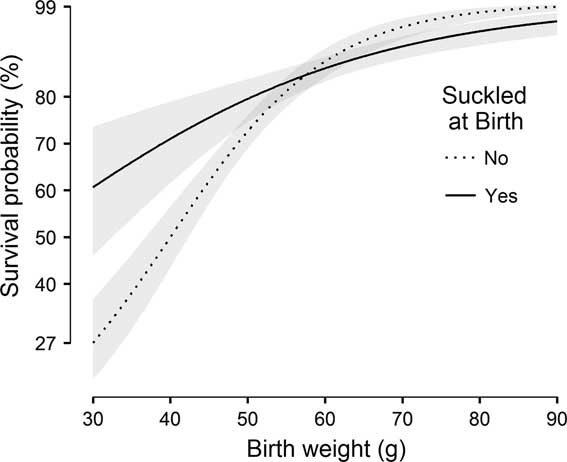
From the 285 females died before weaning, 66.7% had not suckled at birth (absence of milk spot). The lack of milk spot significantly increased mortality of newborns weighing <45 g at birth (P<0.05; Figure 1). Among newborn females that had not suckled at birth, an increment of 1 g on birth weight represented a relative increment of 10.2% in the odds of surviving to weaning. However, among newborn females that suckled at birth, an increment of 1 g on birth weight represented only 4.7%.
Predicted probability (%) of newborn rabbit female survive to weaning age (38 days) depending on its birth weight and whether it had suckled milk or not just after birth. Shaded areas represents the 95% confidence interval.

Development during rearing
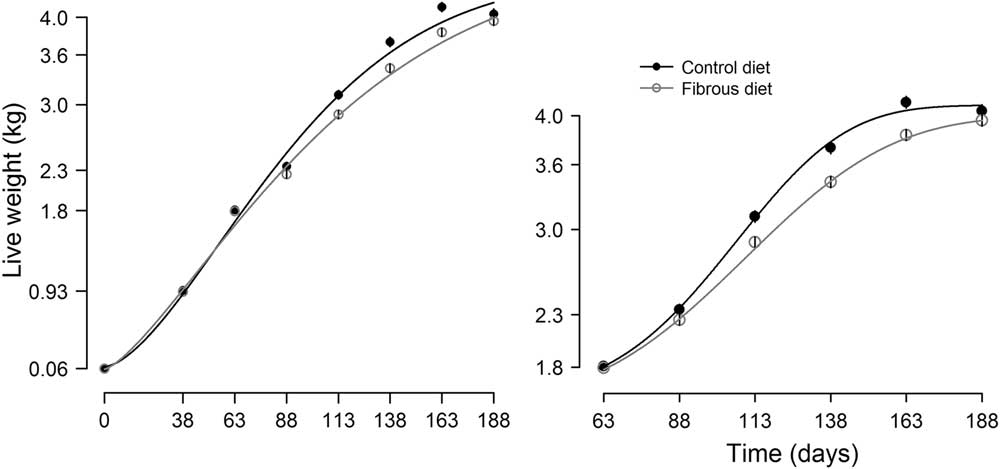
Growth curves of young females from birth to the age of first parturition are shown in Figure 2 (left panel). Almost linear growth was observed between 0 and 63 days (R 2=0.95), where females gained on average 27.8 g per day. From 63 days, the period when young females where fed with the C or F diet, different growth patterns were observed (right panel), especially between 88 and 163 days (P<0.05). Females had grown faster with diet C, reaching their maximum weight 6 days before the first insemination age, whereas females on diet F reached this weight ~37 days later (P<0.05). Parameters of the fitted Weibull growth models confirmed the differences in live weight observed between diet C and F (Supplementary Material Table S1). Model parameters for diet C (from 63 to 188 days) had higher influence on the upper asymptote (α) and growth rate (−e K ) than those for F diet. In addition, we found no influence in the growth range (β) or the growth slope of (δ) for the diet effect, as their 95% confidence interval did not overlap.
Weibull growth curves for young rabbit females fed with control or fibrous diet from 63 to 188 days. Points represent the average live weight and the vertical bars around means represent the 95% confidence interval (no overlapping bars are significantly different). Left panel shows growth curves from 0 to 188 days. Right panel shows growth curves from 63 to 188 days old.

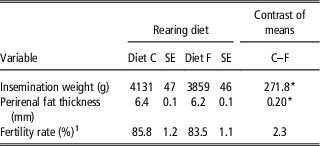
Measures of PFT were available on 494 females alive at the insemination age (diet C=226 and diet F=268). At first insemination, the PFT range varied from 4.1 to 8.1 mm. Its average was 6.28 mm and a SD of 0.54 mm. For females fed with diet C, the PFT range was 4.7 to 8.1 mm with an average of 6.40 mm and a SD of 0.56 mm. For females on diet F, PFT ranged from 4.1 to 7.7 mm, with an average of 6.19 mm and a SD of 0.50 mm. At first insemination, females fed with diet F had, on average, −0.20±0.04 mm of PFT (P<0.05) and −271.8±32.6 g of BW (P<0.05) less than females fed with diet C (Table 2).
Least square means and SE for insemination weight, perirenal fat thickness and fertility rate of rabbit females fed with control (C) or fibrous (F) diet during their rearing period

Contrast of means followed by a star (*) are significant different from zero at P<0.05 (t-test).
1 Fertility rate was defined as the number of parities per insemination through a female reproductive life. No difference was observed in the number of inseminations spend for females that never conceived (Diet C: n=16; 1.5±0.3 inseminations. Diet F: n=18; 1.7±0.3 inseminations).
Reproductive performance
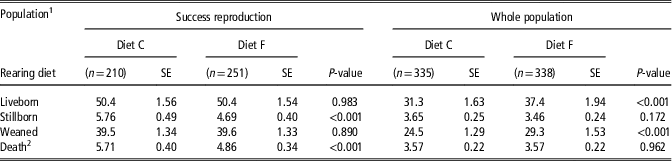
Cumulative number of liveborn, stillborn, weaned and dead kittens according to the rearing diet are shown in Table 3. Among females who had at least one litter, the diet effect had no influence, except for the high number of stillborn (+22.8%; P<0.001) and death kittens during lactation (17.6% higher; P<0.001) for litters of females fed with diet C. When we considered all females housed at the production farm, the cumulative number of liveborn and weaned kittens was higher for females fed on diet F (on average +6.1 liveborn and +4.8 weaned kittens; P<0.001) compared to those fed with diet C.
Cumulative number of liveborn, stillborn, weaned, death kittens during lactation and their SEM according to the diet females received during their rearing period (control (C) or fibrous (F) diet)

1 Success reproduction: females having at least one partum; whole population: females house at the production farm.
2 Offspring that died during lactation.
Regardless of the rearing diet (Table 4), the covariate birth weight only affect the number of weaned kittens of females reaching the reproductive life. Each unit of increment of birth weight value increased the number of weaned kittens by 0.5. In the case of the covariate PFT, it negatively affected the number of liveborn and weaned kittens (P<0.001). Each unit of increment in the PFT value reduced the cumulative number of liveborn and weaned by 3.2 and 3.0 kittens, respectively.
Estimated regression coefficients for model 2.1 and 2.2 used to evaluate the effect of birth weight, perirenal fat thickness (PFT) and the fibrous diet (F) rabbit females received during rearing on reproductive traits

1 Success reproduction: females having at least one partum; whole population: females housed at the production farm.
2 Regression coefficients followed by two stars (**) significantly differed from zero at P<0.001 and those followed by a one star (*) differed from zero at P<0.05.
3 Diet effect was coded as 0 for diet C and 1 for diet F. Birth weight and PFT covariates were standardized to perform the multiple regression.
From the 673 females entering the production farm, 34 females reaching the insemination age never conceived (diet C=16 and diet F=18). For those females fed with diet C, the average number of artificial insemination attempts was 1.5±0.3. The value for females fed with diet F was similar (1.7±0.3). Among females having at least one litter, the number of parities over the number of artificial inseminations was not influenced by the diet (diet C=85.8±1.2% v. diet F=83.5±1.1%; Table 2). No effect of the covariates birth weight or PFT was observed.
Productive lifespan
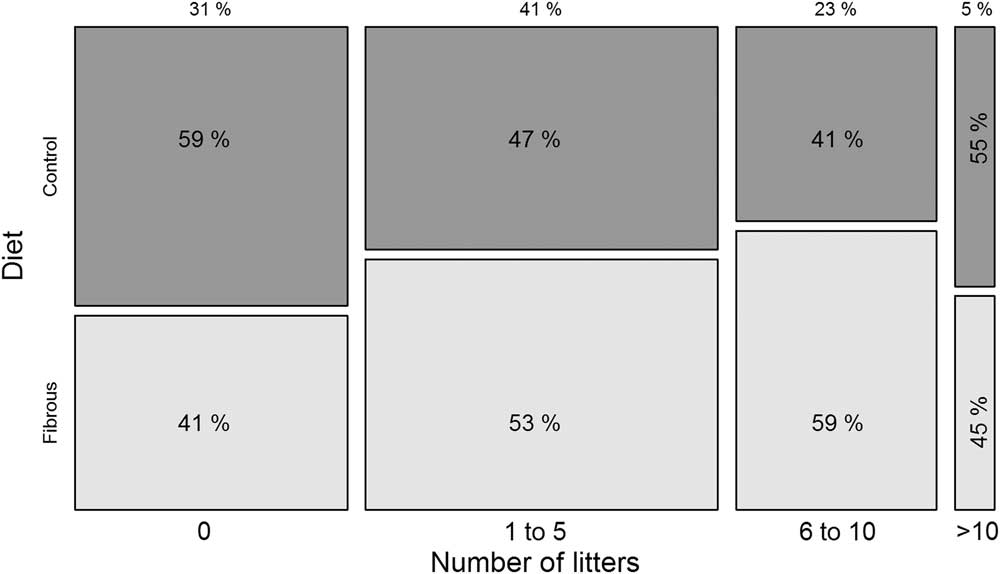
The proportion of females fed with diet C or F according to their maximum parity order is in Figure 3. From the 673 females transferred to the production farm (diet C=335 and diet F=338), 31% never conceived (diet C=125 and diet F=87). From the 461 females having at least one litter (diet C=210 and F=251), 274 females (41%) had between one and five litters, from which 129 (47%) were fed with diet C and 145 (53%) were fed with diet F. Females having between six and 10 litters represented 23% of the data, from which 41% received diet C and 59% the diet F. Only 31 females had 11 litters or more (55% on diet C and 45% on diet F).
Proportion of rabbit females fed with control or fibrous diet according to their maximum number of litters (0=never conceived; 1 to 5=females having at least 1, 2, 3, 4 or 5 litters; 6 to 9=females having at least 6, 7, 8, 9 or 10 litters; >10=females having at least 11, 12, 13, 14 or 15 litters).

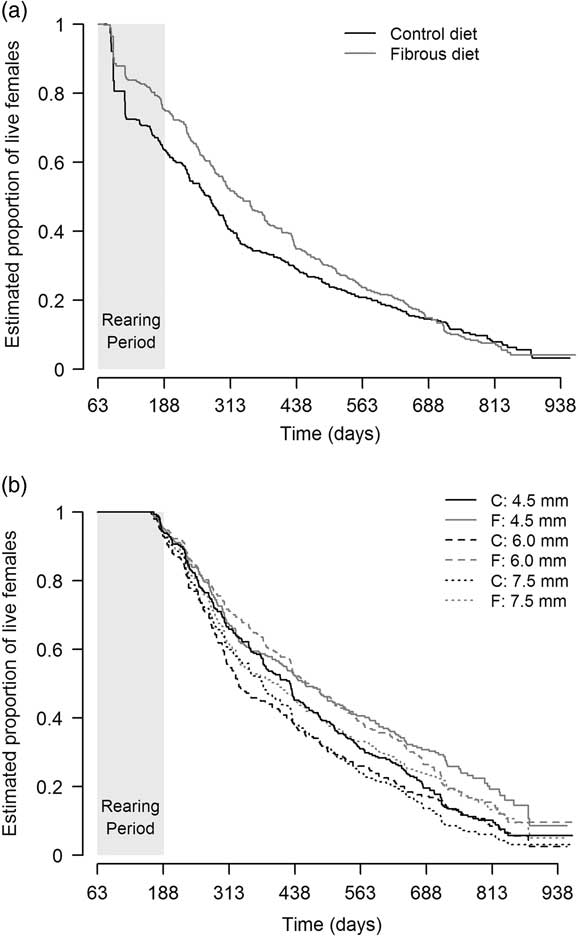
The overall relative hazard risk of culling or death for females fed with diet F was 13% lower than females fed with diet C (P<0.05). From Figure 4a, which represents the percentage of live females throughout the experimental period according to the rearing diets, two drops in the percentage of live females can be distinguished, one around day 91 and another around day 120. Higher losses were observed for females on diet C than females on diet F.
(a) Estimated proportion of live rabbit females fed with the control (C) or fibrous (F) diet during rearing period. (b) Estimated proportion of live females considering the diet and three hypothetical levels of perirenal fat thickness: 4.5, 6.0 and 7.5 mm.

Independently of the diet, survival analysis showed that per unit of augmentation in the PFT, the overall relative hazard risk of culling or death incremented by 13% (P<0.05). However, no difference in the relative hazard risk was observed between females reared with diet C or F (13% v. 14%) during their reproductive life. Figure 4b exemplifies the effect of PFT on the proportion of females alive throughout the experimental period for three hypothetical PFT levels: 4.5, 6.0 and 7.5 mm. No diet differences were observed within these proposed PFT levels, the females with low PFT levels at insemination being the ones at lower risk of death or culling.
Discussion
Survival during lactation
Many factors which take place early in life may condition survival and reproductive performance of captive rabbit females. Our results revealed a greater chance of survival as birth weight increases, in agreement with Argente et al. (Reference Argente, Santacreu, Climent and Blasco1999), who described a positive correlation (+0.30) between birth weight and offspring survival in the first week of life. In fact, some authors proposed a minimum birth weight below which the chances of survival decrease (Argente et al., Reference Argente, Santacreu, Climent and Blasco1999: 50 g, Drummond et al., Reference Drummond, Vázquez and Sánchez-Colón2000: 43 g, Coureaud et al., Reference Coureaud, Schaal, Coudert, Rideaud, Fortun-Lamothe, Hudson and Orgeur2007: 48 g, present work: 45 g). In addition, heavier newborns are usually located in the central positions of the litter huddle, a position that reduces the heat loss and facilitates access to the mother’s teats (Bautista et al., Reference Bautista, Zepeda, Reyes-Meza, Martínez-Gómez, Rödel and Hudson2015). Heavier newborns also have more fat reserves (García-Torres et al., Reference García-Torres, Hudson, Castelán, Martínez-Gómez and Bautista2015), supporting the relevance of birth weight in newborn survival.
Among the smallest newborn of a litter, milk intake is crucial to survival (Argente et al., Reference Argente, Santacreu, Climent and Blasco1999; Coureaud et al., Reference Coureaud, Fortun-Lamothe, Langlois and Schaal2000). The inability to suckle not only hampers correct development, it also alters the circadian rhythm, impairs the regulation of body temperature and reduces the capacity to compete with the well-nourished littermates for milk (Jilge et al., Reference Jilge, Kuhnt, Landerer and Rest2001). All these factors have an impact on survival. In this sense, our results provide evidence that small newborns that had access to milk in the first hours after birth almost doubled their chances of survival when compared with those that had not suckled.
Development during rearing
Adequate growth during the rearing period is crucial to ensure proper physical and physiological development of future reproductive females. In this phase, the diet must provide all the nutrients to cover the maintenance requirements, promote lean growth and ensure an adequate level of body fatness that is essential for their future reproductive career. Energy requirements for this period vary from 1.0 to 1.3 MJ per day depending on the age and size of females (Xiccato and Trocino, Reference Xiccato, Bernardini, Castellini, Dalle Zotte, Queaque and Trocino2010). However, when young females are fed with feeds designed for lactating does, their daily energy intake is much higher than required and this overconsumption affects their reproductive performance (Martínez-Paredes et al., Reference Martínez-Paredes, Ródenas, Martínez-Vallespín, Cervera, Blas, Brecchia, Boiti and Pascual2012).
To avoid overfeeding, the ad libitum use of fibrous diets was proposed as an attempt to modulate the energy intake of young females (Pascual et al., Reference Pascual, Savietto, Cervera and Baselga2013). Here we observed the impact of this strategy on the growth pattern of young females during their rearing period. Those fed with diet F showed a smoother growth pattern, with a lower asymptote that did not impair live weight at first parturition (similar to females on diet C). The observed pattern agrees with the proposed goal: stimulate a gradual growth, avoid reaching insemination age with an excess of fat reserves and at the same time allow females to achieve their first parturition with an adequate maturity (no differences in fertility rate and live weight at first parturition were observed). Martínez-Paredes et al. (Reference Martínez-Paredes, Ródenas, Martínez-Vallespín, Cervera, Blas, Brecchia, Boiti and Pascual2012) reported similar results when comparing diets of similar characteristics.
Reproductive performance
Physiological status and management practices adopted during the pubertal life of rabbit females, such as the birth weight, body fatness at first insemination and the diet used, may influence their future reproductive performance in terms of fertility and prolificacy. Concerning birth weight, Poigner et al. (Reference Poigner, Szendrö, Lévai, Radnai and Biró-Németh2000) observed that heavy newborn females (between 63 and 70 g) reached maturity more rapidly, and delivered more offspring in their first parturition than females born with a lower weight (between 39 and 43 g). Likewise, our heavy newborn females (>57 g) had significantly higher body fatness at first insemination (+0.18 mm of PFT) and bigger litter sizes at first parturition (+0.89 kittens) than lean ones (<57 g). However, no influence of birth weight on the lifetime reproductive performance of females as adults was observed in either study. Poigner et al. (Reference Poigner, Szendrö, Lévai, Radnai and Biró-Németh2000) observed a longer reproductive life of females born with a lighter weight (22.0% reached the sixth parturition) compared with heavier females (only 15.5%). Therefore, regardless of whether females were inseminated at the same age or at the same weight, heavy newborns reached reproduction with a greater amount of body reserves, which they invest in delivering more offspring at the beginning of their reproductive life; a fact that may have a long-term cost.
Pascual et al. (Reference Pascual, Blanco, Piquer, Quevedo and Cervera2002a) reported a better reproductive performance when young females were fed with fibrous diets. In fact, the diets compared in the present study only influence the number of stillborn (+1.07 for diet C with respect to diet F; P<0.001) and weaned (+0.85 for diet C; P<0.001) kittens of females having at least one litter. However, when we considered all females housed, those fed with diet F had 6.1 liveborn and 4.8 weaned offspring more than those fed with diet C, a result directly related to the higher number of females fed with diet F that reached reproductive life. This result may be related to a protective effect of the diet F as reported by Martínez-Paredes et al. (Reference Martínez-Paredes, Ródenas, Martínez-Vallespín, Cervera, Blas, Brecchia, Boiti and Pascual2012), who observed a better survival rate among females fed on a fibrous diet. In their study, the fibrous diet reduced both the incidence of digestive troubles and pregnancy toxaemia before first parturition.
It is widely accepted that larger animals have better fertility because they have more resources to invest in reproduction. Here, although females fed with diet C had more weight and fat reserves at insemination age than females fed with diet F, their fertility was similar. After marginalizing the effect of the diet, we observed that females with higher PFT values at first insemination had fewer liveborn and weaned kittens when compared with females that reached the insemination age with lower PFT values. The worse reproductive performance of ‘fat’ young females may be related, first to an increased number of pre-natal losses during gestation (Vicente et al., Reference Vicente, Llobat, Viudes-de-Castro, Lavara, Baselga and Marco-Jiménez2012), or to an increased culling risk among females with excessive PFT (Theilgaard et al., Reference Theilgaard, Sánchez, Pascual, Friggens and Baselga2006; Martínez-Paredes et al., Reference Martínez-Paredes, Ródenas, Martínez-Vallespín, Cervera, Blas, Brecchia, Boiti and Pascual2012).
Productive lifespan
Rearing diet
Fibrous diet is designed to promote adequate body development, favour future reproductive life and reduce the associated risk of death and culling, mainly related to the energy burden of overlapping lactation and gestation, especially in their first two reproductive cycles. It mainly works by increasing the female’s intake capacity (Xiccato et al., Reference Xiccato and Trocino1999; Pascual et al., Reference Pascual, Blanco, Piquer, Quevedo and Cervera2002a; Quevedo et al., Reference Quevedo, Cervera, Blas, Baselga, Costa and Pascual2005) and by reducing the risks related to the mobilization of body reserves around parturition (Xiccato et al., Reference Xiccato and Trocino1999; Martínez-Paredes et al., Reference Martínez-Paredes, Ródenas, Martínez-Vallespín, Cervera, Blas, Brecchia, Boiti and Pascual2012). Instead of extending their reproductive career, the F diet reduced the risks associated with the new environment. In the first two-months after being transferred to the production farm, 30% of females fed with diet C died, while the values for females fed with diet F were well below 20%; a difference maintained until the third parturition.
The protective effect of diet F may be related to: (1) the energy restriction hypothesis or (2) to the benefits of fibre in itself. In the present study, although we were unable to measure the degree of energy restriction promoted by diet F, females on this diet reached the insemination age weighing 250 g less than females on diet C. Energy restriction is known to extend lifespan from yeast to humans by reducing the incidence of both infectious and chronic diseases (Fontana et al., Reference Fontana, Partridge and Longo2010). However, the time and level of restriction are extremely important in defining the influence, if any, of energy restriction on extending life (Ross, Reference Ross1972). Alternatively, Gidenne (Reference Gidenne2015) submitted an extensive review demonstrating the importance of fibrous diets in the digestive health of rabbits after weaning.
The reasons why the protective effect of diet F was not extended throughout reproductive life is not clear. Although we could not check, it is possible that the intended increment in the intake capacity during the first two reproductive cycles did not occur. In fact, our diet F contained about 1.0 MJ of DE per kg of DM more than other diets that effectively increased the feed intake capacity of young females. We were obliged to make this choice because our diets were manufactured by a feed factory, which ran into some technical limitations when attempting to include more fibre in the diet F. Alternatively, the absence of a continued positive effect of diet F later in life could be related to a loss of microbial diversity when the females on diet F started to consume diet C, a condition related to an increased risk of several diseases (Tamburini et al., Reference Tamburini, Shen, Wu and Clemente2016). Sonnenburg et al. (Reference Sonnenburg, Smits, Tikhonov, Higginbottom, Wingreen and Sonnenburg2016) observed that microbial diversity can be stimulated by increasing the fibre content of the diet, but it can be lost very quickly.
Body fatness at first mating
Starting reproductive life with ‘optimal’ development and an adequate level of reserves is expected to improve fertility and lifespan. In contrast, an inadequate development or inappropriate levels of body reserves increase the risk of death and culling (Theilgaard et al., Reference Theilgaard, Sánchez, Pascual, Friggens and Baselga2006) and impair fertility (Savietto et al., Reference Savietto, Marono, Martínez, Martínez-Paredes, Ródenas, Cervera and Pascual2016). Among the many factors associated with the high risk of death observed around parturition (Rosell and de la Fuente, Reference Rosell and de la Fuente2009), an excess of fat at first effective mating followed by a high pre-partum mobilization of reserves, lower DE intake, high non-esterified fatty acids and low glucose levels are all related to pregnancy toxaemia (Martínez-Paredes et al., Reference Martínez-Paredes, Ródenas, Martínez-Vallespín, Cervera, Blas, Brecchia, Boiti and Pascual2012). In this context, our results support the hypothesis that when an adequate level of body reserves is attained, both reproduction and lifespan are reinforced. Although we could not specify whether the extended lifespan is a result of reducing the risks related to the mobilization patterns of PFT (Savietto et al., Reference Savietto, Marono, Martínez, Martínez-Paredes, Ródenas, Cervera and Pascual2016), our results indicate that PFT at first mating are a good predictor of the future lifetime reproductive performance of rabbit females. Although we should be cautious before recommending a target level of PFT over which females would be at higher risk of being culled, for this particular population we observed that PFT values at first mating above 6.0 mm should be avoided (Figure 4b). So, it is advisable to control the body condition of young rabbit does to avoid excessive fatness at first mating. In gilts, for example, having an adequate body condition at first mating appears to improve fertility (O’Downd et al., Reference O’Downd, Hoste, Mercer, Fowler and Edwards1997) and lengthen their lives (Tarrés et al., Reference Tarrés, Tibau, Piedrafita, Fábrega and Reixach2006). In adult captive rabbits deviation from the adequate levels reduces lifespan (Theilgaard et al., Reference Theilgaard, Sánchez, Pascual, Friggens and Baselga2006).
Conclusions
The results of this study have allowed us an evaluation of the main early life traits that most affect reproduction and lifespan of rabbit females. Regarding reproduction, although a higher birth weight might have a positive effect on litter size in the first cycle, it does not appear to be important in the long term. However, although the use of the diet F in the pubertal phase did not influence the lifetime reproductive performance, it reduced the PFT of young females at their first mating. And the fatness level did improve the reproductive performance (+2.9 total weaned kittens for each unit of decrease in PFT). Regarding lifespan, the different traits evaluated had an effect on survival that was delimited to specific moments of the animal’s life. Thus, having a greater birth weight only increased survival expectancy during lactation; being suckling especially important among light newborns. Diet F only had a positive effect on the survival of young females during the period it was applied. However, from this moment, the PFT at first mating was the factor that most influenced rabbit female’s life expectancy.
Acknowledgements
The authors acknowledge Cesar Villalba (Fabara, Spain), Luis Eroles (Valderrobres, Spain) for the technical support in managing the animals and for kindly providing a space to conduct our study. They also thank the Commission for Science and Technology (CICYT) of the Spanish Government (AGL2014-53405-C2-1-P) for the economic support to carry out this study.
Declaration of interest
Authors declare no conflict of interest of any sort.
Ethics statement
All experimental procedures were approved by the Animal Welfare Ethics Committee of the Universitat Politècnica de València who follow the Spanish Royal Decree 1201/2005 on the protection and use of animals for scientific purposes.
Software and data repository resource
Data is property of the Universitat Politècnica de València and may be available by inquiring the authors.
Supplementary material
To view supplementary material for this article, please visit https://doi.org/10.1017/S1751731118000162