INTRODUCTION
The acquisition and processing of nouns and verbs, two word categories that differ both syntactically (i.e., for their grammatical role) and conceptually (denoting different entities: objects and actions), has received much attention recently. There is empirical evidence that verbs and nouns are two cognitively distinct word categories, involving different kinds of representations and processing demands. Studies of children's early lexical development have shown evidence of a gap in the acquisition of nouns and verbs, with nouns being acquired earlier than verbs in some languages (English, French, German, and Italian: Bassano, Reference Bassano2000; Bates et al., Reference Bates, Marchman, Thal, Fenson, Dale, Reznick, Reilly and Hartung1994; Gentner, Reference Gentner and Kuczaj1982; Gentner & Boroditsky, Reference Gentner, Boroditsky, Bowerman and Levinson2001; MacNamara, Reference MacNamara1982; Nelson, Reference Nelson1973), and the opposite pattern being true in others (Mandarin Chinese and Korean: Choi & Gopnick, Reference Choi and Gopnick1995; Tardif, Reference Tardif1996), suggesting that children's processing of nouns and verbs entails different cognitive demands. The present study adds to this line of research by exploring the lexical and conceptual/semantic variables contributing to object and action naming skills in three- and five-year-old Italian children.
There is extensive evidence that the vocabulary of very young children speaking English, German, and Italian includes mainly nouns, with verbs present in a more restricted number (Bassano, Reference Bassano2000; Bates et al., Reference Bates, Marchman, Thal, Fenson, Dale, Reznick, Reilly and Hartung1994; Caselli et al., Reference Caselli, Bates, Casadio, Fenson, Fenson, Sanderl and Weir1995; Klassert, Gagarina, & Kauschke, Reference Klassert, Gagarina and Kauschke2014; Sheng & McGregor, Reference Sheng and McGregor2010). This phenomenon is labelled ‘noun bias’ (Bassano, Reference Bassano2000; Klassert et al., Reference Klassert, Gagarina and Kauschke2014). Gentner (Reference Gentner1981, Reference Gentner and Kuczaj1982, Reference Gentner, Hirsh-Pasek and Golinkoff2006) was among the first to propose this idea, named the Natural Partitions hypothesis, on the basis of findings that most words in the early lexicon are nouns. The dominant idea is that nouns learned by young children correspond to “highly cohesive collections of percepts that are universally conceptualized as objects” and consequently “lexicalized as nouns” in most languages. The complementary Relational Relativity hypothesis in Gentner's conceptualization states that in order to make the correspondence between the linguistic verb and its meaning there is more variability in the way relations are expressed within and across languages (Gentner & Boroditsky, Reference Gentner, Boroditsky, Bowerman and Levinson2001). For example, the act of making a piece of clothing from wool or cotton with long needles or a machine is lexicalized as a single verb in English (to knit) and as a phrase in Italian (lavorare a maglia, literally ‘to work at knitting’). In contrast, the objects used to knit are lexicalized by a single noun in both languages: needles in English and ferri in Italian.
More generally, the noun bias reflects the fact that nouns (i) are conceptually simpler than verbs, and often refer to natural categories; (ii) are less dependent on context for interpretation; and (iii) mostly refer to stable entities (‘chair’, ‘doll’) in the communicative context, as opposed to verbs, which refer to events (‘pass’, ‘disappear’), or relations between objects and agents (‘give’, ‘take’). For this reason, objects are believed to be easier to identify and represent for a child than actions. A complementary and more comprehensive view of the word learning process, the Emergentist Coalition model holds that an important factor in learning nouns and verbs, besides the difficulty of mapping language to the world, is the ability to use linguistic information, and to understand the social intent of a speaker (Golinkoff & Hirsh-Pasek, Reference Golinkoff, Hirsh-Pasek, Hirsh-Pasek and Golinkoff2006, Reference Golinkoff and Hirsh-Pasek2008; Maguire, Hirsh-Pasek, & Golinkoff, Reference Maguire, Hirsh-Pasek, Golinkoff, Hirsh-Pasek and Golinkoff2006). Children predominantly use perceptual information first to learn words; subsequently, they can use social–linguistic cues which can support the learning of more difficult terms requiring a complex pattern of relations between multiple entities, rather than a single, perceptually salient object (Brandone, Pence, Golinkoff, & Hirsh-Pasek, Reference Brandone, Pence, Golinkoff and Hirsh-Pasek2007). In this theory, not all nouns are necessarily learned early and not all verbs are learned late: factors like figure–ground relation, concreteness, imageability, and the ease of being distinguished from other elements in the context may be important predictors of learning nouns and verbs.
A different perspective is taken by those who note that if conceptual/semantic complexity and context dependency were the only determinants of the noun–verb difference, the noun advantage in acquisition should be found in both comprehension and production, while in fact it is more marked in production (Bassano, Reference Bassano2000; Sandhofer, Smith, & Luo, Reference Sandhofer, Smith and Luo2000). These authors argued that the noun advantage might be a consequence of linguistic characteristics of nouns and verbs. There is some empirical evidence in support of this hypothesis. Bassano (Reference Bassano2000), for example, found that in French-speaking children, the noun–verb gap in the early development of language production was explained by grammatical aspects of verbs and nouns. In two-year-old French-speaking children, verb grammaticalization, or the ability to properly use the grammatical features of verbs, assessed through use of inflections and auxiliaries, lagged behind noun grammaticalization, assessed through use of the determiner.
As noted, children learning Korean and Mandarin Chinese typically show a developmental pattern opposite to that observed for French, English, and German, with verb naming developing earlier than noun naming (Choi & Gopnick, Reference Choi and Gopnick1995; Tardif, Reference Tardif1996), while in Cantonese children no advantage for nouns over verbs was found (Masterson et al., Reference Masterson, Druks and Gallienne2008). All these data would support the idea of an involvement of language-specific factors in the noun–verb developmental gap. Among the language-specific dimensions that are believed to affect real-time word learning or production are the grammatical and syntactic structures of the language. For example, in so-called verb-friendly languages like Mandarin or Korean, noun phrases can be dropped from the sentence. As a consequence, nouns are less frequent in these languages than in noun-friendly languages like English, where nouns are typically explicit (Waxman, Fu, Arunachalam, Leddon, Geraghty, & Song, Reference Waxman, Fu, Arunachalam, Leddon, Geraghty and Song2013). As noted, variability across languages seems higher where verbs, not nouns, are concerned. In a series of experiments with monolingual 24-month-old children acquiring different languages (i.e., English, Mandarin, and Korean), Waxman and collaborators (Arunachalam, Leddon, Song, Lee, & Waxman, Reference Arunachalam, Leddon, Song, Lee and Waxman2013; Arunachalam & Waxman, Reference Arunachalam and Waxman2015; Leddon, Arunachalam, Waxman, Fu, Gong, & Wang, Reference Leddon, Arunachalam, Waxman, Fu, Gong and Wang2011) found that performance in verb learning was more variable than performance in noun learning across languages, and that it reflected the specific characteristics of the language learned, in particular its syntactic structures. In languages like English, richer linguistic (syntactic) contexts (full noun phrases) are necessary to learn a verb in comparison to a noun (Arunachalam et al., Reference Arunachalam, Leddon, Song, Lee and Waxman2013; Arunachalam & Waxman, Reference Arunachalam and Waxman2015). But in languages where noun phrases can be dropped from sentences, like Korean, children typically need less explicit and sparser linguistic contexts to learn a verb (Arunachalam et al., Reference Arunachalam, Leddon, Song, Lee and Waxman2013). At the lexical level, morphological complexity (the use of inflected forms for a noun or verb to express a concept) is also important (Bates et al., Reference Bates, D'Amico, Jacobsen, Szekely, Andonova, Devescovi and Tzeng2003). When different inflected forms of a word exist, these may provide important information to identify the subject argument, but they can also compete during word retrieval. For example, D'Amico, Devescovi, and Bates (Reference D'Amico, Devescovi and Bates2001) found that five- to six-year-old Italian children were affected by gender inflection in object naming. Naming agreement was greater when the target word was masculine (the default gender in Italian) than feminine (less frequent word types). On the other hand, in verb-friendly languages that have a reduced morphology, like Mandarin, the lack of inflections may make it difficult for the child to distinguish nouns from verbs (Imai et al., Reference Imai, Li, Haryu, Okada, Hirsh-Pasek, Golinkoff and Shigematsu2008).
In the present study we investigated the contribution of lexical (word frequency, length) and conceptual/semantic (imageability, familiarity) factors to object and action naming in three- and five-year-old Italian children. Italian linguistic structure is characterized by a complex morphology: Italian verbs, in particular, have a much richer inflectional morphology than English, with different suffixes for tense, aspect, person, number, gender, and mood, and nouns are inflected for person, number, and gender. In Italian, a pro-drop language (Rizzi, Reference Rizzi1982), noun phrases (specifically, subject pronouns) can be dropped from the sentence when the context allows disambiguation (Bates et al., Reference Bates, D'Amico, Jacobsen, Szekely, Andonova, Devescovi and Tzeng2003). Therefore, verbs might potentially be more frequent.
Agreement marking of Italian verbs on person, gender, and number allows for dropping the subject. As a consequence of subject-dropping, verbs are more likely in the salient initial position. Thus, both because of the pro-drop characteristics, and because of the verb position in sentences, verbs should be more salient in Italian than English, and the prediction could be made that verbs would appear before nouns in Italian children's development. In contrast to this prediction, studies describing the spontaneous speech of young Italian children (Caselli et al., Reference Caselli, Bates, Casadio, Fenson, Fenson, Sanderl and Weir1995; Tardif, Shatz, & Naigles, Reference Tardif, Shatz and Naigles1997) showed a noun bias. This results in an apparent contradiction; that is, Italian is more similar to Mandarin than English in certain aspects of linguistic structure, but young children's speech shows a noun bias for Italian and English and a verb bias for Mandarin.
Tardif et al. (Reference Tardif, Shatz and Naigles1997) specifically explored the verb–noun difference in Mandarin, English, and Italian adult speech directed to children and in the children's spontaneous speech. Tardif et al.’s study showed that nouns were more frequent than verbs in Italian adult speech in terms of types, and there was no difference between Italian and English for token frequency, but verb tokens were more frequent than nouns in all three languages. Moreover, considering the two more salient positions in the sentence, beginning and end, verbs were more frequent at the beginning of sentences in all three languages. In the final position, however, nouns were more frequent than verbs in English, while in Mandarin the probability of a verb ending a sentence was higher than for a noun. In Italian the difference was not significant.
Although morphological marking appears to be more complex for verbs than for nouns in both English and Italian, there was a significantly greater variation in the latter, suggesting a greater morphological complexity for Italian verbs than nouns, as anticipated. In Mandarin the trend was the opposite, with greater morphological variation for nouns than for verbs. Finally, subjects were dropped in a high proportion of Italian and Mandarin utterances, in contrast to English. In particular, Italian allowed the omission of both nouns and pronouns, due to important information coming from the inflectional morphology of verbs, specifying person and number. Tardif et al.’s conclusion was that Italian speech input patterns with English for some aspects of linguistic structure, and with Mandarin for other aspects. However, Italian-speaking children “hear an overall pattern of linguistic input that looks more like English than like Mandarin” (Tardif et al., Reference Tardif, Shatz and Naigles1997, p. 560). This might explain why two-year-old Italian children show a preponderance of nouns in their vocabulary.
Given the complexity of the linguistic structure of Italian, however, this kind of distribution might vary when children grow older and their ability to interpret thematic and pragmatic roles in sentences, as specified by verbs, increase. For example, subject dropping may require a larger extent of inferential processing for the mapping between the omitted subject and the referent, and for the identification of (one of) the verb's argument(s). This capacity might require time to develop, and be fully efficient only in older children, not in two-year-olds (but see Arunachalam et al., Reference Arunachalam, Leddon, Song, Lee and Waxman2013; Arunachalam & Waxman, Reference Arunachalam and Waxman2015).
Existing studies on the noun–verb difference across different languages investigated Italian infants in indirect studies, through parental report (Bornstein et al., Reference Bornstein and Cote2004; Caselli et al., Reference Caselli, Bates, Casadio, Fenson, Fenson, Sanderl and Weir1995), while an empirical study is missing. Thus, in the present study we investigated older children, three- and five-year-olds, and verified whether the noun bias found in younger children through parental report still remains in older children.
As noted, investigations through parental report ensure ecological validity, but largely limit the comparability of findings across languages, as named objects and actions vary across language samples, depending on the specific characteristics of the context of the observations. To overcome these limits, some researchers have more recently used picture naming tasks (Bates et al., Reference Bates, D'Amico, Jacobsen, Szekely, Andonova, Devescovi and Tzeng2003; D'Amico et al., Reference D'Amico, Devescovi and Bates2001; Kambanaros, Grohmann, & Michaelides, Reference Kambanaros, Grohmann and Michaelides2013; Masterson et al., Reference Masterson, Druks and Gallienne2008). Picture naming allows for a more controlled assessment (and comparison) of children's naming skills, as both the context (the task) and the stimuli to be named are the same for all children.
Masterson et al. (Reference Masterson, Druks and Gallienne2008) tested three- and five-year-old English-speaking children with a picture naming task, representing objects and actions, and investigated the effect of several lexical variables on both accuracy and latencies in naming a picture. Pictures were line drawings of objects and actions, matched for AoA (Age of Acquisition) and spoken frequency, not for imageability, visual complexity, and length of name. AoA is considered critical in naming tasks, since it has been demonstrated that words learned earlier are retrieved faster (e.g., Brysbaert & Ghyselinck, Reference Brysbaert and Ghyselinck2006; Carroll & White, Reference Carroll and White1973; Gerhand & Barry, Reference Gerhand and Barry1998; Morrison & Ellis, Reference Morrison and Ellis1995; Navarrete, Scaltritti, Mulatti, & Peressotti, Reference Navarrete, Scaltritti, Mulatti and Peressotti2013; Zevin & Seidenberg, Reference Zevin and Seidenberg2002, Reference Zevin and Seidenberg2004) and are less prone to retrieval failures (Navarrete, Pastore, Valentini, & Peressotti, Reference Navarrete, Pastore, Valentini and Peressotti2015). Imageability is related to the semantic aspects of the concept to be named. If the gap between object and action naming is due to semantic factors, imageability should correlate closely with the children's performance in these tasks and explain a significant part of the object and action naming difference. Frequency and length, by contrast, can be considered lexical variables, which affect object and action naming similarly. In their first experiment, Masterson et al., only measured accuracy, and they found higher accuracy for nouns than for verbs only for three-year-old children, who were overall less accurate than five-year-olds. The main predictors of accuracy for three-year-olds were imageability for both actions and objects. Moreover, they found that word length and visual complexity explained part of the variance in naming accuracy for objects, and spoken frequency explained naming accuracy for actions. For five-year-olds, significant predictors were spoken frequency for actions, imageability for objects, and word length for both objects and actions. AoA was not included in the regression analysis, but nouns and verbs were matched for it, while they were not for the other variables.
In a second experiment, Masterson et al. (Reference Masterson, Druks and Gallienne2008) also collected latencies for five-year-old English-speaking children, as a more sensitive measure to investigate the action–object difference, given that this difference did not emerge in the error analysis. Indeed, they found a significant advantage in terms of naming latencies for objects compared to actions. The regression analysis showed a pattern similar to that of Experiment 1. Imageability was the strongest predictor for objects in both error and latencies analyses. In the latter, visual complexity was also significant. For actions, no variable predicted latencies, while errors were predicted by frequency and length. Overall, the study confirmed that English-speaking children acquired action names later than object names, and this trend was still present in five-year-olds. Moreover, imageability and spoken frequency were the more robust predictors, with the first affecting objects and the latter only actions. In fact, the influence of spoken frequency was not stable in the two experiments in Masterson et al., although it showed a stronger effect on actions.
Masterson et al. (Reference Masterson, Druks and Gallienne2008) also examined different categories of errors committed by children for the two types of stimuli. They classified each error type according to three hyper-categories: semantic, visual, and other. They did not find any substantial difference between action and objects in the three-year-olds, who tended to commit more omission errors, while five-year-olds made more semantic errors for actions (‘weaving–knitting’) than for objects, and more omission errors for objects than for actions. Overall, the authors’ interpretation of the results was that the semantic representation of objects and actions differ. In particular, the greater influence of imageability for objects than for verbs that they found in their data would be due to the greater availability of objects in the sensory experience of children, which in turn would lead to a more detailed semantic representation for objects. In contrast, the verbs’ semantic and thematic representation is quite heterogeneous, thus making it possible for children to acquire verbs only through repeated exposures. This would explain the significant effect of the predictor spoken frequency on verb acquisition
This interpretation is in line with the idea that actions are conceptually more complex, an idea shared by many researchers in the field, as mentioned above. As noted, this complexity may be due to different causes, but primarily to the fact that actions involve understanding scenes and episodes, and are more likely to require inferential reasoning. Moreover, object recognition is based on the shape of the object and on a static view (Biederman, Reference Biederman1987; Humphreys, Riddoch, & Quinlan, Reference Humphreys, Riddoch and Quinlan1988), while the interpretation of an action requires the involvement of visual motion, even if it is represented statically (den Ouden, Fix, Parrish, & Thompson, Reference den Ouden, Fix, Parrish and Thompson2009).
From a developmental point of view it is important to point out that concepts may be acquired before their corresponding names, and that their acquisition is not necessarily all or none. Children may have acquired partial representations of a concept, and may not be able to name it at some point, consistent with the more marked noun advantage in production (Bassano, Reference Bassano2000; Sandhofer et al., Reference Sandhofer, Smith and Luo2000). This idea is further supported by evidence that children are extremely sensitive to cues from social–pragmatic contexts (Arunachalam et al., Reference Arunachalam, Leddon, Song, Lee and Waxman2013). The meaning of words, either nouns or verbs, can be considered as given by specific interconnections between the verbal label and the underlying concept. Thus, it is interesting to understand the extent to which the underlying concept has been at least partially grasped when actions and objects are not named correctly. We would expect that young children would not be able to name correctly some words that are not presently in their lexical repertoire, but may nonetheless have acquired at least a partial knowledge of their meanings. In the light of the presumed greater semantic–conceptual complexity of actions, we expected children's acquisition of action labels to lag behind that of objects.
In the present study we investigated the acquisition of actions and objects in three- and five-year-old Italian children with a selection of pictures from the Masterson et al.’s (Reference Masterson, Druks and Gallienne2008) corpus. Given that two-year-olds show a noun bias, we might expect a bias in this direction to still be present in older (three- and five-year-old) children, in particular if the noun advantage is due to the semantic–conceptual representation. In contrast, as the linguistic structure of the language should be completely acquired in five-year-olds, if this is responsible for the noun bias in two-year-olds it should have less influence on older children, and so we would expect no, or a smaller, noun bias in the latter.
We also examined the effect of some predictors investigated in several studies that affected naming performance in adults and children. In particular, among these we included imageability, AoA, and visual complexity of pictures, as they are highly correlated with picture naming performance (D'Amico et al., Reference D'Amico, Devescovi and Bates2001; Masterson et al., Reference Masterson, Druks and Gallienne2008; Szekely et al., Reference Szekely, D'Amico, Devescovi, Federmeier, Herron, Iyer and Bates2005). AoA was measured subjectively, but subjective and objective measures correlate highly (e.g., Ferrand et al., Reference Ferrand, Bonin, Méot, Augustinova, New, Pallier and Brysbaert2008; Lotto, Surian, & Job, Reference Lotto, Surian and Job2010; Morrison, Chappell, & Ellis, Reference Morrison, Chappell and Ellis1997). We included familiarity as a measure of the frequency with which children experienced concepts for actions and objects. We also included an estimate of spoken frequency, drawn from texts written by children, as spoken frequency estimates for children were not available for Italian. We included length in phonemes, as it might be important for the production phase of naming.
Finally, we carried out a qualitative analysis of errors in order to see whether a different pattern emerged for objects and actions. In particular, in order to see if the difficulty in acquiring verbs is dependent on the complexity of their conceptual representations or on a difficulty in acquiring and using the words in spoken language, we investigated if the types of errors in object and action naming would reveal a problem at the semantic or at the lexical level. For example, the incorrectly produced word might be a coordinate, or superordinate, of the target. In this case, one may plausibly conclude that the underlying semantic representation is not correctly specified, lacking some critical attribute differentiating an exemplar from another of the same category. On the other hand, if the child does not come up with the target word, but with a definition of the meaning of the word, as exemplified, for example, by a circumlocution, then it may be plausible to conclude that the semantic–conceptual representation has been to some extent acquired, but not the corresponding verbal label.
In sum, although some aspects of the linguistic structure of Italian may favour verbs, existing studies attested a noun bias in very young children (e.g., Caselli et al., Reference Caselli, Bates, Casadio, Fenson, Fenson, Sanderl and Weir1995; Tardif et al., Reference Tardif, Shatz and Naigles1997). Perhaps this bias may change when linguistic ability is more mature: to this end, in the present study we investigated action and object picture naming in three- and five-year-olds. We also examined lexical and semantic variables and their effects on the noun–verb difference, measured by accuracy and latencies in the picture naming task. Finally, we carried out a qualitative analysis of errors in order to understand which factors in the conceptual structure of nouns and verbs are responsible for their difference. The Natural Partitions and Relational Relativity hypotheses predict that nouns should be easier than verbs, but also that this difference should decrease with age because of the increasing ability to interpret relational terms (Gentner & Borodistsky, Reference Gentner, Boroditsky and Gathercole2009). Moreover, it predicts that there should be more variability in the verbal labels attached to actions than to objects when the proper word has not yet been acquired. By contrast, the Emergentist Coalition model states that verbs are not necessarily acquired later than nouns due to their intrinsic nature, but rather that whether nouns and verbs are learned depends on the different cues that may or may not be available for their interpretation, such as the imageability and concreteness of the concept, and how easily the action may be distinguishable in the event depiction (Golinkoff & Hirsh-Pasek, Reference Golinkoff and Hirsh-Pasek2008).
EXPERIMENT
METHOD
Participants
Participants were 100 children, 50 of whom were aged between 3;0 and 3;8, and 50 were aged between 5;0 and 5;6. Children were native Italian speakers and were recruited from five preschools located in Veneto (north-west of Italy). Children had normal vision and did not present developmental disabilities or suspected language or learning delay.
Materials
In order to select the materials for the object and action naming tasks we selected items from the “Object and Action Naming Battery” developed by Druks and Masterson (Reference Druks and Masterson2000). From the original 162 objects and 100 actions, we selected those items for which the Italian translation consists of one word (e.g., the item conductor was excluded because the Italian translation has two words: direttore d'orchestra). We carried out pre-tests to evaluate familiarity and AoA values for Italian words. Sixty-two adult Italian native speakers, all university students at the University of Padova, were recruited to provide measures of familiarity and AoA. They rated the degree to which they had come into contact with, or thought about, each object and action on a 7-point scale (1, a very familiar item, 7 a very unfamiliar item) and were asked to estimate the age at which they thought they had learned each of the names of the object and action items in its written or oral form on a 7-point scale (1, learned at 0–2 years; 2, learned at 2–4 years; 3, learned at 4–6 years; 4, learned at 6–8 years; 5, learned at 8–10 years; 6, learned at 10–12 years; 7, learned at > 12 years). Another pre-test was carried out on 16 new participants on name agreement, that is, the proportion of participants giving the most common name to each picture. They were presented with the 162 pictures of actions and the 100 pictures of objects and were required to give a label to each picture, producing, if possible, a single word. The values for word frequency were extracted from two corpuses. One was the corpus LIP (Lessico di frequenza dell'italiano parlato) (De Mauro, Mancini, Vedovelli, & Voghera, Reference De Mauro, Mancini, Vedovelli and Voghera1993), based on a corpus of about 490,000 words. The second was based on the Marconi, Ott, Pesenti, Ratti, and Tavella (Reference Marconi, Ott, Pesenti, Ratti and Tavella1994) corpus. This corpus is based on 6,095 lemmas extracted from a corpus of one million word forms from texts written and read by children, and provided the best estimate available of the spoken frequency for children. The frequency values for the selected action pictures correspond to the infinitive form of the verb.
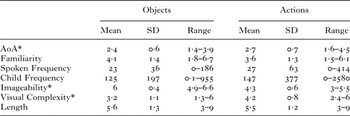
Based on the results of the pre-tests, 120 items (i.e., pictures) from the Druks and Masterson (Reference Druks and Masterson2000) database were selected and used as experimental items, with 60 object pictures and 60 action pictures (see ‘Appendix’). Properties of the selected items are listed in Table 1 (see also Table 2). Visual complexity and Imageability values were taken from the Druks and Masterson database. Word length in the verbs corresponds to the length of the inflected form, third person singular (see below). T-tests revealed that Object and Action items did not differ in Name Agreement (t < 1, d = 0·086), Children (t < 1, d = –0·073), and Spoken Frequency (t < 1, d = –0·136), and Length values (t < 1, d = 0·013) (see Table 1). There was a marginally significant difference in the Familiarity values (t(118) = 1·79, p = ·08, d = 0·327). A significant difference in visual complexity (t(118) = 5·64, p < ·001, d = 1·029), AoA (t(118) = 2·63, p = ·01, d = 0·481), and Imageability (t(118) = 17·23, p < ·001, d = 3·145) was reported in the t-tests. Action items were more visually complex, later acquired, and less imageable than object items.
Properties of the experimental items

notes: Mean values, standard deviations (SD), and range values. AoA = Age of Acquisition; Spoken Frequency = lemma frequency values from De Mauro et al. (Reference De Mauro, Mancini, Vedovelli and Voghera1993); Child Frequency, retrieved from the Marconi et al.’s (Reference Marconi, Ott, Pesenti, Ratti and Tavella1994) database; Length = number of phonemes. Symbol * refers to significant differences in t-tests between objects and actions.
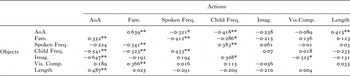
Inter-correlations among variables for the experimental items: Objects (bottom part of the matrix) and Actions (upper part of the matrix)

notes: * p < ·05, ** p < ·01.
Procedure
Children were tested individually in a quiet room at their school. Children were seated at 50 cm from the computer screen on which stimuli were displayed and were asked to name the pictures using a single word. Presentation of the object and action pictures was blocked so that half of the participants named first the objects and the other half the actions. Within each block, items were presented in random order. For actions, children were required to name the action pictures using the third person form of the singular form of the present (e.g., cant-a, sing-s).
In order to avoid fatigue, the 120 experimental stimuli were presented in three separate sessions to three-year-old children (20 action and 20 object stimuli per session), and in two sessions to five-year-old children (30 action and 30 object stimuli per session). All the sessions of each single participant were collected on the same day. There was a short pause after every 20 trials, and prior to the presentation of each block children were informed which picture type they were going to be presented with. The whole experimental session lasted about 50 minutes. All sessions were audio-recorded. The experimenter also wrote down each inaccurate response in a booklet for later examination. Four new items (two object and two action pictures) were selected as training items and presented twice before the experimental items to familiarize the children with the task.
An experimental trial consisted of the following events. A fixation cross was shown in the centre of the screen for 1,000 ms. The fixation cross was followed by a blank screen for 500 ms. Following the blank screen the target picture was presented until the participant's response, or until the voice-key was triggered. The experimenter coded the response as correct, wrong, or invalid trial, pressing a button on the response box. Response latencies were measured from the onset of the picture. The next trial began 1,000 ms after the onset of response coding by the experimenter. The software of the experiment was E-Prime (Psychology Software Tools, Inc., Sharpsburg, PA).
Analysis
Responses from 6 participants (four from the three-year-old group) were discarded because of high error rate (> 75%). In addition, a total of 605 trials were discarded from the analysis due to invalid trials. The analysis was based on a total of 10,675 trials. Two different types of analysis were performed. The first analysis was based on reaction times (RTs) and accuracy rates. Four types of responses were excluded from the RTs analysis: (i) production of clearly erroneous response names; (ii) verbal dysfluencies (stuttering, utterance repairs); (iii) extremely fast (< 300 ms) or long (> 5 s) responses; and (iv) responses above 2·5 standard deviation from a given participant mean in each condition (i.e., object and action pictures). Following these criteria, RT analyses were based on 6,022 trials (56·4%). Accuracy analyses were based on correct responses, that is, excluding types (i) and (ii). Overall, children successfully named 6,967 (65·3%) of the trials.
RESULTS AND DISCUSSION
RTs and accuracy
Separate analyses were carried out treating participants and items as random factors, yielding F1 and F2 statistics, respectively. One within-participant factor, Picture Type (two levels: Object and Action), and one between-participant factor, Age (two levels: three-year-olds and five-year-olds), and their interaction were modelled. Seven items (1 object and 6 action pictures) elicited incorrect responses in all participants of the three-year-old group. In the analysis of naming latencies both the main effects of Picture Type (F1(1,92) = 108·3, p < ·001, η 2 p = ·54; F2(1,111) = 28·01, p < ·001, η 2 p = ·2) and Age (F1(1,92) = 11·3, p < ·002, η 2 p = ·11; F2(1,111) = 88·96, p < ·001, η 2 p = ·44) were significant. The interaction between these factors was not significant (F1 < 1; F2(1,111) = 1·98, p = ·16, η 2 p = ·01). Five-year-old children were faster than three-year-old children, and naming latencies were shorter for object pictures than for action pictures in both groups (see Table 3).
Mean naming latencies, standard deviations (SD) in ms, accuracy percentages (%A), and standard deviation of the accuracy percentages (SDA) according to item type and group

In the analysis of accuracy, the main effects of Picture Type (F1(1,92) = 1041·09, p < ·001, η 2 p = ·91; F2(1,118) = 20·96, p < ·001, η 2 p = ·15) and Age (F1(1,92) = 169·54, p < ·001, η 2 p = ·64; F2(1,118) = 189·89, p < ·001, η 2 p = ·61) were significant. The interaction between these factors was also significant (F1(1,92) = 73·19, p < ·001, η 2 p = ·44; F2(1,118) = 15·88, p < ·001, η 2 p = ·11) (see Table 3, showing that the advantage of objects over actions was greater for three-year-old children).
Since Object and Action items differed by AoA values, we performed the same analysis including AoA values as a covariate variable. Results on Object and Action parallel those just reported. In the analysis of naming latencies, the main effect of Picture Type was significant (F2(1,110) = 23·01, p < ·001, η 2 p = ·17) and there was no interaction with the factor Age (F2(1,110) = 2·14, p = ·14, η 2 p = ·01). In the analysis of accuracy, the main effects of Picture Type (F2(1,117) = 13·15, p < ·001, η 2 p = ·1) and the interaction with the factor Age (F2(1,117) = 10·6, p < ·003, η 2 p = ·08) were significant. By contrast, and reflecting the correlation between the variables AoA and Age, the latter factor was marginally significant in the analysis of naming latencies (F2(1,110) = 3·53, p = ·06, η 2 p = ·03) and not significant in the analysis of accuracy (F2 < 1).
Regression analysis
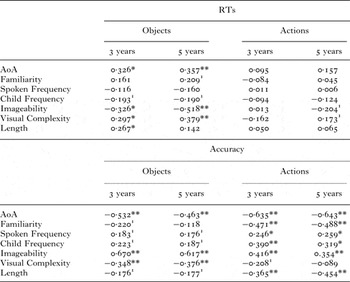
First we examined the relationships among the variables using simple correlations (calculated over items) separately for RTs and Accuracy and for each age group. The correlations are presented in Table 4.
Correlations of the predictor variables and RTs and Accuracy separately by item type and group

notes: 1 p < ·10, * p < ·05, ** p < ·01.
Multiple simultaneous regression analyses were carried out on RTs and Accuracy data separately for each group (see Tables 5 and 6). We included as predictors all the variables listed in Table 1 except for spoken frequency, because its correlation with the dependent variables was lower than for Child frequency. AoA was also excluded, because for children in this age range the effect would be trivial. Indeed, in some cases AoA estimates exceeded the age of our younger participants. For example, in our sample 17% of nouns and 30% of verbs had an AoA value above three years old (for similar analysis, see Masterson et al., Reference Masterson, Druks and Gallienne2008). In these cases, performance is necessarily lower, as children presumably have not yet acquired the target word.
Multiple regression analyses for the RTs data separately by item type and group

notes: B. coeff = Beta coefficient; SE = standard error; 1 p < ·10, * p < ·05, ** p < ·01.
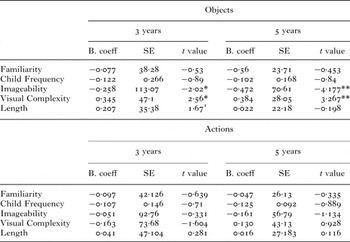
Multiple regression analyses for the Accuracy data separately by item type and group

notes: B. coeff = Beta coefficient; SE = standard error; 1 p < ·10, * p < ·05, ** p < ·01.
We assumed that imageability would be important to explain object–action differences because concepts for objects tend to have higher imageability (and, indeed, pictures were not matched for this variable). Familiarity and frequency are different measures of exposure. The former reflects mainly the familiarity with the concept expressed by the word, while the latter is an estimate of the vocabulary acquired by the children, as frequency values were derived from texts produced or read by children. Length in phonemes might reflect production processes, like planning of articulation, perhaps more important for latencies. Finally, visual complexity reflects the difficulty in interpreting the picture, which should be higher for pictures depicting a scene rather than a single object.
The analysis for the three-year-old children revealed that for RTs imageability and visual complexity were significant predictors for objects, and no variable was significant for actions, these data probably reflecting high variability in the response latencies (see Tables 5 (RTs) and 6 (Accuracy)). The model with the five variables accounted for 25% of the variance for objects and was close to 0 for actions in the RTs analysis.
For accuracy, imageability and visual complexity were the significant predictors for objects, while for actions, besides imageability, the two measures of exposure to the words (familiarity and frequency) and word length were also significant (with, respectively, 55% and 45% of variance accounted for).
For older children, variability in latencies was predicted by imageability and visual complexity for objects (R2 = 0·40) while no predictor was significant for actions. Accuracy was also predicted by imageability and visual complexity for objects (R2 = 0·53), while for actions the strongest predictors were familiarity and word length, but imageability also remained in the model (R2 = 0·46).
Overall, the regression analyses showed that imageability was the most critical predictor, significant in all analyses, for both younger and older children. The more imageable an item, the more likely it was to be produced correctly and easily. The measures of exposure were also important. In particular, familiarity, although a subjective measure derived by adults, was also quite noteworthy. This can be explained by the fact that children learn the language primarily through exposure to adults’ spoken language. It is remarkable that the considered predictors explained little, if any, variance in latencies for actions for both groups of children. Visual complexity was a significant predictor for objects but not for actions. Being actions generally represented with more complex scenes, the lack of a visual complexity effect seems to suggest that performance on actions was most likely influenced by how easily the scene was interpreted, rather than by complexity in purely perceptual terms. Finally, word length was a significant predictor of accuracy only for actions, not for objects.
QUALITATIVE ANALYSIS OF ERRORS
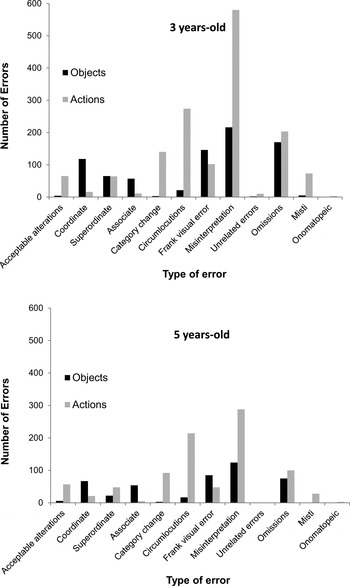
We carried out a qualitative analysis of error types based on 3,708 errors. The errors were classified by two independent judges according to the categories shown and defined in the ‘Appendix’. The error classification was mostly drawn from Masterson et al.’s (Reference Masterson, Druks and Gallienne2008) own classification, because it was more analytic and systematic, and provided a better description of the underlying representation of unlabelled items, compared to other more generic classifications (e.g., Szekely et al., Reference Szekely, D'Amico, Devescovi, Federmeier, Herron, Iyer and Bates2005). Inter-rater agreement computed on 36% of the items (1,346 errors) was 91%. Cases of disagreement were discussed and solved. All errors were re-coded, reaching 100% agreement. The distribution of each type of error is shown in Figure 1, for three- (left) and five-year-olds (right), respectively. The relative percentage of errors was 63% in three-year-old children, and 37% in older children.
Types of errors committed by children of each age.

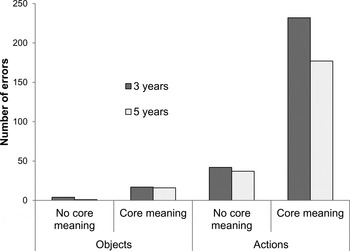
About 58% of the errors (61% for three- and 53% for five-year-olds) reflected a lack of understanding of the picture or lack of knowledge of the underlying concept. These figures were given by the sum of the error categories: misinterpretation, no relation, omissions, and frank visual error (see ‘Error classification’ at the end of the ‘Appendix’ for definitions). In fact, under the category ‘misinterpretation’ there were instances in which there was some understanding of the picture. For example, many children produced piede ‘foot’ instead of the intended target gamba ‘leg’, although most presumably the concept of ‘leg’ would be fairly familiar. Misinterpretations were more frequent for actions (72%) than for objects (28%; see Figure 1). This may reflect several aspects of the task, like, for example, that it is more difficult to interpret an action because a scene is more complex than a single object, or because it requires inferences about the role of the actors, and the construction of a plot (Boureux, Arfé, Pasini, Carretti, Oakhill, & Sullivan, Reference Boureux, Arfé, Pasini, Carretti, Oakhill and Sullivan2012; Sullivan, Oakhill, Arfé, & Boureux, Reference Sullivan, Oakhill, Arfé and Boureux2014). Of the remaining errors, 2·8% were mixed errors, and 39% reflected at least a partial comprehension of the concept. The latter percentage was higher for five- (44%) than for three-year-olds (36%), reflecting an increase in the ability to carry out the task, due to the development of the lexicon and of the underlying semantic representations. Overall, the most frequent error categories in children of both ages were circumlocutions, change of category, and misinterpretations. These categories also showed the most marked difference between objects and actions, in particular the first two (see Figure 1). Thus, children substituted the correct target verb more often than target objects with a phrase, often a verbal phrase, expressing the word's meaning. An example is given by innaffia ‘to water’, for which ‘gives water to the plants’ was produced, or ‘runs with the horse’ for cavalca ‘rides’. These examples show that the core meaning or underlying concept was acquired, but the lexical word was not available. There were 38 circumlocutions for objects, 21 of which were for the same noun, cameriere ‘waiter’. Removing that item resulted in just 17 circumlocutions for objects, 14 of which preserved the core meaning of the word (e.g., for chiave ‘key’: serve per chiudere la porta ‘is used to close the door’). There were 488 circumlocutions for actions, more widely distributed among verbs. A high percentage of these circumlocutions preserved the meaning of the action: 85% for three-year-old and 83% for five-year-old children (see Figure 2).
The figure shows the number of responses that could be interpreted as reflecting, or not, the core meaning of each target, within the errors classified as circumlocutions.

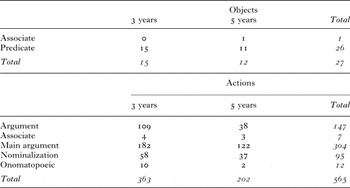
Change of category elicited a heterogeneous number of responses. For some verbs, like nuota ‘swims’, galleggia ‘floats’, and sgocciola ‘spills’, the response was an associate (acqua ‘water’) but also part of the core meaning (‘usually people swim in the water’). In other cases the change of category involved an object that was part of the depicted episode and/or a salient item: auto ‘car’ for guida ‘drives’ and for ferma ‘stops’, and in still other cases they were nominalizations or verbalizations: neve ‘snow’ for nevica ‘is snowing’. There were 592 cases of category change, 378 made by three-year-olds (15 from objects and 368 from actions) and 214 by five-year-olds (12 and 202 for objects and actions, respectively). Change of category errors for objects were mostly a predicate instead of a noun. In general, they were predicates describing relevant actions, for example taglia ‘cuts’ for forbici scissors’, and fa la musica ‘makes music’ or suona ‘plays’ for radio. There was just one example of a non-relevant action, the expression fa una passeggiata ‘goes for a walk’ produced for cammello ‘camel’.
Changes of category in response to actions were more heterogeneous. Children tended to produce a noun, and this could be one of the arguments of the verb, describing the action or the episode in the figure. Examples include the following: cane ‘dog’ for abbaia ‘barks’, bottiglia ‘bottle’ for galleggia ‘floats’, vigile ‘policeman’ for ferma ‘stops’, as subjects, and gatto ‘cat’ produced for accarezza ‘strokes’, auto ‘car’ for ferma ‘stops’ as other types of arguments (mostly an object phrase). The main argument, or subject, was the most frequent response at both ages, 50% and 60% for three- and five-year-olds, respectively, followed by 30% and 18%, respectively, for non-subject arguments. Another frequent sub-type in change of category responses was nominalization. An error was classified as such when it consisted of a noun morphologically derived from the action verb. Examples include: sangue ‘blood’ for sanguina ‘bleeds’, pioggia ‘rain’ for piove ‘raining’, neve ‘snow’ for nevica ‘snowing’. This category included 16% and 18% instances respectively for three- and five-year-olds. Within category change there were also misinterpretations, like pupazzo ‘puppet’ or pupazzo di neve ‘snowman’ for nevica ‘snowing’, and onomatopoeic sounds, like toctoc for bussa ‘knocks’. However, onomatopoeic expressions were considered circumlocutions when they included a verb, like fa ecciù ‘makes ecciù’ for starnutisce ‘sneezing’, or fa baubau ‘does baubau’ for abbaia ‘barks’ (see Table 7 for a summary). As is apparent, this type of error is also much more frequent for actions, and this type of response suggests that in order to name the action verb children tended to construct a sentence phrase, activating not only the predicate action, but also the relevant arguments. When the action verb was not available, the activated arguments were produced instead.
The table shows the number of responses classified as change of category, substituting the correct target. Each response was classified according to whether it corresponded to an argument or predicate of a phrase, or to a nominalization, an associate, or an onomatopoeic sound (see text for further explanations).

As noted, overall there were more errors for actions than for objects. The only exceptions were the two categories associate and coordinate. Associates included, for example, the response musica ‘music’ for radio ‘radio’, bottiglia ‘bottle’ for tappo ‘cork’, caffè ‘coffee’ for cameriere ‘waiter’. Examples of coordinates are: mela ‘apple’ for ciliegia ‘cherry’, colore ‘coloured pencil’ for matita ‘pencil’. The larger proportion of coordinate and associate responses for objects probably reflects the semantic organization of nouns compared to verbs. The former are often hierarchically organized in well-defined structures, in contrast to the latter. Superordinate errors included examples like animale ‘animal’ for cammello ‘camel’, uomo ‘man’ for cameriere ‘waiter’, corre ‘runs’ for pattina ‘skates’, cucina ‘cooks’ for mescola ‘stirring’, and occurred in both object and action naming because they were often more generic terms compared to target, not necessarily reflecting a hierarchy.
To summarize, the qualitative analysis of errors showed that about 25% of all errors made by children were due to a lack of knowledge of the meaning of the words, or of the underlying concept (including the categories no relation, omission, and visual error). Interestingly, the percentage of such errors, compared to the combined errors of both groups of children separately for actions and objects was 19% for action words and 38% for objects. Thus, errors showing that no meaning was available were more frequent for objects than actions. Moreover, a similar proportion was observed for children at each age (39% for younger and 36% for older children, for objects; 20% and 16%, respectively, for actions). This suggests that although action words could be conceptually more complex, at least a partial grasp of their meaning was often acquired.
The remaining error categories revealed an at least partial understanding of the pictures and of the underlying concept, if not of the correct target word. This understanding was reflected in the attempt to interpret the picture with a phrase or an expression that defined the concept or described the picture. In younger children these expressions included onomatopoeic words that are often used by adults in talking to babies.
Overall, the qualitative analysis of errors is congruent with the results of the quantitative analyses. In particular, the regression analyses showed that for objects the most powerful predictor was imageability, suggesting that objects’ semantic representation relies on visual–semantic properties of objects, and their shared features with other objects, explaining the large number of coordinate and superordinate errors. For actions, in contrast, familiarity and frequency correlated more strongly with accuracy. This is congruent with the finding that most errors for verbs were circumlocutions, or attempts to give a definition of the concept, misinterpretations, and category change, showing difficulties in lexical retrieval, or limited lexical knowledge, which of course is strongly sensitive to frequency of exposure. If a verb is encountered very frequently, its verbal label is retrieved relatively easily, despite the potentially greater conceptual complexity. However, imageability also explained some variance for actions, which is quite plausible, given that some verbs refer to relatively simple and concrete actions (lecca ‘licks’; soffia ‘blows’). Overall, the pattern of latencies and errors showed a coherent picture, with the disadvantage of verbs in latencies and number of errors explained by the type of error committed.
GENERAL DISCUSSION
To summarize the present data, both latencies and errors data showed an advantage in naming objects aloud compared to actions, and for accuracy this effect was more marked in three- than in five-year-old children. This noun advantage replicated that obtained in picture naming in English (Masterson et al., Reference Masterson, Druks and Gallienne2008) and confirms the widely held idea that actions are more difficult to name than objects (Szekely et al., Reference Szekely, D'Amico, Devescovi, Federmeier, Herron, Iyer and Bates2005). The most important variables affecting naming latencies for actions and for objects were also different. In particular, when latencies were considered, imageability and visual complexity were significant predictors for objects in both groups, while no variable predicted latencies for actions. The same variables predicted accuracy for objects, while for actions frequency (for three-year-olds), familiarity, imageability, and word length (for both age groups) were significant.
Through a qualitative analysis of errors we have shown that about half of the errors were due to a not yet fully developed semantic representation of words labelling the pictures, or to an incomplete conceptual representation, and this pattern was more marked for action concepts. Remarkably, despite the developmental difference noted in the quantitative analysis, and in the number of errors made by the two age groups in particular, the different error types showed a very similar proportion, both overall and separately, for objects and actions (see Figure 1). This suggests that ways of dealing with lack of knowledge or of understanding is handled in a similar fashion by children despite the age difference, reflecting a general tendency in how to organize semantic and conceptual representations for actions and objects.
As mentioned in the ‘Introduction’, the object–action (or noun–verb) difference has been abundantly discussed in former studies on infants, children, and adults. What the present study adds to the discussion in the literature is evidence that knowledge of the words labelling concepts is not an all-or-none phenomenon, but reveals a gradual increase in the conceptual knowledge underlying words and in the size of the lexicon. The high number of circumlocutions indicates that children tended to express concepts for which the name was not available through a phrase or a sentence. This was especially evident for actions, and the reason may be that actions express thematic relations among entities, and verbs are predicates expressing relations among arguments. Therefore, when the corresponding verbal labels have not been acquired, or are not available, circumlocutions are used preferentially. The same reason may underlie the relatively high proportion of category change produced as a response to actions, as opposed to objects. Many responses to actions were names of an object represented in the picture that was either a subject (cane ‘dog’ for abbaia ‘barks’) or an argument (gatto ‘cat’ for accarezza ‘strokes’). This could be due either to a partial or complete failure to understand what the action was or to the fact that the name for the action was not available. But it could also reflect a tendency to focus the conceptual representation on the described entity (i.e., the object). That is, the object, as an argument of the thematic grid, could represent the nucleus of the conceptual representation of actions. Often the description of a relation (e.g., ‘is stroking’) requires inferential processing, who is doing what to whom, which would be easier when starting from an entity or object as actor or experiencer. Support for this idea comes from the fact that two error types, omissions and visual errors, were proportionally higher in objects than in actions (see above). If responding with an object to an action, which was much more frequent than the opposite, were due to miscomprehension of the task or of the concept, we might also expect omissions and visual errors to be higher in actions, which was not the case.
The increase and enrichment of the conceptual representations interact with experiences of the corresponding verbal labels in speech comprehension and their relative frequency. When words are not very common they may not be available for production, but the concepts may already be present in children's memory, and are then expressed in various ways. This is clearly shown by the productions that did not correspond exactly to the target.
This pattern of data is consistent with the predictions of the Natural Partitions hypothesis summarized in the ‘Introduction’, in that it shows a noun bias even in a language where verbs are salient and frequent as types (because of the argument dropping), and that this bias tends to diminish with age. Moreover, as predicted by the Relational Relativity hypothesis, we found more variability in the labels attached to verbs, often constituted by whole phrases. Changes of category and circumlocutions were more frequent in action than in object naming, confirming the greater delay in the lexical acquisition of action words (verbs) versus object words (nouns). The prevalence of change of category errors in action naming further confirms the children's bias toward noun production. Indeed, most change of category errors consisted in the production of nouns instead of verbs in action naming. However, although most nouns are overall conceptually simpler than verbs, as we noted earlier, errors like circumlocutions and change of categories often revealed a certain comprehension of the (subject–action–object) relation underlying the action to be named.
The data are more ambiguous in relation to the Emergentist Coalition model, which predicted that nouns and verbs do not intrinsically differ, but that their acquisition depends on the degree of imageability and sensory information present in their semantic representation and cued by the picture. Imageability was indeed an important predictor for both actions and objects, although more so for the latter. The cues available in normal life, including social ones, are much more abundant, thus the picture naming task used in the present study was not the most efficient way to test the Emergentist Coalition model.
As noted in the ‘Introduction’, our study was a replication of that conducted by Masterson et al. (Reference Masterson, Druks and Gallienne2008) on three- and five-year-old English-speaking children. It is therefore important to compare the results of the two studies. The quantitative analysis of accuracy and latencies yielded similar results in the two studies, with an advantage for object compared to action naming in both three- and five-year-olds (although in five-year-olds Masterson et al., only found a significant disadvantage for actions in latencies). This finding confirms the view that the noun bias referred to by some authors (Bassano, Reference Bassano2000; Klassert et al., Reference Klassert, Gagarina and Kauschke2014; Masterson et al., Reference Masterson, Druks and Gallienne2008) is also present in a language, Italian, which is morphologically and syntactically different from English.
The qualitative analysis of errors also showed similarities and differences. In particular, Masterson et al.’s error data showed a relatively high percentage of coordinate words as responses in both groups of children, but only a small difference between objects and actions. In our study, the percentage of semantic errors such as associates, coordinates, and superordinates was not very high, was similar for three- and five-year-olds, and was higher for objects. Misinterpretations didn't show differences either between child age groups or between picture types in Masterson et al., while we had a lower proportion for objects. Omissions were relatively fewer and did not show group or picture type differences in our study, while in Masterson et al., there was a high number of omissions in three-year-olds in both picture types and a higher number for objects than actions in five-year-olds. Category changes were relatively few in Masterson et al., and did not show the strong effect on action naming that our study did. Finally, circumlocutions showed a high rate for actions in our study, and not in Masterson et al.’s. Overall, English children, in particular young ones, preferred to omit the word when the target was not available, while Italian children, even young ones, preferred to express the meaning of the picture through other types of expressions, like phrases, particularly for actions.
It is interesting to note that these differences may reflect language-specific variations between English and Italian. In the Masterson et al. (Reference Masterson, Druks and Gallienne2008) study, 100 objects and 100 actions were used. Out of this set we were only able to select 60 objects and 60 actions, partly because some could not be labelled with a single word. Many concepts could only be expressed in Italian through phrases or multiword expressions. This may reflect different characteristics in the way English and Italian label concepts, and may explain the much higher proportion of category change and circumlocution responses for actions in Italian compared to English. In the ‘Introduction’ we discussed several structural and morphological differences between English and Italian that might potentially cause differences between nouns and verbs (e.g., the fact that Italian is a pro-drop language, and that it is morphologically more complex). Despite these differences, the data confirm a noun bias that tends to decrease with age in naming agreement but to remain in latencies. In conclusion, further studies are necessary to better explore the factors responsible for lexical and conceptual acquisition of actions and objects.
Appendix
List of stimuli and variables. English translations are provided in parentheses.

Error classification