

Introduction
The potential to intervene early with families to address disruptive and other externalising behaviour concerns in children is supported by a growing body of research evidence (Bonin, Stevens, Beecham, Byford, & Parsonage, Reference Bonin, Stevens, Beecham, Byford and Parsonage2011; Dretzke et al., Reference Dretzke, Davenport, Frew, Barlow, Stewart-Brown, Bayliss and Hyde2009; Furlong et al., Reference Furlong, McGilloway, Bywater, Hutchings, Smith and Donnelley2012; Waddell, Hua, Garland, Peters, & McEwan, Reference Waddell, Hua, Garland, Peters and McEwan2007). Children with early onset behaviour problems, such as aggression and non-compliance, have a strong chance of developing what is clinically diagnosed as conduct disorder and progressing to anti-social and criminal behaviour in adolescence and adulthood (Foster, Olchowski, & Webster-Stratton, Reference Foster, Olchowski and Webster-Stratton2007; Hutchings et al., Reference Hutchings, Bywater, Daley, Gardner, Whitaker, Jones and Edwards2007). Interventions that effectively divert children from this trajectory help to avoid long-term costs to individuals, families and society (Foster, Jones, & Conduct Problems Prevention Research Group, Reference Foster and Jones2005, Reference Foster and Jones2006; Foster et al., Reference Foster, Olchowski and Webster-Stratton2007; Scott, Knapp, Henderson, & Maughan, Reference Scott, Knapp, Henderson and Maughan2001).
The risk and protective factors that interact in the development of early conduct problems can be grouped into social, relational, cognitive and biological factors (Hughes, Reference Hughes, Cooper, Field, Goswami, Jenkins and Sahakian2010; Thomas, Reference Thomas and Dulcan2010). Family intervention programs attend to building the protective factors for children, including social supports, quality of parent–child relationship and parenting practices (Hughes, Reference Hughes, Cooper, Field, Goswami, Jenkins and Sahakian2010; Morrison, Macdonald, & LeBlanc, Reference Morrison, Macdonald and LeBlanc2000). Parenting practices that have been found to have particular influence on child behaviour include level of supervision, consistency, harshness of discipline, clarity of expectations and emotional expressiveness (Bywater, Reference Bywater2012; Duncombe, Havighurst, Holland, & Frankling, Reference Duncombe, Havighurst, Holland and Frankling2012).
Group parenting education programs delivered by trained facilitators, such as the Triple P – Positive Parenting Program, are widely promoted as part of a preventative strategy for child conduct problems in Australia (Mihalopoulos, Sanders, Turner, Murphy-Brennan, & Carter, Reference Mihalopoulos, Sanders, Turner, Murphy-Brennan and Carter2007; Wade, Macvean, Falkiner, Devine, & Mildon, Reference Wade, Macvean, Falkiner, Devine and Mildon2012). Multi-system intervention programs that target school, family, individual and peer systems in an interactional way, such as the Incredible Years program in the UK and USA, have been found to further enhance protective environments for children and contribute to a reduction in the incidence of conduct problems (Bywater, Reference Bywater2012; Foster et al., Reference Foster, Olchowski and Webster-Stratton2007; Woolgar & Scott, Reference Woolgar and Scott2005). Such programs locate the child's experience within their micro-systems and utilise group work, social learning and family work approaches to work with these systems. Generally a multi-agency approach is needed, which requires collaboration and can be complex to establish (Bywater, Reference Bywater2012; Trentacosta & Shaw, Reference Trentacosta, Shaw and Grigorenko2012). In Australia, multi-system, multi-component interventions have been provided through the CASEA (CAMHS and Schools: Early Action) program in Victoria (Brann et al., Reference Brann, Corby, Costin, McDonald, Hayes and Turner2007) and through the Got It! program in New South Wales (NSW).
The Got It! program is being piloted in schools by NSW Ministry of Health in partnership with NSW Department of Education and Communities. Got It! is an early intervention program provided free to children in Kindergarten to Year 2 (K-2) at selected schools and their families. Funded through the NSW Government Keep Them Safe (KTS) strategy, Got It! is intentionally located to service populations regarded as having high levels of vulnerability and service need. Based on an ecological perspective, Got It! targets the microsystems in which a child participates and the quality of relationships across the parts of the microsystem – that is child, family, peers and school. The program has universal and targeted components designed to address disruptive behaviour problems and, in the longer term, to reduce the incidence of conduct disorder by building capacities in children, families and schools.
The Got It! program is delivered by teams in Child and Adolescent Mental Health Services (CAMHS), comprising psychologists, occupational therapists, social workers and/or nurses. A Got It! team is involved for a period of 6 months in each school. The universal components of the intervention are: teacher training to deliver classroom social-emotional learning programs for all children; a parent information campaign on child behaviour and parenting practices; and screening of all children in K-2, using the Strengths and Difficulties Questionnaire (SDQ) (Goodman, Reference Goodman2001). Targeted intervention is provided for children assessed as having elevated conduct problems and suited to a group intervention program attended with a parent or carer. The targeted components comprise: comprehensive assessment of children, 10-week group program for children and their parents/carers, individual behaviour management and referral. The pilot program was delivered in three regions comprising urban, regional and rural areas.
The intended benefit from combining universal and targeted components is that a mainstream program is expected to be less stigmatised. Using a universal approach, the Got It! program aims to engage with families who may benefit from the targeted components of the program, but who would be unlikely to seek this out had they not been engaged in the universal program at the school. For the families who do not take part in the targeted interventions, the intention is that there will still be benefits to be gained from the universal components. This may be specific knowledge that leads to behaviour changes or awareness raising and preparation to seek out other assistance in the future. Early intervention is only effective if those who are likely to benefit take part in the program. This paper examines the value of strategies used by the Got It! program to increase the participation of families with children with early conduct problems.
The authors were engaged by NSW Ministry of Health to conduct a process, outcome and economic evaluation of the Got It! program, that entailed pre- and post-intervention measures and qualitative data from the range of stakeholders. The current paper does not recount the outcomes and impacts of the targeted intervention program, which are provided in the evaluation report (Debbie Plath Consulting & Family Action Centre, 2014). Rather, the focus of this paper is on the process of identifying and engaging with parents/carers of children with elevated conduct difficulties who are likely to benefit from targeted early intervention. In particular, attention has been given to the interplay between the universal and targeted components of the Got It! program in the family engagement process. Specifically, the paper addresses the following questions: What role do the universal and targeted components of the program play in engaging families for the targeted group intervention? What experiences and benefits of the program are reported by families with children with elevated conduct difficulties who do not take part in the targeted intervention? What features of the partnership between the education and health sectors support the success of the program?
Methods
Data were collected in 12 schools across the three sites where the Got It! program was run during 2013. The schools were located in city suburbs, regional and rural locations across the state of New South Wales. The findings reported in this paper draw on four sources of data. First, screening data used to identify children with elevated conduct scores were accessed by the researchers. Second, interviews were conducted with parents/carers who completed the targeted intervention groups with their children with elevated conduct scores. Third, parents/carers of children with elevated conduct scores who did not take part in the targeted intervention were interviewed. Finally, interviews and focus groups were conducted with health and education staff involved with the delivery of the Got It! program. Informed consent to take part in the evaluation research was provided by participants prior to the intervention and prior to contact or data collection by the researchers. All data collection instruments and protocols were approved in advance by the Hunter New England Health Human Research Ethics Committee.
Screening of all children in K-2, using both the parent and teacher versions of the Strengths and Difficulties Questionnaire (SDQ) (Goodman, Reference Goodman2001), is undertaken as a standard component of the Got It! program. The research team had access to screening data for those children for whom parental consent was provided. The SDQ provides a global assessment of child behaviour and also has five sub-scales: Emotions, Conduct, Hyperactivity, Peer Problems and Pro-social behaviour. The conduct sub-scale, measuring the level of disruptive behaviour, is the most relevant to the Got It! intervention program. The parent and teacher versions of the scale (SDQp and SDQt) are essentially the same questionnaire, but provide the child behaviour assessment from the different perspectives of parents/carers and teachers, who experience the children in different contexts. The SDQ screens help to identify children who could benefit from further clinical assessment for early intervention. Scores indicate whether behaviours fall outside a normal range based on UK norms. Scores for each sub-scale and the total fall in one of three bands: abnormal (top 10% and indicating a potential clinical problem), borderline (next 10%) or normal. Across the 12 schools included in the research, screening data were available for 1061 children, comprising 65% of the children in K-2 at those schools. Parents returned SDQ screening forms for 1213 children, but some of these did not consent to inclusion of data in the research. The data included in the research therefore represent 85% of those children for whom parents returned an SDQ screening form to the school. The teacher SDQ data were only included for those children for whom SDQp data and also consent were provided. The Got It! teams use screening data as the first stage in assessing suitability and availability of families to participate in the targeted intervention. The research team used the screening data to discover the characteristics of children with elevated scores and the participation level in the targeted group program.
Across the 12 schools there were 63 families who completed the targeted interventions, with one 10-week group run in each of the participating schools. Got It! teams assessed suitability for the targeted group program on the basis of consultation with the class teacher and a detailed assessment interview with the parent/carer and child. The criteria used by the clinicians for group selection included: suitability of the parent/carer and child for a group program, commitment of an adult family member to attend the ten weekly group sessions with the child, and no other parenting services involved with the family. On completion of the group intervention, semi-structured interviews were conducted by the researchers in person with one parent/carer from each of the 12 groups. The parents/carers were asked about their experiences with the different components of the Got It! program and the impacts for them and their child. Interviews were audio-recorded, fully transcribed and analysed for themes and illustrative quotations.
On completion of the Got It! program in their school, a telephone survey was also conducted with 40 parents/carers of children with elevated SDQ conduct scores (abnormal or borderline bands for conduct sub-score or total score) who had not been a part of the targeted group programs. Between one and five parents/carers were interviewed from each school. They were asked about the nature of their involvement in the Got It! program, perceived impacts for their child, themselves and the wider school community, and their views on the selection process for the targeted groups.
An online survey was also conducted with health and education staff involved with the delivery of the Got It! program, with the option of a follow-up telephone interview. This was taken up by 12 staff. In addition, a focus group was conducted with each of the three Got It! teams in the Local Health Districts. The scope of these staff data collection instruments was wider than the focus of this paper and hence a general summary of themes relating only to the partnership between health and education are presented in this paper.
Findings from these data sources are reported and discussed in the following sections, each of which focuses on different aspects of the universal–targeted nexus: engaging families for the targeted intervention, experiences of those families with children with elevated conduct difficulties who were not in the targeted intervention, and the partnership between education and health.
Role of the Universal School Intervention in Engaging Families for a Targeted Intervention
From the SDQ screening data, it was possible to determine the proportion of children with elevated conduct scores who completed the targeted intervention program. Not all children with elevated conduct scores are suited to the group program as they may already be in receipt of other specialised services or have behaviours that may be detrimental to the group program. Got It! clinicians engage in a comprehensive assessment process, including consultation with teachers and family interviews, to select families for the groups. The groups are limited to a maximum of eight families. In most schools, group capacity was not reached, due largely to late withdrawals before program commencement. Lack of availability or interest of a parent or carer to take part in the 10-week program with the child was the main reason why the targeted program was not taken up by families. Poor English language skill was another reason, as the group program was only delivered in English. Locating and referring families to culturally appropriate and language-specific interventions is a continuing challenge for the Got It! teams and schools.
Across the 12 schools, a total of 68 families commenced and 63 families completed the 10-week targeted group intervention programs. Groups ranged in size from four to eight families. Attendance rates were high across the 63 families who completed the program, with child and parent/carer attending together for 88% of sessions. Screening data were available for 64 families (94%) who commenced and 60 families (95%) who completed the group intervention.
All of the children in the targeted groups had SDQ scores (SDQp or SDQt) in either the abnormal or borderline bands for either the total score or the conduct sub-scale score, as this was the first criterion for consideration for the targeted groups. Only a weak correlation was found between SDQt and SDQp conduct sub-scores (.3224, p < .001), suggesting that context and perspectives on child behaviour make a difference to how it is rated. It is therefore appropriate to consider elevated scores on the two scales separately. There were 221 children with SDQp conduct scores in the abnormal or borderline ranges (i.e., elevated conduct scores) and 46 (21%) of these were selected for the targeted intervention. Using the SDQt screening data, 122 children had elevated conduct scores and 38 (31%) of these were selected for the targeted intervention. Thus, of the 68 children eventually selected for the targeted group program, only 16 had elevated scores on both the SDQp and SDQt, while the remaining 52 had elevated scores on one or the other scale. While a significant proportion of children with elevated conduct scores took part in the targeted intervention with a parent or carer (20–30% depending upon the measure), these findings show that the majority of children with elevated scores did not participate. It was therefore useful to find out, both from parents/carers who did and those who did not take part in the targeted intervention, the role that the universal program and screening in the school played in identifying and addressing any child behaviour concerns.
Through the interviews with parents/carers who participated in the targeted intervention it became apparent that for most of these families, the Got It! program was the impetus to confront a niggling or significant concern about their child's behaviour. A small number of parents, however, were surprised by, and alerted to, concerns about their child through the screening and assessment processes. All of the parents identified their child's anger outbursts and/or their difficulties making positive friendships with other children as the reasons why they were in the group program. Some said that they had previously considered organising an assessment by a psychologist or health professional, but they had not acted on this. One parent said that the financial implications of this had been a deterrent. Only one parent had consulted a health professional about their child's behaviour prior to the Got It! group and a few parents had previously attended parenting programs. The majority of parents interviewed had not received any prior parenting assistance and said that without the Got It! program they would not have sought assistance in the short term.
The following comments illustrate how four of the parents felt about having issues identified early and being given access to the program.
“I’m working full time, I’m never at the school. So I really had no concept of what was happening at the school . . . and by the time I got there I was shocked ‘cause I had no idea that anything was wrong . . . until it got to a point where it was, where she was stuck in the planning room . . . I didn't realise she had a problem . . . which is what she was in the program for, making positive relationships . . . It's easier when she's little rather than when she's older and complicated . . . I was surprised that I got picked ‘cause I just didn't really see the problem as a big problem.”
“Part of the reason that he was a suitable candidate for Got It! was because of his poor social skills. It's not that he's a bad kid or a mean kid. He just doesn't quite understand the rules of engagement . . . But he's also got a need. You know. Sitting still and listening and joining in is difficult for him . . . He had a strong perception of himself as a naughty child. To the point where he’d go and hide so that he couldn't be told that he was doing anything naughty . . . As a family, we were all desperately unhappy about the fact that we had a boy who was so unhappy to go to school and we really worried for his future.”
“When I did the survey, I thought, ‘Oh yeah, this is really great, I can finally talk to people about how he is.’ And when I got the phone call saying he got into the program, I was a lot happier too because I thought, ‘Yes, I can get some help for who he, like who he is.’ Like a lot of people have told me, ‘You’ve got to take him to a nutritionist and everything ‘cause we think he's got ADD.’ I don't want to put him on medication. I don't want him to have to take pills for the rest of his life. I want help so I can work with him a bit more.”
“Before I started the program I was supposed to take, I was going to take [child] to a psychologist to just get his behaviour assessed and stuff ‘cause I was just worried about him with his social interaction and sharing and that sort of thing . . . I’ve still got the letter in my bag . . . We don't really have that much money.”
The parents were asked about their experiences with the screening and assessment interview as the route to accessing the group intervention program. Some had immediately seen the Got It! program as an opportunity to address their concerns. Two respondents spoke about actively lobbying to get into the program. For others, it was not until they went to the assessment interview that they understood what the program was about. The following comments from three of the parents/carers illustrate some differing experiences.
“I pushed to be selected. In fact, I really went proactive about it . . . I sussed it out. I even went online . . . I filled out his form and then I actually looked for it on the internet and did his score and I kind of went, ‘Hopefully he's in’ . . . I did that and then I kind of just really showed my interest to the teacher and said, ‘I’d really like [child] to go for this. I think he would really benefit.’ ”
“The interview was very in-depth. It was probably more in-depth than ever anyone's ever asked anything like that . . . They took it from day one, you know, newborn. It was quite detailed . . . I felt like they had a good handle of where we’d been and where we came from and so I was really pleased when we got chosen.”
“Well I don't remember actually filling out the form. I don't know whether I got it but we got some phone calls and we did surveys over that . . . and then I got into the program . . . I thought, well, I really don't know what it's all about . . . I knew that it was a parenting, it was to help, but I didn't know what angle they were going to take. I had no idea what was going to be involved but I came every week and I enjoyed it. I looked forward to it.”
This last comment indicates that the relationship between the screening forms and the group program was not clear to some parents. Some parents experienced completing questionnaires as a daunting task, while others felt nervous about the implications of the results. Comments suggest that taking time to provide a range of information on parenting and the Got It! program, in preparation for the screening, may have strengthened parent engagement and comfort level with the screening questionnaire. This is difficult, however, with those parents/carers who are not very involved at the school and points to the value of the universal program.
The nature of the universal campaign of parenting information and seminars, and the location of the screening within that, varied from school to school. The following comments by three parents show how their experiences differed.
“I thought the first process and everything was great and I think the . . . newsletters and getting people's heads around it. Then you had the behavioural surveys, which are time consuming but at the same time very enlightening. I think it's worth every parent just to be forced to do, encouraged to do that . . . The interview was very in-depth, and while it was confronting, it was, you did feel like you were heard.”
“With the survey, we didn't get any information about it before we got it. Like we got it and then you just pretty much filled it in . . . Maybe if you had someone come in and talk to parents or maybe get the teachers to talk to the parents about the survey so that they knew what it was about and there's nothing to worry about . . . They need some sort of information about it so that people are more willing to be involved . . . so they know that it's just to help.”
“I think it was a bit confusing for people as to what was wanted. Because they wanted all these people to fill in forms, but they were only wanting six in total to participate and they only wanted ones with these kind of behaviours. I think a lot of people that went to that initial session were a bit confused as to what was being offered . . . I don't mind filling out forms as long as they sort of, you could see that the results were being addressed in the course, which I didn't necessarily do.”
There were no suggestions from participants in the targeted intervention that it was perceived in a stigmatised or oppressive way. In fact, the opposite was the case. The parents/carers all spoke positively about how they and their child enjoyed the program, and the benefits they subsequently obtained, as illustrated by the following comments by three parents.
“I loved coming up to the school . . . and I love that we were able to spend so much time together.”
“Some of my good friends just said, ‘Oh, how’d you get into that?’ and I said, ‘Well, we did that form . . . Oh well, I had an interview and child was picked.’ I said, ‘So he's one of the lucky ones’.”
“I don't think that they felt any stigma about going to the program or being pulled out of class or anything. Yeah, ‘cause it was an enjoyable, fun thing to do . . . I honestly don't think anyone noticed, mainly the kids didn't notice that they were there for behaviour management purposes at all.”
Another factor that assisted with engaging families in the targeted group intervention was that it was run at the school. This meant that it was on hand for the children and easily accessible for parents/carers in a familiar environment. Child care was organised for younger children during the group time at some of the schools, which further supported participation. All of the groups were run during school time and, while evening partner sessions were offered up to twice during the program, the program did not cater well for working parents. The factors that inhibited participation in the targeted group program are, however, better understood from the perspectives of those who did not take part, which is the focus of the next section.
Experiences of Families Who Did Not Take Part in the Targeted Intervention
Telephone interviews were conducted with 40 parents/carers of children with elevated conduct scores who did not take part in the targeted group intervention, representing 20% of this group. Prior to the selection process for the targeted intervention, these respondents had consented to be contacted for an interview after the program was finished. As detailed above, only about one-quarter of the children with elevated conduct scores took part in the targeted group program. The interviews generated information on why families did not participate in the targeted intervention, whether the universal program had any impact for them, and their experiences overall with the Got It! program. As these parents/carers were interviewed by phone, rather than face-to-face, and their involvement with the program was limited in comparison to the parents/carers in the targeted groups, their responses to open questions tended to be brief.
Prior to the telephone contact, the researchers knew that the parent/carer had a child with an elevated conduct score, but the nature of their involvement with the Got It! program beyond completing the screening forms was not known in advance of the contact. Table 1 reports the information provided by the parents/carers regarding their involvement with the Got It! program. Thirty per cent (30%) of these parents said that they had no further exposure to Got It! following the initial completion of screening forms. Some of these said they were left wondering what had happened to the program and were not aware of the universal components of the program. For the other 70% there was some involvement in either the assessment process and/or the universal components of the program.
Involvement in Got It! program by parents not in targeted group (n = 40).
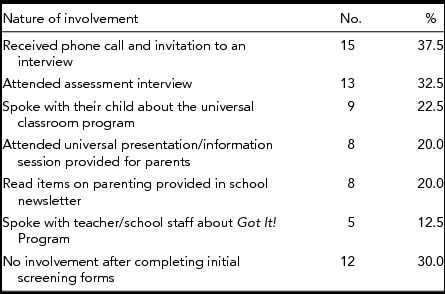
Parents/carers were asked if they were aware of any impact that the universal classroom program had on their child. Only four (10%) said they had observed positive changes in their child as a result of the program. Another three (7%) said that their child did enjoy the universal classroom program, but that it did not have any noticeable impact. Many parents/carers were not aware of the classroom program. While such impacts from the universal classroom program seem small, it is worth noting that there are some positive impacts observed by these families with children with elevated conduct scores. In addition, preliminary findings show a significantly greater improvement in SDQt scores for children in schools in which a classroom program was implemented by teachers in comparison to schools where there had been no classroom program. There remained, however, 34 of the 40 interviewed parents/carers (85%) who said that they were not aware of any impact from Got It! for their child. The following are comments from the three parents who identified changes as a result of the universal classroom program:
“We talk each week about the . . . activities. The Green thoughts and Red thoughts has helped a lot.”
“Talking about feelings at home more. Understanding it.”
“Social skills don't come naturally to my son, but . . . it has given him some ideas on how to deal with situations.”
Two parents/carers who took part in the assessment process, but were not selected for the targeted groups, said that this had made a positive impact for them. For one parent, just receiving the phone call about an interview had prompted her to focus more on her child and to interact more. The mother said that she had noticed positive changes as a result. For the other, some pointers were offered in the assessment interview and were subsequently implemented by the parent. She said:
“It certainly has had an impact. We’ve noticed changes because of the different ways we handle situations.”
In addition to the impact on children, positive impacts on parents/carers’ own understanding and behaviours were reported by 12 parents, representing 30% of those interviewed. Despite a general scepticism by many service providers about anyone reading the school newsletter items, it appears that the parenting tips included as part of the Got It! program were read, acted on and responded to by some of the parents. Given the ease with which they are delivered, the findings suggest that such strategies are valuable. A number of parents/carers also said that they had gained useful strategies from the parent seminars.
“I picked up some ideas from the newsletter and the meeting [parent information session] . . . I try not to lose my cool with them [children]. I try to slow down and think.”
“It [parent seminar on resilient kids] makes me think about how I’m addressing issues . . . I lose my temper too quickly . . . I coach the kids . . . and do things together more now.”
“I love the items in the newsletter . . . I like doing the parents’ homework [from universal classroom program] . . . It's all learning.”
“I use the techniques suggested in the newsletter information . . . talking about emotions. I hadn't really thought about that before.”
The other 70% of parents/carers surveyed by telephone could identify no impacts from the Got It! program for them. For most, this was really of no consequence for them and they did not offer any suggestions on how the program could have been run differently in order to gain their interest. They acknowledged that they were too busy to take much notice of what was going on at the school. Of some concern, however, were the eight parents/carers (20%) who said they had expected to receive some new ideas or guidance when they learnt about the Got It! program but were disappointed when this did not happen.
One-third (13) of the respondents from the telephone survey sample had attended an assessment interview as potential participants in the targeted group intervention, but did not end up participating. These parents/carers were asked by the researcher about their experience of the assessment and selection process. The common response amongst the parents/carers was that they were confident and trusting that the children that “needed it most” were selected. Some parents/carers said that they felt disappointed at the time that their family was not chosen, but at the same time felt relieved that their child therefore “was not as bad” as others in the school. On the whole, respondents were content to accept the outcomes. Work commitments presented as one of the barriers to attending the targeted group intervention. Six parents commented that they could not consider attending a weekly group program because of their employment. It was decided either during the first phone contact by the Got It! team or through the course of the interview that the group program was therefore not suitable. Some said that they had been provided with information about other services and were following these up.
Three parents who took part in an assessment interview for the group, and another two who were not offered an assessment interview, said that they had wanted to do the group program but they missed out. The two who were not contacted for an interview said that they were left wondering why others were approached and not them. The other three parents spoke about attending an interview and feeling positive about attending the group, but then being told that they weren't chosen. Having had their expectations raised, they felt uncertain about whether they should pursue other services that may be available to assist them. The parents who felt this way were, however, in the minority. Most parents who attended an interview and were not selected for the group were quite satisfied with this outcome and understood that participation in the group needed to be prioritised. Two parents commented that the interview was useful for finding out more about the program but they had subsequently decided that the group was not for them or their child. One parent said that the decision not to take part was made because she did not want her son associating with the “naughty kids” who could have a detrimental rather than a positive impact for him. Another parent said that they were very surprised to have been asked to come in for an interview as there were no problems or difficulties. On the whole, parents/carers who took part in the assessment process experienced this as thorough and professional and they were confident that those selected were the most appropriate for the groups. Only one parent said that the interview itself was an unpleasant experience, saying that it was “full on and intrusive”.
The parents’/carers’ suggestions for improvements to the Got It! program related predominantly to the provision of better information on the different components of the program and how they link together. For example, some parents/carers experienced completing the screening forms and then heard no more about the program, and some expressed disappointed at the lack of information, advice and follow-through. Others had, however, simply thought no more about it. The need for full information at the outset of the program and at follow-up points, utilising a range of channels, was evident from the parents’/carers’ comments. There were suggestions made by parents/carers for achieving greater visibility of the Got It! program in the schools, such as more outreach by teachers, updates in the newsletter and information at assemblies. In particular, more information was requested for those who missed out on the group, including clear information on criteria for group selection, why they were not selected and what alternatives they might seek out. A number of parents pointed out the difficulties for families where parent(s) work and suggestions regarding alternative times and online parenting resources were made. Generally these parents/carers were interested in learning more about practical tips and strategies for effectively managing child behaviour.
Partnership between Education and Child and Adolescent Mental Health Services
The formal partnership between health and education at state government level is an important feature of the Got It! program that has enabled attention to be paid to both the universal and targeted components of the program. At state and regional levels, bilateral decisions are made about the appropriate geographical areas and schools to target for program delivery. Through the Got It! program, teachers in the selected schools are trained to deliver a classroom program that promotes resilience and prosocial skills. This is incorporated into the teaching program for all children in K-2. The presence of the Got It! team in the school facilitates the universal screening and assessment that identifies children with behaviours outside the normal range who would otherwise have been unlikely to have presented for CAMHS assessment. The school also provides an accessible context in which to engage families with children with emerging conduct problems in a specialist early intervention program. Without the Got It! program, schools are still able to refer families to specialist services; however, families tend not to take up such referrals until problems are pronounced, and consequently the potential for positive treatment outcomes is lower (Scott et al., Reference Scott, Sylva, Doolan, Price, Jacobs, Crook and Landau2010; Waddell et al., Reference Waddell, Hua, Garland, Peters and McEwan2007). Thus, the partnership model focuses attention on the targeted selection of schools that are likely to benefit from the program, and specialist clinical input in schools to facilitate an integrated approach to screening, assessment and early intervention for emerging conduct problems. Bringing together two organisations with different cultures, policies, professional groupings, terminology, procedures and systems to deliver a program is not, however, an easy task.
A number of themes relating to the health–education partnership emerged from interviews and focus groups with health and education staff involved with Got It!. The health–education partnership was regarded as necessary for program effectiveness and for positive outcomes for children and families. Commitment to prevention and early intervention, and enthusiasm about the value of the Got It! Program, were in turn regarded as fundamental for this partnership to work. Having individuals who are key drivers at the state level in the two departments was recognised as the starting point for the partnership; however, it was apparent that attention to information dissemination and generating enthusiasm for the program is required in an ongoing way if the program is to be implemented effectively in regions and individual schools. As the Got It! teams work with new schools each 6 months, they are continually involved with informing school staff about the program, generating enthusiasm and supporting participation in both the universal and targeted components of the program. While school principals may be committed to the program, this does not always translate into school staff being fully informed and enthusiastic. Continually engaging with new schools is demanding for Got It! teams, particularly if school staff regard the program as an imposition.
Communication mechanisms at state, regional and school level, and negotiation on roles and responsibilities, has been required for the program to work as a partnership, rather than something that is imposed upon schools. This requires ongoing attention to communication, collaborative decision making and negotiation of procedures. Comments from education staff indicate that the program works best if schools have a sense of ownership over the program and a role to play in shaping the program to suit their school. For example, this has included integrating aspects of the parent education component with other school activities, managing the screening process in different ways, adapting or restructuring the universal classroom program and integrating planning and monitoring of Got It! with other decision-making forums within the school. Schools taking ownership and control of the Got It! program was also seen to support more sustainable impacts from the program after the Got it! team has moved on. Education staff gave examples in the interviews of ongoing changes in their schools that had resulted from the Got It! program. These included support groups for parents, inter-school resource exchange forums, changes to school policies and procedures to manage behaviour issues, and the compilation of referral service information.
Within the health service, there are increasing expectations that early intervention and clinical services demonstrate evidence-based links to outcomes. The Got It! teams are expected to utilise clinical expertise in a systematic approach to early intervention that focuses on preventing the escalation from disruptive behaviours to severe conduct problems. Opportunities for clinical supervision and consultation in CAMHS assist to locate the work undertaken in the schools within this framework and to ensure that clinical expertise is effectively utilised to strengthen all aspects of the Got It! program.
New funding to initiate and sustain this innovative partnership program was necessary for its successful implementation. The pilot program was funded by the NSW government Keep Them Safe strategy. During the pilot phase, funding is provided through the Ministry of Health in Local Health Districts where Got It! teams were established and to the Department of Education and Communities for the release of teachers to participate in the program in schools. A partnership and joint program ownership relies on staffing and resource commitments by both parties. The release of teachers from their normal school duties in order to participate in a variety of tasks associated with the Got It! program was identified by both education and health staff as critical for the successful implementation of the program. Staff members are released in schools to take up coordinating activities associated with Got It!, to participate in screening and to work as co-facilitators in the targeted group interventions together with the Got It! clinicians from health.
Discussion
The information from families, teachers and mental health clinicians in this study offers insights into how universal screening and interventions in schools can support the engagement of children with identified conduct problems, and their families, in specialised group intervention programs. The majority of parents/carers in the targeted intervention groups indicated that they would not have sought assistance in the short term without the Got It! program being offered in their school. It was the universal screening and subsequent assessment process that facilitated early intervention for these families. The screening is located within a broadly based, school-wide program that offers all parents the opportunity to attend a parenting seminar and trains teachers to educate children on resilience and pro-social behaviours in the classroom. This is a positive context in which to engage families with the targeted program. Participants in the targeted intervention saw the program as an opportunity to address their (or the teacher’s) concerns about their child's behaviour. Easy, free access to the group program at the school, the familiar environment and the fun and engaging manner in which the program was run were important factors contributing to the active participation of parents/carers and their children. For these parents/carers, the school location made the program more appealing. The positive outcomes from the targeted group intervention are provided in the evaluation report (Debbie Plath Consulting & Family Action Centre, 2014).
While families were effectively engaged in the targeted program, there were many other families with children with elevated conduct problems who did not participate in the targeted group intervention. Interviews with these parents/carers revealed that only a minority regarded the universal parenting information campaign and the universal classroom intervention to have had a positive impact for their children and that any impacts were small. It seems that more could be done within the school setting to improve access to the targeted intervention for children with elevated conduct problems. Practical issues such as timing, child care and transport can impact on whether families access the targeted program, particularly working parents. Comments from both parent groups indicated that better information on the program, parenting tips and how to access other parenting resources need to be provided at several points during the time that the program is run at the school. If parents understand how the universal, screening and targeted components of the program work together, they are in a position to make informed choices about their involvement. Getting this information out to parents requires creativity and perseverance.
The implementation of universal screening for conduct problems raises the question of how to respond ethically to families of children with elevated conduct scores who are not offered or do not take up an offer of the specialised intervention program following the screening. An assessment process is used to select families who are likely to benefit most from the group program. The demand may, however, be greater than can be accommodated, or it may be assessed that the family's needs are better addressed elsewhere. The findings of this research reveal that parents/carers can be left unsettled and uncertain following the assessment process, which heightens awareness of concerns. Integrated procedures for referral, together with the provision of parenting resources and information, are needed for those families not selected for the intervention groups. The factors underlying child behaviour difficulties can include violence, mental health or substance abuse in the family, as well as wider socio-economic factors such as poverty, racism and intergenerational trauma. While the Got It! targeted group intervention is unlikely to be the best response to these wider concerns, the assessment and referral process can play an important role in assisting families to obtain suitable support. Collaboration with other government and non-government services is necessary if support and referral procedures are to be effective in supporting families and children. Got It! is only one component of the multi-level and multi-faceted service network that underpins the child protection policy framework in which the program is located. With attention to assessment, provision of service information and referral, it can assist with facilitating better access to and integration of services for families.
Conclusion
The question of how best to identify and engage children and families for early intervention stands alongside the question of how effective early interventions are. This paper has examined how the integration of universal and targeted elements within the school setting engages families in a specialised group program to address child conduct problems. The health–education partnership approach to the Got It! program embeds specialised and targeted early intervention within the mainstream school context, which consequently increases the access to and appeal of the targeted intervention program for families likely to benefit from early intervention. Alongside the screening and treatment program there are additional benefits that can come from mainstream capacity building in schools and the introduction of assessment and referral procedures for all families. The relationships between the universal and targeted components of the program are, however, complex. Ongoing program monitoring and research are required to more fully understand the universal–targeted nexus in effective early intervention.