1. Introduction
It is a well-known fact that German, besides being an OV language, is also a typical V2 language. In syntax, this is traditionally described by assuming that in main declarative contexts, the verb is first moved to the C head and that a constituent (typically the subject) is then fronted to the first position (also called VORFELD).Footnote 1
(1)


Notice that the pattern XP–V is typical of declarative contexts. In yes/no questions, for example, there is only movement of the verb, triggering the so-called subject-object inversion (V1 order). No constituent is fronted in such cases:
(2)
V1 orders are also widely attested in certain types of declarative clauses, which have also been well investigated by Önnerfors (Reference Önnerfors1997), for example, in episode-introducing sentences:Footnote 2
(3)
Declarative V1 clauses are often described as special emphatic “all-new-utterances” (Sasse Reference Sasse1995:5).
In general, however, it can be argued that the V2 pattern is typical of main declarative clauses. It is important to note that clauses introduced by coordinating conjunctions, such as und ‘and’, oder ‘or’, etc., are only apparent exceptions to this generalization. Such conjunctions do not trigger inversion, as they do not count as occupying the first position of the clause. This is shown by the contrast in 4.
(4)
Coordinating conjunctions must be regarded as external to the clause they introduce. Thus, the first position is still available for fronting any constituent.
The only possibility for an inflected verb (in main declaratives) to occur in the first position after a conjunction is in symmetric coordinations such as the one in 5.
(5)
Here, the subjects of the two clauses are coreferential. Therefore, the subject of the second conjunct can be omitted.
In general, the description above is valid for earlier stages of the language as well. However, there is at least one important exception in the history of the language, which is traditionally referred to as INVERSION NACH UND (‘inversion after and’). This structure is parallel to that of example 4b, which is ungrammatical in present-day German (hence-forth PDG).
Inversion after und represents a phenomenon that has gone completely unnoticed in recent syntactic literature. For example, Paul's (Reference Paul2007:450) Middle High German (MHG) grammar resorts to referring to Behaghel (Reference Behaghel1932:30ff), who provides the most recent description of the phenomenon. In the latter, the construction is defined as the sequence of conjunction, finite verb, and Subjekt in Späterstellung (‘subject in late position’), but the exact position of the subject is not specified:Footnote 3
(6)
Of course, inversion after und is not obligatory. The conjunction und may also introduce standard declarative clauses with the subject or another constituent in the first position. The examples in 7 are taken from Behaghel Reference Behaghel1932:31.
(7)
The inversion after und constitutes an idiosyncrasy of MHG. This period is generally characterized by a stable V2 pattern in declarative contexts. The existence of V1 declarative clauses in MHG has been challenged by many authors (see Maurer Reference Maurer and Horn1924, among others). For this reason, the present paper also concentrates on this period and on the problem of whether inversions after und can be considered genuine V1 constructions.
One should bear in mind, however, that the phenomenon is by no means limited to the MHG period. Even if, according to Prell Reference Prell2001:66, it represents 1.8% of all MHG declarative sentences and thus constitutes a relatively rare phenomenon, inversion after und remains productive from the Old High German (OHG) period into the 17th century (Behaghel Reference Behaghel1932:31). Nonetheless, it is not even mentioned in Schrodt's (Reference Schrodt2004) OHG grammar II, and Ebert et al.'s (Reference Ebert, Reichmann, Solms and Wegera1993:432) Early New High German (ENHG) grammar makes paltry reference to it in a six-line paragraph on the normality of the construction during the whole ENHG period.Footnote 5 The sentences in 8 and 9 are examples from the OHG and ENHG period, respectively.
(8)
(9)
However, inversion after und does not disappear until the 17th century. It is still attested in some works by Goethe as well, and in the late 20th century a somewhat—at times—vehement discussion condemning this construction arose among Sprachpfleger (‘language care-takers’), which “gerade in der gegenwärtigen Zeit unsere Sprache im höchsten Grade überschwemmt” (Lehmann Reference Lehmann1878:79).Footnote 6 It was especially widespread in business, official and legal language, which developed from the Kanzleistil ‘chancellery style’, but also permeated the language of science and newspapers. Consider the examples in 10.
(10)
One of the reasons for the criticism of the Sprachpfleger is that no special function seems to be associated with inversion after und. Lehmann (Reference Lehmann1878:78f) entertains the idea that intended emphasis on the verb could be a possible motivation for its fronting, but he immediately rejects this view since, in the majority of cases, unbedeutendere Verba (‘less significant verbs’) or even auxiliary verbs are used in this construction. According to him, the deutsche Bescheidenheit der Ichheit (‘German modesty when referring to the first person’)—that is, avoiding having a personal pronoun begin a sentence—could only explain a few examples.Footnote 7
Hammarström (Reference Hammarström1923:61) detects the absence of any special functions in the use of inversion after und even in some ENHG texts. He considers their exceptionally high frequency in Doctor Faustus as a mere mannerism of the author. This view is based on his comparison of the frequency of inversions after und in the two chapbooks Eulenspiegel and Doctor Faustus. In Doctor Faustus, 80% of all und-sentences display inversion, whereas in Eulenspiegel they only constitute 14% of the cases. Hammarström (Reference Hammarström1923:61) interprets this high number in Doctor Faustus as a consequence of the influence of the Kanzleistil and partly also of the language of Luther's Bible but does not provide any supporting arguments. Finally, Hammarström's opinion is adopted by Behaghel, who judges inversions after und later than 1700 to be artificial, particularly in view of the fact that they do not occur in regional dialects (Behaghel Reference Behaghel1932:34).
According to Behaghel, the main function of this construction is the same as that of V1 clauses, namely, their Anschlussstellung (‘connecting position’), which is made clear by means of the conjunction und (Behaghel Reference Behaghel1932:30). Paul (2002:1058) interprets this connective function even more narrowly by restricting the occurrence of inversions after und to the cases in which “[…] der zweite Satz eine Folgerung aus dem ersten darstellt o. einen diesen begleitenden Umstand angibt (hier meist Ersetzung durch auch o. u. zwar möglich).”Footnote 8
The specific functions of inversions after und (compared with V1 clauses) are the object of the investigation in the present paper. Can we identify a single function for inversions after und, from which all other functions and properties (their connective function, the expression of a consequence or an accompanying circumstance, etc.) may be derived? Moreover, the question of the syntactic status of inversions after und needs to be addressed. Behaghel (1932:31) considers the inversion after und as the historical product of a former V2 order. He assumes that sentence-initial und was originally an adverb meaning demgegenüber (‘in contrast, in comparison’). Consequently, its presence required that the verb occupy the second position. With this interpretation, he follows Sehrt's (1916) view that the Indo-European origin of the conjunction is a preposition with adversative meaning. According to this analysis, there must have been a grammaticalization process that changed the status of und from an adverb to a conjunction. An obvious consequence of this would be the assumption of at least two—if not three—lexical entries for und in MHG (adverb and conjunction), if one accepts a recent analysis of sentence-initial und in V-final clauses as a subjunction (Ferraresi & Weiß 2011).
Instead, we propose a unified analysis of und as a conjunction from the OHG period onwards. As such, it is placed in front of the whole sentence and can therefore be associated with different clause types (see section 3 with respect to und introducing subordinate clauses). This means that in und-V1-structures, the first position remains empty. We are therefore interested in investigating the following hypothesis:
(11)
We thus adopt Prell's (Reference Prell2001:65) idea, who counts inversions after und—despite their misleading denomination—as V1 clauses. As a result, they should no longer be classified as a free phenomenon but rather as a combinatorial fronting phenomenon, which “[…] nur in bestimmten, beschreibbaren Umgebungen vorkomme […]” (Prell Reference Prell2001:65, note 91).Footnote 9 However, Prell does not provide any explanation for these “describable” environments. The goal of the present paper is to investigate some crucial factors triggering V1 order after und and thereby fill the gap in the research on this phenomenon.
The paper is organized as follows. In the next section, we concentrate on specific problems with respect to V1 structures in MHG. In section 3, we present the texts we used for our survey and the methods we applied in collecting our data. In section 4, we discuss the most important factors for the licensing of inversions after und. We show that these factors partially overlap with those relevant for V1 clauses, but some properties specific to und-clauses are also examined. After some interim conclusions in section 5, section 6 is concerned with some theoretical considerations about the distinctive features of this and other constructions. A possible language change scenario is also presented.
2. V1 Declaratives in MHG
The time span under investigation is the MHG period. The primary reason for this is that, since Maurer Reference Maurer and Horn1924, the MHG period has been regarded as the epoch of the V1 gap. According to Maurer, V1 order, inherited from Proto-Germanic and still attested in OHG, dies out in MHG. In ENHG, the construction re-enters the language under the influence of the Latin used by the humanists. This word order was initially limited to verbs of saying and was then extended to other verbs by process of analogy. Similar proposals are advanced in Biener Reference Biener1926, Maurer Reference Maurer1926, Adolf Reference Adolf1944, Lenerz Reference Lenerz1984, among others.
Maurer arrives at this conclusion by consulting sections of a number of texts from OHG to ENHG. He explicitly underlines the fact that he excluded und-clauses from his random sampling (Maurer Reference Maurer and Horn1924:152). Because of this surmised “gap,” there has since been no theoretical investigation treating them as V1 declaratives either.
However, as is claimed, for instance, in Wunderlich & Reis Reference Wunderlich and Reis1924, Curme Reference Curme1925, Paul & Mitzka Reference Paul and Mitzka1960, Timm Reference Timm1986, and more recently in Coniglio 2012, there are good reasons to assume that V1-order is a native pattern in MHG, despite being rarely attested. It was probably associated with specific stylistic niches and spoken register, as argued in Curme Reference Curme1925:256.
In the Middle High German period, it was […] customary in the literary language to insert here [= sentence-initially] some formal particle [= es, da, etc.]. In Old High German, this was not necessary. While in the literary language of the M.H.G. period there was always a formal particle here, the older usage with the verb in first place was doubtless wide-spread in popular speech.
As becomes clear in the following discussion, our analysis of inversion after und is among those studies that aim at explaining the apparent gap in the diachrony of V1 declaratives in the MHG period, in contrast to the assumptions of Maurer (Reference Maurer and Horn1924).Footnote 10 Thus, the situation can be depicted diachronically as in figure 1.
Attestations for V1 declaratives and inversions after und through the history of German

V1 declaratives (without und) are attested throughout the history of the German language up to the present day (see Önnerfors Reference Önnerfors1997 and Coniglio Reference Coniglio2012). In contrast, inversions after und are attested until ENHG, after which only sporadic attestations can be found, but by now the pattern can be considered extinct.Footnote 11
Now, given the continuity of inversions after und and V1 declaratives, one wonders whether the two constructions belong to one and the same type. In order to answer this question, we must first demonstrate that not only their form but also their usage and properties are analogous. This is what the present paper aims to show, thus confirming the hypothesis formulated in 11. However, before discussing their common functions and properties, a few words should be said about the way we conducted our research.
3. Research Methods
We have to point out that, at the present time, no annotated MHG corpus is available at all. Corpora based on this stage of the language are currently being built, but unfortunately, they are still unavailable for quantitative research. This is why we decided, similarly to Maurer (Reference Maurer and Horn1924), to perform a random search for und-V1-clauses in MHG texts.
For the collection of our data, we first of all investigated sermons. These are particularly suitable for syntactic studies because they are written in prose and thus not affected by metric factors. They cannot be regarded as direct manifestations of actual speeches written down by some impressed listeners, as Müller (Reference Müller, Ewald and Sommerfeldt1995:193) points out. Even if sermons show some features of proximity, such as emotionality or closeness to the hearer, they are mainly characterized by features expressing distance, according to Koch & Oesterreicher Reference Koch and Oesterreicher2011:9, and thus reflect planned usage of language. Moreover, sermons have the advantage of alternating between argumentative/apologetic and narrative sections. Thus, they provide insight into two different styles.
We mainly investigated texts from the Upper German dialect area. The Speculum Ecclesiae (West Bavarian) from the late 12th century is the earliest text we used for our research. The sermon Predigtbuch des Priesters Konrad (Bavarian/Alemannic, 1250–1275) is representative of the 13th century. For the late MHG epoch, we surveyed the Predigten Johannes Taulers (Alemannic, 1325–1350). Furthermore, our corpus includes single records from various other texts.
As mentioned in the introduction, the frequency of inversions after und is relatively low. Therefore, we collected more examples from those texts in which the phenomenon was more abundant. This is especially true for the Predigten Johannes Taulers, for which we covered about 60 pages and registered a total of 16 examples. Interestingly, Maurer (Reference Maurer and Horn1924:156) maintains that precisely in Tauler he found no examples of V1 clauses. Obviously, only a broad-based empirical study, which also covers OHG and ENHG data, as well as other dialects and text types, can be the basis for a more detailed analysis of this construction.
Starting from the collected samples, the aim of this work is to obtain an initial picture of the distribution and functions of this structure. As a matter of course, not all examples of the combination und + verb were recorded. For example, cases like the following, in which the subject of the second conjunct is missing, were intentionally excluded from our corpus. The absence of an overt subject makes the determination of an inversion impossible:
(12)
Here, we cannot decide whether the phonetically nonrealized subject pronoun (pro) is in a pre- (13a) or postverbal (13b) position:
(13)
Furthermore, we excluded other examples from our study that—despite the overt realization of the subject—are probably not to be numbered among inversions after und. The most important types are listed below. The first type consists of conditional and concessive clauses that display the surface word order und–Vfin, as in 14b and 15b. It is well known that in the early stages of the language, some types of subordinate clauses could be introduced by means of the conjunction und (Behaghel Reference Behaghel1932:308ff, Ferraresi & Weiß Reference Ferraresi, Weiß, Breindl, Ferraresi and Volodina2011). A special feature of conditional and concessive clauses is that they show V1 order if the complementizer is missing (see 14b and 15b), as well as verb-late order in the presence of the clause-initial subjunction ob ‘if’, as in 14a and 15a.
(14)
(15)
The alternation of ob and the finite verb indicates that they compete for the same syntactic position. We assume that in the absence of ob, the verb is fronted to the position typically occupied by the complementizer (just as in V1 conditionals not introduced by und):
(16)
It follows that examples like 14b and 15b represent cases of subordination. Therefore, they are not taken into consideration in the following.
The second group of examples excluded from our survey—although they have often been considered as examples of inversions after und in the literature on the topic—are cases like the following:
(17)
In the examples above, we cannot rule out an analysis where the adverb dô/da ‘then’ in the first clause is present in the Vorfeld of the und-clause and then omitted under identity. Cases like 17 would be analyzed as V2 clauses, as represented in 18.
(18)
Such interpretation is provided, for instance, in Hammarström Reference Hammarström1923:59. Sanders (Reference Sanders1908:282) considers this form of inversion as entschuldbar ‘excusable’. Although this phenomenon deserves closer investigation, such examples are not considered further in the present paper. As a matter of fact, the presence of a phonetically nonrealized Vorfeld before the finite verb could be assumed for cases like these.Footnote 12 This also means that examples like 17a, which are listed in Paul Reference Paul2007:450 as cases of inversion after und, do not form part of our data.
The third group of examples not included in our survey are clauses that (intentionally) reproduce the word order of their Latin source. Consider, for instance, the following passage with its Latin original:
(19)
The sequence of the constituents reproduces the Latin one. Hence, the Latin influence cannot be excluded in such cases.
To sum up, we have shown that ambiguous examples cannot represent a solid foundation for a detailed description of inversions after und. In the following, we investigate the conditions underlying the phenomenon by restricting our analysis to unambiguous examples.
4. A Multifactorial Approach to Inversions after und
As we consider so-called Inversionen nach und as instances of V1 clauses, we now discuss the treatment of V1 clauses in the recent syntactic literature. Basically, two main aspects can be identified. In the field of the diachronic studies on the phenomenon, the most prominent discussion is that of the function of V1 clauses in OHG and their decline in the further development of German (see Axel Reference Axel2007). As for the functions of V1 clauses in the discourse, we refer to Hinterhölzl & Petrova (Reference Hinterhölzl, Petrova, Stede, Chiarcos, Grabski and Lagerwerf2005, Reference Hinterhölzl and Petrova2010) and Petrova & Solf (Reference Petrova, Solf, Cathrine and Wiebke2008), who consider them as discourse linking tools.
With respect to the synchronic investigations of V1 clauses, Sasse Reference Sasse1995 and Önnerfors Reference Önnerfors1997 are particularly worth mentioning. Sasse tries to capture the fundamental features of theticity by comparing verb-subject-sequences (henceforth VS) in various (mainly Indo-European) languages. Önnerfors devotes his study to the grammatical and pragmatic functions of V1 declarative clauses in New High German (NHG). He provides insight into the historical development and occasionally into the features of other Germanic languages. The common feature of the two approaches is that they do not provide a unique explanation for the whole V1 phenomenon and, more generally, VS word order, but rather list different favoring factors. For the purposes of our investigation, we treat the characteristics discussed in Sasse Reference Sasse1995 and Önnerfors Reference Önnerfors1997 as crucial for the licensing of the V1 order.Footnote 13 We consider to what extent they may fit with the analysis of und-V1-clauses, too.
The following features shared by V1 and inversions after und are discussed in the next sections: the absence of a topic-comment division (section 4.1), textual connectiveness (section 4.2), the role of the information status of the subject (section 4.3), the lexical-semantic properties of the predicate (section 4.4), and expressivity (section 4.5). It should be emphasized, however, that these factors usually cluster together.Footnote 14
4.1. Absence of Topic-Comment Division
The absence of a topic-comment structure is considered to be a key feature of thetic sentences. Sasse (Reference Sasse1995:4f) defines the latter as sentences in which no argument is picked out as a predication base. The entire situation, including its participants, is represented as a unit. Consequently, the subject is, in a way, also part of the predicate. This is reflected in the iconic VS sequence. The role of the theticity in V1 declarative clauses in the early stages of German has been the object of extensive investigation by Önnerfors (Reference Önnerfors1997) and Hinterhölzl & Petrova (Reference Hinterhölzl, Petrova, Chiarcos, Claus and Grabski2011).
The following sentences illustrate that the absence of a topic-comment structure characterizes inversions after und as well:
(20)
‘Then about the judgment. What is the judgment? Everyone accepts this judgment [of others], and [they] do not bear in mind their own judgment and their more serious shortcomings, and yet Christ said [lit. ‘and said yet Christ’]: “The standards by which you measure others shall also be used to measure you.”’
The bolded clause in 20a lacks a clear topic-comment division. It is not to be interpreted as a predication about the subject ein guot rouch. It is rather the whole process that is predicated here. Thus, the clause has a thetic reading. In 20b, too, the subject Cristus can be interpreted neither as the starting point of the predication nor as the topic of the utterance.
Notice further that Functional Sentence Perspective studies have pointed out that such structureless V1 clauses are used to introduce new information. As such, they typically occur at the beginning of a new text. However, it is clear that the latter characteristic does not directly apply to our examples. Önnerfors (Reference Önnerfors1997:82ff) tries to make sense of the absence of a topic-comment division by assuming peculiar syntactic properties for this type of clauses, which are characterized by a negative feature [–TKG], where TKG stands for Topik-Kommentar-Gliederung ‘topic-comment division’. Below, we use the English abbreviation TCS (topic- comment structure).
As we show in section 6, we can assume that the left periphery of V1 clauses (and, thus, of inversions after und, too) is syntactically characterized by being [–TCS]. The negative specification of this feature is associated with an empty first position. In contrast, its positive specification [+TCS] triggers the fronting of a (nonexpletive) XP to the Vorfeld, as is observed in V2 clauses.
We would like to point out that, starting from MHG, one observes V2 clauses whose first position is occupied by an expletive (such as es ‘it’). These sentences have properties similar to those of V1 clauses, in particular, the absence of a topic-comment division. That is why we assume a feature [–TCS] for es-V2-clauses, too.Footnote 15 That means that this feature may be associated either with an empty first position or with the insertion of an expletive (see section 6). An obvious question arises then: What is the difference between V1 clauses and clauses introduced by an expletive? We show in section 4.5 that a possible explanation for their different functions can lie in another feature, namely, the presence or lack of expressivity.
4.2. Textual Connectiveness
At first glance, V1 clauses seem to have two contradictory functions with respect to text structure. On the one hand, they are used at the beginning of new texts; on the other hand, they may also occur text-internally. If one considers the information status of the discourse participants, what at first glance looks like a sign of unclear distribution is, in fact, guided by specific rules.
An “introductive text function” (Sasse Reference Sasse1995:15) is typical of V1 clauses that introduce new information.Footnote 16 These are called “news sentences,” “all-new-utterances,” etc. (see Sasse Reference Sasse1995:5). They are typical examples of thetic sentences.Footnote 17 Sasse (Reference Sasse1995:14) points out, however, that, in his corpus, sentences with “first mention subjects” occur relatively seldom (with the exception of existential VS clauses with be). In this regard, not all Germanic languages display the same properties. Citing Santorini Reference Santorini1989:60 and SigurÐsson Reference SigurÐsson, Maling and Zaenen1990:46, Önnerfors (Reference Önnerfors1997:37f) reports that neither Yiddish nor Icelandic has discourse-initial V1 clauses.
In text-internal position, though, one finds V1 sentences in which the discourse referents, usually the subjects, realize given information (Sasse Reference Sasse1995:16). However, this givenness must be interpreted as greater referential distance from the antecedent. The resumption of a previously mentioned discourse referent results in topic discontinuity with respect to the immediately preceding sentence (“disruption of immediate topic continuity,” Sasse Reference Sasse1995:16). Therefore, this kind of shift serves to introduce new episodes in the discourse.
With respect to this episode-introducing function, Matras (Reference Matras1995) and Sasse (Reference Sasse1995) distinguish three main subtypes of VS sentences. The first group is the reactive/consequential one (Sasse Reference Sasse1995:17), in which the V1 clause expresses a contextual consequence of the preceding sentence. Such V1 clauses typically occur in oral narrations and contain given subjects (Sasse Reference Sasse1995:17). In addition, Sasse (Reference Sasse1995:18) mentions another type, namely, the explanative/elaborative one. The V1 sentence provides the explanation for a fact that is either explicitly mentioned in the previous sentence or emerges implicitly from the extratextual situation (Sasse Reference Sasse1995:18).
Referring to the aforementioned functions, Matras (Reference Matras1995) and Sasse (Reference Sasse1995) use the more general term connective function. However, they recognize a connective function in the pure discontinuative type of V1 clauses, too. They resolve the apparent contradiction by assuming that connectiveness and discontinuity operate at different levels. The connective function refers to the concatenation of text segments, while the term discontinuity applies to the disruption of topic continuity (Sasse Reference Sasse1995:17, note 9).
In German and in other Germanic languages, the text-internal function of V1 clauses with respect to textual connectiveness is also well documented (see Önnerfors Reference Önnerfors1997:34ff). Also, in earlier stages of the German language, V1 clauses establish a special textual connection with the preceding sentence, as pointed out by Reis (Reference Reis1901) and Biener (Reference Biener1926: 252). This view is adopted by Behaghel (Reference Behaghel1932:30) when he speaks of the Anschlussstellung ‘connection position’ of V1 clauses (see section 1).
Hinterhölzl & Petrova (Reference Hinterhölzl, Petrova, Chiarcos, Claus and Grabski2011) recognize the special episode-introducing function of V1 sentences in OHG Tatian. When these sentences contain not only new information but also thematic material, such as personal pronouns, they typically do not occur at the beginning of a new text, but rather have the textual function of linking a new episode to the preceding one. By adopting the theoretical apparatus for modeling discourse relations proposed by Asher & Lascarides (Reference Asher and Lascarides2003), Hinterhölzl & Petrova (Reference Asher and Lascarides2011) interpret V1 sentences as the implementation of coordinating relations in the discourse, while V2 sentences are to be interpreted as the syntactic realization of subordinating discourse relations.
Unlike pure V1 declarative sentences, und-V1-clauses are easier to describe with respect to their textual function. They are neither at the beginning of a new text nor at the beginning of a new text section, which may probably be attributed to the semantic-pragmatic contribution of the conjunction und. Their connective function is clearly distinguishable. We have found examples both for the reactive and the explanative type. The reactive one is illustrated in example 21.
(21)
One of the sentences opening the scene, hiez im ein grab graben bei dem alter ‘had a grave dug at the altar’, provides the context for the V1 clause at the end of the passage. The sequence of events is completed and terminates with an expected result. The inversion after und at the end of this list signals the logical conclusion of this chain of events.Footnote 18 This often gives the impression of a strongly assertive and corroborative function of such utterances.
Such a function may not only be found in narrative sections, such as in 21, but also in argumentative ones. This means that it is not only events that are affected by the conclusion of a listing but also argumentations, as shown in 22.
(22)
The state of happiness, expressed by means of the und-clause, arises as a result of the pure and chaste lifestyle mentioned in the preceding relative clause.
An example of the explanative function of und-V1-clauses is given in 23.
(23)
The explanation provided in the und-V1-clause refers to a fact that is part of common knowledge. This could be paraphrazed as we all know that there is suffering. In this case as well, the und-V1-clause has the effect of reinforcing the utterance. This is also signaled by the modal particle doch ‘yet’, typical for such contexts (see Önnerfors Reference Önnerfors1997:155).
Summarizing the discussion above, the functions of inversions after und are heterogeneous. Their common characteristic is that they are used in a peculiar way to link an utterance to the preceding context and thus contribute to connectiveness in Sasse's (Reference Sasse1995) terms. In the next section, a further aspect is discussed that is relevant from both a discourse-structural and an information-structural perspective, namely, the information status of the subject.
4.3. Information Status of the Subject
In MHG, the information status of the subject seems to play an important role not only in inversions after und but in V1 declarative sentences in general. In this regard, one can speak of tendencies, since no a priori predictions about the exact syntactic position of a certain subject NP can be made. Sasse (Reference Sasse1995:22f) limits his observations to the more narrow concept of (in)definiteness, which corresponds more or less to the new/ given dichotomy. Following Gundel et al. Reference Gundel, Hedberg and Zacharski1993:275, we use (in)definiteness in a much broader sense. They identify various anaphoric means with a different degree of salience. It is assumed that there are six levels of givenness, that is, “six implicationally related cognitive statuses relevant for explicating the use of referring expressions in natural language discourse” (Gundel et al. Reference Gundel, Hedberg and Zacharski1993:274):
(24)
Determiners and pronouns are used to signal different cognitive statuses and allow the addressee to restrict the set of possible referents (see Gundel et al. Reference Gundel, Hedberg and Zacharski1993:274f). The objects referred to by expressions on the left of this hierarchy are cognitively more accessible than the ones individuated by pronouns or determiners and situated further to the right.
This hierarchy allows us to make some correct predictions about the syntactic positions of subjects in a sentence.Footnote 19 A subject occurring further to the left is a cognitively more salient entity. It is thus a better candidate for syntactic movement to a preverbal position, which is normally available for topics, given constituents, and other elements that are cognitively more accessible. In contrast, a subject that is further to the right tends to remain in a postverbal position.
An initial informal investigation reveals that subjects occur more frequently in postverbal position when their cognitive status is on the right of the Givenness Hierarchy. This explains, for instance, why indefinite subjects are very frequent in inversions after und (and, more generally, in V1 declarative clauses), as in 25.
(25)
‘If the radiance of sensuality were then to enter reason, and reason the spirit, then that which was black would become yellow and that which was yellow would become white and there would be a sincere simplicity [lit. ‘and would become a sincere simplicity’], where this light shines only here and nowhere else,’
Therefore, there is a tendency for indefinite subjects to be placed post-verbally. Notice that indefinites tend to be associated with existential sein ‘to be’ or werden ‘become’. These are the only cases in our corpus that may be referred to as monoargumental in Sasse's (Reference Sasse1995:20ff) terms.
In inversions after und, definite NPs are also possible. However, in this regard one has to distinguish between ACTIVATED and NON-ACTIVATED subjects. A subject is activated if it has been mentioned in the preceding context. In contrast, a subject is nonactivated if it has been newly introduced in the discourse, even if it is familiar in Gundel et al.'s (Reference Gundel, Hedberg and Zacharski1993) terms. In inversions after und, definite subjects are often characterized by being [–activated], as in the example in 26.
(26)
‘There is some grief with man and sometimes nature drives him here, and sometimes there [lit. ‘and drives him nature’], and it is often the case that nature also rules where it is believed that only God was, and so man neither reaches truly perfect peace nor can he prematurely become completely heavenly.’
Definite postverbal subjects that can be described as [+activated] are comparatively less frequent. Consider 27.
(27)
‘So our Lord commanded him to throw down his staff before him, and immediately after he had thrown it down, it turned into a great snake […]. As our Lord saw this, he said to him that he should pick it up by the tail, because then it would become a staff again. Moses did so, and the snake became [lit. ‘and became the snake’] a staff again.’
In 27, the definite subject der ?clange is [+activated] since it has already been mentioned in the preceding context. Although they are less frequent, pronominal subjects are also attested in inversions after und (see example 21, repeated below).
(28)
‘Because of this grace, the good St. John praised our Lord and had a grave dug at the altar, and called the people together and sang the mass and preached God's word to them and gave them the Holy Lord's body and strengthened them in the Holy faith, and went [lit. ‘and went he’] into the grave.’
The frequency of pre- or postverbal positioning of subjects is highly dependent on their cognitive properties. The following hierarchy captures the generalization:Footnote 20
(29)
A subject situated on the left of the hierarchy is more likely to be fronted to the prefield than an element occurring on its right. As a consequence, the probability of it occurring in a construction with und-inversion (and, more generally, in V1 declarative sentences) is lower. In contrast, a subject on the right of the hierarchy occurs more often in a postverbal position. For instance, pronominal subjects are less frequently attested in inversions after und than indefinite subjects.
In this regard, a more detailed survey based on the results of the investigation of Gundel et al. (Reference Gundel, Hedberg and Zacharski1993) would be necessary. As a matter of fact, the exact position of postverbal subjects seems to be related to their information status. While pronominal subjects may occur in a position immediately following the inflected verb, full NPs can also occur further to the right in the sentence. To sum up, we have shown that the factor of information status (possibly in combination with other factors) plays an important role in determining the position of the subject in inversions after und.
4.4. Lexical-Semantic Properties of the Predicate
The role played by the semantics of the predicate has been permanent subject of discussion in the literature on V1 clauses (see Sasse Reference Sasse1995:23 and Önnerfors Reference Önnerfors1997). Existential be, verbs of saying, movement, and those indicating a physical or mental change have often been classified as verbs favoring VS order. For instance, Hinterhölzl & Petrova (Reference Hinterhölzl, Petrova, Chiarcos, Claus and Grabski2011:190) have recently called attention to the importance of these verb classes for OHG Tatian.
Their specific influence is not thoroughly undisputed, though, and the current state of research seems to indicate substantial differences among Germanic languages. Even though Önnerfors (Reference Önnerfors1997:20) claims that verbs of saying are crucial in all Germanic languages, their influence on V1 clauses was emphasized especially for Old English. In contrast, Donhauser et al. (Reference Donhauser, Solf, Zeige, Hornscheidt, Kotcheva, Milosch and Rießler2006:77, note 18) do not recognize any special influence of this lexical class on the formation of V1 clauses in Old Icelandic, thus confirming the results reported by Rieger (Reference Rieger1968:84), who examined the larger saga texts.Footnote 21 Sasse (Reference Sasse1995:23) also underlines that in the languages he examined, VS clauses are neither limited to these classes nor is there any verb in these classes that mandatorily triggers VS order.
With these provisos, the second part of this section deals with the role played by individual lexical classes for und-V1-clauses. First, let us consider verbs of saying. As early as OHG, there emerged a tendency to replace the old V1 pattern with the more recent V2 word order. Petrova (Reference Petrova and Welo2011) conducted a study of the variation of V2 and V1 clauses with tho in OHG Tatian. She comes to the conclusion that in the presence of verbs of saying, the V2 pattern with sentence-opening tho is preferred to V1 order. Nevertheless, we can observe a certain influence of this verb class on the frequency of V1 orders. As already mentioned at the beginning of section 2, Maurer (Reference Maurer and Horn1924) also ascribes a fundamental role in the reemergence of V1 clauses in ENHG to verbs of saying. He claims that the influence of Latin manifests itself in the 15th century starting from verbs of saying, in particular, in parenthetical clauses after direct quotations, which “[…] in einer scheinbaren Anfangsstellung in Gebrauch sind” (Maurer Reference Maurer and Horn1924:184).Footnote 22
In our corpus, we also find some examples for inversions after und with verbs of saying:
(30)
In this example, the inversion after und is inserted as a link into the narrative chain. Since nothing unexpected happens, a corroborative or confirmative effect ensues from this particular structure.
In inversions after und, verbs of saying are often used to introduce quotations:
(31)
‘Our Lord, he says that we will never enter his kingdom, if we do not eat his Holy body. And St. Paul says [lit. ‘and says St. Paul’] “whosoever eats God's body and drinks his blood unworthily, (he) eats and drinks his way to eternal damnation”.’
It is interesting to compare the sentence in bold with the preceding one, which also contains a verb of saying but begins with the subject. A spot test we carried out showed that nonpronominal subjects are very often activated by means of left dislocation and are thus established as Aboutness Topics.Footnote 23 In contrast, Paulus—in the sentence in bold in 31—is introduced as a new subject. This means that even these cases with VS order display specific functions and that und-V1-sentences with verbs of saying are not to be considered as mere lexicalizations.
Second, the so-called psych verbs mentioned by Sasse (Reference Sasse1995:23) are characterized by an experiencer subject (for example, sich freuen ‘to rejoice’ or hassen ‘to hate’; see Petrova Reference Petrova and Welo2011:217, note 4). The same applies to perception verbs, such as hören ‘to hear’ and sehen ‘to see’. Both classes of verbs are attested in inversions after und. Consider the example in 32.
(32)
‘These are the people who still remain in their natural purity and innocence, and they are very happy, and God has always seen [lit. ‘and saw them God always’] that they are not bound by the world or by creatures, or even if they were ever bound at some time, that they are now free, and released, and unbound.’
In this example, the function of the sentence is again that of reinforcement and confirmation. This view is confirmed by the aspectual prefix ge- on the preterite form of the verb.Footnote 24 Herewith, additional emphasis is placed on the completion of the verbal action. A similar confirmative interpretation is also available for the following sentence:
(33)
‘Then, the queen said: “You people are very stupid as you do not abandon your fathers’ mistake. You read the prophets and do not understand [lit. ‘and understand you not’].”’
Third, the importance of verbs of motion is constantly referred to in the literature on OHG. This was already shown for Otfrid by Ohly (Reference Ohly1888); and Petrova (Reference Petrova and Welo2011) also considers the influence of this verb type as crucial for the pattern V1–tho. In contrast, we found hardly any evidence for this class in our corpus, which may be related to text type. Verbs of motion typically occur in narrative sequences. One example was already given in 21 and is repeated below.
(34)
‘Because of this grace, the good St. John praised our Lord and had a grave dug at the altar, and called the people together and sang the mass and preached God's word to them and gave them the Holy Lord's body and strengthened them in the Holy faith, and went [lit. ‘and went he’] into the grave.’
Fourth, most often, however, it is the verb sein ‘to be’ that occurs in inversions after und. In the cases investigated by Sasse (Reference Sasse1995), mostly the existential reading of the verb seems to come into play. Existential sein is also attested in our corpus, for instance, in 35a as an infinitive in combination with the modal verb müssen. Sentence 35b is an example of a similar use with werden ‘to become’.
(35)
Petrova (Reference Petrova and Welo2011) points to the relevance of this verb type for OHG V1 clauses in Tatian. Moreover, based on the frequency of the combination of the verb be with indefinite subjects, Sasse (Reference Sasse1995:23f) even discerns a correlation with discourse-opening strategies. This observation does not seem to apply to the evidence in our corpus, though. The V1 pattern introduced by und has an almost opposite function, since it concludes a certain sequence as a sort of résumé. One possible reason for the functional difference is that existential clauses in MHG could already be introduced by means of expletive es ‘it’.
The following two examples illustrate the inversion with the copulas sein in 36a and werden in 36b, respectively.
(36)
Fifth, besides copula verbs, auxiliary and modal verbs are also attested in this kind of construction, as shown in 37. The aforementioned example in 35a with m?s ‘must’ + sin ‘to be’ can also be numbered among these cases.
(37)
The sentence-opening function of auxiliary verbs was very early observed in OHG (see Reis Reference Reis1901:229), as well as in Gothic (Delbrück Reference Delbrück1911:17) and Old English (Barrett Reference Barrett1953:46). As mentioned in section 1, it is precisely the presence of such verbs that makes Lehmann (Reference Lehmann1878:78f) doubt whether the fronting of the verb may be associated with its emphasis.
One could wonder why sentences with periphrastic verb forms should be more prone to having V1 than sentences with synthetic verb forms.Footnote 25 We should point out that a solution for this problem is necessary for an account of V1 clauses in general, not just for inversions after und. We can purely conjecture that in thetic sentences, auxiliary/modal verbs (and light verbs in periphrastic constructions in general) are more prone to fronting than lexical verbs because this enables the lexical verb to occur in a neutral position at the end of the clause. A lexical verb in the first position easily receives a narrow scope interpretation (with focus on the verb), which is not the relevant one in thetic sentences. This is a possible explanation for the higher number of periphrastic verb forms in V1 clauses.
To sum up, lexical factors may also play an important role in licensing of inversions after und. Nonetheless, formulating an exact definition of which verb classes can occur in these constructions is no easy task.
4.5. Expressivity
German V1 sentences can be regarded as a marked type of declarative clause. The feature that distinguishes them from their unmarked V2 counterparts is described as “expressivity” and “emphasis” in the literature (see Önnerfors (Reference Önnerfors1997:25ff, 178ff), whose account the present section draws on considerably).Footnote 26 This interpretation is also widely supported from a diachronic perspective. Germanic V1 sentences are described as “emphatic” or “dramatic” (see Hopper Reference Hopper1975:47, 59). Schrodt (Reference Schrodt2004:197f) interprets OHG V1 sentences as “emphatic” or “expressive”, too. Moreover, Erdmann (Reference Erdmann1886:184) and Reis (Reference Reis1901:227) use the term Lebhaftigkeit ‘livelyness’ to characterize the effect of the V1 phenomenon in Otfrid.
Following Oppenrieder Reference Oppenrieder, Altmann, Batliner and Oppenrieder1989, Önnerfors (Reference Önnerfors1997) assumes the existence of an independent type of emphatic V1 declarative sentences in PDG. In most of these cases, the modal particle doch is used, which, however, is not to be confused with the one used in contexts of inhaltliche Begründung ‘content-related explanation’ (Önnerfors Reference Önnerfors1997: 155). The following is an example of a PDG emphatic V1 declarative sentence:
(38)
According to Önnerfors, this usage must be distinguished from the exclamative one as well.Footnote 27 At the information-structural level, exclamative clauses are characterized by the absence of a topic-comment division, too. Furthermore, at the speech act level, they simultaneously realize exclamative and assertive illocutions, although the exclamative component is predominant (Önnerfors Reference Önnerfors1997:175f, 206). What distinguishes emphatic V1 clauses from exclamative ones is, among other things, that sentences such as 38 are incorporated into the text progression (Önnerfors Reference Önnerfors1997:183).Footnote 28
As already shown in section 4.2, integration into the text progression can be considered a typical feature of MHG und-V1-sentences. Consider the following example:
(39)
In the sentence in 39, there are two und-V1-clauses following one another. Among others, their integration into the preceding discourse is reinforced by the properties of the subjects that have been mentioned in the immediately preceding context. In contrast to PDG example 38, in which the subject is newly introduced into the discourse, no similar effect (that of an event happening surprisingly) can arise in this case. Nonetheless, an emphatic reading is probably associated with the V1 order in this sentence as well. However, the emphasis is more likely due to the fact that the content of the proposition must be interpreted as strongly asserted. This becomes clearer in the following example:
(40)
Similarly, in this case the V1 sentence has an assertive/corroborative function: It may well be expected that animals and shepherd know each other. In PDG, one could paraphrase the sentence by adding the modal particle doch:
(41)
It is true that the sentence literally reproduces its Latin original (Ego sum pastor bonus et cognosco (oves) meas et cognoscunt me meae, John 10, 14).Footnote 29 However, based on the comparison with other OHG V1 sentences it can be argued that this usage was also a native pattern in OHG. This interpretation is also consistent with the observation by Wunderlich & Reis (Reference Wunderlich and Reis1924:104, cited in Önnerfors Reference Önnerfors1997:32), who speak of Beteuerungs-formeln mit doch (‘asseveration formulas with doch’).
As mentioned in section 4.1 and anticipating the discussion in the next section, we assume that this expressivity is syntactically realized by means of an illocutive feature [+EXPR] to be posited in the left periphery. This feature distinguishes V1 clauses from V2 clauses in general. Furthermore, we show below that this feature also allows us to distinguish V1 clauses from V2 clauses introduced by an expletive (pace Önnerfors Reference Önnerfors1997:96 and Coniglio Reference Coniglio2012:31f). Although es-V2-clauses also lack a topic-comment division, they are characterized by the absence of expressivity.
5. Interim Conclusions
The discussion above makes clear that the occurrence of inversions after und is made possible by certain (in particular, information-structural) factors. Above, we have just considered the most important ones, namely:
i. the lack of a topic-comment division, that is, of the typical split within categorical sentences between the entity the predication is about and the predication itself;
ii. textual connectiveness, that is, the discourse-linking function of inversions after und;
iii. the information status of the subject, that is, the referential properties of the subject and its salience in the discourse;
iv. lexical-semantic factors, namely, the specific classes of predicates that occur in such constructions;
v. expressivity, that is, the particular stylistic effect achieved by means of the VS order.
It is clear from the discussion above that und-V1-clauses share these properties with normal V1 clauses. This confirms the hypothesis in 11 (see p. 206 above) that inversions after und are to be classified as special instances of V1 clauses.
At this point the question arises whether all these factors can be considered equivalent in order to explain the presence of und-V1-clauses or whether one or a combination of some factors can be considered more basic than others. Many traditional grammarians often assumed that the fundamental function of inversions after und consists in textual linkage and/or conveying some degree of expressivity (see Önnerfors Reference Önnerfors1997:25ff, 34ff). In contrast, Önnerfors (Reference Önnerfors1997:86ff) argues that the lack of the topic-comment division is the common feature of all the modern subtypes of V1 declarative sentences. We do not intend to reject his proposal but we consider the absence of this division as the structural manifestation of the pragmatic function.
The other two factors (3 and 4) can be derived from this formal functional characterization. On the one hand, the preference for new (indefinite) subjects in und-V1-clauses results from the specific function of these clauses to connect the preceding and following discourse: They usually present the sometimes unexpected result of an argumentation or a sequence of events described in the narrative. Nonetheless, this connective function does not preclude the occurrence of given (definite) subject NPs or pronouns. On the other hand, the preference for certain semantic verbal classes can be related to this function as well. Since most V1 clauses are mainly perceived as expressing thetic statements, they are associated—among other things—with the semantics of ending, appearance and disappearance, sudden events, or “verbs of utterances, emotions,” as Sasse (Reference Sasse1995:24) puts it.
Within this perspective, the view of und-V1-clauses from the late 20th century such as in 10 as instantiations of mere mannerism is too simplistic. Most of them—if not all—maintained their original function of expressing the result of a previously mentioned activity or state of affairs and of reinforcing it at the same time. It follows that they were relatively widespread in registers of business as well as in official and legal language. However, it is a fact that und-V1 clauses were limited to such contexts, and we thus have to raise the question of how the further diachronic development proceeded in less marked registers.
6. A Theoretical Approach to the Development of V1 Clauses
In the following, we address the problem of the distinction between inversions after und—and more generally, V1 clauses—and V2 clauses. First, we explain the distinction between the two types of clauses in terms of different feature specification of the left periphery. Then, we present a possible change scenario.
As mentioned in the preceding sections, the question of what functions V1 clauses have can only be answered by considering the difference between V1 clauses and V2 clauses. We have argued that the topic-comment division plays a fundamental role. This view is endorsed by the literature on this topic, and it is also supported by diachronic research (see Hinterhölzl & Petrova Reference Hinterhölzl and Petrova2010, Petrova Reference Petrova and Welo2011). Following Önnerfors (Reference Önnerfors1997:82ff), we could assume that V1 clauses (and thus also inversions after und) are characterized by the presence of the feature [–TCS] indicating that no topic-comment structure is available in this type of clauses. In contrast, V2 clauses typically show a topic-comment division and are therefore associated with the feature [+TCS].
Now, the question arises what is the relation between V1 clauses and clauses with an expletive (such as es ‘it’ or da/do ‘there’) in the first position. Since the latter are also described in the literature as all-comment constructions, one could assume that V1 clauses are identical to es-V2-clauses, apart from the fact that their expletive is not realized phonetically. Thus, from a diachronic viewpoint, it is often claimed that es-V2-clauses replace the older V1 clauses (see Axel Reference Axel2007:120ff and her criticism there; Fuß Reference Fuß2008:236ff). Fleischer (Reference Fleischer2011:220) shows that V1 clauses in OHG Bible translations are rendered by es-V2-clauses in the ENHG period. However, subtle differences between the two types of clauses are sometimes reported in the literature.
For example, Önnerfors (Reference Önnerfors1997:96f) distinguishes between V1 clauses and es-V2-clauses in PDG. On the one hand, although the former do not have a topic-comment structure, they contain elements able to function as topics (for instance, pronouns). The latter, on the other hand, potentially possess such a structure; however, they signal explicitly that no topic is available by filling the structural topic position with an expletive.Footnote 30 Önnerfors (Reference Önnerfors1997:96) assumes that es-V2-clauses are characterized by the presence of the feature [–Topik].
The precise distinction between [–TCS] (–TKG in Önnerfors' terminology) and [–Topik] remains mysterious. Here we intend to depart from Önnerfors' view and argue for a different feature composition of the two types of clauses. We claim that both types share the feature [–TCS], and that their different functions can be ascribed to a different feature, namely, the illocutionary feature associated with expressivity mentioned in section 4.5. We assume that V1 clauses—which are characterized by expressivity—are endowed with the feature [+EXPR]. In contrast, es-V2-clauses are better defined as [–EXPR], given that they lack this typical property of V1 clauses.
Let us assume that these features are realized in the left periphery of the clause. The head C is endowed with (a bundle of) features that can be held responsible for the possible fronting of an XP or the realization of an expletive in the Vorfeld.Footnote 31 To begin with, we consider the typical declarative clause in German, which is a V2 clause with a constituent (typically the topic) fronted to the first position. The head C carries the feature [+TCS] that triggers the movement of the XP to SpecCP. The sentence in 42 and in the following examples are free adaptations of the MHG sentence in 20b.Footnote 32
(42)
The feature specification of V1 clauses (and consequently of inversions after und) differs from that of V2 clauses in the polarity of the feature for topic-comment division: [–TCS] versus [+TCS]. Furthermore, V1 clauses display the feature [+EXPR], which syntactically encodes the particular expressive nuance discussed in section 4.5:
(43)
The combination of the features [–TCS] and [+EXPR] is the reason why no XP-fronting takes place in V1 declarative clauses.
With respect to V2 clauses introduced by es or by another expletive, we claim that although they lack the topic-comment division just like V1 clauses, they are characterized by the feature [–EXPR]:
(44)
It is specifically this absence of expressivity that distinguishes es-V2-clauses from V1 clauses. In the latter case, one cannot assume the existence of a phonetically null expletive identical to es ‘it’ or da/do ‘there’. An analysis in terms of ellipsis of the expletive could certainly explain some cases of inversion; but it would be too restrictive since it would not account for all the cases where the V1 order occurs.Footnote 33 The feature specification is different for the two cases, which have partially different usage contexts. The hypothesis of ellipsis of an expletive must therefore be rejected.
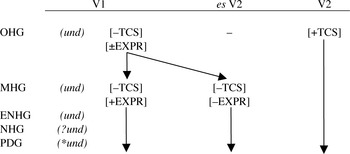
Let us now look at the diachronic development of V1 and V2 clauses. For the sake of our argumentation we assume the scenario in figure 2 below. In OHG, both the V1 and the V2 order are already established. According to recent investigations (Hinterhölzl & Petrova Reference Hinterhölzl and Petrova2010:315, Petrova Reference Petrova and Welo2011:215), V1 order is characterized by the absence of a topic-comment division, while V2 order is better described as [+TCS]. Hinterhölzl & Petrova (Reference Hinterhölzl and Petrova2010) assume that V2 order is derived from V1 order by means of the fronting of a constituent, typically the topic. They consider V2 clauses as the product of reanalysis of V1 clauses that were preceded by a syntactically nonintegrated Aboutness Topic.
A syntactic change scenario involving the feature specification of V1 and V2 clauses.
As shown in figure 2, V1 clauses are described as [–TCS]. In contrast, we argue that in OHG (and probably in Proto-Germanic, too) V1 clauses were underspecified with respect to the feature [EXPR]. We are thereby able to explain the wide distribution and frequent use of V1 clauses in OHG. Apart from introducing new discourse relations (Hinterhölzl & Petrova Reference Hinterhölzl and Petrova2010) or new discourse referents (Petrova Reference Petrova and Welo2011), the V1 pattern is used to introduce quotations, at least in the OHG Isidore's treatise (Robinson Reference Robinson1994). Thus, its expressive value is not always instantiated.
For MHG, we assume that a fundamental change takes place, the results of which can also be seen in the following epochs. V1 clauses are specified as [+EXPR], while V2 clauses introduced by an expletive emerge as the nonexpressive counterparts to V1 clauses. We treat modal particles found in V1 clauses (see 20b) as evidence for the positive instantiation of this value. Structurally, they possibly originate from OHG V2 sentences introduced by tho ‘there, then’. They are also characterized by the absence of a topic-comment division, or [–TCS]. Hence, they have a function similar to V1 clauses. However, unlike V1 clauses they are further specified as [–EXPR]. Therefore, they can be considered as the unmarked pendant of V1 clauses for instantiating utterances without topic-comment division. The contrast between the marked V1 order and the unmarked es-V2-order can also be found in the subsequent stages of language development, up to PDG, without any substantial change. The MHG period is hence characterized by the predominance of the V2 order, given the underspecification of this pattern with respect to expressivity.
We suggest that a possible trigger for the splitting of the functional values of the features in the MHG period is the further development of the distinction between written and oral language. Written language is characterized by es-V2-clauses, while bare V1 clauses are typical for oral registers. The association of this feature with a spoken register probably explains the scarce written attestation of V1 clauses during this stage (Curme Reference Curme1925), but also during the subsequent ones. As discussed above, the basic function of V1 clauses is an expressive one, that is, they reinforce a preceding utterance by adding a narrative or explanative sequence to the preceding text unit. A similar view can be held for und-clauses that share the same properties of other V1 sentences.Footnote 34
To conclude, we would like to underline that the term Inversion nach und, which has become established in the literature, is actually mis-leading. The view that the types of clauses investigated in this paper are V1 clauses introduced by a conjunction was recently advocated by Prell (Reference Prell2001) as well. In this paper, we have shown why this view is on the right track by examining the factors that trigger the VS pattern. We argued that these factors are mainly related to discourse and information structure and that the main purpose of these structures is to produce stylistic and rhetoric effects. Furthermore, we proposed a syntactic analysis of und-V1-clauses that takes into account the typical lack of topic-comment division and expressivity in this sentence type and suggested a possible diachronic development.