

Introduction: Program Creation
The significance of Department of Defense (DOD) Directive 2311.01E, The Law of War Program (DODD 2311.01E), last updated in 2020, is not simply rhetorical.Footnote 1 Born in 1974 in immediate reaction to the well-publicized atrocities committed by U.S. service members in Vietnam (such as at My Lai and Song Thang), the original directive represented the most tangible and highest-level expression of the U.S. executive branch's desire that its members comply with the laws and customs of war.Footnote 2 Beyond important symbolism, the original regulation created a true law of war program in more than name only by establishing an interrelated set of measures focused on training, reporting, and investigating with designated offices and positions of responsibility—measures expressly crafted to ensure law of war adherence. DODD 2311.01E maintains and improves the original 1974 program's compliance architecture, and in doing so operationalizes, more than any other DOD or military initiative, the U.S. national commitment that its military should live by the law of war's precepts.
History and Context
DODD 2311.01E's first 1974 incarnation certainly did not emerge within a law of war vacuum, nor is its current version lonely today. The U.S. military has long promulgated law of war guidance. Prior to the Civil War, the laws and customs of war were operationalized in disparate orders, such as General George Washington's famous edicts during the American Revolutionary War to treat British prisoners humanely after the Battles of Trenton and Princeton.Footnote 3 During the U.S. Civil War, President Lincoln commissioned the first modern codification of the law of war, promulgating the resulting “Lieber Code” as general orders.Footnote 4 This watershed codification,Footnote 5 copied by nations around the globe, laid the foundation for subsequent regulations that continue today.Footnote 6
However, until 1974 the U.S. military lacked a programmatic, comprehensive, and institutional commitment to law of war compliance, a lacuna finally filled by The Law of War Program. First and foremost, the original The Law of War Program directive (like DODD 2311.01E) mandated extensive law of war training for all members of the U.S. military within the context of a new, comprehensive regulatory scheme aimed at enhanced compliance. It was the first DOD-wide mandate of such training during peacetime, a requirement implemented through lower-level, Joint Staff, and service-specific regulations that continue to operationalize the directive's mandates (fulfilling long-standing treaty obligations to do so).Footnote 7 It is important to note that while a sanctions regime—enforcement through individual accountability for transgressions—is also necessary for optimal compliance with this (or any) body of law, training is even more vital to achieving adherence to the law of war. No human being can intentionally conform their behavior to standards that they do not know or understand, never mind do so when under lethal pressure—hence DODD 2311.01E's ultimate significance.Footnote 8
Furthermore, in addition to its department-wide scope and training measures, DODD 2311.01E's 1974 predecessor also established reporting and investigatory requirements regarding allegations of law of war violations; these requirements have been refined in the ensuing decades.Footnote 9 Critically, this directive was revolutionary regarding its involvement of military lawyers in its new law of war compliance regime.Footnote 10 Furthermore, in later iterations, DOD 2311.01E expanded its aperture to make law of war compliance more cultural—part of the U.S. military ethos—and less contingent on technical legal threshold determinations. Today, the directive importantly requires that:
Members of the DoD Components comply with the law of war during all armed conflicts, however characterized. In all other military operations, members of the DoD Components will continue to act consistent with the law of war's fundamental principles and rules, which include those in Common Article 3 of the 1949 Geneva Conventions and the principles of military necessity, humanity, distinction, proportionality, and honor.Footnote 11
Additionally of note, the current directive expressly applies its requirements to contractors supporting U.S. military operations, an important step toward ensuring compliance, given the huge numbers of contractors involved in modern armed conflict.
Conclusion
A closing caveat: a stated desire to adhere to the law of war, even if expressed at the highest levels of the military's civilian and military leadership, does not automatically translate into a reality of compliance. Gauging U.S. military compliance with the law of war is challenging due to a tremendous lack of transparency into U.S. battlefield operations, particularly those conducted by special operations forces. While the American public and U.S. Congress are aware of rare, sensationalized military prosecutions of service members for war crimes, and of reports of U.S. airstrikes causing excessive civilian casualties for which there is seemingly never any accountability, they have no fact-based idea of how often the military actually fails to adhere to this body of law. The exceedingly rare criminal prosecution for battlefield misconduct could signify substantial compliance; the paucity of such trials could also signify poor compliance accompanied by equally poor accountability.Footnote 12 Given this factual deficit, as only one part of the U.S. Armed Forces' huge bureaucratic machine, DODD 2311.01E's unilateral casual effects are difficult if not impossible to quantify. However, its symbolism, along with training and reporting requirements, positively contributes to a culture of apparent compliance and to a military ethos that views adherence to the law of war as an integral component of U.S. military professional identity.

DoD Directive 2311.01
DoD Law of War Program
_______________________________________________________

_______________________________________________________
Purpose: This issuance:
• Establishes policy and assigns responsibilities for the DoD Law of War Program.
• Establishes the DoD Law of War Working Group to advise the General Counsel of the Department of Defense (GC DoD) on law of war matters to develop and coordinate on law of war initiatives and issues.
TABLE OF CONTENTS
SECTION 1: GENERAL ISSUANCE INFORMATION....................[198]
1.1. Applicability....................[198]
1.2. Policy....................[198]
1.3. Information Collections....................[198]
1.4. Issuances That Support DoD Compliance with the Law of War....................[198]
a. Review of the Legality of Weapons....................[199]
b. Detention and Interrogation Policies....................[199]
c. Dissemination of Information About the Law of War....................[199]
d. Identification Cards Required by the Geneva Conventions....................[199]
SECTION 2: RESPONSIBILITIES...............[199]
2.1. GC DoD....................[199]
2.2. Under Secretary of Defense for Policy....................[199]
2.3. Director, Defense Intelligence Agency....................[200]
2.4. Assistant Secretary of Defense for Legislative Affairs....................[200]
2.5. Assistant to the Secretary of Defense for Public Affairs....................[200]
2.6. DoD Component Heads…....................[200]
2.7. Secretaries of the Military Departments....................[200]
2.8. Chairman of the Joint Chiefs of Staff....................[201]
2.9. Combatant Commanders…....................[201]
SECTION 3: DoD LAW OF WAR WORKING GROUP…...............[202]
3.1. General…....................[202]
3.2. Membership....................[202]
SECTION 4: REPORTING AND INVESTIGATION REQUIREMENTS…...............[203]
4.1. Reports of Incidents....................[203]
4.2. Unit Commanders....................[203]
4.3. Combatant Commander Reporting....................[204]
GLOSSARY…...............[204]
G.1. Acronyms....................[204]
G.2. Definitions...............[205]
REFERENCES…...............[205]
SECTION 1: GENERAL ISSUANCE INFORMATION
1.1. Applicability
This issuance applies to the Office of the Secretary of Defense, the Military Departments, the Office of the Chairman of the Joint Chiefs of Staff and the Joint Staff, the Combatant Commands, the Office of the Inspector General of the Department of Defense, the Defense Agencies, the DoD Field Activities, and all other organizational entities within the DoD (referred to collectively in this issuance as the “DoD Components”).
1.2. Policy
It is DoD policy that:
a. Members of the DoD Components comply with the law of war during all armed conflicts, however characterized. In all other military operations, members of the DoD Components will continue to act consistent with the law of war's fundamental principles and rules, which include those in Common Article 3 of the 1949 Geneva Conventions and the principles of military necessity, humanity, distinction, proportionality, and honor.
b. The law of war obligations of the United States are observed and enforced by the DoD Components and contractors or subcontractors assigned to or accompanying U.S. Armed Forces.
c. The DoD Components implement effective programs to prevent violations of the law of war, including:
(1) Law of war dissemination and periodic training.
(2) Qualified legal advisers advising on the law of war.
(3) Instructions, regulations, and procedures to implement law of war standards and establish processes for ensuring compliance.
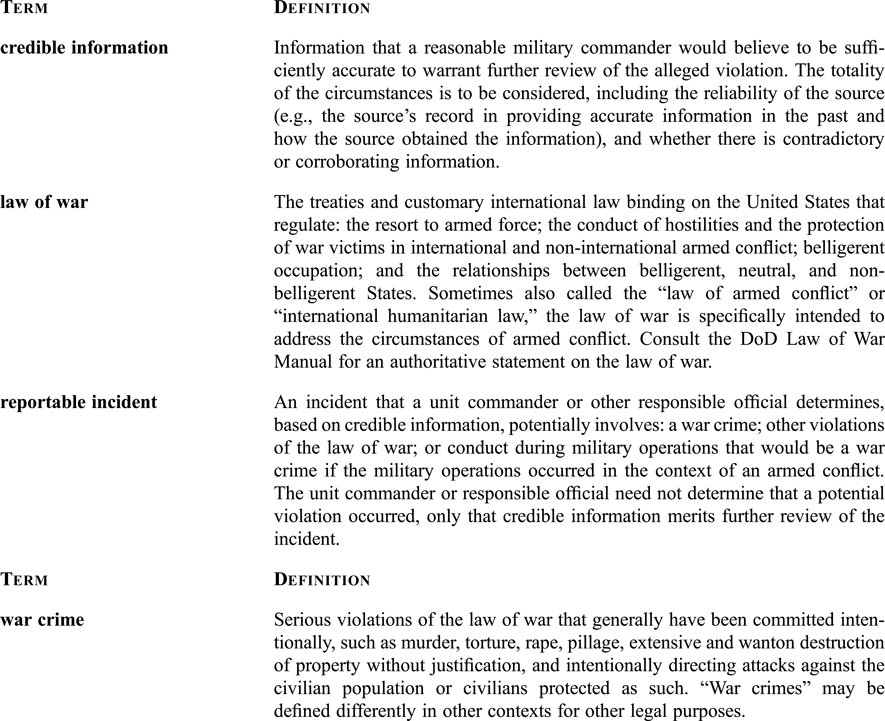
(4) Reporting of incidents to ensure that commanders can exercise their responsibilities to implement and enforce the law of war. All reportable incidents, as defined in this issuance, are reported promptly through the chain of command in accordance with the requirements of Section 4.
(5) Assessments, investigations, inquiries, or other reviews of incidents needed to determine appropriate responses, which may include:
(a) Additional review or investigation, such as referral to a responsible Defense Criminal Investigative Organization or inspector general's office of competent jurisdiction.
(b) Transmission to relevant U.S. departments and agencies, partner governments, or other authorities with responsibilities with respect to the reportable incident.
(c) Accountability or improvement actions.
(6) Appropriate actions to ensure accountability and to improve efforts to prevent violations of the law of war in U.S. military operations. Such actions may include:
(a) Providing additional training.
(b) Taking adverse or corrective administrative action, including non-judicial punishment.
(c) Instituting criminal proceedings.
(d) Revising or issuing policies, regulations, instructions, procedures, training documents, or other guidance to incorporate lessons learned.
d. The intended acquisition, procurement, or modification of weapons or weapon systems is reviewed for consistency with the law of war.
1.3. Information Collections
The reports of reportable incidents referred to throughout this issuance do not require licensing with a report control symbol in accordance with Paragraphs 1.b.(4) and 1.b.(8) of Enclosure 3 of Volume 1 of DoD Manual 8910.01.
1.4. Issuances that Support DoD Compliance with the Law of War
The following DoD issuances also provide requirements that support DoD compliance with the law of war.
a. Review of the Legality of Weapons.
DoD Directives (DoDDs) 5000.01, 3000.03E, and 3000.09 impose requirements to review weapons to ensure DoD activities will be consistent with the law of war.
b. Detention and Interrogation Policies.
DoDDs 2310.01E and 3115.09 provide policies and responsibilities to ensure compliance with law of war requirements with respect to the treatment of detainees.
c. Dissemination of Information About the Law of War.
The DoD Law of War Manual provides information about the law of war to DoD personnel responsible for implementing the law of war and executing military operations.
d. Identification Cards Required by the Geneva Conventions.
DoD Instruction (DoDI) 1000.01 provides procedures for DoD identification cards issued to meet certain requirements of the Geneva Conventions.
SECTION 2: RESPONSIBILITIES
2.1. GC DoD
The GC DoD:
a. Exercises primary staff responsibility for the DoD Law of War Program.
b. Provides the DoD Components with overall legal guidance on the DoD Law of War Program, including:
(1) Review of policies developed under or relating to the program and resolution of disagreements on questions of law.
(2) Coordination with other U.S. departments and agencies on special legislative proposals and other matters relating to the law of war.
c. Promulgates updates to the DoD Law of War Manual developed through the DoD Law of War Working Group.
d. Supervises and assigns a chair for the DoD Law of War Working Group.
e. Coordinates and monitors DoD Components', including Military Departments', respective plans and policies for training and education in the law of war.
f. Reviews appropriate plans, policies, directives, and rules of engagement, as necessary, ensuring their consistency with this issuance and the law of war.
g. Leads DoD strategic efforts to engage with external actors on the legality of DoD military operations and on the clarification and potential development of the law of war.
2.2. Under Secretary of Defense for Policy
The Under Secretary of Defense for Policy:
a. Advises the Secretary of Defense on the policy implications for major DoD policies and plans of potential U.S. decisions to ratify new law of war treaties.
b. Advises the Secretary of Defense on policy issues relating to confidential communications from the International Committee of the Red Cross.
2.3. Director, Defense Intelligence Agency
Under the authority, direction, and control of the Under Secretary of Defense for Intelligence and Security, and in addition to the responsibilities in Paragraph 2.6., the Director, Defense Intelligence Agency:
a. Provides information to the Combatant Commanders, consistent with their respective responsibilities in Paragraph 2.9., concerning reportable incidents:
(1) Involving alleged violations of the law of war committed by persons outside of U.S. control, such as reportable incidents perpetrated against U.S. persons captured or detained by hostile groups.
(2) Committed by or against U.S. coalition partners.
(3) Perpetrated by other actors in theaters of U.S. military operations.
b. Provides a repository for the central collection of defense intelligence data concerning reportable incidents.
c. Assists the DoD Components in declassifying or sanitizing information for transmission, in accordance with Paragraph 1.2.c.(5)(b), to relevant U.S. departments and agencies, partner governments, or other authorities with responsibilities with respect to the reportable incident.
2.4. Assistant Secretary of Defense for Legislative Affairs
The Assistant Secretary of Defense for Legislative Affairs serves as the DoD liaison between the DoD and Congress on all matters related to the DoD Law of War Program and provides legislative affairs guidance, as appropriate, to the DoD Components.
2.5. Assistant to the Secretary of Defense for Public Affairs
The Assistant to the Secretary of Defense for Public Affairs monitors the public affairs aspects of the DoD Law of War Program and provides public affairs guidance, as appropriate, to the DoD Components, in accordance with DoDD 5122.05.
2.6. DoD Component Heads
The DoD Component heads:
a. Comply with the policies contained in this issuance.
b. Implement effective programs to prevent violations of the law of war by members of their component, including programs for law of war dissemination and periodic training commensurate with each individual's duties and responsibilities.
c. Make available qualified legal advisers to appropriate levels of command to advise on law of war compliance during planning and execution of exercises and operations; and to help implement programs to comply with the reporting requirements established in Section 4.
d. Ensure that contract work statements for contractors and their subcontractors comply with the policies contained in this issuance and DoDI 3020.41, and require contractors that engage in activities governed by the law of war to implement effective programs to prevent violations of the law of war by their employees and subcontractors, including programs for law of war dissemination and periodic training commensurate with each individual's duties and responsibilities.
e. Ensure that the intended acquisition, procurement, or modification of weapons or weapon systems by the component is reviewed for consistency with the law of war.
2.7. Secretaries of the Military Departments
In addition to the responsibilities in Paragraph 2.6., the Secretaries of the Military Departments develop internal policies and procedures consistent with this issuance in support of the DoD Law of War Program to:
a. Implement effective programs within their respective Military Departments to prevent violations of the law of war.
b. Provide directives, publications, instructions, and periodic training so the principles and rules of the law of war will be known to members of their respective Military Department. Such training will ensure that:
(1) All military members of their respective Military Department know the fundamental precepts of the law of war and that all members have knowledge of the law commensurate with each individual's duties and responsibilities. This includes relevant standards applicable in international armed conflict and belligerent occupation.
(2) Information about the law of war in such directives, publications, instructions, and training is consistent with information in the DoD Law of War Manual.
c. Where appropriate, provide for disposition, pursuant to Sections 801-946 of Title 10, United States Code (U.S.C.), also known as the “Uniform Code of Military Justice,” of cases involving alleged violations of the law of war committed by persons who are subject to court- martial jurisdiction and who are under the responsibility of their respective Military Department.
d. Forward relevant information to the Combatant Commander or DoD Component heads concerned regarding:
(1) The results of assessments, inquiries, investigations, or other reviews of reportable incidents conducted by their respective Military Department.
(2) Disposition actions taken by their respective Military Department concerning reportable incidents.
e. Forward reports of reportable incidents involving allegations of war crimes committed by U.S. civilians, contractors, or subcontractors assigned to or accompanying military forces of their respective Military Department, or their dependents, to the GC DoD, for review for potential prosecutorial action under the criminal jurisdiction of the United States, pursuant to Sections 2441, 2442, or 3261 of Title 18, U.S.C., or other provisions of U.S. law.
2.8. Chairman of the Joint Chiefs of Staff
In addition to the responsibilities in Paragraph 2.6., the Chairman of the Joint Chiefs of Staff:
a. Provides appropriate guidance to the Combatant Commanders, consistent with Section 163 of Title 10, U.S.C. This guidance will include direction on the collection and investigation of reportable incidents.
b. Designates a primary point of contact in his or her organization to ensure the implementation of the Chairman's responsibilities under this issuance.
c. Reviews appropriate plans, policies, directives, joint doctrine, and rules of engagement, as necessary, ensuring their consistency with this issuance and the law of war.
d. Helps ensure that plans, policies, directives, and rules of engagement issued by the Combatant Commanders are consistent with this issuance and the law of war.
2.9. Combatant Commanders
In addition to the responsibilities in Paragraph 2.6., the Combatant Commanders:
a. Implement effective programs within their respective commands to prevent violations of the law of war and ensure that their commands' plans, policies, directives, and rules of engagement are subject to periodic review and evaluation, particularly in light of any violations reported.
b. Implement the requirements of Section 4 and guidance from the Chairman of the Joint Chiefs of Staff on the reporting, investigation or review, and collection of reportable incidents. This includes:
(1) In accordance with Paragraph 4.2.b., determining whether, how, and to what extent a reportable incident not involving U.S. persons will be investigated or reviewed by U.S. forces. The Combatant Commander is to ensure that information regarding such reportable incidents is prepared for appropriate transmission to foreign governments with responsibilities with respect to the reportable incident. Depending on the circumstances, appropriate transmission may include direct, military-to-military communication or coordination with or transmission by the Department of State or other U.S. Government departments or agencies with relationships with relevant authorities in the foreign government.
(2) In accordance with Paragraph 4.3.b., providing for the central collection of relevant information about reportable incidents involving alleged violations of the law of war committed by or against members of their respective Combatant Commands, or persons assigned to or accompanying them, or reported in accordance with Paragraph 4.2.b.
(3) Forwarding reports to the Secretary of Defense, the Chairman of the Joint Chiefs of Staff, the Commander of U.S. Special Operations Command, if applicable, and relevant Secretaries of the Military Departments in accordance with Paragraph 4.3.
c. Direct the command staff judge advocate to advise on the implementation of this program, including advising command staff responsible for investigations or operational reporting on the implementation of those aspects of this program dealing with reportable incidents.
d. Ensure all plans, policies, directives, and rules of engagement issued by the command and its subordinate commands and components are reviewed by legal advisers to ensure their consistency with this issuance and the law of war.
e. Ensure that law of war dissemination and periodic training programs of subordinate commands and components are consistent with this issuance and the law of war.
f. Report to the GC DoD any assistance, in accordance with DoDI 5525.11, to the Department of Justice on specific cases occurring within the Commander of the Combatant Command's area of responsibility that may lead to arrest or criminal prosecution pursuant to Section 3261 of Title 18, U.S.C., also known as the “Military Extraterritorial Jurisdiction Act,” involving alleged violations of the law of war.
SECTION 3: DOD LAW OF WAR WORKING GROUP
3.1. General
The DoD Law of War Working Group will:
a. Develop and coordinate law of war initiatives and issues, such as analysis regarding the legality of new means or methods of warfare under consideration by DoD components.
b. Support the research, preparation, review, and updating of the DoD Law of War Manual. To ensure consistency in legal interpretation, the DoD Law of War Manual serves as the authoritative statement on the law of war within the DoD.
c. Manage other law of war matters as they arise.
d. Advise the GC DoD on legal matters covered by this issuance.
3.2. Membership
In addition to representatives of the GC DoD, the DoD Law of War Working Group will consist of representatives, at the election by each, of the:
a. General Counsel of each Military Department.
b. Counsel for the Commandant of the Marine Corps.
c. Judge Advocate General of each Military Department.
d. Staff Judge Advocate to the Commandant of the Marine Corps.
e. Legal Counsel to the Chairman of the Joint Chiefs of Staff.
SECTION 4: REPORTING AND INVESTIGATION REQUIREMENTS
4.1. Reports of Incidents
a. All military and U.S. civilian employees, contractor personnel, and subcontractors assigned to or accompanying a DoD Component must report through their chain of command all reportable incidents, including those involving allegations of non-DoD personnel having violated the law of war.
b. Contracts must require contractor employees to report reportable incidents to the commander of the unit they are accompanying or the installation to which they are assigned, or to the appropriate Combatant Commander.
c. Reports of incidents may be made through other channels, such as the military police, a judge advocate, or an inspector general. Reports made to officials other than those specified in this paragraph will, nonetheless, be accepted and immediately forwarded through the recipient's chain of command. Reports will also be forwarded to the chain of command of the subject of the allegation, where appropriate.
4.2. Unit Commanders
The commander of any unit that obtains information about an alleged violation of the law of war must assess whether the allegation is based on credible information and thus constitutes a reportable incident. The unit commander must immediately report reportable incidents, by operational incident reporting procedures or other expeditious means, through the chain of command to the Combatant Commander.
a. The unit commander or higher authorities receiving information about a reportable incident will, when warranted, take any of the following actions:
(1) Subject to operational constraints, take appropriate measures to preserve on-scene evidence of reportable incidents pending a decision by higher authorities on whether to conduct an assessment, investigation, inquiry, or other review.
(2) Direct an assessment, investigation, inquiry, or other review in accordance with applicable procedures, including Paragraph 4.2.b. An assessment, investigation, inquiry, or other review under this paragraph will be properly scoped to de-conflict with any investigation initiated by a responsible defense criminal investigative organization.
(3) In accordance with DoDI 5505.03 and other applicable procedures, refer information about alleged war crimes to, or request an investigation by, a responsible Defense Criminal Investigative Organization.
(4) In addition to the report required by this issuance, comply with other applicable reporting requirements and procedures, which potentially could include:
(a) Requirements in DoDI 6055.07 concerning all reportable incidents that constitute a “friendly fire” incident or other mishap addressed by DoDI 6055.07.
(b) Requirements in DoDD 3115.09 to report “any suspected or alleged violation of DoD policy, procedures, or applicable law relating to intelligence interrogations, detainee debriefings, or tactical questioning for which there is credible information.”
(c) Requirements in DoDD 5148.13 concerning all reportable incidents that constitute a “questionable intelligence activity” or “significant or highly sensitive matter” reported, in accordance with DoDD 5148.13.
(d) Policies and procedures relating to the reporting and assessment of civilian casualties.
(e) Military Department, Military Service, or Combatant Command incident reporting requirements.
b. If the unit commander or a superior commander determines that U.S. persons are not involved in a reportable incident, a U.S. investigation or review will be continued only at the direction of the appropriate Combatant Commander. However, such incidents must be reported in accordance with this issuance. In particular, incidents that involve allegations of partner forces violating the law of war will be reported with a view to ensuring compliance with the requirements of Section 362 of Title 10, U.S.C., and associated DoD policies.
c. If the unit commander or a superior commander determines that an allegation is not supported by credible information, the allegation will nonetheless be forwarded through the chain of command to the appropriate Combatant Commander with this determination. The Combatant Commander may provide additional guidance on making and forwarding such determinations, including regarding the timing and manner of doing so.
4.3. Combatant Commander Reporting
The Combatant Commander must report, by operational incident reporting procedures or other expeditious means, all reportable incidents to the Chairman of the Joint Chiefs of Staff, the Secretary of Defense, the Commander of United States Special Operations Command, if applicable, and relevant Secretaries of the Military Departments.
a. The Chairman of the Joint Chiefs of Staff will forward reports of reportable incidents to the GC DoD; Assistant to the Secretary of Defense for Public Affairs; Under Secretary of Defense Policy; Under Secretary of Defense for Intelligence and Security; Assistant Secretary of Defense for Legislative Affairs; and Inspector General of the Department of Defense.
b. The Combatant Commander must ensure that, no less often than every 6 months, the central collection of information on reportable incidents that the Combatant Commander has reported pursuant to this issuance is updated and accessible by the Secretary of Defense. The central collection must include:
(1) The reportable incidents reported to the Secretary of Defense in the previous 6 months.
(2) The disposition, if any, of each reportable incident within the Combatant Command.
(3) The results of any review or investigation of reportable incidents completed within the Combatant Command in the previous 6 months and any such information forwarded by the Military Departments.
(4) Information on any significant corrective actions taken within the Combatant Command and any such information forwarded by the Military Departments.
(5) Any additional information the Combatant Commander deems relevant and appropriate to include, such as determinations submitted in accordance with Paragraph 4.2.c.
GLOSSARY
G.1. ACRONYMS
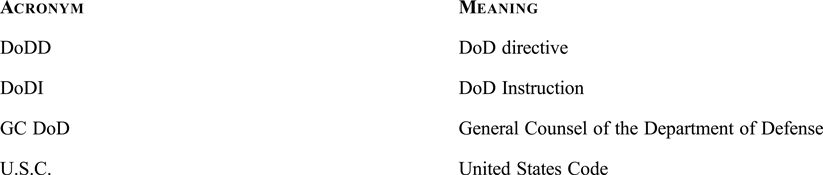
G.2. DEFINITIONS
These terms and their definitions are for the purpose of this issuance.