Introduction
Hallucinatory experiences, especially in the auditory modality, are regarded as pathognomonic symptoms of schizophrenia spectrum disorders, although similar complaints are also reported by patients with other diagnoses (Aleman & Larøi, Reference Aleman and Larøi2008) and non-clinical individuals who do not meet diagnostic criteria for psychiatric disorders (e.g. Honig et al. Reference Honig, Romme, Ensink, Escher, Pennings and DeVries1998; Johns et al. Reference Johns, Nazroo, Bebbington and Kuipers2002; Andrew et al. Reference Andrew, Gray and Snowden2008; Lawrence et al. Reference Lawrence, Jones and Cooper2010). From a cognitive perspective, hallucinations are believed to arise from the misattribution of internally generated cognitive events (e.g. inner speech) to external sources (Bentall, Reference Bentall1990; Frith, Reference Frith1992; Ditman & Kuperberg, Reference Ditman and Kuperberg2005; Larøi & Woodward, Reference Larøi and Woodward2007). Bentall (Reference Bentall1990) proposed that hallucinatory experiences may be explained by reality discrimination, a metacognitive process used to discriminate agency between internal and external perceptions (for reviews, see Ditman & Kuperberg, Reference Ditman and Kuperberg2005; Aleman & Larøi, Reference Aleman and Larøi2008). According to this account, hallucination-prone individuals are impaired in their capacity to discriminate between internally and externally generated cognitive events and present a specific cognitive bias towards the misattribution of internal cognitive events to external sources.
Several studies have employed signal detection theory (SDT) to investigate the relationship between reality discrimination and hallucination-proneness. SDT assumes that the capacity to discern signals from noise relies on two parameters: perceptual sensitivity (i.e. the capacity to detect a signal from background noise); and response bias (i.e. the extent to which an individual is more or less likely to report the presence of a signal in background noise). Studies that employed auditory SDT tasks have generally supported the reality discrimination model of hallucinations by showing that both hallucinating patients and non-clinical hallucination-prone individuals are characterized by greater bias towards the detection of signals (and not by perceptual sensitivity impairment) when compared with controls (Bentall & Slade, Reference Bentall and Slade1985a; Rankin & O'Carroll, Reference Rankin and O'Carroll1995; Barkus et al. Reference Barkus, Stirling, Hopkins, McKie and Lewis2007, Reference Barkus, Smallman, Royle, Barkus, Lewis and Rushe2011; Vercammen et al. Reference Vercammen, de Haan and Aleman2008; Varese et al. Reference Varese, Barkus and Bentall2011a).
Recent research has witnessed a growing interest in the contribution of trauma to hallucination-proneness. Large population-based investigations and several cross-sectional studies suggest traumatic events may increase the likelihood of experiencing psychotic symptoms (for reviews, see Read et al. Reference Read, Goodman, Morrison, Ross, Aderhold, Read, Mosher and Bentall2004, Reference Read, van Os, Morrison and Ross2005, Reference Read, Fink, Rudegeair, Felitti and Whitfield2008; van Os et al. Reference van Os, Kenis and Rutten2010) and there might be specific associations between different types of adversities and specific psychotic complaints (Bentall & Fernyhough, Reference Bentall and Fernyhough2008). In this context, the experience of early adversity, especially childhood sexual abuse (CSA), has been specifically linked to hallucinations in schizophrenia (Read et al. Reference Read, Agar, Argyle and Aderhold2003) and bipolar disorder patients (Hammersley et al. Reference Hammersley, Dias, Todd, Bowen-Jones, Reilly and Bentall2003) as well as in community samples (Whitfield et al. Reference Whitfield, Dube, Felitti and Anda2005; Shelvin et al. Reference Shelvin, Dorahy and Adamson2007).
It has been proposed that the relationship between trauma and psychotic symptoms could be accounted for by dissociative processes (e.g. Moskowitz & Corstens, Reference Moskowitz and Corstens2007; Moskowitz et al. Reference Moskowitz, Read, Farrelly, Rudegeair, Williams, Dell and O'Neil2009; Anketell et al. Reference Anketell, Dorahy, Shannon, Elder, Hamilton, Corry, MacSherry, Curran and O'Rawe2010). Dissociation has been defined as the ‘lack of normal integration of thoughts, feelings and experiences into the stream of consciousness and memory’ (Bernstein & Putnam, Reference Bernstein and Putnam1986, p. 727) and represents the core component of DSM-IV diagnosis of dissociative disorders. Although dissociative states can be experienced in the absence of antecedent trauma (Merckelbach & Muris, Reference Merckelbach and Muris2001; Mayer & Farmer, Reference Mayer and Farmer2003), research findings suggest that dissociation is a pervasive sequela of traumatic events in non-psychotic samples (van Ijzendoorn & Schuengel, Reference van Ijzendoorn and Schuengel1996) and that psychotic patients exposed to traumatic life experiences score higher on measures of dissociative tendencies compared with patients with no history of trauma (Goff et al. Reference Goff, Brotman, Kindlon, Waites and Amico1991; Holowka et al. Reference Holowka, King, Saheb, Pukall and Brunet2003; Offen et al. Reference Offen, Waller and Thomas2003; Dorahy et al. Reference Dorahy, Shannon, Seagar, Corr, Stewart, Hanna, Mulholland and Middleton2009; Perona-Garcelán et al. Reference Perona-Garcelán, García-Montes, Cuevas-Yust, Pérez-Álvarez, Ductor-Recuerda, Salas-Azcona and Gómez-Gómez2010).
Although studies have linked dissociative tendencies to psychotic symptoms and psychosis-proneness in general (e.g. Startup, Reference Startup1999; Pope & Kwapil, Reference Pope and Kwapil2000; Moskowitz et al. Reference Moskowitz, Barker-Collo and Ellson2005), increasing evidence suggests dissociation is specifically related to hallucinations rather than other psychotic symptoms (Altman et al. Reference Altman, Collins and Mundy1997; Escher et al. Reference Escher, Romme, Buiks, Delespaul and van Os2002a, b; Kilcommons & Morrison, Reference Kilcommons and Morrison2005). Several cross-sectional studies have found robust associations between dissociative tendencies and hallucinatory experiences in psychotic patients (Kilcommons & Morrison, Reference Kilcommons and Morrison2005; Perona-Garcelán et al. Reference Perona-Garcelán, Cuevas-Yust, García-Montes, Pérez-Alvarez, Ductor-Recuerda, Salas-Azcona, Gómez-Gómez and Rodríguez-Martín2008, Reference Perona-Garcelán, García-Montes, Cuevas-Yust, Pérez-Álvarez, Ductor-Recuerda, Salas-Azcona and Gómez-Gómez2010), sexual abuse victims (Kilcommons et al. Reference Kilcommons, Morrison, Knight and Lobban2008), post-traumatic stress disorder patients (Anketell et al. Reference Anketell, Dorahy, Shannon, Elder, Hamilton, Corry, MacSherry, Curran and O'Rawe2010), non-psychotic adolescents (Altman et al. Reference Altman, Collins and Mundy1997; Yoshizumi et al. Reference Yoshizumi, Murase, Honjo, Kaneko and Murakami2004) and adult non-clinical samples (Glicksohn & Barrett, Reference Glicksohn and Barrett2003; Morrison & Petersen, Reference Morrison and Petersen2003; Barkus et al. Reference Barkus, Stirling and Cavill2010; Varese et al. Reference Varese, Barkus and Bentall2011a). In a longitudinal study of adolescents experiencing auditory hallucinations (Escher et al. Reference Escher, Romme, Buiks, Delespaul and van Os2002a, b), dissociation significantly predicted the persistence of hallucinations over a 3-year follow-up period. Finally, in a recent experience-sampling study (a structured diary method used to investigate different aspects of the participants' behavioural, emotional and cognitive experience as it occurs in real time; Delespaul, Reference Delespaul1995), increased state dissociation was found to be a significant predictor of auditory hallucinations in the flow of daily life of psychotic patients (Varese et al. Reference Varese, Udachina, Myin-Germeys, Oorschot and Bentall2011b).
The accumulating evidence linking childhood trauma, dissociation and hallucinations has led to speculation that the effect of childhood trauma on hallucination-proneness may be mediated by increased dissociative tendencies (e.g. Moskowitz & Corstens, Reference Moskowitz and Corstens2007; Anketell et al. Reference Anketell, Dorahy, Shannon, Elder, Hamilton, Corry, MacSherry, Curran and O'Rawe2010). This hypothesis, however, has not been empirically tested to date. Similarly, no published studies have yet investigated the interplay between dissociation and the cognitive mechanisms believed to underlie hallucinatory experiences. Allen et al. (Reference Allen, Coyne and Console1997) proposed that dissociation might represent a vulnerability to experience psychotic symptoms in virtue of its capacity of ‘loosening the moorings in inner and outer reality’ (p. 327), therefore making individuals vulnerable to psychotic states by impairing reality testing. From this perspective, it can be assumed that dissociative tendencies could directly interfere with discrimination between internally and externally generated events, resulting in reality discrimination difficulties.
The primary objective of this study was to test whether dissociation mediates the relationship between childhood trauma and hallucination-proneness in a sample of psychotic patients with diagnoses in the schizophrenia-spectrum. In addition, this study examined whether dissociation is related to reality discrimination difficulties by comparing patients with and without pathological dissociative symptoms using an auditory signal detection task. Corollary analyses (correlational and between-group differences analyses) were also carried out to replicate previous findings that linked hallucination-proneness to childhood trauma, dissociative symptoms and reality discrimination abnormalities (i.e. increased response bias in an auditory SDT task).
Method
Participants
Altogether, 45 patients with diagnoses in the schizophrenia spectrum (i.e. diagnoses of schizophrenia, schizoaffective disorder and delusional disorder, as confirmed by the referring clinicians or members of the patients' care teams) were recruited from in-patient and out-patient services in North Wales (UK). In addition, 20 healthy controls with no history of mental health difficulties or hallucinations were recruited through the Bangor University Community Research Panel via an invitation letter or email. Their eligibility was ascertained using a clinical interview comprising the Structured Clinical Interview for the Positive and Negative Syndromes Scales (SCI-PANSS; Opler et al. Reference Opler, Kay, Lindenmayer and Fishbein1992) and additional items taken from the ‘Demographic Data’, ‘Education and Work History’ and ‘Treatment and Hospitalization History’ sections of the overview module of the Structural Clinical Interview for DSM-IV-TR Axis I Disorders (First et al. Reference First, Spitzer, Gibbon and Williams2002). Non-clinical participants who disclosed past or current psychiatric complaints were deemed ineligible. The absence of lifetime history of hallucinations in the non-clinical group was ascertained using the hallucinations screening questions of the SCI-PANSS, which require participants to disclose whether they have ever experienced auditory hallucinations (e.g. ‘Sometimes people tell me that they can hear noises or voices that others can't hear. What about you?’) and hallucinatory experiences in other sensory modalities. None of the control participants recruited in this study reported past or current hallucinatory experiences.
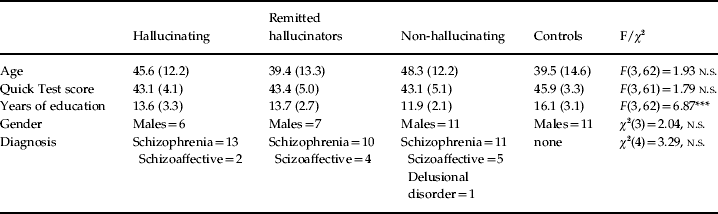
For the purpose of the between-group analyses, patients were divided into three subgroups according to their responses to the hallucinations items of the SCI-PANSS. The hallucinating patients group (n=15) comprised participants with a score ⩾3 on the hallucinatory behaviour item of Positive and Negative Syndrome Scales (PANSS) (i.e. symptom present). The remitted hallucinators group (n=14) comprised non-hallucinating patients (PANSS hallucinations score=1; i.e. symptom absent) who suffered from auditory hallucinations in the past. Finally, the non-hallucinating patients group (n=16) included participants who reported no lifetime occurrence of hallucinatory experiences. Clinical and sociodemographic characteristics of the sample are reported in Table 1.
Means (s.d.) and observed frequencies for the clinical and demographic characteristics of the sample

n.s., Non-significant.
* p<0.05, ** p<0.01, *** p<0.001.
The Quick Test was used to measure pre-morbid verbal intelligence.
Between-group differences on the clinical and demographic variables were tested using analysis of variance (ANOVA) and Pearson's χ2 test. There were no significant between-group differences for age, gender and pre-morbid IQ [as assessed by the Ammons Quick Test (QT); Ammons & Ammons, Reference Ammons and Ammons1962]. Patients spent significantly less years in education compared with healthy controls, but there were no differences on education between the three clinical groups. In total, 40 patients were taking antipsychotic medication at the time of testing (13 hallucinating patients, 12 remitted hallucinators and 15 non-hallucinating patients).
Measures
PANSS (Kay et al. Reference Kay, Fiszbein and Opler1987)
The PANSS was used to assess the presence and severity of positive and negative psychotic symptoms in the week preceding the interview. Each symptom is scored on a scale ranging from 1 (symptom absent) to 7 (extreme symptom severity). The PANSS subscales have good reliability and validity (Kay et al. Reference Kay, Opler and Lindenmayer1988).
The revised Launay–Slade Hallucination Scale (LSHS-R; Bentall & Slade, Reference Bentall and Slade1985b)
The LSHS-R is a widely used self-report measure of hallucination-proneness. The 12 items of the scale describe clinical and subclinical forms of auditory and visual hallucinations. Participants are asked to rate the degree to which the content of each item applies to themselves on a 5-point Likert scale (1=‘certainly does not apply’ to 5=‘certainly applies’). The LSHS-R had excellent internal consistency in this sample (α=0.91).
The Child Abuse and Trauma Scale (CATS; Sanders & Becker-Launsen, Reference Sanders and Becker-Launsen1995)
The CATS is a 38-item self-report scale of the perceived stress and trauma experienced during childhood and adolescence. The questionnaire provides a total score reflecting the perceived severity of maltreatment during childhood, as well as four subscale scores assessing experiences of child sexual abuse (six items; e.g. ‘Were there traumatic or upsetting sexual experiences when you were a child or teenager that you couldn't speak to adults about?’), punishment/physical abuse (six items; e.g. ‘Did your parents ever hit or beat you when you did not expect it?’), neglect/negative home environment (14 items; e.g. ‘As a child, did you have to take care of yourself before you were old enough?’) and emotional abuse (seven items; e.g. ‘Did your parents ridicule you?’; Kent & Waller, Reference Kent and Waller1998). Participants are required to estimate how frequently they were exposed to the abusive experiences described in each item on a 5-point Likert scale (0=never; 4=always). In previous studies the CATS has shown good test–retest reliability (Sanders & Becker-Launsen, Reference Sanders and Becker-Launsen1995) and convergent validity with other validated retrospective measures of childhood maltreatment (e.g. Kroll et al. Reference Kroll, Fiszdon and Crosby1996; Rankin, Reference Rankin1999; Baker & Festinger, Reference Baker and Festinger2011). In this study, the CATS presented good internal consistency both at the total scale (α=0.95) and at the subscales level (α coefficients ranging between 0.73 and 0.92).
The Dissociative Experiences Scale (DES; Bernstein & Putnam, Reference Bernstein and Putnam1986)
The DES is a self-report measure of dissociative symptoms and experiences. Participants are asked to estimate the frequency of 28 dissociative phenomena in their daily life using a 100 mm visual analogue scale. Using taxometric analysis, Waller et al. (Reference Waller, Putman and Carlson1996) identified an eight-item subset of the DES [known as the Dissociative Experiences Scale – Taxon (DES-T)] used to estimate the probability that an individual belongs to the pathological dissociation taxon (Waller et al. Reference Waller, Putman and Carlson1996; Waller & Ross, Reference Waller and Ross1997). The DES and the DES-T had good internal consistency in this sample (α=0.93 and α=0.83, respectively).
The Ammons QT (Ammons & Ammons, Reference Ammons and Ammons1962)
The QT was included as a measure of pre-morbid verbal intelligence. Participants are required to associate a list of 50 words of increasing difficulty to four different line drawings. The test score is then calculated from the number of correct word–drawing associations before six consecutive incorrect responses. In previous studies, the QT has shown good convergent validity with other validated measures of verbal intelligence including the Wechsler Adult Intelligence Scale (e.g. Ammons & Ammons, Reference Ammons and Ammons1962; Joesting & Joesting, Reference Joesting and Joesting1972) and has been previously employed to assess verbal intelligence in psychotic samples (e.g. Kay et al. Reference Kay, Fiszbein and Opler1987).
The auditory signal detection task
An auditory SDT task previously employed to investigate the cognitive underpinnings of non-clinical hallucination-proneness (Barkus et al. Reference Barkus, Stirling, Hopkins, McKie and Lewis2007, Reference Barkus, Smallman, Royle, Barkus, Lewis and Rushe2011; Varese et al. Reference Varese, Barkus and Bentall2011a) was used as a measure of reality discrimination. The task consisted of two 8-min blocks, comprising a total of 120 8-s epochs. Each epoch contained one 5-s burst of white noise and 3 s of silence. During 60% of the bursts of white noise, a 1-s androgynous voice was presented after 2 s. A third of the time the voice was clearly audible to participants; in the remaining epochs the voice was presented at auditory thresholds (auditory thresholds were estimated by prior testing using 10 pilot participants in the same age range as the experimental participants, i.e. age range 18–65 years) Stimuli were presented through standard stereo headphones. After each burst of white noise, participants indicated whether they perceived a voice by pressing mouse buttons labelled ‘Yes’ or ‘No’ using their preferred hand. Four measures were obtained: hits (positive responses when the voice was present); false alarms (positive responses when the voice was absent); misses (negative responses when the voice was present); correct rejections (negative responses when the voice was absent). From the relationship between hits and false alarms, measures of perceptual sensitivity (d') and response bias (β) were calculated using the computational methods described by Barkus et al. (Reference Barkus, Stirling, Hopkins, McKie and Lewis2007). A d' value of zero indicates complete inability to discriminate between signals and background noise, whereas higher d' scores indicate better capacity to detect true signals. Conversely, any β score <1 suggests a bias towards the detection of signals when no signal is present, whereas scores equal to 1 indicate no response bias.
Procedure
Participants were tested individually in a quiet room in the Bangor University School of Psychology, or in other appropriate facilities in in-patient and out-patient units in North Wales (UK). After informed consent had been obtained, participants underwent the SCI-PANSS, completed the QT and were asked to fill in the LSHS-R and the DES. Participants were then asked to read a set of standardized instructions and completed the signal detection task. The task was described as a simple hearing test. At the completion of the task, participants were asked to fill in the CATS and were fully debriefed.
Results
Between-group differences on the PANSS and questionnaire measures and correlational analyses
Prior to mediation analysis, a series of one-way ANOVA was carried out to examine between-group differences on the PANSS and questionnaire measures. Post-hoc comparisons were conducted using Tukey's Honestly Significant Difference. Correlational analyses were also performed to examine the associations between DES, LSHS-R and CATS scores. All analyses involving the DES were carried out after excluding the DES hallucinations item to avoid any confound stemming from the overlapping content with hallucination-proneness.
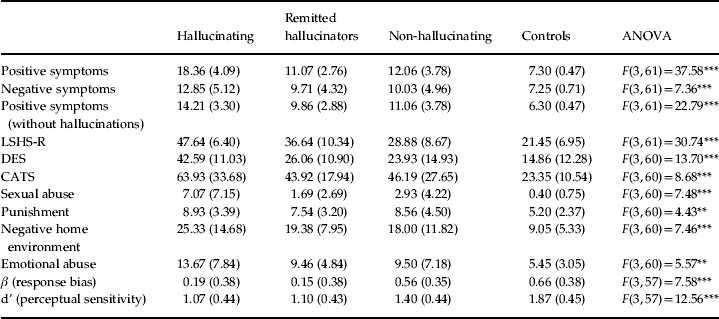
Descriptive statistics for the PANSS and questionnaire measures are displayed in Table 2. The analyses of the PANSS revealed that all patient groups scored significantly higher than controls on positive symptoms (all p's <0.01). Hallucinating patients presented significantly higher scores on the PANSS positive symptoms scale compared with the other patient groups (all p's <0.001), whereas the remitted hallucinators versus non-hallucinating patients contrast was not significant (p=0.80). To determine whether this result might be accounted for by differences on hallucinations scores, the analysis was also carried out after excluding the hallucinations item of the PANSS. The difference between the hallucinating and the other patient groups remained statistically significant (all p's <0.05). In terms of negative symptoms, hallucinating patients scored significantly higher than participants with no history of mental health difficulties (p<0.001). The comparison between the remitted hallucinators and healthy controls was not significant (p=0.99), whereas the difference between non-hallucinating patients and healthy controls approached statistical significance (p=0.07). All pairwise comparisons carried out between the clinical groups were not significant, although a trend towards significance was observed for the hallucinating patients versus remitted hallucinators contrast (p=0.08).
Means (s.d.) for the PANSS, questionnaire measures and SDT task performance

PANSS, Positive and Negative Syndrome Scales; SDT, signal detection theory; ANOVA, analysis of variance; LSHS-R, revised Launay–Slade Hallucination Scale; DES, Dissociative Experiences Scale; CATS, Child Abuse and Trauma Scale.
* p<0.05, ** p<0.01, *** p<0.001.
The results of the hallucination-proneness scores showed that all patient groups scored significantly higher than healthy controls (all p's <0.05). Among the clinical groups, hallucinating patients had significantly higher LSHS-R scores than the other groups considered (all p's <0.01). In addition, remitted hallucinators scored higher than the non-hallucinating patients (p=0.05). The analysis of dissociation scores revealed that hallucinating patients had significantly higher DES scores compared with both clinical and healthy controls (all p's <0.01). No other between-group differences reached statistical significance, although a trend was observed for the remitted hallucinators versus healthy controls contrast (p=0.06).
The analysis of the childhood trauma measures revealed that both hallucinating and non-hallucinating patients scored significantly higher than healthy controls on the CATS (p<0.001 and p<0.05, respectively), whereas the comparison between remitted hallucinators and controls only approached statistical significance (p=0.08). The three patients groups did not differ significantly from each other in terms of CATS total scores (all p's >0.05). The analyses carried out at the subscale level showed that the hallucinating patients scored significantly higher than non-clinical controls on all CATS subscales (all p's <0.01). In addition, non-hallucinating patients reported significantly higher levels of neglect and physical abuse compared with participants with no history of mental health difficulties (all p's <0.05), whereas patients in the remitted hallucinators group scored higher than controls only on measures of neglect/negative home environment (p<0.05). The three patient groups did not differ from each other on physical abuse, neglect or emotional abuse (all p's >0.05). However, hallucinating patients reported significantly more CSA compared with both remitted hallucinators (p<0.01) and hallucinating patients (p<0.05).
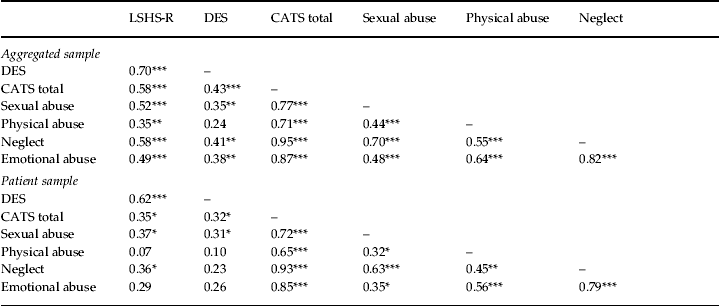
To examine the associations between LSHS-R, DES and CATS scores, two separate correlational analyses were conducted on both the aggregated sample of participants (i.e. including both psychiatric and non-clinical participants) and exclusively on the psychiatric patients sample (see Table 3). Hallucination-proneness was significantly associated with dissociation and CATS total scores in both the aggregated and psychiatric sample analyses. In the aggregated sample, hallucination-proneness was significantly related to all subscales of the CATS, whereas only the associations with CSA and neglect were statistically significant in the psychiatric subsample analysis. In the aggregated sample, significant associations were also found between dissociation and CATS total scores, CSA, neglect and emotional abuse. However, only the relationship with CATS total scores and with CSA were significant when the analysis was restricted to psychiatric patients.
Non-parametric correlations (Spearman's rho) between childhood trauma, dissociation and hallucination-proneness measures

LSHS-R, Revised Launay-Slade Hallucination Scale; DES, Dissociative Experiences Scale; CATS, Child Abuse and Trauma Scale.
* p<0.05, ** p<0.01, *** p<0.001.
Mediation analyses
The hypothesized mediating role of dissociation in the relationship between childhood trauma and hallucination-proneness was tested using the general approach to mediation analysis developed by Imai et al. (Reference Imai, Keele and Tingley2010a) This statistical approach provides a unified estimation procedure for mediation effects that can accommodate linear and non-linear relationships, parametric and non-parametric models and different types of mediators and outcome variables (i.e. both continuous and dichotomous) without the need of individually tailored statistical models. The analysis was carried out using the ‘mediation’ statistical package for R (Imai et al. Reference Imai, Keele, Tingley, Yamamoto and Vinod2010b). Point estimates for mediated, direct and total effects and their associated 95% confidence intervals were estimated using the non-parametric inference algorithm detailed by Imai et al. with 1000 bootstrap resamples. First, mediation analysis was employed to test whether the association between CATS and LSHS-R scores is mediated by dissociative tendencies. In addition, separate analyses were carried out using the four CATS subscales as independent variables to examine whether the hypothesized mediating role of dissociation could be ascribed to specific experiences of childhood trauma. The analyses were conducted both on the aggregated sample and on the psychiatric patient sample alone.
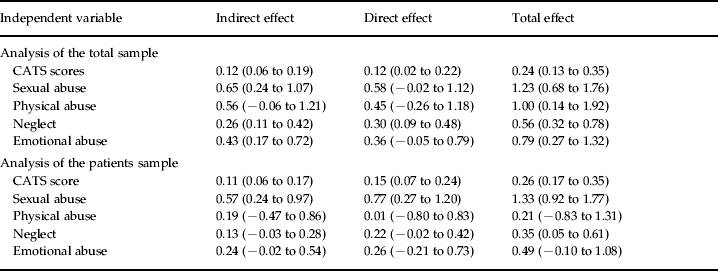
The results of the aggregated sample analysis (see Table 4) indicated that the relationship between CATS scores and hallucination-proneness was positively mediated by DES scores. Similar findings were obtained when the analysis was restricted to the patient sample. When focusing on specific types of trauma, dissociation significantly mediated the effect of sexual abuse on hallucination-proneness in both the aggregated and psychiatric sample analyses. In the aggregated sample, dissociation also mediated the relationship between neglect/negative home environment and hallucination-proneness, as well as the effect of emotional abuse on hallucination-proneness. However, these effects were not significant when the analyses were performed exclusively within the patient sample.
Point estimates (95% CI) for the total, direct and indirect (i.e. mediated via dissociative tendencies) effects of trauma on hallucination-proneness

CATS, Child Abuse and Trauma Scale.
Between-group differences on the signal detection task
Prior to examining the SDT data, four participants (two remitted hallucinators and two non-hallucinating patients) were dropped from the analysis as they reported hearing problems at the time of testing. Two one-way ANOVA were carried out on β and d' scores in an attempt to replicate previous findings that linked auditory hallucinations to perturbed reality discrimination. The hallucinating and the remitted hallucinators groups presented significantly lower response bias scores compared with non-hallucinating patients and healthy controls (all p's <0.05). Conversely, there were no significant differences on β scores between hallucinating patients and remitted hallucinators (p=0.99), and between non-hallucinating patients and healthy controls with no history of mental illness (p=0.87). The analysis of the perceptual sensitivity data indicated that all patients had significantly lower d' scores than controls (all p's <0.05), but no significant between-group differences were observed for post-hoc comparisons between the psychotic patient groups (all p's >0.05).
To investigate whether dissociation is directly related to reality discrimination difficulties, we examined the signal detection performance of patients with elevated levels of pathological dissociation compared with patients whose level of dissociation was non-pathological. The DES-T scores of participants in the patient groups were used to estimate their individual Bayesian probability of belonging to the pathological dissociation taxon. The analysis was carried out using the Excel adaptation of the SAS algorithm developed by Waller & Ross (Reference Waller and Ross1997) made available on the International Society for the Study of Trauma and Dissociation website (Perry, Reference Perry2004). Following the cut-off proposed by Waller & Ross, participants with a Bayesian probability level >0.90 were assigned to the pathological dissociation group (n=14), whereas the remaining participants were assigned to the non-dissociative patient control group (n=31). Between-group differences on hallucination-proneness and signal detection performance were examined using a series of Mann–Whitney U tests. The analysis of the hallucination-proneness data indicated that patients with pathological dissociative symptoms scored significantly higher than non-dissociative patients on the LSHS-R (mean=45.86, s.d.=8.25 and mean=34.06, s.d.=11.05 respectively; U=90.00, z=3.12, p<0.01). However, the two groups did not differ significantly in terms of β (mean=0.27, s.d.=0.38 and mean=0.32, s.d.=0.42 respectively; U=167.50, p>0.05) and d' scores (mean=1.30, s.d.=0.49 and mean=1.09, s.d.=0.57 respectively; U=155.00, p>0.05).
Discussion
Our results indicate that the relationship between childhood trauma and hallucination-proneness was positively mediated by dissociative tendencies. The mediational role of dissociation was particularly robust for experiences of sexual abuse relative to other types of trauma. Consistent with this, we found that hallucinating patients could be clearly distinguished from the other groups in terms of dissociation and the frequency of traumatic childhood sexual experiences. The results of the SDT task indicated that perturbed reality discrimination was primarily related to vulnerability to hallucinations and not dissociation. When patients belonging to the pathological dissociation group were compared with the non-dissociative patients, we found no significant differences in terms of signal detection performance. Conversely, patients in the hallucinating and remitted hallucinators groups had significantly lower β scores (i.e. greater response bias) compared with non-hallucinating patients and healthy controls.
Overall, these findings corroborate recent accounts suggesting that the trauma–hallucinations link might be explained by dissociative processes (Moskowitz & Corstens, Reference Moskowitz and Corstens2007; Anketell et al. Reference Anketell, Dorahy, Shannon, Elder, Hamilton, Corry, MacSherry, Curran and O'Rawe2010) and are consistent with epidemiological and cross-sectional data suggesting an apparent specific association between CSA and hallucinations (Read & Argyle, Reference Read and Argyle1999; Hammersley et al. Reference Hammersley, Dias, Todd, Bowen-Jones, Reilly and Bentall2003; Read et al. Reference Read, Agar, Argyle and Aderhold2003; Shelvin et al. Reference Shelvin, Dorahy and Adamson2007). However, the mechanism through which dissociation might promote hallucinations remains to be clarified. Recent evidence suggests that weakened cognitive inhibition may represent a prevailing cognitive concomitant of dissociation (Dorahy & Green, Reference Dorahy, Green, Moskowitz, Schäfer and Dorahy2008; Giesbrecht et al. Reference Giesbrecht, Lynn, Lilienfeld and Merckelbach2008). In some individuals, this could be expressed by experiencing intrusive thoughts; while in others, it may promote the onset of auditory hallucinations. Other individual difference variations (possibly reality discrimination deficits) may account for the symptom that is expressed after the weakened cognitive inhibition. In keeping with this theory, recent empirical evidence has pointed to the importance of inhibitory processes in explaining auditory hallucinations as misattributed auditory mental representations that intrude into consciousness as a result of intentional inhibition deficits (Waters et al. Reference Waters, Badcock, Maybery and Michie2003, Reference Waters, Badcock, Michie and Maybery2006; Badcock et al. Reference Badcock, Waters, Maybery and Michie2005). Further studies are required to determine whether these kinds of processes can explain the relationship observed between dissociation and hallucinations in this and previous studies.
With regard to SDT, our findings are consistent with previous patient studies (Bentall & Slade, Reference Bentall and Slade1985a; Vercammen et al. Reference Vercammen, de Haan and Aleman2008). The finding that reality discrimination is related to hallucinations vulnerability rather than acute hallucinatory experiences is consistent with previous observations of impaired SDT performance in psychometric high-risk samples (Bentall & Slade, Reference Bentall and Slade1985a; Barkus et al. Reference Barkus, Stirling, Hopkins, McKie and Lewis2007, Reference Barkus, Smallman, Royle, Barkus, Lewis and Rushe2011; Varese et al. Reference Varese, Barkus and Bentall2011a). This contrasts with the results from the DES, which showed that elevated dissociation was associated with current hallucinations (even though a trend suggesting higher dissociative tendencies in the remitted hallucinators compared with healthy controls was also observed). Hence, the findings might be interpreted in terms of a two-hit model, in which impaired reality discrimination (perhaps resulting from neurophysiological dysfunctions such as reduced connectivity between the frontal cortex and the auditory cortex; Ford et al. Reference Ford, Mathalon, Whitfield, Faustman and Roth2002; Ford & Mathalon, Reference Ford and Mathalon2005) is an enduring vulnerability factor, perhaps predating the onset of psychosis, but increased dissociation (possibly representing a sequela of traumatic experiences) triggers the actual onset of hallucinatory experiences.
One finding was unexpected and is perhaps inconsistent with this account. The relatively infrequent childhood maltreatment reported by the remitted hallucinators and the lower level of dissociative tendencies observed in this group are apparently inconsistent with dissociative accounts of the origin of hallucinatory experiences. However, the present study focused exclusively on childhood trauma. Although early abuse and maltreatment is frequently regarded as the most prominent developmental antecedent of persistent dissociative tendencies, empirical evidence suggests that transient dissociative phenomena can be triggered by acute adult trauma and stressful life events (e.g. Cardena & Spiegel, Reference Cardena and Spiegel1993; Morgan et al. Reference Morgan, Hazlett, Wang, Greer Richardson, Schnurr and Southwick2001). Given evidence suggesting that auditory hallucinations in the daily life of psychotic patients are predicted by increased levels of state dissociation (Varese et al. Reference Varese, Udachina, Myin-Germeys, Oorschot and Bentall2011b), future studies should consider the potential contribution of transient dissociation resulting from adult traumatic experiences on the vulnerability to hallucinations.
The findings of the present study add on to the existing literature documenting the pervasive prevalence of traumatic life experiences in psychotic populations (for reviews, see Read et al. Reference Read, van Os, Morrison and Ross2005, Reference Read, Fink, Rudegeair, Felitti and Whitfield2008). From a clinical perspective, these findings call for a more thorough examination for past exposure to traumatic events and the assessment of the impact of childhood trauma and its psychological sequelae on the maintenance of adult psychopathological complaints. Given evidence that trauma directly influences the content (Hardy et al. Reference Hardy, Fowler, Freeman, Smith, Steel, Evans, Garety, Kuipers, Bebbington and Dunn2005; Thompson et al. Reference Thompson, Nelson, McNab, Simmons, Leicester, McGorry, Bechdolf and Yung2010) and subjective appraisal of hallucinatory experiences (Andrew et al. Reference Andrew, Gray and Snowden2008), the identification of trauma and abuse may be particularly beneficial in the assessment, formulation and treatment planning of patients suffering from auditory verbal hallucinations.
Several methodological limitations should be acknowledged. Childhood trauma was assessed using retrospective self-report measures. The use of these self-rated measures in psychotic samples has been criticized because of concerns about memory inaccuracies and bias stemming from current symptoms (Morgan & Fisher, Reference Morgan and Fisher2007; Bendall et al. Reference Bendall, Jackson, Hulbert and McGorry2008). Although several studies indicate that patients' reports of child abuse have good concurrent validity, convergent validity with other assessment methods (i.e. case notes) and adequate test–retest reliability over long periods of time (Darves-Bornoz et al. Reference Darves-Bornoz, Lemperiere, Degiovanni and Gaillard1995; Goodman et al. Reference Goodman, Thompson, Weinfurt, Corl, Acker, Mueser and Rosenberg1999; Fisher et al. Reference Fisher, Craig, Fearon, Morgan, Dazzan, Lappin, Hutchinson, Doody, Jones, McGuffin, Murray, Leff and Morgan2011), future studies should ideally try to replicate our results using corroborated measures of abuse. The sample employed was modest in size, therefore limiting the generalizability and the statistical power of the present study. These findings should therefore be interpreted with caution and should be replicated in larger patient samples. As in other studies in this field, the present sample did not consist of a random selection of patients. Although we are not aware of any systematic bias in the participant selection to have occurred, the possibility that our findings may be affected by selection bias cannot be ruled out. Patients' primary diagnoses were confirmed by referring clinicians. We are not aware of any patient with co-morbid dissociative disorder to have taken part in the study; however, the possibility that our findings may be biased by co-morbid dissociative conditions cannot be excluded. Future studies will benefit from the use of purposely designed clinical instruments (such as the Structured Clinical Interview for DSM-IV Dissociative Disorders; Steinberg, Reference Steinberg1994) to rule out the influence of co-morbid dissociative disorders. Finally, the correlational nature of our findings does not allow inferences about causality and we acknowledge that alternative models linking trauma, hallucinations and dissociative tendencies might be fitted to these data. For example, self-reported dissociation and trauma may be influenced by the participants' current mental state or may represent a consequence of psychotic experiences rather than their precursor (for a review, see Schäfer et al. Reference Schäfer, Aderhold, Fryberger, Spitzer, Moskowitz, Schäfer and Dorahy2008). Future studies might resolve these issues by the judicious use of longitudinal data.
Declaration of Interest
None.