


Today theologians and biblical scholars find themselves talking more than ever about method (or, in Jeffrey Stout's famous metaphor, clearing their throats before actually making theological claims), while simultaneously feeling disorientated about the nature of their tasks. So my modest effort in this article will be to contribute some analytical clarity, first, by detailing the ongoing questions regarding biblical theology and, second, by defining its relationship with the new movement supporting theological interpretation of scripture. In service of the second effort, I will develop a fivefold typology of ways to relate the two approaches, in parallel with Hans Frei's typology concerning the relation between theology and philosophy.
Biblical theology
It will soon become clear why even the history of biblical theology is complicated to sketch: both terms, ‘biblical’ and ‘theology’, are ‘essentially contested concepts’. Nevertheless,
almost all discussion of the subject begins by referring to the famous inaugural address of J. P. Gabler at the University of Altdorf in 1787, entitled (in English translation of the scholarly Latin of the original) ‘An Oration on the Proper Distinction between Biblical and Dogmatic Theology and the Specific Objectives of Each’.
Subsequent discussion assumes some kind of distinction between biblical and dogmatic theology, mapped in terms of the former being ‘historical’ and the latter ‘normative’.Footnote 1
However, this distinction – or simplistic mapping of it, anyway – is open to question, along with the historical claim that biblical theology is a modern development. Charles Scobie, for a current example, claims that before the modern ‘independent biblical theology’ there was ‘integrated biblical theology’ throughout the theological history of the church, from Irenaeus onward. The books of the Bible were integrated as a whole, even Old Testament with New Testament; so were biblical interpretation and theology, and these with the pastoral practices of the church. This sense of unity and integration persisted alongside, even despite, awareness of legitimate concerns regarding biblical diversity. It may be, therefore, that Spinoza's strong rationalism, Gabler's lecture and the other events leading ultimately to Wrede and his descendants applying modern historical consciousness to biblical interpretationFootnote 2 (and against traditional church authority) need not be taken as defining for ‘biblical theology’. These issues of history and definition, especially from the perspective of the church's theological heritage, require me to sketch briefly five key questions that have bedevilled biblical theology's role in academic discourse.Footnote 3
Scope
Do we do Old Testament and New Testament theology, or whole-Bible theology, or somehow both (in layers)? In other words, what does the adjective ‘biblical’ denote, exactly? Certainly non-Christian scholars, and even to an extent the academic guild in general, do not think a whole-Bible theology possible, but – at most – an Old Testament or New Testament theology. As evidence, note the lack of such whole-Bible theologies, even among the so-called ‘biblical theology movement’ of the twentieth century, which so retained its historical-critical commitments ‘that it did not produce a single major, scholarly volume of “biblical theology”’.Footnote 4 Looking further at the twentieth century, Scobie can highlight only a few contenders. He settles on Brevard Childs's Biblical Theology of the Old and New Testaments as ‘the most significant biblical theology of the twentieth century’.Footnote 5 This is due, in part, to the insistence of the canonical approach upon a whole-Bible theology, rather than simply an Old Testament or New Testament theology, or a tracing of theological themes in one biblical author or corpus. On Scobie's definition, ‘It is interesting to note that the most recent attempts to revive the writing of a “biblical theology”. . . have generally been undertaken by Old Testament scholars who are also professing Christians’.Footnote 6 However, these attempts remain few.
Among Christian scholars, then, the debate about definition tends to focus on the relationship between the Testaments, taking a form illustrated by Christopher Seitz and Francis Watson. The latter claims that we cannot help but read the Old Testament Christianly, referring to fulfilment in Jesus, as part of one canon. Indeed we simply must, or else we wind up Marcionite, denying the Old Testament any authority as part of Christian scripture by assuming that the God of Israel is not the same God revealed in Christ. Seitz claims, by contrast, that the early Christians themselves read the Old Testament as their Bible, as a canon completed in some sense, so their practice authorises a moment of distinctly Old Testament theology performed within a larger biblical theology.Footnote 7 Already, in any case, Christian faith has acute methodological implications for intellectual life.
Organisation
Do we use theme(s) as an organising principle, or corpora, or historical development? And if the former, is there a ‘centre’? The widespread objections to whole-Bible theology, in practice not only in theory, suggest the difficulty of a historical approach to biblical theology's structure. In one sense this descriptive study of the development of religious ideas related to the texts is the dominant academic strategy for biblical theology. It successfully displaced the frequent older use of systematic borrowing from doctrinal categories, in which the Bible's theological ideas are laid out under the headings (or ‘loci’) of God, Christ, Spirit, sin, salvation and so on. Post-Gabler, the days of systematic approaches were numbered, despite their periodic reappearance. The historical approach, however, can be problematic too, certainly if one wants to do whole-Bible theology but also simply if one wants to be methodologically clear about biblical theology's locus: the ideas as expressed in the texts, or as reconstructed regarding the authors’ minds and communities.
Suppose we take on Scobie's challenge to do whole-Bible theology. Should we give priority to tracing an overarching theme such as covenant, promise, God, kingdom and the like, across the biblical literature? If we take such a thematic (or, one might say, material) approach, will one theme emerge as central? Or, since for instance the popular theme of ‘salvation history’ – at least in its use as an organising principle – seems to leave behind the contribution of corpora such as Wisdom literature, must we leave behind the search for one centre, and track multiple themes?Footnote 8
Rather than a material approach, should we instead organise (more formally) according to the types or sections or authors of the various biblical writings, for example, Pauline theology, or Law/Prophets/Wisdom? These formal categories could be either historical (see above) or more literary in their implementation. Clearly this gets even trickier if we are seeking unity while moving between the Testaments. Not only is it difficult to find truly comprehensive themes for Old Testament and New Testament, but also the two Testaments share few types of literature – except arguably for narrative, apocalyptic and isolated poetry. Even in those cases, each Testament has special features.
So, according to another way of putting the question, should we analyse or synthesise?Footnote 9 Should we relate wholes to the workings of their individual parts, or may we draw together these parts into wholes that are unforeseen and greater than their sum? If we synthesise, should we speculate about or seek to reconstruct what the texts (which are occasional) do not address directly – for example, laying out the structure of the theology in Paul's own mind (assuming we can isolate which writings are his), discussing whether ‘participation in Christ’ or ‘justification’ describes more appropriately his central theme? As you can see, we wind up circling around the same sorts of methodological questions from a variety of angles.
Theological commitment(s)
May or should we read with Christianity's trinitarian rule of faith, and perhaps according to ‘the analogy of faith’? Indeed, some biblical themes such as covenant might almost be taken as structural principles as well – that is, they address both the material and formal unity of the Bible. (They are thematic and historical, maybe even systematic.) At a more basic level, does not the trinitarian rule of faith (which takes tangible shape in, for instance, the Nicene Creed) do the same? It is, after all, an attempt to sum up the scope of scripture's teaching in connection with a narrative that fits everything inside. Furthermore, as we traverse the hermeneutical circle, most of us acknowledge we are guided by more particular versions of something like what the Protestant Reformers borrowed from St Augustine and called ‘the analogy of faith’ – explaining some scripture passages in relation to others and in relation to a sense of scripture's message as a whole. In principle, of course, our rules of faith (small r) must be subject to reform even if the Rule (capital R) – though variously expressed – has stood the test of time.Footnote 10
At any rate, the desire to keep biblical theology rather close to the Bible's language and thought-forms is admirable at one level, but arguably rejects the hard-won insight of the early church's experience, which is that one can stick close to passages from the Bible and still be a heretic. One must, in fact, use different words and concepts to say the same thing across time and place.Footnote 11 So, what role may the doctrine of the Trinity – and all that goes with it – play as the underlying, unifying logic of the Bible even if it is not the surface grammar?
Theological discipline(s)
What is the role of biblical theology vis-à-vis other theological endeavours, most especially systematic theology? Moving now to what the ‘theology’ in biblical theology denotes, another issue relates to James Barr's insight that biblical theology is usually defined with reference to something else: it is not exegesis, not history of religions, not systematic theology, but (in Barr's view) something like historical theology done on the Bible. We move from the texts to describing the apostle Paul's theology just as we would from Martin Luther's texts to redescribing his theology.Footnote 12 If biblical theology is descriptive of then and systematic theology normative for now, though, how can Protestants avoid the fear of abandoning sola scriptura: is not some philosophical scheme intruding on our theological judgements, as we make the hermeneutical move from biblical theology to deciding what is normative?Footnote 13
So that is one side of the argument: Protestants (in particular) must keep biblical and systematic theology close together. Systematic theology basically builds a bridge between biblical theology's descriptions and contemporary language. But there is another side to the argument: if we do keep these theological disciplines close, how can we avoid the well-documented problems of viewing systematic theology as simply the translation of biblical theology into new contexts? Among others, David Kelsey has shown the complex variety of ways in which the Bible functions within theological arguments.Footnote 14 There is also the obvious but neglected fact that English-language (for example) descriptions of biblical theology are already translations into new contexts. Pretty soon, translation becomes a very pliable metaphor. This other side of the argument is what worries many theologians about hitching systematic theology too closely to biblical theology. Likewise, in such cases the biblical scholar worries as well: biblical theology will become too philosophical or analytic regarding ideas and their interconnections – losing its descriptive focus. Alternatively, and perhaps more likely, systematic theologians will use the Bible glibly to prove what they already want to say.
Disciplinary method(s)
Is biblical theology a primarily or even exclusively historical discipline? Or, rather, a literary one? Is it philosophical at all? Or is it an interdisciplinary programme of some sort? These four questions, and especially the fourth one regarding biblical theology's disciplinary home, pertain to the broader issue of its academic social location. Is biblical theology largely a descriptive discipline that describes the history of religious ideas implied in or behind a set of texts? Or does it better describe the theological ideas and their relationships across the biblical literature, without much regard to positing their historical development? Can biblical theology avoid making or at least using some normative judgements to sort through how the texts (literary) or their development (historical) might go together – for instance, is there a trinitarian theology in the New Testament, and is it a faithful development from Old Testament monotheism? But, again, would not making such judgements introduce philosophical concerns or forms of analysis in such a way that biblical theology cannot comfortably indwell a largely historical or literary home?
Does this methodological mess matter? We need to know whether the Bible's authoritative content is to be grasped primarily on historical or literary grounds, or whether we can also include the ‘philosophical’ dimensions of doing theology. Perhaps methods need not determine results, but in the modern academic context they often do. Certainly the methods of inquiry should also influence the training and reading habits of scholars. Further, if a renewed biblical theology is truly the interdisciplinary integrating centre for our work that some might like it to be, how does it relate to the methods and disciplines of the rest of (Christian) academic thinking over which scripture is the norm – so that we might also take seriously the larger public square? Questions of method should not leave us, as in Stout's analogy, always clearing our throats and never actually saying anything. But nor will biblical theology gain a serious hearing if competing voices perpetuate cacophony about the nature of the enterprise and its claims. For, in the judgement of Ellen Charry, the effort of biblical scholasticism has been a huge failure: such theology has retreated on both academic and pastoral fronts, becoming ‘emotionally inaccessible to believers and academically unacceptable to the wider academy’.Footnote 15
Theological interpretation of scripture
Meanwhile, therefore, a second proposal – ‘theological interpretation of scripture’ – has begun more recently to emerge, though it still remains in the process of self-definition.Footnote 16 A particular problem concerns its relation to biblical theology, with which some (but not all) of its advocates would claim a family linkage. Even more particularly, tension persists between predominantly historical or literary approaches to theological hermeneutics. So the following section sets out a fivefold typology for how scholars relate – or do not – the two approaches, suggesting that this is in part based on their preferred disciplinary methodologies for (or emphases within) biblical theology.
Its relation to biblical theology?
The following typology parallels an earlier one: Hans Frei famously laid out a fivefold set of approaches for relating philosophy (with its general schemes for explaining religion) to theology as ‘Christian self-description’.Footnote 17 In the present circumstance, we can recognise a parallel. Emphasis on literary approaches to the Bible and especially its unity tends to accord with theological interpretation, viewing Christian theology primarily as an exercise in particular self-description – what do the texts taken together, and read for their literary potential as scripture, teach? Emphasis on historical approaches to the Bible, and especially on the diversity of how the texts refer to various circumstances, tends to accord with biblical theology, valuing correlation with some more general or universal scheme. Such a scheme – concerning religion, ethics or philosophy without much historical credibility (for non-conservatives such as Barr), or even the Bible's historical accuracy and logical consistency (for theological conservatives) – would serve as a philosophical basis from which to use the Bible in undertaking Christian self-description.
Type 1: accepting biblical theology as usual
Barr presents, in the view of many, the standard academic approach, even if more by destruction of alternatives than by constructive definition.Footnote 18 The basic two-step distinction, famous from Krister Stendahl's 1962 article,Footnote 19 between what the text ‘meant’ (back then) and ‘what it means’ (for today) is more precisely, for Barr, between what the theology behind or of the text ‘was’ (descriptively) and ‘what it means’ (normatively). Biblical theology (BT) reconstructs historically a description of that theology which can be more or less directly related to the text depending on its type of literature. The implications for theological interpretation of scripture (TIS) might then be summarised like this:

The parallel to type 1 in Frei's descriptive scheme fits nicely. For theo-logians such as Gordon Kaufman, who was Frei's model for one extreme, theology is a philosophical or academic discipline with no holds barred. In order to qualify as Wissenschaftlich, Christian self-description in theology must be accountable to, even included within, a general philosophical scheme. The external description not only justifies, but strongly determines, the parameters of Christian theology's existence. With regard to biblical theology, Barr's claim is similar: Christians may only read the Bible (responsibly) in ways for which historians allow, while reading the Old Testament and New Testament together is simply an act of faith.Footnote 20 Christian belief is not directly rejected, but in such views ‘the ordinary user of the religious language of Western culture looks uncannily like an academic reader of histories of Western philosophy and theology with a stake in inventing a religious apologetic’.Footnote 21
Type 5: rejecting biblical theology as usual
We can best unfold the typology not in order of one–two–three–four–five, but from outside-to-in, so that the parallels in (even polar) opposites become clear. So we move to type 5, the flip-side of view 1, among many theologians and some biblical scholars who advocate theological interpretation of scripture: it is the rejection of apologetics altogether, just as D. Z. Phillips and others whom Frei labelled ‘Wittgensteinian fideists’ have done. Theology is Christian self-description with no holds barred. There is no normative or influential place for philosophy in doing such description, for basically it serves as an alternative religious community or language-game.
In the context of biblical interpretation, the parallel to type 5 would suggest that the disciplinary definition of biblical theology – which runs from its beginnings in Gabler up through Barr and others today – is largely coherent in the academic arena, but inadequate for the church's theological interests. Stephen Fowl's writings are illustrative;Footnote 22 he even, insightfully, recognises that the academic community may command stronger allegiance, and accomplish more significant formation in certain virtues and practices, than the church seems to. But it is the church that reads the Bible as scripture, for the people of God, and in Fowl's view this means Christian virtue is not only the aim but also a norm of interpretation.Footnote 23 Thus any Christian use of critical biblical scholarship should be ad hoc, non-normative, pursued very, very carefully:

Type 2: redefining biblical theology's historical focus
Meanwhile, others such as D. A. Carson, who do not accept Barr-like conclusions regarding the diversity of the two Testaments or the lack of organic development between and within them, tend to retain (at least functionally) a disciplinary definition of biblical theology as a history of religious ideas. They may struggle over whether it is a history of what is expressed in the text or what can be inferred from behind it (in the writers’ heads), but they still believe that biblical theology can be strongly related to theologically interested exegesis by the church. The biblical texts represent true history and do not ultimately conflict. So, though the hermeneutical and/or interpretative process may be non-linear and even messy, the line of authority is drawn one-way, from exegesis to biblical theology through historical to systematic theology, and so on.Footnote 24 Systematic theology tends to become biblical theology contextualised, or else its ‘biblical’ credentials are viewed with suspicion.

The parallel in Frei's typology again unfolds clearly. For the earlier David Tracy of Blessed Rage for Order, Frei's type for type 2, theology is a philosophical discipline; for Carson, biblical theology is a historical discipline. For another type 2 theologian, Carl Henry, Christian self-description and external description merge in a sense, because the former is justified by a foundational philosophical scheme; for Carson, the historical integrity of Christian claims about the biblical narrative must in some way be justified philosophically (even if he would not maintain quite the same apologetic practice as Henry). Whether or not Frei was right to include Henry and Tracy under the same heading is (or should be) controversial. And whether or not Frei was right to view this type quite so negatively (as he seemed to), regarding either the Christian faithfulness or the intellectual credibility of such apologetic stances in their contexts, is also contestable. But I find the general parallels here to be instructive, regarding the ways in which external standards can exercise foundational intellectual influence over the methods that committed Christian thinkers deploy vis-à-vis the church's theological heritage.
Type 4: redefining biblical theology with a literary/contemporary focus
Still others may tend towards a ‘canonical approach’ in which biblical theology works with religious ideas in the Bible, however the historical trajectory behind the text as we have it is reconstructed. This may fit with some, such as Francis Watson, David Yeago, Joel Green, Steven Motyer and Brian Rosner, who (it seems) approach biblical interpretation with all the interests of systematic theology – concerning how the commitments of the church in the contemporary world illuminate the reading of the texts.Footnote 25 In addition to the difficulty of defining biblical theology as a discipline in contemporary or non-descriptive terms, the difficulty here too can lie in finding a unique role for systematic over against biblical theology. For there may be a tendency not to allow philosophy and/or natural theology any proper place or integrity in relation to the theological task. Theology could perhaps be swallowed up by biblical exegesis, however broadly defined.

The earlier parallel, from Frei's typology, is Karl Barth. Theology is an academic discipline, but only secondarily; primarily, it is critical Christian self-description. Theology is not philosophically founded; it is a science not due to universal, formal criteria, but insofar as it follows rules appropriate to understanding its particular object. The difference between ‘self-involving statements and the analysis of self-involving statements-language about Christianity and Christian language use’ is not altogether removed from Barth, but functions at most as an ad hoc rule.Footnote 26 The contrast between Barth and someone such as Henry lies in whether or not a rule such as the ‘law of non-contradiction’ functions foundationally, to set intellectual limits on what Christians may say; strictly speaking, for Barth it does not.Footnote 27
Applying these descriptions to the biblical scholars just mentioned, we see ready parallels. Many of them do outstanding critical work, using intellectual tools of their trade. But they are rather chastened about the certainty or comprehensiveness that such methods can attain in their results. Some are even directly indebted to Barth; while not slavish followers, they have seen him as inspiration for aspects of their programme.Footnote 28 Those whom I place in this category are by no means methodologically monolithic; not all are even biblical scholars. Their family resemblances, however, seem significant.
Type 3: accepting productive tension between biblical theology and theological interpretation of scripture
My own (developing) tendency is to straddle the fence. Like the middle type in Frei's typology, this view may not exist – it may not seem possible in pure form, anyway.Footnote 29 The idea would be that theology is (or, I would say, can be)Footnote 30 an academic discipline, but not a philosophical one in the Wissenschaftlich sense. Thus both external and Christian self-description must be undertaken, enjoying relative independence; philosophy is not a ‘foundational’ discipline for theology. By analogy, when it comes to biblical theology as a historical discipline, we cannot accept that as normative for Christian reading of the Bible, at least not when ‘historical’ is defined in typical Wissenschaftlich terms that often imply acute methodological naturalism. In doing theological exegesis of scripture, we will profit greatly from interaction with such biblical theology, and we can even pursue space for promoting a more holistic biblical theology in the public square. But our realistic goal would be two-way traffic that allows the respective disciplinary interests of biblical scholars and systematic theologians to coexist with integrity. Such a goal does not preclude the construction of more fluid boundaries that encourage increasingly broader, interdisciplinary horizons. For there will be methodological overlap between the two communities as explored below; moreover, some biblical scholars will self-identify with theological exegesis, while some systematic theologians will contribute (at least in terms of content) to biblical theology.
Now, to continue exploring the spatial metaphor: Colin Gunton suggested that theology and philosophy of religion are invariably competing for a largely shared conversational space.Footnote 31 Neither can allow the other to take over completely how that space will be arranged. Instead, theology steals philosophy's weapons but sometimes has to use them in fighting for territory. This side of the eschaton, though, human ambiguities also require an ongoing practice of philosophy that is not overtaken entirely by (or equated with) theology, which otherwise can become triumphalist about possessing revelation.
We should apply such a paradigm likewise to biblical scholarship, it seems to me: theology will have to fight for the church's commitments and interests in reading the Bible as scripture, yet the methods of biblical scholarship remain indispensable. And if theology completely ruled over their use in the here-and-now, eradicating biblical theology as it has emerged in the modern period, something human and historical would be neglected or lost. The most acute tension with which academic biblical theology faces us, the issue of how we may read the Old Testament Christianly, seems necessary and productive. Yet nor could the church simply suspend her commitment to the rule of faith, acting as if worship of the triune God must be put on hold until biblical scholarship decides exactly how to prove the matter. Therefore:
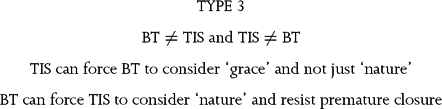
Theological interpretation of scripture can allow the church to teach with relative confidence and resist prematurely turning theology into apologetics.Footnote 32 Rather than maintaining the ‘truth’ of the Bible by changing its ‘meaning’ – for a Bultmannian example, reinterpreting Christ's resurrection to mean something existential about hope or new life – or defending biblical truth by historical methods that obscure its meaning, theological exegesis will be oriented to the Bible as scriptural text. Whatever its difficulties of definition, theological exegesis involves reading the Bible as some kind of a literary whole – Old Testament and New Testament – with its scope matching the trinitarian rule of faith and its subject matter oriented towards judgements about God's identity, work and will. More specifically, the church's doctrinal traditions, its personal and corporate liturgical practices, and concerns for life amid the cultures of this world, may all contribute to the ways we inquire about the meaning of scripture – even as scholars.
A distinction between discovery and warrant
Thus, put differently, we need to distinguish process from result, or discovery versus warrant.Footnote 33 As a discourse, the results of theologically interpreting scripture are invariably claims about the content or result of a biblical theology: what does the Bible teach on its terms? So, for example, what the theologian says about humans as ‘image of God’ must be at least consistent with anthropological judgements we find in the biblical texts. Yet normative, theological or philosophical concerns inevitably influence the process or approach we use in arriving at such claims. The line of authority does move from the Bible to theology, but a sort of provisional authority must be granted to the analogy of faith – to our theological understanding of the scope of the Bible's teaching – to get interpretation of particular texts going (to get us into the hermeneutical spiral).Footnote 34 The process of a biblical theology discipline (even biblical theology as an interdisciplinary programme) will involve a more historically and literarily focused approach, whereas the process of a systematic theology (or interdisciplinary theological interpretation of scripture programme) will involve a more literarily and philosophically focused approach. (This is not even to mention the non-academic dimensions involved with theological interpretation of scripture such as personal prayer, liturgical practice, participation in struggles for justice, and so on.)
Returning to the example above, theological interpretation of scripture would explore the issue of humans as the image of God not only on historical and literary grounds, but also by asking questions of the biblical text in terms of the history of Christian anthropology (with issues such as freedom, nature and grace surfacing); relevant aspects of scientific theories; philosophical interests regarding agency and selfhood; as well as contemporary concerns regarding bioethics, technology, social justice, environmental stewardship and the like. Suppose that the content of biblical theology is to be a bridge between the text and theology;Footnote 35 still the traffic must be two-way. And if a biblical theology enterprise is to travel into the public square, not just walking around a walled-off Christian enclosure, then we must not simply collapse our strategies for public engagement or our apologetic concerns (such as defending the Bible historically) into the commitments we use in understanding and teaching our faith (reading the Bible for the Word of God).Footnote 36 Instead, theological exegesis assumes that addressing implications for the church's life in the world actually assists us in recognising what is the biblical teaching in the first place. Compared to biblical theology, then, theological interpretation opens up more conversational space, or opportunities for processes of discovery, between both scripture and church practice, and the Bible and the arts and sciences. Historical and literary scholarship on the Bible will offer criticism of the questions that surface in these conversations, and scriptural warrant for the answers we seek. Because those questions open up ultimate concerns, however, and because integrating the biblical texts themselves obligates us to undertake conceptual analysis, philosophical/theological construction is integral to the process – essential to discovering warranted results from genuine interaction of faith and learning.
Whether or not one accepts my tentative proposal about which model to adopt, I hope that the analytical power of applying Frei's typology to the present question has become evident. Of course the five types are idealised, just as in Frei's scheme itself and even more so in Niebuhr's now-criticised original typology. But if the oversimplification helps us to see the ways in which our intellectual standards affect the methods we use, and the methods affect how we seek Christian self-description, then the exercise will have been valuable. The question of how historical inquiry functions as a foundational philosophical scheme in theologically interested biblical scholarship – and of whether it should – now lies on the table for discussion. The follow-up question, therefore, must be to what extent biblical theology, precisely to avoid correlationist strategies for doing theology, adopts a correlationist model of another kind, through the back door. Theological interpretation of scripture, meanwhile, must attend to concerns regarding history, even as theologies focused on Christian self-description must not adopt anti-critical approaches to interaction with philosophy.


