Introduction
In the last decade, Drosophila suzukii Matsumura (Diptera: Drosophilidae) has reached high economic pest status as an invasive pest threatening fruit production in many regions of the world (Walsh et al. Reference Walsh, Bolda, Goodhue, Dreves, Lee and Bruck2011; Cini et al. Reference Cini, Ioratti and Anfora2012; Rota-Stabelli et al. Reference Rota-Stabelli, Blaxter and Anfora2013; Asplen et al. Reference Asplen, Anfora, Biondi, Choi, Chu and Daane2015; Bondi et al. Reference Bondi, Traugott and Desneux2016; Andreazza et al. Reference Andreazza, Bernardi, dos Santos, Garcia, Oliveira, Botton and Nava2017; Centre for Agriculture and Bioscience International 2019). Insecticide or behaviour-based mass trap-and-kill programmes with insecticide-bait mixtures are under investigation to control D. suzukii on fruit crops (e.g., Beers et al. Reference Beers, Van Steenwyk, Shearer, Coates and Grant2011; Bruck et al. Reference Bruck, Bolda, Tanigoshi, Klick, Kleiber and DeFrancesco2011; Diepenbrock et al. Reference Diepenbrock, Hardin, Hannah and Burrack2017; Van Timmeren et al. Reference Van Timmeren, Mota-Sanchez, Wise and Isaacs2018; Gullickson et al. Reference Gullickson, Rogers, Burkness and Hutchison2019; Noble et al. Reference Noble, Dobrovin-Pennington, Phillips, Cannon, Shaw and Fountain2019). However, insecticide applications on food crops are undesirable and lead to problems, including toxicity to humans, disruption of natural pest control, and insecticide resistance (Schetelig et al. Reference Schetelig, Lee, Otto, Talmann, Stoekl and Degenkolb2018). To develop natural D. suzukii-control strategies that do not include pesticides, deeper knowledge of the fly’s behaviour and ecology is required (reviewed by Alkema et al. Reference Alkema, Dicke and Wertheim2019). Such knowledge is needed for all life stages of D. suzukii and particularly for adult flies, which must survive throughout the year. In particular, more information is needed about D. suzukii’s interactions with its diverse fruit plant resources, generalist natural enemies, and habitat complexity, and about the effect of stressful climatic conditions on the species (reviewed by Schetelig et al. Reference Schetelig, Lee, Otto, Talmann, Stoekl and Degenkolb2018; Schmidt et al. Reference Schmidt, Whitehouse, Green, Krehenwinkel, Schmidt-Jeffrise, Ashfaq and Sial2019).
Overwintering in cold climatic regions such as Canada represents a major challenge for the local establishment and persistence of invasive species such as D. suzukii, a native of southeastern Asia (Walsh et al. Reference Walsh, Bolda, Goodhue, Dreves, Lee and Bruck2011; Cini et al. Reference Cini, Ioratti and Anfora2012; Langille et al. Reference Langille, Arteca and Newman2017). Drosophila suzukii respond developmentally to seasonal cold stress by phenotypic plasticity (e.g., Jakobs et al. Reference Jakobs, Gariepy and Sinclair2015; Wallingford and Loeb Reference Wallingford and Loeb2016), resulting in adult flies maturing as ‘winter morphs’, which are more resistant to temperature and desiccation, are longer lived, and remain in a reproductively inactive state for a much longer period of time in early adult life compared to ‘summer morph’ flies (Toxopeus et al. Reference Toxopeus, Jakobs, Ferguson, Gariepy and Sinclair2016; Nikolouli et al. Reference Nikolouli, Colinet, Renault, Enriquez, Mouto and Gibert2018). Although the effects of cold winter temperatures and frost are not completely understood, they appear to represent major risks for winter mortality because D. suzukii flies are both intolerant of sub-zero temperatures and intolerant of chilling; that is, they suffer cell damage at temperatures above 0 °C, excluding ice formation (Kimura Reference Kimura2004; Lee Reference Lee2010; Jakobs et al. Reference Jakobs, Gariepy and Sinclair2015; Langille et al. Reference Langille, Arteca, Ryan, Emiljanowicz and Newman2016; Nikolouli et al. Reference Nikolouli, Colinet, Renault, Enriquez, Mouto and Gibert2018; Thistlewood et al. Reference Thistlewood, Gill, Beers, Shearer, Walsh and Rozema2018; Grumiaux et al. Reference Grumiaux, Andersena, Colinet and Overgaard2019).
Champagne-Cauchon et al. (Reference Champagne-Cauchon, Guay, Fournier and Cloutier2020) recently published a three-year study of the distribution and phenology of D. suzukii in lowbush blueberry, Vaccinium angustifolium (Ericaceae), in the Saguenay–Lac-Saint-Jean region of Québec, Canada, which is near the northern limits of D. suzukii’s known distribution (Dos Santos et al. Reference Dos Santos, Mendes, Krüger, Blauth, Gottschalk and Garcia2017; Centre for Agriculture and Bioscience International 2019; Ørsted and Ørsted Reference Ørsted and Ørsted2019). A key objective of that study was to document the overwintering potential of D. suzukii in a cold–temperate region. However, Champagne-Cauchon et al. (Reference Champagne-Cauchon, Guay, Fournier and Cloutier2020) could report only indirect evidence, manifest to female reproductive arrest in response to early fall conditions and high-density accumulation of winter morphs in late fall (October) in forest borders of blueberry fields. Previously, it had been suggested that D. suzukii flies likely overwinter in forest litter (Zerulla et al. Reference Zerulla, Schmidt, Streitberger, Zebitz and Zelger2015; Stockon et al. Reference Stockon, Wallingford, Rendon, Fanning, Green and Diepenbrock2019).
Behavioural thermoregulation and phenotypic plasticity are key mechanisms of nonevolutionary, short-term adaptations of Drosophila to climatic stress (Jakobs et al. Reference Jakobs, Gariepy and Sinclair2015; Xue et al. Reference Xue, Majeed, Zhang and Ma2019). To understand how D. suzukii, as an invasive species, could adapt to the cold winters of, for example, Québec, Canada, we need to understand the longevity distribution of fall-acclimated flies – that is, how D. suzukii responds when maintained under realistic overwintering conditions, including at least six months of cold winter stress, followed by slow springtime warming that allows the flies to recover reproductive fitness that is timed to correspond with the availability of suitable, mature fruit resources in summer.
Experimental work on insect responses to cold stress varies greatly in terms of the timing and duration of treatments used in bioassays (Blackburn et al. Reference Blackburn, van Heerwaarden, Kellermann and Sgrò2014; Colinet et al. Reference Colinet, Sinclair, Vernon and Renault2015). Temperature stress assays vary in intensity and duration. Chronic, rather than acute, stress is generally used to study the seasonal variations in tolerance of insects as ectotherms. In studies of chronic stress tolerance over longer periods – for example, over six months to determine D. suzukii’s ability to survive cold winters – the thermal stressor(s) should vary with diurnal periodicity. Daily periodicity represents the natural short-term time distribution of thermal stress to which species living in strongly seasonal climates must be adapted for successful overwintering. Tolerance to sustained temperature stress is often studied using daily constant temperatures. However, ample evidence indicates that daily fluctuating patterns of temperature variation can limit stress-induced chill-injury accumulation (Colinet et al. Reference Colinet, Nguyen, Cloutier, Michaud and Hance2007, Reference Colinet, Sinclair, Vernon and Renault2015 (for a review); Kostal et al. Reference Kostal, Renault, Mehrabianov and Bastl2007). Enriquez et al. (Reference Enriquez, Ruel, Charrier and Colinet2018b) studied D. suzukii’s fitness by varying fluctuating temperature–regime parameters of flies in cold storage. With frequent intervals of brief (two-hour) warm exposure (at 20 °C), flies survived up to 130 days. More recently, Grumiaux et al. (Reference Grumiaux, Andersena, Colinet and Overgaard2019), using D. suzukii flies from a laboratory strain originally collected in Italy, showed that longevity reached 160 days when daily temperatures fluctuated by 3 °C and included a brief (80-minute) daily warming at 25 °C, a threefold prolongation of survival compared to constant temperature regimes. Reproductive fitness of flies under fluctuating temperatures was preserved and extended longer than for flies maintained at 25 °C, which was hypothetically attributed to protected cellular homoeostasis inherent to fluctuating temperature regimes. Evidence suggests that chill injury in Drosophila involves systemic loss of neuromuscular homoeostasis, normally expressed as balanced ionic gradients across cell membranes, that can be repaired or alleviated by exposure of chronically stressed flies to brief periods of warming (Colinet et al. Reference Colinet, Nguyen, Cloutier, Michaud and Hance2007, Reference Colinet, Sinclair, Vernon and Renault2015, Reference Colinet, Rinehart, Yocum and Greenlee2018; Enriquez et al. Reference Enriquez, Renault, Charrier and Colinet2018a; Grumiaux et al. Reference Grumiaux, Andersena, Colinet and Overgaard2019).
In the present study, the ability of D. suzukii flies to persist over long winters was examined in experimental regimes that simulated cold winter and were applied for six months, followed by a springtime regime emulating vernal warming in a cold–temperate region. Fall-acclimated flies overwintering in behaviourally selected microhabitats are expected to persist not only through the cold winter (approximately six months in duration) but also for two to three months longer in the spring, until fruits of precociously flowering host plants ripen in early summer. A sufficiently extended longevity that extends over the springtime transition between winter dormancy and expression of reproductive fitness in summer is as important as the ability to mitigate chilling injury during cold winters (Bradshaw and Holzapfel Reference Bradshaw and Holzapfel2010).
We hypothesised that the responses of D. suzukii flies exposed to fluctuating, rather than constant, temperature daily regimes are most likely to reveal the flies’ potential to survive prolonged cold winter and slow spring recovery conditions in cold–temperate climatic regions. Our specific objectives were (1) to evaluate the maximum long-term potential survival of D. suzukii flies that were naturally acclimated in field conditions and subsequently exposed to cold winter regimes and (2) to test cold stress regimes of different daily patterns of fluctuation to determine suitable conditions for long-term survival not only through cold winters but also through the following springs until the flies’ reproductive potential is recovered.
Methods
Insects and rearing 2016–2017
Drosophila suzukii were collected in the field from late-season populations in lowbush blueberry fields located at or near Albanel, Dolbeau-Mistassini, La Doré, and Saint-David-de-Falardeau in the Saguenay–Lac-Saint-Jean region, Québec, Canada, in 2016–2017 and in 2017–2018. Most adult flies were trapped in the field over 24 hours using conventional cider vinegar–baited traps that had been modified to prevent flies from drowning in the liquid bait (Champagne-Cauchon et al. Reference Champagne-Cauchon, Guay, Fournier and Cloutier2020).
Adult flies were trapped on 7, 27, and 28 September 2016, on 7 and 13 October 2016, and on 2 November 2016, with the intent of collecting flies with increasing degrees of acclimation to naturally declining photoperiod and temperatures. We also used young adult flies that emerged in the laboratory from field-collected fruits infested by D. suzukii larvae. We used laboratory-reared flies for three reasons: (1) the efficacy of live-trapping flies to be used for experimental work was unknown in 2016–2017; (2) it allowed us to include immature stages directly exposed to field conditions as they changed with time (Zhai et al. Reference Zhai, Lin, Zhang, Zhang, Zheng and Yu2016); and (3) it allowed us to control fly age in survival tests, as the age of live-trapped flies was unknown. The flies that emerged from fruits were collected as immatures in fruits on 6, 14, 21, and 29 September 2016 from Canadian bunchberries, Cornus canadensis (Cornaceae). Fruits were handpicked from the same fields that the trapped flies were collected from, and they were maintained under simulated fall conditions in a controlled environment room (see Insects and rearing section, below). Patches of Canadian bunchberry naturally occur as weeds in lowbush blueberry fields (Champagne-Cauchon et al. Reference Champagne-Cauchon, Guay, Fournier and Cloutier2020). Canadian bunchberries remained suitable hosts for D. suzukii in the fall, whereas blueberries from the same fields either had been harvested or were not in sufficiently good condition to provide adult flies in adequate numbers for this experiment.
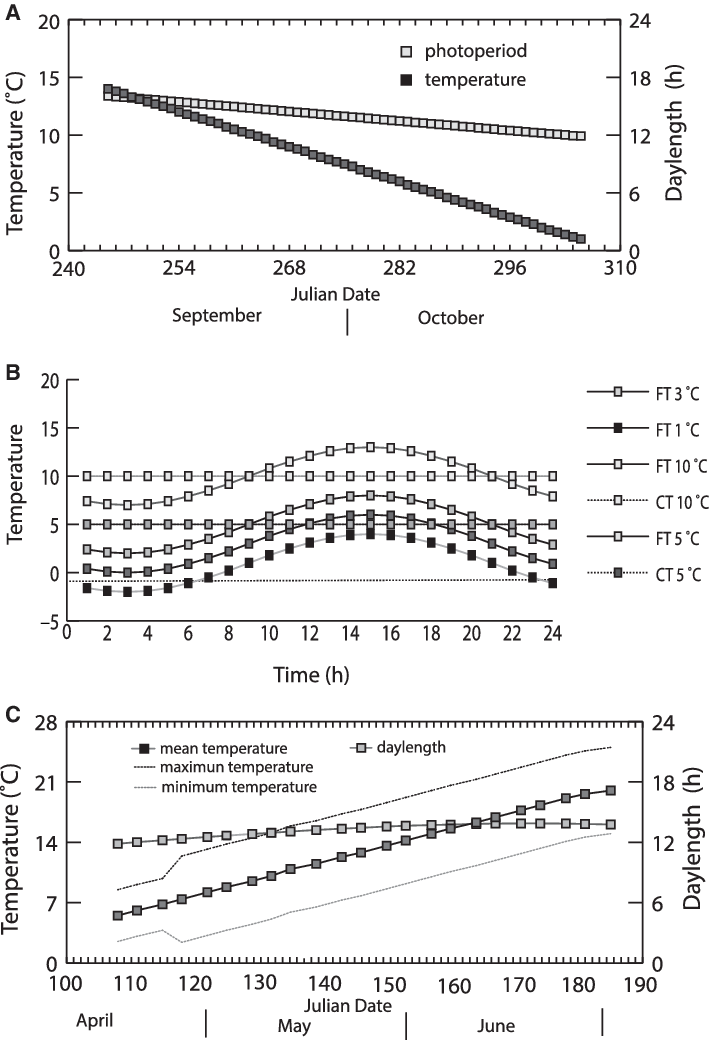
Following collection, both trapped flies and infested fruits were grouped (maximum 10 individuals of either sex) according to provenance (site and date of collection). They were placed in ventilated, clear plastic cages, with access to fresh blueberries and water during periods of activity, which varied with temperature. They were maintained in plant growth chambers (Conviron, Winnipeg, Canada) that were programmed to simulate local conditions of declining temperature and day length, based on 10-year data from Environment Canada for Normandin, Saguenay–Lac-Saint-Jean, Québec, Canada (48° 50′ 30.000″ N, 72° 32′ 49.000″ W; see Fig. 1A). Abiotic conditions were monitored continuously with temperature and humidity loggers (Onset Computer Corporation, Bourne, Massachusetts, United States of America).
Experimental conditions of temperature and photoperiod. A, Simulated late-summer–fall conditions of temperature and day length under which adult Drosophila suzukii trapped alive or emerged from fruits were maintained to experience fall acclimation similar to the natural seasonal conditions of the Saguenay–Lac-Saint-Jean region, Québec, Canada; B, daily constant (CT) and fluctuating (FT) temperature regimes experienced by winter morph flies during the six-month period of cold stress in 2016–2017 and 2017–2018 experiments; C, spring–early summer regime into which winter survivors were transferred following cold winter to simulate early season conditions of that region.

We tested four experimental regimes that consisted of a constant pattern and a fluctuating daily pattern of 10 °C and 5 °C mean temperatures. These moderately low temperatures were selected as temperatures at which D. suzukii flies could hypothetically survive for about six months, and they simulated partly protected seasonal temperature conditions. The regimes tested were either a constant temperature pattern or a sine-wave daily fluctuating temperature pattern with six-degree (Celsius) amplitude (Fig. 1B). The fluctuating 5 °C regime thus oscillated daily between 2 °C as the minimum and 8 °C as the maximum, and the fluctuating 10 °C regime oscillated daily between 7 °C and 13 °C.
Flies that were trapped (n = 448) and flies that emerged from fruits (n = 431) were transferred to the experimental cold winter regimes within 24–48 hours of collection or emergence in the lab, respectively. They were randomly allocated to one of the four cold winter regimes in growth chambers programmed under a 12-hour light : 12-hour dark photoperiod and 65% relative humidity. Experimental cold winter regimes were maintained for six months, until April 2017. Survival of flies was monitored every three to four days, when dead individuals were counted, removed, and sexed.
Insects and rearing 2017–2018
Because of the 2016–2017 results obtained, in 2017–2018, overwintering survival was studied using trapped flies only. All flies were collected from the Dolbeau-Mistassini site, where captures sometimes exceeded 1000 flies per day (Champagne-Cauchon et al. Reference Champagne-Cauchon, Guay, Fournier and Cloutier2020), on 10 September 2017 and on 14 and 22 October 2017. Flies were maintained temporarily (maximum two days) under the temperature and day-length regime used in 2016–2017 (Fig. 1A) and then were transferred into cold winter regimes.
A total of 802 field-captured adult individuals were available. Based on results of the 2016–2017 experiment, cold winter regimes during simulated winter in the 2017–2018 experiment were chosen to be daily fluctuating (sinusoidal) and colder than in the 2016–2017 regimes. The mean temperatures chosen were 1 °C and 3 °C, both with a six-degree (Celsius) amplitude between minimum and maximum. Temperature thus varied daily between –2 °C and 4 °C in the fluctuating 1 °C regime and between 0 °C and 6 °C in the fluctuating 3 °C regime. Flies in the 1 °C regime were thus exposed to temperatures below 0 °C for five hours each day (Fig. 1B).
Spring warming
In both the 2016–2017 and 2017–2018 experiments, overwintered D. suzukii flies that survived the cold winter period were transferred to a regime of springtime temperature and photoperiod so that survival to the next season of reproductive activity could be estimated under realistic conditions. The date of the ending of the cold winter period in April varied slightly depending on the date when each group of flies had been moved to the cold regime in the fall. Surviving flies were transferred to a growth chamber programmed with daily fluctuating temperatures based on 10-year spring–summer data for Normandin, Québec (Fig. 1C). Only one simulated springtime regime was tested, mainly because we did not have enough survivors to design a more complex experiment. Furthermore, we assumed that risk of death during overwintering in D. suzukii is mostly associated with the cold winter extreme conditions, rather than with conditions during springtime warming and recovery. For logistical reasons, simulated spring temperature and photoperiod conditions in the growth chamber were reset twice each week rather than daily.
Statistical analysis
Survival time (in days) of flies under the experimental cold winter regimes that lasted six months, followed by a unique springtime warming regime, was modelled using frailty Cox models. These survival models contain a mix of fixed and Gaussian-distributed random effects terms, which were estimated using the Coxme function in R (Therneau Reference Therneau2020). The analysis assumes that populations of D. suzuki adults in Saguenay–Lac-Saint-Jean have a characteristic hazard function that describes risk of death during winter and the subsequent spring–early summer seasons, when fruit resources presumably become available. In our experiments, the risk of death could be influenced strongly by the cold winter temperature treatments to which flies of both sexes were exposed and by covariates that included fly provenance (e.g., date of collection, mode of capture) and interactions between fixed effects. Hazard ratios estimated with model parameters were statistically compared between groups of flies of different sexes and provenances exposed to the simulated overwintering conditions. For hazard ratio analysis in the 2016–2017 experiment, we defined the effects of a cold winter regime (four levels) with a reference to the constant temperature 10 °C regime. Hazard ratios for the other three regimes were thus scaled to estimated hazard in the constant temperature 10 °C regime. For sex and provenance (two-level factors), the references used were female hazard and flies emerged from fruits hazard, respectively. For the 2017–2018 experiment (two regimes, no provenance effect), the hazard ratio for regime was referred to the fluctuating 1 °C regime. Hazard ratios for each effect were then plotted using an adapted version of the ggforest plot function of R, survminer package (Kassambara Reference Kassambara2020).
Results
We monitored survival of fall-acclimated D. suzukii flies in two experiments involving individuals collected in late-summer 2016 and 2017 in the Saguenay–Lac-Saint-Jean region, Québec, Canada, where adult flies were abundant in late season. Flies were exposed to a total of six cold winter regimes of temperature emulating partly protected microhabitats where fall-acclimated flies would presumably choose to overwinter in a dormant state. In both experiments, the cold winter treatments were followed by a unique springtime warming regime.
Survival in the 2016–2017 experiment
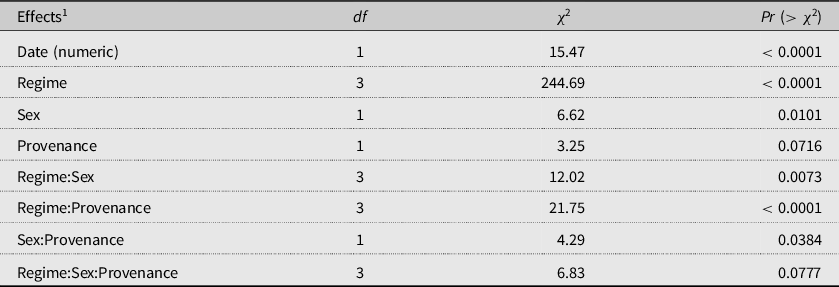
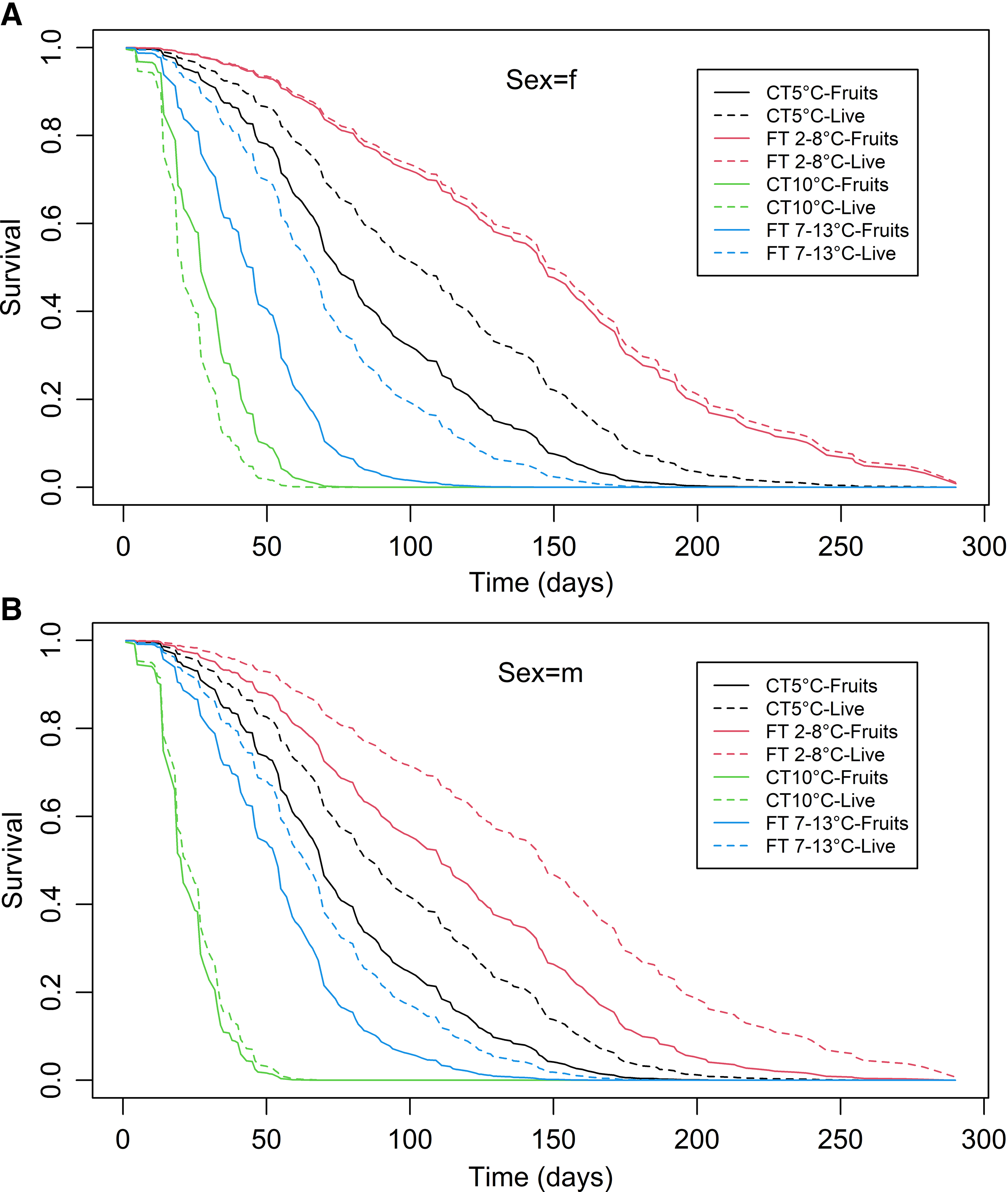
Date, regime, sex, and the two-factor interactions between regime, sex, and provenance had significant effects on survival of D. suzukii in the 2016–2017 experiment (Table 1; Fig. 2A). Provenance appeared to have no direct additive effect (P = 0.073; Table 1), but it had significant interactive effects with both regime and sex (Table 1).
Frailty Cox analysis of variance table 1 of Drosophila suzukii adult flies survival in four cold winter temperature regimes in 2016–2017. Provenance refers to the source of flies, which either were trapped alive or emerged under laboratory conditions 2 from field-collected fruits that were infested with larvae.

1 Type III effects, where effect contribution is estimated considering all other sources of variation.
2 Simulated regime of decreasing temperature and daylight during September in Normandin, Saguenay–Lac-Saint-Jean region, Québec, Canada, based on 10-year data.
Distribution in time (days) of survival of A, female and B, male fall-acclimated Drosophila suzukii collected from traps (live) or fruit in the 2016–2017 experiment. Flies were exposed to chilling conditions for six months under constant (CT) and fluctuating (FT) daily temperature regimes averaging 5 °C or 10 °C.

The fluctuating 5 °C regime allowed the longest survival, up to 40 weeks or longer – extending long after the simulated winter ended and well into the next season (Fig. 2). By contrast, the shortest survival times occurred in the 10 °C regimes, in which survival rarely exceeded seven to eight weeks – only about half of the time period of the experimental cold winter season. We also found that, in comparison to the 10 °C regimes, both 5 °C cold winter regimes (with and without fluctuation) markedly prolonged survival, confirming that colder winter temperatures increased longevity.
Adult fly provenance interacted with both sex and regime factors in a complex manner (Table 1). For example, trapped flies generally survived longer than those that emerged from field-collected fruits, except under the constant 10 °C regime, which demonstrated no apparent difference in provenance effects (Fig. 2). Sex interacted with both regime and provenance factors, indicating that the sex effect depended on the levels of both factors (Table 1). For example, under the fluctuating 5 °C regime (which allowed the longest survival), provenance had little effect on females (Fig. 2A), whereas male trapped flies survived longer than did male flies from fruits (Fig. 2B). In contrast, under the constant 5 °C regime, no survival difference between sexes was apparent: compared to trapped flies, both males and females from fruits had reduced survival. Sex interactive effects also appeared in the survival trends (Fig. 2) for the constant 10 °C regime, with female flies from fruits surviving longer than males, but no clear provenance effect occurring for males.
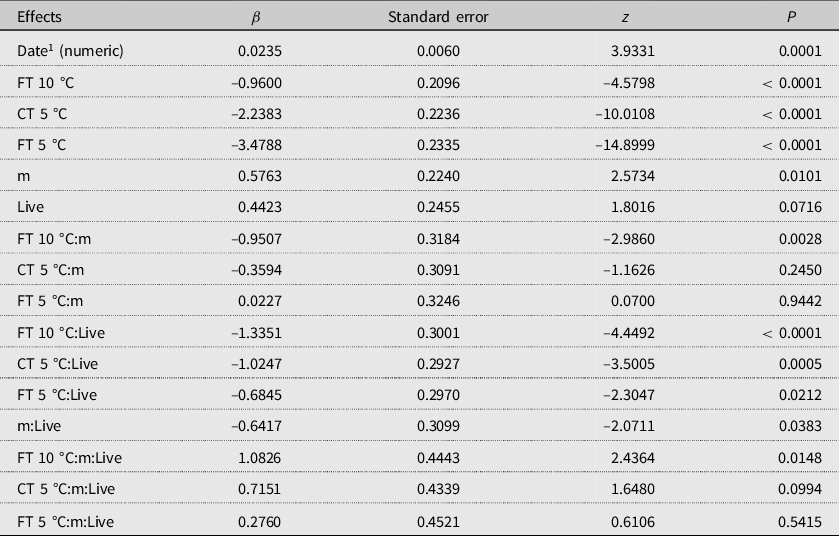
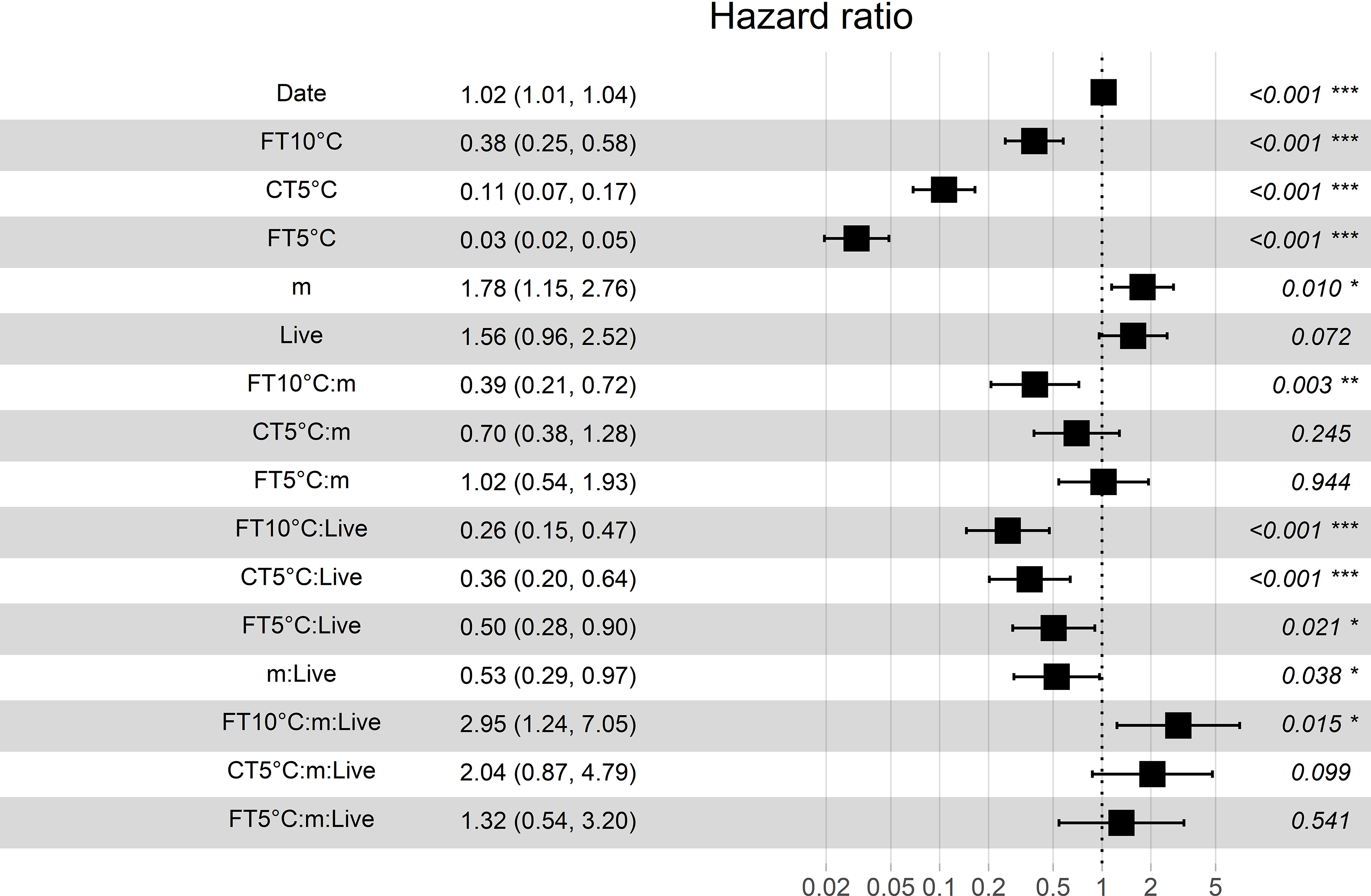
Parameter estimates of the frailty Cox model for 2016–2017 are based on the mortality of 691 flies (Table 2). The overall mortality risk of flies varied significantly with date of collection. Flies that experienced the fluctuating 10 °C and both 5 °C regimes had a reduced risk of mortality compared to flies that experienced the constant 10 °C reference regime, as is shown by the highly significant negative model estimates (Table 2). Male flies were significantly more at risk than females, and the direct effect of fly provenance was not significant (P = 0.0716).
Frailty Cox’s model parameters fitted to the 2016–2017 data by maximum likelihood. Male (m) and female (f) Drosophila suzukii flies collected from traps (live) or fruits were exposed to four constant (CT) or fluctuating (FT) temperature regimes. The references for each effect tested are constant 10 °C for regime, female for sex, and flies collected from fruits for provenance.

1 Date of field collection, varying from 7 September to 2 November 2016.
The hazard ratios estimated from frailty Cox model parameters are shown in Fig. 3. The risk of mortality increased by 2.38% per day over the sampling period (date hazard ratio of 1.0238; Fig. 3). For fixed effects, each ratio value is the risk of mortality relative to the ratio estimated for the reference level, as defined in the Methods (illustrated by the dotted line in Fig. 3). The hazard ratios significantly decreased from the constant 10 °C regime (reference) to the fluctuating 10 °C and then to the constant 5 °C and fluctuating 5 °C regimes (all significantly different; Fig. 3). Instantaneous mortality was lowest for fluctuating 5 °C, being only about 3% (0.0308) of that observed for the constant 10 °C regime. The reduction of mortality risk under fluctuating temperatures amounted to nearly 40% (0.383 versus 1) for fluctuating 10 °C relative to constant 10 °C (reference), and it amounted to 30% (0.0308 versus 0.107) for fluctuating 5 °C relative to constant 5 °C (Fig. 3).
Hazard ratios and their 95% confidence intervals for effects estimated from frailty Cox’s model for results of the 2016–2017 experiment. Drosophila suzukii flies were exposed to chill injury for six months under four constant (CT) and fluctuating (FT) temperature regimes. Each ratio (value, 95% confidence limits) scaled to the risk of mortality for the reference level, which is represented by the vertical dotted line (see Results, Survival in the 2016–2017 experiment section, for details).

With respect to sex as a factor, the overall hazard ratio for males was 1.78 times higher than for females. However, under the fluctuating 10 °C regime, mortality risk for males was less than half that for females (0.386 versus 1, regime:sex interaction). The overall risk of mortality for trapped flies appeared to be 1.56 times higher than for flies reared from fruits (Fig. 3). However, higher hazard ratios for flies from fruits are clear only for the constant 10° C regime, and only for female flies (Fig. 2). In other temperature regimes, hazard ratios were lower for trapped flies than for flies emerged from fruits, with any differences between regimes being insignificant, as shown in Fig. 3.
Survival in the 2017–2018 experiment
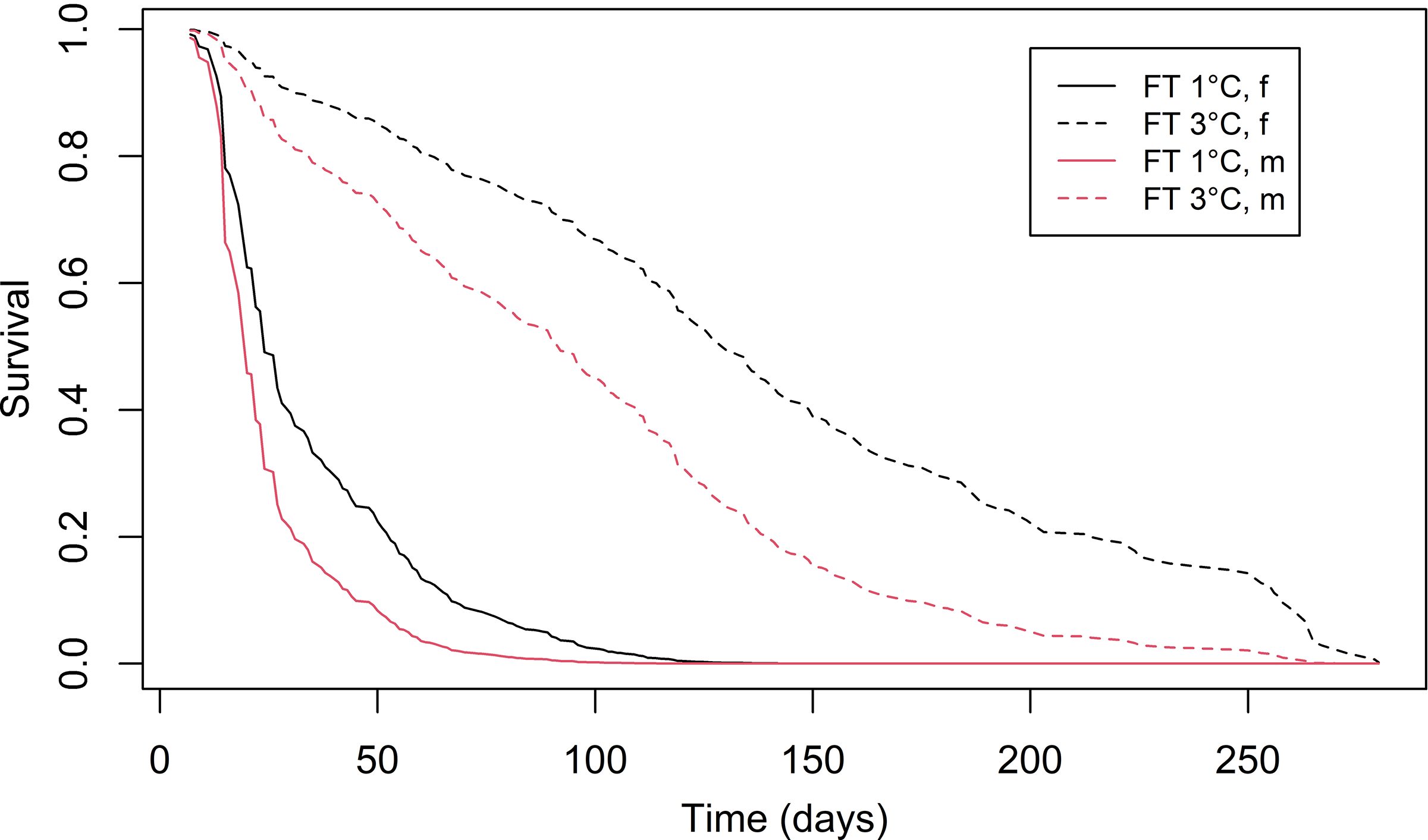
All flies used in the 2017–2018 experiment were collected from one site, rendering provenance not a factor. As in the 2016–2017 experiment, trap date affected survival significantly (Table 3). Flies collected in late-summer (10 September 2017) were at greater risk of winter mortality than those collected in October 2017. Both the cold winter regime and the sex effects were highly significant, whereas the regime:sex interaction was not, indicating that both fluctuating 1 °C and fluctuating 3 °C regimes similarly affected males and females. Figure 4 shows the extent to which the fluctuating 1 °C regime reduced survival compared to fluctuating 3 °C regime; this effect was similar for both males and females.
Frailty Cox analysis of variance table 1 of results of Drosophila suzukii survival in two cold winter temperature regimes in the 2017–2018 overwintering experiment. Fall-collected flies were trapped alive on three occasions (date effect).

1 Analysis of variance, Type III effects, where effect contribution is estimated considering all other sources of variation.
Distribution in time (days) of survival of male (m) and female (f) fall-acclimated Drosophila suzukii in the 2017–2018 experiment. During simulated cold winter, flies were exposed to two fluctuating temperature (FT) regimes of cold stress for six months, including a regime of daily exposure to –2 °C.

Parameter estimates for the frailty Cox model were derived from 802 flies (Table 4). The instantaneous mortality risk decreased by 2.40% per day over the sampling period (date). The longest survival times were observed under the fluctuating 3 °C regime oscillating daily from 0 °C to 6 °C. Survival extended beyond the simulated cold winter for approximately 20% of the males and 40% of the females (Fig. 4).
Cox mixed effects model fitted to the 2017–2018 data by maximum likelihood. Male and female Drosophila suzukii were exposed to two fluctuating temperature (FT) regimes. Reference effects for tested fixed effects: FT 3 °C (–2 to 4 °C) for regime; female for the sex effect.

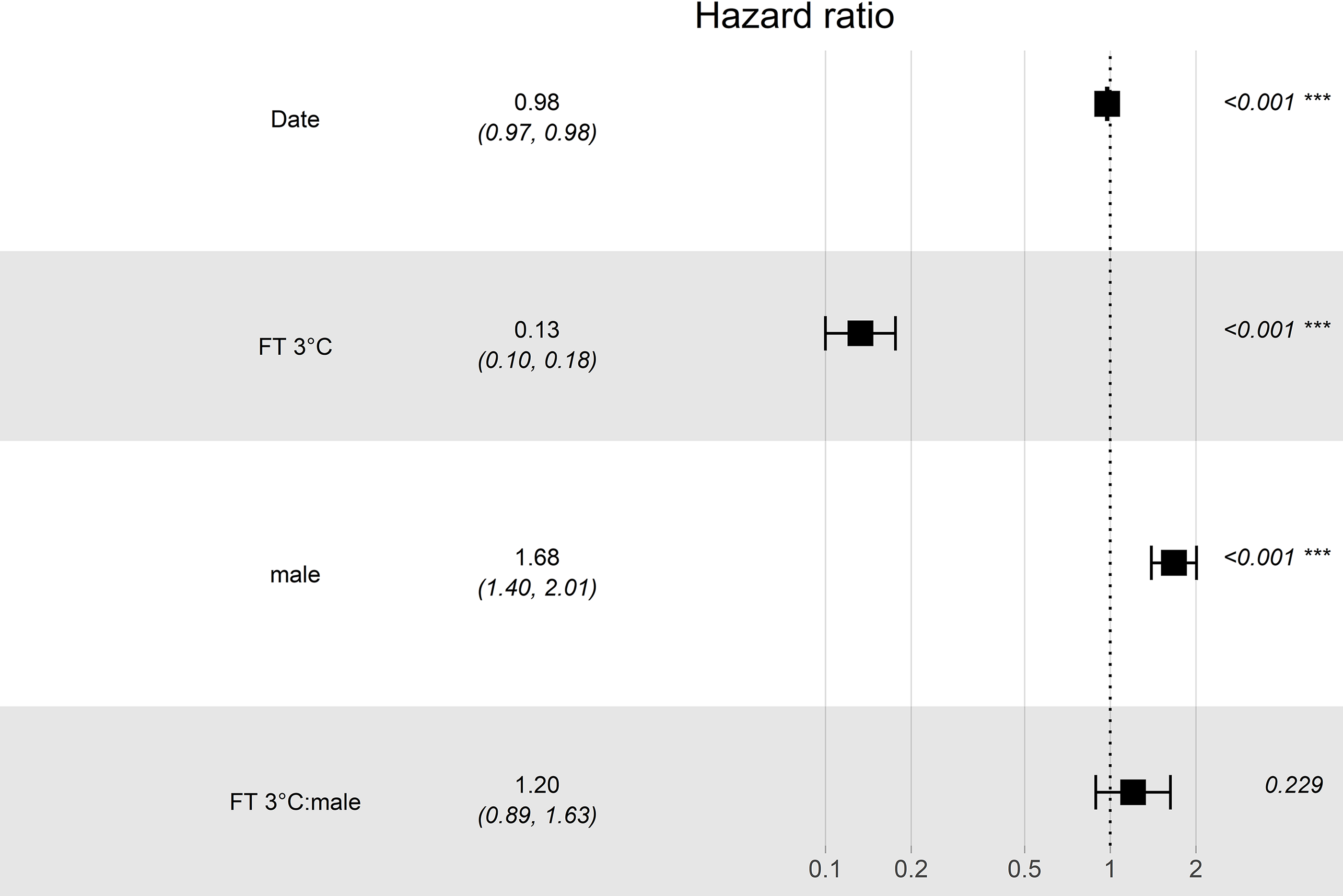
The instantaneous risk of mortality for flies in the fluctuating 3 °C was seven to eight times (0.133 versus 1) less than for flies in the fluctuating 1 °C regime (flies exposed to temperatures below 0 °C), according to the hazard ratio analysis for fixed effects (Fig. 5). A strong sex effect favoured female survival, whereby male flies were at 1.68 times greater risk of dying than females were.
Hazard ratios and their 95% confidence intervals for effects estimated from the frailty Cox model for results of the 2017–2018 experiment. Drosophila suzukii flies were exposed to two cold winter fluctuating temperature (FT) regimes for six months. Each ratio value (± 95% CI) shown is scaled to the risk of mortality for the reference level, which is represented by the vertical dotted line (see Results, Survival in the 2016–2018 experiment section, for details).

Predicting survival into the next summer season
In both experiments, any survivors to six months of cold stress were transferred to conditions that simulated spring warming. Monitoring of survival under springtime conditions allows us to predict if such flies may survive to the summer season and in what proportions relative to numbers surviving cold winter regimes.
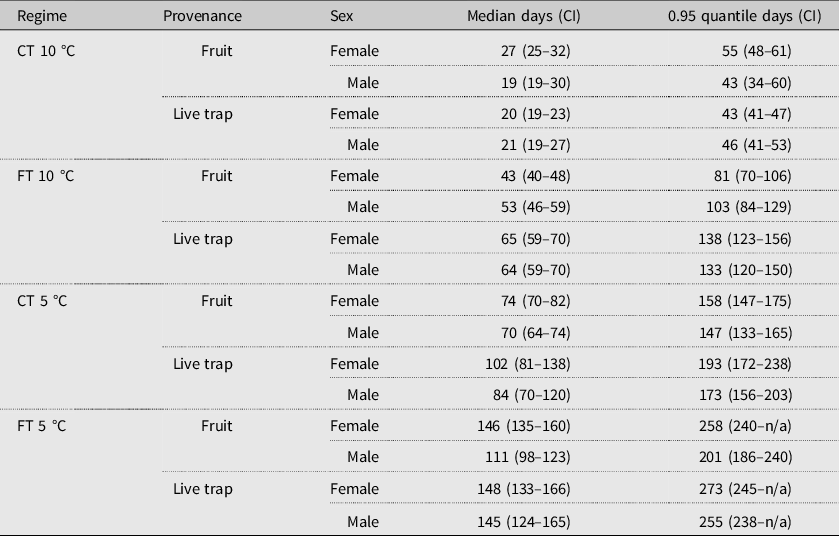
The 2016–2017 experiment resulted in median survival-time estimates of three to nine weeks for flies exposed to the 10 °C regimes, compared to 10 to 21 weeks under the colder 5 °C regimes (Table 5). Comparing median survival times between the fluctuating and the constant regimes for each temperature shows that, at 10 °C mean temperature, the fluctuating regime increased survival by a factor of 1.6–3.3, relative to the constant regime, with a slightly smaller increase by a factor of 1.1–2.1 at a 5 °C mean temperature (Table 5). The 0.95 quantile estimates for 2016–2017 could generally be calculated with their 95% confidence intervals, given sufficient numbers of replicate flies available (Table 5). For both of the 10 °C regimes, such survival (0.95 quantile) would not exceed 180 days (about six months); that is, all flies would die during the cold winter period, despite the survival time being generally twice as long under the fluctuating 10 °C regime as under the constant 10 °C regime. However, much longer survival times are predictable for the 5 °C regimes – and especially for the fluctuating regime – where estimates generally exceed 180 days (Table 5). Notably, female trapped flies would likely survive 193 days, even under a constant temperature 5 °C regime (Table 5).
Median and 0.95 quantile survival estimates (days), with their respective 95% confidence intervals (CI), for fall-acclimated Drosophila suzukii flies in 2016–2017. Flies were exposed for six months to constant (CT) and fluctuating (FT) temperature regimes simulating overwintering temperatures at 5 °C or 10 °C (see text for details).

Estimates of the median survival times for flies in the colder fluctuating 1 °C regime (exposing flies to temperatures between –2 °C and 0 °C for five hours every day during cold winter) were only 24 and 20 days for females and males, respectively, in the 2017–2018 study (Table 6). Corresponding estimates for the 0.95 quantile of survival time distribution are 84 and 55 days, respectively. These results indicate that in this presumably mild freezing regime, 95% of female flies would die within three months and 95% of male flies would die within two months. In contrast, the fluctuating 3 °C regime (temperatures ≥ 0 °C) permitted substantially longer survival. The median survival times were only 128 and 90 days for females and males, respectively. However, the 0.95 quantile survival times reached as high as 265 and 199 days (Table 6). The latter estimates indicate that some 5% of male flies would survive at least until approximately mid- to late April following winter and that some 5% of female flies would survive at least two months longer, until early to mid-July.
Estimates of median and 0.95 quantile survival times (days), with 95% confidence intervals (CI), for Drosophila suzukii exposed to fluctuating temperature (FT) regimes in the simulated overwintering experiment of 2017–2018.

Discussion
Three years of field studies on D. suzukii in the same region of Québec, Canada (Champagne-Cauchon et al. Reference Champagne-Cauchon, Guay, Fournier and Cloutier2020), consistently showed that reproductively diapausing flies accumulate at high densities in the fall in lowbush blueberry forest borders, similar to the ‘autumn flushes’ reported by Thistlewood et al. (Reference Thistlewood, Gill, Beers, Shearer, Walsh and Rozema2018). We assumed in this study that fall-acclimated D. suzukii flies could survive cold winter temperatures well below the flies’ activity threshold in behaviourally selected microhabitats. These winter microhabitats could be under snow-covered forest debris or in protected habitats related to human activity, as Kimura (Reference Kimura2004), Jakobs et al. (Reference Jakobs, Gariepy and Sinclair2015), Thistlewood et al. (Reference Thistlewood, Gill, Beers, Shearer, Walsh and Rozema2018), and Stockon et al. (Reference Stockon, Wallingford, Rendon, Fanning, Green and Diepenbrock2019) have suggested. Our results demonstrate that, despite substantial mortality, numerous D. suzukii flies of both sexes and even field-trapped flies of unknown age collected in late summer are able to survive local winters well into the next season of potential reproductive activity. About 5% of those flies can be expected to survive until mid-spring (males) or until mid-summer (females). In the fall, they likely would have selected microhabitats where temperatures fluctuate daily within a small range above 0 °C and where mild freezing could be experienced for short periods but would not persist throughout winter. This is consistent with Jakobs et al. (Reference Jakobs, Gariepy and Sinclair2015), who showed that experimentally acclimated D. suzukii flies from Ontario did not survive a cold snap below –3 or –4 °C in December 2013.
We assumed that if D. suzukii has indeed been established in Saguenay–Lac-Saint-Jean since the time when they were first reported, local populations may already express favourable biological traits for survival in cold winter climatic conditions (Bradshaw and Holzapfel Reference Bradshaw and Holzapfel2010). We thus used field-collected D. suzukii rather than a laboratory strain, presuming that field-collected individuals might better reflect their potential to overwinter under experimental conditions of cold–temperate winter. We also presumed that measured survival times mostly reflect the effect of the cold winter experimental regimes. However, abiotic conditions in which survival was measured included substantial time spent by winter survivors in improving conditions where they could express ability to survive to find food for maintenance and reproductive maturation until mature fruit resources for oviposition are available. Below, we discuss more specific aspects of our findings in each experiment.
Survival in the 2016–2017 experiment
Overwintering conditions were chosen to exclude temperatures below 0 °C because, according to current literature, D. suzukii flies are freeze intolerant and chill susceptible (Kimura Reference Kimura2004; Tochen et al. Reference Tochen, Dalton, Wiman, Hamm, Shearer and Walton2014; Langille et al. Reference Langille, Arteca, Ryan, Emiljanowicz and Newman2016). In the absence of knowledge of their overwintering microhabitats, we tested four winter temperature regimes covering a range of temperature conditions excluding sub-zero temperatures. We assumed that fall-acclimated D. suzukii winter morph flies would have selected appropriate microhabitats in which they would remain mostly inactive physically and metabolically throughout the winter.
Results of this experiment at two moderately cold winter temperatures under a constant or a fluctuating daily regime indicated that experiencing cold winter at mean 10 °C would allow flies to reach next spring only exceptionally, even with the three-times advantage provided under a fluctuating regime (Table 2). By contrast, flies under both constant and fluctuating 5 °C regimes would clearly live much longer. This could occur if flies kept at 10 °C during the cold winter period were ageing (senescing) faster than those kept at 5 °C (Bowler and Terblanche Reference Bowler and Terblanche2008). Flies evidently aged at a slower rate in both 5 °C regimes and especially in fluctuating 5 °C for those flies that had emerged from field-collected fruits (Fig. 2). This also confirms the hypothesis that, even at temperatures well below optima for D. suzukii, flies can survive cold stress much longer under a daily fluctuating, rather than a constant, temperature regime of the same mean. This suggests that temperature fluctuation between cold and less cold is intrinsically beneficial or less stressful, even within a rather limited range of chilling injury temperatures for D. suzukii (6 °C), which needs further study. Grumiaux et al. (Reference Grumiaux, Andersena, Colinet and Overgaard2019) found that daily pulses (80 minutes) of warming at 25 °C increased D. suzukii survival in cold storage (3 °C) experiments with a laboratory D. suzukii strain. However, in our study, the maximum warm temperature in the fluctuating regimes was only 8 °C (fluctuating 5 °C) or 13 °C (fluctuating 10 °C). A reduced cumulative effect of chill injury, rather than available time to repair injury at warmer temperatures, could possibly explain our results. In Grumiaux et al.’s (Reference Grumiaux, Andersena, Colinet and Overgaard2019) study, the fluctuating temperature regimes were designed for mass-rearing D. suzukii, whereby a brief interval of warming at optimum temperatures presumably allowed repair mechanisms to compensate for the injuries of cold stress (physiological recovery hypothesis, as reviewed in Colinet et al. Reference Colinet, Rinehart, Yocum and Greenlee2018).
The present study revealed that flies collected in fruits as larvae tended to survive better or worse than trapped flies, depending on the cold winter regime (Fig. 1), according to a hazard ratio analysis. More generally, trapped flies were at lower risk of dying during winter than were flies from fruits (Figs. 2, 3). This may be explained by the fact that flies from infested fruits were all young adults at the beginning of the experiment, whereas trapped flies likely included many older adults.
We expected that male D. suzukii flies would survive for shorter periods than females did, as earlier work had suggested (Dalton et al. Reference Dalton, Walton, Shearer, Walsh, Caprile and Isaacs2011; Jakobs et al. Reference Jakobs, Gariepy and Sinclair2015), although Enriquez and Colinet (Reference Enriquez and Colinet2017) concluded that it is not possible to generalise about male versus female cold tolerance in D. suzukii. Our results indicate a clear female advantage in long-term overwintering survival overall, notably from a hazard ratio analysis wherein the overall risk of mortality for males was much higher (1.78 times) than for females (Fig. 3). Survival curves show that females survived longer than males in all regimes except the fluctuating 10 °C regime – that is, the riskiest overwintering regime tested here (Fig. 2B). Results from the present study suggest that, in D. suzukii populations from a cold–temperate region with overwintering temperatures averaging 5 °C and remaining below 8 °C, females are more likely to survive longer than males.
Finally, the trapped flies experienced acclimation to fall conditions in the field, both as immature stages and as adults. They thus acclimated to incipient fall at an earlier time in late summer than did the fruit-collected flies. The flies from fruits developed, for the most part, and emerged in the simulated fall conditions regime and thus were exposed to slightly different rates of day length and temperature decline before they were transferred to experimental conditions. However, it is not clear why the trapped flies generally survived better than flies from fruits, despite their variable (unknown) ages when the experiment started.
Survival in the 2017–2018 experiment
Drosophila suzukii is frequently reported to be intolerant to sub-zero temperatures (e.g., Enriquez and Colinet Reference Enriquez and Colinet2017 and references therein), but the fluctuating 1 °C regime exposed flies for 5 hours daily to temperatures below 0 °C. Before our study, data were unavailable on flies that were naturally acclimated in late season in cold climate regions of D. suzukii’s invaded range. We aimed to test winter morph flies for winter survival with consideration for sub-zero temperatures, even though those temperatures did not fall much below 0 °C. We assumed that D. suzukii flies would intermittently be exposed to such conditions at least temporarily in the fall before snow covers the ground in a cold–temperate climate (unpublished ground-level temperature data; Jakobs et al. Reference Jakobs, Gariepy and Sinclair2015). It is known that freezing temperatures just a few degrees below 0 °C generally exclude internal ice formation, especially for fall-acclimated insects, and that ice crystallisation is a most critical factor in causing frost damage (e.g., Lee Reference Lee2010). Jakobs et al. (Reference Jakobs, Gariepy and Sinclair2015) found the super-cooling point in D. suzukii from Ontario varied between –16 °C and –23 °C and was not affected by sex or cold hardening; based on this information, Jakobs et al. (Reference Jakobs, Gariepy and Sinclair2015) concluded that D. suzukii is chill susceptible.
We found that the date of field collection in 2017 (date), the experimental cold winter conditions (regime), and gender (sex) all significantly affected winter survival. The fluctuating 3 °C regime clearly allowed the longest survival – up to 250 days or more (Fig. 3) – despite temperatures not exceeding 6 °C during the day. Interestingly, current knowledge suggests that all temperatures in our fluctuating 3 °C regime are within the chill-injury range for D. suzukii (Langille et al. Reference Langille, Arteca, Ryan, Emiljanowicz and Newman2016; Nikolouli et al. Reference Nikolouli, Colinet, Renault, Enriquez, Mouto and Gibert2018; Thistlewood et al. Reference Thistlewood, Gill, Beers, Shearer, Walsh and Rozema2018; Grumiaux et al. Reference Grumiaux, Andersena, Colinet and Overgaard2019).
As expected, the risk of mortality (hazard ratio) for flies exposed to the fluctuating 1 °C regime was several times higher than that for flies exposed to the fluctuating 3 °C regime (Fig. 4). This is not surprising, as greater mortality could be expected under the fluctuating 1 °C regime rather than the fluctuating 3 °C regime despite a difference of only 2 °C between their daily mean. Interestingly, however, these results indicate that in fall-acclimated D. suzukii flies that are exposed for five hours daily to ice-free, physically innocuous freezing (minimum –2 °C), cold injury either could not be compensated (repaired) or could be compensated only to a limited extent by a return to above-zero temperatures (maximum 4 °C) for the most part of the day (19 hours). Few flies survived the fluctuating 1 °C treatment for more than a few months, but females did better than males (Fig. 3). However, these results also show that, among our D. suzukii flies (from a high-density population in late fall), approximately 50% survived daily exposure to freezing at –2 °C for five hours per day for 2–3 weeks and 5% survived this regime for 2–3 months (Table 6). We suggest that the sustained tolerance to temperatures slightly below 0 °C of these exceptional D. suzukii individuals might be critical for survival in late fall in natural conditions, before accumulated snow provides insulation in ground-surface microhabitats. When Jakobs et al. (Reference Jakobs, Gariepy and Sinclair2015) studied the flies’ potential overwintering in partly protected microhabitats (under leaf litter, in unheated buildings) in London, Ontario, D. suzukii were killed by a 24-hour cold snap at temperatures below 4 °C.
Predicting survival into the next summer season
One objective of this study was to determine whether D. suzukii infesting lowbush blueberry fields in a cold–temperate region could survive the long cold winters and slow spring warming that characterise the study region. In particular, if fall-adapted flies (winter morphs) could overwinter in partly protected microhabitats, given that they are relatively intolerant to temperatures below 0 °C and are chill susceptible (e.g., Jakobs et al. Reference Jakobs, Gariepy and Sinclair2015; Nikolouli et al. Reference Nikolouli, Colinet, Renault, Enriquez, Mouto and Gibert2018; Stockon et al. Reference Stockon, Wallingford, Rendon, Fanning, Green and Diepenbrock2019).
We tested this possibility with field-collected flies from local populations, assuming partial adaptation to the local climate but without direct evidence of that adaptation (Champagne-Cauchon et al. Reference Champagne-Cauchon, Guay, Fournier and Cloutier2020). Overwintering survival implies that flies remain inactive in reproductive diapause for at least six months, which was shown to occur at near-freezing temperatures. Furthermore, successful overwintering also implies prolonged, slow post-winter recovery of mobility, feeding activity, and reproductive potential before fruit resources become available. Survival distribution models allowed us to make reasonable predictions of proportions of flies surviving winter that would live long enough to coincide with fruit availability, assuming that winter mortality is a major factor in their annual dynamics. The 0.95 quantiles of the survival distributions (Tables 5 and 6) indicate that only a small minority (5%) of flies would be alive the following season. Nonetheless, this is a considerable proportion, given that large numbers of acclimated flies do accumulate before winter due to reproductive diapause (Champagne-Cauchon et al. Reference Champagne-Cauchon, Guay, Fournier and Cloutier2020). Therefore, at densities such as those sampled in fall 2017, we suggested that, even with 95% winter mortality, substantial numbers of female flies might survive until new fruit resources matured in early summer 2018. Potential host fruit resources included common red raspberry (Rubus idaeus), serviceberry (Amelanchier sp.), fire cherry (Prunus pensylvanica) and choke cherry (P. virginiana) (all Rosaceae); Canadian bunchberry (Cornus canadensis), bristly salsaparilla (Aralia hispida) (Araliaceae), and others (Guay et al., unpublished data). Predicted survival times for males do not suggest that males would survive and reproduce, but this cannot be excluded. Overall, considerable work remains to be done to demonstrate that winter survivors with long life expectancy from these populations could indeed find suitable food to recover reproductive potential and find conspecific mates to ensure persistence in the new season.
Enhanced overwintering success at fluctuating temperature just a few degrees above 0 °C might be explained by alleviation of cold-stress injury by small-amplitude temperature fluctuations, for which molecular and metabolic markers of mechanisms possibly involved are already known in D. suzukii (reviewed in Colinet et al. Reference Colinet, Rinehart, Yocum and Greenlee2018). We did not attempt to include such observations here, fearing that high mortality in our cold winter regimes would likely leave us with insufficient long-lived survivors to observe.
Conclusions
This study examined northern populations of D. suzukii collected near lowbush blueberry fields in Québec, Canada. We found that fall-acclimated flies could survive for at least 250 days in experimental conditions that simulated local overwintering. To our knowledge, this is the longest longevity yet reported for adults of this global pest. Our results unequivocally support the hypothesis that fall-acclimated flies could survive the harsh winters of Canada, despite substantial mortality, but more research is needed to confirm that they do so and where. As has been suggested elsewhere (Zerulla et al. Reference Zerulla, Schmidt, Streitberger, Zebitz and Zelger2015; Stockon et al. Reference Stockon, Wallingford, Rendon, Fanning, Green and Diepenbrock2019), we assumed that winter morphs in diapause would behaviourally select overwintering microhabitats to avoid continuous exposure to ambient air temperatures. Based on our results, temperatures should remain above 0 °C during most of winter and should fluctuate daily around 3–5 °C with limited amplitude. Additionally, we found that constant or fluctuating 10 °C temperature regimes, as well as a constant 5 °C regime, would not allow survival to the end of prolonged cold winters. Winter mortality is expected to be substantially higher for male winter-morph D. suzukii flies than for female winter morphs. We also observed that field-collected and fall-acclimated D. suzukii flies could survive a daily fluctuating temperature regime with freezing to –2 °C for five hours per day when the freezing is followed by a return to above-zero temperatures of up to 4 °C. Adults exposed to this regime survived simulated winter for many weeks, and 5 % of exposed individuals survived up to 2–3 months. Cox proportional hazard models of survival fitted to mortality data for hundreds of flies exposed to six-month cold stress in both the fluctuating 3 °C and 5 °C regimes also showed that substantial numbers of D. suzukii flies, especially females, could survive not only as long as six months but until the summer of the next year. This suggests they would have sufficient residual longevity after winter to recover feeding activity and reproductive potential until host fruit resources become available in the summer.
Acknowledgements
The authors thank the Natural Sciences and Engineering Research Council of Canada Cooperative Research and Development programme and Discovery programme, the Syndicat des Producteurs de Bleuets du Québec, the Fonds de recherche du Québec-Nature et technologies, and the Fonds de la recherche agroalimentaire axé sur l’agriculture nordique du Saguenay-Lac-Saint-Jean, Québec, Canada, for research grants to C.C. Special thanks are due to Mireille Bellemare and Anna-Marie Devin (Club Conseil Bleuet) and Pierre-Olivier Martel (Ministère de l’Agriculture, des Pêcheries et de l’Alimentation du Québec) for effective collaboration and to Gaétan Daigle, Service de consultation statistique, Département de mathématiques et statistiques, Université Laval. The authors also thank summer students Jonathan Franchomme, Anne-Marie Olivier, and Emil Shatov for critical help with laboratory and field work and Fréderic McCune for constructive comments on the manuscript. Finally, the authors extend their gratitude to the blueberry producers from Saguenay-Lac-Saint-Jean for providing access to their lowbush blueberry fields.
Authors’ contributions
C.C. conceived the experiments and methodology with J.-F.G. and W.C.C. W.C.C. and J.-F.G. realised the experiments and recorded observations. C.C. statistically analysed the data with help from J.-F.G. and professional statistician. All authors contributed to the drafts and authorised final publication.