INTRODUCTION
Tolerance to dehydration stress is very complex at whole plant and crop levels because of variable effects of the stress on molecular, biochemical and physiological processes at different stages of plant development. A large number of redundant pathways are involved in the perception and signalling of drought stress (Pastori & Foyer Reference Pastori and Foyer2002; Chinnusamy et al. Reference Chinnusamy, Schumaker and Zhu2004). Two major pathways that play a role in the expression of dehydration-induced genes have been identified in plants (Yamaguchi-Shinozaki & Shinozaki Reference Yamaguchi-Shinozaki and Shinozaki2006). The first pathway is the abscisic acid (ABA)-dependent pathway, wherein dehydration leads to the synthesis of ABA and the binding of ABA response elements (ABRE) with ABRE-binding factors (ABF), inducing a number of drought-responsive genes (Huang et al. Reference Huang, Wu, Abrams and Cutler2008). The second pathway leads to the induction of dehydration-responsive genes without the involvement of ABA and is called the ABA-independent pathway. The ABA-independent pathway is thought to involve dehydration response elements (DRE) which interact with DRE binding (DREB) proteins. The DREB proteins belong to the Apetala 2 (AP2) family of transcription factors and consist of two subfamilies: DREB1 and DREB2, which differ in the conserved domains outside the AP2 domain (Nakano et al. Reference Nakano, Suzuki, Fujimura and Shinshi2006). They bind to DRE consisting of a core sequence A/GCCGAC, which is present in the promoters of genes regulated by abiotic stresses like drought, salinity (DREB2) and cold (DREB1) (Yamaguchi-Shinozaki & Shinozaki Reference Yamaguchi-Shinozaki and Shinozaki1994). However, there are reports on the induction of DREB genes by ABA (Egawa et al. Reference Egawa, Kobayashi, Ishibashi, Nakamura, Nakamura and Takumi2006).
The signalling pathways are known to bring about the activation of specific transcription factors, which regulate gene expression under stress conditions (Bartels & Souer Reference Bartels, Souer, Hirt and Shinozaki2004). Transcription factors act as master switches and trigger the simultaneous expression of a large number of stress-response genes. The DREB proteins have been identified in both dicotyledons and monocotyledons. In Arabidopsis, more than 40 genes downstream of DREB1 have been identified through the use of both cDNA and microarrays (Fowler & Thomashow Reference Fowler and Thomashow2002; Maruyama et al. Reference Maruyama, Sakuma, Kasuga, Ito, Seki, Goda, Shimada, Yoshida, Shinozaki and Yamaguchi-Shinozaki2004). Their protein products include RNA-binding proteins, sugar transport proteins, desaturases, metabolism-related proteins, Late Embryogenesis Abundant (LEA) proteins, cold-inducible proteins, osmoprotectants, biosynthesis proteins and protease inhibitors (Yamaguchi-Shinozaki & Shinozaki Reference Yamaguchi-Shinozaki and Shinozaki2006). Many of these genes were also up-regulated by DREB2 transcription factors, indicating cross-talk between cold and osmotic signalling. Over-expression of DREB1 transcription factors from Arabidopsis has been reported to confer drought tolerance in crops like rice (Oh et al. Reference Oh, Song, Kim, Jang, Kim, Kim, Kim, Nahm and Kim2005; Chen et al. Reference Chen, Meng, Zhang, Xia and Wang2008) and wheat (Pellegrineschi et al. Reference Pellegrineschi, Reynolds, Pacheco, Brito, Almeraya, Yamaguchi-Shinozaki and Hoisington2004). Over-expression of ZmDREB2A resulted in improved stress tolerance in maize plants and brought about an up-regulation of genes encoding LEA proteins, genes related to heat shock responses and genes involved in the detoxification of reactive oxygen species (Qin et al. Reference Qin, Kakimoto, Sakuma, Maruyama, Osakabe, Tran, Shinozaki and Yamaguchi Shinozaki2007). A significant improvement in tolerance to water deficit stress was also reported in transgenic rice over-expressing OsDREB2 (Chen et al. Reference Chen, Meng, Zhang, Xia and Wang2008). However, there are no reports on heterologous expression of DREB2 genes from another monocot in rice.
The objective of this study was to isolate and clone a DREB2 gene from Sorghum bicolor and transfer it to rice through Agrobacterium-mediated transformation. This was the first DREB2 gene identified in sorghum and showed homology to the DREB2A gene of rice. It was hypothesized that the DREB genes from sorghum, which is a drought-tolerant crop, may be more effective in improving drought tolerance of rice as compared to the other DREB genes used so far, which are largely from plants showing drought susceptibility.
MATERIALS AND METHODS
Plasmid construction
A cDNA clone HS1_50_A11 was identified from the Sorghum EST libraries available (http://fungen.org), which showed sequence similarity to DREB2 proteins from other grasses like rice, wheat, barley and Pennisetum. Similarity was determined by aligning the DREB2 protein sequences from various dicot and monocot plants and constructing dendrograms. The HS1_50_A11 cDNA was sequenced (Genebank accession number DQ403725) and the Open Reading Frame (ORF) of this DREB2 gene was cloned at Nco I and Pml I sites of pCAMBIA 1301 such that the GUS gene was replaced with SbDREB2 gene, to obtain pC1301CaMV35S: SbDREB2. For the second construct, the rd29A promoter was cloned at Xba I and Pst I sites in pC1301CaMV35S: SbDREB2. The CaMV35S promoter was then excised by Nco1 and Pst1 digestion to obtain pC1301rd29A: SbDREB2. Both the binary vectors were mobilized into Agrobacterium strain LBA4404.
Agrobacterium-mediated transformation of rice
Rice (Oryza sativa subsp indica) transformation was carried out using embryogenic calli as described in Azhakanandam et al. (Reference Azhakanandam, McCabe, Power, Lowe, Cocking and Davey2000). Embryogenic calli of rice were used for transformation with pC1301rd29A: SbDREB2 and pC1301CAMV35S: SbDREB2 binary vectors harbouring the SbDREB2 gene under the constitutive CAMV35S promoter and stress inducible rd29A promoter. When the calli were transferred to selection media (N6 medium with hygromycin 50 mg/l for selection and Cefotaxime 250 mg/l as bacteriostatic agent), the transformed calli were seen to proliferate while the non-transformed calli died. The selected transformed calli were transferred to shoot regeneration media (including hygromycin 30 mg/l for selection) where shoot buds were observed in 8–10 days of transfer and 30–40 mm long shoots were obtained in 2 weeks. The shoots were then transferred to rooting medium (including hygromycin 30 mg/l for selection) and profuse rooting was observed in 2 weeks. The rooted plantlets were hardened and established in the glasshouse. Genomic DNA from the independent transformant lines was extracted (Dellaporta et al. Reference Dellaporta, Wood and Hicks1983) and the presence of the transgene was determined by polymerase chain reaction (PCR), using SbDREB2 gene-specific primers in GeneAmp 7000 (Applied Biosystems, USA) thermocycler. The thermal cycling conditions were: 94°C for 30 s, 62°C for 45 s and 72°C for 1·5 min for 30 cycles. Gene-specific primers were designed to amplify the region from within the ORF to within the 3΄-untranslated region (3΄-UTR; 787 bp).
T1 segregation analysis
Grains collected from primary transformants were sown to raise T1 plants. Genomic DNA was isolated from 45 to 60 rice seedlings and scored for the presence or absence of the transgene by PCR analysis using SbDREB2 gene-specific primers.
Southern hybridization analysis
Genomic DNA from the T1 transgenic plants was digested with EcoR1, electrophoresed on 10 g/l agarose gel and blotted onto a positively charged nylon membrane (Roche Diagnostics, Germany). A digoxigenin (DIG)-labelled SbDREB2 probe was prepared by labelling the DNA fragment amplified with SbDREB2 gene-specific primers (787 bp) using the DIG labelling and detection kit (Roche Diagnostics). Hybridization and detection were carried out as per suppliers’ instructions using the chemiluminescent AP substrate, CDP-star (Roche Diagnostics).
Expression analysis of SbDREB2
Expression of SbDREB2 in drought-stressed sorghum seedlings and expression of the native OsDREB2 and SbDREB2 in T1 transgenic rice seedlings were studied using semi-quantitative RT-PCR. Three-leaf stage seedlings of sorghum (var. IS18551) were carefully removed from soil without damaging the roots. Drought stress was applied by air drying the uprooted seedlings (three seedlings per treatment) for 1, 2, 3, 5, 7 and 24 h at 23–27°C. The total RNA was isolated from the seedlings after each treatment, as well as from the control plants that were not exposed to air drying. Stress was similarly applied to three-leaf stage rice seedlings by air drying the uprooted plants for 1, 3 and 5 h at 25±2°C, after which the total RNA was isolated. Gene expression was studied using the first strand cDNA synthesis kit for RT-PCR (AMV) from Roche Diagnostics, USA followed by PCR using SbDREB2- and OsDREB2-specific primers, respectively. Actin primers were used to amplify the actin gene as a loading control in both sorghum and rice.
Drought stress studies using T1 transgenic rice plants
One transgenic line (event no. 1) of pC1301rd29A: SbDREB2 transformed rice was subjected to water stress, in a glasshouse experiment. One hundred grains of the T0 generation were sown in pots (210 mm diameter at the top, 110 mm diameter at the base and 180 mm height) in a completely randomized design to raise T1 plants, which were screened by PCR for the presence of SbDREB2 transgene. Forty-five plants that showed the presence of the rd29A: SbDREB2 transgene (confirmed by PCR) and 23 plants of non-transformed controls (which showed absence of the transgene) were transplanted into pots (210 mm diameter at the top, 110 mm diameter at the base, 180 mm high) after 4 weeks and the pots were placed in a glasshouse (28±2°C). At 8 weeks old, plants were stressed by withholding water for 13 days, during which the relative water content (RWC) in the leaves was measured from the third-youngest leaf of five randomly selected plants per treatment. Leaf pieces (20 mm long) were weighed (fresh weight, FW), immersed in distilled water in Petri dishes overnight at 10°C and reweighed after blotting the surface water (turgor weight, TW). The pieces were then dried for 48 h in an oven at 80°C and weighed to give the dry weight (DW). RWC was calculated using the formula

Watering was resumed after 13 days of stress and data were collected eventually for plant height at maturity, the number of tillers, the number of panicles, days to flowering, grain yield and 100 seed weight.
Statistical analysis
The data collected for plant height, tiller number, panicle number, days to flowering, grain yield and mean seed weight were statistically analysed using the non-parametric Mann–Whitney test, to determine significant differences between the stressed and unstressed transgenic and non-transgenic plants.
RESULTS
Rice transformation with SbDREB2
A total of nine events were generated using pC1301rd29A: SbDREB2 and six using pC1301CaMV35S: SbDREB2. Polymerase chain reaction (PCR) analysis of genomic DNA from transformed plants using specific primers to SbDREB2 gave an amplification of a 787 bp fragment, which confirmed the presence of the transgene (Fig. 1).
PCR analysis of primary transformants with primers specific to the SbDREB2 gene. Lane 1: MW marker; Lane 2: water control; Lane 3: negative control (DNA from untransformed plant); Lane 4: pC1301rd29A: SbDREB2 plasmid DNA; Lane 5: blank; Lanes 6–14: putative transgenic lines 1–9 expressing rd29A: SbDREB2; Lanes 15–20: putative transgenic lines 1–6 expressing CaMV35S: SbDREB2.

Plants transformed with pC1301CaMV35S: SbDREB2 exhibited retardation in the growth of shoots and roots, fewer numbers of panicles, poor pollen development and lack of seed set compared to the untransformed control plants and transgenic plants of pC1301rd29A: SbDREB2. Due to these unfavourable pleiotropic effects, T1 grains could not be collected and further studies were restricted to five of the nine transformation events obtained from pC1301rd29A: SbDREB2 transformation.
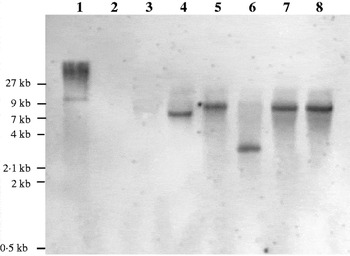
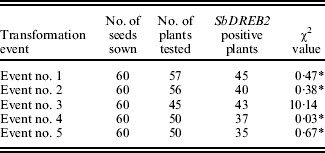
Analysis of transgene segregation in T1 progeny of self-pollinated T0 plants by PCR using SbDREB2 gene-specific primers showed that the five events chosen for analysis showed a monogenic segregation ratio (Table 1). Transgene integration and copy number in the T1 transgenic plants, analysed using Southern hybridization, showed that the transgenic lines contained a single copy of the transgene integrated into the genome (Fig. 2). Although line 3 did not give monogenic segregation ratios, it showed single copy insertion using southern hybridization.
Southern analysis of rd29A: SbDREB2 transgenic lines for the determination of transgene copy number. EcoR1 digested DNA was hybridized with DIG labelled SbDREB2-specific probe. Lane 1: pC1301rd29A: SbDREB2 plasmid; Lane 2: Blank; lane 3: DNA from untransformed plant; Lanes 4–8: DNA from rd29A: SbDREB2 transgenic lines 1–5.

Segregation analysis of T1 plants. Plants were tested for the presence of the SbDREB2 gene using PCR. Chi-square test was applied to test the ratios for monogenic inheritance
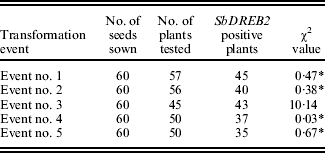
* Transgenic lines showing 3:1 ratio.
Expression of SbDREB2 and OsDREB2
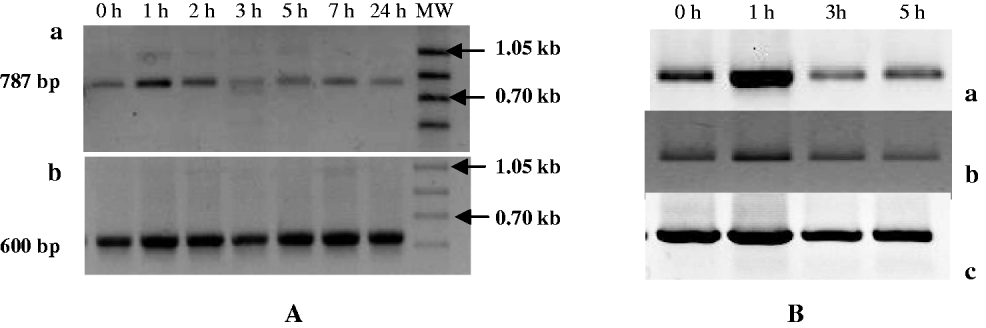
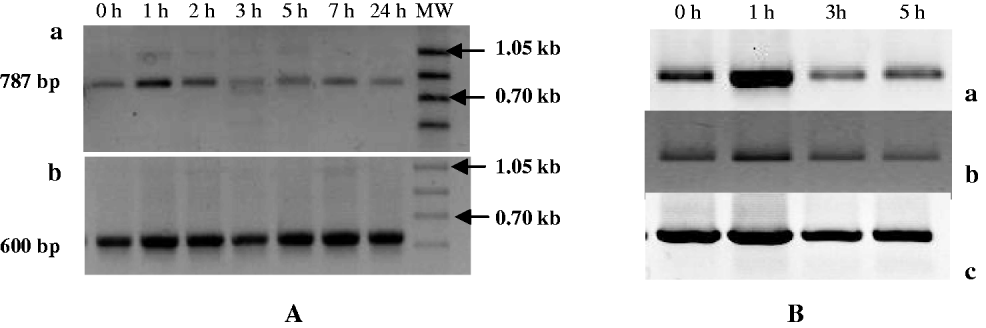
Analysis of SbDREB2 expression in drought-stressed sorghum seedlings revealed that desiccation stress treatment induced the expression of SbDREB2 transcription factor in sorghum and maximum expression was observed in the first hour of drought stress, after which the expression declined but remained detectable (Fig. 3a). A similar pattern of expression was observed for the native DREB2 gene (OsDREB2) as well as rd29A: SbDREB2 gene in the rice transgenic plants (Fig. 3b).
RT-PCR showing (A) (a) SbDREB2 expression in sorghum and (b) actin expression in sorghum subjected to 1–24 h drought exposure. (B) (a) OsDREB2 expression in transgenic rice; (b) SbDREB2 expression in transgenic rice; and (c) actin expression in transgenic rice subjected to 1, 3 and 5 h of drought exposure. Primers corresponding to SbDREB2 or OsDREB2 were used for amplifying the cDNA synthesized by reverse transcription. MW=molecular weight marker.
Drought stress tolerance of rd29A: SbDREB2 transgenic rice
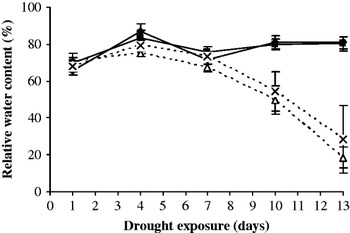
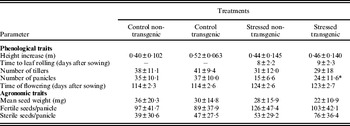
Drought stress led to a similar decrease in RWC in control and transgenic plants (Fig. 4). The plants appeared dehydrated and showed leaf rolling after 8–9 days of drought exposure, but recovered and produced new leaves, tillers and panicles after watering was resumed. There was a reduction in the number of tillers and panicles/plant and the stressed plants showed delayed flowering (Table 2). Since the data did not show normal distribution, statistical analysis for comparing the means of stressed and non-stressed transgenics and controls was carried out using the non-parametric Mann–Whitney test. Of all the parameters measured, a significant increase was only observed in the number of panicles produced by transgenic plants as compared to those produced by control plants under drought stress conditions. Under non-stressed conditions, these plants did not show any variation in panicle number.
RWC in control and transgenic rice plants on exposure to drought stress. (⧫) Control non-stressed, (●) transgenic non-stressed, (∆) control stressed, (X) transgenic stressed. Error bars indicate standard deviations of means.

Phenological and agronomic data for non-transgenic and rd29A: SbDREB2 transgenic plants growing under irrigated (control) and drought-stressed conditions. Values represent means and standard deviations of at least 20 plants for the transgenics and 10 plants for non-transgenics per treatment. Comparisons were made between non-transgenic and transgenic plants under either irrigated or drought conditions using the Mann–Whitney's test

* Indicates significant difference (P<0·05).
DISCUSSION
A constitutive CaMV35S promoter and a stress-inducible rd29A promoter were used to drive the expression of Sorghum DREB2 (SbDREB2) gene in rice plants. The constitutive expression of SbDREB2 gene using the CaMV35S promoter led to pleiotropic effects in transgenic rice, which consisted of stunted growth, fewer panicles, sterile pollen and poor seed set. The undesirable phenotypic effects due to the constitutive expression of DREB genes have been attributed to the activation of stress-response genes, which are known to disrupt metabolic processes, even in the absence of stress conditions (Kasuga et al. Reference Kasuga, Liu, Miura, Yamaguchi-Shinozaki and Shinozaki1999).
The rd29A promoter contains four copies of the cis-acting DRE/CRT element (Yamaguchi-Shinozaki & Shinozaki Reference Yamaguchi-Shinozaki and Shinozaki2005) to which the DREB transcription factors bind and regulate the expression of rd29A gene that codes for a LEA-like protein under stress conditions.
Analysis of SbDREB2 expression in drought-stressed sorghum seedlings and transgenic rice seedlings using RT-PCR revealed that the SbDREB2 gene was upregulated as early as 1 h after exposure to the stress in sorghum plants, after which the expression decreased to basal levels. In rice, both the native OsDREB2 gene as well as the transgenic rd29A: SbDREB2 showed similar patterns of expression, i.e. maximum induction at 1 h exposure to drought and then a subsequent reduction in expression levels. Transient expression of DREB transcription factors is an important aspect in the stress-response gene expression cascade (Thomashow Reference Thomashow2001; Yamaguchi-Shinozaki & Shinozaki Reference Yamaguchi-Shinozaki and Shinozaki2006). Transient expression of wheat DREB2 was seen using RT-PCR, where the gene was induced as early as 15 min after the onset of stress application by exogenous ABA treatment (Egawa et al. Reference Egawa, Kobayashi, Ishibashi, Nakamura, Nakamura and Takumi2006). Induction of Pennisetum DREB2 transcripts in response to drought also occurred within 1 h of treatment (Agarwal et al. Reference Agarwal, Agarwal, Nair, Sopory and Reddy2007).
The mechanism of the regulation of gene expression appeared to be similar for the native OsDREB2 and the transgene rd29A: SbDREB2 in the transgenic rice plants. It was expected that the expression of rd29A: SbDREB2 would be constitutive once the plants were exposed to drought since the rd29A promoter would drive the expression of DREB2, which in turn would bind to the rd29A promoter, thereby generating an autoregulatory loop. However, the similar expression patterns of the native and transgenic DREB2 suggest the involvement of other regulatory factors (probably trans-acting) in controlling the temporal expression of DREB2. The authors believe that this is the first report of heterologous expression of a monocot DREB2 in another monocot species.
The rice rd29A: SbDREB2 transgenics were used to study their performance under drought stress, which was administered under glasshouse conditions by withholding watering for 13 days. RWC decreased with prolonged exposure of non-transformed and rd29A: SbDREB2 transformed plants to drought and both types of plants showed leaf rolling symptoms, indicating that the water regulating mechanisms were similar in the transgenics and wild-type plants. Many studies report better stress tolerance and higher survival rate in DREB over-expressing transgenic plants. Rd29A-DREB2A-CA (which lacks the phosphorylation domain of DREB2 and leads to the constitutive expression of DREB2) showed 0·88 survival as compared to 0·21 survival in wild-type plants under drought conditions (Sakuma et al. Reference Sakuma, Maruyama, Qin, Osakabe, Shinozaki and Yamaguchi-Shinozaki2006).
In the present work, drought stress was terminated after the RWC fell to about 0·20 and watering was resumed, in order to study the effects of this intermittent stress on subsequent growth and yield of the wild-type and transgenic plants. All the plants recovered on the resumption of irrigation and completed their life cycle. The stressed rice plants showed delayed flowering, fewer numbers of tillers and panicles and a larger number of sterile grains. In field trials reported with different rice varieties, drought stress led to a delay in the onset of flowering and a decrease in spike fertility as was also seen in the present experiments (Babu et al. Reference Babu, Nguyen, Chamarerk, Shanmugasundaram, Chezhian, Jeyaprakash, Ganesh, Palachamy, Sadasivam, Sarkarung, Wade and Nguyen2003). Traits such as plant height, number of tillers and days to flowering were similar in the rice transgenics and the wild-type plants under stress as well as irrigated conditions. The transgenic plants produced a significantly higher number of panicles as compared to wild plants under stress conditions, though the mean grain weight was similar. The rice rd29A: SbDREB2 transgenics, therefore, appeared to increase yield under stress conditions due to an increase in panicle number rather than improved grain-related traits. There are no reports on phenological and agronomic traits of transgenic rice over-expressing DREB genes.
Transcription factors lead to the differential regulation of a large number of genes. Our studies showed that the SbDREB2 rice transgenics brought about an increase in panicle number, which is a complex trait governed by several genes (Kushalappa et al. Reference Kushalappa, Mattoo and Vijayraghavan2000). Hence, the use of transcription factors for transforming plants could be a useful strategy for improving multigenic traits.
The authors thank Dr Lee Pratt, University of Georgia, USA, for providing the HS1_50_A11 cDNA clone and Mr Khurade, Statistics Department, University of Pune, India, for statistical analysis. Pankaj Bihani thanks Mahyco Research Center, Jalna, India for providing the facilities and consumables required for this work.