Introduction
Psychopathy is a personality disorder characterized by a constellation of traits including interpersonal-affective features (e.g. manipulativeness, lack of affect and emotion) and antisocial features (e.g. impulsivity and aggression) (Hare, Reference Hare2003). In contrast to significant research on the psychophysiological and neurocognitive risk factors for psychopathy, there is a surprising gap in our knowledge of psychosocial influences (Raine, Reference Raine1993). This may be due to Cleckley's influential argument, based on case studies, that negative parental influences are virtually non-existent in psychopaths (Cleckley, Reference Cleckley1976). Nevertheless, Cleckley's cases tended to be biased towards more functional, middle-class psychopaths, and may not be representative of the broader societal population of psychopaths.
Consequently, only a few studies have examined psychosocial influences on psychopathy (Lang et al. Reference Lang, af Klinteberg and Alm2002; Campbell et al. Reference Campbell, Porter and Santor2004; Afifi et al. Reference Afifi, Brownridge, Cox and Sareen2006; Farrington, Reference Farrington and Patrick2006). Male prison psychopaths tend to have a background history of negative family influences (e.g. abuse, neglect, poor supervision) compared with non-psychopathic prisoners (Marshall & Cooke, Reference Marshall and Cooke1999). Prospectively, abused and neglected children show higher psychopathy scores in adulthood (Weiler & Widom, Reference Weiler and Widom1996). Psychopathy is associated with childhood abuse and neglect within substance-abusing adolescents (O'Neill et al. Reference O'Neill, Lidz and Heilbrun2003) and adults (Bernstein et al. Reference Bernstein, Stein and Handelsman1998). Highly psychopathic adults have higher levels of childhood abuse and neglect than those low on psychopathy (Lang et al. Reference Lang, af Klinteberg and Alm2002). Overall, this small literature identifies physical abuse as a potential correlate of psychopathy.
One under-researched psychosocial construct relevant to psychopathy is parental bonding. A classic developmental study by Bowlby (Reference Bowlby1969) on 44 male juvenile offenders who suffered maternal deprivation indicated that poor mother–child bonding early in life resulted in ‘affectionless psychopathy’. However, Rutter (Reference Rutter1982) argued that: (a) the key emphasis on the mother may be misleading; bonding with a father-figure could be important, and (b) there may be a ‘critical period’ from approximately 6 months until about 2–3 years of age during which bonding is critical. Nevertheless, it is unclear if disrupted bonding is associated with psychopathic personality per se, as the 44 thieves in Bowlby's study (and Rutter's re-analysis) were juvenile delinquents convicted of property offenses, with no formal assessments of psychopathic personality being used.
To the authors' knowledge, only two studies have examined explicitly defined parental bonding in relation to psychopathic personality. Both studies used the parental bonding instrument (PBI; Parker et al. Reference Parker, Tupling and Brown1979), the most widely used measure of parental bonding. Kimbrel et al. (Reference Kimbrel, Nelson-Gray and Mitchell2007) found that low maternal care in undergraduates predicted high self-report secondary but not primary psychopathy scores. McCartney et al. (Reference McCartney, Duggan, Collins and Larkin2001) found that patients with psychopathic disorder (UK 1983 Mental Health Act legal classification) had significantly low parental care and high overprotection scores compared with a mental illness control group; because no normal control group was included, it is unknown whether psychopaths have impaired parental bonding compared with normal controls.
Initial studies have also examined measures bearing similarity to parental bonding. Kosson et al. (Reference Kosson, Cyterski, Steuerwald, Neumann and Walker-Matthews2002) found psychopathy scores in male adolescents to be associated with their self-report rating of closeness to family as well as parental assessment of closeness of parental attachment, suggesting poor bonding. Campbell et al. (Reference Campbell, Porter and Santor2004) found that in addition to abuse, adolescent psychopaths were more likely to have experienced foster care placement, a variable likely to signal disrupted parental bonding. Importantly, foster care placement but not abuse uniquely added to the prediction of psychopathy, suggesting that poor bonding may be more important than abuse in predicting psychopathy.
An even bigger research gap concerns the influences of maternal and paternal bonding in predicting psychopathy. Although the child in its formative critical years spends more time with the mother than the father, paternal bonding may be of significance, yet it has been largely ignored (Rutter, Reference Rutter1982). Furthermore, there appears to be very little research on the differential correlates of subfeatures of psychopathy. The affective/interpersonal subfactor assesses callousness, lack of empathy, superficial charm and grandiosity, while the behavioral subfactor assesses antisocial behaviors, including impulsivity, irresponsibility and thrill seeking (Hare, Reference Hare1991a, Reference Hareb). O'Neil et al. (Reference O'Neill, Lidz and Heilbrun2003) found that abuse and neglect correlated with both factors and total scores. In contrast, based on one prior study (Wootton et al. Reference Wootton, Frick, Shelton and Silverthorn1997), Campbell et al. (Reference Campbell, Porter and Santor2004) hypothesized that abuse factors ‘influence the development of the antisocial life-style characteristics of psychopathy, but not the core interpersonal and affective aspects of the disorder’ (p. 42). Farrington (Reference Farrington and Patrick2006) similarly reported that poor parental supervision predicted high antisocial scores but not high affective scores, whereas low paternal involvement was a strong predictor of high psychopathy, in particular the affective component of psychopathy. These findings raise the question of whether bonding (in addition to abuse) is differentially related to the two subfactors of psychopathy.
Using both cross-sectional and prospective longitudinal designs, the present study attempts to add to this small, initial literature on bonding and abuse in relation to psychopathy. Measures of parental bonding, childhood physical abuse and psychopathic personality were assessed in male and female participants when they were aged 28 years. In addition, a prospective assessment of fostering before the age of 3 years was utilized to address the lack of prospective longitudinal research in this field. Gaps in the literature that the current study attempts to address are: (i) the generalizability of findings of bonding, abuse and psychopathy from institutionalized samples to community samples; (ii) whether parental bonding is related to psychopathic personality over and above the influence of childhood physical abuse, and conversely, whether abuse is associated with psychopathy over and above the influence of parental bonding; (iii) whether abuse interacts with bonding in relation to psychopathy; (iv) which aspect(s) of bonding (mother's care and overprotection, and father's care and overprotection) relates most to psychopathy; and (v) whether bonding and abuse are differentially related to the two subfactors of psychopathy.
Method
Participants
Participants consisted of a subsample of 333 participants (203 male, 130 female) who were randomly derived from a larger sample of 1795 children from the island of Mauritius (a tropical island lying in the Indian Ocean between Africa and India). All children born in 1969 or 1970 in two towns on the island were recruited into the study when aged 3 years. The two towns (Vacoas and Quatre Bornes) were chosen in order to be representative of the ethnic distribution of the whole island.
Ethnic breakdown of the subsample was as follows: Creole 25.7%, Hindu 38.9%, Moslem 19.5%, Tamil 10.0%, and other (Chinese, English, French and ethnically unidentified) 5.9%. This corresponds very closely to the ethnic distribution of the full sample. Those included in this test phase did not differ from the untested sample on parental occupation [t=1.35, degrees of freedom (df)=1783, p=0.19], ethnicity (χ2=0.06, df=4, p=0.81) or a comprehensive index of age 3 years social adversity (see below for details; Raine et al. Reference Raine, Yaralian, Reynolds, Venables and Mednick2002b) (t=0.04, df=1793, p=0.66), but did have a greater representation of males (χ2=13.7, df=1, p<0.001).
Measures (age 28 years)
Parental bonding
Parental bonding was assessed using the PBI (Parker et al. Reference Parker, Tupling and Brown1979), a measure of parental care and overprotection used in many countries throughout the world (Qadir et al. Reference Qadir, Stewart, Khan and Prince2005; Uji et al. Reference Uji, Tanaka, Shono and Kitamura2006). It consists of a 12-item care scale and a 13-item overprotection scale (Parker et al. Reference Parker, Tupling and Brown1979; Kazarian et al. Reference Kazarian, Baker and Helmes1987). The care scale consists of items such as ‘spoke to me in a warm and friendly voice’, ‘appeared to understand my problems and worries’ and ‘was affectionate to me’. The overprotection scale includes items such as ‘tried to control everything I did’, ‘invaded my privacy’ and ‘was overprotective of me’. Participants rated statements on a four-point Likert scale (0=very unlike, 1=moderately unlike, 2=moderately like, and 3=very like) about their parents' behavior during the first 16 years of their lives. Ratings were collected for both mother's and father's (or male and female caregivers if separated from parents) behavior. The PBI has shown good internal consistency and test–retest reliability (Parker et al. Reference Parker, Tupling and Brown1979; Parker, 1983). Coefficient α for the parental care and overprotection subscales ranged from 0.67 to 0.75, indicating moderate reliability for subscale scores in this sample.
Childhood physical abuse
Experience of significant physical childhood abuse was assessed using a modification of the Conflict Tactics Scale (Straus, Reference Straus1979). This modified self-report measure has been validated against adults who had been physically abused 20 years previously as demonstrated by official court reports of child abuse, and shows good discriminant and predictive validity (Widom & Shepard, Reference Widom and Shepard1996). Abuse was restricted to acts occurring before the end of elementary school because early trauma may be particularly important in influencing behavioral development (Teicher et al. Reference Teicher, Ito, Glod and Andersen1997). Participants rated statements on a six-point Likert scale (0=never, 1=once, 2=twice, 3=sometimes, 4=frequently, and 5=most of the time) about their parents' behavior when disagreement occurred. A total score of very serious physical abuse (five items including kick, beat up, burn or scald, threat with knife/gun, use a knife/gun) was computed to assess significant forms of physical abuse (Straus & Gelles, Reference Straus and Gelles1990). Of the sample, 43% scored 1 or more on this physical abuse measure. Coefficient α for the very serious physical abuse was 0.74.
Psychopathy
Psychopathic personality was assessed using Hare's Self-Report Psychopathy scale (SRP-II) (Hare, Reference Hare1985), a 60-item self-report version of the Psychopathy Checklist – Revised (PCL-R) (Hare, Reference Hare1991a, Reference Hare2003). Factor analyses of the PCL-R have revealed a two-factor structure (Harpur et al. Reference Harpur, Hakstian and Hare1988, Reference Harpur, Hare and Haskstian1989; Hare, Reference Hare1991a, Reference Hareb) that has also been demonstrated with the SRP-II (Williams & Paulhus, Reference Williams and Paulhus2004). Factor 1 (emotional detachment) assesses characteristics such as callousness, lack of empathy, superficial charm and grandiosity, and has been found to be associated with low anxiety. Factor 2 (deviant behavior) assesses antisocial behaviors, including impulsivity, irresponsibility and thrill seeking, and has been demonstrated to be correlated with antisocial personality disorder (Harpur et al. Reference Harpur, Hare and Haskstian1989). The SRP-II has been found to show a moderate correlation with PCL-R in a prison sample (Hare, Reference Hare1991b) and to be a valid measure of psychopathy in non-forensic populations (Williams & Paulhus, Reference Williams and Paulhus2004). Each item is scored from 1 (strongly disagree) to 7 (strongly agree). A total psychopathy score (coefficient α=0.67) and scores for the two psychopathy subfactors (α=0.60 for the emotional detachment factor and 0.64 for the deviant behavior factor) were collected for each participant.
Separation from parents in the first 3 years of life (age 3 years)
At age 3 years, social workers visited the homes of all the children to conduct a detailed, psychosocial interview with the primary caregiver on the circumstances of the child (Raine et al. Reference Raine, Yaralian, Reynolds, Venables and Mednick2002b). Included in the structured interview was an evaluation of whether the child was separated from both parents before the age of 3 years (being orphaned or raised by a substitute mother). Of the sample of 333, six (two males and four females, 1.8%) fell into this category. Males and females did not differ on the level of separation (χ2=1.912, df=1, p=0.167).
Social adversity (age 3 years)
Social adversity data were collected by the social workers in their home visitations. An index was created based on eight variables along lines similar to prior literature (Rutter, Reference Rutter, Hersov, Berger and Shaffer1978; Moffitt, Reference Moffitt1990) and was reported in detail by Raine et al. (Reference Raine, Yaralian, Reynolds, Venables and Mednick2002b). A total adversity score was created by adding 1 point for each of the following eight variables: father uneducated (no schooling), mother uneducated (no schooling), semi-skilled or unskilled occupation, teenage mother (aged 19 years or younger when child was born), single-parent status, large family size (sibling order fifth or higher by age 3 years), poor health of mother and overcrowded home (five or more family members per house room). In the same Mauritius sample, social adversity is negatively correlated with age 3 years stimulation seeking and cognitive ability, and age 11 years total intelligence quotient (Raine et al. Reference Raine, Reynolds, Venables and Mednick2002a).
Procedure
All test instruments were administered in Creole using an audio computer self-interviewing technology. Instruments were translated to Creole and back-translated to English by different local research staff and then confirmed by the second author (A.R.). Questions were individually presented to the participant on the computer screen and simultaneously spoken to the participant over headphones using a pre-recorded sequence. Participants responded to each question by typing a number on the keyboard that corresponded to a pre-determined numeric level of endorsement. Written informed consent was obtained from the participant and all research protocols approved by an Institutional Review Board.
Results
Descriptive statistics
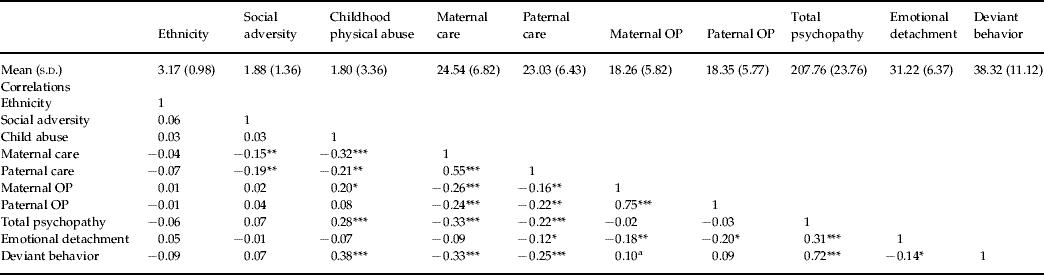
Means, standard deviations (s.d.) and intercorrelations between study variables are listed in Table 1.
Study variables and their intercorrelations

s.d., Standard deviation; OP, overprotection.
a p<0.10.
* p<0.05, ** p<0.01, *** p<0.001.
Early parental bonding and adult psychopathic personality (cross-sectional approach)
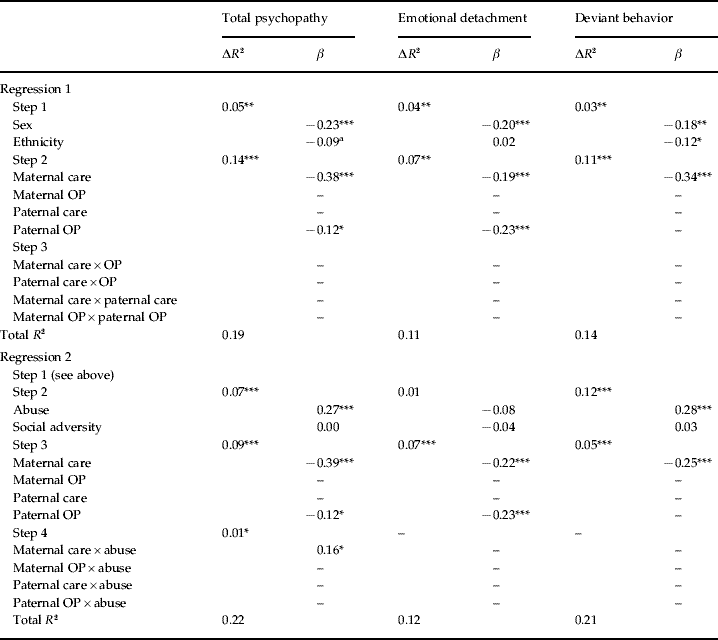
Hierarchical multiple regression analyses were conducted and all variables were standardized before the analyses. In the first set of analyses, sex and ethnicity were entered in the first step to partial out their influences using forced entry. Maternal care, overprotection, paternal care and overprotection were then entered simultaneously on the second step using a forward stepwise method to examine the association of these measures over and above demographic factors. The same set of analyses was conducted separately on total psychopathy and the two factor scores. Results are summarized in Table 2. After controlling for the effects of sex and ethnicity, low maternal care was associated with high total psychopathy (β=−0.38, t=−7.30, p<0.001) and both emotional detachment (β=−0.19, t=−3.55, p<0.05) and deviant behavior factors (β=−0.34, t=−6.45, p<0.001). Low paternal overprotection was associated with high total psychopathy (β=−0.12, t=−2.28, p<0.05) and the emotional detachment factor (β=−0.23, t=−4.29, p<0.001), but not the deviant behavior factor (p>0.05).
Summary of hierarchical regressions for total psychopathy and each factor score: the predicting effects of bonding

OP, Overprotection.
a p<0.10.
* p<0.05, ** p<0.01, *** p<0.001.
The association between paternal bonding and psychopathic personality after controlling the effects of abuse
In these analyses, variables were entered in the following order: step 1 – sex and ethnicity; step 2 – abuse and social adversity; step 3 – maternal and paternal care and overprotection; step 4 – the two-way interaction terms between child abuse and parental bonding. Results are summarized in Table 2. After the influences of sex, ethnicity, child abuse and social adversity were accounted for, the associations between maternal care and psychopathy remained significant: low maternal care was associated with high total psychopathy (β=−0.39, t=−6.36, p<0.001) and both factor scores (β=−0.22, t=−3.87, p<0.001 for the emotional detachment factor, β=−0.25, t=−4.67, p<0.001 for the deviant behavior factor). Paternal overprotection was associated with total psychopathy (β=−0.12, t=−2.33, p<0.05) and the emotional detachment score (β=−0.23, t=−4.30, p<0.001), but not with the deviant behavior factor score (p>0.05). Finally, the abuse×maternal care interaction was significant for the total psychopathy (β=0.16, t=2.21, p<0.05), but not with the two subfactors (p's>0.42).
The association between childhood physical abuse and psychopathic personality after controlling the effects of bonding
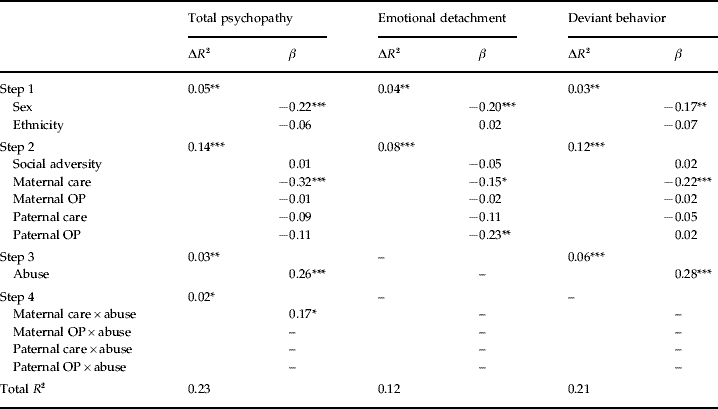
Hierarchical regression analyses were conducted in the following way: step 1 – sex and ethnicity; step 2 – social adversity, maternal care, maternal overprotection, paternal care and paternal overprotection; step 3 – abuse; step 4 – the two-way interaction terms between abuse and each parental bonding component (Table 3). After the influences of sex, ethnicity, child abuse, social adversity and parental bonding were accounted for, the association between child abuse and psychopathy remained significant for the total psychopathy (β=0.26, t=4.10, p<0.001) and the deviant behavior factor (β=0.28, t=5.07, p<0.001), but as before not for the emotional detachment factor (p>0.05). Finally, the abuse×maternal care interaction was again significant for the total psychopathy (β=0.17, t=2.51, p<0.05), but not for the two subfactors (p's >0.05).
Summary of hierarchical regressions for total psychopathy and each factor score: the predicting effects of child abuse

OP, Overprotection.
* p<0.05, ** p<0.01, *** p<0.001.
Physical abuse × bonding interaction
To help illustrate and understand the abuse×maternal care interaction, separate regression equations of maternal care on total psychopathy at +1 s.d. and −1 s.d. for childhood physical abuse were computed (Holmbeck, Reference Holmbeck2002). As can be seen in Fig. 1, for both low and high abuse groups, lack of maternal care is associated with high psychopathy scores (β=−0.419, s.e.=0.076, t=−5.534, p<0.001 for the low abuse group, β=−0.174, s.e.=0.078, t=−2.227, p=0.027 for the high abuse group). For individuals with high (+1 s.d.) or low (−1 s.d.) maternal care, childhood physical abuse is associated with total psychopathy scores (β=0.156, s.e.=0.057, t=2.712, p=0.007 for the low maternal care group, β=0.400, s.e.=0.112, t=3.581, p<0.001 for the high maternal care group).
The interaction between maternal care and child abuse in predicting total adult psychopathy scores. – –•– –, Low abuse; –▪–, high abuse.

Maternal care, paternal overprotection and psychopathy
After controlling the effects of sex, ethnicity, social adversity, abuse and maternal care, paternal overprotection remained significant for total psychopathy (ΔR 2=0.01, F=5.31, p<0.05, β=−0.12, t=−2.30, p<0.05) and the emotional detachment factor (ΔR 2=0.05, F=18.50, p<0.001, β=−0.23, t=−4.30, p<0.001). Similarly, after controlling sex, ethnicity, social adversity, abuse and paternal overprotection, maternal care was significantly associated with total psychopathy (ΔR 2=0.09, F=35.79, p<0.001, β=−0.33, t=−5.98, p<0.001) and both subfactors (ΔR 2=0.04, F=15.01, p<0.001, β=−0.22, t=−4.87, p<0.001 for the emotional detachment factor, ΔR 2=0.05, F=20.26, p<0.001, β=−0.25, t=−4.50, p<0.001 for the deviant behavior factor).
Early separation from parents and psychopathic personality (prospective approach)
Compared with others, the six individuals separated from their parents by age 3 years showed significantly lower scores on maternal care [t(331)=2.54, p=0.02, d=−0.90]. The group difference was marginally significant for paternal overprotection [t(331)=1.77, p=0.08, d=−0.72]. However, no significant group differences were found for maternal overprotection, paternal care or childhood physical abuse [t(331) <1.05, p's >0.29].
After entering social adversity as a covariate, significant group differences were found for total psychopathy [F(1, 330)=6.99, p<0.01] and the deviant behavior factor score [F(1, 330)=7.158, p<0.01]. Compared with other children, those separated from their parents by age 3 years scored significantly higher on total psychopathy (M 1=233.50, M 2=207.00, d=0.95) and the deviant behavior score (M 1=50.50, M 2=38.00, d=0.79). Groups were not different on the emotional detachment score [F(1, 330) <2, p>0.05, M 1=33.17, M 2=31.14, d=0.24].
Discussion
The key finding of this study is that disrupted parental bonding is associated with an increased level of adult psychopathic personality. Low maternal care was the key aspect of bonding most associated with psychopathy, while low paternal overprotection (i.e. increased autonomy and lack of regulatory control) was also important, especially in relation to the emotional detachment factor. Childhood physical abuse was also associated with psychopathy, but evidence from regression analyses suggests that bonding is more primary than abuse. Paternal bonding was of significance as it was associated with psychopathy after controlling for maternal care. These relationships remained significant after controlling for sex, social adversity and ethnicity. Prospective data on a small group suffering from significant bonding disruption in the first 3 years of life both confirmed links to later psychopathy and provided some validation of the self-report PBI. Findings indicate that maternal bonding and other psychosocial influences should not be ignored in the etiology of psychopathy, and for the first time implicate a role of bonding with the father.
Consistent with our hypothesis, low maternal care was the parental variable most strongly associated with both factors of adult psychopathy, reflecting the relatively greater impact of mothers. This finding is consistent with prior research showing that lack of maternal care was more consistently associated with adult psychopathology (including antisocial personality disorder) than paternal care (Enns et al. Reference Enns, Cox and Clara2002). Nevertheless, our study for the first time demonstrates a significant role of paternal bonding with respect to psychopathy. Low paternal overprotection was associated with higher scores on the emotional detachment factor of psychopathy, even after the effects of maternal care were accounted for. Low paternal overprotection scores reflect a lack of paternal involvement and regulatory control, and poor paternal monitoring and supervision. The significance of paternal bonding is consistent with prior work showing a trend for low paternal overprotection to be associated with increased risk for externalizing disorders (substance-use disorders and antisocial personality disorder) (Enns et al. Reference Enns, Cox and Clara2002). Similarly, low paternal involvement has been associated with the affective component of psychopathy (Farrington, Reference Farrington and Patrick2006). In addition, Wootton et al. (Reference Wootton, Frick, Shelton and Silverthorn1997) found that poor monitoring and supervision (within the context of a negative parenting composite) was related to greater callous-unemotional traits in 6- to 13-year-old youth. Lack of involvement and monitoring may impair the child's capacity for bonding, and conversely the presence of a protective (albeit strict) father may enhance the emotional connection between father and child, conferring some protection from the development of affective features of psychopathy. Future studies on parental bonding taking both maternal and paternal bonding into account are warranted.
One of the strengths of the current study is that the prospective component confirmed the concurrent findings. The finding of significant associations between early separation from parents assessed at age 3 years and psychopathy scores at age 28 years lends preliminary prospective support to the hypothesis that poor bonding predisposes to psychopathy, particularly the deviant behavior feature. This is broadly consistent with the finding that parental separation prior to age 10 years predicted the antisocial component of adult psychopathy but not the affective component (Farrington, Reference Farrington and Patrick2006). The fact that children separated from parents in the first 3 years of life showed significantly lower bonding scores in adulthood also shows some construct validity for the PBI and lends more credence to the concurrent relationships that we observed at age 28 years. Interestingly, children separated from their parents in the early years showed significantly lower maternal care scores and a trend (p<0.08) for reduced parental overprotection, the two components of bonding that related to psychopathy. This convergence of findings implicates these specific forms of maternal and paternal bonding in particular, rather than global bonding impairments in general.
Parental bonding was associated with both factors of psychopathy whereas abuse was only related to the deviant behavior factor. Furthermore, a significant abuse×maternal care interaction was observed, suggesting that parental bonding (especially lack of maternal care) may be a relatively more potent process than abuse in shaping psychopathic personality, given that it increases psychopathy scores in both conditions (i.e. whether abuse is present or not), and given the prior emphasis placed on lack of maternal care in predisposing to psychopathy (Bowlby, Reference Bowlby1969; Rutter, Reference Rutter1982). Because this interaction could be a chance finding, future studies assessing both abuse and bonding are needed to replicate and extend this interaction effect. Nevertheless, the differential associations between bonding and psychopathy subfactors are broadly consistent with prior psychosocial research (Harpur et al. Reference Harpur, Hare and Haskstian1989; Hare, Reference Hare2003). Seminal theories of primary and secondary psychopathy (Karpman, Reference Karpman1948; Porter, Reference Porter1996) argue that primary psychopathy (i.e. the emotional detachment factor) is more influenced by genetics while secondary psychopathy (i.e. the deviant behavior factor) is more environmentally influenced (abuse and bonding). Our findings in contrast suggest that abuse and bonding may have somewhat differential influences on psychopathy.
Findings may have prevention and intervention implications. Programs aimed at strengthening parental bonding, improving the quality of parenting and reducing physical abuse may be especially helpful. One longitudinal study of pregnant mothers randomized to a home visit program aimed at promoting maternal care and functioning demonstrated significantly lower scores on child abuse and neglect as well as juvenile delinquency 15 years later (Olds et al. Reference Olds, Eckenrode, Henderson, Kitzman, Powers, Cole and Sidora1997, Reference Olds, Henderson, Cole, Eckenrode, Kitzman, Luckey, Pettitt, Sidora, Morris and Powers1998). We nevertheless caution that common genetic influences could account for both the poor bonding in the parent and also the psychopathic personality in the offspring. Twin studies that include bonding and psychopathy measures are required to tease out the effects of genetic influences on the bonding–psychopathy relationship.
An unanswered question concerns the mechanism of action underlying the association between parental bonding and psychopathic personality. According to attachment theory, individuals who are not emotionally bonded or attached to warm and caring parents tend to become antisocial (Bowlby, Reference Bowlby1969; Carlson & Sroufe, Reference Carlson, Sroufe, Cicchetti and Cohen1995). Neurobiologically, parental deprivation or parental loss may induce enduring changes in neuroendocrine functioning, specifically alterations of hypothalamic–pituitary–adrenal (HPA) axis function. Early maternal deprivation reduces central nervous system serotonin turnover in Rhesus infant monkeys (Shannon et al. Reference Shannon, Schwandt, Champoux, Shoaf, Suomi, Linnoila and Higley2005). Parental desertion and very low levels of care have been associated with abnormal cortisol levels and stress responses in humans (Luecken, Reference Luecken2000; Kertes et al. Reference Kertes, Gunnar, Madsen and Long2008; Tyrka et al. Reference Tyrka, Wier, Price, Ross, Anderson, Wilkinson and Carpenter2008). Abnormal HPA axis functioning has been associated with psychopathic traits in prisoners (Cima et al. Reference Cima, Smeets and Jelicic2008) and with callous-unemotional traits in community adolescents (Loney et al. Reference Loney, Butler, Lima, Counts and Eckel2005). Therefore, it is possible that early parental deprivation predisposes to later development of psychopathic traits by altering HPA axis functioning.
Finally, limitations of this study should be recognized. This community sample is culturally and ethnically unique, so the findings may not necessarily generalize to Western samples or to clinical populations. In addition, due caution should be exercised in interpreting the effects for the emotional detachment subfactor of psychopathy, given that its association with bonding was only observed in retrospective but not prospective data. As with many prior studies, we used self-report measures of bonding, abuse and psychopathic personality which have their limitations. Later functioning at age 28 years could affect retrospective memories and reports of individuals' bonding to parents and even of reports of childhood physical abuse. We made efforts to address this limitation by using computerized data collection procedures to maximize openness/honesty, and by using a prospective, longitudinal design to validate the self-report measure on bonding. Although the sample size of children separated from their parents in this prospective study component was small, this longitudinal sample confirms that disruption to early bonding predisposes to psychopathy, despite lack of statistical power. Furthermore, small sample size biases towards type II rather than type I errors. Similarly, the relatively low internal consistency of the SRP-II in the current sample may have underestimated psychosocial–psychopathic personality associations. Nevertheless, findings are suggestive of possible links between bonding and psychopathy, and future longitudinal studies with large sample size are needed to replicate the current findings. Another limitation consists of self-report psychopathy as opposed to use of the PCL-R, the most widely used assessment tool of psychopathy, specifically in correctional settings (Hare, Reference Hare2003). We were constrained in this context by the use of a non-institutionalized community sample, although we did utilize an instrument developed by Hare (Reference Hare1991b) which has been validated against PCL-R ratings in prisoners (Hare, Reference Hare1991a). We were also unable to collect other abuse other than physical abuse data from the current sample. Finally, it is possible that a third evocative factor, such as personality and temperamental traits in the child that predispose to adult psychopathic personality, may elicit low levels of care or overprotection from the parents. Furthermore, the six preschool children separated from both of their parents by age 3 years may have been at higher risk for later foster care, which may partly account for the association between poor bonding/abuse and psychopathic personality. Despite these limitations, it is felt that this study helps address an important, decades-old gap in the literature on bonding and psychopathy. Converging findings from prospective and concurrent study designs draw attention to the potential critical importance of specific components of bonding in predisposing to adult psychopathy, highlight the neglected role of paternal bonding, and have potential implications for early intervention and prevention of psychopathy. Given the critical role of the early psychosocial environment on brain development, and given brain influences on psychopathy (Raine & Yang, Reference Raine and Yang2006), it is felt that future neurobiological research on psychopathy could be potentiated by the inclusion of parental bonding measures.
Acknowledgements
The initial data collection was made possible by grants to P.H.V. from the Medical Research Council (UK) and the Wellcome Trust (UK). This study was also supported by grants to A.R. from National Institutes of Health (Independent Scientist Award K02 MH01114). We thank all the local members of the project for help with data collection.
Declaration of Interest
None.