An SEP [somebody else's problem] is something we can't see, or don't see, or our brain doesn't let us see, because we think that it's somebody else's problem . . . The brain just edits it out, it's like a blind spot. If you look at it directly you won't see it unless you know precisely what it is. Your only hope is to catch it by surprise out of the corner of your eye . . . it relies on people's natural predisposition not to see anything they don't want to, weren't expecting, or can't explain.
Douglas Adams, Life, the universe and everythingIn the archaic understanding of ‘occulting’, objects, particularly celestial bodies, may be hidden from view by something else passing through one's line of sight. Though the occulted body disappears from view, we presume that it has not physically disappeared, and a readjustment of our position will restore our view. This works because we are independent of the occulting body. Is this is the metaphoric belief that we hold with respect to certain subjects in the past? More specifically, do we believe that the past, as historical memory, is independent of the processes that occlude our view? Or is forgetting instead partially constitutive of memory and the ability to re-member the past?
The question is significant because the tension between memory and forgetting parallels a paradox in archaeological interpretation which is at the crux of our understanding of what ‘the past’ is. Of late, archaeologists have explored the relevance of social memory with respect to embodied tradition, subaltern histories, partisan pasts or archaeological practice (Lucas Reference Lucas1997; Van Dyke and Alcock Reference Van Dyke and Alcock2003; Mills and Walker Reference Mills and Walker2008; Tarlow Reference Tarlow1999; Meskell Reference Meskell2004; Bradley Reference Bradley2002; Jones Reference Jones2007; Williams Reference Williams2006; Shackel Reference Shackel2000; Reference Shackel2001; Kuijt Reference Kuijt2008; Silliman Reference Silliman2009, for example). On the one hand, we recognize that explorations of memory and forgetting are natural outgrowths of a contemporary atmosphere in archaeology as politically and publically engaged practice. American historical archaeologists like myself often approach the study of European colonialism and slavery in North America from an embattled and democratizing position, that of re-presencing a past hidden in the landscape and material culture of the period. By and large this is regarded as success, as social justice, as the return of history to the ‘peoples without history’ (Wolf Reference Wolf1982): women, African Americans, immigrants, the working class, children, and many more (a few examples include Wilkie Reference Wilkie2003; McDavid Reference McDavid, Shackel and Chambers2004; Mullins Reference Mullins and Orser2001; Clark Reference Clark2005; Voss Reference Voss2005; Saitta Reference Saitta2007; Sofaer-Derevenski Reference Sofaer-Derevenski2000; see the brief but cogent overview in Shackel Reference Shackel2008). While I agree that these cases are to be applauded, I sometimes catch myself thinking of such hidden histories as eminently recoverable, because we approach social memory as something either overt or occulted, or from a Freudian perspective, repressed or not. In this view, the condition of histories as occulted or repressed is reversible through the relatively straightforward process of digging, in the ground, in the archives, in the subconscious.
On the other hand, we acknowledge that the subject positions to which descendant communities and stakeholders connect have no essential or universal commonality. Singular categories of persons have no empirical reality today, and we now assume this to be so in the past. For example, in gendered and feminist approaches, archaeologists very quickly moved past the ‘add-women-and-stir’ phase, rejecting the notion of straightforward representations of gender in favour of complex constructions and experiences of sex, sexuality, embodiment, reproduction, restriction and empowerment (for example Joyce Reference Joyce2008). In other words, subjectivities are built out of historically contingent experiences, to the extent that the bundle of experiences we categorize as gender (or race, or class) may not have been a coherent aspect of identity at all in the past. The difference in these lived experiences, past and present, is partly translated into social memory – identifying past experiences as a reason why we are not like that today – and partly forgotten, in that the conditions for our present reality as doxic or ‘natural’ require the exclusion of such experiences from possibility. This ‘prehistory’ of gender, in the sense explored by Agamben (Reference Agamben, D'Isanto and Attell2009) recalling Foucault's genealogical method, must be forgotten in order for gender to exist as it does today. ‘Archaeological regression, going back to the hither side of the dividing line between the conscious and unconscious, also reaches the fault line where memory and forgetting, lived and non-lived experience both communicate with and separate from each other’ (ibid., 102). The realms of the unconscious, non-lived experience, and the forgotten, all shape our presents as much as their opposites, and yet they are defined by their inaccessibility to us.
Given this paradox, treating memory as the object, while forgetting becomes the dysfunction or occulting of that object, is untenable. Reclaiming certain memories entails reifying identities which are retrospectively significant, and forgetting itself contributes to their significance. Thus I argue that we do not spend enough time considering how or why historical actors enacted forgetting. Often our occulting obstacle is evidentiary, as in a lack of preservation, but just as often it is a conceptual roadblock, a category or ontology which is the product of creating narratives of the past in the present. These narratives include disciplinary explanations of who our subjects are and what temporal era they belong to, without acknowledging the sources of those stories. I would like to suggest that in our haste to get rid of occulting bodies we have forgotten to look at them more closely, as something which is not simply a product of our present (modern) perspective, but of active processes in the past. If the goal is to remember, we should investigate how certain pasts were forgotten as partly constitutive of memory, and as an aid in understanding if or how they may be recovered. It would be valuable to understand how forgetting is itself a critical component in the construction of historical selves at any scale, and not simply a tool of the powerful. Conversely, in the sense noted above, the possibility (or impossibility) of recovering the forgotten speaks to the conditions of the present which make the past experiences knowable.
In this paper I explore forgetting, not in opposition to memory but as a critical component of it. The enactment of forgetting has implications for the production of history, identity and heritage past and present, including the shape of archaeology as a discipline. An explicit focus on that enactment may aid in closing the gap between presently experienced identity constructions and the historical experiences to which living communities seek to connect. This is because forgetting and memory, with their prolonged temporal reach, must be traced from past to present rather than recovered in whole from a past ‘event’. In particular, I have found these perspectives relevant and revelatory for my own interpretations of the history and archaeology at the site of Sylvester Manor in New York. Established in the 17th century as a provisioning plantation, this estate demonstrates the process of occulting a complex pluralistic past. Here, commemorative landscapes, material culture and technology, as well as documentary remains, are explored as sites where a variety of historical agents have enacted forgetting with a variety of methods and aims. The significance of viewing that past through a lens of forgetting has been to draw attention away from the description of subsequently racialized groups in an earlier moment and towards the process of racial categorization over the long term and in tension with other sorts of association (class, for example). Thinking through this case I have come to believe that one of the more powerful contributions of archaeology to how we understand the production of history may be the ability to directly confront the process of forgetting, even if we cannot recover what is forgotten.
The case of Sylvester Manor
The estate of Sylvester Manor, first settled by Europeans in 1651–52, originally encompassed the 8,000-acre island located at the east end of Long Island (New York). Though the estate is today reduced in landholding to approximately 250 acres, descendants of the Sylvester family have held the property continuously since that time, and have retained a significant private archive of estate-related documents. Thus both family oral histories and reference to selected and revered documents were the foundation for the popularly known history (social memory) of the plantation (for example in Lamb Reference Lamb1887; Mallmann Reference Mallmann1990; and Duvall Reference Duvall1952). This history indicates that the island was settled amidst a contested transfer of the property from the indigenous Manhanset to the Sylvesters and their financial partners, mediated by several interim English owners and finally by the United Colony Court. The final disposition entailed the formal transfer of the property from Youghco, the sachem (tribal leader) of the Manhanset, to the Sylvesters, and the departure of the Manhanset. The plantation was in the meantime established to provide essential goods to two sugar plantations in Barbados, also held by the financial partnership. While the original demographic is unknown, by 1680 Nathaniel Sylvester claimed to be sole owner not only of the estate, but also of 23 named individuals who were mostly identified as ‘negro’. In the interim there is no reference to the presence of Manhanset on the plantation, with the exception of their occasional hire as guides, and one instance of Quaker proselytizing (Mrozowski, Hayes and Hancock Reference Mrozowski, Hayes and Hancock2007; Priddy Reference Priddy2007; Hayes Reference Hayes2008).
Excavations were undertaken at Sylvester Manor at the invitation of the property owner at the time, between 1998 and 2006.Footnote 1 A combination of survey and wide-area excavations indicated that most of the extant property was sparsely used in the 17th century except in the areas immediately surrounding the standing 18th-century house. In this area, an extensive working yard, cobbled road surface, waste pits and sheet middens, and a few poorly defined structures date to the early plantation period. There is no clear segregation of working space from domestic structures, and no evidence of separate quarters for the enslaved (Hayes Reference Hayes2007). Mixed with architectural construction and destruction debris, utilitarian ceramics of European manufacture, items of personal adornment and quantities of livestock slaughter waste were a large number of fragments of lithic debris and expedient tools, and sherds of locally produced coarse earthenware. The latter two materials were quite similar in fashion to those found at several indigenous fortified sites in the southern coastal New England/eastern Long Island region. Distinguishing the experiences of the Manhanset (as suggested by the presence of these materials) and the enslaved Africans (as denoted by documents) was not possible by spatial or task-oriented materials, although the presence of wampum (shell bead) production waste suggests at least one undocumented skilled role likely filled by the Manhanset. This production alone may explain the conspicuous silence in documentary remains regarding the presence of the Manhanset, as wampum was used by colonists as currency in the lucrative fur trade, and as such may have represented a source of income for Sylvester which could be hidden from his financial partners.
Guided by the suspicion that I could not identify distinct groups because those groups were not distinguishing amongst themselves in the past, I sought to clarify whether technological practices different from those demonstrated by precolonial Manhanset remains were incorporated into the lithic and ceramic production in the plantation setting, indicating collaboration among people of very different technological traditions. Materials from precolonial sites and the contemporaneous fortified indigenous sites were used as a basis for comparison to plantation-context assemblages. The lithic and coarse earthenware material from the early plantation contexts demonstrated tremendous variability beyond what was evident for the comparative materials. In the lithic material, a most obvious switch in raw material (from quartz to ballast flint) was accompanied by a more subtle change in manufacturing practices. Heat treatment of flint cores and greater reliance on expedient flake tools were introduced, while evidence of novice or lesser-skilled stone-knapping techniques (inefficient core use, poorly chosen striking platforms resulting in step or hinge fractures, and wayward percussion marks) on some materials was also observed. I interpret these signs as the result of enslaved African adoption of lithic manufacturing practices, through either first-hand observation or direct teaching of the method by skilled indigenous toolmakers (Hayes Reference Hayes2008, 191–228).
In a similar instance of technological sharing, local ceramic production in the plantation context became quite variable. While the stylistic conventions were quite consistent with those seen at contemporaneous indigenous sites, chemical and mineralogical markers revealed the introduction of higher ceramic firing temperatures, and the possibly experimental inclusion of mortaring materials in ceramic pastes (Hayes Reference Hayes2008, 141–90; Hayes n.d.). The changes in manufacturing techniques point to the task of mortar and plaster production undertaken at the plantation by enslaved Africans. Additionally, skills derived from ironworking or managing sugar boilers may have contributed African knowledge of pyrotechnology to local ceramic firing.
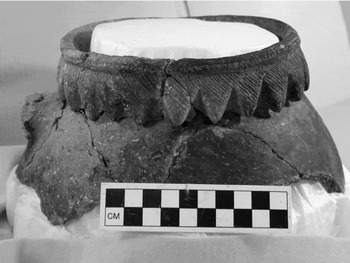
These results are indexical of interaction through technological sharing. In an overt example of a ‘hybrid’ form, one ceramic vessel also incorporated a handle attached to its side, an element unique in the regional indigenous pottery of this period or before (figure 1). Such a vessel form is a poignant suggestion of sharing, with a handle which literally reaches out to those who might otherwise be unaccustomed to managing such vessels. We might also safely assume that other interactions which left no material traces also took place, such as mutual aid, sharing of meals, or even intermarriage as later census records suggest (as will be discussed in more detail below). Whatever the degree or kind of interaction, the common experience of labour on the plantation created the conditions for forging some sense of community amongst the enslaved and the indigenous (as a potentially comparable example see Voss Reference Voss2008).
Partially reconstructed vessel recovered from trash pit. Note upper fragment of vertical handle on left; the style is otherwise consistent with Shantok ware, found throughout southern coastal New England and New York following the Pequot War of 1637.

Forgetting in the creation of new identities
Thus the first instance of forgetting which the recovered material points to is that which occurs in the construction of new community identities. For the Manhanset this may have been a double-edged sword. On the one hand, the evidence for technological sharing suggests the incorporation of enslaved Africans to their own community, and their very presence on the plantation working landscape suggests an alliance with the Sylvesters, either based in coercion or through an agreement to provide protection from other tribal polities in the region. Through the middle of the 17th century, relationships between indigenous political groups were still quite contentious, in part because control of the lucrative wampum trade was at play following the near decimation of the Pequot in 1637 at the hands of the English with the assistance of Mohegan and Narragansett (Ales Reference Ales1979; Hayes Reference Hayes2008, 30–43). On the other hand, the ceramic styles also point to the effort at reformation of a broader Indian community alliance. As Connerton (Reference Connerton2008, 62–64) has noted, forgetting may be constitutive of a new identity, particularly in efforts to overcome pluralism perceived as divisive. What I argue here is that the pottery played a particular role in the process of shifting alliances, and that those shifting alliances are implicated in strategic constructions of memory and forgetting.
In some instances, this process may be viewed as an act of resistance, as when subaltern groups join forces, forgetting past enmities when an even greater threat is presented. Native North American groups in some notable examples have agreed to forget their own differences, as in the Pueblo Revolt of 1680. Liebmann (Reference Liebmann2008) has argued that this process was in part seen in the abandonment of diverse pottery styles in favour of more uniformity as part of a native revitalization movement. While architectural styles post-revolt referenced a much more ancient tradition of living space, the local pottery style in Liebmann's study area, Jemez black-on-white, was abandoned, possibly because the style had been applied to Spanish vessel forms. Instead, Jemez potters adopted styles in use by neighbouring Pueblo communities, or in hybrid combinations of elements, thought to re-emphasize identity associations based in indigeneity while rejecting styles which had come to be associated with the Spanish (see also Mills Reference Mills and Preucel2002; Capone and Preucel Reference Capone, Preucel and Preucel2002).
In southern New England, a similar shift to a single emblematic pottery style called Shantok ware, recovered in quantity at Sylvester Manor, is found across many formerly hostile groups in the wake of the Pequot War of 1637. As noted earlier, United Colony court records document the ongoing struggles between tribes for political ascendancy following the Pequot defeat. Yet efforts at alliance between these groups may have been attempted. One Montauk individual's recollection, recorded later by an Englishman, was that an Algonquian sachem had made gestures of alliance to the Indians of Long Island: ‘he gave them gifts, calling them brethren and friends, for so are we all Indians as the English are, and say brother to one another; so must we be one as they are, otherwise we shall be all gone shortly’ (Gardener Reference Gardener and Hampton1897, 142). Sites where the Shantok-style pottery has been found relate to historically documented polities which participated in these shifting confederacies in the early colonial period. While the pottery was originally believed to have been the product of a single tribe on the move following the war (Rouse Reference Rouse1947; Johnson Reference Johnson, Levine, Sassaman and Nasseney1999), closer examination of not only the stylistic elements but also the manufacturing techniques suggests that, instead, the ware was produced by multiple communities. This pottery is an abrupt shift to smoothed exterior vessels with prominent castellations and/or a collar ‘frilling’ composed of pendant triangular incised lobes. These elements are, literally and figuratively, inscribed with a common reference.
Yet a comparison of examples from Sylvester Manor (including the example pictured in figure 1), the coastal Connecticut Shantok site and a fortified Corchaug site on Long Island also demonstrates that there was variability in the application of those elements (following the work of Goodby Reference Goodby and Stark1998; Reference Goodby and Kerber2002). Lobes might be either externally applied clay, or an extrusion from the vessel interior, and local preferences for thicker or thinner incising, perhaps from choices in tools, was expressed (Hayes Reference Hayes2008, 187). The techniques might then be thought of as habit-memory or incorporated traditions (following Connerton Reference Connerton1989; Rowlands Reference Rowlands1993). While the stylistic elements are widely recognizable, the participation of potters from different communities is also apparent. The wide distribution of this highly recognizable style across multiple communities with unstable relationships to one another does seem to suggest some effort to signal solidarity in response to the gestures of alliance, a challenge to English efforts to pit communities against one another. For the Manhanset on Shelter Island, such an emblem might serve to signal alliance with other Algonquian groups along with mistrust of the English when individuals from those groups had occasion to witness them laboring for the Sylvesters. At the same time, the incorporation of new manufacturing practices and the unique addition of a vessel handle could have evoked memories of collaborators on the plantation.
How is this material culture, acting as a signal of alliance and identity, implicated in memory and forgetting? Identity is here framed as a malleable set of associations that may be remembered or forgotten as situations demand. Comparable ethnographic and ethnohistoric examples of indigenous and non-Western concepts of forgetting demonstrate the essential role of material culture in enacting or dissolving associations. In Melanesia, where ‘fame’ is created through the circulation of materialized memory (partible persons) in gift exchange (Munn Reference Munn1986), anthropologists have also noted that the process of receiving such gifts incurs debt and shame which must ultimately be shed through ritual ‘finishing’ of associations (Battaglia Reference Battaglia1992). In other instances, mortuary rites for the dead are moments to finish associations through material destruction, disposal or decay, in the recognition that one cannot maintain all associations as they may no longer be healthy (Weiss Reference Weiss1997; Küchler Reference Küchler2002). Not only is it the dead that are to be forgotten. Cole (Reference Cole1998, 616) found that for the Betsimisaraka of Madagascar, memory ‘means defining their place and position in the world, asserting links with particular places and people while rejecting others . . . they believe that by remembering one set of relationships they forget or erase another’. In the Western Algonquian world of the 17th century, gift exchange and debt payments figured heavily in the system of kinship and social relations (White Reference White1991; Witgen Reference Witgen2007). And amongst the Eastern Algonquians, including the Manhanset, social and political networks were not produced through a single interaction, but evidently had to be nurtured in person and through persuasion, lest the connection be forgotten (Bragdon Reference Bragdon1996; Johnson Reference Johnson, Levine, Sassaman and Nasseney1999). Such a system was thus quite open to revising notions of ‘community’.
What of the notion of community created by association between the Manhanset and the enslaved? Certainly throughout the region, census records suggest that intermarriage between individuals of African and indigenous descent was not uncommon (Mandell Reference Mandell1996; Reference Mandell2008), yet such a historical narrative is rendered nearly silent by predominant constructions of distinct racial identities. How is it forgotten? In part this gap is the result of disciplinary divides. There is little archaeological research examining indigenous presence in plantation settings, or of the incorporation of enslaved African Americans into indigenous communities (but see Weik Reference Weik1997; Mathis and Weik Reference Mathis, Weik, Smith and Wobst2005). As Lightfoot (Reference Lightfoot1995) has pointed out, until recently the archaeology of Native American sites has been the exclusive preserve of prehistorians, while African American archaeologies are the province of historical archaeology, creating an apparent temporal division rendering the possibility of interaction nil (see also Lucas Reference Lucas2004 on disciplinary temporalities). Although one could readily point to archaeological research relating to both in the colonial period, the discussions of African Americans tend to resemble origin stories, while discussions of Native Americans are extinction stories (although see Rubertone Reference Rubertone2000).
Temporality matters in other respects in the historical process of constructing social memory, creating and finishing associations around such communities. That is, such interactions may not have been marked as significant events, as social memory, until circumstances marked them retrospectively, per Trouillot's (Reference Trouillot1995) understanding of the creation of facts and archives. Similar to this is Fogelson's ‘nonevent’ (Reference Fogelson1989). Nonevents come in several flavours, including traumatic repressions, and legendary events which did not occur. Most germane to materialized memory are latent nonevents, or differentially recognized events, which are unremarked at their occurrence as events. These nonevents are, he suggests, most useful to the ethnohistorian who looks for minor recorded details in historical documents, inessential to the recorder but assigned retrospective significance by the scholar (Fogelson Reference Fogelson1989, 142–43). As with autobiographical memory, there is a selective process that occurs in the construction of facts and archives (documentary or other materiality) in which not everything is sedimented as part of a coherent narrative (for example Joyce Reference Joyce2004). Latent nonevents highlight the longer-term processes of social memory construction and evolution, as well as its instrumentality. At Sylvester Manor the labour community forged in indigenous–enslaved interactions may have been too mundane to remark upon at the time. In other words, the category of race as a practical division of society was not at issue at this time. Had the circumstances continued uncontested perhaps the setting would have been memorialized as a ‘socioeconomic consortium of two marginalized communities’, as in the whaling industry of the nearby town of Sag Harbor (Barsh Reference Barsh and Brooks2002, 77).
Instead the silence surrounding Manhanset presence at that time is palpable, hinting at something more than the covert production of wampum. Could there have been another reason why such a community would be excluded from social memory? Court records from the surrounding colonies reveal some of the reasons white colonists made this a matter of concern as early as the plantation period itself. Increasing tensions in the Massachusetts Bay Colony between settlers and indigenous communities exploded into King Philip's War in 1675, less than forty years after the horror of the Pequot War (Lepore Reference Lepore1998). In the newly won colony of the Duke of York, new laws were issued clarifying the distinction between indenture and enslavement, declaring Indians ineligible for enslavement, yet also establishing prohibitions on indigenous possession of firearms (Fernow Reference Fernow1883, 697). In other areas, enslavement of Indians was still permitted, but usually only in cases of punishment, in which the convicted party or group was sold into slavery in the Caribbean (Newell Reference Newell, Calloway and Salisbury2003). Even earlier, a 1657 case of arson was attributed to the actions of ‘a wicked Indian’ and ‘a mischieuious Negar woman seruant [sic]’ (Pulsipher Reference Pulsipher1859, ii, 180). Nathaniel Sylvester himself, after years of apparent silence regarding the presence of the Manhanset on his plantation, found himself compelled to complain to the colonial courts in 1672 of the threatening behaviour of those residents (Fernow Reference Fernow1881, 671).
Such collaborations and uprisings had become an increasingly frightening spectre to white settlers who must have been cognizant of the fact that they had created conditions of disenfranchisement. Similarly exploited, the enslaved and the indigenous had many reasons to collaborate, hinting that this story might otherwise have been one of class conflict. But those reasons would be later masked or forgotten by attributing actions instead to racially inherent behaviours (literally underwritten by slavery laws), rather than to a situation of the settlers’ own making. Such events and rationalizations would also inspire efforts to separate those groups who were most disenfranchised. These attitudes are carried forward and compounded, as recently noted: ‘histories tend to reflect the biases of Euro-Americans, whose fears of military alliance between Africans and Native Americans and focus on inter-group antagonisms ignores the productive interactions between them’ (Mathis and Weik Reference Mathis, Weik, Smith and Wobst2005, 282).
Landscapes of memory and forgetting
The process of legal, physical and symbolic separation of the enslaved from the indigenous begun by colonial settlers in the 17th century continued to unfold through the landscape of the estate of Sylvester Manor over the next several hundred years. Separation is suggested by Forty (Reference Forty, Forty and Küchler1999, 8) as one process by which objects enact forgetting, in particular with memorials ‘performing a separation between what is to be remembered, and what can be forgotten’. Certainly some aspects of the plantation setting are memorialized in the landscape, even the remarkable pluralism of its historic populations, but it is a rather particular version of the history which is told. The overtly commemorative aspects of the landscape, constructed over 200 years after the early plantation operation, cannot be understood without the longer-term revisions to Sylvester Manor as a place which enables or restricts the circulation of memory.
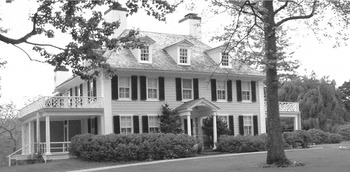
The restriction and exclusion of memory was first accomplished by effacing the very grounds of interaction. Archaeological excavations, taking place in the tranquil landscape of the estate, have revealed the extent to which the Sylvester descendants effaced the early plantation edifice, in the construction of a genteel English estate in the early 18th century (figure 2). While it has been suggested that elements of earlier structures are incorporated into the standing Georgian house, large quantities of demolition debris were deposited atop sheet middens accumulated from the later 17th century. This mixture was then used as fill, to smooth and level the land surface, erasing the uneven, cluttered, working landscape of the past. While the original orientation of the plantation compound was likely towards the water, as the sole route of connection to other communities, the 18th-century house faces inwards, towards the community which had now established itself on the island (Hayes Reference Hayes2007). No longer provisioners, merchants peripheral to the established gentry, the Sylvester descendants created a setting for themselves appropriate to landed gentry, separated from the labour which provided their wealth. Though the estate continued to make use of enslaved labour, it was regarded more as a country property, occupied by the family periodically between stretches in Newport or Boston (Mrozowski, Hayes and Hancock Reference Mrozowski, Hayes and Hancock2007).
1735 house and current landscape in the location of the early plantation working area.

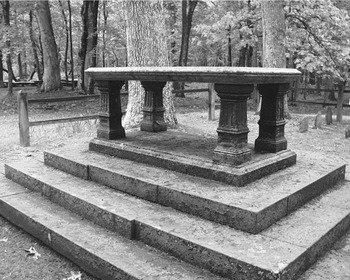
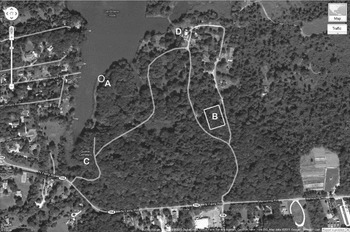
It was not until the later 19th century that active commemoration of the earliest plantation residents began to appear. Three main memorials placed on the remaining estate completed the process of separation by recognizing all the early residents, but only by oblique reference to modern racial categories. Most prominent is the commemoration of Nathaniel Sylvester himself, who figures centrally in local histories (figure 3). His and his wife's efforts on behalf of Quakers persecuted by the Puritans of Massachusetts and other colonies are celebrated in a graceful monument in the midst of a small cemetery for Quakers. Polished, sculpted, inscribed and dedicated in 1884, the text of the monument explicitly references associations to Charles II, and his auditor who remained with him in exile who was Nathaniel's father-in-law. Two heavily romanticized historical narratives of the period also note that ‘the cemetery and grove where it stands is called Woodstock from its threads of relationship to the ancient English manor of Woodstock, where Charles II was concealed in his flight’ (Lamb Reference Lamb1887, 387; Duvall Reference Duvall1952). Sylvester is thus set apart in a distinct realm of history unconnected to the original aims of the plantation. With an adjacent Friends’ meeting space on the estate still open to the public via a secondary entrance, it is the most accessible and widely known memorial. It is so widely known that it is labeled on Google Map satellite images (figure 4).
Monument commemorative of the Quakers sheltered from persecution by the Sylvesters.

Google Map image of the estate, indicating location of (A) Youghco's marker, (B) ‘Burying Ground of the Colored People of Sylvester Manor’, (C) Quaker Cemetery and monument (note that this marker is labeled by Google Maps) and (D) extant manor house and plantation core.

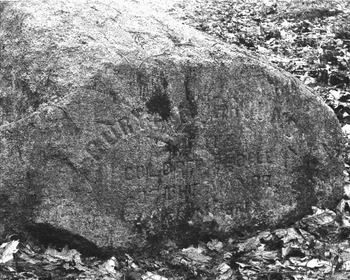
Memorials to the enslaved and the indigenous demonstrate quite different historical representations. At a distance away is another area marked as a cemetery (figure 5) for the ‘Colored People of Sylvester Manor from 1651’. It is less prominently on view – or at least less publicly accessible, as it stands within the central estate nonetheless, easily visible from the private roadway to the house. Unlike the elaborately sculpted monument to Nathaniel Sylvester, the coarse surface of the stone is unaltered beyond the inscription, perhaps a suggestion of the view of the enslaved as raw or uncultured. In its placement it is an oblique acknowledgement of a slave-owning past that might otherwise be unknown to visitors who are unfamiliar with the details of the estate's history. Those visitors, however, would have been invited to the property and to this history, as this is the private entrance. By family recollection, the marker and possibly the fence are thought to have been placed in the early 20th century, at a safe temporal remove from the Civil War. Though minimal text is offered to the viewer, it does situate the enslaved in time and bears witness to their association with the plantation of Sylvester Manor.
Engraved stone, ‘Burying Ground of the Colored People of Sylvester Manor’.

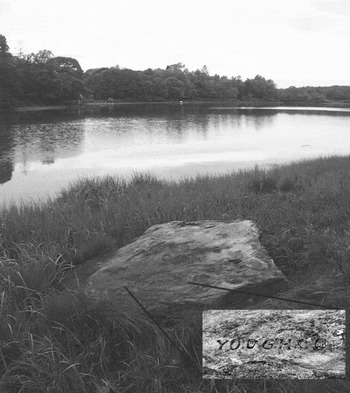
This is a marked contrast with the stone commemorative of Youghco, the Manhanset sachem who died in 1653 shortly after transferring possession of the island to the Sylvesters (figure 6). Like the marker of the enslaved the stone is apparently unshaped, coarsely engraved with only the name ‘Youghco’, without a date, and with no reference to Sylvester Manor. Its location is on view to no one, laid flat on the ground amidst a dense and tick-infested marsh. There is no roadway or even path to this marker, and only those who are explicitly told of its location or are guided to it will be likely to see it. It is an interesting choice of Manhanset representation, suggesting virtually no interaction between Native and European tenures, relegating the indigenous to the natural, timeless realm which came to an end with Youghco's documented relinquishment of the property, regardless of the murkier conditions under which that transfer occurred. This is in line with the subtext of popular historical literature framing Native Americans as thoroughly outside the modern world (O'Brien Reference O'Brien2010). Further, there are no known records or recollections of when or how the engraving came to be made, or by whom, adding to its sense of timelessness. Some might find this a dubious memorial at best. It might also be considered one of the pieces of the Sylvester Manor past which has been clearly separated and deemed best forgotten by Sylvester descendants.
Engraved stone (image enhanced for clarity) memorial for Youghco, sachem of the Manhanset.

As materialized memories, these markers reinforce a historical narrative in which racial categories are maintained by strict boundaries, and Native Americans are not in any way a central part of the early plantation history. Interactions of people of diverse backgrounds are not written into this spatial story. But the presence of the Manhanset and the enslaved Africans has not been excluded from the current representation. It is their interactions which have been effaced, whether by active effort or by passive acceptance of racial categorization, and thus the markers reproduce isolated racial representations through separation over time. Here I draw much from Connerton's exploration of forgetting as taking a peculiarly modern form. It would be unsurprising to him that much of the commemorative landscape at Sylvester Manor is thought to have been emplaced in the late 19th and early 20th centuries: ‘It was when the age of mechanical reproduction caused objects to become obsolete at an ever accumulating speed that many Europeans devoted their energy to a cult of monuments without earlier parallel and founded public museums on an unprecedented scale’ (Connerton Reference Connerton2009, 27; see also Lowenthal Reference Lowenthal1993; Reference Lowenthal1996). Further, ‘memorials permit only some things to be remembered and, by exclusion, cause others to be forgotten. Memorials conceal the past as much as they cause us to remember it’ (Connerton Reference Connerton2009, 29). As an example, he offers war memorials depicting the robust bodies of soldiers, who presumably died for their cause, while the ravaged and suffering bodies of survivors are often forgotten. Similarly Tarlow, in discussing the shift in commemorative practices precipitated by the vast scale and violence of the First World War, suggests that such memorials tell a specific version of the story by depicting the dead ‘as martyrs and not victims’ (Tarlow Reference Tarlow1999, 161–62; see also Rowlands Reference Rowlands, Forty and Küchler1999).
At Sylvester Manor, the monuments to the persecuted Quakers who were sheltered by the Sylvesters, to the ‘Colored People of Sylvester Manor’, and to Youghco the sachem of the Manhanset perform their memorials in just such a fashion. Certain aspects of the past are indeed faced: that there were enslaved people labouring at the estate, that there was an indigenous community displaced, that the Sylvesters as Quaker sympathizers (if not Quakers themselves) were often in conflict with the surrounding Puritan communities. But the autobiographical memory of the place selects these aspects of the past as separate facts. What was thus forgotten is the details between those three statements: for example, that those involved in the Quaker movement, who later would be remembered as vehemently opposed to slavery, were once slaveholders; that the displaced Manhanset did not disappear, but instead were incorporated into the plantation operation in some capacity, and perhaps intimately involved with the enslaved. The spatial separation and relative accessibility of these monuments forgets the daily interactions between all three groups which the archaeological excavations revealed, as even without tree cover none of these monuments would be visible from any other (see figure 4). The placement of these monuments many generations removed from the lived experiences that are commemorated demonstrates also how the reconstitution of memory may effectively reinforce forgetting, by excluding a complex narrative of the early history of Sylvester Manor.
Was this a deliberate effort to forget? Undoubtedly the social landscape of the early plantation was no longer a closely held secret, if it was even remembered. The work of this project was substantially accomplished in the 18th century with the construction of the new house and grounds, with less concern for a racial narrative than for the representation of class and status. In effect, this earlier landscape modification, in combination with the absence of documentary reference to Manhanset tenure on the plantation, cut off the materiality of social memory (per Trouillot Reference Trouillot1995, 29), precluding the incorporation of the more complex setting in later historical narratives. It would remain so until the late 20th century, when archaeological remains would be re-membered as a redundant historical source. Even so, the estate remains private property, and the audience for a revised historical memory is limited.
It is also worth recalling that the shape and regard of the commemorative landscape materializes a rather recent Western conception of social memory, particularly in the value of an inscribed ‘permanent’ marker. In ethnographic explorations of non-Western communities’ perceptions of how landscape, monuments and memory are related, a number of examples indicate that neither permanence nor overt inscription are universally valued or desired as ideal media for social memory. The classic case of this is the Malanggan funerary sculptures, crafted from non-durable wood in an acknowledgement that some memories are meant to decay (Küchler Reference Küchler2002). In a similar setting in Papua New Guinea, Harrison (Reference Harrison2004) has found that not only are the environment and landscape conducive to the rapid destruction of historical traces, also the local community does not want memory to reside there: ‘they regard knowledge – in particular knowledge of the past – as something powerful, a value whose circulation must be carefully restricted and controlled’ (Harrison Reference Harrison2004, 147; a similar case may be found in Ferme Reference Ferme2001). An example more local to Sylvester Manor is found within the popular histories of Shelter Island, regarding the burial of the sachem Youghco. At a place where the body was temporarily laid upon the earth as it was carried to the burial ground,
a small excavation was made to designate the spot. From that time to the present . . . this memorial has remained, as fresh, seemingly, as if but lately made. Neither leaf nor stone, nor any other thing, has been suffered to remain in it. The Montauk tribe, though reduced to a beggarly number of some ten or fifteen drunken and degraded beings, have retained to this day the memory of the event, and no one individual of them now passes the spot in his wanderings without removing whatever may have fallen into it (Gardiner, cited in Mallmann Reference Mallmann1990, 18).
This landscape feature is acknowledged to have been destroyed by road construction in the 19th century, causing one to wonder what the relationship might have been between its effacement and the emplacement of the existing monument at Sylvester Manor. It appears that not only indigenous control of the landscape, but also memory, its message (reducing Indians to ‘drunken and degraded’) and its medium (making Montauk knowledge and practice publicly inscribed) have been fully appropriated.
Commanded forgetting
The separation and persistent myth of isolated racial histories in North America are silences underwritten at a broader level by commanded forgetting, as described by Ricoeur (Reference Ricoeur2004, 447–55). This is often framed as forgiveness or amnesty, which has semantic links with amnesia. Commanded forgetting is institutionalized, strategic, governmental. The term directly confronts the active nature of the process in contradistinction to assumptions that memory passively decays. As amnesty, commanded forgetting has a generally positive connotation for us today, but it is possible to regard it as a strategy to coerce, to obligate one to admit a position of wrongdoing to obtain forgiveness. The memory or heritage to be forgiven and forgotten is thus excluded, and replaced with the dominant or normative narrative. This is a process of forgetting which occurs far beyond the bounds of Sylvester Manor, though I argue that its discourse is implicated in the way that the landscape and archaeology of the place are interpreted today.
Racial identifiers can be viewed as the result of selective memory and forgetting of one's ancestry, particularly when there is some condition of amnesty tied to one identity. In British colonial North America and the Caribbean, one of the earliest institutional impositions of racial categories on communities shared between African Americans and Native Americans was the legal codification of race-based slavery, declaring ‘Negroes’ subject to lifelong hereditary enslavement while ‘Indians’ were not. Slightly earlier, Barbados planters had passed their first laws regulating control and conduct of slaves, referring specifically to ‘Negroes’ (Beckles Reference Beckles1990, 33). This might have had the immediate effect of creating strict racial boundaries between the groups. Counterbalancing this effort were Native American participation in colonial wars and selective transportation of African males to the colonies, creating complementary demographic imbalances and often encouraging the marriage of African American men to Native American women in the Northeast (Mandell Reference Mandell1996, 183–96; Reference Mandell2008) and other forms of economic cooperation (Barsh Reference Barsh and Brooks2002). Eighteenth-century New England censuses bear evidence of this trend, although ironically the changing labels used as racial identifiers and the subjective assessment of race by census-takers have made an accurate genealogical approach impossible (Forbes Reference Forbes1993; Gonzales Reference Gonzales and Tayac2009).
Throughout the following two centuries, however, the freedom to dispense with racial categorization in practice, if not in legal status, was repeatedly thwarted by the paternalistic view of white Americans towards non-white individuals and groups (McMullen Reference McMullen and Brooks2002). In the 19th century, ironically, the Progressivist and anti-slavery efforts of white Americans led them to pursue legal definitions of citizenship that were to be offered to all, regardless of race or ethnicity. Citizenship would entail individual rights, something greatly desired by the formerly enslaved, but potentially dangerous to the corporate entities of many Native American communities. In Massachusetts, the specific policy pursued by the state legislature encouraged tribal termination in exchange for full citizenship, meaning that individuals could sell their portion of previously community-held land (Plane and Button Reference Plane and Button1993). Later, the process was altered at the national level in the allotment acts, distributing tribal lands according to enrolment, and thus forcing a determination of race, or blood, as one marker of inclusion (Gross Reference Gross2008, 140–77). Indeed, all racial segregation enacted in Jim Crow laws entailed a protracted effort to erase or forget the interactions of previous generations (ibid.; Perdue Reference Perdue and Tayac2009). With issues of citizenship, allotment, enrolment and recognition at stake, those efforts additionally took on the characteristics of amnesty, wherein the complicated, historically contingent trajectories of interaction and intermarriage are ‘forgiven’ and forgotten.
While many tribes resisted the replacement of community and cultural identification with racial ideologies, some dissent from within groups arose, often resulting from questions of the rights conferred by racial identifications. The trend to dissolve corporate communities in favour of individual citizenship was felt keenly by some tribes that sought protection of their land. The Montauk, closely related to the Manhanset in the colonial period, fought internally over the right to sell portions of tribal land when it meant that that land would be used for the railway. In pursuing the case in court, the Montauk who wished to retain tribal lands found, to their dismay, that their status as a tribe was called into question, in part because of the perception that they were racially mixed (Strong Reference Strong2001). This same struggle for community autonomy in the face of poverty and land removal was repeatedly diverted to discourses of racial impurity by white state or church authorities in New England, most poignantly in the case of the Mashpee Wampanoag (Campisi Reference Campisi1991; Mandell Reference Mandell, Calloway and Salisbury2003). Often historical censuses, with the problems noted above of inconsistent labelling and lack of self-identification, have been used to argue that an Indian community is instead black, in a careless conflation of ‘race’ with ‘nation’ that has had deep repercussions. Currently, state and federal requirements for tribal recognition include the construction of a coherent cultural history, a documentation of continuity, implicitly demanding demonstration of unadulterated ‘Indianness’ often with reference to perceived racial categories (Campisi Reference Campisi2003; Garroutte Reference Garroutte2001; Reference Garroutte2003; McKinney Reference McKinney, Miles and Holland2006). That the preference to choose tribal corporate identity over American citizenship is problematic in the eyes of the US government is demonstrated by the fact that currently no other type of racial identity is subject to court review (although the last antimiscegenation law was left in place until 2000 (Pascoe Reference Pascoe2009)).
This process of categorical and ahistorical racial ascription also contributes to another process of forgetting through outright exclusion of Native Americans from history, and, in particular, modernity. New England native nations especially suffer from the ongoing perception that they no longer exist. In a survey of 19th-century local historical narratives, O'Brien (Reference O'Brien2010) has identified a trope of ‘lasting’ Indians, writing them out of existence by documenting the ‘last of the [name of tribe]’. Those lasts are pinned in particular to individuals thought to be full-blood, again eliding blood with nation or community. The reliance on ‘blood’ as a marker of race also recalls the irony and selective association of racial categorization (as noted by numerous scholars of race), that while historically Indian blood may be diluted unto a vanishing point, African American blood need only contribute one drop to retain categorization as black. Some associations are believed easier to forget than others in American society.
Ultimately, however, this should not be left as a story in which racialization was a discourse that reigned dominant among Indians. Even amidst the period when narratives of the extinction of New England Indians began to circulate, these communities actively resisted simply by continuing to show up long after their extinction had been declared, in some cases by retaining small landholdings, and in some cases by explicitly rejecting the racialized basis of their community identity (O'Brien Reference O'Brien2010, 145–99). Commanded forgetting cannot be deemed successful as a strategy, as attested by numerous Indian communities today despite their continued non-recognition by the federal government (for example Handsman and Richmond Reference Handsman, Richmond, Schmidt and Patterson1995; Silliman Reference Silliman2009; Cipolla Reference Cipolla2008).
Discussion
What is described above is only a distilled view of a much larger literature on the ways in which notions of race impact federal identity policies, to try to make the point that such policies act as commanded forgetting. The discussion of this broader topic may seem to outstrip the narrower exploration of Sylvester Manor's history as viewed through the enactment of memorializing and forgetting. But these larger discourses of race, class, land tenure and modernity are incorporated within those very local enactments at multiple moments in the representation of social memory. An archaeology which aims to cut through the blanketing representation to expose a ‘hidden history’ often, instead, reveals the shaping of that representation as memory and forgetting, while contributing to its ongoing construction. And colonialism is not so far away that our work does not risk touching on a process of forgetting that is still at work.
Periods of colonialism represent interactions not only of people of different backgrounds, but also of their different senses of historicity, and methods for maintaining memory. In discussing social memory, Kenny (Reference Kenny1999) offered examples of Aboriginal Australians whose present generation has no historical memory of late 19th-century violent conflicts with white settlers, though these events were documented elsewhere by white colonial administrators. The reasons for Aboriginal forgetting may be collective trauma, and a lack of access to landscapes and places which often form the associations of historical memory for the indigenous groups. More recently, however, the documentary records of violence have contributed to what he calls ‘repatriated memories’ – a reclaiming of this historical knowledge from other sources (Kenny Reference Kenny1999, 425–26). The fact that this knowledge is instrumental does not make it any less ‘true’ in the eyes of the broader Australian society. Indigenous claims and revitalization cases worldwide have brought the issue of how to put different histories, and particularly different historical practices, into conversation with one another (Johnson Reference Johnson2008; McMullen Reference McMullen and Harkin2004), and highlight the instances of redundancy of even partisan social memory. Archaeology itself has become a form of historical practice, contributing redundant (though no less situated) memory. In other words, how we talk about those pasts matters, and it would be helpful to contribute not only to memory, but also to clarifying how things are forgotten.
The importance of taking on this much broader history of state and federal policies to explore the singular case of Sylvester Manor is dual. This history is first implicated in the ethnic or racial categories that we use to try to understand the past (Silliman Reference Silliman2009), such that we find it difficult to accommodate a situation such as the one at Sylvester Manor. This difficulty is on the part of white society which sustains racial ideologies in assumptions about what constitutes Indian identity. Sociocultural anthropologists and scholars of postcolonialism have given us a rich vocabulary and set of conceptual tools to use, such as transnationalism, diaspora and borderlands identities. In our disciplinary divides, archaeologists replicate reference to isolated identities as though they could ultimately be teased apart in the archaeological context. Native American and African American archaeologies are still often viewed as distinct realms of temporality and thus also of study, and, as a result, any discussion or conceptualization of a black–Indian diaspora is occulted, excluded or forgotten.
Second, and equally important, these historical processes of separation and ‘commanded forgetting’ work to obscure the very historical grounds on which such pluralism and colonial entanglement are based. That is, it is not only our current racial politics which obscure the past, but also long-term processes of forgetting. Why, specifically, was it of such great importance to British colonists to subject enslaved Africans and Native Americans to legally separate categories, yet both were still disenfranchised? This describes a gap or silence in which might be the collaborations between African Americans and Native Americans that Europeans found more threatening or dangerous than either group alone. Evidence for those interactions often remains frustratingly elusive, not because of preservation problems, or because we as scholars are not attentive to the possibilities, but rather because we are working against active efforts to efface these aspects of the past. This is what makes conversation with descendant communities so critically important.
It is for these reasons that I find the exploration of processes of social forgetting to be valuable, beyond a philosophical interest. Memory, for all its mutability, variability and often ineffability, has taken hold in archaeology because it brings our interpretations more into the realm of heritage, and contemporary relevance. Forgetting cannot be left out of consideration: ‘the relation between remembrance and forgetfulness is not a linear process but a struggle, a tension . . . it is what is not there, what is absent that causes this tension’ (Buchli and Lucas Reference Buchli, Lucas, Buchli and Lucas2001, 80, original emphasis). The tension is also not a historical artefact; it is felt by those who consume or identify with historical or archaeological narratives of the past. Archaeologists may be uniquely positioned to explore the issue of social forgetting, simply because the bread and butter of our evidence is the abandoned, the disposed, the separated and excluded materiality of human experience. To date we have recognized our role in re-membering those materials with historical value, but let us not forget the manner in which they were disposed. Thus in addressing what is forgotten, we should consider also by whom is it forgotten, and for what purpose? And when does it also become (thank you, Douglas Adams) somebody else's problem?
Acknowledgements
I wish to acknowledge the significant contributions of several people as I thought through this paper. The initial seeds were sown in a paper I prepared for a TAG USA session in 2009, invited by Rosemary Joyce and Laurie Wilkie, who provided enthusiastic feedback, as did Kent Lightfoot, as discussant. A second attempt, focused on the landscape of Sylvester Manor, was invited by Jack Gary and Eric Proebsting and commented on by Audrey Horning at an SHA session in 2010. Finally, John Matsunaga, Hoon Song, Steve Mrozowski and the Archaeological dialogues editors and two anonymous reviewers have provided me with excellent critical comments and suggestions. Thanks to you all, though any errors within are my own. I also wish to acknowledge the remarkable support and encouragement of the past and present owners of the estate of Sylvester Manor for these investigations.