“If the problem of death can be solved, the solutions to other problems cannot but follow.”Footnote 1 These are the words of the Russian librarian and philosopher Nikolai Federov, as performed by David Wilson. Wilson is founder and curator of the Museum of Jurassic Technology, Los Angeles's ironic encomium to the Renaissance Wunderkammern which preceded Enlightenment-era museums of natural history. The “resurrection and resuscitation” in full body of all the dead who have gone before is a “task that will be realized by the museum,” Wilson intoned in a voice-over at a recent screening of his film mash-up about Federov, The Common Task (2008). By this point in the screening it was unclear exactly who – Wilson or Federov – was commenting upon the museum's foundational desire. Natural history museums in particular have partaken in the desire to archive life itself, creating an exhibit space of “universal time,” in the phrase of the cultural critic Tony Bennett, through the display of representative species from across the globe and across historical and geological periods.Footnote 2 Methods of natural history, systematic biology or taxonomy made possible the very notion of biodiversity, according to historian Robert E. Kohler; Steven Conn argues that “ecological research is an updated version of nineteenth-century natural history” and that such research grows urgent in the shadow of mass extinction.Footnote 3
Recent studies show the disappearance of approximately 20,000 to 60,000 species per year. In museum literature, the possibility of resurrecting these dead appears dependent upon both scientific methods like species inventories and their dissemination through new media. “Bio-informatics” signifies the digitization of museum collections such that global information sharing can keep scientists up to date about species loss.Footnote 4 “Interactives” or multimedia displays promise to generate creativity in museum-goers, fashioning a public primed for the flexible thinking demanded by ecological crisis.Footnote 5 The question of what endurance means for “nature,” “history,” and the natural history museum seems to break around what will continue to count as lifelike: information or object, media or bone.
Los Angeles offers a rich setting for a consideration of these questions, both because it is the world capital of entertainment media and because it hosts the world's largest archive of Pleistocene fossils, preserved in the asphaltum sinks that formed atop the Salt Lake Oil Field, itself the world's largest urban oil reserve. The La Brea tar pits serve up natural history in the raw, and they share kinship with the Renaissance curiosity cabinet and other “disreputable displays of objects,” in Conn's words, such as those which might be found at fairs, freak shows, or circuses.Footnote 6 The sensory regime of these bubbling, odoriferous sinks exceeds the didactic visuality associated with nineteenth-century natural history, which Michel Foucault once described as “nothing more than the nomination of the visual.”Footnote 7 In a way that may not be apparent to tourists, the tar pits represent a regional ecology. They are a petroleum archive within a city that exemplifies better than any other what oil could make of modernity. The effort to build a museum around the La Brea tar pits tells a story about Los Angeles's image of itself through the twentieth century, its desire to make history and the authenticity we associate with “nature” from within an immensely profitable pursuit of spectacle. One even can imagine the tar pits in the terms of the ecomuseum, the ensembles écologiques developed most extensively in France during the 1970s as a means of honoring regional cultures.Footnote 8
Asphaltum, the semi-solid form of petroleum that bubbles in the misnamed tar pits, refers out to Los Angeles's freeway culture and to its “electric media” culture – to riff on an old McLuhanite term for film and television media powered by electricity – and is indebted to fossil fuel. The apotheoses of automobility and electric media on display in Los Angeles spring from the peak of US oil discovery in the 1930s. Oil played a foundational role in the making of two aspects of LA's four ecologies, in Reyner Banham's terms: the ecology of autopia (the freeways) and the architecture of the fantastic, namely the commercial storefronts designed to hail automobile drivers. Yet the La Brea tar pits indicate a petroleum reserve – again, the Salt Lake Oil Field – which has been removed from the “destructive circulation of commodities,” in Andreas Huyssen's phrase, and from the transformative industrial work of the modern energy system.Footnote 9 In the midst of the world city whose infrastructure, architecture, and cultural production most bluntly express how fundamental oil has been to modern aspiration, the La Brea tar pits make oil visible as a material presence that cannot be easily reduced to the abstraction of “energy.” Fences cordon off this dense petroleum which sits at the surface of the Earth, displaying itself to the naked eye as an organic, irreducible treasure. In the shadow of the Los Angeles County Museum (LACMA), the tar pits can be contemplated as land art, with the potential to effect self-transformation that art implies to a middle-class public accustomed to refining its sensibility in art museums. The opportunity to think of oil as nature and/or art opens broad possibilities for thinking about how oil has expressed fundamental notions of humanness.
The tar pits share in the qualities of both carnival and museum. They are stinking, sticky objects indicative as much of the humiliations of embodiment as of the transcendental notion of the human which has been articulated through technological prostheses, like computers or cars, which extend the human body – at an increasingly unsustainable expense. Unlike the Oil Sands Discovery Centre in Fort McMurray, Alberta, where bitumen, a substance quite similar to asphaltum, stars in a multimedia narrative whose first premise is the “transformation” and “refinement” of humanity through the heavy industrial labor of making a tar-like solid into oil, at Rancho La Brea oil has been decoupled from any clear idea of progress. The Alberta museum also displays fossils found in the bitumen – which the Canadian oil industry anxiously refuses to call “tar” – but there the fossils are incidental to the curatorial line, which reinforces the pleasures of disembodiment, of losing oneself in the big trucks and diggers that make tar sands extraction possible.Footnote 10 In northern Alberta, tar insures that the modern cultures and infrastructures which oil made possible in the twentieth century appear, improbably, as “the future.” In contrast, Los Angeles's petroleum exhibit has been in the making since the early twentieth century, in a time and place where oil seeps were ordinary, frequent, and indicative of what looked like an endless supply of cheap energy. With this essential confidence in the fossil-fuel system, one could take petroleum as it presented itself, at Earth's surface, and consider it as bothersome tar, as decaying micro-organisms, or as media through which large mammals, including humans, might be preserved.
This manifesto considers the La Brea tar pits, which by the first decade of the twenty-first century have fallen far toward the disreputable status of the carnival, as the potential site of a post-oil museum. My gentle polemic draws upon Bennett's recognition of the natural history museum in particular as a “civic experiment” which reassembles objects in such a way as to create new entities “that can be mobilized … in social and civic programs.”Footnote 11 In brief, I recognize museums as organizing material cultures which in turn generate new social narratives and civic behaviors. The La Brea tar pits offer a narrative about living with petroleum in petrotopia (e.g. Los Angeles, USA) and the possibility of thinking beyond the explicit uses of oil which have defined modern energy.
PETROLEUM MEDIA
At the George C. Page Museum of La Brea Discoveries, opened in 1977 amongst the tar pits in LA's Hancock Park district, visitors learn about the problem of dying, if you are a mammal, and about what it means to be petroleum, which never dies. The mammal/petroleum difference generates a key aspect of the museum's drama, a locus of tension and anticipated resolution within the museum space, which relies upon petroleum-based media, including film and its famous asphaltum pits, to create a sim-ecology where mammals, too, might live forever, in the half-light of dioramas and continuously looping reels. Jonathan Spaulding, former associate curator of the Natural History Museum of Los Angeles County (of which the Page Museum is a satellite) argues that the curatorial voice of scientific authority that once organized such museums by taxon and chronology is “dead,” citing “emotion,” “sensation,” and “rhythm” as key curatorial goals, to be accomplished through the spatial, acoustic, and kinesthetic art of scenography.Footnote 12 Historian Alison Griffiths argues that such emphases on multisensory media in fact date back to the nineteenth century, citing museum features such as panoramas and the slightly later innovations of habitat groups and period rooms as examples of how “illusionistically re-created space can reinforce the sensory experience of space and time travel” that museums always promise.Footnote 13
The Page Museum's natural advantage, its literally immersive scene over the fossil-rich Salt Lake field, may offer a rather low interactivity ratio in comparison with the new media pyrotechnics of younger and richer museums. But it is still the only museum famous for literally sticking to its visitors, forcing the issue of its oozy embodiment. In an era in which screen culture has become so ordinary as to make less of an impression on museum visitors than an apparently authentic experience, the tar pits present a discomfort that signals the “real.”Footnote 14 On a recent tour, my docent, Gail, ended her introductory remarks with a promise to hand out recipes for tar-removal at the end of our walk amongst the sumps.Footnote 15 As parents warned errant children to stay away from the museum's lawns and the distracted found their shoes sticking in place, it became clear that our clothing was at risk, and with it the social abstraction and status that distinguishes us from other mammals. At the Pit 91 excavation site, where some of the museum's most significant fossils have been discovered, the filthy T-shirts and jeans of volunteer excavators are on prominent display. Here nature presents itself, quite viscerally, as stain.
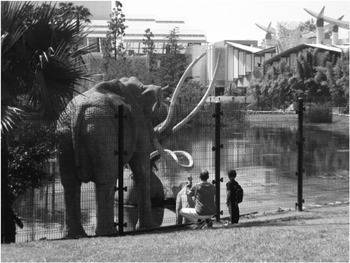
If no single framing narrative can be derived from sticky shoes or blackened socks, such by-products of the La Brea experience at least suggest our vulnerability to and interrelationship with other life. The museum's displays reinforce the message of our vulnerability. Like modern “body genres” such as the horror film, exhibits invoke visceral mimicry in visitors by representing the distress of lone actors.Footnote 16 The first stop on the outdoor tour that is the highlight of the La Brea experience is the “Lake Pit,” an asphaltum pit covered in water, the sort of mirage that the large mammals of the Pleistocene fatally ventured into for a drink. “The story of entrapment” that is the museum's leitmotif unfolds at the Lake Pit, according to a museum postcard: it is performed by “a fiberglass mammoth” (to scale) “struggling as she sinks into the large asphalt lake in front of … the museum. A father and baby mammoth watch from the shore.”Footnote 17 Docents will add that the sinking imperial mammoth is “crying out,” perhaps “in pain” or in “warning” to her appropriately nucleated family (Figure 1). At other points on the La Brea tour, and in the museum's story theater, visitors hear of the “screams” of entrapped mammals (the western horse, the Shasta ground sloth), most of whom are now extinct. The museum's drama is discomfiting, all the more so because it is scaled to children. One of its few interactive displays consists of a child-height game wherein large metal pins might be pulled from asphaltum muck, although what we learn is that the muck relentlessly grips the pins and we cannot move them. In this low-tech game, entrapment – which can be conceived as little else than slow death – becomes corporeal knowledge. “Pull up on the handle, / Discover what it feels like to be trapped in tar,” the exhibit beckons. While the single human skeleton at the Page, known as “La Brea Woman,” has been retired to storage, there is little question that human death is on show. With a cloying ordinariness (e.g. it sticks to your shoe), personal extinction defines our “authentic experience,” offering the downbeat to this museum's emotional rhythm.
Father and son enjoy family drama in the lake pit. Photograph by the author.

Perhaps the museum's consistent reminder of the biological arc of singular lives (as Hannah Arendt tells us, the concept of mortality depends upon the elevation of the individual above speciesFootnote 18) makes the geological temporality represented in the tar pits more readable. Imagining waves of extinctions which mark the edges of geological periods requires a shuttling back and forth between smaller- and larger-scale notions of loss. My docent at Rancho La Brea offered a strong argument for the difficulty of perceiving time at geological scales, as she explained when the Pleistocene occurred, some 2.6 million to 11,700 years ago, and how its now-foreign fauna reflect the fluctuations of Earth's climate resulting from the rotation of its axis closer or farther from the Sun. “There are other theories of climate change,” Gail noted, dismissively raising an eyebrow.Footnote 19 For her, this was not the place to throw the autonomy of geological process into question by discussing anthropogenic climate change, although the petroleum patch could be an ideal site in which to raise such environmental concerns. Geological time, as a concept, has long been the natural history museum's ally, granting these museums what William Pannapacker celebrates as the aura of “things that are real.”Footnote 20 Andrea Witcomb writes more cynically of the ways in which concepts such as aura and authenticity derive from “a museological practice which emphasized the importance of classification systems and taxonomies which attributed meaning to the object according to its physical characteristics.” The nineteenth-century natural history museum's taxonomic systems claimed to express an immanent divine order, and they supported “a narrative of Western society as the pinnacle of civilization.”Footnote 21 Through the 1960s, natural history museums offered an image of time's passage segregated from social turbulence.
But when, among nature's things, a natural history exhibit displays asphaltum, a form of crude oil that is a product of the Miocene seas which once covered the Los Angeles basin, a question arises for me: Are some things that are real more real than other things that are real? My point is auratic, rather than biological or ontic. By “aura” I mean the feeling and ambience of authenticity, which, as Benjamin taught us, cannot exist without the mechanical means of destroying “aura” by separating objects from their images in media such as photography.Footnote 22 At Rancho La Brea, the tar pits are in situ ecological features, therefore unlike the displaced natural objects typically associated with museums and laboratories, to which museums often have been compared. Although one can photograph the tar pits, their low visual readability makes for bad images, and they work best as multisensory media. They generate a physical ambience through the olfactory dimension of odor – specifically, the smell of hydrogen sulfide, which, along with the odorless methane gas that bubbles to the surface of the pits, betrays the formation of crude. Of course, too, they are viscous, and their stickiness offers a kind of bad patina, literally tracking their use over time by human excavators and unlucky animals.
Yet the tar pits extend into their geographic frame in a way which troubles their status as “real things.” One only has to venture to the edge of Hancock Park to recognize their entanglement in a complex social history. The La Brea exhibit depends upon the high real-estate values of the surrounding neighborhood of Hancock Park, which made possible the preservation of this portion of the Salt Lake Oil Field from intensive drilling. Hancock Park, in turn, both derives value from and confers value upon Wilshire Boulevard, the historical shopping district that is known as LA's Miracle Mile. It was on the Miracle Mile that the parking lot was essentially invented, as planners in the 1920s recognized the convenience of auto parking behind department stores in a city already poised to enable the individualized mobility of the car. Asphalt, which used to be made from asphaltum (and is now made directly from petroleum), paves “the mile” and the parking lots behind it. In the late 1960s the parking lots of Los Angeles demonstrated the end of art and other real things in a series of aerial photographs that Ed Ruscha commissioned from a commercial photographer. Without a connection to the artist's own hand or to the promise of self-transformation evident in aesthetic categories such as the beautiful, Ruscha's Thirty-Four Parking Lots (1967) humorously enshrined the most ubiquitous indication of capital's homogenization of place. An art book of parking lots, photographed by someone other than the artist, empties the “art” concept, the “exhibit” or museum concept of the art book, and the idea of sacred space. Thinking about the parking lot as itself a kind of museum of modernity makes the conceit of the museum at La Brea, the asphaltum preserve, seem precious, if not duplicitous. Does petroleum ever remain in situ, and what might be the ideological effect of showing it that way?
The original plan for “Pleistocene Park,” an earlier incarnation of the La Brea outdoor museum, offered a clear alternative to car culture. This plan called for the screening of automotive traffic by landscape features and a single footbridge entrance to guard against auto touring.Footnote 23 Hailing from the 1920s, the “Pleistocene Park” concept marks the same decade in which an LA Times editorial noted that all horses in Los Angeles “belonged in the tar pits” because this would be the automobile city. It was thought that climate itself dictated that cars should dominate southern California, since horses were still recognized as more capable of negotiating the ice and snow of Eastern winters.Footnote 24 In 1919, the first gas station in Los Angeles, run by the Gilmore family, opened near the current site of the George C. Page Museum. Now the Gilmores are known for “The Gilmore Collection,” photographs of early fossil excavations on the La Brea ranch, which their descendants donated to the museum. At the intersection of modern media (automobiles, photographs) and the Pleistocene (via the Miocene), the La Brea petrol preserve manages to ally itself to both media time and geological time. Both are arguably forms of deep time, insofar as both involve a temporality irrelevant to the work of human memory. William L. Fox has written a fine essay about what the La Brea tar pits and a disaster movie featuring them, Volcano (1997), tell us of the human sense of time, the way in which time has been “speeded up” by film narratives to the extent that longer-duration problems, such as oil scarcity and the increasingly devastating methods of oil mining, are not only imperceptible but also indifferent to us.Footnote 25
I admire Fox's essay, and I would add to its treatment of time the suggestion that geological and media time both offer styles of temporal imagining that enable the making of petroleum as a spectacle and, therefore, as a commodity. The Museum of La Brea Discoveries allows us to conceive of fossil fuel as fossil and fuel, and predominantly as fossil. We learn at the museum that what might have been an oil field became a paleontological site. Fossils and fuel are distinct forms of commodity whose value relies, in both cases, upon the occlusion of specific historical relationships – social and ecological histories – that confer value. The fossil is the unique object separated by museum display from other cultural meanings, while fuel offers an abstraction of matter, a dream of disembodied energy.Footnote 26 The dramatization of “fossil, fuel” at Rancho La Brea shows us how commodity values rely upon the segregation of the natural from history. In contrast, a natural history concept that places nature and history in dialogue has the potential to generate ecological action, as the methods of systematic biology now intervene in global habitat and species loss.
ECOLOGICAL DESIGNS
The making of the La Brea tar pits from a loosely defined exhibit into a museum coincides with the introduction of ecology into the design of the natural history museum in the 1960s. On the National Mall, the American Museum of Natural History's two-year exhibit Can Man Survive? opened in April of 1969, marking a sea change in both the themes and presentation of natural history. The exhibit explored many of the ecological issues haunting North Americans at the time, including overpopulation and industrial pollution. Can Man Survive? employed cutting-edge mixed media, Alison Griffiths notes, offering an “immersive informational and experiential architecture” that turned visitors from mere viewers into active and uncomfortable participants.Footnote 27 Visitors walked through various stages of the show to be confronted by looping films of river pollution, bacteria, and other blight, without recourse other than to move deeper into the museum space. This premier exhibit on world ecological damage called for a total virtual environment in order to deliver its message, which, as the exhibit's title indicates, was that humanity was destroying itself.
Such doomsday ecological thinking, together with an amped-up commitment to making natural history into “hypermediated” space, introduces the moment when Pit 91 was reopened for excavation in 1969 at Rancho La Brea. It had been fifty-four years since the last major excavations at the site, and the events of 1969 signaled a civic commitment to reimaging the tar pits as a place of scientific inquiry. The reopening was coordinated by paleontologist George Miller, who shepherded a small army of volunteer excavators in what was billed by journalists as a quest for the origins of humankind in the western hemisphere. Miller's team found evidence of human presence in California at approximately 15,000 years ago. Humanity showed up as trace, through decorative cuts made by tools on the leg bones of saber-toothed cats. Perhaps in celebration of this discovery, in 1973 Governor Ronald Reagan would name the saber-toothed cat California's state fossil. Volunteers came together from all over Los Angeles to search for the origins of human culture in their own city. The “dig-in,” as it was called, expressed civic pride and the flamboyant humanism of the late 1960s, mixed up with the hermeneutics of suspicion that also characterized the Vietnam War era.
In a letter to the LA Times of May 1970, a self-described “concerned citizen,” Max Poschin, counts himself amongst the more than one hundred volunteers “privileged to have the opportunity of helping uncover paleontological treasures from the Ice Age” at Rancho La Brea. But Mr. Poschin's note of gratitude sounds a shrill concern: “What has happened to our priorities? … We have billions to prosecute an illegal war in Asia or to send men on perilous missions to the moon, but not even a tiny fraction of that amount to extend the knowledge of man here on earth.”Footnote 28 Mr. Poschin explicitly condemns the lack of funding for public science, and he suggests more broadly that his participation in the search for human origins at the “dig-in” has not led him to imagine a long human future. Similar predictions that greater scientific knowledge of humanity would only reveal our near extinction appeared in US popular culture in this period, blatantly in Paul Ehrlich's The Population Bomb (1968) and glancingly in popular fictions such as Franklin J. Schaffner's film Planet of the Apes (1968). The Planet of the Apes series offers a wry commentary on the natural history endeavor. Like the AMNH exhibit Can Man Survive?, the first Planet of the Apes film places human social history at the center of the problem of natural history, turning the tables on our curatorial ambitions by depicting the study and museum display of human subjects at a sophisticated research center overseen by orangutans. The fear that inspires the AMNH exhibit and the contemporary film, as well as Mr. Poschin's letter, is that humanity has written itself out of ecological relations, following the technologies of war into an inarticulate end-time. If we are lucky, evolved orangutans might someday tell the story of how we overstepped ourselves with weapons such as the hydrogen bomb. This moment of intense anxiety about human endurance on the planet generated some innovative attempts to remake the practice of natural history in such a way as to decenter Western cultures and human subjects.
More than 750,000 species, including many microfossils, were uncovered at Rancho La Brea on Dr. Miller's watch, testimony to his dedication to avoiding what he called the “stamp-collecting” of large mammal specimens which characterized the earlier twentieth-century excavations.Footnote 29 Following on the heels of the 1890s “dinomania,” which was characterized by the investment of philanthropists like Andrew Carnegie in massive sauropod dinosaur skeletons for display in urban museums, early tar pits excavators focussed on large Pleistocene specimens, namely Columbian mammoths, ground sloths, American bison, saber-toothed cats, and American camels.Footnote 30 In contrast, Dr. Miller foregrounded the value of the asphaltum matrix that encased these trophy specimens, as it was the matrix that was the key to Pleistocene climate. The matrix offered plant microfossils. This was, again, the age of ecology, and Miller's volunteers were made aware that even tiny specimens might be relevant to the human story. Sadly, the Pit 91 project was facing bankruptcy by 1970, a problem later blamed on Dr. Miller's ambitious attempt to reconstruct a complete Pleistocene environment. When Miller was fired by the Natural History Museum of Los Angeles in 1972, the museum's director, Dr. Mead, stressed the importance of generating “more scientific information at less cost,” an objective vaguely related to his corollary plan of making the tar pits into a “museum-like display.”Footnote 31 The dual commitment of public science to education and research evident in this conflict is not unique to the Natural History Museum of Los Angeles. However, the question of how to make the tar pits into a “museum-like display” reflects the regional culture of Los Angeles, as a place where spectacle, in Guy DeBord's sense of screen images which obscure the origins and relations of things, has figured prominently.Footnote 32 The fine-tuned, relational thinking that Dr. Miller introduced to his field-workers in the 1960s had little precedent in the history of designs intended for the La Brea site.
Let us consider, briefly, the various iterations of “museum” which have been imagined at Rancho La Brea since the early twentieth century, in order to return to the current museum via ecological thought. For most of its history, the La Brea site was unmoored from ecological concerns, hitched instead to the theatrical problem of presenting the tar pits as a “wonder of the world.” This was an effortful project, given that the pits essentially smelled and looked like mines to Angelenos accustomed to oil leaks and derricks in their neighborhoods. The famous “Lake Pit,” where the museum's fiberglass mammoth now cries to her distraught baby, became so deep and large because it had been a regular asphaltum mine, used for caulking, waterproofing, and fuel from at least the eighteenth century. The open pit mine was filled with water in the early twentieth-century in order to offer a natural history feature to visitors of Hancock Park. This early act of outdoor scenography already implies a contest of meanings for what counts as natural history. The real ecological relations of locals to the asphaltum sumps, the use of these resources, could not be shown as “natural” in the sense that Pleistocene mammals could. The fiberglass animals now present in the park are products of a similar effort to make nature available to the senses not through its local uses – or even through the motile presence of the asphaltum itself – but through the representation of ancient mammals. The animal statuary suggests the conventional pleasures of natural history, referring to the more showy vertebrate fossils found in the pits. In contrast to the staining tar, the “animals” also create user-friendly interactive surfaces for park-goers to touch, sit on, lunch beside, and photograph.
One of the most ambitious designs for the La Brea museum and park, and the design in which animal statuary figures most dramatically, is a Works Progress Administration (WPA) project referred to as the “Garden of the Giants.” Howard Kegley wrote about it for the LA Times in 1940.
This stupendous undertaking, as a circus press agent might express it, will be super-colossal. In real fact it should out-Barnum old Barnum himself, for it will bring into permanent existence here, within a stone's throw of the world-famous Miracle Mile … a monumental memorial in masonry to a gosh-awful galaxy of prehistoric animals and birds.Footnote 33
These “permanent animals,” crafted “in enduring rock,” would ground an immersive, virtual landscape, through which “visitors, traversing the jungle-flanked paths, would unexpectedly come upon sculptured groups.” Fifteen years before the opening of Disneyland, the tar pits were conceived as a natural history theme park. Although WPA project planners stressed the “educational value such a monumental menagerie might possess,” the project goal was sensational, making the effect of time and space travel which has been associated with museums into pure entertainment. Coming from the shops on Wilshire Boulevard into this spectacular park, visitors would experience a near-absolute departure from Los Angeles proper. They would wander into an “extinct” space–time. The petrol pits themselves have almost no meaning – social, sensory, or scientific – in this preserve of giant mammals. They are merely low-lying indices of an exotic other life, discontinuous with the Miracle Mile and modern humans.
The WPA ultimately did not approve the mid-century Garden of the Giants sculptural project because of the high cost of building over the active geology of Hancock Park. Gases arising from the pits were recognized as a perpetual fire hazard. Such perpetual fire suggests enduring life in a manner quite different from sculptural animals. The effort to express geological agency through sculptures of extinct mammals betrays a lack of imagination about where petroleum might fit within the natural history concept. It also suggests a human wish to make animals, and by extension ourselves, permanent – a task which mid-twentieth-century Americans liked to imagine might be feasible, given the right technology. Fiberglass, the material used to craft the latest set of Pleistocene mammals in Hancock Park, represents a chemical bid for endurance that, like many developed during World War II, utilizes petroleum-based plastics. The wish to be “forever animal” gets monumentalized, in oil.
For ordinary Angelenos, the La Brea tar pits have been close collaborators in human histories in a manner that park and museum designers tend to overlook. Vernacular use of the pits betrays long-standing appreciation for asphaltum as both a practical and an expressive material. While everyday use of the sumps for chores such as caulking faded with the dedication of Hancock Park as a scientific preserve in the early twentieth century, locals continued to interact with the tar pits in ways that exceed the directed goals of education or staged entertainment. The relationship between the people and their “tar” was intimate and sociable, if not ecological per se. For locals, the pits were matter that could convey messages, media in the most unmediated sense. Los Angeles newspapers brim with cases of individuals using the tar pits to make statements or to preserve strong feelings, presumably forever.
One celebrated case involved Mary Alice Bernard, daughter of the county livestock inspector and a “society” girl in the small-town Los Angeles of 1935. Newspapers report that Mary Alice suffered from “amnesia” and from “a nervous breakdown.”Footnote 34 For months during her nineteenth year, she went missing. The Los Angeles County Sheriff's Department searched the tar pits for Mary Alice's body, using a special apparatus to heat the contents of the pools so that heavy asphalt could be pumped out, and employing grappling hooks to drag the depths. The county was literally mining for Mary Alice. The cost of this was considerable, news coverage sensational. The drama had begun when Mary Alice's mother remembered the young woman's parting hint: “someday you will find me in the bottom of the La Brea pits.” In fact, Mary Alice turned up several months later in Los Angeles, having gone to San Francisco to take a job as a domestic. The tar pits search closed, with newspaper photographs of sheriff's deputies bending over draglines. This young woman's flight from her family and her class did not grant her the permanence, as a local heroine, that she might have achieved had she really jumped into the pits. Countless others seized upon the tar pits as means of indelible self-expression. Three years after Mary Alice's vanishing, a man billed as the “Tar Pits Suicide Hoaxer” was jailed for making a false report of his own suicide in the tar pits in an embittered note to his ex-girlfriend.Footnote 35
The tar pits present a handy means of preserving bad affects. They have served as local channels that broadcast sensory cues, such as smell, viscosity, and visual obscurity, which intimate human vulnerability. The story of the 10,000-year-old “La Brea Woman” found in the pits mimics the noir-ish dramas of the twentieth-century tar pits insofar as paleontologists continue to speculate upon whether this woman was murdered due to her insanity – her skeleton suggests a sinus infection serious enough to affect brain function. Regardless of the validity of these speculations, the tar pits generate a good deal of thinking about what aspects of the mammalian body might be preserved, from its bones to its somatized feelings. In popular use, they suggest a rather dark ecology. They have served as sites for speculation about what might be done with human mortality and how the fragility of our own bodies might be used to make larger stories about humanity's relationship to itself, to geological time, and to other life.
When the Page museum was built in the 1970s, its design expressed a brighter ecological mission. George C. Page, a former fruit-packing entrepreneur who recognized the La Brea tar pits as evidence of Los Angeles's singular heritage, commissioned an architectural design for the museum which preserved its historical status as an outdoor park. Rising like an indigenous burial mound from exhibit rooms built largely below ground level, the museum's external walls are covered with grass, making for sloping hills that visitors can sit and play on. Page responded to the “green” parks initiative that was popular in the Los Angeles of the 1970s. Too, his designers recognized that the asphaltum itself should be treated as a main event, signaling not only the original storehouse of the museum's fossils but also LA's natural wealth as an oil town. The Page has been intended as an indoor–outdoor museum which combines some of the social ideals of the ecomuseum with the spectacular pleasures of earlier museum concepts, such as the erstwhile Garden of the Giants. The museum's mission speaks well to the twin ideals of ecology and entertainment that marked the moment of its completion. In the twilight of the fossil-fuel regime and the shadow of climate change, it simply needs to reanimate its vision.
TOWARD THE POST-OIL MUSEUM
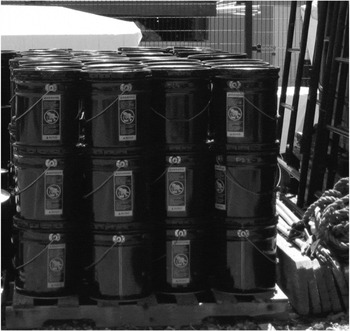
A tour of the Page today makes clear that “life in asphalt” is no longer about ancient mammals, not really. The slick, black drums stacked up around Project 23 (a recent dig opened as a result of the neighboring LACMA's proposed expansion into fossiliferous ground) look like miniature oil drums, which essentially they are. “Is that the matrix?” one of my fellow visitors asked, a rising note of expectation in his voice. The blocks of shiny drums, and perhaps the popular film of the same name, grant this once obscure product of the pits an almost glamorous persona (Figure 2). Matrix was defended as a key to ecological knowledge of the LA basin by Dr. George Miller back in the 1960s, but forty years after Earth Day it has taken on new significance as a source of living microorganisms with potential “applications” for biotech, particularly biofuels, enhanced oil recovery, and bioremediation of oil spills. The US Department of Agriculture and the EPA provided funding for a recent study of the living bacteria in La Brea matrix, conducted by environmental scientists at the University of California, Riverside. “We were surprised to find these bacteria because asphalt is an extreme and hostile environment for life to survive,” reports Jong-Shik Kim, a postdoctoral researcher. “It's clear, however, that these living organisms can survive in heavy oil mixtures containing many highly toxic chemicals.”Footnote 36 Entirely new branches on the so-called “tree of life” have been opened by the over two hundred species of microorganism that Kim and his fellow scientists discovered. While the specific applications of this new life drive the research, the project produces a broad rhetoric of hope that life itself will persist through the most toxic scenarios of “hydrocarbon contamination and radioactive environments.”Footnote 37 La Brea's living bacteria, progeny of soil microorganisms trapped in the petrol sumps tens of thousands of years ago, are prepared – for a worst-case anthropogenic climate, for the end of conventional oil, even for the Bomb. The conceptual “application” for La Brea's new petroleum species is, simply, the future.
The Matrix – life in asphalt. Photograph by the author.

For museum-goers who witness this microscale bid for a future natural history – and it is possible to miss it, to walk right past Project 23, for instance – there will be questions, at least implicit ones, about how such a downsized future might accommodate the natural history museum. Microscale natural history unfolds in the privatized space of research laboratories and requires more explicit context than even the old-fashioned cabinet-and-text-based natural history museums provide. Then again, Steven Conn suggests that natural history museums survived a similar crisis of representation as early as the 1860s, when Darwinian theory shifted biological research “from science that could be conducted with the naked eye toward science that needed a microscope.”Footnote 38 The Page gestures toward an exhibit of the potentially human-life-saving bacteria in the tar pits, illustrating how the bacteria were discovered and what the discovery might mean for the long future. This display looks a bit like a drawing table and sits awkwardly against a wall, in the shadow of the fishbowl laboratory, the museum's public exhibit of paleontologists scraping and cleaning the recognizable bones (helpfully labeled “Zed's pelvis” and so on) of La Brea mammals. “What Does Bacteria Look Like?” asks a cartoonish laminated booklet. Potato-shaped figures of “bacteria” meant to enliven the laminated pages give us an easy answer: bacteria doesn't look like much, please imagine. While imagination and daydreaming can be more valuable modes of interactivity in museums than playing with high-tech displays, this exhibit fails to evoke dreams. BioArtists and BioArchitects have proven that microscale life can look like something beautiful, often through computer simulation and digital media.Footnote 39 It would be fabulous to see microorganismic life in oil, perhaps on-screen, that rivals the beauty of the Pleistocene fossil. Perhaps the scarce funding which besets most natural history museums today, plus a traditional commitment to the sensual vertebrate skeleton, keeps a remarkably exciting aspect of the Page Museum – entirely new “branches of life” growing up in local petroleum – confined to marginal display.
The life-forms that petroleum generates tell us something about how to live through oil scarcity and into an energy shift, about how to clean up our toxic spills, about living through the destruction that has complemented human creativity. The Page Museum could be a premier site of thinking through the limitations of petroleum culture with the North American public and the science community. Rancho La Brea has long been a “post-oil” museum insofar as it has considered its asphaltum as matter in excess of the transformative energy idea. Since its preservation as a public park, the La Brea site has challenged the meanings of oil and demonstrated how not to get stuck in any single logic of its value – consider, again, that the oil business which might have developed on the museum site was given over to “science” back in 1915, under the assumption that it was more profitable, here, to mine fossils than fuel. The museum might reconsider its framing narrative. Through the microorganismic life in the tar pits, the Page could rethink the definition of natural history or even life itself along the lines that the philosopher Bruno Latour has considered in his discussions of the agency of things, both “real” and fabricated, in the ongoing story of ecology.Footnote 40 Petroleum has bumped up against various forms of life at this site for millennia, generating death and treasure and a unique means of storing life's forms and the birth of new living species. The museum's most recent, Telly award-winning, film, Ice Age Fossils of the La Brea Tar Pits (2004), begins to consider the multiple vectors of ecological action and power by making a vial of petroleum its star.
Immediately outside the “Behind the Scenes” theater where the film Ice Age Fossils is shown, a weather-worn animatronic sloth creakily ducks up and down, attempting to free itself from an equally down-at-the-heels animatronic saber-toothed cat. These are not the new audio-animatronics of Disneyland, where a 2003 Living Character Initiative inspired engineers to create figures so lifelike that their speech appears spontaneous and they move autonomously through unregulated space.Footnote 41 At the Page, visitors press a red button to hear the ground sloth's simulated screams. Last summer, the fiberglass Imperial Mammoth sinking into the Lake Pit slipped off of her cement base, floating to the far end of the lake, where she appeared to be summoning her “husband” and “child” to a frolicsome swim. The Page Museum seems on its way to becoming a museum of obsolescent infrastructure, following its Pleistocene mammals into the tar. The asphaltum, for its part, entertains the saviors of a new geologic epoch, the Anthropocene, in which the Earth that humans damaged through our profligate use of fossil fuels just might be saved by microorganisms grown up in petroleum sludge. When petroleum becomes more important as habitat than as energy to simulate habitat, or preservative for our bones, then a new natural history concept is required. This one cannot be scaled to children or even humans, perhaps, but it can offer us the opportunity to reimagine life without ourselves at the center, which is a conceptual starting point for any sustainable design.