Introduction
Cyclostome bryozoans existed in low diversities during the Paleozoic alongside the dominant palaeostomates (esthonioporines, trepostomes, cystoporates, cryptostomes and fenestrates). Most species had small encrusting or narrow-branched erect colonies, easily overlooked and difficult to study using the standard techniques of sectioning used in research on Paleozoic bryozoans. Encrusting species are best observed in muddy sediments where well-preserved surfaces of brachiopods and other shelly substrates may be visible. One such deposit is the Upper Ordovician (Sandbian, early Caradoc) Bromide Formation of Oklahoma (see Carlucci et al., Reference Carlucci, Westrop, Brett and Burkhalter2014). In addition to abundant colonies of the primitive cyclostome Corynotrypa, Bromide shells are also encrusted by an undescribed cyclostome genus named here Zigzagopora wigleyensis n. gen. n. sp.
Material
The specimens described here were mostly collected from spoil heaps at the abandoned Wigley Quarry (34.56139°N, 96.62687°W) approximately 5.9 km south of Fittstown, Pontotoc County, Oklahoma, USA. Here the so-called “Lower Echinoderm Zone” of the Mountain Lake Member of the Bromide Formation crops out. Two specimens were also collected from the “Upper Echinoderm Zone” (see Sprinkle, Reference Sprinkle1982) of the Mountain Lake Member exposed in a roadcut on Interstate 35 (northbound), south of Exit 51, Murray County, Oklahoma (34.4392°N, 97.1271°W).
Repository and institutional abbreviation
Types and other specimens examined in this study are deposited in the Natural History Museum, London, United Kingdom (NHMUK).
Geological and paleontological setting
The Zigzagopora wigleyensis n. gen n. sp. specimens were collected from the Mountain Lake Member of the Bromide Formation (Upper Ordovician, lower Caradoc, Sandbian). The predominantly carbonate sediments in this unit were deposited in a subsiding trough formed by the Southern Oklahoma Aulacogen, at a paleolatitude of approximately 30°S (Carlucci et al., Reference Carlucci, Westrop, Brett and Burkhalter2014). An embayment of the Iapetus Ocean extended into this trough along a ramp shallowing landward (Cocks and Torsvik, Reference Cocks and Torsvik2011; Carlucci et al., Reference Carlucci, Westrop, Brett and Burkhalter2014). The Mountain Lake Member was deposited in the middle ramp environment and is characterized by grainstones, packstones and thin terrigenous mudstones. This is part of “Sequence 2” of Carlucci et al. (Reference Carlucci, Westrop, Brett and Burkhalter2014).
Bryozoans are a dominant element in the Bromide Formation and yet their taxonomy is incompletely known, despite Farmer’s (Reference Farmer1974) suggestion that the Bromide may harbor the oldest well preserved bryozoan fauna anywhere in the world. Loeblich (Reference Loeblich1942) described 31 bryozoan species from the Bromide, of which 26 were new. As was customary at the time, the species he described were illustrated only in thin section, and it is clear that his account is not comprehensive because none of the abundant encrusting cyclostomes are included. In a paper showing the potential utility of bryozoans from well cuttings in subsurface stratigraphy, Merida and Boardman (Reference Merida and Boardman1967) re-illustrated four of Loeblich’s (Reference Loeblich1942) trepostomes from the Bromide. Subsequently, Farmer (Reference Farmer1975) described a few ptilodictyine cryptostomes from the Bromide, and Key (Reference Key1990, Reference Key1991) some additional trepostomes. There remains, however, the need for a fuller study of the Bromide bryozoan fauna, illustrated by a combination of thin sections, which are absolutely essential for precise taxonomic placement, and external views of corresponding colonies needed by collectors as a first indication of identity.
Systematic paleontology
Phylum Bryozoa Ehrenburg, Reference Ehrenberg1831
Class Stenolaemata Borg, Reference Borg1926
Order Paleotubuliporina Brood, Reference Brood1973
Family Sagenellidae Brood, Reference Brood1975
Genus Zigzagopora new genus
Type species
Zigzagopora wigleyensis n. gen. n. sp.
Diagnosis
As for species, by monotypy.
Etymology
From zigzag, an English word with French origins for a line characterized by sharp turns alternately to one side and then to the other; and pora from the Latin porus referring here to the numerous zooidal apertures.
Occurrence
Sandbian (lower Caradoc), Upper Ordovician; Oklahoma, USA.
Remarks
See species description below.
Zigzagopora wigleyensis new genus, new species
Figures 1.1–1.6, 2.1–2.6, Table 1
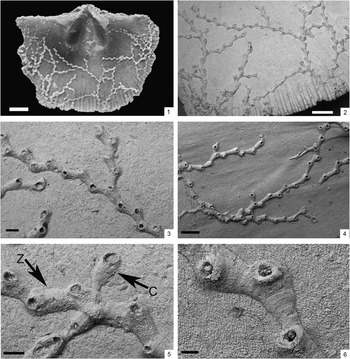
Zigzagopora wigleyensis n. gen. n. sp. from the Bromide Formation (Upper Ordovician) of Oklahoma. (1) Colony encrusting the interior of the orthid brachiopod Multicostella sulcata (holotype, NHMUK BZ 7750). Scale bar represents 2.00 mm. (2) Closer view of colony encrusting the interior of an orthid brachiopod valve (holotype, NHMUK BZ 7750). Scale bar represents 1.00 mm. (3) Extended branch with bifurcation (NHMUK BZ 7750). Scale bar represents 0.20 mm. (4) Branches with bifurcations (NHMUK BZ 7751). Scale bar represents 0.60 mm. (5) Z. wigleyensis (Z) overgrowing Corynotrypa (C); (NHMUK BZ 7750). Scale bar represents 0.20 mm. (6) Close-up view of three zooids (NHMUK BZ 7751). Scale bar represents 0.10 mm.

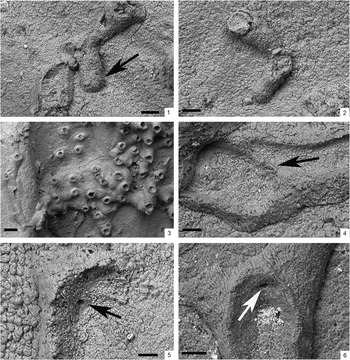
Zigzagopora wigleyensis n. gen. n. sp. from the Bromide Formation (Upper Ordovician) of Oklahoma. (1) Ancestrula with initial buds (NHMUK BZ 7750); arrow points to protoecium. Scale bar represents 0.06 mm. (2) Another ancestrula with single bud (NHMUK PD10020). Scale bar represents 0.20 mm. (3) Oligoserial portion of colony (NHMUK PD10020). Scale bar represents 0.20 mm. (4) Eroded zooid; arrow showing transverse interior wall (NHMUK PD10020). Scale bar represents 0.40 mm. (5) Interior wall; arrow showing possible interzooidal pore (NHMUK BZ 7751). Scale bar represents 0.03 mm. (6) Another interior wall; arrow shows another possible interzooidal pore (NHMUK BZ 7752). Scale bar represents 0.03 mm.

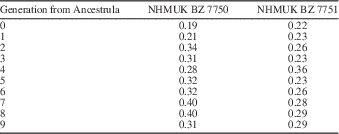
Astogenetic gradients for two colonies of Zigzagopora wigleyensis: NHMUK BZ 7750 and NHMUK BZ 7751, both from the Mountain Lake Member of the Bromide Formation exposed in Wigley Quarry near Fittstown, Oklahoma.
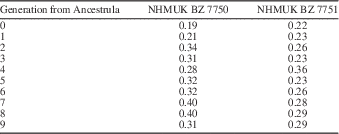
Measurements are zooid lengths in millimeters. 0 is the ancestrula.
Diagnosis
Colony encrusting, primarily uniserial but distally oligoserial in some specimens; uniserial branches are geniculate with distolateral budding of monomorphic zooids alternately on the left and right sides; branch bifurcations occur when occasional zooids bud on both right and left sides; protoecium not well differentiated from the distal ancestrular tube; exterior zooidal walls lack pseudopores; calcified interior walls present between contiguous zooids, seemingly with a single pore penetrating them.
Description
Most colonies of Zigzagopora wigleyensis encrust brachiopod valves, with the holotype on the interior of the orthid Multicostella sulcata (Fig. 1.1–1.6). The same shell substrates also host the more common Bromide cyclostome Corynotrypa (Fig. 1.5). The largest colony, that of the holotype, has an approximate diameter of 14.0 mm, being constrained by the size of the host shell (Fig. 1.1).
Protoecia average 0.08 mm in width (0.07–0.08 mm range; n=5), are rounded proximally, and distally poorly differentiated from the distal ancestrular tube (Fig. 2.1–2.2). Together the protoecium and ancestrular tube average 0.19 mm long (0.16–0.22 mm range; n=5). Two buds emerge distolaterally from either side of the ancestrula. The primary astogenetic gradient of zooid size was measured through nine generations on two specimens and shows an irregular increase in zooid lengths from 0.21 to 0.31 mm (Table 1). Budding is uniserial and geniculate through most of the colony, with distolateral budding of zooids alternately on the left and right sides (Fig. 1.1–1.6). Branches bifurcate when a zooid buds distolaterally on both right and left sides; this occurs irregularly, with some bifurcations only two zooids after the last bifurcation, whereas other branches may contain fifteen or more zooids without bifurcation. Rarely branches become narrowly multiserial (oligoserial) distally (Fig. 2.3).
The zooids are monomorphic with some irregularities induced by local growing conditions. The typical zooid is spatulate with a narrow proximal portion expanding distally to a rounded region around the aperture (Fig. 1.6). The aperture is nearly circular with no evidence of a peristome, but the rim is irregular and likely eroded. Fine transverse growth lines are visible on the frontal walls of well-preserved zooids and occasionally faint longitudinal striations. The surface microstructure of the frontal wall skeleton in well-preserved zooids is planar spherulitic, confirming that this is an exterior wall that would have been covered by cuticle in life. Pseudopores are lacking in the frontal walls. Some zooidal apertures appear to be capped by terminal diaphragms (Fig. 2.2).
Visible in worn branches near the distal end of each zooid is a curved interzooidal wall, concave distally (Fig. 2.4). Two specimens show a central circular depression in this wall about 0.01 mm in diameter and interpreted as the opening of an interzooidal pore (Fig. 2.5–2.6).
Etymology
This species is named after the Wigley Quarry near Fittstown, Oklahoma, where the first specimens were found. We also appreciate the homophone wiggly, which describes an undulating line.
Material
Holotype: NHMUK BZ 7750 from the Wigley Quarry (see above). Paratypes: NHMUK PD10020 (collected by F. Siewers and T. Guensburg), NHMUK BZ 7751 from the Wigley Quarry; NHMUK BZ 7752 from the Interstate 35 locality (see above). Other material: NHMUK BZ 7754–7769 (16 specimens) from the Wigley Quarry; NHMUK 7770 from the Interstate 35 locality.
Occurrence
All specimens known to date are from the Mountain Lake Member of the Bromide Formation (Upper Ordovician, lower Caradoc, Sandbian), Arbuckle Mountains, Oklahoma, USA.
Remarks
Zigzagopora resembles the common Paleozoic cyclostome Corynotrypa, with which it shares the same substrates in the Bromide fauna. Both genera have at least initially uniserial runner-like colonies, a protoecium poorly differentiated from the ancestrular tube, and a lack of pseudopores in the frontal zooidal walls (Taylor and Wilson, Reference Taylor and Wilson1994). Zigzagopora, however, has distinctive geniculate budding, internal calcified walls, and occasional distal oligoserial growth, features not possessed by Corynotrypa. Goryunovia is another Ordovician non-pseudoporous, uniserial encruster originally described as a cyclostome bryozoan, but it has large, slender zooids, trichotomous branching, and partial internal walls (Taylor and Rozhnov, Reference Taylor and Rozhnov1996) and may possibly be an early example of a hederelloid rather than a bryozoan (Taylor and Wilson, Reference Taylor and Wilson2008).
The phylogenetic position of Zigzagopora is problematic. Colony-form is similar to some colonies of the tubuliporine Stomatoporina (notable S. incurvata), but Zigzagopora lacks the pseudoporous exterior walls of this Jurassic–Recent genus (Illies, Reference Illies1975). Zigzagopora is, nevertheless, more derived than Corynotrypa in having calcified interior walls. The new genus resembles some of the Polish Ordovician material assigned by Dzik (Reference Dzik1994) to his erect genus Wolinella, but is encrusting only. The presence of interior walls suggests an affinity with Sagenellidae, a paleotubuliporine family of multiserial cyclostomes. However, the type genus of Sagenellidae, Sagenella Hall, Reference Hall1851, is primarily a sheet-like, multiserial form lacking the runner-like colony form seen in Zigzagopora.
Measurements
Zooid length=0.21–0.46 mm (n=98); zooid width=0.12–0.26 mm (n=76); aperture length=0.05–0.12 mm (n=25); aperture width=0.06–0.12 mm (n=26).
Discussion
Following the recognition of a separate order Cystoporata by Astrova (Reference Astrova1964) for ceramoporine and fistuliporine bryozoans, Paleozoic representatives of the order Cyclostomata became reduced to the aberrant Hederelloidea plus a residuum of genera subsequently united in the suborder Paleotubuliporina by Brood (Reference Brood1973). Hederelloids are not now regarded as bryozoans (see Taylor and Wilson, Reference Taylor and Wilson2008). What remains of the Paleozoic cyclostomes is a small number of genera with ‘weedy’ encrusting or narrow-branched erect colonies that are similar to many post-Paleozoic cyclostomes in having exterior frontal walls (see Brood, Reference Brood1975; Taylor, Reference Taylor1975; Taylor and Wilson, Reference Taylor and Wilson1994, Reference Taylor and Wilson1996; Taylor and Rozhnov, Reference Taylor and Rozhnov1996; Dzik, Reference Dzik1981, Reference Dzik1994).
Paleozoic cyclostomes have few external morphological characters and making thin sections is both difficult and generally unrewarding for the majority of genera. They fall into three main morphological grades: the simplest—corynotrypids—lack calcified interior walls and have skeletons composed entirely of calcified exterior walls; intermediate are sagenellids, with calcified interior walls but few or no perforations (pseudopores) in the frontal exterior walls; crownoporids most closely resemble post-Paleozoic cyclostomes in having pseudoporous exterior frontal walls.
The new Bromide genus Zigzagopora has a sagenellid-grade skeletal structure and represents the first runner-like Paleozoic cyclostome of this grade: Corynotrypa is a runner-like corynotrypid, and Cuffeyella a crownoporid runner. It is always difficult to formulate phylogenetic hypotheses for groups with so few characters, but we suspect that Zigzagopora is a basal sagenellid because it is uniserial and the other sagenellids are multiserial and sheet-like. Multiseriality appears to be a derived character in the cyclostomes (see Dzik, Reference Dzik1981; Taylor and Rozhnov, Reference Taylor and Rozhnov1996).
Bryozoan runners such as Zigzagopora use a fugitive strategy (Buss, Reference Buss1979), spreading their zooids widely across the substratum to maximize colony survival in the face of patchy partial mortality, for example through localized overgrowth by superior competitors. The distant spacing of the lophophores of runner colonies also makes them well adapted to conditions of restricted planktonic food supply (Okamura et al., Reference Okamura, Harmelin and Jackson2001). Most colonies of Zigzagopora were found to occur on the concave interior surfaces of disarticulated brachiopod shells, often together with the runner-like Corynotrypa. It is conceivable that these represented cryptic microhabitats, perhaps semi-buried, where food supply was limited.
Acknowledgments
We are particularly grateful to T. Ewin who organized and J. Sprinkle who led a fieldtrip to Oklahoma during which most of the specimens described were collected. C. Sendino, M. Graham and W. Rushlau also helped in the field. We thank two anonymous reviewers for their constructive comments on this manuscript.