Children who grow up in poor neighborhoods are less likely to graduate from high school, more likely to spend time in prison, and can expect to suffer from more health-related problems when compared to their peers in more affluent settings. Even within the wealthiest nations, the proportion and absolute numbers of children confronting the conditions associated with poverty are staggering. In the United States, an estimated 14 million children (~20% of all children) are living in families that have incomes below the federal poverty level (Wight, Chau, & Aratani, Reference Wight, Chau and Aratani2010). In the United Kingdom, national statistics indicate that up to 1 in 3 children (3.8 million) live in relative poverty once housing costs are considered (Joyce, Phillips, & Sibieta, Reference Joyce, Phillips and Sibieta2010). A commission assembled by the World Health Organization recently concluded that these types of inequalities are “killing people on a grand scale” and called for investment during the early years of life to reduce social inequalities within the next generation (Marmot et al., Reference Marmot, Friel, Bell, Houweling and Taylor2008). Throughout their call, the Commission emphasized the need to extend the current focus on social inequalities in child development beyond physical and cognitive aspects to include the crucial domains of social and emotional well-being (Commission on Social Determinants of Health, 2008).
Child well-being has been conceptualized as encompassing the broad domains of physical, educational, behavioral, and emotional status (Bradshaw, Reference Bradshaw2011). Poverty is considered the single biggest threat to child well-being, and efforts directed at reducing socioeconomic inequalities that begin in childhood are sorely needed. To date, the majority of information on how poverty affects children has emerged from studies focused on physical health (e.g., infant mortality, birth weight, and asthma) and academic achievement (e.g., test scores, school readiness, and academic performance). These streams of research have been invaluable in shaping policy initiatives in public health and education. However, the general consensus is that efforts aimed at reducing social inequalities will require a more complete understanding of how the long reach of childhood poverty influences all aspects of development, including emotional and behavioral well-being (Brooks-Gunn, Duncan, & Aber, Reference Brooks-Gunn, Duncan and Aber1997; Commission on Social Determinants of Health, 2008; Duncan & Magnuson, Reference Duncan and Magnuson2011).
Antisocial behavior is a key indicator of children's well-being that has been linked to socioeconomic disparities at both the neighborhood and family levels (Duncan, Brooks-Gunn, & Klebanov, Reference Duncan, Brooks-Gunn and Klebanov1994). Antisocial behavior is a relatively common problem among school-aged children and, if it persists across childhood, signals a host of costly physical health, mental health, social, and economic difficulties (Cohen & Piquero, Reference Cohen and Piquero2009; Moffitt, Caspi, Harrington, & Milne, Reference Moffitt, Caspi, Harrington and Milne2002). In this study we defined antisocial behavior as aggressive and delinquent acts that result in physical or psychological harm to others or their property (e.g., “stealing,” “lying,” and “getting into fights”). Such behaviors violate the rights of others and, in some cases, violate legal codes. Children's antisocial behavior was assessed using the Achenbach family of instruments (Achenbach, Reference Achenbach1991a, Reference Achenbach1991b), which is the most widely used and well validated assessment scheme for assessing antisocial behavior problems among children and adolescents. Operationally, the measure of antisocial behavior referenced throughout this article was derived based on items from the Delinquent Behavior Scale (e.g., “lying or cheating,” “swearing or bad language”) and Aggressive Behavior Scale (e.g., “hot temper,” “physically attacks people”) of the Child Behavior Checklist and the Teacher Report Form.
Unfortunately, most neighborhood effects research has not focused specifically on children's antisocial behavior because of the belief that contexts outside of the family are more likely to influence the behavior of adolescents and adults (Klebanov, Brooks-Gunn, Chase-Lansdale, & Gordon, Reference Klebanov, Brooks-Gunn, Chase-Lansdale, Gordon, Brooks-Gunn, Duncan and Aber1997). As a result, the effects of neighborhood socioeconomic status (SES) on delinquency and crime have been widely studied among older adolescents (for a review, see Sampson, Morenoff, & Gannon-Rowley, Reference Sampson, Morenoff and Gannon-Rowley2002; Shaw & McKay, Reference Shaw and McKay1942), and there is a long history of linking neighborhood features to crime among adults (Sampson, Raudenbush, & Earls, Reference Sampson, Raudenbush and Earls1997; Wilson, Reference Wilson1987). However, the question of whether and how SES influences children's antisocial behavior has received less attention (for notable exceptions see Caspi, Taylor, Moffitt, & Plomin, Reference Caspi, Taylor, Moffitt and Plomin2000; Caughy, Nettles, & O'Campo, Reference Caughy, Nettles and O'Campo2008; Chase–Lansdale & Gordon, Reference Chase-Lansdale and Gordon1996; Criss, Shaw, Moilanen, Hitchings, & Ingoldsby, Reference Criss, Shaw, Moilanen, Hitchings and Ingoldsby2009; Duncan et al., Reference Duncan, Brooks-Gunn and Klebanov1994; Ingoldsby et al., Reference Ingoldsby, Shaw, Winslow, Schonberg, Gilliom and Criss2006; Mrug & Windle, Reference Mrug and Windle2009; Reijneveld et al., Reference Reijneveld, Veenstra, de Winter, Verhulst, Ormel and de Meer2010; Schneiders et al., Reference Schneiders, Drukker, Van der Ende, Verhulst, Van Os and Nicolson2003; Vanderbilt-Adriance & Shaw, Reference Vanderbilt-Adriance and Shaw2008).
In this paper we ask whether neighborhood-level socioeconomic disparities make an independent contribution to children's involvement in antisocial behavior across childhood. More specifically, we test whether a graded relationship between neighborhood-level SES and antisocial behavior can be detected at school entry and whether there is evidence that growing up in a deprived versus more affluent neighborhood has a stronger effect on children's antisocial behavior as they approach adolescence and begin to spend more time in their neighborhoods. Many people wonder whether neighborhood SES is merely a proxy for family-level SES and question whether associations between neighborhood poverty and the health of residents is simply due to the type of people who live in a given neighborhood (social selection) versus the effects of neighborhood characteristics per se (social causation). To address this concern, we tested whether differences in children's antisocial behavior across deprived versus more affluent neighborhoods remain after accounting for more proximal family-level factors, including family-level SES and parent's own history of antisocial behavior. Finally, most theories assume that the effects of neighborhood-level poverty, especially for young children, are transmitted through parents (Klebanov et al., Reference Klebanov, Brooks-Gunn, Chase-Lansdale, Gordon, Brooks-Gunn, Duncan and Aber1997). In this paper we ask the policy-relevant question of whether supportive parenting practices, including maternal warmth and parental monitoring, mediate the effects of socioeconomic deprivation on children's developmental course of antisocial behavior. Additional details regarding our three main research questions are outlined below.
Question 1. Does the widely observed SES gradient in health underlie children's antisocial behavior?
The SES gradient in health is pervasive. The seminal Whitehall Studies in the United Kingdom provided evidence of a steep inverse association between social class and mortality for a wide range of diseases (Marmot et al., Reference Marmot, Stansfeld, Patel, North, Head and White1991). Similarly, the last two decades of work by the MacArthur Network on SES and Health have provided countless illustrations of how the gradient in health reproduces itself over time, populations, and different types of diseases (Adler & Ostrove, Reference Adler and Ostrove1999). Over the last decade, the field has moved to a new era of research focused on mechanisms linking SES and health via multiple levels of influence, from characteristics of the individual to features of the larger community (Adler & Stewart, Reference Adler and Stewart2010). Within this discussion, neighborhoods have emerged as potentially relevant contexts for understanding the elusive SES gradient as they contain both physical and social attributes known to influence health status (Diez Roux & Mair, Reference Diez Roux and Mair2010). More specifically, neighborhood settings are believed to influence resident's lives through two broad domains of influence: (a) the physical environment (e.g., physical spaces, air quality, safe places to for children to play) and (b) the social environment (e.g., social norms, safety and violence, the type and nature of connections between residents).
In this study we test whether the SES gradient can be observed across neighborhood settings for children's antisocial behavior, beginning at school entry (age 5) and persisting through to age 12. Children from low- versus high-SES families typically have higher levels of socioemotional problems, including antisocial behavior (for a review, see Bradley & Corwyn, Reference Bradley and Corwyn2002). However, less is known about how neighborhood-level SES shapes children's developmental trajectories. The neighborhood settings that children are embedded in are believed to shape children's antisocial behavior in at least three (interrelated) ways.
First, low- versus high-SES neighborhoods are more likely to be characterized by high levels of crime, disorder, and exposure to other threatening and uncontrollable events that are hypothesized to have downstream effects on families and children. Chronic stress exposure is believed to account for much of the difference in outcomes between children across these settings (e.g., Adler & Ostrove, Reference Adler and Ostrove1999; McLoyd, Reference McLoyd1998; Shonkoff & Phillips, Reference Shonkoff and Phillips2000), with evidence that young people growing up in poverty confront more stressors in their daily lives when compared to their more affluent counterparts (Evans, Vermeylen, Barash, Lefkowitz, & Hutt, Reference Evans, Vermeylen, Barash, Lefkowitz and Hutt2009). The stressors, uncertainties, and low social standing that accompany living in a low- versus high-SES neighborhood are also believed to deplete energy, predict negative emotional states, and lead to a pattern of behavior known as “reactive responding.” Reactive responding is often characterized by chronic vigilance, emotional reacting, and sense of powerlessness when confronted with environmental stressors (Taylor & Seeman, Reference Taylor and Seeman1999). In line with this theory, parents living within low-SES contexts have been found to overuse negative control strategies, fail to adequately monitor children, and exhibit low warmth and responsiveness (McLoyd, Reference McLoyd1990). Prior research also suggests that it is the absence of supportive parenting, not just the presence of negative parenting, that mediates the relationship between low SES and child well-being (for a review, see Bradley & Corwyn, Reference Bradley and Corwyn2002).
Second, children growing up in low- versus high-SES neighborhoods are more likely to be exposed to delinquent peer groups and spend greater amounts of unsupervised time with antisocial peers (Haynie & Osgood, Reference Haynie and Osgood2005; Osgood, Wilson, O'Malley, Bachman, & Johnston, Reference Osgood, Wilson, O'Malley, Bachman and Johnston1996). Research has also shown that exposure to delinquent peers within low-SES contexts may overwhelm the effects of family-level factors on children's conduct problems (Schonberg & Shaw, Reference Schonberg and Shaw2007) and that association with delinquent peers may serve as a way in which early starting conduct problems are reinforced and maintained over time (Ingoldsby et al., Reference Ingoldsby, Shaw, Winslow, Schonberg, Gilliom and Criss2006). In short, peers have been shown to mediate, exacerbate, and directly affect antisocial behavior among children and are believed to play an increasing role as children move through adolescence. Most theories and studies of children's development assume an interactive pattern of influence of neighborhood effects through both family and peer settings (Criss et al., Reference Criss, Shaw, Moilanen, Hitchings and Ingoldsby2009; Eamon, Reference Eamon2002; Loeber & Farrington, Reference Loeber and Farrington2000) and, for the most part, operate on the assumption that neighborhood effects operate primarily through family contexts in early childhood and that peers begin to play a larger role as children approach adolescence.
Third, low- versus high-SES neighborhoods typically have lower levels of community-based resources, such as collective efficacy, which are believed to facilitate the successful socialization of children into school and other community contexts, increase the amount of social support available to parents, and enhance parents' feelings of safety and trust in their communities. High levels of cohesion and trust within a community are also believed to play a role in establishing local norms discouraging harsh parenting and domestic violence, while also informally monitoring levels of antisocial behavior among children and adolescents (Browning & Cagney, Reference Browning and Cagney2003; Sampson, Reference Sampson2003; Sampson, Morenoff, & Earls, Reference Sampson, Morenoff and Earls1999).
As described in more detail below, in the present study we test whether a graded relationship between neighborhood SES and children's antisocial behavior is present at school entry, increases over time, and can be mediated at least partly by supportive parenting. We acknowledge that community-based resources and peers are likely to play a significant role in the transmission of neighborhood effects on children, but we focus primarily on the role of supportive parenting practices. The motivation for our focus on parenting behaviors is that most early childhood interventions seek to enhance supportive parenting as the family context is considered to be one of the primarily ways in which neighborhood effects are transmitted to young children (Klebanov et al., Reference Klebanov, Brooks-Gunn, Chase-Lansdale, Gordon, Brooks-Gunn, Duncan and Aber1997). This approach is consistent with the emerging belief among those in policy and intervention circles that the most effective way to enhance the life prospects of vulnerable children (while one waits for the unlikely scenario where child poverty is eliminated) is to build capacities and strengths within families that are capable of mitigating the effects of toxic stress on the developing child (Shonkoff, Reference Shonkoff2012).
Our longitudinal study also offers a unique opportunity to test whether the effects of neighborhood SES on children's antisocial behavior increase over time. The effects of neighborhood settings on children's antisocial behavior are expected to increase as children begin to spend more time in their neighborhoods, making their way to and from school, participating in afterschool activities, and acquiring more freedom to spend unsupervised time in their local communities with peers (Brooks-Gunn, Duncan, Klebanov, & Sealand, Reference Brooks-Gunn, Duncan, Klebanov and Sealand1993). Antisocial behavior is relatively common in early childhood and has been shown to decline as children make the transition into primary school and move across middle childhood (Stanger, Achenbach, & Verhulst, Reference Stanger, Achenbach and Verhulst1997; Tremblay & Nagin, Reference Tremblay, Nagin, Tremblay, Hartup and Archer2005). This normative pattern of decline is believed to result from a host of positive socialization experiences that children encounter as they learn to navigate social relationships in their homes, schools, and neighborhoods and acquire the skills needed to achieve their aims through prosocial means (Cairns, Cairns, Neckerman, Ferguson, & Gariepy, Reference Cairns, Cairns, Neckerman, Ferguson and Gariepy1989; Tremblay, Reference Tremblay2000). Children who do not follow this normative trajectory of decline in behavioral problems are at risk for a host of poor outcomes in adulthood (Moffitt et al., Reference Moffitt, Caspi, Harrington and Milne2002; Odgers et al., Reference Odgers, Moffitt, Broadbent, Dickson, Hancox and Harrington2008).
To address this question, we mapped the developmental course of antisocial behavior separately for children growing up in relatively deprived, middle-, and high-SES areas and tested whether children in deprived versus more affluent neighborhoods exhibited a slower rate of decline in antisocial behavior between the ages of 5 and 12. The influence of neighborhood SES on the developmental course of antisocial behavior was tested separately among boys versus girls, and we were especially interested in testing whether the “gap” in antisocial behavior between children living in more deprived versus affluent settings widened across childhood. We expected to observe a general decrease in antisocial behavior from middle to late childhood, were especially concerned about children who were not exhibiting the expected decline in antisocial behavior, and asked whether neighborhood social inequalities play a role in placing children on an early-onset and persistent pathway of antisocial behavior.
Question 2. Does the level of socioeconomic deprivation in a neighborhood continue to influence children's antisocial behavior after considering more proximal family-level factors?
Prior research has demonstrated small, but robust, effects of neighborhood conditions on children's educational, emotional, and behavioral well-being (for a summary, see Leventhal & Brooks-Gunn, Reference Leventhal and Brooks-Gunn2000). However, questions remain as to whether these effects are sensitive to unmeasured variables that may influence the types of families that live in a specific neighborhood. Neighborhood- and family-level SES are often closely linked, and it is possible that neighborhood SES serves only as a proxy for family-level status. Levels of neighborhood- and family-level deprivation were moderately but not completely correlated in the present sample (r = .51), which provided the opportunity to evaluate the relative contribution of each form of SES and test whether neighborhood and family-level SES exerted cumulative effects on children's antisocial behavior (e.g., see Leventhal & Brooks-Gunn, Reference Leventhal and Brooks-Gunn2000; Wasserman, Shaw, Selvin, Gould, & Syme, Reference Wasserman, Shaw, Selvin, Gould and Syme1998).
Because families are not randomly selected into neighborhoods, we also tested whether the effects of neighborhood-level deprivation were robust to conditions that are believed to influence both where families are able to live and children's levels of antisocial behavior, including the mother's and father's history of antisocial behavior and mental health problems among family members. Controlling for family history information in our analyses helped to account for two important causes of antisocial behavior: familial genetic loading and parents' environmental influences on their children's antisocial behavior (Moffitt et al., Reference Moffitt, Arseneault, Jaffee, Kim-Cohen, Koenen and Odgers2007). Our analyses also controlled for exposure to family violence, which is more heavily concentrated in deprived neighborhoods and has demonstrated robust associations with children's antisocial behavior in prior research (Coulton, Crampton, Irwin, Spilsbury, & Korbin, Reference Coulton, Crampton, Irwin, Spilsbury and Korbin2007). More specifically, we asked whether neighborhood-level SES independently predicted children's levels of antisocial behavior and/or the rate of change in children's antisocial behavior between the ages of 5 and 12.
Question 3. Can supportive parenting practices mediate the effects of neighborhood SES on children's developmental course of antisocial behavior?
Poverty and its associated conditions are believed to exact a cumulative toll on children through two broad categories of influence: (a) access to environmental resources/constraints (“what money can buy” pathway) and (b) increases in unfavorable environmental exposures associated with declining SES, such as exposure to family violence and harsh parenting (Adler & Ostrove, Reference Adler and Ostrove1999; Cohen, Janicki-Deverts, Chen, & Matthews, Reference Cohen, Janicki-Deverts, Chen and Matthews2010). That is, childhood SES is often viewed as a dual-risk factor capable of exerting a direct effect on behavior as well as setting the scene for more proximal factors, such as parenting behaviors, to exert their influence (Poulton & Caspi, Reference Poulton and Caspi2005). Among adolescents, parenting factors such as harsh discipline, low parental monitoring, and weak parent–child attachment have been shown to mediate the effects of poverty and other structural neighborhood characteristics on delinquency and violence (Chung & Steinberg, Reference Chung and Steinberg2006; Sampson & Laub, Reference Sampson and Laub1994; Tolan, Gorman-Smith, & Henry, Reference Tolan, Gorman-Smith and Henry2003). Much less attention has been paid to how the effects of neighborhood poverty are transmitted to preadolescent children (Mrug & Windle, Reference Mrug and Windle2009). However, it is assumed that neighborhood effects at this young age are largely mediated by family-level processes and parenting (Klebanov et al., Reference Klebanov, Brooks-Gunn, Chase-Lansdale, Gordon, Brooks-Gunn, Duncan and Aber1997; Kohen, Leventhal, Dahinten, & McIntosh, Reference Kohen, Leventhal, Dahinten and McIntosh2008).
Parental monitoring has been identified as a key mediator of neighborhood effects on children's behavior because neighborhood conditions are likely to influence the degree to which parents perceive threats in the local community and, in turn, the extent to which they monitor and keep track of their children (Leventhal & Brooks-Gunn, Reference Leventhal and Brooks-Gunn2000). Although there is evidence of both child elicited and parent driven effects (Laird, Pettit, Bates, & Dodge, Reference Laird, Pettit, Bates and Dodge2003; Pettit, Laird, Dodge, Bates, & Criss, Reference Pettit, Laird, Dodge, Bates and Criss2001; Stattin & Kerr, Reference Stattin and Kerr2000), effective parental monitoring (a) has consistently been associated with lower levels of antisocial behavior among children and adolescents; (b) has been identified as a mediator of treatment effects in intervention studies, where increases in parental monitoring have been associated with reductions in adolescent substance use; and (c) is considered to be particularly important, but difficult to implement, in high-risk neighborhoods (for a recent review, see Racz & McMahon, Reference Racz and McMahon2011).
Other types of supportive parenting practices, including parental warmth and responsivity, have also emerged as likely candidates in the transmission of neighborhood effects among both adolescents and young children (Brooks-Gunn et al., Reference Brooks-Gunn, Duncan and Aber1997; Gershoff, Aber, Raver, & Lennon, Reference Gershoff, Aber, Raver and Lennon2007). For example, one of the reasons that poverty is believed to be so detrimental to children's lives is that it has been shown to reduce a mother's ability to respond to her child (Evans, Boxhill, & Pinkaya, Reference Evans, Boxhill and Pinkaya2008; Grant et al., Reference Grant, Compas, Stuhlmacher, Thurm, McMahon and Halpert2003; Magnuson & Duncan, Reference Magnuson, Duncan and Marc2002). Mothers who are trying to parent in poverty are often faced with a wide range of physical and psychosocial stressors that may interfere with their ability to be responsive to their children's needs. Mothers living in low-income neighborhoods also tend to have lower levels of social support, lack positive parenting role models in the community, and are more prone to depression and other mental health problems that are known to compromise supportive parenting practices (Conger et al., Reference Conger, Conger, Elder, Lorenz, Simons and Whitbeck1992; Kiernan & Huerta, Reference Kiernan and Huerta2008; McLoyd, Reference McLoyd1998).
There are numerous examples of large-scale interventions that target parents in low-income communities and focus on enhancing supportive parenting practices. The Nurse–Family Partnership is one of the most widely implemented and evaluated early intervention programs. The Nurse–Family Partnership targets first time and low-income mothers through home visitations prior to and following the birth of their first child and, among other things, aims to help the mother to provide responsible and competent care for her child (Olds, Reference Olds2006). Similarly, other behavioral family intervention programs, such as the Triple P-Positive Parenting Program (Sanders, Reference Sanders1999) and the Oregon Model of Parent Management Training (Patterson, Forgatch, & DeGarmo, Reference Patterson, Forgatch and DeGarmo2010), focus on strengthening parenting skills including parental supervision and monitoring and building warm and supportive parent–child relationships. In this study we test whether two of the main targets of these interventions, parental monitoring and maternal warmth, mediate the effects of neighborhood SES on children's antisocial behavior between the ages of 5 and 12 years. If we find that the supportive parenting practices mediate the effect of neighborhood SES on children's antisocial behavior, it would aid our understanding of how community level resources are translated into child outcomes and may point to malleable targets for intervention research.
This study is unique in that it provides the opportunity to do the following:
1. map the developmental course of antisocial behavior in a large cohort of children (n = 2,232) followed prospectively with high retention across childhood (>95% at all ages);
2. trace the influence of neighborhood SES on the lives of families representing the full range of socioeconomic conditions in the United Kingdom;
3. test whether differences in antisocial behavior between children living in deprived versus more affluent neighborhoods widen across childhood using a standardized assessment of antisocial behavior at the ages of 5, 7, 10, and 12; and
4. evaluate the influence of neighborhood SES on children's antisocial behavior using multiple-informant and longitudinal assessments of children's behavior (mother and teacher reported), neighborhood SES (census and resident surveys), and family-level parenting and risk (both rater coded and mother reported).
Our prior work in this sample mapped the developmental course of antisocial behavior between the ages of 5 and 10 years and illustrated how community-level cohesion and informal social control can protect children from the negative effects of neighborhood deprivation at school entry (Odgers et al., Reference Odgers, Moffitt, Tach, Sampson, Taylor and Matthews2009). In this study we extend our prior work by (a) following children to the age of 12 (a time when neighborhood effects on behavior are believed to strengthen), (b) asking whether differences in antisocial behavior between children living in deprived versus more affluent neighborhoods remain after considering family-level risks, (c) testing whether the influence of neighborhood SES on children's antisocial behavior increases over time, and (d) responding to one of our calls for future research by testing how the effects of neighborhood characteristics are transmitted to children via more proximal family-level processes such as parental monitoring and maternal warmth.
Methods
Participants
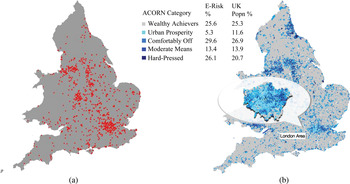
The participants were members of the Environmental Risk (E-Risk) Longitudinal Twin Study, which tracks the development of a nationally representative birth cohort of 2,232 British children (see Figure 1a for a description of the geographical distribution of the families in the study). The sample was drawn from a larger birth register of twins born in England and Wales in 1994–1995 (Trouton, Spinath, & Plomin, Reference Trouton, Spinath and Plomin2002). Details about the sample have been reported previously (Moffitt, Reference Moffitt2002). Briefly, the E-Risk sample was constructed in 1999–2000, when 1,116 families with same-sex 5-year-old twins (93% of those eligible) participated in home-visit assessments. Families were recruited to represent the UK population of families with newborns in the 1990s, based on (a) residential location throughout England and Wales and (b) mother's age (i.e., older mothers having twins via assisted reproduction were underselected and teenage mothers with twins were overselected). Follow-up home visits were conducted when the children were aged 7 years (98% participation), 10 years (96% participation), and, most recently, 12 years (96% participation). With parents' permission, questionnaires were mailed to the children's teachers, who returned questionnaires for 94% of children at age 5, 91% of the 2,232 E-Risk children (93% of those followed up) at age 7, 86.3% of the 2,232 E-Risk children (90.1% of those followed up) at age 10, and 80% of the 2,232 E-Risk children at age 12 (83% of those followed up). The sample included 55% monozygotic and 45% dizygotic twin pairs. Sex was evenly distributed within zygosity (51% female). Parents gave informed consent and children gave assent. The Maudsley Hospital Ethics Committee approved each phase of the study.
(a) The locations of the Environmental Risk Longitudinal Twin Study families at the Phase 12 home visit, and (b) Environmental Risk Longitudinal Twin Study families represent the full range of neighborhood socioeconomic statuses in Britain. ACORN, A Classification of Residential Neighborhoods. [A color version of this figure can be viewed online at http://journals.cambridge.org/dpp]

Measures
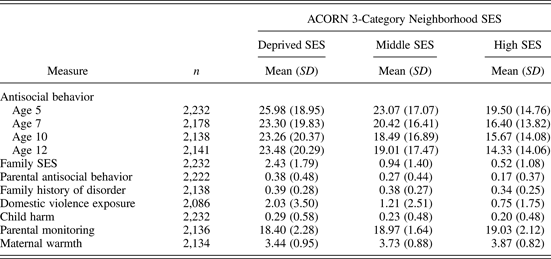
Table 1 provides the means and standard deviations for all of the measures described below separately for children growing up in deprived, middle-, and high-income neighborhoods.
Children's levels of antisocial behavior, family-level risk, exposure to violence, and supportive parenting by neighborhood SES
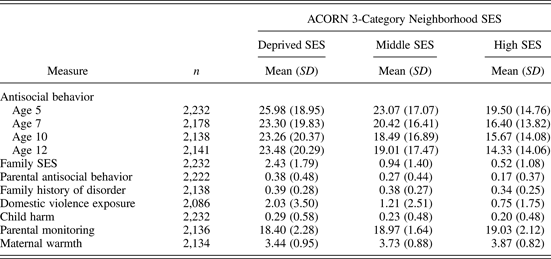
Note: SES, socioeconomic status; ACORN, A Classification of Residential Neighborhoods.
Antisocial behavior consists of aggressive and delinquent acts that result in physical or psychological harm to others or their property (e.g., “stealing,” “lying,” and “getting into fights”). Such behaviors violate the rights of others and, in some cases, violate legal codes. Children's antisocial behavior was assessed using the Achenbach family of instruments (Achenbach, Reference Achenbach1991a, Reference Achenbach1991b), which is the most widely used and well validated assessment scheme for assessing antisocial behavior problems among children and adolescents. The antisocial behavior construct reported in this article was derived from items from the Delinquent Behavior Scale (e.g., “lying or cheating,” “swearing or bad language”) and Aggressive Behavior Scale (e.g., “hot temper,” “physically attacks people”) of the Child Behavior Checklist and the Teacher Report Form. We combined mother interviews and teacher reports of children's behavior on the aggression and delinquency scales by summing the items from each rater (items scored from 0 to 2). The Antisocial Behavior Scale was administered at age 5 (M = 23.0, SD = 17.3, α = 0.94, range = 0–130.4, N = 2,232), age 7 (M = 20.3, SD = 17.2, α = 0.95, range = 0–132.0, N = 2,178) age 10 (M = 19.5, SD = 17.8, α = 0.92, range = 0–150.0, N = 2,138), and age 12 (M = 19.4, SD = 18.03, α = 0.93, range = 0–139.0, N = 2,141).
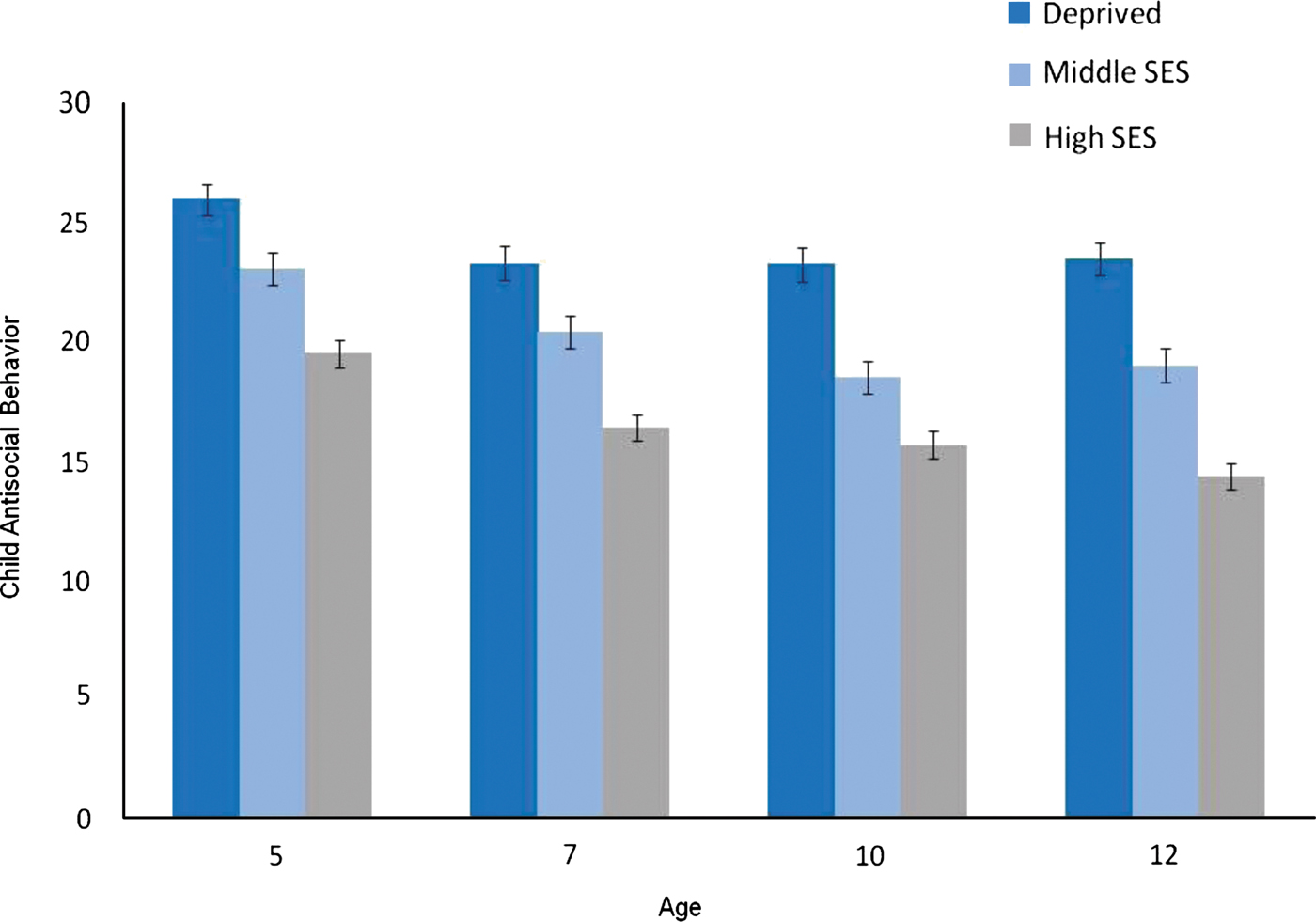
Neighborhood-level SES was assessed using geodemographic discriminators developed by CACI Limited for commercial use in Great Britain. A Classification of Residential Neighborhoods (ACORN) index was built using over 400 variables from the 2001 census and an extensive consumer research database (e.g., age, educational qualifications, unemployment, single-parent status, housing tenure and dwelling type, and car availability) combined to give a comprehensive picture of socioeconomic differences between different areas (see Figure 1b). Classifications were provided at the enumeration district level (~150 households) and were geocoded to match the location of each family's home (Odgers, Caspi, Bates, Sampson, & Moffitt, in press). Hierarchical cluster analysis was used to group enumeration districts into 56 neighborhood types and five distinct and homogeneous ordinal groups ranging from “wealthy achievers” (Category 1) with high incomes, large single-family houses, and access to many amenities (25.6% of E-Risk families and 25.3% of the UK population) to “hard pressed” neighborhoods (Category 5) dominated by government-subsidized housing estates, low incomes, high unemployment, and single parents (26.1% of E-Risk families and 20.7% of the UK population). ACORN classifications are typically sold to businesses and health and local health authorities for marketing and planning purposes but were shared with our research team by their developers CACI Ltd (http://www.caci.co.uk/) for educational and research purposes. Findings are displayed for children growing up in relatively high-SES (ACORN Category 1 and Category 2), middle-SES (ACORN Category 3), and deprived (low) SES (ACORN Category 5 and Category 6) neighborhoods (see Figure 2, Figure 3, Figure 4). All regression analyses were performed using the ACORN-defined five category measure of neighborhood SES.
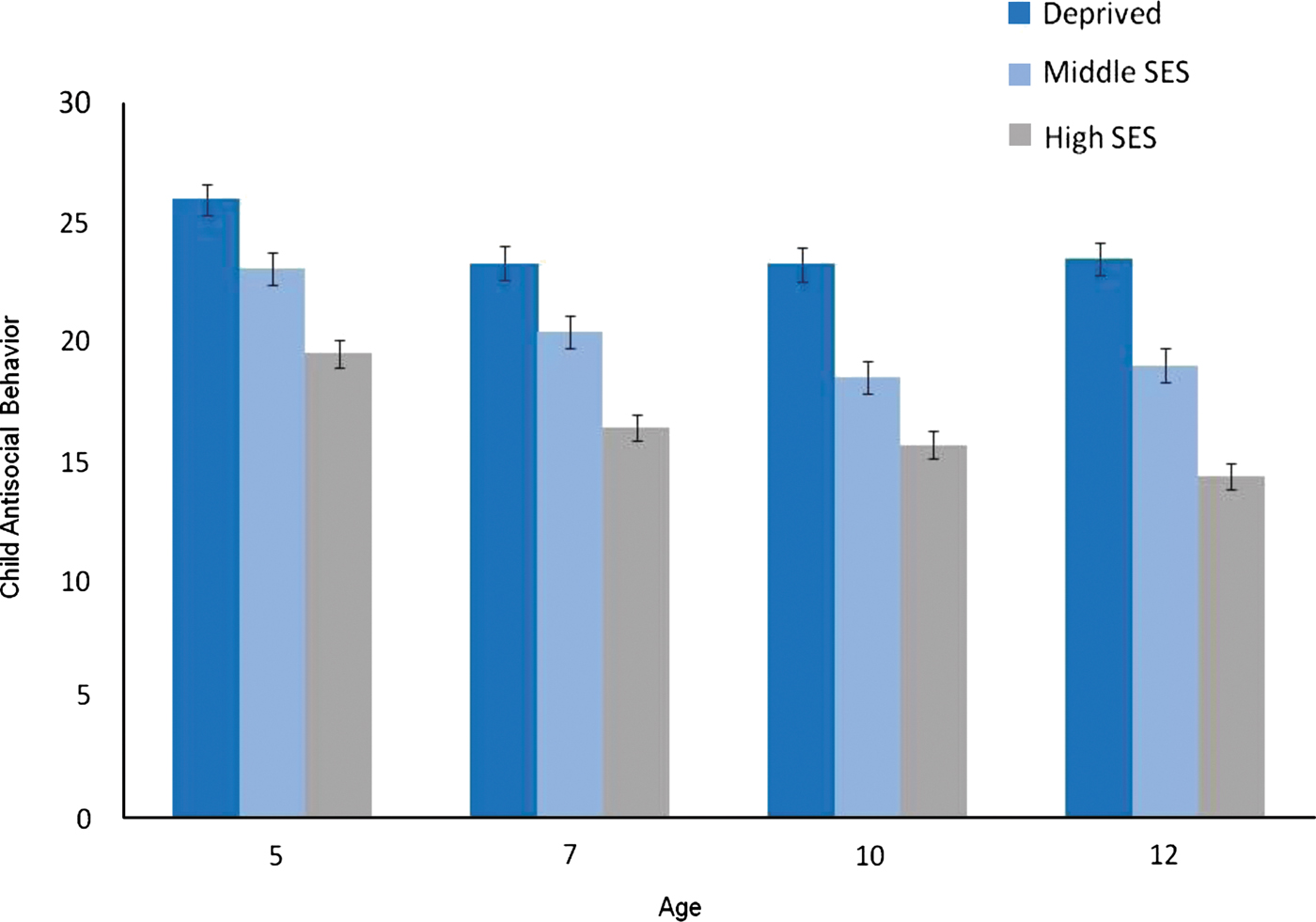
The graded relationship between neighborhood socioeconomic status (SES) and children's antisocial behavior at ages 5, 7, 10, and 12 (n = 2,055). Deprived, A Classification of Residential Neighborhoods (ACORN) Category 5 (hard pressed) and Category 4 (moderate means); middle SES, ACORN category 3 (comfortably off); high SES, ACORN Category 2 (urban prosperity) and Category 1 (wealthy achievers). Results held at the p < .001 level at all ages for boys, 5 (b = 2.19, β = 0.17), 7 (b = 2.24, β = 0.17), 10 (b = 2.35, β = 0.18), and 12 (b = 2.87, β = 0.21), and girls, 5 (b = 1.21, β = 0.13), 7 (b = 1.23, β = 0.14), 10 (b = 1.74, β = 0.17), and 12 (b = 1.96, β = 0.20). [A color version of this figure can be viewed online at http://journals.cambridge.org/dpp]
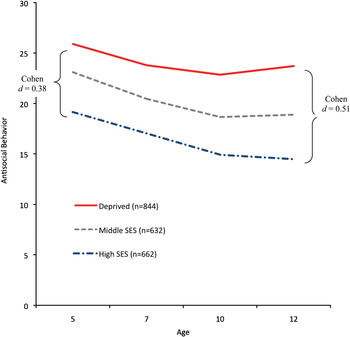
Neighborhood socioeconomic disparities in children's antisocial behavior increase across childhood (n = 2,138). Deprived, A Classification of Residential Neighborhoods (ACORN) Category 5 (hard pressed) and Category 4 (moderate means); middle socioeconomic status (SES), ACORN Category 3 (comfortably off); high SES, ACORN Category 2 (urban prosperity) and Category 1 (wealthy achievers). Cohen d: 0.2 = small, 0.5 = medium, 0.8 = large. Model fit: χ2 = 6.03, df = 8, comparative fit index = 1.00, root mean square error of approximation = 0.00 (0.00–0.03), standardized root mean square residual = 0.01. [A color version of this figure can be viewed online at http://journals.cambridge.org/dpp]

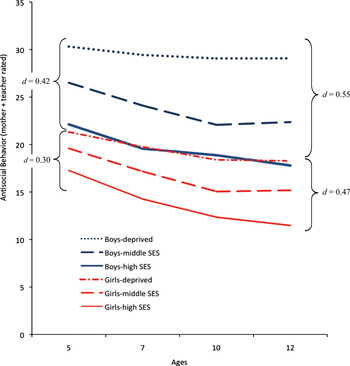
Neighborhood-level socioeconomic disparities in antisocial behavior increase across childhood for boys and girls. Model fit for six-group latent basis model: χ2 = 22.19, df = 18, root mean square error of approximation = 0.02 (0.00–0.05), comparative fit index = 1.00, standardized root mean square residual = 0.03. Cohen d: 0.2 = small, 0.5 = medium, 0.8 = large. SES, socioeconomic status. [A color version of this figure can be viewed online at http://journals.cambridge.org/dpp]

Family socioeconomic disadvantage was assessed at age 5 using a count of six socioeconomic disadvantages, defined as (a) head of household has no educational qualifications; (b) head of household is employed in an unskilled occupation or is not in the labor force; (c) total household gross annual income is less than £10,000; (d) family receives at least one government benefit, excluding disability benefit; (e) family housing is government subsidized; and (e) family has no access to a vehicle. The average socioeconomic disadvantage score was 1.38 (SD = 1.70, α = 0.79, range = 0–6, N = 2,232). The full details of this measure in this sample are reported elsewhere (Kim-Cohen, Moffitt, Caspi, & Taylor, Reference Kim-Cohen, Moffitt, Caspi and Taylor2004).
Father's and mother's history of antisocial behavior was reported by the mothers when the children were 5 years old. Mothers were interviewed using the Young Adult Behavior Checklist (Achenbach, Reference Achenbach1997) that was modified to obtain lifetime data. Full details of father's and mother's history of antisocial behavior within this sample are reported elsewhere (Jaffee, Moffitt, Caspi, & Taylor, Reference Jaffee, Moffitt, Caspi and Taylor2003). A study of mother–father agreement about men's antisocial behavior in this sample showed that women provided reliable information about their children's father's behavior (Caspi et al., Reference Caspi, Taylor, Smart, Jackson, Tagami and Moffitt2001). A symptom of antisocial behavior was considered to be present if the mother endorsed the symptom as being “very true or often true.” Antisocial behavior symptoms scores for mothers (M = 0.67, SD = 1.16, range = 0–6.0, N = 2,226) and fathers (M = 1.42, SD = 2.00, range = 0–7.0, N = 2,216) were combined into a single score that indexed whether at least one of the parents had three or more antisocial behavior symptoms (27.6% of the children had at least one parent who exceeded this threshold). A similar pattern of results emerged when either the continuous antisocial problem scores or a dichotomous measure of parental antisocial behavior were entered into the models. For the ease of presentation, results are presented for the dichotomous measure only.
Family history of mental health problems was assessed at age 12 by asking the mother to report on her own mental health history and the mental health history of her biological mother, biological father, biological sisters, biological brothers, as well as the twins' biological father. Mothers were asked to report if anyone on the aforementioned list experienced difficulties with substance-use problems, alcohol problems, depression, psychosis, and suicide attempts (Milne et al., Reference Milne, Moffitt, Crump, Poulton, Rutter and Sears2008; Weissman et al., Reference Weissman, Wickramaratne, Adams, Wolk, Verdeli and Olfson2000). The mental health history items comprised four items of substance use derived from the short Michigan Alcoholism Screening Test (Selzer, Vinokur, & Vanrooijen, Reference Selzer, Vinokur and Vanrooijen1975) and the Drug Abuse Screening Test (Skinner, Reference Skinner1982) and one each on problems with drinking and drugs derived from the Family History Screen (FHS; Weissman et al., Reference Weissman, Wickramaratne, Adams, Wolk, Verdeli and Olfson2000); five items on depression derived from the FHS; one item on suicide ideation derived from the FHS; and two items asking about hospitalization and treatment for “other” mental health disorders. For each of the four domains (substance, depression, suicide, other), family members were considered to have a positive history if any items within that domain were answered positively and a negative history otherwise. For the purposes of our analyses, we calculated the proportion of family members with a positive history of any disorder. The average proportion of family members with a history of mental health problems was .37 (SD = .27, range = 0–1.0, N = 2,138).
Physical child maltreatment was assessed separately for each twin at ages 5, 7, and 10 by interviewing mothers with the standardized clinical interview protocol from the Multi-Site Child Development Project (Dodge, Pettit, Bates, & Valente, Reference Dodge, Pettit, Bates and Valente1995).Footnote 1 Full details of the child physical maltreatment measure within this sample are reported elsewhere (Jaffee, Caspi, Moffitt, & Taylor, Reference Jaffee, Caspi, Moffitt and Taylor2004). Examples of such maltreatment included being the victim of adjudicated assault by a teenaged sibling, being burned with matches, injuries (e.g., fractures) from neglectful or abusive parental care, and/or formal registration with a social-services child protection team for physical abuse (0 = no harm, 1 = probable harm, 2 = definite harm). Prior to age 10, there was no evidence of harm for 80.3% of the sample, probable harm for 15.2% of the sample, and definite harm for 4.5% of the sample. Similar results were reported for both the three category and dichotomous classification of physical harm (no harm vs. probable/definite harm).
Adult domestic violence was assessed by the Conflict Tactics Scale (Straus, Reference Straus, Straus and Gelles1990), inquiring about 12 acts of physical violence (e.g., kicking a partner, threatening a partner with a knife). Mothers were asked about their own violence toward any partner and about partners' violence toward them. The physical violence acts reported at the ages of 5, 7, and 10 were summed to yield a measure of cumulative exposure to domestic violence. The internal consistency reliability of the physical abuse scale was .89. Full details of the adult domestic violence measure in this sample are reported elsewhere (Koenen, Moffitt, Caspi, Taylor, & Purcell, Reference Koenen, Moffitt, Caspi, Taylor and Purcell2003). As previously shown, interpartner agreement about abuse perpetration is substantial, with latent correlations between perpetrator and victim reports of perpetration ranging from .71 to .83 (Moffitt et al., Reference Moffitt, Caspi, Krueger, Magdol, Margolin and Silva1997).
Maternal warmth was assessed at age 10 using a 5-min speech sample from the mother to elicit expressed emotion about each child. Trained interviewers asked caregivers to describe each of their children (“For the next 5 minutes, I would like you to describe [child] to me; what is [child] like?”). The mother was encouraged to talk freely with few interruptions. However, if the mother found this difficult, the interviewer could aid the mother with a series of semistructured probes, such as “In what ways would you like [child] to be different?” Interviews about each twin were separated in time by approximately 90 min. All interviews were audiotaped with the mother's consent. Two trained raters coded the audiotapes (interrater reliability = .90) A full description of the procedure is detailed elsewhere (Caspi et al., Reference Caspi, Moffitt, Morgan, Rutter, Taylor and Arseneault2004). Maternal warmth was a global measure of the entire speech sample that captured the warmth expressed about the child during the speech and was coded on 6-point scale, ranging from high warmth (5) and moderately high warmth (4) to very little warmth (1) or no warmth (0). The average maternal warmth score was 3.67 (SD = 0.91, range = 0–5, N = 2,100).
Parental monitoring was assessed at age 10 by asking the mother to report on how closely she monitors her child's behavior when the child is away from home. Ten items were adapted from Stattin and Kerr's (2000) Monitoring and Supervision Questionnaire to capture whether the mother knew the friends the child hangs out with, where they go in their spare time, how they spend their money, what type of homework the child has, when the child has tests or projects, and how the child performs in different subjects. Mothers also reported on whether the child needs permission to leave home, needs permission before deciding what to do on the weekend, reports on where and who they are going out with, and reports on what they did when they return home (0 = no, never, 1 = sometimes, 2 = yes, always). The average parental monitoring score was 18.77 (SD = 0.91, range = 0–20, α = 0.75, N = 2,136).
Statistical analyses
Our analyses proceeded in four steps. First, we tested whether there was a graded relationship between neighborhood SES and children's antisocial behavior at each assessment age within a regression framework. Second, children's developmental course of antisocial behavior between the ages of 5 and 12 was estimated using latent growth curve models (LGCMs). LGCMs map interindividual differences in intraindividual change over time and provide a means of aggregating repeated measures into relatively few parameters, such as estimates of the average rate of growth and variability in development over time (Bollen & Curran, Reference Bollen and Curran2006). LGCMs are now commonly applied in developmental research (Kim & Cicchetti, Reference Kim and Cicchetti2006) and offer the opportunity to test whether the developmental course of antisocial behavior differs across subpopulations. Multiple-group LGCMs were used to test (a) whether children growing up in deprived versus more affluent neighborhoods exhibited a slower rate of decline in antisocial behavior across childhood, (b) whether socioeconomically related disparities in children's antisocial behavior increased between the ages of 5 and 12, and (c) whether boys and girls followed a different developmental course of antisocial behavior depending on the type of neighborhood that they were living in.
Third, a series of conditional structural equation models (SEM) were applied to test whether the effect of neighborhood-level SES on children's antisocial behavior (levels and rate of change) held after controlling for family-level factors, including family SES, family history of mental health problems, parental history of antisocial behavior, and child exposure to domestic violence and physical harm.
Fourth, we tested whether the effects of neighborhood SES on children's antisocial behavior were mediated by parental monitoring and maternal warmth, two indicators of supportive parenting that are believed to play a role in the transmission of the effects of neighborhood poverty on children's behavior. Using procedures outlined by MacKinnon, Fairchild, and Fritz (Reference MacKinnon, Fairchild and Fritz2007), the direct and indirect effects of neighborhood deprivation on children's levels of antisocial behavior were estimated within an SEM framework.
All models were fitted in Mplus Version 6.1 (Muthén & Muthén, Reference Muthén and Muthén1998–2008) using maximum likelihood estimation. Missing data were handled through the full information maximum likelihood procedure (Raykov, Reference Raykov2005) and presented a minimal threat to the results because of high retention rates in the E-Risk Study (>95% response rate across occasions). Statistical analyses were complicated because the E-Risk Study contained two children from each family. Therefore, the COMPLEX option in Mplus was used to compute adjusted standard error estimates and correct for the nonindependence of observations because the children in our study were nested within families.
Results
Is the neighborhood-SES gradient in children's antisocial behavior observed by age 5? Does neighborhood SES influence children's antisocial behavior more strongly over time?
A graded relationship between neighborhood SES and children's antisocial behavior was observed at ages 5 (b = 1.78, β = 0.15, p < .001), 7 (b = 1.82, β = 0.16, p < .001), 10 (b = 2.16, β = 0.18, p < .001), and 12 (b = 2.51, β = 0.21, p < .001). A three-group classification of neighborhood context is presented in Figure 2. It contrasts the levels of antisocial behavior among children growing up in relatively affluent (ACORN Category 1 and Category 2), middle- (ACORN Category 3), and deprived (ACORN Category 4 and Category 5) SES neighborhoods. Differences between children living in each type of neighborhood were significant at the p < .001 level and were observed across each of the neighborhood SES categories at each age.
As shown in Figure 3, the gap between children living in deprived versus more affluent neighborhoods widened across childhood. Between the ages of 5 and 12, the standardized mean difference in children's levels of antisocial behavior across deprived versus more affluent neighborhoods increased from d = 0.38 to 0.51. A multiple-group LGCM demonstrated a significant degradation in fit when either the initial levels (Δχ2 = 31.4/Δdf = 1, p < .001) or the rate of change over time (Δχ2 = 5.4/Δdf = 1, p < .05) in antisocial behavior were constrained to be equal across low- versus high-SES neighborhoods. Children living in high-SES neighborhoods experienced a steeper decline in antisocial behavior (standardized slope estimate = –0.50, p < .001) when compared with children growing up in deprived neighborhoods (standardized slope estimate = –0.15, p < .001).
The developmental trajectories of antisocial behavior were also estimated separately for males and females living in deprived versus more affluent neighborhoods using a latent basis growth curve model.Footnote 2 The results from a multiple group model are presented in Figure 4 and they illustrate three main findings. First, socioeconomic disparities in children's antisocial behavior widened for both males and females between the ages of 5 and 12, with an increase in the standardized mean difference in antisocial behavior between children in deprived versus more affluent neighborhoods increasing from 0.42 to 0.55 among males (43% increase in the mean differences in children's antisocial behavior between neighborhoods over time) and from 0.30 to 0.47 among females (57% increase in the mean differences in children's antisocial behavior between neighborhoods over time).
Second, males growing up in deprived neighborhoods were the only subgroup who did not experience a significant decline in antisocial behavior. The estimated amount of change between the ages of 5 and 12 was not significantly different than zero (estimate = –1.23, p = .28), and constraining the amount of change among boys in deprived neighborhoods to equal zero did not result in a significant change in the overall model fit (Δχ2 = 1.51/Δdf = 1). Thus, on average, boys in deprived neighborhoods did not experience the expected decline in antisocial behavior across childhood. Third, all five of the remaining groups demonstrated significant reductions in antisocial behavior across time, with girls in deprived and boys in high-SES neighborhoods following an indistinguishable pattern of antisocial behavior between the ages of 5 and 12.
Do the effects of neighborhood SES on children's antisocial behavior hold after controlling for more proximal family-level factors? Does supportive parenting mediate the influence of neighborhood SES on children's antisocial behavior?
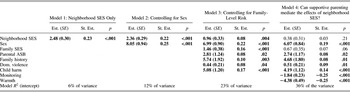
Table 2 and Table 3 report the results from a series of conditional SEMs predicting children's levels of antisocial behavior (Table 2) and their rate of change in antisocial behavior across the ages of 5 and 12 (Table 3). The results presented in Table 2 were derived from a conditional LGCM with the intercept centered at age 12 to estimate the effect of neighborhood deprivation at the age where the effects of neighborhood deprivation on children appeared to be the strongest. Table 2 illustrates three main findings.
Estimates from conditional SEMs predicting children's levels of ASB at age 12

Note: SEMs, structural equation models; ASB, antisocial behavior; SES, socioeconomic status; Est., unstandardized estimate; St. Est., standardized estimate. Model 3 fit: χ2 = 44.6, df = 19, root mean square error of approximation = 0.03 (0.02–0.04), comparative fit index = 0.99, standardized root mean square residual = 0.01. Model 4 fit: χ2 = 53.25, df = 23, root mean square error of approximation = 0.03 (0.02–0.04), comparative fit index = 0.99, standardized root mean square residual = 0.02.
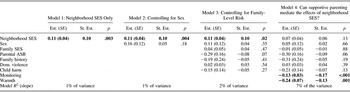
Estimates from conditional SEMs predicting rate of change in children's ASB between 5 and 12 years

Note: SEMs, structural equation models; ASB, antisocial behavior; SES, socioeconomic status; Est., unstandardized estimate; St. Est., standardized estimate.
First, the unconditional effect of neighborhood deprivation on children's antisocial behavior at age 12 was significant and substantial (standardized coefficient = 0.23, p = .001, Model 1). Second, the effects of neighborhood deprivation on children's levels of antisocial behavior remained after controlling for sex (Model 2) as well as family SES, parental antisocial behavior, family history of mental health problems, exposure to domestic violence, and child harm (standardized coefficient = 0.08, p = .01, Model 3). Together these variables accounted for 23% of the variation in children's behavior at age 12.
Third, our findings provided evidence that supportive parenting mediated the persistent effects of neighborhood- and family-level deprivation on children's levels of antisocial behavior. Once maternal warmth and parental monitoring were entered into the model, the effects of both neighborhood- and family-level socioeconomic deprivation on children's antisocial behavior became nonsignificant (Model 4). Meditational models fit within an SEM framework also revealed significant indirect effects of neighborhood deprivation on antisocial behavior via both parental monitoring and maternal warmth (total effect = 1.43, standardized = 0.14, p < .001; total indirect effect = 0.99, standardized = 0.10, p < .001; specific indirect pathway via parental monitoring = 0.047, p < .001; specific indirect pathway via maternal warmth = 0.052, p < .011) alongside a nonsignificant direct effect of neighborhood SES on child antisocial behavior. In other words, supportive parenting practices completely mediated the effects of neighborhood deprivation on children's levels of antisocial behavior. Together the neighborhood- and family-level factors included in Model 4 accounted for 36% of the variation in children's antisocial behavior at age 12.
Table 3 presents the coefficients from the conditional LGCAs predicting the rate of change in antisocial behavior across the ages of 5 and 12. The findings detailed in Table 3 illustrate two main points. First, even though it is notoriously difficult to predict differences in how children change over time, neighborhood deprivation predicted the rate of change in antisocial behavior across the ages of 5 and 12 (standardized coefficient = 0.10, p = .003, Model 1). That is, as the level of deprivation in the neighborhood increased, the rate of change (improvement) in antisocial behavior slowed. The influence of neighborhood deprivation on children's rate of change in antisocial behavior also held after controlling for sex and family-level risk factors (Model 3). Second, supportive parenting practices completely mediated the influence of neighborhood deprivation on children's rate of change over time. Follow-up analyses revealed a significant indirect effect of neighborhood deprivation on children's rate of change in antisocial behavior over time through both parental monitoring and maternal warmth (total effect = 0.14, standardized = 0.13, p = .002; total indirect effect = 0.06, standardized = 0.06, p < .001; specific indirect pathway via parental monitoring = 0.03, p = .001; specific indirect pathway via maternal warmth = 0.03, p = .003) alongside a nonsignificant direct effect of neighborhood SES on the rate of change in child antisocial behavior.
Discussion
The World Health Organization Commission on Social Determinants of Health (2008) concluded that a child born in a poor neighborhood can expect to die sooner and spend more of his life afflicted with a disability than if he was born into relative affluence. The results of our study augment this narrative by illustrating that by the time a child from a poor versus affluent neighborhood enters school he will be more likely to exhibit antisocial behavior and is expected to fall further behind on this marker of well-being as he approaches adolescence. This paper adds to the growing body of research tracing the effects of poverty on children's lives in three main ways.
First, we provided evidence that there is a graded relationship between neighborhood SES and children's antisocial behavior that can be observed as early as age 5, was observed across each of the assessment ages, and increased across childhood for both boys and girls. By age 12, the standardized mean difference in children's levels of antisocial behavior across deprived versus more affluent neighborhoods approached the size of one of our best and most robust predictors of antisocial behavior: sex (Cohen d = 0.51 when comparing children growing up in deprived vs. more affluent neighborhoods in comparison to Cohen d = 0.53 when comparing antisocial behavior among boys vs. girls). Moreover, the pattern of increasing neighborhood-level socioeconomic disparities in antisocial behavior held for both boys and girls.
We also found that boys in deprived neighborhoods were the only group who was not experiencing the expected decline in antisocial behavior across childhood. In contrast, girls in deprived neighborhoods were following the normative pattern of decline and mirrored the developmental trajectory of boys in high-SES neighborhoods with respect to both their initial levels of antisocial behavior and their rate of change (improvement) in antisocial behavior across childhood (see Figure 4). Overall, our examination of the developmental course of antisocial behavior across neighborhood types is consistent with theories suggesting that neighborhood effects on child outcomes are likely to increase with age and provide yet another piece of evidence that boys growing up in deprived neighborhoods may be the most likely to follow an early onset and persistent course of antisocial behavior. The failure of boys growing up in deprived neighborhoods to exhibit signs of improvement in antisocial behavior is especially troubling because a persistent course of early antisocial behavior has been linked to a wide range of later problems (Moffitt et al., Reference Moffitt, Caspi, Harrington and Milne2002; Odgers et al., Reference Odgers, Moffitt, Broadbent, Dickson, Hancox and Harrington2008).
Second, neighborhood deprivation continued to predict differences in children's developmental course of antisocial behavior across childhood even after controlling for family-level factors. Questions regarding whether social selection (the type of people who live in certain neighborhoods) versus social causation (the effects of neighborhood factors per se) is responsible for observed relationships between environmental risks and behavior are pervasive throughout much of social science (Rutter, Reference Rutter2003). Although it is possible that unmeasured influences are confounding our findings, we were able to control for many of the factors that are believed to influence both the types of neighborhoods that families are able to live in and the development of children's antisocial behavior. In doing so, we provide evidence that the effect of neighborhood SES on children's antisocial behavior is robust to many of the “usual suspects,” including family SES, parental antisocial behavior, family history of mental health problems, exposure to domestic violence, and child harm. Even after accounting for these more proximal risk factors, neighborhood-level SES continued to predict children's levels of antisocial behavior as well as the rate of change in antisocial behavior across time. More specially, as the amount of deprivation in the local neighborhood increased, children exhibited higher levels of antisocial behavior and a slower decline in antisocial behavior between the ages of 5 and 12 years.
Fourth, we asked whether supportive parenting practices, such as parental monitoring and maternal warmth, could mediate the persisting effects of neighborhood deprivation on children's antisocial behavior. We focused on supportive parenting practices because they have been shown to be responsive to neighborhood conditions, consistently emerge as predictors of children's antisocial behavior, and are often targeted by early childhood intervention programs within low-income communities (e.g., Nurse–Family Partnership and Triple-P Parenting). Our findings demonstrate that maternal warmth and high levels of parental monitoring completely mediated the effects of neighborhood- and family-level deprivation on children's developmental course of antisocial behavior. Moreover, even though differences in how children change over time are notoriously difficult to predict, maternal warmth and parental monitoring were able to explain 7% of the variation in how quickly children's antisocial behavior decreased, whereas other family-level factors demonstrated no measurable effect.
The complete mediation of the effects of neighborhood- and family-level SES on children's levels and rate of change in antisocial behavior was encouraging because (a) prior intervention work has demonstrated that measurable changes in responsive parenting and maternal warmth are possible early in life (Landry, Smith, Swank, & Guttentag, Reference Landry, Smith, Swank and Guttentag2008) and (b) among adolescents, changes in parental monitoring have been shown to mediate the effects of parent-based interventions on antisocial behavior and substance use (for a review, see Racz & McMahon, Reference Racz and McMahon2011). However, future research is required to understand how child behavior shapes the development of parental monitoring and other supportive parenting practices (Patrick, Snyder, & Schrepferman, Reference Patrick, Snyder and Schrepferman2005). The reciprocal nature of parenting practices and child behavior may be particularly important to consider among children exhibiting an early onset course of antisocial behavior (where child behavior is likely to evoke parental responses at an early age) and/or among children living in high-risk communities (where negative patterns of parent–child interactions may be amplified against a backdrop of a series of environmental stressors and pressures on both parents and children; Dishion & McMahon, Reference Dishion and McMahon1998; Laird et al., Reference Laird, Pettit, Bates and Dodge2003).
This study also had limitations. First, unmeasured factors may have confounded our estimates of neighborhood effects on children's antisocial behavior. We selected our control variables to represent family-level factors that are most likely to influence neighborhood selection and children's antisocial behavior. Nonetheless, our finding that the effects of neighborhood SES on child antisocial behavior are robust to family-level risk factors may not hold with a broader set of controls. Second, the children in our sample were twins, and families with twins may experience unique pressures as parents struggle to meet the social and economic demands of caring for two children (Spillman, Reference Spillman1984). Although a number of studies have demonstrated that twins and singletons do not differ on their mean levels of behavioral problems (Gjone & Novik, Reference Gjone and Novik1995; Kendler, Martin, Heath, & Eaves, Reference Kendler, Martin, Heath and Eaves1995; Moilanen et al., Reference Moilanen, Linna, Ebeling, Kumpulainen, Tamminen and Piha1999; van den Oord, Koot, Boomsma, Verhulst, & Orlebeke, Reference van den Oord, Koot, Boomsma, Verhulst and Orlebeke1995) and that the association between neighborhood factors and children's mental health outcomes are similar across singleton versus twin samples (Kim-Cohen et al., Reference Kim-Cohen, Moffitt, Caspi and Taylor2004), replication of our findings in samples of singletons is required. Third, our definition of supportive parenting in this study was restricted to high levels of parental monitoring and maternal warmth. However, it is likely that other dimensions of supportive parenting, including consistent parenting and positive parent–child communication also play a role in mediating the effects of neighborhood- and family-level deprivation. Fourth, we reported evidence consistent with a casual influence of parental monitoring on children's antisocial behavior. However, prior research has raised questions regarding whether high levels of parental monitoring simply reflect the willingness of certain children to disclose information (Kerr, Stattin, & Burk, Reference Kerr, Stattin and Burk2010). Future research is required to isolate the key dimensions of supportive parenting and determine whether changes in either neighborhood conditions and/or supportive parenting practices can break the chain of influence from neighborhood SES to child outcomes. Fifth, statistical mediation can also be observed if the same reporter serves as the source of information for the predictor, mediator, and outcome at the same assessment point. In the current study we went to great lengths to integrate multiple informants (e.g., child and teacher for our outcome of antisocial behavior, census data for our predictor of neighborhood SES, and audiotapes coded via independent raters for maternal warmth). We also relied on assessments that were separated by multiple years. Nonetheless, we still cannot be certain that supportive parenting is the active pathway through which neighborhood effects are transmitted to children. Sixth, our age 12 assessment did not include comprehensive assessments of peer delinquency and, as such, did not allow for a fair test of the neighborhood to peer pathway. As we follow the cohort through adolescence we will have the ability to document the interplay between neighborhood-, family-, and peer-level factors. Seventh, given that less than 10% of our sample self-identified as belonging to an ethnic minority group, replication of our findings with ethnically diverse and non-British samples is required.
The implications of our findings for research and policy can be considered with these limitations in mind. Public health officials have long accepted that place matters when trying to understand the origins, progression, and end points for chronic disease. However, social scientists have been slower to completely embrace the existence of place effects because much of the last 50 years of neighborhood effects research has been spent debating the merits of social causation versus social selection. In the end, most estimates of neighborhood effects on behavior and health are likely the product of forces related to both selection and causation (Jaffee, Strait, & Odgers, Reference Jaffee, Strait and Odgers2011). Notably, researchers are now beginning to move from the question of whether early insults and the conditions associated with economic deprivation are causal factors in children's lives to how and when these effects are transmitted to children. That is, researchers are beginning to trace how features of the neighborhood, such as air and noise quality as well as exposure to violence and other stressors, can “get under the skin” and influence health (Miller, Chen, & Cole, Reference Miller, Chen and Cole2009). For example, Chen, Fisher, Bacharier, and Strunk (Reference Chen, Fisher, Bacharier and Strunk2003) have been testing whether children within low-SES neighborhoods differ in their biological profiles related to asthma, including immune and cortisol functioning. More recently, neuroscientists have begun to examine the ways in which specific brain structures and responsivity to stress differ between people living in urban versus rural settings (Lederbogen et al., Reference Lederbogen, Kirsch, Haddad, Streit, Tost and Schuch2011), and creative experimental paradigms are providing evidence that the presence of neighborhood features such as physical disorder may influence behavior (Keizer, Lindenberg, & Steg, Reference Keizer, Lindenberg and Steg2008). As our interest in understanding how the neighborhoods in which we work, live, and play influence well-being across the life span continues to grow, we will need to continue to explore new and cost-effective ways of assessing the features of neighborhood settings that may influence child development. To this end, our team has been conducting virtual assessments of neighborhood settings using Google Street View, and we found that virtual neighborhood assessments may provide a cost-effective alternative to census derived data for capturing key features of neighborhood settings.
The fortunes of many children rise and fall with the resources available in their zip code. Economic inequalities between families are widening (Duncan & Murnane, Reference Duncan and Murnane2011) and exposure to the adverse conditions associated with poverty early in life is believed to lay the foundations and independently contribute to growing inequalities in mental health, disease, and social status across the life span (for a review, see Cohen et al., Reference Cohen, Janicki-Deverts, Chen and Matthews2010; Shonkoff, Boyce, & McEwen, Reference Shonkoff, Boyce and McEwen2009). Unfortunately, the harmful effects of poverty are likely to become even more pronounced in the coming years as programs supporting low-income and poor families are eliminated or scaled back in size. For example, the United Kingdom has been waging an aggressive war against child poverty since 1999 and, despite lifting over a half-million children out of poverty since that time, is currently facing the challenge of maintaining public commitment to ending child poverty by 2020 in the face of a global recession and shrinking national resources. In the United States, many cash-transfer programs and policies designed to redistribute wealth to children and families in need have been cut or are being met with increasing opposition (Couch, Smeeding, & Waldfogel, Reference Couch, Smeeding and Waldfogel2010).
The results of research on whether policies and programs designed to change the socioeconomic conditions of families would be effective are mixed. Creative natural experiments have demonstrated marked improvements in children's conduct problem symptoms when their family was lifted out of poverty (Costello, Compton, Keeler, & Angold, Reference Costello, Compton, Keeler and Angold2003). Yet, randomized housing experiments have generated mixed support regarding whether movement from a deprived neighborhood can reduce children's levels of behavioral problems (Kling, Ludwig, & Katz, Reference Kling, Ludwig and Katz2005). Thus, even if the government offered everyone a “move to opportunity,” it is not clear whether antisocial behavior among children living in deprived neighborhoods would be affected. What is becoming increasingly clear is that poverty is taking a significant toll on the lives of children and there is a need to identify malleable intervention targets to mediate the downstream effects of structural disadvantages. In this paper we identify two potential targets for intervention and prevention efforts (parental monitoring and maternal warmth); but we also encourage the continued search for factors at the neighborhood, school, and family level that may play a role in the lives of children and families who confront the conditions associated with poverty in their daily lives.
As macrolevel market and global trends continue to determine how many children are living in poverty on any given day, researchers and child advocates are working to identify ways that children can be protected and thrive in these conditions. Rapid advancements in our understanding of how early experiences become embedded and alter children's developmental course of health and behavior are offering clues to how we can best support families and alter settings to improve children's lives. Our findings point to the importance of expanding key outcomes in the fight against childhood poverty to include behavioral as well as health and educational outcomes and support continued investment in bolstering positive parenting practices for all children, but especially for those growing up in deprived neighborhood and family contexts.