I. INTRODUCTION
Perovskites, denoted as ABO3, are inorganic structures which can include most of the metallic ions from the Periodic Table (Wang et al., Reference Wang, Xu, Luo, Ding and Liu2010). Their structure can be represented by octahedra sharing corners (BO6), oxygen anions at the vertices, and B atoms at their centers (Kobayashi et al., Reference Kobayashi, Kimura, Sawada, Terakura and Tokura1998). The A cations are found in cubo-octahedral cavities (King and Woodward, Reference King and Woodward2010).
These compounds are commonly used for their catalytic (Huang et al., Reference Huang, Bassir and Kaliaguine2005), photocatalytic (Yao et al., Reference Yao, Xu, Wang, Zhou, Yang, Zhang, Shang and Huang2004), and dielectric properties (Kim et al., Reference Kim, Sekino and Niihara2010). In addition, the strong electrical responses (Smyth, Reference Smyth2009) and magnetic properties (Decorse-Pascanut et al., Reference Decorse-Pascanut, Berthon, Pinsard-Gaudart, Dragoe and Berthet2009) are some essential characteristics of perovskites.
For example, steam reforming of methane (CH4 + H2O ↔ 3H2 + CO) has been performed using perovskites (Tuza and Souza, Reference Tuza and Souza2016, Reference Tuza and Souza2017; Gómez-Cuaspud et al., Reference Gómez-Cuaspud, Vera-López, Carda-Castelló and Barrachina-Albert2017; Mosayebi and Nasabi, Reference Mosayebi and Nasabi2020). This technology produces H2, which can be used for naphtha reforming, ammonia production, or electricity generation from a fuel cell.
Cation reducibility depends on time, temperature, gas concentration, heating rate, flow gas, catalyst mass, particle size, water vapor, and metal–support interaction (Schmal, Reference Schmal2016). Moreover, this is influenced by cation redox potential. Thus, Ni or Co reduces easily than La or Ti (Gallezot, Reference Gallezot, Karge and Weitkamp2003; Atkins et al., Reference Atkins, Overton, Rourke, Weller, Armstrong and Hagerman2010), according to their values of standard free energy for the corresponding reduction (Kapteijn et al., Reference Kapteijn, Moulijn, Tarfaoul, Moulijn, van Leeuwen and van Santen1993). Also, cation reducibility is affected by cation precursors, the cation molar ratio (Benito et al., Reference Benito, Labajos, Rives and Buckley2007), synthesis thermal treatment, and reductive gases (H2, CO, or synthesis gas) (Rauch et al., Reference Rauch, Kiennemann, Sauciuc, Triantafyllidis, Lappas and Stöcker2013). Moreover, cation reducibility depends on the coordination number and its location in the crystalline structure (Gallezot, Reference Gallezot, Karge and Weitkamp2003). Finally, for the case of oxidation reactions, cation reducibility depends on the oxygen partial pressure in the reaction (Sumathi et al., Reference Sumathi, Johnson, Viswanathan and Varadarajan1998).
Cation reducibility can be quantified using the degree of reduction, which measures the number of atoms with catalytic properties from a catalyst precursor. The degree of reduction enables to explain the conversion of chemical species with great interest to the industry. Moreover, the reduction products from a catalyst precursor influence the catalyst stability through the so-called metal–support interaction.
Rietveld refinement of X-ray diffraction pattern of the sample after the reduction process can be used to determine the reduction degree of any crystalline material. By using this methodology, the reduction degree of the carbon-supported cobalt (Ghogia et al., Reference Ghogia, Cayez, Machado, Nzihou, Serp, Soulantica and Pham Minh2020), Ni/Mg1−xNixO (Zhang et al., Reference Zhang, Ma and Gao2015), Fe/TiO2 (Rayner et al., Reference Rayner, Billing and Coville2014) catalysts, or the LaNi0.5Ti0.5O3, LaNi0.5Ti0.45Co0.05O3, and LaNi0.45Co0.05 Ti0.5O3 perovskites (Tuza and Souza, Reference Tuza and Souza2016, Reference Tuza and Souza2017) was determined. Regarding these last La containing perovskites, the La2NiO4 phase was not taken into account and the details of Rietveld refinement was not reported.
This paper aims to report cation reducibility from the LaNi0.5Ti0.5O3, LaNi0.5Ti0.45Co0.05O3, and LaNi0.45Co0.05Ti0.5O3 perovskites using X-ray diffraction data coupled to the Rietveld method.
II. EXPERIMENTAL
A. Synthesis
LaNi0.5Ti0.45Co0.05O3, LaNi0.45Co0.05Ti0.5O3, and LaNi0.5Ti0.5O3 perovskites were synthesized using the modified Pechini method (Tuza and Souza, Reference Tuza and Souza2016), which will be called LN0.5T0.45C0.05O, LN0.45C0.05T0.5O, and LN0.5T0.5O, respectively. Adequate amounts of nickel nitrate hexahydrate (Ni(NiO3)2·6H2O, 97%), cobalt nitrate hexahydrate (Co(NiO3)2·6H2O, 100%), lanthanum nitrate hexahydrate (La(NiO3)3·6H2O, 99.5%), along with titanium isopropoxide (C12H28O4Ti, 97%), from Sigma-Aldrich, were used for the synthesis. A metal to citric acid and citric acid to ethylene glycol ratios of 1:2 and 1:4, respectively, were employed. Ni2+, Co2+, and La3+ precursors were dissolved in water. Ti4+ precursor was dissolved using 3.4 mol l−1 of nitric acid previous to isopropoxide evaporation. Titanium citrate was prepared by heating the titanium solution to 60 °C, in which citric acid was added. Ammonium hydroxide was added to the titanium citrate solution in a volume close to nitric acid volume. This final solution was aged overnight at room temperature. Lanthanum, cobalt, and nickel citrates were prepared using the same methodology for titanium citrate preparation, except the step for ammonia hydroxide addition. The citrates were mixed at room temperature and heated up to 90 °C for the addition of ethylene glycol. The polyester containing solution was aged similarly to metal citrate solution and evaporated at 60 °C for obtaining a resin. This resin was calcined in the oven at 240 °C for 1 h, followed by thermal treatment at 450 °C for 4 h, with a heating rate of 2 °C min−1. A fragile and porous material was obtained. Finally, this last material structure was calcinated in air at 800 °C for 17 h with a heating rate of 10 °C min−1 for obtaining a perovskite black powder. After each thermal treatment, the fragile and porous material was ground in an agate mortar.
B. Characterization
X-ray fluorescence (XRF) was carried out using a Rigaku Primini spectrometer equipped with a Pd X-ray tube operating at 50 W (40 kV, 1.25 mA) together with a ZSX software package. A sample mass of around 200 mg was packed on a polyethylene sample cup covered with polypropylene thin-film and fixed with a ring.
X-ray diffraction (XRD) data were collected at room temperature on a Rigaku Miniflex II X-ray diffractometer equipped with a fixed slit, incident beam graphite monochromator, Cu Kα radiation (30 kV and 15 mA), and a scintillation counter detector. This detector has an active area of size 23 mm. The measurements were carried out over the 2θ range of 5 to 90°. Step size and count time were equal to 0.02° and 6 s, respectively, for LN0.5T0.5O, or 0.05° and 1 s for the other as-synthesized materials. These last values of step size and count time were employed for the LN0.5T0.5O-1.8, LN0.5T0.5O-10, LN0.5T0.45C0.05O-10, and LN0.45C0.05T0.5O-10 materials (see Temperature-Programmed Reduction, TPR). Approximately 300 mg of specimen weight was packed in the depression of the quartz specimen holder as a thin layer of powdered compound.
Rietveld Refinement of XRD data were performed using Fullprof Suite Program (Rodríguez-Carvajal, Reference Rodríguez-Carvajal1993). For the case of the as-synthesized materials, the background, the scale factor, the structural parameters, except the x coordinate for O2, four profile parameters, and the sample displacement, Sycos, were refined. This last x coordinate was not refined to achieve convergence. Sycos is defined as the ratio of a parameter accounting for sample displacement error, in degrees, and the cosine of θ, in radians (Rodríguez-Carvajal, Reference Rodríguez-Carvajal2001). Also, the isotropic displacement parameter for all elements was maintained at 0.5 Å2 (Attfield et al., Reference Attfield, Barnes, Cockcroft and Driessen2004). Moreover, peak shapes of powder XRD patterns were described using the pseudo-Voigt function, and the fraction of site occupancy for all elements was not refined.
Related to the perovskites after reduction, the background was defined by a fourth-order polynomial in 2θ and refined simultaneously with the scale, profile parameters, structural parameters, Sycos, and asymmetry parameters. The structural models of Ni0 (ICSD: 53807, (ICSD, 2017)), La2O3 (ICSD: 641603, (ICSD, 2017)), La2TiO5 (ICSD: 261167, (ICSD, 2017)), and La2NiO4 (ICSD: 98562, (ICSD, 2017)) were employed to obtain the quantitative phase analysis.
Regarding the calculation of the XRD pattern for each non-stoichiometric perovskite, a cubic structure model was used. The shape of XRD peaks was modeled using the Thompson-Cox-Hastings pseudo-Voigt convoluted with an axial divergence asymmetry function. An important remark is that non-stoichiometric La2NiO4 or La2O3 (for the case of LN0.45C0.05T0.5O-10) were used to model small peaks.
The isotropic displacement parameter was maintained constant and presented values lower or equal to that shown in work by Yang et al. (Reference Yang, Liu, Lin and Chen2012) for La, Ni, Ti, O, and Panfilov et al. (Reference Panfilov, Lyogenkaya, Grechnev, Pashchenko, Vasylechko, Hreb and Kovalevsky2020) for Co. The fraction of site occupancy was not refined. Details of the refined parameters can be found in Supplementary Table SI.
The reduction degree (RD) calculated using the Rietveld method considers the theoretical mass percentage of the reductive cations and was equal to 12.22% for LN0.5T0.5O or LN0.45C0.05T0.5O and 13.4% for LN0.5T0.45C0.05O. The respective RD value is the experimental mass percentage of Ni0 or Ni0–Co0 (Co containing perovskites) divided by the corresponding theoretical one.
The size-strain analysis of reduced perovskites was also performed using Fullprof. The instrumental resolution file was derived using results from Rietveld refinement of XRD pattern of the CeO2 standard. In this last case, the peaks were modeled using the Thompson-Cox-Hastings pseudo-Voigt convoluted with an axial divergence asymmetry function. The XRD data acquisition was performed using the same conditions used for the reduced perovskites.
Instead of using an internal standard to determine Ni0 (Co free perovskites) or Ni0–Co0 (Co containing perovskites) content in perovskites after reduction, as described by Paz et al. (Reference Paz, Kahn and Angélica2018) and Ufer et al. (Reference Ufer, Stanjek, Roth, Dohrmann, Kleeberg and Kaufhold2008), TPR was used. TPR was carried out in conventional equipment with a thermal conductivity detector and a microflow quartz-tube reactor. Ar was employed as a reference gas; its flow rate and that of the reductive mixture were equal to 30 ml min−1. TPR of LN0.5T0.5O with 1.8% H2/Ar, called LN0.5T0.5O-1.8, consisted of two steps: (1) dehydration of 350 mg of LN0.5T0.5O at 150 °C for 1 h under flowing Ar, and (2) reduction from room temperature to 1000 °C followed by an isothermal period at 1000 °C for 45 min. By using 10% H2/Ar instead of 1.8% H2/Ar, a TPR of the LN0.5T0.5O (LN0.5T0.5O-10), LN0.5T0.45C0.05O (LN0.5T0.45C0.05O-10), and LN0.45C0.05T0.5O (LN0.45C0.05T0.5O-10) was performed. In this last reduction condition, a sample amount equal to 1400 mg, a flow rate of 55 ml min−1, and an isothermal period equal to 330 min were employed. The RD was calculated by integration of the peak with the maximum around 1000 °C and the isothermal period.
III. RESULTS AND DISCUSSION
The chemical compositions of the as-prepared perovskites from XRF are reported in Table I. These values are close to the theoretical compositions. The differences are within the expected experimental error.
Theoretical and experimental chemical compositions of as-synthesized materials.

The average crystallite size, XRD data of the as-prepared perovskites, and Rietveld refinement results of as-synthesized materials were reported in work of Souza et al. (Reference Souza, Maza and Tuza2021). It is important to point out that XRD data are available with the PDF numbers 00-69-0417, 00-69-0418, and 00-69-0419 for the LN0.5T0.45C0.05O, LN0.45C0.05T0.5O, and LN0.5T0.5O, respectively.
The average crystallites sizes were no longer than 39.8 nm, which shows that these materials are composed of nanostructures. The unit-cell parameters were similar to the respective for LaNi0.5Ti0.5O3 (ICSD, 2017). Metal to oxygen bond distances were close to values found in ICSD (2017), except the B-O1 and B-O2 bond distances for the perovskite obtained from the partial substitution of Ti4+ by Co2+ in 0.05 mol. These results were attributed to different metal to oxygen bond distances for B-cations with two different valences (Ni2+, Ni3+, Ti4+, and Co3+) assumed to achieve electroneutrality. Therefore, the powder XRD data show the symmetry of the as-prepared perovskites is orthorhombic, with the Pbnm space group.
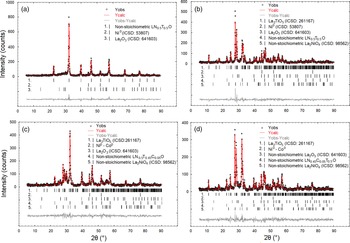
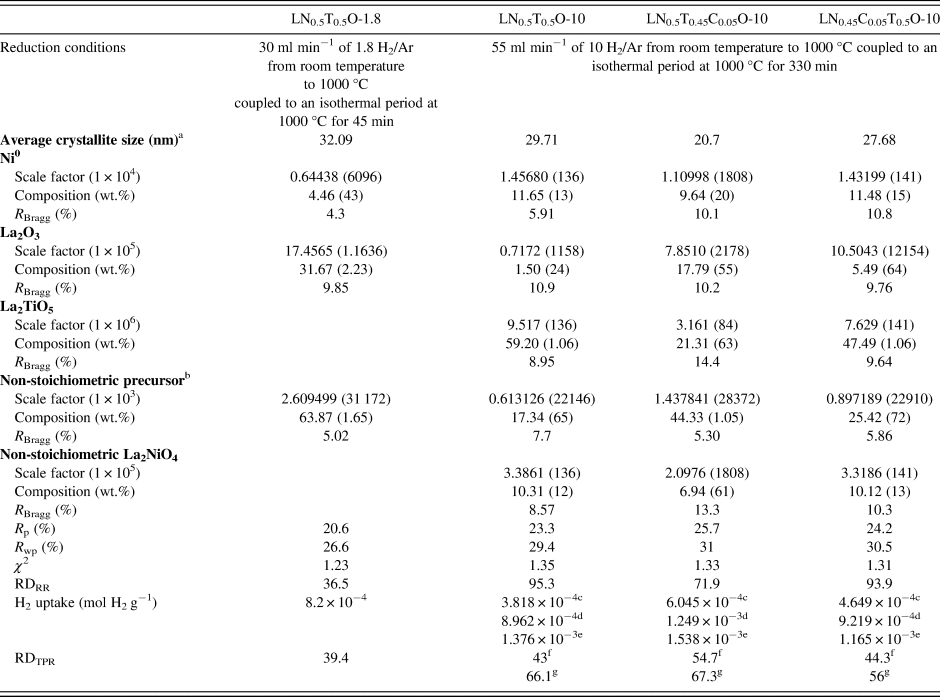
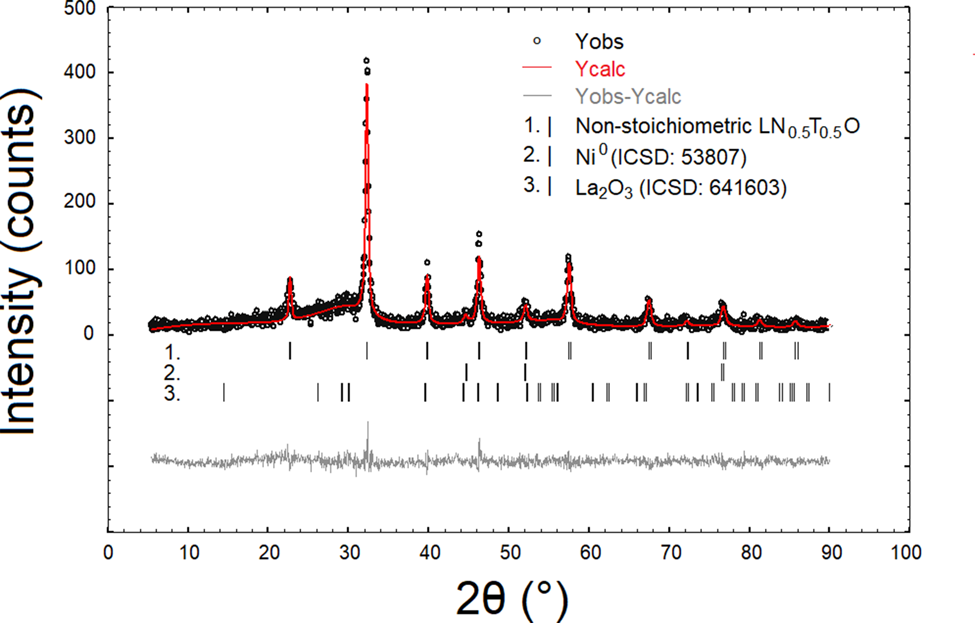
The experimental and calculated XRD profiles for LN0.5T0.5O-1.8, LN0.5T0.5O-10, LN0.5T0.45C0.05O-10, and LN0.45C0.05T0.5O-10 are depicted in Figure 1. In addition, the corresponding refinement results are indicated in Table II.
Observed (black circles), calculated (red line), and difference (gray bottom line) XRD patterns for (a) LN0.5T0.5O-1.8, (b) LN0.5T0.5O-10, (c) LN0.5T0.45C0.05O-10, and (d) LN0.45C0.05T0.5O-10.

Reduction conditions, average crystallite size, phase analysis results, conventional discrepancy factors from Rietveld refinement of powder XRD data, H2 uptake, RD calculated using Rietveld Refinement (RDRR), and TPR (RDTPR) for LN0.5T0.5O-1.8, LN0.5T0.5O-10, LN0.5T0.45C0.05O-10, and LN0.45C0.05T0.5O-10.

The standard uncertainty refers only to the mantissa and not to the exponent of the value.
a Average crystallite size of Ni0 for Co free perovskites and that of Ni0–Co0 for Co containing perovskites. Also, the strain value was equal to 3.867 × 10⁻⁴ for all reduced perovskites.
b Non-stoichiometric precursor for LN0.5T0.5O-1.8 is the same for the case of LN0.5T0.5O-10. On the other hand, non-stoichiometric precursor for LN0.5T0.5O-10/LN0.5T0.45C0.05O-10/ LN0.45C0.05T0.5O-10 is non-stoichiometric LN0.5T0.5O/non-stoichiometric LN0.5T0.45C0.05O-10/non-stoichiometric LN0.45C0.05T0.5O.
c H2 uptake for the peak at low temperature.
d H2 uptake for the peak at high temperature.
e H2 uptake for the peak at isothermal period.
f RD calculated from integration of the peak at high temperature.
g RD calculated from integration of the isothermal period.
For the case of LN0.5T0.5O reduced with two different reductive mixtures, the composition of crystalline phases was different. With 1.8% H2/Ar, metallic nickel with the lower proportion, La2O3, and the non-stoichiometric precursor with the higher ratio, were obtained. It is essential to point out that amorphous TiO2 is accounted for in the phase composition value for La2O3, i.e., La2O3 phase (ICSD: 641603) adequately fits the amorphous phases in LN0.5T0.5O-1.8. Regarding the reduction condition employing 10% H2/Ar, the non-stoichiometric LN0.5T0.5O and La2TiO5 were the main crystalline phases, while the La2O3 was the phase with the lower percentage. Moreover, after the reduction process with 10% H2/Ar, the materials showed different content of crystalline phases (Table II).
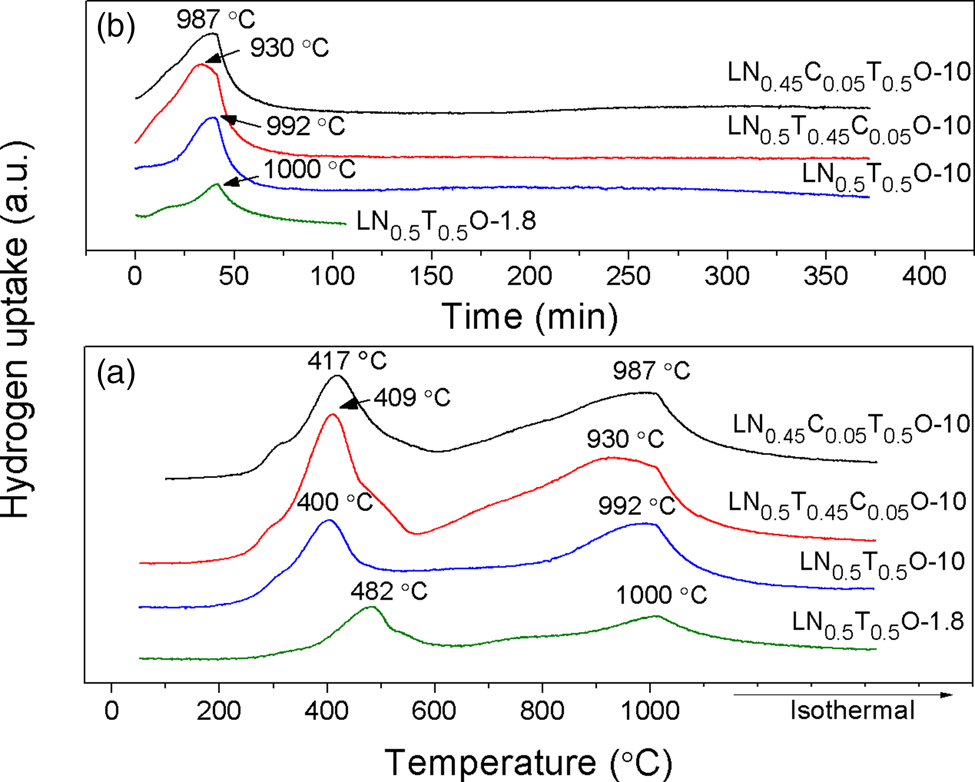
TPR profiles of as-synthesized materials are shown in Figure 2(a). The peaks at lower temperature are attributed to the reduction of Ni3+ to Ni2+, Co3+ to Co2+ for the case of cobalt containing perovskites, and oxygen adsorbed on the sample surface. This H2 uptake is in agreement with the absence of metallic nickel from LN0.5T0.5O-1.8 at 625 °C, as indicated in Supplementary Figure S1. Ni valence equal to 3+ together with oxygen on LaNi0.5Ti0.5O3 surface was proposed by Yang et al. (Reference Yang, Huo, Zhao, Gao and Rong2009). The high temperature peaks are associated with the reduction of Ni2+ to Ni0, or the Ni2+ and Co2+ to Ni0–Co0 for the case of cobalt containing perovskites. H2 uptake for each reduced perovskite (Row 27, Table II) is higher than the expected theoretical value. This increase could be related to the reduction of NiO (Co free perovskites) or NiO and CoO (Co containing perovskites) from water vapor oxidation, as a consequence of the low flow rate used in the analysis (Satterfield, Reference Satterfield1991).
H2 uptake (a) from room temperature to 1000 °C, along with (b) isothermal period equal to 45 min for the LN0.5T0.5O-1.8, and 330 min for LN0.5T0.5O-10, LN0.5T0.45C0.05O-10, and LN0.45C0.05T0.5O-10.

The non-stoichiometric precursors after reduction showed a cubic symmetry with space group  $Pm\bar{3}m$. These results differ from the corresponding as-prepared perovskites (symmetry orthorhombic, space group Pbnm, Souza et al. (Reference Souza, Maza and Tuza2021)). In reducing conditions, the perovskite phase transformation from orthorhombic to cubic symmetry was shown in Bahout et al. (Reference Bahout, Managutti, Dorcet, Le Gal La Salle, Paofai and Hansen2020) and Périllat-Merceroz et al. (Reference Périllat-Merceroz, Gauthier, Roussel, Huve, Gelin and Vannier2011).
After reduction, crystalline phases reported in the literature from LaNi0.5Ti0.5O3 based perovskites were similar to the corresponding observed in this work. For example, Arrivé et al. (Reference Arrivé, Delahaye, Joubert and Gauthier2013) reduced the perovskite La0.5Sr0.5Ti0.75Ni0.25O3 with 15 l h−1 of 2% H2/Ar at 1300 °C for 2 h. This reduced perovskite presented the same crystalline phases observed for the LN0.5T0.5O-10, with the greater quantity ascribed to the non-stoichiometric precursor.
Moreover, based on the phase composition of LN0.5T0.5O-10, LN0.5T0.45C0.05O-10, and LN0.45C0.05T0.5O-10, Ti4+ reduction to Ti3+ does not occur. This absence of Ti with a valence equal to 3+ agrees with the onset Ti4+ reduction temperature of at least 1500 °C (Arrivé et al., Reference Arrivé, Delahaye, Joubert and Gauthier2013).
Related to LN0.5T0.5O-1.8 and LN0.5T0.5O-10, RD of Ni2+ to Ni0 calculated using XRD coupled to the Rietveld method were equal to 36.5% and 95.3%, respectively. For the case of the LN0.5T0.45C0.05O-10 and LN0.45C0.05T0.5O-10, the Ni2+ and Co2+ reduction to Ni0–Co0 calculated from XRD data were equal to 71.9% and 93.9%, respectively. These values are in accordance with those obtained using TPR (LN0.5T0.5O-1.8: 39.4%; LN0.5T0.5O-10, LN0.5T0.45C0.05O-10, and LN0.45C0.05T0.5O-10: around 100%, Table II) and with the oxidable cations content from water vapor. Therefore, although the recording of XRD patterns with counts above 10 000 is reported in the literature (Rodríguez et al., Reference Rodríguez, Álvarez, López, Veiga and Pico1999), RD obtained from TPR agrees with that from Rietveld refinement of XRD patterns of each perovskite.
The phase composition of reduced perovskites is evidence of the cation reducibility modification from LaNi0.5Ti0.5O3 with cobalt substitution of either Ni2+ or Ti4+ in 0.05 mol. This is according to the H2 uptake at 409 °C (6.045 × 10⁻⁴ mol H2 g−1, Table II) for LN0.5T0.45C0.05O-10, when compared to the corresponding for the LN0.5T0.5O-10 (3.818 × 10⁻⁴ mol H2 g−1, Table II) and LN0.45C0.05T0.5O-10 (4.649 × 10⁻⁴ mol H2 g−1, Table II).
H2 content in the reductive gas did not affect the average crystallite size of Ni0 (32.09 nm from LN0.5T0.5O-1.8 vs. 29.71 nm from LN0.5T0.5O-10, Table II), which is opposite to the expected trend described by Schimpf and Muhler (Reference Schimpf, Muhler and de Jong2009) and Schmal (Reference Schmal2016).
Regarding materials reduced with 10% H2/Ar, and considering similar covalent radii values for nickel (1.24 Å) and cobalt (1.26 Å) (Cordero et al., Reference Cordero, Gómez, Platero-Prats, Revés, Echeverría, Cremades, Barragán and Alvarez2008), values of Ni0–Co0 crystallite sizes smaller than that of only Ni0 indicates a weaker metal–support interaction of reduced nickel than that of Ni0–Co0 in the corresponding perovskites after reduction. It is worth noting that the support is formed by La2TiO5, La2O3, and non-stoichiometric compounds (the precursor and La2NiO4).
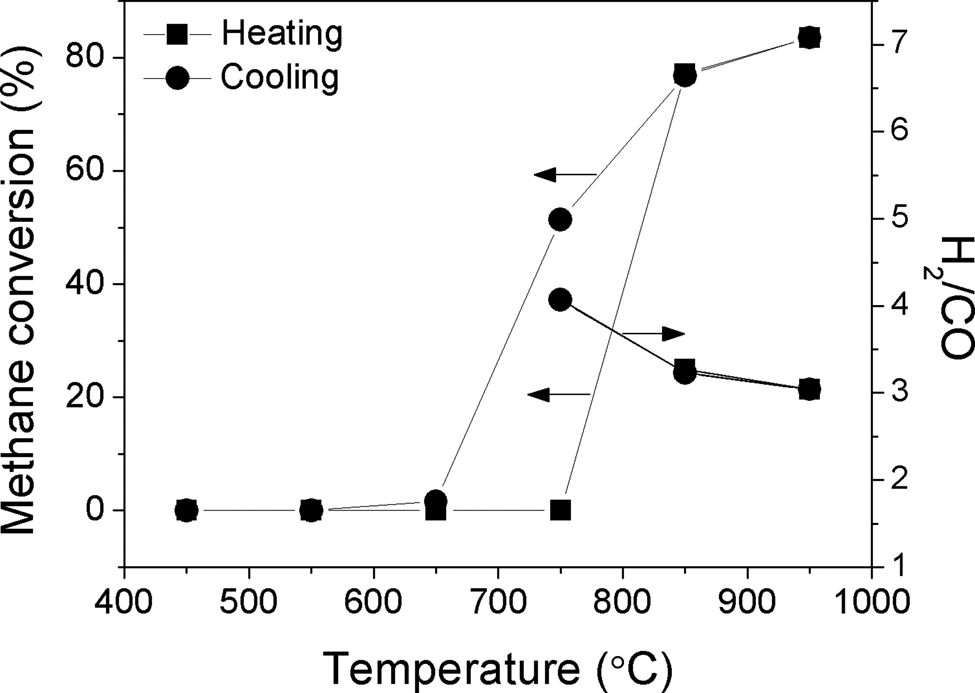
An important application of using Rietveld refinement of XRD patterns of these perovskites is to determine catalyst reduction degree after the reaction. For example, LN0.5T0.5O was used as a catalyst for steam reforming of methane. Methane conversion and syngas production are indicated in Figure 3. Figure 4 shows Rietveld refinement of XRD pattern of LN0.5T0.5O after the reaction. Supplementary Tables SII and SIII show Rietveld refinement results. The reaction was carried out in a cycle of heating (450 to 950 °C) and cooling (950 to 450 °C) processes. It was used a mass amount of LN0.5T0.5O equal to 100 mg, 200 ml min−1 of 9.8% CH4/He, and a molar ratio of CH4/H2O equal to 1. After the reaction, the reduction degree determined using Rietveld refinement was 26.35%. Therefore, by using the Rietveld method to determine the catalyst reduction degree, the catalyst activity can be explained from the number of nickel sites present on the catalyst surface after reaction.
Methane conversion and syngas production from steam reforming using LN0.5T0.5O catalyst.

Observed (black circles), calculated (red line), and difference (gray bottom line) XRD patterns for LN0.5T0.5O after steam reforming of methane.

IV. CONCLUSION
Cation reducibility from LaNi0.5Ti0.5O3 with two different H2 concentrations and the corresponding for LaNi0.5Ti0.45Co0.05O3 and LaNi0.45Co0.05Ti0.5O3 perovskites using X-ray diffraction data coupled to the Rietveld method is reported in this work.
LaNi0.5Ti0.5O3, LaNi0.5Ti0.45Co0.05O3, and LaNi0.45Co0.05Ti0.5O3 were synthesized by the modified Pechini method. After reduction, the non-stoichiometric structures from LaNi0.5Ti0.5O3, LaNi0.5Ti0.45Co0.05O3, and LaNi0.45Co0.05Ti0.5O3 showed cubic symmetry, with the space group  $Pm\bar{3}m$. Furthermore, the amount of Ni0 for Co free perovskites, Ni0–Co0, La2O3, La2TiO5, and non-stoichiometric oxides (the precursor and La2NiO4) was different for each as-prepared material. This amount depends on the H2 content in the reductive mixture.
For the case of the LaNi0.5Ti0.5O3 perovskite, Ni2+ reduction to Ni0 with 1.8% H2/Ar and 10% H2/Ar was equal to 36.5% and 95.3%, respectively. Moreover, Ni2+ and Co2+ reduction to Ni0–Co0 from LaNi0.5Ti0.45Co0.05O3 and LaNi0.45Co0.05Ti0.5O3 using 10% H2/Ar was equal to 71.9% and 93.9%, respectively.
Ni3+ and Co3+ population from LaNi0.5Ti0.45Co0.05O3 material were higher than that observed from the other perovskites. Also, Ni0 particle size was not influenced by the H2 content in the reductive gas. In addition, Ni0 showed weaker metal–support interaction than that from Co0, where the support was formed by La containing materials.
Catalyst reduction degree determined using Rietveld refinement of XRD pattern of this sample enables to explain the catalyst activity from the number of active sites after reaction.
V. DEPOSITED DATA
RAW and DAT files with XRD data and TPR data for the title materials were deposited with the ICDD. You may request this data from ICDD at info@icdd.com.
SUPPLEMENTARY MATERIAL
The supplementary material for this article can be found at https://doi.org/10.1017/S0885715622000112.
ACKNOWLEDGEMENTS
The authors thank Carlos André de Castro Perez from Instituto Federal de Ciência e Tecnologia do Rio de Janeiro – IFRJ, Brazil for his suggestions to perform the Rietveld analysis.
CONFLICTS OF INTEREST
The authors have no conflicts of interest to declare.